The Temple and the First Synagogues · For Grades 3–5
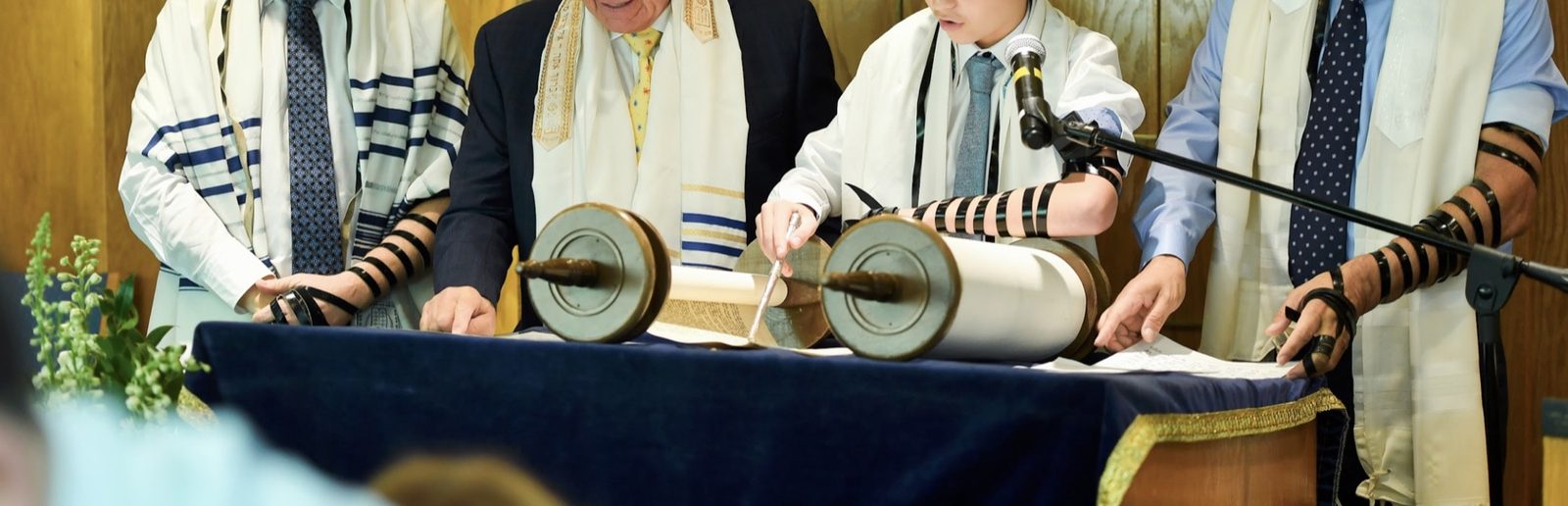
A bar mitzvah reads from the Torah scroll, the same act at the heart of a synagogue in any century. Courtesy of The Makor Project.
Grade band
Grades 3–5
Lesson length
35–45 minutes
Format
Guided lesson + class discussion
Materials
Two handouts · vocabulary card
Prerequisites
None
Standards
NYS Social Studies K–5 · C3 Framework · Common Core ELA
What this module teaches
Students learn that the synagogue is an institution with a specific historical origin, that it came into being at a particular moment in history because of a particular need, and that this is why it looks and functions the way it does. By the end of the lesson, students will be able to answer the question "Where did the synagogue come from?" in their own words.
Core understandings
The Temple in Jerusalem was the central religious building of the ancient Jewish people, but it no longer stands today.
The synagogue developed historically as a "house of meeting" that could exist anywhere Jewish families settled.
Every traditional synagogue contains the same core elements — Ark, Torah scroll, Bimah, Ner Tamid, Mezuzah — regardless of where in the world it is.
The synagogue's portability is what made it possible for Jewish communities to maintain continuous tradition across many regions over more than 2,500 years.
Use the accompanying vocabulary card to introduce these terms before the lesson, or as a reference during it. A reproducible version is included with this guide.
The lesson, step by step
Step 1 · Title
Where Did the Synagogue Come From?
Time: 1 minute
Say: "Today we're going to figure out where the synagogue came from. A synagogue is the building Jewish people meet in. But it wasn't always there — somebody had to invent it. Let's find out who, and when, and why."
Step 2 · A Question to Hold
The framing question
Time: 2 minutes
Ask: "Has anyone here ever been to a synagogue? What did it look like? What did you notice inside?" Listen to two or three answers. No need to correct anyone — this is for activating background knowledge.
Then say: "We're going to go back about three thousand years. That's a really long time. Before phones, before cars, before America. Even before most of the buildings you've ever seen."
Step 3 · The First Temple
King Solomon builds the First Temple (c. 957 BCE)
Time: 4 minutes
Key vocabulary to introduce here: Temple · Jerusalem · Temple Mount
Say: "About three thousand years ago, a king named Solomon built a very large stone building in Jerusalem. We call it the First Temple. The Temple wasn't a synagogue. It was something different — only priests worked inside it, and people brought offerings to it once or twice a year. It stood on a high stone platform called the Temple Mount, which still exists today."
Optional aside: If students have heard of the Western Wall, you can mention: "The Western Wall in Jerusalem today is one of the walls that supported the Temple Mount platform. Even though the Temple was destroyed long ago, that platform is still there."
Step 4 · Destruction and Exile
The Temple is destroyed (586 BCE)
Time: 4 minutes
Key vocabulary: Exile · Babylon
Say: "After 370 years, a powerful empire called Babylon came and attacked Jerusalem. The Babylonians knocked down the walls, burned the city, and destroyed the Temple. Many Jewish families were taken away from their homes and brought to live in Babylon. This is what we call the Exile. Imagine: you are far away from your home, you cannot go back, and the place you used to gather for prayer is gone. What would you do?"
Listen for: Students often suggest "find a new place to meet" or "meet at home." That is exactly the answer the next step gives.
Step 5 · A New Idea
The first synagogues — a portable house of meeting
Time: 4 minutes
Key vocabulary: Synagogue · Beit knesset
Say: "The Jewish families in Babylon did something new. They started gathering in small groups — in houses, in shops, in any space they could find — to pray and read sacred writings and teach their children. In Hebrew this is called beit knesset, which means 'house of meeting.' In Greek, the international language at the time, this same idea was called a synagogue, which also means 'a gathering.'"
Emphasize: The synagogue is not a building first. It is an idea first — the idea that people can gather anywhere — and then a building grows around the idea.
Step 6 · The Second Temple
The Temple is rebuilt (516 BCE) — but synagogues continue
Time: 3 minutes
Say: "After about 70 years in Babylon, many Jewish people were allowed to come home to Jerusalem. They rebuilt the Temple — this is called the Second Temple. But the synagogues did not disappear. Once people had found a way to gather close to home, they kept doing it. So now there were both: the Temple in Jerusalem, and synagogues in every Jewish town."
Step 7 · A Turning Point
70 CE — the Temple is destroyed for the last time
Time: 4 minutes
Say: "About 600 years later, the Roman Empire — the same Romans who built the Colosseum — attacked Jerusalem and destroyed the Second Temple in the year 70 CE. The Temple has not been rebuilt since. This was a turning point. With no Temple, the synagogue became the most important Jewish building. It has been ever since — for almost two thousand years."
Connecting question: "So if there is no Temple anymore, where do Jewish people pray today?" (Answer: in synagogues.)
Suggested approach: Read through each element. Repeat the words together as a class. Have students touch their own forehead and say each word — kinesthetic anchoring helps retention.
Handout connection: Distribute Handout B: What's Inside a Synagogue? now. Students can refer to the labeled diagram as you discuss each element, or complete it after the lesson as a worksheet.
Step 9 · Around the World
Six synagogues, six places, six centuries
Time: 5 minutes
Say: "Synagogues exist all over the world." Name a few your students could picture visiting: the ruins of Dura-Europos in Syria (about 244 CE, with wall paintings now in a museum), the Altneuschul in Prague (about 1270, still in use today), El Tránsito in Toledo (1357, now a museum), and, in the United States, the Touro Synagogue in Newport, Rhode Island (the oldest still standing in the country) and the Eldridge Street Synagogue in New York.
Local connection: Mention if there is a historic synagogue in your area, your state, or a nearby city. A local field trip is an excellent follow-up to this module.
Step 10 · Words to Know
Vocabulary review
Time: 3 minutes
Suggested activity: Quick recall. Point at each word on the board and have the class call out the definition together. Or, hand out the vocabulary card and have students point to each word on it as you read the definition aloud.
Step 11 · The Big Idea
The synagogue is a portable idea
Time: 4 minutes
Say: "Here is the most important idea of this whole lesson. A synagogue isn't a special kind of building. A synagogue is what happens when ten Jewish adults agree to meet together. The building grows around the meeting, not the other way around. That's why Jewish communities could keep their traditions going for more than 2,500 years, even when they had to move from one country to another. They could always start over, anywhere."
Connecting question: "Can you think of any other tradition that travels with people, that they can take anywhere?" (Answers might include: cooking, music, language, holidays. All good answers — and worth acknowledging that these too are portable traditions.)
Step 12 · What We Learned
Wrap-up
Time: 3 minutes
Suggested activity: Ask one student to summarize what they learned in their own words. Distribute Handout A: Timeline as homework or for an in-class follow-up activity.
Suggested follow-up activities
This week
Handout A — Timeline activity. Students cut out the nine event cards and arrange them in chronological order. Then color them in. A simple, low-stakes review of the lesson's chronology.
Handout B — What's Inside a Synagogue? Labeling activity. Students label the five core elements on a simplified diagram of a synagogue interior.
Vocabulary card. Send home with each student. Encourage families to review at the dinner table.
Next week or next class
Virtual field trip. Visit the Eldridge Street Synagogue (New York) or Touro Synagogue (Newport) online tour. Both have free, age-appropriate virtual visits.
Reading a story together. Patricia Polacco's The Keeping Quilt (1988) is a picture book about an immigrant Jewish family in America that pairs well with this module's themes of continuity and portability. Available in most school libraries.
Drawing activity. Have students draw their own "house of meeting" — the building they would design if they were starting a synagogue. Where would they put the ark? The bimah? The eternal lamp? This gets them thinking about the elements they learned.
If you have more time
Local field trip. Many communities have a historic synagogue that welcomes school visits. Contact the local Jewish federation, the historical society, or the rabbi of a nearby congregation.
Compare to other houses of worship. If the curriculum includes a unit on world religions or American religious history, build the comparison: church, mosque, synagogue, temple. Each has a story like this one, and each is worth the same depth.
Suggested videos for classroom use
The following short videos pair well with this module. None is embedded in the lesson itself, because school networks vary and embedded video reliability is uneven. Instead, we recommend the teacher pre-screens one or two before the lesson, opens them in a separate browser tab, and plays them at a natural pause point, typically after step 8 or step 9, or saved for a follow-up class.
All videos listed are from established institutions and are free to view. The teacher should confirm the video plays on the school network before the lesson.
For the synagogue itself
Virtual Tour of the Eldridge Street Synagogue and Historic Lower East Side (Museum at Eldridge Street, on YouTube) — A docent-led tour of one of the historic synagogues mentioned in step 9. Pause for the building exterior, then for the interior of the sanctuary. Sit and watch with the class, or excerpt a 3-to-5-minute segment. youtube.com/watch?v=hwZe7CtLTak
Eldridge Street Museum YouTube channel — additional shorter videos including docent stories and architectural details. youtube.com/@EldridgeStreetMuseum
For the Temple and ancient Jerusalem
BimBam · Jewish History playlist — short, well-produced animated explainer videos on topics including Masada, the Bar Kochba revolt, the origins of Judaism, and the Jewish calendar. Most are 3 to 5 minutes — well-suited to a one-class pairing with this module. bimbam.com/history
BimBam YouTube channel — over 400 free animated videos for K–12 Jewish education. youtube.com/@bimbam
For broader K–5 Jewish themes
PJ Library YouTube channel — read-aloud videos of Jewish picture books (including The Keeping Quilt, recommended above for follow-up). Useful for younger end of the grade band. youtube.com/@PJLibrary
Shalom Sesame archive — a co-production of Sesame Workshop and HIDC, designed for K–2 and lower elementary. shalomsesame.org and on YouTube
If your district blocks YouTube, ask the school technology coordinator to whitelist the specific channels above for educational use — they are all from established educational institutions and are widely used in K–5 classrooms. Alternatively, the BimBam and Eldridge Street videos can be downloaded for offline classroom playback using standard browser tools the school IT department can advise on.
Standards alignment
Framework
Strand
How this module aligns
NYS Social Studies K–5
Geography, Humans, and the Environment
Students learn how human communities respond to changes in their environment by developing portable institutions. They identify a specific location (Jerusalem) as the cultural center of a community even when that community is dispersed.
NYS Social Studies K–5
Time, Continuity, and Change
Students place events in chronological sequence (First Temple → Babylonian Exile → First Synagogues → Second Temple → Roman Destruction → Spread of Synagogues) using a 2,500-year timeline.
C3 Framework
Dimension 2 — Civic and Political Institutions
Students identify how a community develops new institutions in response to historical changes. The synagogue is presented as a community-built institution rather than a top-down decree.
C3 Framework
Dimension 2 — Geographic Representations
Students engage with the geography of the ancient Near East (Jerusalem, Babylon) and the modern global spread of synagogues (Prague, Toledo, Newport, New York).
Common Core ELA
Reading Informational Text · Grades 3–5
Students read short informational text, identify key ideas, distinguish vocabulary, and use a chronological structure to summarize a sequence of events.
Common Core ELA
Speaking and Listening · Grades 3–5
The class discussion model uses sequential framing questions designed to elicit student responses, build on student answers, and develop collective understanding.
Sources and further reading
This module is built on university-press scholarship and documented historical and archaeological evidence, simplified for the K–5 reading level but not historically simplified. Where an event rests mainly on traditional accounts rather than independent evidence, that is noted below:
The First Temple (c. 957 BCE): the building of Solomon's Temple is known mainly from traditional accounts in the Hebrew Bible (1 Kings); there is little direct archaeological evidence for the structure itself, partly because the Temple Mount where it stood cannot be excavated: the Dome of the Rock and the Al-Aqsa Mosque stand there today, and it is one of the most contested holy sites in the world. Present it to students as what tradition describes, not as an independently documented event.
The Babylonian destruction (587/586 BCE): well documented historically. The Babylonian Chronicle (British Museum, BM 21946) records Nebuchadnezzar's campaigns against Jerusalem, and excavations in Jerusalem (the City of David and Mount Zion) have uncovered ash layers, Babylonian-type arrowheads, and destruction debris from this event.
The Persian return and Second Temple (from 539 BCE): the Cyrus Cylinder (British Museum), inscribed after Cyrus took Babylon in 539 BCE, records his policy of letting deported peoples return home and restoring their temples. The Cylinder does not name the Jews specifically, but their return to Jerusalem is understood by historians as part of this documented policy.
The Roman destruction (70 CE): documented by the Roman-era historian Josephus, The Jewish War (c. 75 CE), and depicted on the Arch of Titus in Rome.
Lee I. Levine, The Ancient Synagogue: The First Thousand Years, second edition (Yale University Press, 2005) — the standard scholarly work on the origins of the synagogue.
Steven Fine, ed., Jewish Religious Architecture: From Biblical Israel to Modern Judaism (Brill, 2020) — chapters on the synagogue's institutional development.
The full Topic page on The Makor Project, The Synagogue, is in production and will include additional images, primary-source extracts, and scholarly references for teachers who want to go deeper.
 K–5 Lesson