
A missing chapter · The ancient Near East
Ancient Israel and Judah
A small kingdom in the hills between the great empires, and the written and carved evidence that it was really there.
Standards alignment
New York State Social Studies Framework, Key Idea SS.9.1, Development of Civilization (the First Civilizations). Grade 9, Global History & Geography I.
Three thousand years ago, in the hill country between the great empires of the ancient Near East, a people called the Israelites built villages, towns, and kingdoms. They lived in the same world as Egypt and Mesopotamia, traded and fought with the powers around them, and left behind writing, cities, and objects that archaeologists still dig up today. This chapter tells their story, and shows you the evidence that proves they were really there.
That evidence is unusual. Some of the strongest proof that ancient Israel existed comes from its enemies: the kings of Egypt and Assyria carved monuments boasting about defeating Israel, which means Israel was there to be fought. Alongside those outside witnesses are the objects the Israelites made themselves, letters, seals, and inscriptions in their own early Hebrew. Together they let us study ancient Israel and Judah the way we study any ancient civilization: through its cities, its writing, its government, its religion, and the record it left in the ground.
Historians judge every ancient society by the same features. Ancient Israel and Judah had all of them:
- Cities and settlement — fortified towns like Jerusalem, Lachish, and Megiddo.
- Writing and record-keeping — an alphabet, letters, seals, and inscriptions in ancient Hebrew.
- Government — kings, a royal administration, and a capital at Jerusalem.
- Religion — a developing belief in one God, centered on a temple — alongside other practices that the religion's own prophets argued against.
- A material record — pottery, seals, figurines, and inscriptions excavated by archaeologists, plus the monuments of neighboring empires that name Israel directly.
Where and when
Ancient Israel sat in the hill country of Canaan, the historic name for the land along the eastern Mediterranean coast that today includes Israel and the Palestinian territories. Unlike Egypt on the Nile or Mesopotamia between the Tigris and Euphrates, Israel was not a river-valley society. It grew up in the highlands between those great powers, on the land bridge connecting Africa, Asia, and the trade routes between them. That location shaped everything: a small people living in the path of much larger empires.
The earliest archaeological trace of a distinct Israelite population appears in the highlands around the late thirteenth century BCE, small hilltop villages with a particular kind of four-room house and, tellingly, no pig bones, which set them apart from their neighbors. By about 1000 BCE, according to the biblical account, a united kingdom under David and then Solomon centered itself on Jerusalem, where Solomon built the First Temple around 957 BCE. Historians debate how large that early kingdom really was, since little of it has yet turned up in the ground, and the First Temple itself is known from written sources rather than from digging, because the platform where it stood, the Temple Mount, cannot be excavated: the Dome of the Rock and the Al-Aqsa Mosque stand on it today, and it is among the most sacred and contested sites in the world, so no archaeology is possible there. What the outside evidence confirms is narrower but firm: kingdoms called Israel and Judah, and a royal line remembered as the "House of David," that really existed. Around 930 BCE the kingdom split in two: the northern Kingdom of Israel, with its capital at Samaria, and the southern Kingdom of Judah, with its capital at Jerusalem. The word "Jew" comes from "Judah."
The evidence that Israel was there
How do we know any of this? The same way we know about Egypt or Assyria, from objects in the ground and writing on stone, clay, and pottery. Some of the strongest evidence for ancient Israel comes from an unexpected place: the monuments of its enemies.
An Egyptian pharaoh names Israel
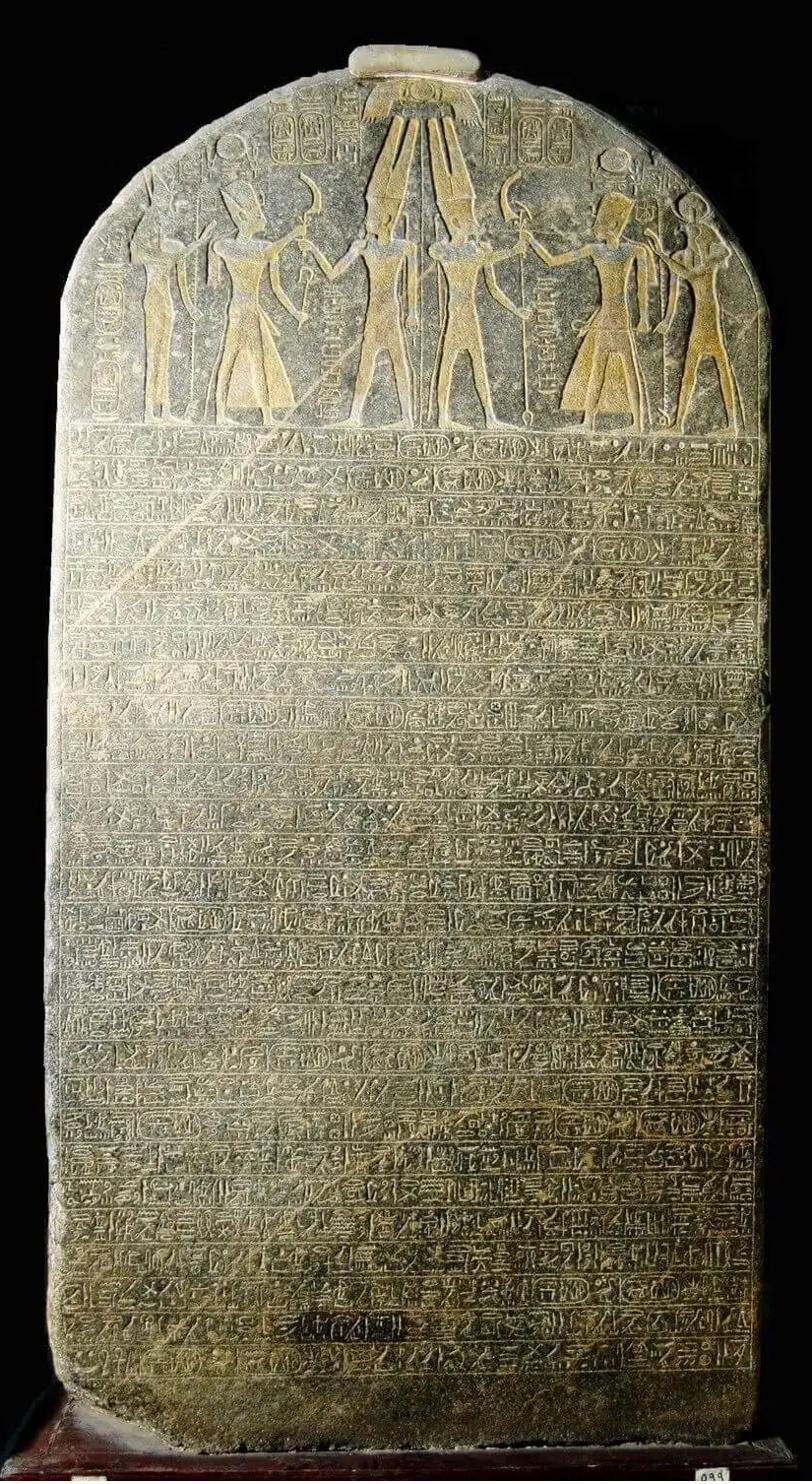
The oldest mention of Israel anywhere outside the Bible was carved by an enemy. Around 1208 BCE the Egyptian pharaoh Merneptah set up a tall granite stele, a standing stone with a message carved on it, to boast about peoples he claimed to have crushed. In one line, written with the Egyptian sign meaning "a people," appears the name Israel. The boast was almost certainly exaggerated. But a king inflating a victory still had to be bragging about a people his audience would recognize. The monument meant to celebrate wiping Israel out is instead the earliest proof that Israel was there.
A king bragging on a monument is not a neutral witness, ancient victory texts routinely exaggerated. But that can cut in a useful direction: a pharaoh, an Assyrian, or a Moabite king inflating a victory still had to be boasting about a people who were really there. Across the centuries, Israel keeps surfacing in the records of one empire after another, peoples rarely friendly to Israel and never in doubt that it existed.
An Assyrian empire records a war with Judah
In 701 BCE the Assyrian king Sennacherib, ruler of the empire centered in what is now Iraq, invaded the southern Kingdom of Judah. He destroyed the fortified city of Lachish and besieged Jerusalem, where King Hezekiah ruled. We have this story twice over: in the Bible (2 Kings 18–19), and in Sennacherib's own words and pictures.
Sennacherib lined a room of his palace at Nineveh with carved stone panels showing the assault on Lachish, soldiers driving battering rams up ramps, archers firing, the city's defenders fighting from the walls. It is the most detailed picture of ancient siege warfare that survives. And his scribes wrote the campaign onto a six-sided clay prism in cuneiform, the wedge-shaped writing of ancient Mesopotamia. On it, Sennacherib boasts of capturing forty-six of Hezekiah's walled towns and trapping the king of Judah "like a caged bird" inside Jerusalem.
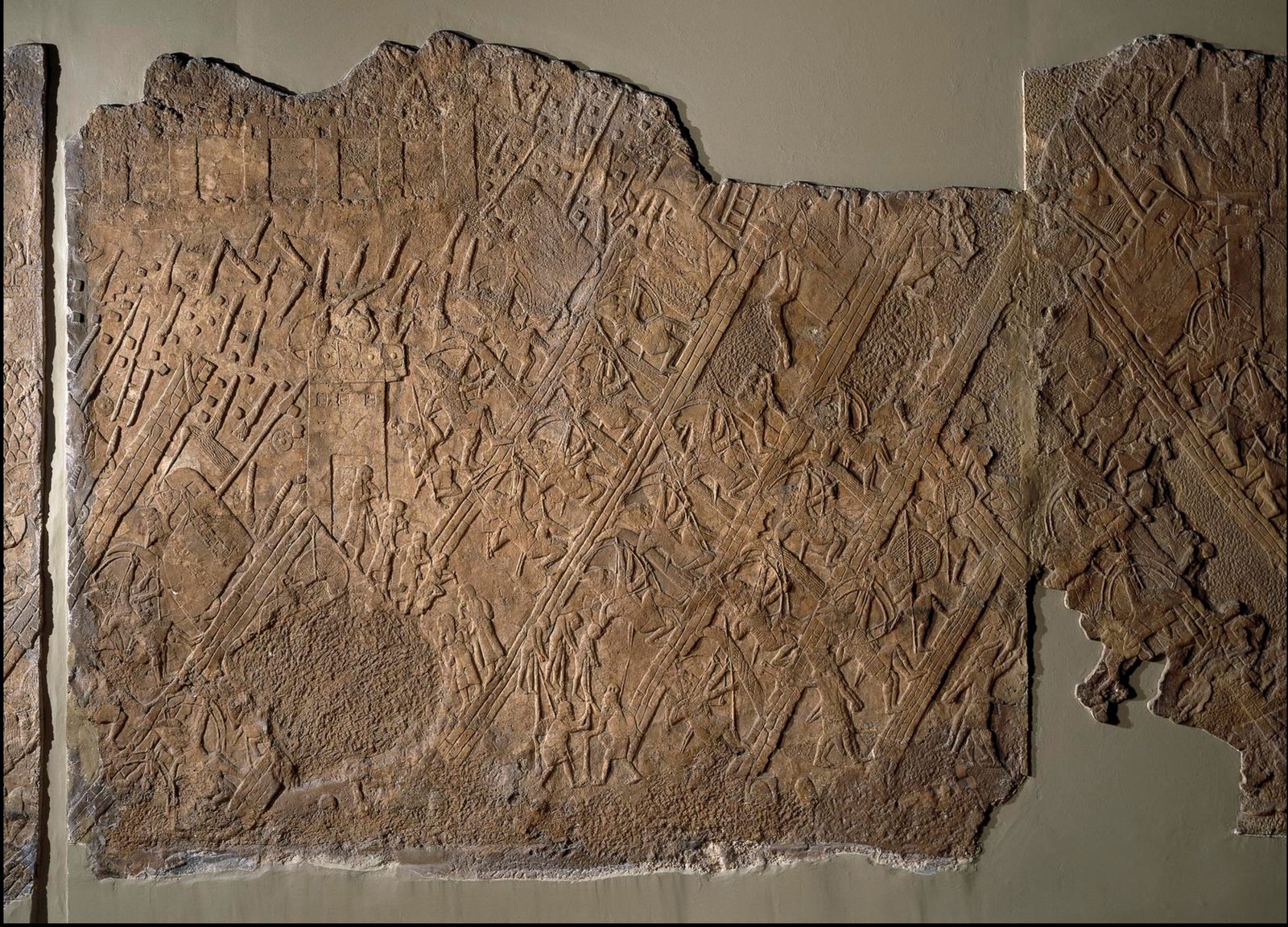
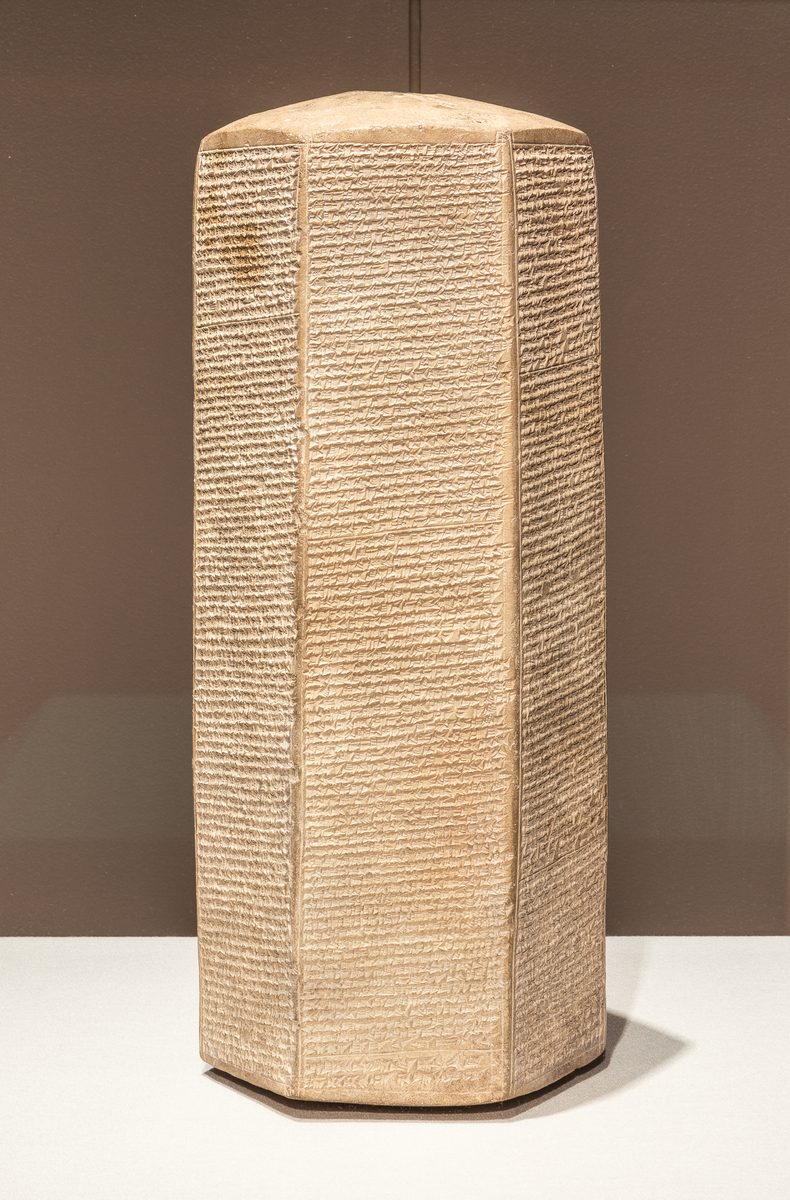
Here is the detail worth pausing on. Sennacherib lists every Judahite city he claims to have taken, but he never says he took Jerusalem. On his own triumphal monument, the boast stops at the city walls. The Bible says Jerusalem was spared when the Assyrian army withdrew. The enemy's own record, written to celebrate his victories, quietly leaves room for the one outcome it had no reason to admit: the capital did not fall.
An enemy names the House of David
The Bible tells of a king named David who founded a royal line in Jerusalem. For a long time, no evidence of him existed outside the Bible, and some scholars doubted he was a real person at all. Then, in 1993 and 1994, archaeologists digging at Tel Dan in northern Israel found pieces of a broken basalt monument carved in Aramaic, the language of a neighboring kingdom to the north.
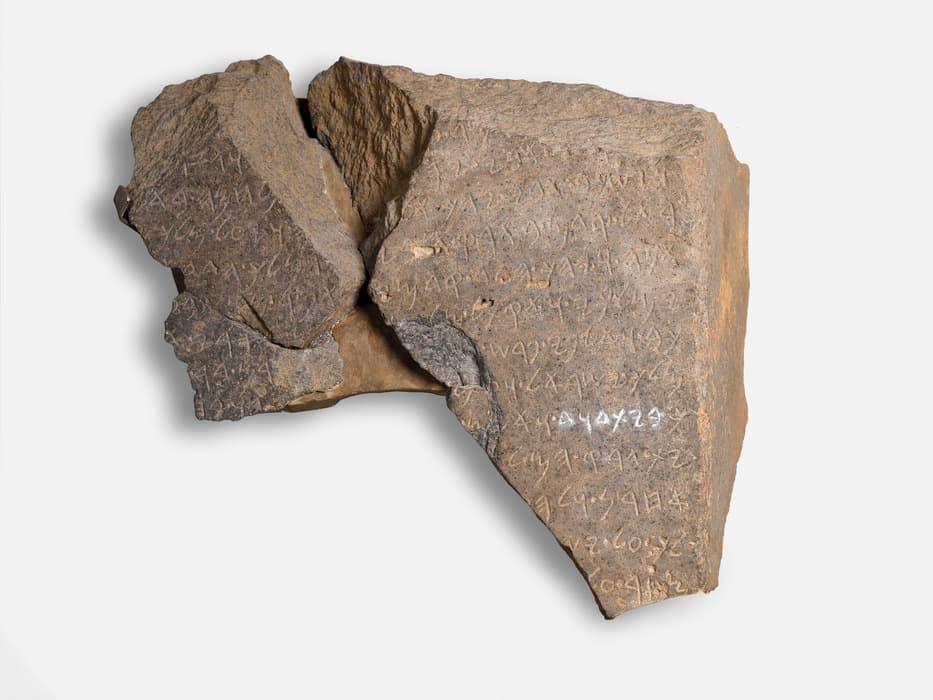
The monument was a victory boast, most likely set up by Hazael, king of Aram-Damascus, a kingdom in what is now Syria, around 840 BCE. On it, the Aramean king brags of defeating two enemies: the king of Israel and the king of a place written in Aramaic as bytdwd, the "House of David." Most scholars read this as the dynasty that traced itself back to David, exactly as the Bible describes; a few have proposed other readings, but the majority view is that this is the earliest mention of David's line outside the Bible. Once again, the proof came from an enemy: a foreign king, with no reason to invent a Judahite dynasty, named it while bragging about beating it.
A people who wrote
Ancient Israel and Judah were literate. They used an early alphabet, the ancestor of the Hebrew alphabet still used today, and they left writing behind. From the city of Lachish come the Lachish letters: military messages written in ink on broken pieces of pottery (the cheap scrap paper of the ancient world) during the last desperate days before Babylon's conquest. These are not an enemy's record but Judah's own voice, in its own hand.
Officials owned personal seals, small carved stones pressed into wet clay to sign documents and mark property. One black stone seal, found in Jerusalem, carries the figure of an archer and a name in old Hebrew letters: Hagab. Because private seals usually belonged to officials, archaeologists think Hagab may have been a senior figure in Judah's army, perhaps an officer of its archers. It is a single named person reaching out of the First Temple period, not a king or a prophet, but an ordinary official, signing his name.
The religion the prophets argued for — and against
Ancient Israel is best known for an idea: monotheism, the belief in a single God. It became one of the most influential ideas in human history. But the archaeology shows that this belief was not settled from the start. It was an argument still being fought, house by house.
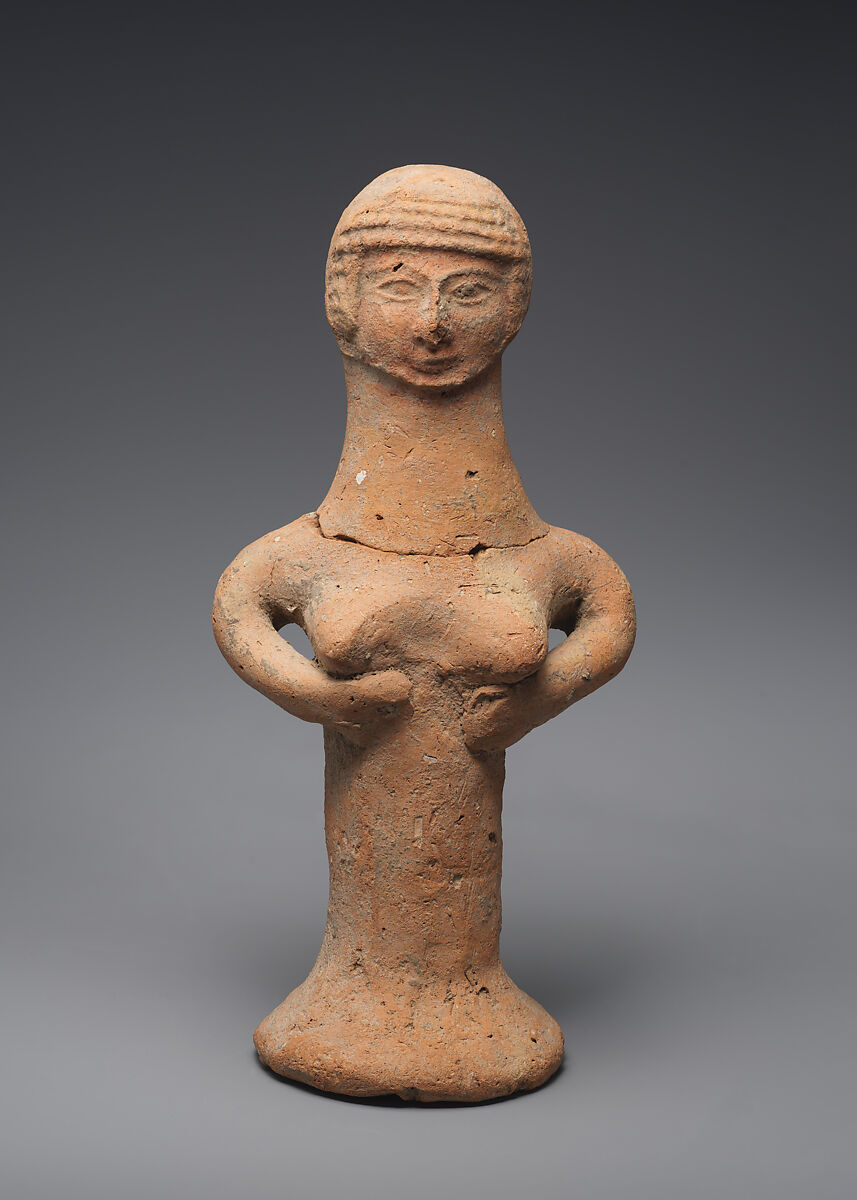
Archaeologists have found, in ordinary Judahite homes, hundreds of small clay pillar figurines of a woman, exactly the kind of household religious image the Bible's prophets condemned. They are physical evidence that everyday people made and kept such images anyway, probably connected to older fertility practices the prophets were fighting to stamp out. The figurines do not weaken the story of Israelite religion; they show what that story actually was, the slow, contested rise of a new idea, house by house, against the older practices all around it.
The end of the First Temple period — and why it is not the end
Assyria destroyed the northern Kingdom of Israel in 722 BCE and scattered its people, the origin of the later "ten lost tribes" tradition. Judah held on until 586 BCE, when the Babylonian empire under Nebuchadnezzar II besieged Jerusalem, destroyed the First Temple, and carried much of the population into exile in Babylonia.
This might have been the end of the Israelites. But the exile did not end the people. It lasted about fifty years, a single generation. In 539 BCE the Persian king Cyrus conquered Babylonia and, the next year, permitted the exiles to return and rebuild their Temple. Not all returned: a large community stayed in Babylonia and became one of the most important centers of Jewish life for the next two thousand years. The people who had been a small hill-country kingdom were becoming something the ancient world had not seen, a community that could survive the loss of its land and its temple and continue anyway.
The Israelites were not an origin story that ended at the Babylonian exile. They were the beginning of a continuous people whose history runs unbroken from these hill-country villages all the way to the present.
Key terms
Canaan: The historic name for the land along the eastern Mediterranean where ancient Israel emerged; today includes Israel and the Palestinian territories.
Israel and Judah: The two kingdoms after the split around 930 BCE, Israel in the north (capital Samaria), Judah in the south (capital Jerusalem). "Jew" comes from "Judah."
Monotheism: The belief in a single God. Its development in ancient Israel is one of the most influential ideas in world history.
Stele: A standing stone slab carved with a message, often a king's record of his victories.
Cuneiform: The wedge-shaped writing system of ancient Mesopotamia, pressed into clay.
Ostracon: A broken piece of pottery used as a cheap writing surface (plural: ostraca).
Seal: A small carved stone pressed into wet clay to sign a document or mark ownership.
- Reading a hostile source. The Merneptah Stele, the Tel Dan Stele, and the Sennacherib prism were all made by Israel's enemies to brag about defeating it. Why might a historian trust an enemy's monument as evidence that a people — or a royal dynasty — existed, even when the enemy is exaggerating?
- Comparing kinds of evidence. The siege of 701 BCE survives as a carved picture, a boasting text, and a written narrative. What can each kind of source tell you that the others cannot? Where would you expect them to disagree?
- Evidence and argument. Archaeologists found household figurines that the Bible's own prophets condemned. Does that contradict the idea that ancient Israel was monotheistic, or does it tell us something about how a new belief takes hold? Explain using the evidence.
- Parity. Compare how your textbook treats ancient Egypt or Mesopotamia with how it treats ancient Israel. What features (cities, writing, government, religion, objects) does it give to one and not the other? Why might that gap exist?
Sources & where to see the objects
- The Merneptah Stele, c. 1208 BCE — Egyptian Museum, Cairo. Earliest extra-biblical reference to "Israel."
- The Tel Dan Stele, 9th century BCE — The Israel Museum, Jerusalem. Earliest extra-biblical reference to the "House of David"; discovered at Tel Dan, 1993–94.
- The Lachish Reliefs and the siege panels, c. 700–681 BCE — The British Museum, London.
- The Sennacherib Prism (the annals of Sennacherib), c. 689–691 BCE — three complete copies: The British Museum (the Taylor Prism); the Institute for the Study of Ancient Cultures, University of Chicago; and The Israel Museum, Jerusalem.
- The Lachish Letters, c. 590 BCE — The British Museum, London, and The Israel Museum, Jerusalem.
- Judahite pillar figurines, 8th–7th century BCE — collections including The Metropolitan Museum of Art, New York, and The Israel Museum, Jerusalem.
- For a museum account of the 701 BCE campaign, see the Metropolitan Museum of Art, "Sennacherib and Jerusalem" (Assyria to Iberia exhibition).
- Fuller treatment, with the objects and full citations, in the Land of Israel topic of The Makor Project (makorproject.org).