 K–5 Lesson
Teacher's Guide
Three Voices, One Country
A letter, a poem, and a song: Jewish Americans in the American story · Grades 3–5
K–5 Lesson
When Jewish Americans appear in an elementary classroom at all, they usually arrive at Ellis Island around 1900, newcomers in a crowd. This lesson moves the starting line back a century. In 1790, the first full year of government under the Constitution, the President of the United States wrote a letter to a Jewish congregation in Newport, Rhode Island, and made a promise in it that the country still quotes. Ninety-three years later a Jewish poet from New York wrote the words that turned the Statue of Liberty into a welcome. Thirty-five years after that, a Jewish immigrant who had arrived in New York as a five-year-old wrote the song the country sings at ballgames. For the students, the lesson is simply: here are three short pieces of writing from three different centuries, and here is what they tell you about who was here, and who wrote the story down.
The idea a child should leave with: Jewish Americans have been part of the American story since the republic's first years, and the country's own promises were written partly to them and partly by them.
Students read three short primary sources, one from 1790, one from 1883, and one from 1918, and place them on a single line across the room. They decode one famous sentence word by word, read five famous lines aloud in a round and answer them in their own voice, and build a timeline with their own hands. By the end, a student can say what President Washington promised and to whom, name the poet whose words are on the Statue of Liberty, tell who wrote "God Bless America" and where he came from, and carry one sentence out the door: Jewish Americans have been part of the American story since the country's first years, and some of the country's best-known words were written to them, and by them.
Put these in your own words. Keep the dates exact and the hedges where they are.
In August 1790, during his first term, George Washington toured Rhode Island, the last state to ratify the Constitution. At Newport, on August 17, the Jewish congregation of the town greeted him with a letter of welcome, read by its warden, Moses Seixas. Their synagogue, built in the 1760s and now called Touro Synagogue, still stands. Washington answered the next day, August 18, in a letter addressed "To the Hebrew Congregation in Newport" ("Hebrew" was the word people then used for Jewish). The sentence the country remembers:
"For happily the Government of the United States, which gives to bigotry no sanction, to persecution no assistance, requires only that they who live under its protection should demean themselves as good citizens, in giving it on all occasions their effectual support."
Two points for the decoding. First, "demean themselves" meant "behave" in 1790, not "put themselves down"; the President is asking only that people be good citizens. Second, the famous phrase was not his. The congregation's letter, the day before, described a government "which to bigotry gives no sanction, to persecution no assistance." Washington took their words and made them his promise. Written to them, and partly by them. He closed with an older image, from the Hebrew Bible's prophets: that each person should "sit in safety under his own vine and fig tree, and there shall be none to make him afraid." You can mention that line or leave it for another day.
Emma Lazarus was born in New York City in 1849 into a Jewish family whose roots in America went back before the Revolution. She published her first book of poems as a teenager. In the early 1880s, when Jewish refugees from violence in the Russian Empire began arriving in New York, she helped them and wrote about them. In the fall of 1883 she was asked to write a poem to help raise money for the pedestal of a statue France was giving to the United States. She wrote a fourteen-line sonnet, "The New Colossus," and named the statue "Mother of Exiles." She died in 1887, at thirty-eight. The poem was largely forgotten until 1903, when it was placed on a bronze plaque at the statue, where the plaque still stands on Liberty Island. The last five lines are the ones the class reads:
"Give me your tired, your poor,
Your huddled masses yearning to breathe free,
The wretched refuse of your teeming shore.
Send these, the homeless, tempest-tost to me,
I lift my lamp beside the golden door!"
The statue was a gift about liberty; the poem turned it into a welcome. A child can see that a poem can change what a monument means.
Lillian Wald was a young nurse who, in 1893, moved into the crowded Lower East Side of New York, where many immigrant families lived, and began caring for the sick in their own homes. Two years later she moved the work to a house on Henry Street, which became Henry Street Settlement and still serves the neighborhood today, and the nurses she organized became the Visiting Nurse Service, the idea that a nurse can come to you. For the lesson she is a card on the line, not a source: a woman who wrote part of the story in what she did rather than in words.
One more voice is not written down at all. Carl Laemmle was born in 1867 in the Jewish quarter of Laupheim, a small town in Germany, and came to America at seventeen with a ticket his father could barely afford. He ran a nickelodeon, where a nickel bought a seat at the moving pictures, then made films himself. In 1912 he merged his company into Universal, and in 1915 he opened Universal City in California, a whole town built for making movies. Most of the other studios that invented Hollywood, Paramount, Fox, MGM, Warner Bros., and Columbia, were founded or led by Jewish immigrants and their sons too. The full record is in the Makor chapter The Founders of Hollywood.
Irving Berlin was born Israel Beilin in 1888 in the Russian Empire; his family had been living in a town in what is now Belarus when they left. They arrived in New York in 1893, when he was about five, and settled on the Lower East Side. He grew up to write more than a thousand songs, including "White Christmas" and "There's No Business Like Show Business." In 1918, while serving as a soldier at Camp Upton on Long Island, he wrote "God Bless America" for an Army show called Yip, Yip, Yaphank, then set it aside. Twenty years later, in the fall of 1938, with war gathering in Europe, he took it out, rewrote it as a song of peace rather than a war song, and gave it to the singer Kate Smith, who introduced it on her radio program in November 1938, around Armistice Day. In 1940 he set up a fund so that the song's earnings go to the Boy Scouts and Girl Scouts, which they still do. The words are still under copyright, so the source sheet prints the title and the dates, not the lyric; most children have heard it at a ballgame or on the Fourth of July.
Albert Einstein, the most famous scientist in the world, was working in California when Hitler took power in Germany on January 30, 1933. He never set foot in Germany again. He settled at the Institute for Advanced Study in Princeton, New Jersey, became a United States citizen in 1940, and lived in Princeton for the rest of his life. For this lesson he is the last card on the line, not a source to decode: a scientist who had to leave his country and made this one his own. The full story is in the Makor chapter Albert Einstein.
Before class: print the Three Voices source sheet and the Decode & Timeline handout, one each per student, plus one spare source sheet. Cut the 1790 sentence off the spare sheet and seal it in an envelope. Run a string or a strip of masking tape across the room at shoulder height and mark six spots on it, evenly spaced and labeled 1790, 1883, 1893, 1915, 1918, 1940. Keep six clothespins or pieces of tape by the string. The steps below run 40 minutes.
Do: Hold up the sealed envelope. Say: "In 1790, George Washington had been President for about a year. He wrote this letter. Who do you think it was to? Congress? The King of France? One of his generals?" Take four or five guesses and write them on the board. Then: "It was to a synagogue. A Jewish congregation in Newport, Rhode Island, wrote to welcome him to their town, and the next day he wrote back. His letter is about 340 words long. Today you get one sentence of it, and your job is to figure out what the President promised, and to whom." Tear open the envelope, unfold the sentence, and tape it to the board without reading it yet.
Do: Hand out the Three Voices source sheet and the Decode & Timeline handout. Read the 1790 sentence aloud once, slowly, while students follow with a finger. Read the short middle of it again: "which gives to bigotry no sanction, to persecution no assistance." Say: "Four hard words. Let's crack them." Work Part A of the handout together at the board, one word at a time, and let students guess before you tell: bigotry, hating a group of people for who they are; sanction, here, approval, a yes; persecution, hurting people or chasing them out because of who they are; assistance, help. Then the two "no" phrases: "No sanction to bigotry: the government will not say yes to hate. No assistance to persecution: the government will not help anyone hurt you." Pairs rewrite the sentence in their own words on the handout (two lines are enough). Collect three versions out loud.
Say: "Now the second question. Who was this promise for?" Students will say the Jewish congregation, which is right. Push one step: "He was the President. When the President writes a promise down, who else is listening?" (The whole country.) Then the surprise: "Here is something most grown-ups don't know. The day before, the congregation's letter to Washington used almost these same words: a government 'which to bigotry gives no sanction, to persecution no assistance.' Washington read their letter, took their words, and made them his promise. So this sentence was written to them, and partly by them. Keep that in your pocket. It comes back at the end."
Grade 3: do the rewrite as a whole class on the board and have students copy it. Grades 4–5: pairs write on their own, then one pair reads the original and another reads its rewrite, back to back.
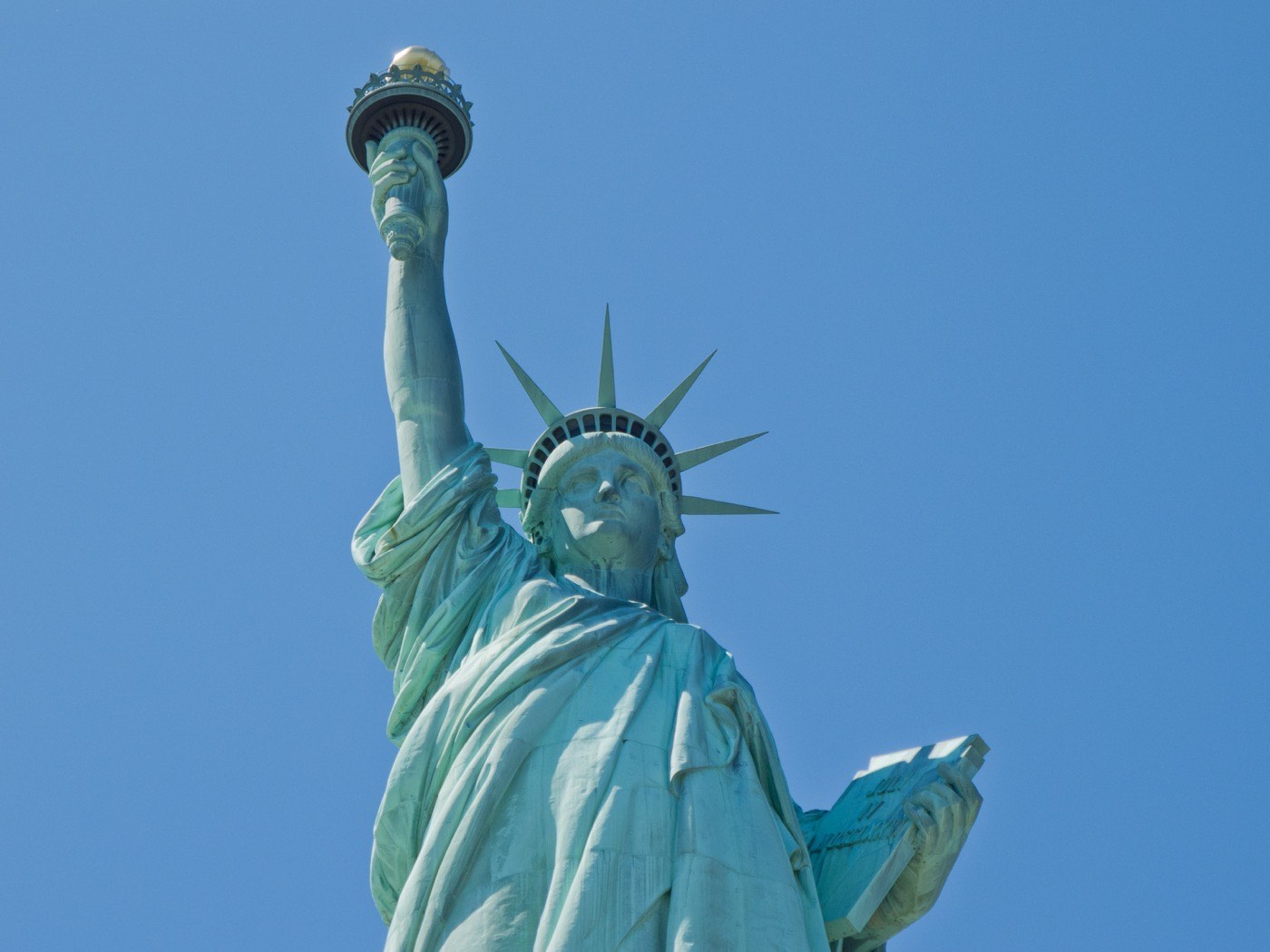
Do: Project the photograph at the top of this guide if you can. Say: "Ninety-three years later, another welcome, this time a poem. In 1883 a poet from New York named Emma Lazarus was asked to write a poem to help raise money for the pedestal of a giant statue France was giving to the United States. She was Jewish, and her family had been in America since before the Revolution. She wrote fourteen lines. The last five are on your sheet. In 1903, after she died, they were put on a bronze plaque at the statue, and the plaque is still on Liberty Island."
Do: Divide the class into five groups, one line each, and read the five lines in a round: group one, then two, straight through, no pause. Read it a second time faster. Read it a third time with the whole class joining on the last line, "I lift my lamp beside the golden door!" Then crack three phrases quickly, letting students guess first: "huddled masses" (a crowd pressed close together, to keep warm or because they are scared), "tempest-tost" (thrown around by a storm, so: people who have had a very hard trip), "the golden door" (the way into America, which the statue stands beside). Say: "Who is talking in this poem?" (The statue.) "Who is she talking to?" (People coming to America, and the old countries they are leaving.)
Do: Part B of the handout. Say: "A family is arriving in America today. They have had a long trip. The statue can speak. Write what she says to them, three or four lines. You may borrow Emma Lazarus's words or use your own." Give five minutes. Ask three students to read theirs standing up. Grade 3: two lines, and the starter "Give me your..." is already on the handout. Grades 4–5: three or four lines, and ask for one word the poem uses and one word of their own.
Say: "The third voice is a song you already know. In 1893 a five-year-old boy named Israel Beilin arrived in New York with his family from the Russian Empire. He grew up on the Lower East Side, changed his name to Irving Berlin, and wrote more than a thousand songs. In 1918, as a soldier at an Army camp on Long Island, he wrote one for a soldiers' show, then put it in a drawer. Twenty years later, in 1938, with war coming in Europe, he took it out and rewrote it as a song about peace. A singer named Kate Smith sang it on the radio that November. The song is 'God Bless America.' He gave all the money it earns to the Boy Scouts and Girl Scouts, and it still goes there." If you have a recording, play thirty seconds; the class listens and does not need to sing.
Then say: "Two more voices are not written down at all. In 1893 a young nurse named Lillian Wald moved into the Lower East Side, where thousands of immigrant families lived in crowded buildings, and started going to sick people's homes to care for them. Two years later she moved the work to a house on Henry Street. It became Henry Street Settlement, and it is still there, still helping. Her card is 1893, between the poem and the studio." Then: "The other voice is in pictures. In 1884 a seventeen-year-old named Carl Laemmle arrived from a small town in Germany. He ended up running a tiny movie theater where a seat cost a nickel, then making the movies himself, and in 1915 he opened Universal City, a whole town in California built for making films. Most of the people who built Hollywood were immigrants like him. So this voice is in pictures: the movies."
And one last card: "In 1933 the most famous scientist in the world, Albert Einstein, was working in California when Hitler took power in Germany. He never went back. He settled in Princeton, New Jersey, and in 1940 he became an American citizen. His card goes at the end of our line, 1940: a scientist who had to leave his country and made this one his own."
Do: Part C of the handout. Students cut apart the seven timeline cards along the dashed lines and fill in the blanks on the first six (who, where, and what) under the printed year and kind: a letter, a poem, a nurse, a studio, a song, a scientist. They lay the six in order on the desk and notice that the nurse comes before the studio and the studio before the song. The seventh card is theirs: "My voice," with their own name and this year, and one line of their own welcome or promise. Grade 3: the word bank at the bottom of the handout supplies the names and years; cutting can be done in pairs. Grades 4–5: fill in without the word bank, then add on the back of each card one sentence saying who the writing was for.
Do: Ask six volunteers to bring one card each to the string and clip it at its mark: 1790, 1883, 1893, 1915, 1918, 1940. Stand the class facing the line. Say: "Read the line with me." The class reads, in order: the 1790 phrase ("to bigotry no sanction, to persecution no assistance"), the last line of the poem ("I lift my lamp beside the golden door!"), the nurse ("Lillian Wald, 1893"), the studio ("Universal City, 1915"), the title and year of the song ("God Bless America, 1918"), and the scientist ("Albert Einstein, citizen, 1940"). Say: "Look at the distance between the first card and the last. One hundred and fifty years. A letter, a poem, a nurse, a studio, a song, a scientist. The promise was written to a Jewish congregation, and partly by them. The welcome on the statue was written by a Jewish poet. The movies were built by immigrants who came through that golden door, and so was the song. Jewish Americans were here at the start of the story, and they helped write it down." Then invite students, a few at a time, to clip their own "My voice" cards at the far end of the line, past 1940, and read one line each as they go. End on the last child's line. On the board: A letter, a poem, a song: part of America's story from the first years, and part of writing it.