The Founders of Hollywood
A clothing salesman from a German village. A furrier from Hungary. A garment cutter from another Hungarian town. A scrap-metal dealer’s son from the Russian Empire. A cobbler’s sons from Poland. Around 1910, these men, immigrants and children of immigrants, all Jewish, all shut out of more respectable trades, bet everything on a novelty the respectable considered beneath them: the moving picture. The industry they built became America’s storyteller to the world.
The immigrant founders of the American film industry, documented by the industry’s own museum
Why this Chapter exists
The most American industry has an immigrant origin story.
Universal. Paramount. Fox. MGM. Warner Bros. Columbia. Every one of these studios, the firms that invented the Hollywood studio system and with it much of American popular culture, was founded or led by a Jewish immigrant or the child of one, within roughly a dozen years of each other. Since 2024 it is the story the film industry’s own museum tells in its first permanent exhibition.
This Chapter tells that story the way this Unit tells the others: who they were, what they built, why it was these men and this industry, and what the record shows about how the industry’s own history has been remembered, forgotten, and corrected.
1867–1892
Six arrivals.
Carl Laemmle was born in the Jewish quarter of Laupheim, Germany, in 1867, and came to America at seventeen with a ticket his father could barely afford. Adolph Zukor left Hungary at fifteen, an orphan apprenticed to a furrier. William Fox, born Vilmos Fried in Tolcsva, Hungary, arrived as an infant and left school at eleven to support his family in the garment trade. Louis B. Mayer, born Lazar Meir in the Russian Empire around 1884, was a scrap-metal dealer’s son who never knew his own birthday, so he assigned himself the Fourth of July. The Warner brothers were the sons of a cobbler from Krasnosielc, Poland; three of the four were born there. Harry Cohn was born on New York’s Upper East Side in 1891 to a tailor from Germany and a mother from the Pale of Settlement, the region of the Russian Empire where Jews were required to live.
The biographies share three absences. Not one of these men attended a university. Not one inherited capital. And not one could expect a career in the industries where American fortunes were then made: banking, railroads, steel, and the professions kept their doors substantially closed to Jews, a pattern documented in the American Jewry Chapter. The scholar Neal Gabler, whose history of the founders is the standard account, put the consequence plainly: they went where the doors were not yet built, into a brand-new amusement the established classes dismissed as a vulgar fad for immigrants: the nickelodeon, the storefront theater where a nickel bought a seat.
1905–1930
From nickelodeons to an industry.
They started as exhibitors, running nickelodeon theaters where a nickel bought a seat, and worked backward into making the films themselves. Zukor’s Famous Players (1912) grew into Paramount. Laemmle merged his film company into Universal in 1912 and opened Universal City, a purpose-built studio city, in 1915. Fox Film incorporated the same year. Warner Bros. incorporated in 1923 and bet the company on synchronized sound; The Jazz Singer (1927), the film that began the end of the silent era, is the story of a cantor’s son (a cantor leads the sung prayers of a synagogue), which is to say, a version of the brothers’ own story. The film also contains blackface performance, a fact of its record. Marcus Loew, a New York theater-chain owner and himself the son of Jewish immigrants, assembled MGM in 1924 and put Mayer at its head. Cohn’s company became Columbia the same year.
Between them they invented the studio system: production, distribution, and exhibition under one roof, the star system, the movie palace, the idea that a film opens everywhere at once. By 1930, an industry that had not existed when its founders were boys was among the largest in America, and its product, the American movie, had become the country’s face to the world. The men the establishment would not hire had built the establishment’s imagination.
The pattern reached past the front office. The star of The Jazz Singer was Al Jolson, born Asa Yoelson, an actual cantor’s son playing one. Emanuel Goldenberg became Edward G. Robinson; Issur Danielovitch became Kirk Douglas; Betty Joan Perske became Lauren Bacall. The renaming is itself part of the record, and the founders enforced it on their stars as they practiced it themselves: the men who built the dream factory believed the dream sold better without their own names on the characters.
And the pattern was not only American. Jewish entrepreneurs were leading promoters of early cinema in Baghdad, and Togo Mizrahi was a founding figure of Egyptian cinema in Alexandria: the fuller regional story, with its sources, is told on this site’s Films & Video page. Wherever the new medium appeared, the same open door drew the same shut-out talent.
1936–1939
Laemmle’s list.
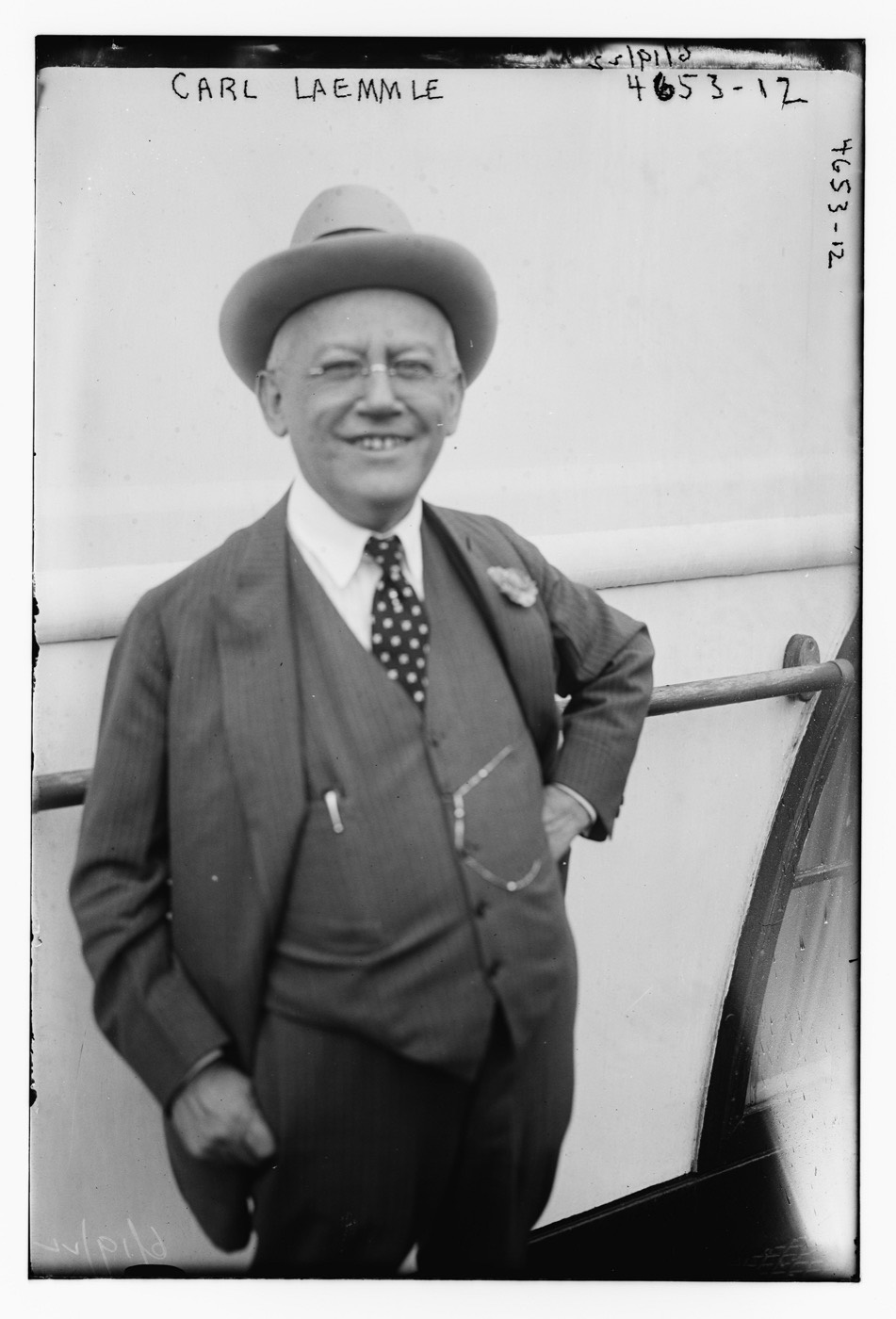
The founders’ story connects to this site’s larger record in one man’s last act. Carl Laemmle sold Universal in 1936 and spent his retirement, as the Nazi government stripped Germany's Jews of their rights and livelihoods, on a single project: getting Jews out. Under American immigration law, a refugee needed a citizen’s sworn affidavit of financial support; Laemmle signed them by the hundreds, for the Jews of Laupheim, the town he had left as a poor teenager, and far beyond it, and lobbied the State Department directly. His April 1938 letter to Secretary of State Cordell Hull survives in the National Archives: he wrote that he felt it “the solemn duty of every Jew in America” to do what he was doing. He kept signing until consuls began refusing his guarantees on account of his age, and he died in 1939, weeks after the Second World War began that September. Scholarship on his campaign credits his affidavits with saving hundreds of people, an accounting known in the literature as “Laemmle’s list.” (U.S. National Archives, from State Department records; Udo Bayer, “Laemmle’s List,” Film History.)
2021–2024
How the industry remembered, and corrected itself.
The memory of the founders has its own documented history, and it is recent. When the Academy Museum of Motion Pictures, the film industry’s official museum, opened in Los Angeles in 2021, critics across the press noted that its telling of Hollywood’s origins largely omitted the Jewish immigrants who founded it. In May 2024 it opened Hollywoodland: Jewish Founders and the Making of a Movie Capital, its first permanent exhibition, dedicated to exactly this story. Weeks later, hundreds of Jewish film professionals publicly objected that some of the exhibition’s wall text leaned on old stereotypes; the museum acknowledged the criticism and revised the text. (Academy Museum, the exhibition; the omission, the response, and the revisions are documented in the trade press of record.)
Object Spotlight
A gate on former farmland.
The object of this Chapter is the photograph at the top of this page: the entrance gate of Universal City, a city invented for an industry invented by people the other industries would not have. The distance between a cheap steamship ticket from Hamburg and a studio gate in the California hills is thirty-one years, and the road between them ran through the one door that was open. Students who want to walk through the fuller collection can visit the Academy Museum’s permanent exhibition, where the industry itself now keeps this record.
The analytical question
Why these men, why this industry.
When a group is barred from established paths, its talent concentrates wherever the barriers have not yet been built: a new science, a new trade, a new art. The founders did not build Hollywood because Jews have a special gift for entertainment; that framing is the mirror image of the old slurs, and the record does not support it. They built it because they were locked out of everything older, and the movies were too new, too disreputable, and too risky to have locks yet. Exclusion explains the where; their work explains the rest.
Key takeaways
- Universal, Paramount, Fox, MGM, Warner Bros., and Columbia were all founded or led by Jewish immigrants or children of immigrants from Central and Eastern Europe, within roughly a dozen years.
- Shut out of established industries, the founders entered the disreputable new nickelodeon trade and invented the studio system that made film America’s dominant popular art.
- Carl Laemmle, Universal’s founder, spent his final years sponsoring affidavits that saved hundreds of Jews from Nazi Germany, a campaign documented in the U.S. National Archives.
- The industry’s own museum omitted the founders from its origin story in 2021, then answered with its first permanent exhibition, Hollywoodland, in 2024, a documented case study in how memory is corrected.
- The analytical rule: exclusion explains where Jewish talent went, and only their work explains what it built. The record supports no mystique in either direction.
Discussion questions
Working from the evidence.
Grounded in the sourced record above. Each asks students to read the documents rather than restate a conclusion.
- None of the six founders went to college, and none could enter the era’s established industries. What does their concentration in a brand-new industry tell you about how discrimination shapes where talent goes?
- The Jazz Singer, the film that began the end of the silent era, is about a cantor’s son choosing between tradition and the American stage. Why might the Warner brothers have bet their company on that particular story?
- Laemmle’s affidavit campaign is preserved in State Department files. What does it change historically when private generosity leaves a government paper trail?
- The Academy Museum first omitted the founders, then built a permanent exhibition about them, then revised that exhibition’s language under criticism. What does this sequence teach about who controls a story and how corrections happen?
- The Chapter warns against explaining this history by a “special gift,” calling that the mirror image of the old slurs. Why is a flattering group-explanation still a group-explanation, and what does the record support instead?
Classroom Connections
Where this Chapter fits.
Teaching Connections
The disciplines and courses this Chapter naturally supports, for any educator, anywhere.
- US History: immigration, exclusion from the professions, and the invention of a signature American industry.
- Media & Film Studies: the studio system’s origins, the nickelodeon era, and the coming of sound.
- Holocaust Studies: the Laemmle affidavit campaign as a documented American rescue effort within restrictive immigration law.
- Historical Thinking: the Academy Museum sequence as a live case study in public memory and its correction.
- Economics & Entrepreneurship: market entry where incumbency and credentials mattered least.
Standards Alignment
- NYS US History & Government: 11.2 (immigration and industrialization) and 11.5 (the interwar economy and mass culture).
- Common Core ELA-Literacy: RH.9–10.2 (central ideas from primary and secondary sources) and RH.11–12.6 (comparing points of view on the same history).
Further Teaching Resources
- Academy Museum, Hollywoodland, the industry’s own permanent exhibition on its founders.
- U.S. National Archives on Carl Laemmle, the rescue campaign from the government’s own files.
- Films & Video: the studio-era materials gathered in the full Films & Video collection.
Sources and citations
Primary sources
A primary source is a record from the time. It was made by people who were there. Examples: letters, diaries, photos, decrees, trial records, and newspapers.
- Laemmle, Carl. Letter to Secretary of State Cordell Hull, April 12, 1938, and related affidavit correspondence. U.S. National Archives, State Department records. archives.gov.
- Universal City entrance, 1915. Photograph, public domain.
- Academy Museum of Motion Pictures. Hollywoodland: Jewish Founders and the Making of a Movie Capital. Permanent exhibition, opened May 2024. academymuseum.org.
Secondary sources
A secondary source was written later. It is a book or article by a historian who studied those records and explains what they mean.
- Gabler, Neal. An Empire of Their Own: How the Jews Invented Hollywood. New York: Crown, 1988.
- Bayer, Udo. “Laemmle’s List: Carl Laemmle’s Affidavits for Jewish Refugees.” Film History.
- German Historical Institute. Immigrant Entrepreneurship entries on Carl Laemmle and Harry Cohn. immigrantentrepreneurship.org.
A finding note. Founder biographies follow the institutional and scholarly records above; where a birthplace is uncertain in the documents, as with Louis B. Mayer’s town in the Russian Empire, this page says only what the records support. The count of those saved by Laemmle’s affidavits follows Bayer’s scholarship; the National Archives’ own account says “hundreds.”
The son of Russian-Jewish immigrants who ended polio’s reign of fear, refused to patent the vaccine, and answered a television interviewer with five words: could you patent the sun?
Comments?
Write to editor@makorproject.org.
Last updated: August 2026.