He served as physician to the Muslim ruler Saladin's court. He wrote the code of Jewish law still studied throughout the Jewish world. And the greatest Christian theologian of the Middle Ages, Thomas Aquinas, cited him dozens of times under the name "Rabbi Moses the Egyptian." Few medieval thinkers were taken seriously across the Jewish, Islamic, and Christian worlds alike.
Maimonides · Unit 5
Why this Topic exists
One man, read by three traditions at once.
Secondary-school courses in medieval history rarely stop on a single Jewish figure long enough to say who he was. Maimonides is the one who most repays the stop. Very few people from the entire medieval world were read in earnest by the Islamic philosophers, the Christian theologians, and the Jewish scholars of their own time, and then kept being read, in all three traditions, for the eight centuries since. He is one of them.
This Topic treats him at the depth the record allows: the life, the three great books, the medical writing, the letters he sent to frightened communities across the Mediterranean, and the reception that carried his name into Arabic, Latin, and Hebrew alike. Where the record is contested, and parts of it genuinely are, the Topic says so plainly rather than smoothing it over. The aim is an anchor point in medieval history that connects, directly, to the wider medieval world a class is already studying.
Object Spotlight
A page of the law code, painted in gold.
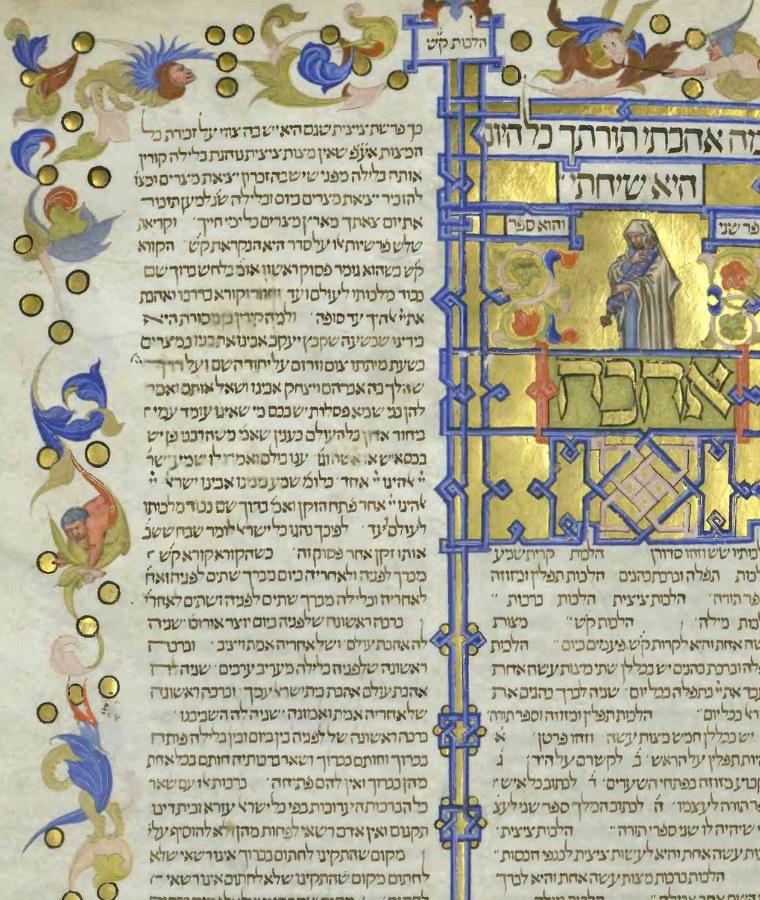
Look at the page before you read a word of it. A column of dense Hebrew script runs down one side. Beside it rises a tall blue frame, and inside it the opening word of the section glows in gold leaf, with a small painted figure hugging a Torah scroll. Around the edges, vines curl through the margins, and small animals and people climb among them. It looks like a king's prayer book, the kind of object made to be shown off.
It is, in fact, a law book. This is a hand-copied manuscript of the Mishneh Torah ("the repetition of the Law"), Maimonides' enormous code of Jewish law, finished around 1180. A code is a single organized rulebook: instead of making a reader chase an answer through the sprawling Talmud, Maimonides sorted the entire legal tradition by subject and wrote it out in clear Hebrew, so an ordinary literate Jew could simply look a matter up. The text itself is plain and practical. What you are looking at is what later owners did with it: a wealthy family commissioned an artist to copy it onto parchment and cover it in gold.
Here is why that matters. We often picture medieval law as dry or forbidding. Yet a community that devoted gold leaf and months of an artist's labor to a book of legal rulings was making a different statement. This was not merely a reference book. It was an object of learning, status, beauty, and continuity, meant to be preserved and handed from one generation to the next.
Look closer at one detail and it tells the whole story of this Topic. These luxury copies were made by Christian artists (the same workshops that illuminated Latin prayer books for bishops), hired by Jewish families to decorate a Jewish law code written by a man who served a Muslim king. Three traditions meet on a single page. That is Maimonides in miniature.
The afterlife is the part that lasts. The plain text these painted copies preserve is still in print, still studied daily, eight hundred years on, one of the few books from the twelfth century a person can buy today and use as its author intended. The gold-leaf manuscripts sit in museum cases; the words inside them never left circulation.
Córdoba and the Almohad break · 1138–1148
The city he lost at ten.
Moses ben Maimon was born in Córdoba, in the Muslim-ruled part of Spain known as al-Andalus, on March 30, 1138 (the traditional date; some scholars place his birth in 1135). His father, Rabbi Maimon ben Joseph, was a scholar and a dayyan, a judge in the Jewish religious court, in the Córdoba community. The family belonged to the long line of Andalusian Jewish scholars who had produced the great Hebrew poets, philosophers, and legal minds of the previous century.
His first ten years shaped everything. Córdoba in the early 1100s was a leading center of Jewish learning and one of the intellectual capitals of the whole Islamic world. The Muslim regime then ruling the city tolerated its Jews; the community ran its own institutions, supported its scholars, and stayed tied into the wider Mediterranean Jewish network.
That ended in 1148, when Maimonides was about ten. A movement called the Almohads (al-Muwaḥḥidūn, "those who declare God's oneness," a militant religious-political movement out of the Atlas Mountains of Morocco) conquered Córdoba. The Almohads broke sharply with the practice of earlier Muslim rulers. Where those rulers had let Jews and Christians live as protected minorities under a recognized legal status, the Almohads gave the Jews and Christians of the lands they took three choices: convert to Islam, leave, or die.
The Maimon family left. The cost to Andalusian Jewry was severe, its great communities were broken up or destroyed across the late 1140s and 1150s. For the next eighteen years the family moved from place to place, across the Iberian Peninsula and into Morocco itself, with recorded stops at several towns along the western Mediterranean.
The years of wandering · 1148–1166
From Spain to Egypt, the long way.
For the next eighteen years the family was on the move, staying ahead of a regime that wanted them gone. Exactly where they went, and when, is only partly known, but the pieces that survive sketch the route:
- Fez, in the early 1160s. The family lived for a time in Fez, inside Almohad Morocco itself. There Maimonides began his earliest surviving work, including parts of the Commentary on the Mishnah he would finish later in Egypt. How a Jewish family lived openly in a city where Almohad law forbade Jewish life is still debated by scholars. Some argue the family lived as outward, nominal converts to Islam, what the period called anusim, "the forced ones", while keeping Jewish practice in private. The question is not settled.
- The Letter on Apostasy (Iggeret HaShemad). Written during or just after the Fez years. It addresses the standing of Jews forced to convert to Islam under Almohad pressure. Maimonides took a notably gentler line than some rabbis of his day: he held that Jews living under coercion kept their Jewish identity, and urged them to get out, to places where Jewish life could be lived in the open.
- A brief stay in the Land of Israel (1165). The family visited the Land of Israel in 1165, with recorded time in Acre and Jerusalem. They did not settle. Conditions under Crusader rule in the mid-1100s, traced in the Continuous Presence Topic, could not support the scholarly life the family needed.
- Egypt (1166). The family settled in Fustat, Old Cairo, in Fatimid Egypt, in 1166. Egypt offered what they had been looking for: a tolerant regime, a large established Jewish community, and a place in the wider intellectual life of the Islamic world. The mature career began here.
Maimonides' father died soon after the family reached Egypt. His younger brother David, who had supported them all through the Indian Ocean gem trade, drowned in a shipwreck around 1168. Maimonides' own letters describe what the loss did to him: he writes that he lay ill with grief for about a year, and that he took up the practice of medicine in part to support the family once David's income was gone.
Fustat · 1166–1204
The center of a life's work.
The wandering finally stopped in Egypt, and the man who had spent eighteen years on the run did his greatest work in the decades that followed. Almost everything Maimonides is remembered for (the law code, the philosophy, the medicine) comes from the Fustat years. The main threads of that period:
- Leading the community. Maimonides served as ra'is al-Yahud ("head of the Jews") of the Egyptian Jewish community for much of this period, formally from about 1191. Egypt's Jewish community was then among the most important in the Islamic world, with Fustat at its center.
- Court physician. Maimonides became a physician at the court of Saladin (Ṣalāḥ al-Dīn), the ruler who established Ayyubid power in Egypt and who took Jerusalem from the Crusaders in 1187. He continued under Saladin's son al-Afdal. His letters to his student and translator Joseph ben Judah describe the sheer demands of the medical work and how it pressed against his time for scholarship.
- The three great books. The Commentary on the Mishnah was finished around 1168, the Mishneh Torah around 1180, and the Guide of the Perplexed around 1190, all written here, alongside the medical works and the letters.
- The letters. From Fustat he wrote to Jewish communities across the Mediterranean and beyond (to Yemen, to Provence in southern France, to North Africa) letters preserved in later rabbinic collections and in the Cairo Geniza, the great document trove of the Fustat community.
Maimonides died at Fustat on December 12 or 13, 1204. The Jewish community held a long public mourning; documents in the Cairo Geniza record the weight of the loss. His body was carried to Tiberias, in the Galilee region of the Land of Israel, for burial, as he had wished. His tomb there has been a place of Jewish pilgrimage since the thirteenth century.
Commentary on the Mishnah · completed c. 1168
The first great work.
His first big book set out to solve a problem. The Mishnah (the early collection of rabbinic law, edited around 200 CE, that sits at the base of the Talmud) was studied everywhere, but a student opening it cold had little help making sense of it. So around 1168, about thirty years old, Maimonides wrote a running explanation he called the Kitāb al-Sirāj, "the Book of the Lamp" (in Hebrew, Pirush HaMishnah). He wrote it in Judeo-Arabic (Arabic written in Hebrew letters, the everyday literary language of Jews across the Islamic world) and it was later translated into Hebrew, the form in which it became standard.
It broke ground in several ways. It was the first running commentary on the whole Mishnah from a single author, the first to treat the Mishnah as one connected work rather than a stack of separate tractates. It organized the legal material around underlying principles. And it carried a set of philosophical introductions to particular tractates that laid down positions Maimonides would build on for the rest of his life. The most influential of these introductions:
- The General Introduction: on the history of the rabbinic tradition, the relationship between the Oral and Written Torah, and how rabbinic law is to be interpreted.
- The introduction to Sanhedrin, chapter 10 (Helek): where Maimonides set out what became his "Thirteen Principles of Faith": a short list of core beliefs covering the existence and nature of God, prophecy, divine providence, the messianic future, and resurrection. The Thirteen Principles entered Jewish worship in poetic form, the Ani Ma'amin ("I believe") and the Yigdal hymn, and are recited to this day.
- The Eight Chapters (Shemonah Perakim): his introduction to Tractate Avot, the "Ethics of the Fathers." Drawing on the ethical thought of Aristotle, it sets out a framework for shaping human character, the virtues, and right action.
The Mishneh Torah · completed c. 1180
The whole of Jewish law, in one book.
Then he attempted what no one had pulled off before: the whole of Jewish law in a single, organized book. He called it the Mishneh Torah (Hebrew for "Repetition of the Torah"), finished around 1180 after about a decade of work, when he was around forty-two. It is the work that most established his standing across the medieval Jewish world, and the book whose illuminated copy opens this Topic above.
Its ambition was unusual. Maimonides set out to gather the entire legal architecture of Judaism (drawn from the Bible, the Mishnah, the two Talmuds, and the later legal literature) into one organized work, arranged by subject rather than following the winding order of Talmudic debate. The goal, as he explained in his introduction, was a single reference a Jew could consult for an ordinary legal question without having to work back through the whole Talmud each time.
How the work is built:
- Fourteen books. The number fourteen spells the Hebrew letters Yad ("hand"), so the work is also known as the Yad ha-Hazakah, "the Strong Hand."
- The opening. It begins not with a legal technicality but with the Laws of the Foundations of the Torah, the nature of God, the basis of belief, the question of prophecy. By placing philosophy at the very foundation of a legal code, the structure itself argues that Jewish law and Jewish thought are not two separate pursuits.
- Full scope. The fourteen books reach across the whole of Jewish practice, prayer and blessings, Sabbath and festivals, marriage and divorce, business and commerce, criminal law, and the laws of the Temple (kept in the code even though the Temple no longer stood). The closing book, the "Laws of Kings," sets out the framework for political authority and the messianic future.
- Written in Hebrew. Unlike his other two great works, written in Judeo-Arabic, the Mishneh Torah is in clear classical Hebrew, which gave it reach to Jewish communities across the diaspora whatever their spoken language.
Its reception was wide and not without argument. Rabbi Abraham ben David of Posquières (Rabad, c. 1125–1198), a Provençal scholar and contemporary, wrote sharp critical glosses (hassagot) on points of philosophy and law; those glosses are printed alongside the code in the standard editions, the running record of medieval disagreement with it. The principal modern study of the work is Isadore Twersky's Introduction to the Code of Maimonides (Yale, 1980).
The Guide of the Perplexed · completed c. 1190
The book for the believer who also reasons.
His third great work was for a different reader: the believer who had also studied philosophy and felt the two pulling in opposite directions. Finished around 1190, the Guide of the Perplexed (Hebrew: Moreh Nevuchim; in the original Judeo-Arabic, Dalālat al-Ḥā'irīn) set out to show that faith and reason need not be enemies. He wrote it in Judeo-Arabic; the standard Hebrew translation was made by Samuel ibn Tibbon during Maimonides' own lifetime, with his involvement.
The "perplexed" reader of the title is a specific kind of person: someone educated in both the Jewish tradition and the philosophy of Aristotle, who finds the two pulling against each other and does not know how to hold both. The book is framed as private instruction (addressed to one student, Joseph ben Judah) working through exactly those tensions. The questions it takes up:
- How to read the Bible's language about God. When scripture speaks of God's "hand" or "face" or "anger," Maimonides argues, the words are figurative; to read them literally is to misunderstand a God who has no body and no human attributes.
- What can be said of God at all. His answer is a "negative theology": we can state what God is not (not physical, not changing, not made of parts) but we cannot positively capture God's essence in human terms.
- Whether the world is eternal or created. He weighs the Aristotelian view that the world always existed against the biblical view that it was created in time, and concludes for creation while acknowledging that neither side can be proven outright.
- Why the commandments exist. He argues that the commandments serve reasons a person can grasp, building moral character, ordering a just society, turning the mind toward the contemplation of God.
- What the highest human life is. The closing sections place intellectual understanding of God and the order of the world at the summit of human achievement, resting on a foundation of just action and a working community.
Its reception was large and contested from the start. The major Christian scholastics read it: Albert the Great engaged it in the thirteenth century, and his student Thomas Aquinas, whose Summa Theologica remains foundational for the Catholic Church, cited Maimonides extensively, naming him "Rabbi Moyses Aegyptius," Rabbi Moses the Egyptian. Within the Jewish world the Guide set off the Maimonidean Controversies of the late twelfth and thirteenth centuries, the period's sharpest internal Jewish dispute, over whether Aristotelian philosophy belonged inside the tradition at all. The standard English translation is Shlomo Pines' (University of Chicago Press, 1963).
The medical corpus
The doctor at Saladin's court.
Medicine was a major body of Maimonides' work alongside the religious and philosophical writing. He wrote about ten medical treatises during the Fustat years, drawing on the Greek tradition (Hippocrates and Galen) and the Islamic tradition (Ibn Sīnā, al-Rāzī) that made up the medical literature of the medieval world. The principal works:
- Medical Aphorisms (Fuṣūl Mūsā; Hebrew: Pirkei Moshe): a large compilation of medical observations in twenty-five chapters, among the most widely copied medieval medical texts.
- Regimen of Health: a treatise on staying well through diet, exercise, and habit, written for al-Afdal, Saladin's son and successor.
- Treatise on Asthma: written for a particular patient, on understanding and managing the condition.
- Treatise on Poisons and Antidotes: on the medical response to poisoning, with the remedies of the day.
- Further treatises on specific medical questions.
His medical standing reached well beyond the Jewish community. His post as court physician to Saladin is well documented, and his patients ran into the Ayyubid elite. Ibn Abī Uṣaybi'a, the thirteenth-century Arab historian of medicine, gives him a respectful entry in his Lives of the Physicians. The modern critical edition of the medical works is the ongoing Gerrit Bos series (Brigham Young University Press, 2002–).
The correspondence
Letters to frightened communities.
Maimonides' surviving letters, preserved in later rabbinic literature and in the Cairo Geniza, are among the closest views we have of his daily life and of the role he played for Jews far beyond Egypt. The major ones:
- The Letter on Apostasy (Iggeret HaShemad): written in the early 1160s, on the standing of Jews forced to convert under Almohad rule. His gentler position held that forced converts kept their Jewish identity and should aim to reach places where they could live openly as Jews.
- The Letter to Yemen (Iggeret Teiman): written around 1172 to Jacob ben Nathaniel al-Fayyumi, head of the Yemenite Jewish community, then under religious pressure and stirred by a local would-be messiah. Maimonides made a steady case for patience and endurance, set against the long history of such moments.
- The Letter on Astrology: written around 1194 to the rabbis of Lunel, in Provence. Against the common medieval view, held across the Christian and Islamic worlds alike, that astrology was real knowledge, Maimonides argued it was groundless.
- Personal correspondence: letters to his student Joseph ben Judah, to his translator Samuel ibn Tibbon, and to family and correspondents around the Mediterranean. The Geniza letters in particular have let scholars reconstruct his actual day-to-day life.
The reception across traditions
Read across three traditions.
What sets Maimonides apart is the reach of his readership, across three traditions, and across eight centuries. The main lines:
- The Jewish reception. His place in the Jewish tradition has been central ever since. The Mishneh Torah became a foundational reference for later Jewish law, later paired with Joseph Karo's Shulchan Aruch (the subject of its own Topic in this Unit). The Guide has been read continuously, with a long line of commentaries and modern study.
- The Christian reception. Albert the Great engaged him in the thirteenth century; Thomas Aquinas cited him roughly eighty times in the Summa Theologica; Meister Eckhart took up his metaphysics. He is among the very few medieval Jewish thinkers the major Christian minds of the period read closely.
- The Islamic reception. His medical works were part of the Arabic medical literature and were treated with respect by figures like Ibn Abī Uṣaybi'a. His philosophy, though less circulated in the Islamic world than his medicine, was known and engaged there as well.
- The modern reception. Sustained modern engagement runs from Hermann Cohen (Religion of Reason, 1919) through Leo Strauss, whose work from the 1930s onward reshaped how scholars read the Guide, to Yeshayahu Leibowitz, Isadore Twersky, Moshe Halbertal, Kenneth Seeskin, and many others.
Contested elements in the record
The honest accounting.
Parts of the Maimonidean record are genuinely contested, and the discipline of this Topic is to say so rather than tidy it away. The main open questions:
- The Fez years and nominal conversion. Whether Maimonides and his family lived as outward Muslim converts in Almohad Fez (argued by some scholars, including Joel Kraemer) or kept an openly Jewish identity throughout, as the traditional Jewish account holds, is not settled.
- The philosophical positions. What Maimonides actually held on resurrection, miracles, and the eternity of the world has been argued over since the Middle Ages. A long scholarly debate, sharpened by Leo Strauss, asks whether his private ("esoteric") views matched his public ("exoteric") statements, Strauss's reading is influential and itself much disputed.
- The Maimonidean Controversies. The medieval Jewish disputes over whether his whole philosophical project belonged inside the tradition. They are documented across a large scholarly literature.
- Specific legal rulings. Particular positions in the Mishneh Torah were contested by later authorities (the Rabad glosses, and the commentaries of Nahmanides and others) and that record of disagreement survives in the rabbinic literature.
The honest summary is that Maimonides is a major figure whose record is genuinely complex. The Topic keeps the complexity rather than trading it for a tidier portrait. What he held, what he meant, and how he should be read are questions readers can weigh for themselves from the sources below.
Sites that survive
Where the record stands.
- Tiberias, in the Galilee, Israel, the tomb of Maimonides. His burial place, a site of Jewish pilgrimage since the thirteenth century, in the center of Tiberias.
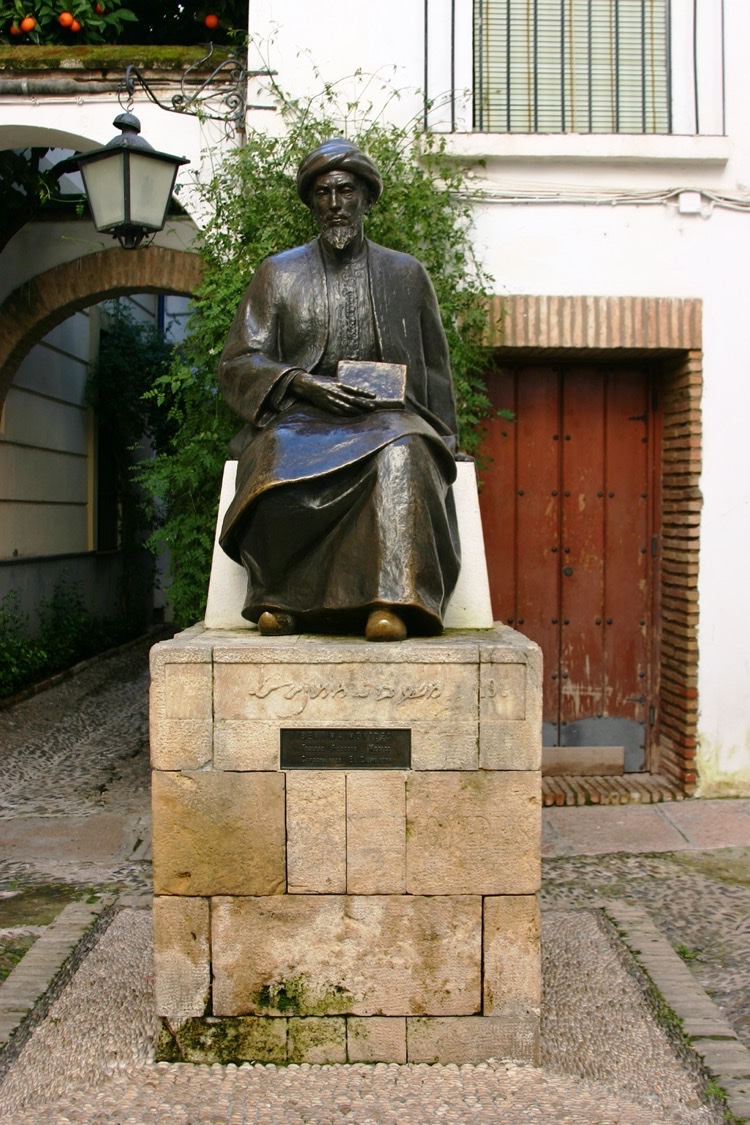
- Córdoba, Spain, the Plaza de Tiberíades. A small square in Córdoba, named for Maimonides' burial city, holding a statue of him by the sculptor Amadeo Ruiz Olmos (1964): Spain's acknowledgment of one of its city's great medieval minds.
- Fustat / Old Cairo, Egypt, the Rambam Synagogue. The synagogue in Fustat traditionally tied to Maimonides' communal life, restored in the late 2000s.
- Hamburg, Germany, the Maimonides Centre for Advanced Studies. Founded at the University of Hamburg in 2015, the present-day academic center for research on Maimonides. maimonides-centre.uni-hamburg.de →
Key takeaways
- Maimonides (1138–1204) is the medieval Jewish thinker read in earnest by all three of the great traditions of his world (Islamic, Christian, and Jewish) and read continuously in the eight centuries since.
- Driven from Córdoba by the Almohad conquest at about age ten, he wandered for eighteen years before settling in Fustat (Old Cairo), where he served as a physician at the court of Saladin and led Egypt's Jewish community.
- His three great works are the Commentary on the Mishnah (c. 1168), the Mishneh Torah (c. 1180): a complete code of Jewish law, still in daily use, and the Guide of the Perplexed (c. 1190), his major work of philosophy.
- Thomas Aquinas cited him roughly eighty times as "Rabbi Moses the Egyptian"; within the Jewish world the Guide set off the Maimonidean Controversies over the place of philosophy in the tradition.
- Parts of his record (the Fez years, his private philosophical views, specific legal rulings) remain contested, and the scholarly debate is part of the story.
For the classroom
Where this Topic fits the standards.
- World History, NY Global History 9.7 (the connected medieval Mediterranean). Maimonides maps the medieval world through one life (Muslim Spain, Almohad Morocco, the Crusader-era Land of Israel, and Fatimid and Ayyubid Egypt) and the movement of philosophy, law, and medicine across the Jewish, Islamic, and Christian worlds. For grades 7–8, anchored through Common Core literacy and interdisciplinary humanities.
- Common Core RH.6–8, RH.9–10 & RH.11–12. Students assess an author’s purpose and point of view (RH.6–8.6, RH.9–10.6, RH.11–12.6) and corroborate evidence across sources (RH.6–8.9, RH.9–10.9, RH.11–12.9), working from Maimonides’s own writings (the Mishneh Torah, the Guide for the Perplexed, his letters), later commentary, and modern scholarship.
- C3 Framework, D2.His.1 and D2.His.14 (grades 6–8 and 9–12). Students investigate chronology, historical context, continuity and change, and the evaluation of evidence.
- Classroom Applications. Students can:
- analyze Maimonides’s works as primary sources;
- trace the movement of philosophy, law, and medicine across the medieval Jewish, Islamic, and Christian worlds;
- examine how one life maps a connected medieval Mediterranean;
- compare Maimonides the “system-builder” with Rashi the “text-explainer”;
- construct evidence-based historical arguments.
- International Classroom Relevance. Because Maimonides was read across the Jewish, Islamic, and Christian traditions, this Topic supports world history, philosophy, religious studies, and the history of medicine and science internationally.
Questions for the classroom
Each question is keyed to a standard cited above. They are written as open inquiry, there is no single expected answer.
- Maimonides spent eighteen years moving from place to place before he settled. How might a life of forced movement shape what a person chooses to write down and pass on? (C3 D2.His.5)
- A community paid a Christian artist to cover a Jewish law book in gold. What does the way people decorate an object tell you about how they valued it, and what are the limits of reading feeling from an object? (C3 D2.His.10)
- The same man served a Muslim ruler, was quoted by a Christian theologian, and wrote law for Jews. What does his career suggest about how ideas crossed religious lines in the medieval Mediterranean? (C3 D2.His.1)
- Scholars still disagree about what Maimonides privately believed and whether he wrote his real views openly. How should a historian handle a figure whose own meaning is contested? (C3 D2.His.11)
Sources and citations
Primary sources come straight from the time: documents, letters, speeches, images, and objects created by the people involved. Secondary sources come later: books, articles, and analysis in which scholars study and interpret those primary sources.
Primary sources
- Maimonides, Moses. The Guide of the Perplexed. Translated by Shlomo Pines, with an introductory essay by Leo Strauss. 2 vols. Chicago: University of Chicago Press, 1963.
- Maimonides, Moses. Mishneh Torah. Hebrew–English edition. New York: Moznaim Publishing.
- Maimonides, Moses. Commentary on the Mishnah. Translated and edited by Joseph Kafih. Jerusalem: Mossad ha-Rav Kook, 1963–1968.
- Maimonides, Moses. Crisis and Leadership: Epistles of Maimonides. Translated by Abraham S. Halkin, with discussions by David Hartman. Philadelphia: Jewish Publication Society, 1985.
- Maimonides, Moses. Medical Works. Edited and translated by Gerrit Bos. Provo: Brigham Young University Press, 2002–.
- Ibn Abī Uṣaybi'a. 'Uyūn al-anbā' fī ṭabaqāt al-aṭibbā' (The Best Accounts of the Classes of Physicians). 13th century.
Secondary sources
- Twersky, Isadore. Introduction to the Code of Maimonides (Mishneh Torah). New Haven: Yale University Press, 1980.
- Davidson, Herbert A. Moses Maimonides: The Man and His Works. Oxford: Oxford University Press, 2005.
- Kraemer, Joel L. Maimonides: The Life and World of One of Civilization's Greatest Minds. New York: Doubleday, 2008.
- Halbertal, Moshe. Maimonides: Life and Thought. Princeton: Princeton University Press, 2014.
- Seeskin, Kenneth, ed. The Cambridge Companion to Maimonides. Cambridge: Cambridge University Press, 2005.
- Strauss, Leo. Persecution and the Art of Writing. Chicago: University of Chicago Press, 1952.
- Stroumsa, Sarah. Maimonides in His World: Portrait of a Mediterranean Thinker. Princeton: Princeton University Press, 2009.
- Cohen, Mark R. Under Crescent and Cross: The Jews in the Middle Ages. 2nd ed. Princeton: Princeton University Press, 2008.
- Hasselhoff, Görge K. Dicit Rabbi Moyses: Studien zum Bild von Moses Maimonides im lateinischen Westen vom 13. bis zum 15. Jahrhundert. 2nd ed. Würzburg: Königshausen & Neumann, 2005.
- Goitein, S. D. A Mediterranean Society. 6 vols. Berkeley: University of California Press, 1967–1993.
- The Maimonides Centre for Advanced Studies, University of Hamburg. maimonides-centre.uni-hamburg.de →
Finding these documents: many primary sources are free online. Good places to start are the Fordham Internet Jewish History Sourcebook, Yale’s Avalon Project (law and diplomacy), German History in Documents, the collections of the US Holocaust Memorial Museum and Yad Vashem, the National Library of Israel, and Sefaria (for Jewish texts). Search the document’s name and date.
Joseph Karo (1488–1575): expelled from Spain as a small child, he spent a lifetime wandering before settling in Safed and writing the Shulchan Aruch, the law code Jews still follow today.
Comments?
Write to editor@makorproject.org.
Last updated: August 2026.