In 1952 the State of Israel offered its presidency to Albert Einstein. Nineteen years earlier, Nazi Germany had forced him into exile with a bounty on his head. Between those moments lay one of the twentieth century's most influential public lives: scientist, refugee, humanitarian, and one of the world's most recognizable Jewish voices. This Topic explores the parts of Einstein's life that science classes rarely have time to tell.
Albert Einstein · Unit 5
Why this Topic exists
The famous part isn't the whole story.
Everyone knows Einstein the genius, the man whose name is a synonym for "smart." That part gets taught: the physics, the 1905 papers, E = mc². What gets left out is almost everything else about his life, and the rest is where he belonged to Jewish history.
Einstein lived through the worst of the twentieth century as a Jew in the middle of it. He was a refugee from Nazi Germany. He used the most famous name on earth to pull other refugees out and to speak against the regime that wanted him dead. He spent decades arguing, in public, about what it meant to be Jewish and what a Jewish homeland should be. And in 1952 he was asked to lead the new State of Israel. This Topic is about that Einstein, the one the physics class doesn't have time for. It closes the Unit 5 arc of figures who shaped Jewish life: Rashi, Maimonides, Karo, Herzl, and now the one who carried that story into the modern, scientific, catastrophic twentieth century.
Object Spotlight
The job offer he said no to.
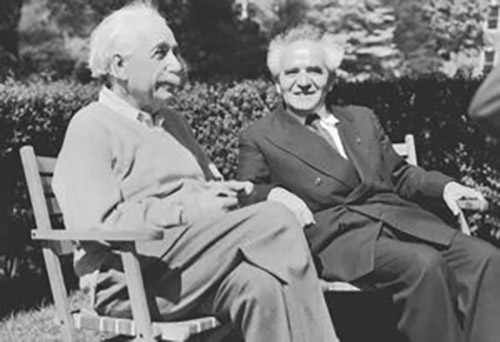
On November 17, 1952, a letter went out from the Israeli embassy in Washington to a house on Mercer Street in Princeton, New Jersey. It carried an offer almost no one in history has ever received: would Albert Einstein agree to become the President of the State of Israel?
The offer was real and serious. Israel's first president, Chaim Weizmann (a chemist, a Zionist leader, and Einstein's friend of thirty years) had just died. Prime Minister David Ben-Gurion himself had signed off on approaching Einstein, and the message promised he could keep doing his science at Princeton if he said yes. The presidency of Israel is a ceremonial role, a head of state who stands above day-to-day politics, exactly the kind of figure a young country might want the world's most admired Jew to be. For a country only four years after independence, offering the office to Einstein reflected the symbolic place he held within Jewish public life and in the wider world.
Einstein said no. He wrote back the next day, on November 18, and his answer was honest rather than modest. "I am deeply moved by the offer from our State of Israel," he wrote, "and at once saddened and ashamed that I cannot accept it." Then he explained why, plainly: "All my life I have dealt with objective matters, hence I lack both the natural aptitude and the experience to deal properly with people." A president has to handle people. He would not pretend otherwise, not even for Israel.
Here is why the letter matters more than any equation on this page. An offer like that does not get made to a scientist for being smart. It gets made because, by 1952, Einstein was the Jewish people's most recognizable face to the rest of the world, the refugee who got out, the voice that spoke when others were silenced, the man who had stood by the Zionist project for thirty years. The presidency offer is the proof of what he had become. And his refusal (clear-eyed about his own limits, with no false humility) is one of the most revealing lines he ever wrote. The job went instead to Yitzhak Ben-Zvi, who held it until 1963. Einstein stayed in Princeton and kept working until he died, three years later.
Ulm, Munich, and Switzerland · 1879–1900
A German Jewish boyhood.
Albert Einstein was born on March 14, 1879, in Ulm, a city in southern Germany. His family were secular Jews, Jewish by heritage and identity, but not religiously observant, and thoroughly at home in German language and culture. That was the ordinary pattern for the Jewish middle class of Germany at the time: comfortable, educated, assimilated, and certain that Germany was home. His father Hermann and uncle Jakob ran an electrical engineering business, first in Munich, where the family moved when Albert was a baby.
School did not love him and he did not love it. Einstein clashed with the rigid, drill-and-obey style of the German Gymnasium (the academic high school), even as his gift for math and physics ran far ahead of his classmates. When the family business failed in 1894 and his parents moved to Italy, the fifteen-year-old was left behind in Munich to finish school. He didn't. He walked out without a diploma, followed his family to Italy, and in 1896 formally gave up his German citizenship, which left him, for the next five years, a citizen of no country at all.
He finished high school instead in Aarau, Switzerland, where the schools encouraged exactly the independent thinking Munich had tried to stamp out, and it suited him. In 1896 he entered the famous technical university in Zurich (the ETH) to study physics and math, graduating in 1900. He became a Swiss citizen in 1901. Statelessness would become a recurring fact of his life, by the end he had been, at various points, a citizen of Germany, no one, Switzerland, and finally the United States.
Bern · the miracle year
The miracle year.
Here is the part the physics class does cover, so we'll be quick, but it explains the fame that everything else depended on. After graduating, Einstein couldn't get a university job. He took work as a clerk in the Swiss patent office in Bern, evaluating other people's inventions. It was steady, it paid, and it left his evenings free. In his spare time, on his own, he rebuilt physics.
In a single stretch of 1905, his annus mirabilis (Latin for "miracle year"), the unknown patent clerk published four papers, any one of which would have made a career:
- One showed that light comes in discrete packets of energy, later called photons, a cornerstone of quantum physics, and the work that won him the Nobel Prize in 1921 (not, as people assume, relativity).
- One explained the jittering motion of tiny particles in a liquid, giving the first hard proof that atoms are physically real and not just a useful idea.
- One laid out the special theory of relativity, rebuilding the way physics understood space and time.
- A short follow-up contained the most famous equation in the world, E = mc², energy and mass are two forms of one quantity.
Ten years later, in 1915, he completed the general theory of relativity, a new account of gravity itself. When astronomers confirmed one of its strange predictions in 1919 (that starlight bends as it passes the sun), Einstein became almost overnight the most famous scientist alive. That worldwide fame is the point to hold onto. It is what later let a refugee speak and be heard, and what made a government think to offer him a presidency.
Becoming Jewish in public
Becoming Jewish in public.
Einstein grew up barely religious and stayed that way. But being Jewish, for him, was never only about religion, and the older he got, the more public it became. The turn came after the First World War, in the early 1920s, in Berlin.
Germany after the war was poor, bitter, and looking for someone to blame, and a wave of antisemitism rose with it. One target was the Ostjuden: Jews who had fled poverty and violence in Eastern Europe and arrived as refugees in Germany, poorer and more visibly traditional than the assimilated German Jews. Plenty of established German Jews kept their distance from them, anxious not to be associated. Einstein did the opposite: he defended the Ostjuden openly and started speaking about antisemitism as a problem to be named out loud, not managed quietly.
In 1921 he made his choice visible to the whole world. He sailed to America on a fundraising tour, his first trip there, beside Chaim Weizmann, the head of the World Zionist Organization, to raise money for a planned Hebrew University in Jerusalem. The most famous scientist on earth was now publicly, unmistakably tied to the Jewish national project. Over the next decade his essays worked out a Jewish identity that was entirely his own: Jewish in culture and belonging rather than religious law, proud of it, and unwilling to hide it.
Zionism, the complicated kind
Zionism, the complicated kind.
Einstein supported the building of a Jewish home in Palestine for thirty-five years, but his version of Zionism was particular, and worth getting right rather than flattening. (Zionism is the movement for Jewish national self-determination in the ancestral homeland; the Herzl Topic covers its founding.)
- He helped build the Hebrew University. Einstein was a founding governor of the Hebrew University of Jerusalem in 1925 and gave its first scientific lecture during a visit in 1923. He stayed involved for the rest of his life, and left the university his papers, which is why his archive sits in Jerusalem today.
- He saw it for himself in 1923. On a twelve-day visit to Palestine he toured Jerusalem, Tel Aviv, and the farming settlements, meeting the community building the country on the ground.
- He wanted it to be generous, not nationalist. Through the 1920s and 1930s he leaned toward thinkers like Martin Buber and Judah Magnes who hoped Jews and Arabs might share the land, and he was wary of any nationalism that turned chauvinist. He framed Zionism as a cultural and moral revival more than a flag-and-borders project.
- He backed Israel, with reservations. After 1945 he supported the founding of the State of Israel, while disagreeing openly with some of its early political leadership. He applied the same standard to violence on the Jewish side: in April 1948 he wrote to an American group raising money for the militant Lehi (the "Stern Gang"), refusing to help and warning against "the terrorist organizations built up from our own ranks." Later that year, in December 1948, he co-signed a letter to the New York Times, alongside the philosopher Hannah Arendt and others, criticizing a visiting Israeli politician, Menachem Begin, whose party they considered too extreme. Both letters were arguments within the Zionist family about how the project should be conducted, not opposition to a Jewish home, the same conscience he brought to the bomb and to American racism, turned on his own side.
1933 · refugee from Nazi Germany
A bounty on his head.
When Adolf Hitler took power on January 30, 1933, Einstein happened to be abroad, working in California. He never set foot in Germany again. He understood at once what the regime meant, and the regime understood exactly what he was: famous, Jewish, and loud.
Within weeks the Nazis seized his summer house outside Berlin, threw him out of the Prussian Academy of Sciences (he had already resigned), and put a bounty of roughly 5,000 reichsmarks on his head. His books were among those burned. A German magazine ran his photograph in a lineup of enemies of the regime with the caption "not yet hanged." For the most recognized scientist in the world, the message was unmistakable.
He turned the threat into a platform. From 1933 on, Einstein became one of the most prominent public critics of Nazism anywhere, and he used his name to save people. Working through refugee organizations, he signed affidavit after affidavit vouching for Jewish refugees trying to reach the United States, because an American immigration system with strict quotas would take a refugee more readily if a famous citizen swore to support them. He could not save everyone. He saved many he never met.
His own landing was soft compared to most refugees': in October 1933 he took a position at the brand-new Institute for Advanced Study in Princeton, New Jersey, and stayed for the rest of his life, twenty-two years.
Princeton · 1933–1955
Starting over in America.
Einstein became a U.S. citizen in 1940 and lived quietly at 112 Mercer Street in Princeton with his sister, his stepdaughter, and his longtime secretary, Helen Dukas. The science of these years was a long, unsuccessful hunt for a "unified field theory," a single framework meant to tie together all the forces of nature. He never found it, and most physicists think the tools of his day made it impossible. (One of his Princeton papers, though, the 1935 "EPR" paper, written to attack a weird feature of quantum theory, ended up launching the study of what's now called quantum entanglement, a field very much alive today.)
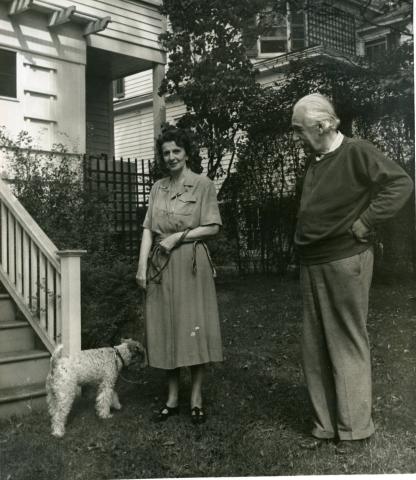
But the more important Princeton story isn't the physics, it's what he did with his standing as a free man in a free country while the world burned. He kept signing refugee affidavits. And he turned, with real force, to a problem inside his new home: American racism. Einstein joined the NAACP, spoke out against segregation and lynching, and in 1946 accepted an honorary degree from Lincoln University, a historically Black college in Pennsylvania, where he gave a blunt commencement speech calling American racism "a disease of white people." He befriended the singer and activist Paul Robeson and the scholar W.E.B. Du Bois at a time when doing so openly carried real cost.
The 1939 letter to Roosevelt
The letter and the bomb.
In the summer of 1939, with war about to break out, a group of physicists realized something frightening: recent discoveries about splitting the uranium atom meant a bomb of unimaginable power might be possible, and Nazi Germany had the scientists to try building one first. They needed to warn the U.S. government, and they needed someone the President would actually read.
The letter was written mostly by the physicist Leo Szilard. But Szilard wanted Einstein's signature, because Einstein's name would open any door. Einstein signed it on August 2, 1939. The letter told President Franklin Roosevelt that a nuclear chain reaction looked possible, that it could produce extraordinarily powerful bombs, that Germany might be pursuing this, and that the United States should pay attention. It helped push the government toward what became the Manhattan Project, the program that built the atomic bomb.
The irony ran deep, and Einstein felt it. He never worked on the bomb itself (the U.S. Army refused him security clearance because of his pacifist politics) and he learned of the project's progress only secondhand. After the bombs fell on Hiroshima and Nagasaki, he called signing that letter "the one great mistake in my life." Historians note that the American bomb program would very likely have gone ahead without his letter at all. But Einstein spent the rest of his life trying to put the danger back in the box.
The last ten years · 1945–1955
Using his fame.
For his final decade, Einstein did with his fame what he had done since 1933, spent it on causes, not on comfort:
- Against the bomb. He became a leading public voice for putting nuclear weapons under international control, chairing a committee of atomic scientists devoted to the cause. Days before his death in 1955 he signed the Russell–Einstein Manifesto, written with the philosopher Bertrand Russell, warning that nuclear weapons now threatened the survival of the human race. It led to an ongoing scientists' movement that later won a Nobel Peace Prize.
- For civil rights. He kept up his open support for the American civil rights movement (petitions, defense funds, public statements) through years when many prominent people stayed carefully quiet.
- Against the witch hunts. During the McCarthy era of the early 1950s, when Americans were being hauled before Congress and pressured to name supposed communists, Einstein publicly urged witnesses to refuse to cooperate. The FBI kept a file on him that ran to thousands of pages.
- For refugees, still. He went on helping survivors of the Holocaust find places to resettle, signing affidavits to the end.
The presidency offer · 1952
The offer he turned down.
The Object Spotlight above tells this story in full, but it belongs in the life as well, because it is the moment everything else had been building toward. When Israel's first president died in 1952, the country offered the job to Einstein, and meant it. Prime Minister Ben-Gurion signed off; the message said he could keep his science.
Einstein declined, with the honesty that ran through his whole life: he was a man of equations, not of people, and a head of state has to be a man of people. He stayed in Princeton. But the offer stands as the clearest possible measure of what a secular patent clerk from Ulm had become, by the end, the most recognizable Jew in the world, and the one a new Jewish state wanted as its face.
The honest accounting
The honest accounting.
A serious page does not hand you a saint. Several parts of Einstein's record are genuinely debated, and they belong here:
- His family life. Einstein's published letters show a personal life with real failings, strain and coldness in his first marriage to Mileva Marić, a daughter born before that marriage whose fate is unknown, and conduct toward people close to him that by today's standards reads harshly. The brilliant public figure and the difficult private man are the same person.
- Did Mileva Marić help with the 1905 work? Marić was a physicist and Einstein's fellow student, and some writers argue she contributed to the famous papers. Most historians conclude she was an important intellectual companion during those years but that the ideas in the papers were Einstein's. The question is still argued at the edges.
- The 1939 letter. How much blame or credit Einstein deserves for the atomic bomb is debated. He regretted it; scholars think the bomb would have been built without him. Both are true.
- His Zionism. Because his views were specific and shifting (for a Jewish homeland, wary of nationalism, hopeful about sharing the land) people across the political spectrum quote the parts they like. The honest move is to read the whole record rather than the convenient slice. (One common distortion, that he turned down the presidency to protest the state's fighters, splices his real 1948 letters onto the 1952 decision; we take it apart on the Misconceptions page.)
Key takeaways
- Albert Einstein (1879–1955) was the most famous scientist of the twentieth century, but his place in Jewish history rests on his life as a refugee, an activist, and a public Jewish figure, not on his physics alone.
- His worldwide fame came from the 1905 "miracle year" and the 1919 confirmation of general relativity; that fame is what later let a refugee be heard.
- Driven out of Nazi Germany in 1933 with a bounty on his head, he used his name to help other Jewish refugees escape and became a leading public critic of the regime.
- He supported a Jewish homeland for thirty-five years in his own particular way (cultural rather than nationalist, hopeful about Jewish-Arab coexistence) and in 1952 was offered, and declined, the presidency of Israel.
- In America he fought for nuclear disarmament and civil rights, regretted his role in prompting the atomic bomb, and left a record honest enough to include real personal failings.
Sites that survive
Where the record stands.
- Jerusalem, the Albert Einstein Archives, Hebrew University. The home of Einstein's papers, correspondence, and personal effects, left to the university in his will. albert-einstein.huji.ac.il →
- Princeton, New Jersey, the Institute for Advanced Study. Einstein's academic home from 1933 until his death. ias.edu →
- Princeton, 112 Mercer Street. Einstein's house from 1935 until his death, now privately held and not open to the public, but a landmark of the town.
- Ulm, Germany. A memorial marks his birthplace; the house he was born in was destroyed in a 1944 wartime bombing.
For the classroom
Where this Topic fits the standards.
- World History, NY Global History 10.5 and 10.10 (the twentieth century). Einstein’s 1933 flight from Nazi Germany, the 1939 letter to Roosevelt, and his postwar work on nuclear disarmament and civil rights sit within the era’s record, material for the upper grades. At grade 6, the Topic enters through biography, science, innovation, and civic responsibility; the later history of Nazism, exile, and the atomic-bomb letter is carried in the upper-grade work.
- Common Core RH.6–8, RH.9–10 & RH.11–12. Students assess an author’s purpose and point of view (RH.6–8.6, RH.9–10.6, RH.11–12.6) and corroborate evidence across sources (RH.6–8.9, RH.9–10.9, RH.11–12.9), working from Einstein’s own letters and public statements, the Russell–Einstein Manifesto, and modern scholarship.
- C3 Framework, D2.His.1 and D2.His.14 (grades 6–8 and 9–12). Students investigate chronology, historical context, continuity and change, and the evaluation of evidence.
- Classroom Applications. Students can:
- (grades 6–8) explore Einstein’s life, scientific discoveries, and public voice as a model of curiosity and civic responsibility;
- analyze his letters and public statements as primary sources;
- (upper grades) examine his 1933 flight, the Roosevelt letter, and his postwar advocacy in historical context;
- weigh the responsibilities of scientists and public figures;
- construct evidence-based historical arguments.
- International Classroom Relevance. Because Einstein was a global scientific and public figure, this Topic supports world history, the history of science, and the study of refugees, human rights, and public intellectuals internationally.
Questions for the classroom
Each question is keyed to a standard cited above. They are written as open inquiry, there is no single expected answer.
- Israel offered Einstein its presidency because of what his name meant, not because of his physics. How does a person come to stand for something larger than what they actually do? (C3 D2.His.5)
- Einstein used his fame to vouch for refugees the immigration system would otherwise have turned away. What does that tell you about how fame can function as a kind of power? (C3 D2.His.1)
- Einstein called signing the 1939 letter "the one great mistake in my life," yet historians think the bomb would have been built without him. How should we weigh a person's own regret against what actually caused an outcome? (C3 D2.His.14)
- This page includes Einstein's failings alongside his contributions. Why might a history that admits the hard parts be more trustworthy than one that doesn't? (C3 D2.His.11)
Sources and citations
Primary sources come straight from the time: documents, letters, speeches, images, and objects created by the people involved. Secondary sources come later: books, articles, and analysis in which scholars study and interpret those primary sources.
Primary sources
- Einstein, Albert. The Collected Papers of Albert Einstein. Edited by John Stachel et al. Princeton: Princeton University Press, 1987– . (The scholarly edition.)
- Einstein, Albert. Ideas and Opinions. New York: Crown, 1954.
- Einstein, Albert. The World As I See It. New York: Covici-Friede, 1934.
- Einstein, Albert. About Zionism: Speeches and Letters. Edited by Leon Simon. London: Soncino Press, 1930.
- Jerome, Fred, ed. Einstein on Israel and Zionism. New York: St. Martin's Press, 2009.
- Rowe, David E., and Robert Schulmann, eds. Einstein on Politics. Princeton: Princeton University Press, 2007.
- Einstein to Shepard Rifkin, April 10, 1948 (refusing to support fundraising for Lehi). Typed letter signed, authenticated and sold at Sotheby's, Important Books and Manuscripts, lot 244.
- Russell, Bertrand, Albert Einstein, et al. The Russell–Einstein Manifesto. July 9, 1955.
- The Albert Einstein Archives, Hebrew University of Jerusalem. albert-einstein.huji.ac.il →
- The Einstein Papers Project. einsteinpapers.press.princeton.edu →
- Photograph of Einstein with Helen Dukas and his dog Chico: Michael Amrine Papers (GTM-760826), Booth Family Center for Special Collections, Georgetown University Library. library.georgetown.edu →
Secondary sources
- Isaacson, Walter. Einstein: His Life and Universe. New York: Simon & Schuster, 2007.
- Pais, Abraham. "Subtle Is the Lord": The Science and the Life of Albert Einstein. Oxford: Oxford University Press, 1982.
- Fölsing, Albrecht. Albert Einstein: A Biography. Translated by Ewald Osers. New York: Viking, 1997.
- Jerome, Fred, and Rodger Taylor. Einstein on Race and Racism. New Brunswick: Rutgers University Press, 2005.
- "Offering the Presidency of Israel to Albert Einstein." Jewish Virtual Library (citing the Albert Einstein Archives, Hebrew University; the Israel State Archives; and The Einstein Scrapbook, Johns Hopkins University Press, 2002). jewishvirtuallibrary.org →
- The Institute for Advanced Study, Princeton. ias.edu →
Finding these documents: many primary sources are free online. Good places to start are the Fordham Internet Jewish History Sourcebook, Yale’s Avalon Project (law and diplomacy), German History in Documents, the collections of the US Holocaust Memorial Museum and Yad Vashem, the National Library of Israel, and Sefaria (for Jewish texts). Search the document’s name and date.
The final Unit turns to memory and responsibility, how the Holocaust is remembered, judged, and guarded against.
Comments?
Write to editor@makorproject.org.
Last updated: August 2026.