The same century that handed out Nobel Prizes to a long line of Jewish scientists also stripped many of them of their jobs, their citizenship, and in some cases their lives. The achievement and the persecution were not separated by an ocean or a generation. They happened in the same countries, to the same people, often in the same decade. That is the strange double fact this page is about.
Why this Topic exists
The work, not just the worker.
The five Topics that follow this one each go deep on a single figure: Rashi, Maimonides, Joseph Karo, Theodor Herzl, and Albert Einstein. That is one way to tell the story of a people's contribution: through the figures big enough to carry a page on their own.
This page does the opposite. Instead of one life at a time, it looks across whole fields (science and medicine, scholarship, the arts, music, law, and computing) and asks a plainer question: what did the work add up to, and how does that compare to the size of the community that produced it? The figures on the other pages are the peaks. This page is about the range of the mountain.
A warning that doubles as the method: lists of "great people from group X" are easy to inflate and easy to misuse. This one is built the other way: fewer claims, each tied to a name, a date, and a record you can check. Where a number is used, it is a careful number. Where a field is rich, the page picks two or three concrete examples rather than reaching for a total that cannot be sourced. The reader is trusted to do the adding up.
Object Spotlight
A medal that is also a list.
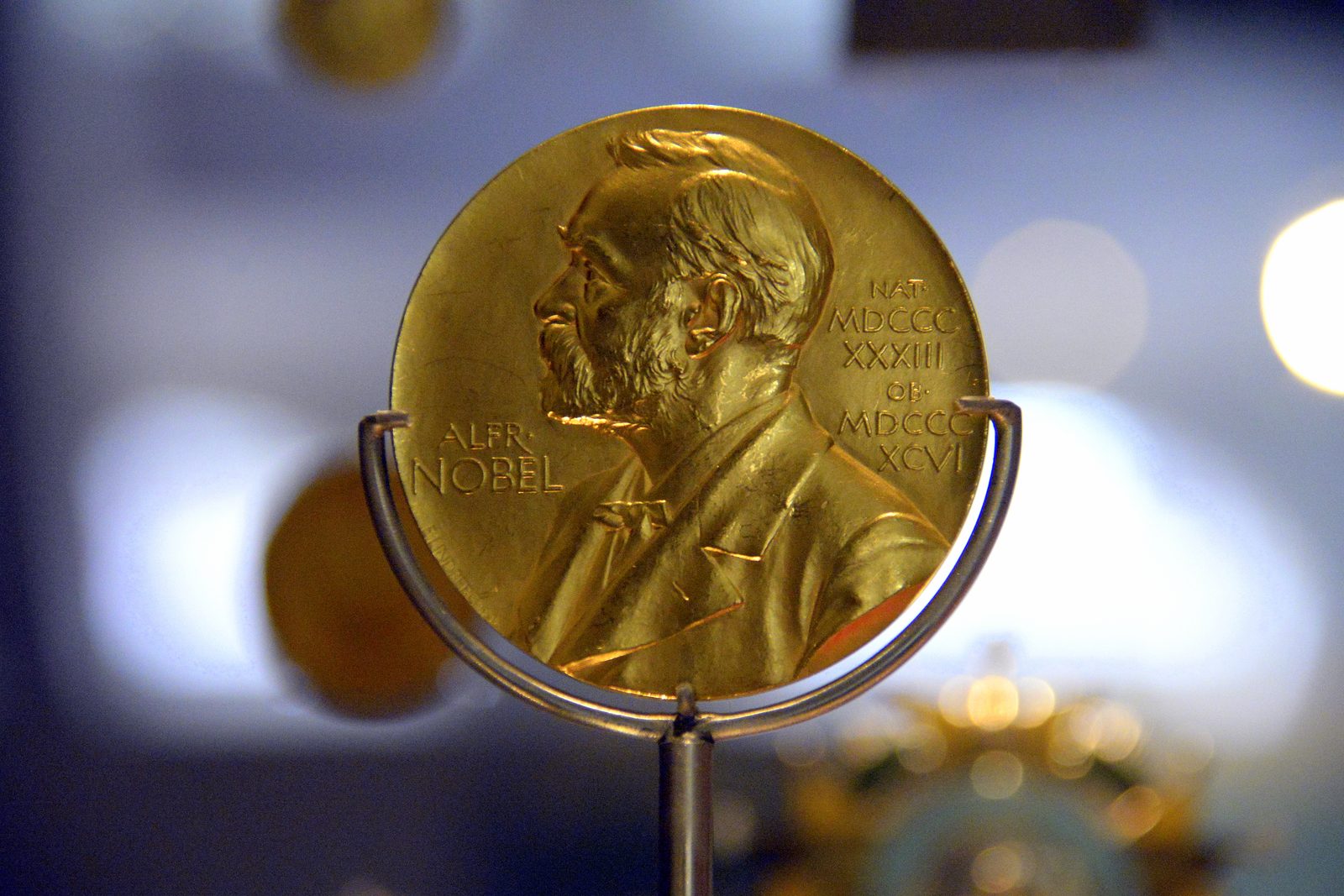
Picture a gold disc about the width of a coaster, heavy in the hand. On one side, the bearded profile of a man looking left; on the other, two robed figures and a line of Latin. This is a Nobel Prize medal, struck by the Royal Swedish Academy of Sciences and first awarded in 1901, under the will of the Swedish chemist and inventor Alfred Nobel, the man who invented dynamite and, troubled by what it was used for, left his fortune to reward those who had "conferred the greatest benefit to humankind."
Each medal is given to one person for one piece of work: a discovery in physics, a breakthrough in medicine, a body of literature. So a single medal is not a statement about any group. But the Nobel committees have kept careful, public records since 1901, and those records can be counted. When they are counted, the same names recur far more often than the size of the Jewish population would lead you to expect. How much more often depends on how "Jewish" is defined (by religion, by ancestry, by self-identification), and serious sources give a range rather than a single figure. The page comes back to the size of that population in a moment; for now, the medal is the object, and the pattern in the records is the point to hold.
The detail worth holding is on the back of the medal: a veiled woman, Nature, stands holding a cornucopia while a second figure, the Genius of Science, gently lifts her veil. The Latin around the rim reads, in translation, that those who improve life through the arts and sciences make it worth living. The image says something simple, that the point of knowledge is to better human life. That is the thread this whole page follows, and the medal, multiplied across more than a century of winners, is the closest there is to a single object that holds the argument. The conclusion it points to is left, deliberately, to the reader.
The number behind the page
A question of scale.
Today, the world's Jewish population is estimated at roughly 15 to 16 million people, about 0.2 percent of humanity. That figure is not, by itself, a measure of historical importance, but it is an essential part of historical context. Historians measure the influence of civilizations in many ways: through ideas, institutions, discoveries, literature, law, science, and works that continue to shape later societies. This Topic places the documented historical record alongside the size of the population from which it emerged. The examples that follow are representative case studies rather than a complete catalogue, allowing readers to evaluate that historical record for themselves.
That number was also, within living memory, much reduced. On the eve of the Second World War there were about 16.5 million Jews in the world; the Holocaust killed roughly a third of them. The population today has still not returned to its pre-war size. So the community whose work this page surveys is not only small. It is a community that was, in the twentieth century, nearly halved.
Field one
Science and medicine.
The Einstein page covers the most famous case. But he was one of many. A few concrete examples, each checkable:
In medicine, Jonas Salk (born New York, 1914) developed the first effective polio vaccine, announced in 1955; he declined to patent it, reportedly asking whether one could patent the sun. Gertrude Elion (born New York, 1918), who never earned a doctorate, designed drugs that made organ transplants and leukemia treatment possible and shared the 1988 Nobel Prize in Medicine. Rita Levi-Montalcini (born Turin, Italy, 1909) did her early research in a makeshift home laboratory after Mussolini's 1938 racial laws barred her, as a Jew, from the university. She lived to 103 and won the 1986 Nobel Prize for discovering nerve growth factor.
In physics and chemistry, the names run through the century. Niels Bohr (Copenhagen, 1885; his mother was Jewish) built the early model of the atom and later helped smuggle scientists out of occupied Denmark. Lise Meitner (Vienna, 1878) explained nuclear fission and refused to work on the bomb.
Here is one way to feel the scale. Some of the words a student uses for medicine were put into the language by people on this list. Selman Waksman (born near Kyiv, in present-day Ukraine, 1888) discovered streptomycin, the first drug effective against tuberculosis, and coined the word antibiotic. Paul Ehrlich (born in Strehlen, then Germany, 1854) founded chemotherapy and gave it its name, developing the first effective treatment for syphilis. Casimir Funk (born Warsaw, 1884) coined the word vitamine and the idea that some diseases are caused by what a diet lacks. A student who says antibiotic, chemo, or vitamin is using words a handful of these people set down.
The founding discoveries run the same way. Karl Landsteiner (born Vienna, 1868) discovered the ABO blood groups, which made safe blood transfusion possible, though Landsteiner himself, as the honest-accounting section below explains, is a complicated case. Baruch Blumberg (born New York, 1925) identified the hepatitis B virus and developed its vaccine, the first vaccine shown to prevent a human cancer. The pattern is not that every great scientist was Jewish; most were not. It is that the same names keep surfacing in the founding work of modern science and medicine, often attached to people who were being driven out of their own countries while they did it.
Field two
Scholarship and ideas.
This field runs deepest, because it is the oldest. Long before there were Nobel Prizes, the Jewish tradition was built around close reading, argument, and the preservation of text, the world of Rashi and Maimonides on the earlier pages. That habit of mind carried into the modern university.
A few examples a student can picture: Sigmund Freud (born Freiberg, Moravia, in what is now the Czech Republic, 1856), whose ideas about the unconscious mind reshaped how the twentieth century talked about itself, whether or not later science upheld them. Hannah Arendt (born near Hanover, Germany, 1906), the political thinker who fled the Nazis and later wrote about how ordinary people take part in great crimes. She has her own Topic in Unit 6. Emmy Noether (born Erlangen, Germany, 1882), a mathematician whose theorem became one of the foundations of modern physics, and who was barred from a paid professorship first for being a woman and then, in 1933, for being Jewish.
There is a sharper way to see it. Several of the modern fields that study how human beings live were founded, or refounded, by Jewish scholars. Émile Durkheim (born in Épinal, France, 1858, the son of a rabbi) was one of the founders of sociology. Franz Boas (born Minden, Germany, 1858) founded American anthropology and spent his career using it to take apart the "race science" that Unit 3 describes, a Jewish scholar assembling, in the same decades, the evidence that refuted the racial theories then being aimed at his own people. Claude Lévi-Strauss (born Brussels, 1908) and Noam Chomsky (born Philadelphia, 1928) did the same for structural anthropology and for modern linguistics.
The through-line is not that Jews invented modern thought. It is that a people raised for centuries on textual argument, and then forced repeatedly across borders, turned up in disproportionate numbers wherever ideas were being tested, and that the same century which honored some of them also tried to expel or kill them.
Field three
The arts.
In painting, Marc Chagall (born Vitebsk, in present-day Belarus, 1887) carried the look of the Eastern European Jewish village (fiddlers, floating brides, wooden synagogues) into the center of modern art, and lived long enough to flee France for the United States in 1941 and return after the war. Camille Pissarro (born on the Caribbean island of St. Thomas, 1830), one of the founders of Impressionism, was the only painter to show in all eight Impressionist exhibitions in Paris.
The Russian-born Mark Rothko (born in Dvinsk, in present-day Latvia, 1903) helped invent color-field painting; he also appears on the Makor museum page. Amedeo Modigliani (born Livorno, Italy, 1884) came from an Italian Sephardic family that opened its home to him with the words of the Jewish tradition.
In film, the American movie industry was built in large part by Jewish immigrants and their children, a story told in full on the Films page, and worth naming here too. The founders of the studios that became Warner Bros. (the Warner brothers: Harry, Albert, Sam, and Jack, sons of Polish Jewish immigrants), Paramount (Adolph Zukor, a Hungarian Jewish immigrant), Universal (Carl Laemmle, German Jewish), and MGM (Louis B. Mayer and Samuel Goldwyn) arrived with little and built the century's dominant art form. The standard history is Neal Gabler's An Empire of Their Own: How the Jews Invented Hollywood (1988). In literature, the list is long enough that picking is unfair, but it includes Nobel laureates writing in many languages: Hebrew, Yiddish, English, German, and more.
Field four
Music.
Music is where the contribution is loudest and hardest to count, because so much of it is woven into popular culture that the names have come loose from their origins. A few anchors: Felix Mendelssohn (born Hamburg, Germany, 1809), the composer of music still played at weddings worldwide, came from a famous Jewish family. His grandfather was the philosopher Moses Mendelssohn, though he was baptized as a child. Leonard Bernstein (born Lawrence, Massachusetts, 1918), the conductor and composer of West Side Story, was the son of Ukrainian Jewish immigrants and spoke openly about his heritage.
The American popular songbook is a case of its own. Many of the songs that became the United States' unofficial standards were written by the children of Jewish immigrants. Irving Berlin (born in the Russian Empire, 1888) wrote "White Christmas" and "God Bless America." George Gershwin (born Brooklyn, 1898), the son of Russian Jewish immigrants, wrote Rhapsody in Blue and Porgy and Bess. Aaron Copland (born Brooklyn, 1900), often called the dean of American composers, wrote the music, Appalachian Spring, Fanfare for the Common Man, that many Americans hear as the sound of the country itself. A people that had been outsiders in Europe helped write the songs America sang to itself.
One life holds the whole page in miniature. Arnold Schoenberg (born Vienna, 1874), who reshaped twentieth-century music by inventing twelve-tone composition, had been baptized a Lutheran as a young man. In 1933, as the Nazis took power, he formally returned to Judaism, choosing the identity he was about to be persecuted for, at the moment it became most dangerous to hold. He fled to the United States and never went back.
Field five
Law and human rights.
The strongest version of this page's argument is in law, and it is almost unbearable in its directness. Raphaël Lemkin (born in 1900 in what is now Belarus) lost most of his family in the Holocaust. In 1944 he coined a word for the crime that had no name: genocide. He then spent the rest of his life pushing the United Nations to outlaw it, and in 1948 it did. René Cassin (born Bayonne, France, 1887) was the principal drafter of the Universal Declaration of Human Rights, adopted in 1948, three years after the camps were opened. The people the century had tried to exterminate wrote the laws the next century would use to forbid extermination.
In the United States, three Jewish justices sat on the Supreme Court across the long arc of the same story. Louis Brandeis (born Louisville, Kentucky, 1856) was the first Jewish justice, confirmed in 1916 over open antisemitic opposition. Benjamin Cardozo (born New York, 1870) came from the same colonial Sephardic community that opens the American Jewry page. Ruth Bader Ginsburg (born Brooklyn, 1933) built much of American gender-equality law as an advocate before she ever joined the Court.
Field six
Computing and high tech.
This is the field where lists are easiest to inflate, so this page stays close to the foundations, where the record is clearest. John von Neumann (born Budapest, 1903) designed the basic architecture (a stored program, run step by step) that nearly every computer in the world still uses; the design carries his name. He was one of a remarkable group of Hungarian Jewish scientists who fled to the United States in the 1930s.
The modern industry has the same thread running through its origins. Andy Grove (born Budapest, 1936) survived the Nazi occupation of Hungary as a child, fled the country after 1956, arrived in America barely speaking English, and became the engineer who built Intel, the company whose chips made the personal computer possible. His life is the page's persecution-and-achievement thread compressed into one résumé: a hunted child in 1944, the maker of the machine on a student's desk by the 1990s.
Two shorter fields
Chess, and sport.
Two fields where the pattern is striking and easy to check. In chess, a strikingly high share of the world champions and grandmasters of the twentieth century came from Jewish families across Europe, the Soviet Union, and the Americas, a fact often noted in the game's own histories. The page keeps this general rather than turning it into a roster, for the reason the honest-accounting section gives.
In sport, the presence is smaller but real, and well documented in the resources below, Olympic champions, baseball figures like Hank Greenberg and Sandy Koufax, both of whom famously sat out games on the holiest day of the Jewish year and, in doing so, taught a wide American public what that day meant.
The honest accounting
How to read a list like this.
Three cautions, because this is the kind of page that can be misread.
First, "Jewish" is not a single category here. Some of the people on this page were religious; many were secular; some were baptized or had only one Jewish parent; some wanted nothing to do with the label and were assigned it anyway, often by people who meant them harm. The page counts descent and identification broadly, which is why honest sources give ranges, not single figures. The hard cases are the honest ones. Karl Landsteiner, who discovered blood groups, converted to Catholicism and late in life reportedly tried to keep his Jewish ancestry quiet. The composer Gustav Mahler was baptized in 1897 in order to be allowed to run the Vienna Opera. Ludwig Wittgenstein had three Jewish grandparents and a lifelong, unsettled relationship to the fact. Set against them is Arnold Schoenberg, in the music section, who did the opposite and returned to Judaism exactly when it became dangerous. A list that pretended these were all the same kind of "Jewish" would be the inflated kind this page is built to avoid.
Second, no field belongs to any people. For every name here, the great majority of scientists, artists, and thinkers were not Jewish. The point of the page is a comparison: a small population set beside a large body of work, not a claim of ownership over any discipline. One absence is deliberate. This page leaves out "business" and "finance" as a field, not because Jews have not built companies, but because "Jewish money" is itself one of the oldest antisemitic lies, the one Unit 3 traces from the medieval moneylender myth through the Protocols. A page that turned that smear into a brag would betray its own method. The omission is the method working, and it is the kind of gap a careful reader should always ask about.
Third, the achievement and the persecution share a century. Many of the people on this page did their work as refugees, or after being expelled from a university, or in the shadow of the events Units 3 and 4 describe. Noether, Levi-Montalcini, Einstein, Chagall, Meitner, Schoenberg, Grove, Lemkin: the same decades that produced the work also tried to destroy the people who made it. That is not a footnote to the contribution. It is the condition under which much of it was made.
What the reader does with all this is the reader's own. The page lays the record down and stops there.
For the classroom
Where this Topic fits the standards.
- World History, NY Global History. As a synthesis, this Topic spans world history (the place of belief systems, ideas, and minority communities across civilizations (9.2) through the modern era) and the broader question of how a small population shaped fields far beyond its size.
- Common Core RH.9–10 & RH.11–12. Students assess purpose and point of view (RH.9–10.6, RH.11–12.6) and corroborate evidence across sources (RH.9–10.9, RH.11–12.9), working from biographies, primary documents, demographic data, and historical scholarship.
- C3 Framework, D2.His.1 and D2.His.14 (grades 9–12). Students investigate chronology, historical context, continuity and change, and the evaluation of evidence.
- Classroom Applications. Students can:
- evaluate how historians measure a civilization’s influence;
- weigh cultural and intellectual contribution against population size;
- distinguish representative case studies from a complete catalogue;
- test claims of cumulative influence against documented evidence;
- construct evidence-based historical arguments.
- International Classroom Relevance. Because it concerns the measurement of cultural and intellectual influence, this Topic supports world history, comparative civilizations, and source-based inquiry internationally.
For further classroom use
- Notable Jewish Americans (lesson plan). The Anti-Defamation League's Celebrating Jewish American Heritage: Lessons to Reflect and Connect includes a ready-to-teach lesson that has students research an accomplished Jewish American of their choice, with handouts and a student-facing activity built in.
- Six figures across fields (video + guide). The Jewish American Heritage Month educator hub, run by the Weitzman National Museum of American Jewish History, hosts classroom-ready lesson plans, including "Stories That Shaped a Nation," a video and educator's guide on six influential Jewish American figures across law, business, media, and sport. The hub's lessons can be filtered by grade and subject, and take in popular song and Broadway as well.
- Profiles to research (reading). The American Jewish Committee's Amazing Jewish Americans gathers short profiles of figures across law, literature, music, and civil rights, from Ruth Bader Ginsburg and Irving Berlin to Emma Lazarus and Rabbi Abraham Joshua Heschel. A good source for a research-a-figure assignment.
A lesson built specifically around Jewish contribution to music is still being sourced; the hub above is the closest fit in the meantime.
Key takeaways
- The world's Jewish population is roughly 15–16 million people, about 0.2 percent of humanity, and still smaller than it was before the Holocaust.
- Across science and medicine, scholarship, the arts, music, law, and computing, the same names recur far more often than the population’s size would predict, a pattern visible in records as concrete as the Nobel Prize lists kept since 1901.
- The page argues from named, dated, checkable examples rather than from unverifiable totals, and treats "Jewish" as a broad and contested category.
- No field belongs to any one people; for every name here, most practitioners were not Jewish. The page describes a ratio, not ownership.
- Much of this work was done by people who were, in the same years, being expelled, barred, or hunted. The achievement and the persecution belong to the same century.
- The page leaves "business" out on purpose: "Jewish money" is itself an old antisemitic lie, and a list that fed it would betray the page's own method. What a list leaves out, and why, is part of reading it honestly.
Questions for the classroom
Use these to turn the page into discussion or a short writing assignment. Each maps to a C3 Framework inquiry standard.
- The page gives the size of the world’s Jewish population once, then mostly lets it sit in the background. Why does a body of work look different when you know how small the group that produced it is? What would change if the group were much larger? (C3 D2.His.1)
- Many of the people on this page did their most important work after being forced to leave their home countries. How might persecution and migration affect what a community produces, and what it loses? (C3 D2.His.5)
- The "honest accounting" section warns that lists like this can be misused. Who might want to inflate such a list, and who might want to deny it? How does naming sources protect against both? (C3 D2.His.11)
- The page counts "Jewish" broadly, by religion, ancestry, and self-identification, and notes that sources give ranges, not single numbers. Why is a range sometimes more honest than a single figure? (C3 D2.His.10)
Sources and citations
Primary sources come straight from the time: documents, letters, speeches, images, and objects created by the people involved. Secondary sources come later: books, articles, and analysis in which scholars study and interpret those primary sources.
Primary sources
- The Nobel Foundation. Official prize records and laureate database, 1901–present. nobelprize.org. The primary record for prize counts.
- Law and human rights. Raphael Lemkin, Axis Rule in Occupied Europe (Washington: Carnegie Endowment, 1944), and the United Nations Convention on the Prevention and Punishment of the Crime of Genocide (1948). For René Cassin, the Nobel Peace Prize 1968 records and the United Nations history of the Universal Declaration of Human Rights (1948).
- Computing. John von Neumann, "First Draft of a Report on the EDVAC" (1945); for Andy Grove, his memoir Swimming Across (New York: Warner Books, 2001) and the Intel corporate history.
- Sport. The Weitzman National Museum of American Jewish History and the National Baseball Hall of Fame records for Hank Greenberg and Sandy Koufax.
Secondary sources
- Sergio DellaPergola, "World Jewish Population," annual study in the American Jewish Year Book (Springer). The standard scholarly source for global Jewish population figures.
- Pew Research Center. Religion and demography studies, used as a cross-check on population share.
- Science and medicine. Nobel Prize laureate biographies for Salk, Elion, Levi-Montalcini, Waksman, Ehrlich, and Blumberg; Science History Institute collections for Ehrlich and Funk.
- Scholarship. On Franz Boas and the refutation of scientific racism, Charles King, Gods of the Upper Air (New York: Doubleday, 2019), and the American Anthropological Association's "Understanding Race" project.
- The arts. Neal Gabler, An Empire of Their Own: How the Jews Invented Hollywood (New York: Crown, 1988). The standard history of the studio founders. For Rothko and Modigliani, the holding-museum catalog records (Rothko also appears on the museum page).
- Music. Library of Congress music collections and standard composer biographies for Gershwin, Berlin, and Copland; on Schoenberg's 1933 return to Judaism, the Arnold Schönberg Center, Vienna.
- Individual birth dates and identifications confirmed against holding institutions and standard reference works also listed on the site Sources page, including the Albert Einstein Archives and the National Library of Israel.
Finding these documents: many primary sources are free online. Good places to start are the Fordham Internet Jewish History Sourcebook, Yale’s Avalon Project (law and diplomacy), German History in Documents, the collections of the US Holocaust Memorial Museum and Yad Vashem, the National Library of Israel, and Sefaria (for Jewish texts). Search the document’s name and date.
The figures that follow were selected because each illustrates a different form of documented historical influence. Together they show how Jewish civilization has shaped religious life, law, philosophy, political thought, and modern science across many centuries without attempting to tell the whole story.
The survey above maps the breadth of Jewish contribution across whole fields. The five Topics that follow go deep on individuals, beginning with Rashi of Troyes, the eleventh-century commentator whose explanations became the first guide generations of Jewish students encountered.
Comments?
Write to editor@makorproject.org.
Last updated: August 2026.