In September 1654 a French ship called the Sainte Catherine sailed into the harbor of New Amsterdam, the small Dutch port that would become New York, and put ashore twenty-three Jews with almost nothing to their names. The governor wanted to turn them away. They stayed. Nearly three centuries later, by the time the United States entered the Second World War, the American Jewish community was already older than almost any other in the country.
The 1654 arrival at New Amsterdam, the founding moment of organized Jewish life in what became the United States. American Jewish Historical Society.
Why this Topic exists
The simplest way to see American Jewish history is as a story you already teach.
American history classes already teach immigration. They teach who came, when, why they left home, where they landed, what work they found, and which laws opened or shut the door behind them. American Jewish history fits inside that frame without changing a single one of its rules. It is one community arriving in distinct waves, each from a different corner of the Jewish world, each leaving for different reasons, each reshaping the community that came before it.
Three features make it worth teaching as its own thread. It is a clean case study in how immigration actually works, because the same community arrives five separate times under five separate sets of conditions, so the causes and effects stand out clearly. It connects directly to topics the curriculum already covers: colonial settlement, the great migration of 1880 to 1924, the quota laws that ended it, the refugee crises of the 1930s and 1940s, and the human-rights movements of the Cold War. And it shows a single principle being tested over and over: whether a country built on religious liberty would actually extend it to a small and visible minority.
What this Topic covers
Five waves, in order.
The history of Jews in America runs the entire length of European settlement in the Americas, and it arrives in five recognizable waves. Each section below takes one wave: who came, why they left, where they settled, and how the story connects to the rest of the curriculum. Read in sequence, they add up to a single account of how one community became part of American life.
A note on a recurring word. A Sephardic Jew traces ancestry to the Jewish communities of Spain and Portugal, expelled in 1492; an Ashkenazi Jew traces ancestry to the Jewish communities of Central and Eastern Europe. The two groups spoke different languages, followed slightly different customs, and arrived in America at different times, which is exactly why the waves look so distinct.
The Sephardic beginning · 1654
Twenty-three refugees and a governor who wanted them gone.
The first organized Jewish community in what became the United States arrived in 1654. Twenty-three Jews, refugees from Dutch Brazil, themselves descendants of Jews expelled from Spain and Portugal more than a century and a half earlier, reached New Amsterdam, the Dutch trading port on the southern tip of Manhattan that the English would later rename New York. They had fled Recife, in Brazil, when the Portuguese recaptured it and brought the Inquisition with them. New Amsterdam was where their ship ended up.
The local governor, Peter Stuyvesant, asked the Dutch West India Company for permission to expel them. The Company refused, partly because Jewish investors held shares in it, partly because the colony needed settlers. The newcomers were allowed to stay, on the condition that they care for their own poor and not become a burden. From that grudging permission grew Congregation Shearith Israel, the oldest Jewish congregation in North America, founded in 1654 and still active in New York today.
This first wave was small, and it stayed small for a long time. By the time of the American Revolution, perhaps two thousand Jews lived in the thirteen colonies, in a handful of port towns: New York, Newport, Philadelphia, Charleston, Savannah. Their story matters out of proportion to their numbers, because it ties the American narrative directly to the Iberian expulsions of the fifteenth century and to the global Sephardic dispersion. It also produced one of the most quoted documents in American religious history: in 1790, President George Washington wrote to the Hebrew Congregation of Newport, Rhode Island, assuring them that the new government would give "to bigotry no sanction, to persecution no assistance." Although the letter is not a legal document, historians have long regarded it as one of the clearest early statements that religious liberty in the United States belonged to minority communities as a matter of right rather than mere tolerance. The line is famous because it set down, early and in plain words, the promise this Topic keeps testing.
Object Spotlight
Myer Myers's Torah finials, New York, 18th century.
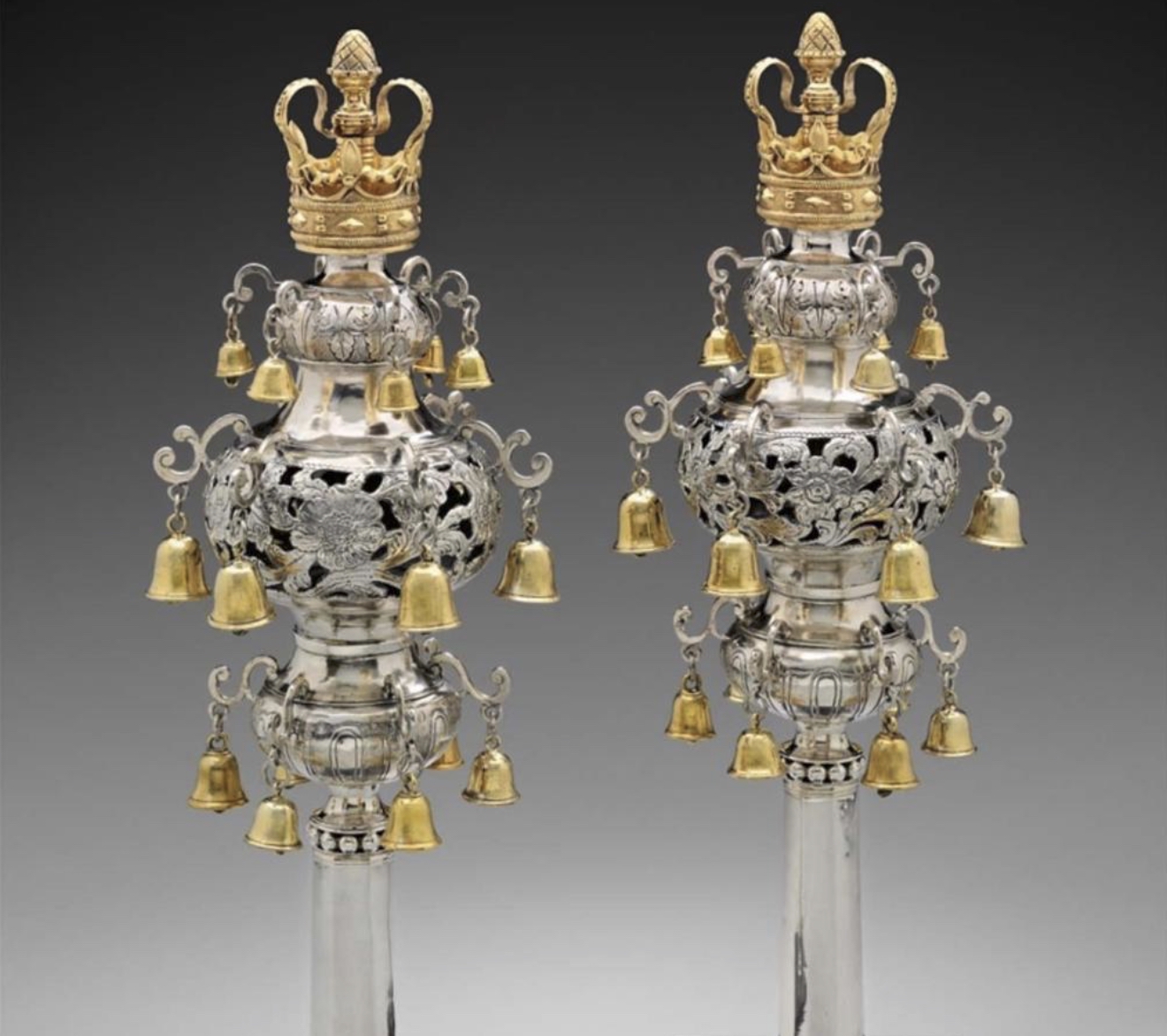
Start with what these actually are. A Torah scroll, the handwritten parchment scroll of the first five books of the Hebrew tradition, is wound on two wooden rollers. When the scroll is dressed and not in use, a pair of ornaments is slipped over the tops of those rollers. In Hebrew they are called rimonim, "pomegranates," because the older ones were shaped like the fruit; many, like these, are hung with tiny silver bells that ring when the scroll is carried. They are among the few objects in a synagogue made purely to honor the scroll, and a community that could afford fine ones commissioned them from the best silversmith it could find.
In eighteenth-century New York, that silversmith was Myer Myers. He was born in New York in 1723, the son of Dutch Jewish immigrants, and he became one of the most accomplished silversmiths in the colonies, skilled enough that his Christian neighbors hired him too, and prominent enough in his own community to serve as a leader of New York's Congregation Shearith Israel. Most colonial Judaica was made by Christian craftsmen, in Europe, Jews were barred from the silversmiths' guilds, so almost no Jewish artisans existed to make it. Myers broke that pattern. Historians regard him as the first formally trained Jewish silversmith in the British Empire, a Jewish craftsman, working in colonial America, making ceremonial objects for his own community.
Here is why a pair of silver ornaments belongs in a history of immigration. This pair was made for the Newport synagogue, the building completed in 1763 that still stands as the oldest synagogue in the United States, and they belong to Congregation Shearith Israel, the New York congregation that traces back to that first 1654 arrival. The Museum of Fine Arts in Boston, where the finials have been displayed, notes that they were most likely in the Newport synagogue on the day in 1790 when George Washington visited, the same visit that produced his letter promising "to bigotry no sanction." Today the New York congregation still uses them on the High Holidays. The objects are physical proof of how early this community took root. By the seventeen-sixties, American Jews were not merely surviving on a governor's grudging permission. They were building synagogues, commissioning art, and employing one of the finest silversmiths in the colonies to make it. The finials are small, but they carry the whole point of the Sephardic beginning: a community that arrived with almost nothing was, within a few generations, established enough to make beautiful objects, and to keep them in use for two and a half centuries.
Object record and image: Museum of Fine Arts, Boston. The standard study of Myers is David L. Barquist, Myer Myers: Jewish Silversmith in Colonial New York (Yale University Press, 2001).
The German wave · 19th century
Peddlers, merchants, and a new kind of synagogue.
In the middle decades of the nineteenth century a larger wave arrived: Central European Jews, most of them German-speaking, leaving the German states and the Austrian Empire as those societies industrialized and as legal restrictions on Jewish life loosened just enough to make leaving possible. Many started as peddlers, walking the back roads of a fast-growing country with packs of goods, then opening stores in the towns that grew up around them. They spread far beyond the East Coast, into the South, the Midwest, and the mining towns of the West, settling where earlier immigrant Jews had never reached.
This wave brought an idea as much as a population. Reform Judaism: a movement, begun in the German states, to adapt traditional Jewish practice to modern life, took root in America and grew into a major branch of American Jewish religious life. Some families from this wave became prominent in American commerce, banking, and civic life. By the time the next and largest wave arrived, the German Jewish community was established, prosperous, and in some ways anxious about the very different newcomers who were about to land.
The Eastern European wave · 1880–1924
The wave that built the picture most people carry.
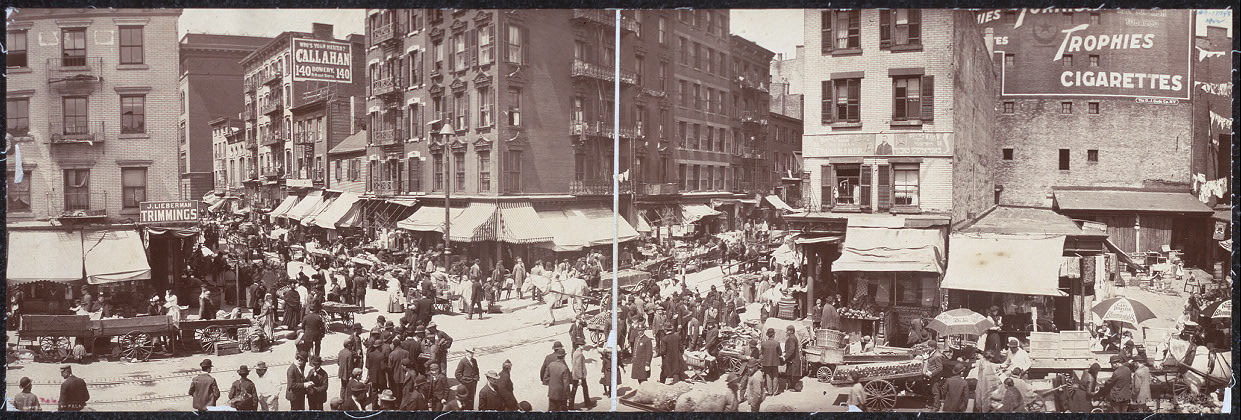
The largest wave came between roughly 1880 and 1924, when more than two million Jews left the Russian Empire and Eastern Europe for the United States. They were fleeing grinding poverty and organized anti-Jewish violence: the pogroms, mob attacks on Jewish towns and neighborhoods, often with the authorities standing aside or joining in. This was Ashkenazi immigration, Yiddish-speaking, and on a scale the earlier waves could not have imagined. It is the wave that produced the image most Americans picture when they think of Jewish immigration at all: the crowded tenements of New York's Lower East Side, the pushcart markets, the garment shops.
They concentrated in the cities, above all New York, and entered the needle trades (the garment industry) in enormous numbers. Out of those shops came a vigorous Yiddish-language press and theater and a major Jewish presence in the American labor movement, including in the unions that organized garment workers after disasters like the 1911 Triangle Shirtwaist Factory fire. You can still walk through this history. The Lower East Side Tenement Museum in New York has rebuilt the actual apartments of real immigrant families from this wave, including Jewish families from the Russian Empire, using census records, ship manifests, and oral histories to document who lived in each room.
The doors close · 1924
The law that ended the wave, and what it cost later.
The great migration did not taper off on its own. It was stopped by law. A series of federal immigration acts in the early nineteen-twenties, culminating in the Immigration Act of 1924, set strict national-origin quotas designed to sharply cut immigration from Southern and Eastern Europe. For Eastern European Jews, the door that had been open for forty years was, in effect, shut.
The timing is the reason this belongs in any serious immigration unit. The quotas were written in 1924. They were still in force in the 1930s and early 1940s, when Jews trying to escape Nazi Germany and Nazi-occupied Europe sought entry to the United States, and found the legal door narrowed to a crack. The connection between an immigration law passed in one decade and a refugee crisis in the next is one of the clearest cause-and-effect chains in twentieth-century American history, and the Jewish wave is where it shows most plainly. That refugee story is taken up in Unit 4, The Holocaust Era.
The same decade carried something else across the ocean. The 1920s in America saw a revived Ku Klux Klan and a hardening suspicion of immigrants. In the autumn of 1928, in the small town of Massena in upstate New York, that climate produced the one recorded case of blood libel in American history, the medieval accusation that Jews murder Christian children for ritual blood. When a four-year-old girl went missing, rumor blamed the town's Jews, and the mayor and a state trooper summoned the local rabbi for questioning before the child was found unharmed in the woods the next day. Historian Edward Berenson, who grew up in Massena, has shown why the accusation took root there: so many of the town's residents, Christian and Jewish alike, had recently arrived from the same regions of Eastern Europe where the libel was old and familiar. The Old-World accusation traveled with the wave. The full history of the blood libel is told in Unit 3, The Blood Libel.
Refuge, survival, and Soviet Jewry
The last two arrivals.
The Nazi era brought a wave of refugees, those who managed to enter despite the quotas, including a remarkable concentration of scientists, scholars, writers, and artists who reshaped American intellectual and cultural life. After 1945, survivors of the Holocaust resettled in the United States, the second of these later arrivals.
The final wave was different in kind: it was a rescue that American Jews led rather than a migration that simply arrived. In the second half of the twentieth century, American Jews built a sustained civil-rights campaign on behalf of Soviet Jews, who were forbidden by the Soviet government to practice their religion freely or to emigrate. The movement pressed for the simple right to leave, and it worked, contributing to the large emigration of Soviet Jews from the 1970s through the 1990s. That story has its own Topic in this Unit: Soviet Jewry. Together, these last arrivals closed a circle. A community that had begun in 1654 as twenty-three refugees turned away at the dock had become, by the end of the twentieth century, a community organized enough to open the door for others.
The civil-rights generation
Praying with their legs.
The same decades that brought refugees and rescue also pulled American Jews into the defining domestic struggle of the century. By the 1960s the children and grandchildren of the immigrant waves were established Americans, and a striking number of them joined the civil-rights movement: as marchers, organizers, lawyers, and freedom riders, in numbers far out of proportion to how small a share of the population they were. For many, the reasoning was direct: a people that had been the target of exclusion and violence understood what it meant to be denied equal standing, and felt obligated to stand with others who were.
The friendship between Rabbi Abraham Joshua Heschel and the Reverend Dr. Martin Luther King, Jr. became the emblem of that partnership. Heschel, a philosopher who had escaped Nazi Europe weeks before the invasion of Poland and lost much of his family in the Holocaust, marched in the front row beside King on the Selma-to-Montgomery voting-rights march in March 1965. Afterward he wrote that "I felt my legs were praying," a line that fused his activism to his faith. King, in turn, called Heschel a great moral voice, and in March 1968 spoke at a gathering in Heschel's honor, ten days before King was assassinated. Their bond is one of the most documented examples of the Black–Jewish alliance of the civil-rights era, and it belongs in this story because it shows what the immigrant community had become: secure enough, and conscious enough of its own history, to take risks for someone else's equality.
The alliance was real, and it was also imperfect and contested; it frayed in later decades over disagreements that historians still study. The point here is not that the relationship was simple, but that Jewish participation in the civil-rights movement ran deep and shaped how a generation of American Jews understood their place in the country.
Key takeaways
- Organized Jewish life in America began in 1654, when twenty-three Sephardic refugees landed at New Amsterdam, older than the United States itself.
- The community arrived in five distinct waves: Sephardic (1654), German (19th century), Eastern European (1880–1924), Nazi-era and postwar refugees, and the Soviet Jewry emigration.
- The Immigration Act of 1924 ended the largest wave by law, and that same law narrowed the door for refugees fleeing Nazi Europe a decade later.
- The whole arc maps onto immigration and religious-liberty topics the U.S. History curriculum already teaches, told through one community.
Discussion questions
Working from the evidence.
Grounded in the sourced record above. Each asks students to read the sources rather than restate a conclusion.
- In 1654 the Dutch West India Company overruled Governor Stuyvesant and let twenty-three Jewish refugees stay, partly on principle, partly because the colony needed settlers and Jewish investors held shares in the Company. How should we weigh principle against self-interest when judging why a group was admitted?
- The Myer Myers finials show a community commissioning fine ceremonial art within a few generations of arriving with almost nothing. What can an object tell a historian that a written record cannot, and what can it not tell us?
- The Immigration Act of 1924 was written in one decade and was still law in the next, when refugees fled Nazi Europe. How does tracing a single law across two crises change the way we read each one?
- America's only recorded blood-libel case (Massena, 1928) took root because residents had recently arrived from regions where the accusation was common. What does it mean that a prejudice can travel with the people who feared it?
- Many descendants of the immigrant waves joined the civil-rights movement, citing their own history of exclusion. When does shared experience of injustice create solidarity between different groups, and when does it not?
Classroom Connections
Where this Topic fits.
Teaching Connections
The disciplines and courses this Topic naturally supports, for any educator, anywhere.
- United States History, Immigration: the five waves mapped onto the standard US immigration narrative: the Eastern European wave, the 1924 quotas, the garment trades, and the labor movement.
- United States History, Colonial Foundations & Religious Liberty: the 1654 Sephardic arrival and Washington’s 1790 Newport letter.
- United States History: the Civil-Rights Era: Jewish participation in the civil-rights movement (Heschel and King).
- Comparative Migration: read beside Soviet Jewry and The Departure from MENA: one community arriving and departing across very different political systems.
- Historical Thinking & Source Analysis: census records, ship manifests, congregational records, and oral histories.
- Art History & Museum Education: the Myer Myers Torah finials.
Standards Alignment
- NYS US History: 11.5 (immigration and industrial America, the Eastern European wave and the 1924 Act) and 11.9 (the Cold War, the Soviet Jewry movement).
- Common Core ELA-Literacy: RH.6–8.2 and RH.11–12.2 (determining central ideas across census records, manifests, congregational records, and oral histories).
Further Teaching Resources
- Institute for Curriculum Services, “Jewish Americans: Identity, History, Experience”, a standards-aligned overview fact sheet for classroom use.
Learn more · take this further
Verified resources from outside organizations for teachers and students. Where a dedicated classroom resource does not yet exist, The Makor Project is developing one.
Sources and citations
Primary sources come straight from the time: documents, letters, speeches, images, and objects created by the people involved. Secondary sources come later: books, articles, and analysis in which scholars study and interpret those primary sources.
Primary sources
- Bain News Service. "[Protest against child labor in a labor parade]," May 1, 1909. George Grantham Bain Collection, Library of Congress Prints & Photographs Division, LC-DIG-ppmsca-06591. loc.gov
- The Jewish Theological Seminary. "King and Heschel at the Rabbinical Assembly Conference," Heschel archive. heschel.jtsa.edu
- American Jewish Historical Society. Records of the 1654 New Amsterdam arrival and Congregation Shearith Israel. ajhs.org
- Immigration Act of 1924 (the Johnson–Reed Act), Pub. L. 68–139, 43 Stat. 153. (The national-origin quota legislation.)
- Washington, George. Letter to the Hebrew Congregation in Newport, Rhode Island, August 1790. The Papers of George Washington, University of Virginia.
- Petition of the Jewish merchants of Amsterdam to the Dutch West India Company on behalf of the Jews of New Amsterdam, January 1655. The document that won the right to remain.
- Lazarus, Emma. “The New Colossus.” 1883. The sonnet mounted on the pedestal of the Statue of Liberty in 1903.
Secondary sources
- Sarna, Jonathan D. American Judaism: A History. New Haven: Yale University Press, 2004. (The standard one-volume scholarly history of the American Jewish community.)
- Diner, Hasia R. The Jews of the United States, 1654–2000. Berkeley: University of California Press, 2004.
- Diner, Hasia R. A Time for Gathering: The Second Migration, 1820–1880. Baltimore: Johns Hopkins University Press, 1992. (On the German Jewish wave.)
- Barquist, David L. Myer Myers: Jewish Silversmith in Colonial New York. New Haven: Yale University Press, 2001. The finials\' object record: Museum of Fine Arts, Boston. collections.mfa.org
- Howe, Irving. World of Our Fathers: The Journey of the East European Jews to America and the Life They Found and Made. New York: Harcourt Brace Jovanovich, 1976.
- Berenson, Edward. The Accusation: Blood Libel in an American Town. New York: W. W. Norton, 2019. (On the 1928 Massena case.) See also NYU News, "The Story of America's First, and Only, Blood Libel," September 2019. nyu.edu
- United States Holocaust Memorial Museum. Americans and the Holocaust teaching materials and the lesson "American Responses to the Holocaust." ushmm.org
- United States Holocaust Memorial Museum. "Nazis in America" (German American Bund), Americans and the Holocaust online exhibition. exhibitions.ushmm.org
- Nazi Town, USA. PBS American Experience, 2024. pbs.org
- Zelizer, Julian E. Abraham Joshua Heschel: A Life of Radical Amazement. New Haven: Yale University Press, 2021. Discussed in Brandeis University, "The Jewish Experience." brandeis.edu
- "Abraham Joshua Heschel." PBS Religion & Ethics NewsWeekly (WNET), January 18, 2008. pbs.org
- Institute for Curriculum Services. "Jewish Americans: Identity, History, Experience" fact sheet. icsresources.org
- The National WWII Museum. "Jewish Americans in World War II." nationalww2museum.org
- Camp Confidential: America's Secret Nazis. Documentary, 2021 (subscription streaming). On the Jewish refugee soldiers of Fort Hunt, Virginia ("P.O. Box 1142").
- Lower East Side Tenement Museum. Documented immigrant family histories (Gumpertz, Levine, Rogarshevsky). tenement.org
Finding these documents: many primary sources are free online. Good places to start are the Fordham Internet Jewish History Sourcebook, Yale’s Avalon Project (law and diplomacy), German History in Documents, the collections of the US Holocaust Memorial Museum and Yad Vashem, the National Library of Israel, and Sefaria (for Jewish texts). Search the document’s name and date.
The Beta Israel, the Jews of Ethiopia, their tradition, their recognition under Jewish law, and the Israeli airlifts of 1984–1991, including Operation Solomon, the largest airlift in history.
Comments?
Write to editor@makorproject.org.
Last updated: August 2026.