Soviet Jewry: From Revolution Through Exodus
In the Soviet Union, three million Jews were forbidden to leave, and punished for trying.
Why this Topic exists
The biggest Jewish migration of the century after 1948.
Between 1968 and the mid-1990s, about 1.5 million Jews walked out of the Soviet Union and the countries that replaced it. Most went to three places: roughly 900,000 to Israel, between 325,000 and 400,000 to the United States, and between 150,000 and 220,000 to Germany, with smaller groups reaching Canada, Australia, and beyond. It was the largest single movement of Jews in the second half of the twentieth century, and it redrew the map of where Jews live.
School courses cover the Soviet bloc and the Cold War as a clash of systems: capitalism against communism, NATO against the Warsaw Pact. They rarely stop to look at what life was actually like for the peoples inside that system. The Jewish story there is one of the sharpest examples: a community that watched its religion, its schools, and its language taken apart piece by piece; that lived through a wave of Stalinist persecution so severe it has its own name; that was reawakened by a war in 1967; that produced one of the most famous human-rights movements of the age; and that finally left in numbers no one had predicted. This Topic tells that story in the order it happened.
Common misconceptions this Topic addresses
Soviet antisemitism (the anti-"cosmopolitan" campaign of 1948–1953, the 1953 Doctors' Plot, the UN's 1975 "Zionism is racism" resolution, and the long persecution of the refuseniks) is a reminder that hostility to Jews was never only a Western or Christian story. It ran just as hard through an officially atheist state in the East. The full entries are on the Misconceptions page.
The Pale, before 1917
The largest Jewish community on earth.
On the eve of the 1917 Revolution, the Russian Empire held about 5.5 million Jews, more than any other country in the world. Most of them were packed into the Pale of Settlement, the strip of western territory where imperial law allowed Jews to live, and almost nowhere else. Life in the Pale was so cramped and so dangerous that it had already driven the great wave of emigration from 1881 to 1924: the boats to New York, Buenos Aires, London, and Palestine that you can follow in the American Jewry Topic. The Jews still in Russia in 1917 were the ones who, for whatever reason, had stayed.
Theirs was a dense, organized world. It had religious schools (the heder for young children, the yeshivot for advanced study) and trade guilds, merchant networks, a lively Yiddish press and Yiddish theater, and political movements of every stripe: the socialist Bund, the various Zionist groups, the religious parties. Most people's daily language was Yiddish. Hebrew belonged to prayer and study; Russian was the language you used to deal with the wider empire. It was a civilization in miniature, and within a few decades the Soviet state would set about taking it apart.
Revolution and civil war
Freed on paper, then caught in the bloodshed.
The February Revolution of 1917 freed Russia's Jews overnight, at least on paper. The Provisional Government formally abolished the Pale's restrictions on where Jews could live, work, study, and vote on April 2, 1917. When the Bolsheviks seized power that November, they kept that legal equality in place even as they remade everything else about the country.
Then the civil war came, and with it some of the worst anti-Jewish violence between the old pogroms and the Holocaust. From 1918 to 1922, Jewish communities were attacked by Ukrainian nationalist forces (most infamously those of Symon Petliura), by anti-Bolshevik White armies, by Polish troops during the 1919–1921 Polish-Soviet War, and by freelance bands roaming the countryside. Somewhere between 100,000 and 200,000 Jews were killed, and far more were driven from their homes.
The early Soviet years pulled Jewish life in two directions at once. The new regime outlawed antisemitism by decree in 1918 and pulled Jews into the upper ranks of Soviet politics, the military, science, and the arts. The same regime methodically dismantled Jewish religious and communal life: it shut religious schools, persecuted rabbis and other religious officials, suppressed Hebrew as a "clerical" language, banned Zionist groups, and abolished the kehillot, the self-governing community councils Jews had run for centuries. The one corner of Jewish life the state allowed to survive (and even, for a while, encouraged) was secular Yiddish culture, channeled through a body called the Yevsektsia.
The Jewish Section
The Jewish bureau that dismantled Jewish life.
The Yevsektsia (short for Yevreyskaya sektsiya, "Jewish Section") was the Jewish bureau of the Communist Party, set up in October 1918. Its job was to carry Soviet policy into the Jewish population: to take apart the old religious and communal world and replace it with a Soviet, Yiddish-speaking, secular one. At its height it ran about 1,500 local cells across the country, and it was staffed by Jewish Communists who had themselves grown up inside the very communities they were now dismantling.
The work was blunt. The Yevsektsia closed synagogues and religious schools, put religious officials on trial for "counter-revolutionary" activity, and pushed Hebrew out of public life. In its place it built Soviet-Yiddish institutions: Yiddish schools, a Yiddish press, Yiddish literature, and Yiddish theater, including the Moscow State Jewish Theater, founded in 1919. The result was a strange transformation: a Jewish life that was still Jewish in language and culture but stripped of its religion and its old self-government.
The Yevsektsia did not outlast its usefulness for long. Stalin's consolidation of power swept it away in 1930. The Soviet-Yiddish culture it had built carried on through the 1930s under steadily heavier pressure, until it was nearly wiped out in the postwar years described below.
Birobidzhan
A "Jewish homeland" at the edge of Siberia.
In 1928 the Soviet government picked an unlikely spot for a Jewish homeland: Birobidzhan, a region in the Russian Far East about 7,000 kilometers east of Moscow, up near the Chinese border on the Amur River. It became the official Jewish Autonomous Oblast on May 7, 1934, part of a wider Soviet system of giving each major nationality its own territory. Yiddish was named an official language there alongside Russian.
The idea was openly pitched as a Soviet answer to Zionism, a way to give Jews a national territory inside the Soviet Union, secular and socialist and Yiddish-speaking, without the "bourgeois nationalism" the Soviets accused the movement for a Jewish state in Palestine of carrying.
Reality did not cooperate. Birobidzhan was swampy, mosquito-ridden, brutally cold in winter, and poor farmland. Jews never moved there in the numbers the planners hoped. At its peak in 1948 the region held about 30,000 Jews, roughly a quarter of the population. Stalin's purges of the late 1930s and the postwar Black Years hit the community there too. By the 1959 census it was down to about 14,000; by 1989, about 9,000; by 2010, about 1,600, less than one percent of the region. Birobidzhan still carries its Jewish Autonomous Oblast title today, but it is mostly a leftover on the map, with little Jewish life remaining.
War, soldiers, and the Black Book
The Holocaust on Soviet soil, and the first attempt to document it.
The Second World War brought the Holocaust onto Soviet territory, the mass shootings told in detail in the Einsatzgruppen Topic. About 5 million Jews lived in the Soviet Union when Germany invaded in June 1941. Across 1941 to 1944, the mobile killing units, the Order Police, the German army, and local collaborators murdered roughly 2.5 million of them. The Jews who survived were mostly those evacuated east ahead of the German advance, those who served in the Red Army (about 500,000 Soviet Jews served and about 200,000 died) and those whose homes lay beyond the reach of the German occupation.
The Soviet state's main Jewish wartime project was the Jewish Anti-Fascist Committee, the JAC, founded in Moscow on April 23, 1942. Its mission was to rally Jewish support abroad, above all American Jewish support, behind the Soviet war effort. Its chairman was Solomon Mikhoels (1890–1948), director of the Moscow State Jewish Theater and the leading figure of Soviet Yiddish stage life. Its members included the great Soviet Yiddish writers Itzik Fefer, David Bergelson, Peretz Markish, Leyb Kvitko, and David Hofshteyn.
The JAC raised money, published, and sent its people abroad: Mikhoels and Fefer spent seven months in 1943 touring the United States, Mexico, Canada, and Britain, speaking to about 50,000 people at the Polo Grounds in New York and bringing in roughly $16 million in war relief. The committee also tried to record what was being done to Jews on Soviet soil. Its great documentary project, The Black Book, edited by the writers Vasily Grossman and Ilya Ehrenburg, was one of the first attempts anywhere to document the Holocaust through the testimony of its victims. It was ready to print in 1946, and the Soviet authorities suppressed it. The manuscript survived in secret and was finally published in Russian in Jerusalem in 1980 and in English the next year.
The Black Years · 1948–1953
Stalin turns on the Jews.
The "Black Years" (HaShnot HaShchorot in Hebrew, chernyye gody in Russian) run from about 1948 to Stalin's death in March 1953. In those five years the Soviet state tore down the Jewish cultural world it had allowed to exist before and during the war. The campaign was dressed up as a fight against "cosmopolitanism" and "Zionist agents of imperialism," but its targets were Jewish.
The turning points:
- The murder of Solomon Mikhoels. January 13, 1948, in Minsk. Mikhoels was killed by the secret police and the scene staged to look like a traffic accident. Stalin ordered it personally, and Lavrenty Beria's apparatus carried it out. The point was to remove the public face of Soviet Jewish culture. Mikhoels got a state funeral; the truth about his death was admitted only after Stalin died.
- The shutdown of the Jewish Anti-Fascist Committee. November 20, 1948. The JAC was dissolved by Politburo decree, the cover story being that its wartime work was finished. Over the following year its members were arrested on charges of "espionage" and "bourgeois nationalism."
- The arrest of the Yiddish writers. 1948–49. About 110 leading Soviet Yiddish writers and cultural figures were rounded up. Their institutions were shut one after another: the Yiddish press, the Yiddish publishing house Der Emes (closed November 1948), the Moscow State Jewish Theater (closed November 16, 1949), the Yiddish schools.
- The Night of the Murdered Poets. August 12, 1952. After a secret trial, thirteen JAC members and Soviet Yiddish writers were shot at Lubyanka Prison in Moscow, among them Peretz Markish, Itzik Fefer, David Bergelson, David Hofshteyn, and Leyb Kvitko. The date is marked every year as the Night of the Murdered Poets (Di nakht fun di dermordete dikhter). The trial records stayed sealed for decades; the fullest account came only after 1991, in Joshua Rubenstein and Vladimir Naumov's Stalin's Secret Pogrom: The Postwar Inquisition of the Jewish Anti-Fascist Committee (Yale University Press, 2001).
- The Doctors' Plot. Announced January 13, 1953. Nine prominent Soviet doctors, six of them Jewish, were arrested and accused of scheming to murder Soviet leaders through deliberate mistreatment. Many historians believe the Doctors' Plot was meant to be the trigger for a mass arrest and deportation of Soviet Jews, like Stalin's earlier deportations of the Chechens, Crimean Tatars, and Volga Germans. Barracks to receive the deported were reportedly going up in Birobidzhan and Kazakhstan. The deportation never happened, because Stalin died on March 5, 1953, before it could begin. The accused doctors were freed on April 3, 1953, and the new leadership admitted the charges had been invented.
By the end of the Black Years, the secular Yiddish world the Soviets themselves had helped build over thirty years was gone: its press, theater, publishing, and schools closed; its writers killed, imprisoned, or silenced. The Soviet Jews who came through it now spoke Russian. Yiddish, as a living public language, did not survive.
After Stalin
A thaw for almost everyone but the Jews.
Stalin's successor, Nikita Khrushchev, eased much of the terror, releasing political prisoners and, at the 20th Party Congress on February 25, 1956, denouncing Stalin's crimes in the famous "Secret Speech." Soviet cultural and intellectual life loosened. For Jews, though, the thaw was thin.
What the post-Stalin years looked like for Soviet Jews:
- Religious and cultural life stayed boxed in. The state allowed a sliver of religious practice (about 100 synagogues operated nationwide, far below the prewar number) but it would not let the secular Yiddish world destroyed in the Black Years be rebuilt.
- The Doctors' Plot victims were cleared. The new leadership admitted the charges had been fabricated and rehabilitated the accused. The JAC members shot in 1952 were cleared after death in 1955–56, though the paperwork stayed quiet for years.
- The 1959 census. The first count since 1939 found about 2.27 million Soviet Jews, a steep drop from the roughly 5 million of the prewar territory, reflecting both the Holocaust and the emigration that had happened where it was allowed.
- The coded language continued. Official rhetoric kept reaching for words everyone understood ("cosmopolitan," "rootless," "Zionist") through the Khrushchev and Brezhnev years. Moscow's stance on Israel (relations cut in 1953, restored, then cut again after 1967) made Jewish identity look politically suspect.
- The economic-crimes trials. In a wave of trials for "economic crimes" in the early 1960s (currency dealing, "speculation") about 250 people were executed between 1961 and 1964, and roughly 60 percent of them were Jewish. Observers then and since read the pattern as antisemitism in practice.
The 1967 turning point
A war 2,000 miles away wakes a generation.
The Six-Day War between Israel and the Arab states, fought June 5–10, 1967, sent a shock through the Soviet Union. Moscow sided with the Arab states, cut relations with Israel on June 10, and launched a fierce campaign in the press, anti-Israel, anti-Zionist, and laced with old antisemitic themes.
It backfired inside the Jewish community. The very identity the Soviet state had spent fifty years trying to erase came roaring back. Scholars point to 1967 as the spark for what became the refusenik movement and a broad Jewish reawakening:
- Open declarations of Jewishness. Soviet Jews (including the assimilated, secular, city-dwelling, well-educated majority) began identifying publicly as Jews in ways the system had not allowed, often tied to Israel and to Zionism.
- Underground revival. Secret Hebrew study circles, secret religious teaching, and underground cultural activity spread from 1967 on, at real personal risk.
- Visa applications. Jews started applying to emigrate to Israel in large numbers. The state turned most of them down and punished the applicants: firing them, taking their housing, harassing them, often arresting them. Those refused permission to leave became known as otkazniki: refuseniks.
The refuseniks
The people the Soviet Union would not let leave.
The refusenik movement (the Soviet Jews denied exit visas, and the worldwide network that rallied to them) ran from about 1970 to 1991. Its key figures and moments:
- The Leningrad trials. June 15, 1970. A group of Jewish activists led by Eduard Kuznetsov and the pilot Mark Dymshits, and including Sylva Zalmanson and Yosef Mendelevich, tried to seize a small Soviet airliner near Leningrad and fly it to Sweden and on to Israel. They were caught before takeoff and put on trial. The first Leningrad trial that December handed Kuznetsov and Dymshits death sentences; an outcry around the world got those commuted to fifteen years in prison. The trials turned the refusenik cause into an international one and set the pattern for the decade to come.
- Anatoly (Natan) Sharansky. The most famous refusenik of all. Born Anatoly Borisovich Shcharansky in 1948 in Donetsk, he was a computer specialist and a strong chess player. Denied an exit visa in 1973, he joined the refusenik movement and worked alongside the physicist and dissident Andrei Sakharov. Arrested on March 15, 1977 and charged with espionage and treason, he was convicted in July 1978 and sentenced to thirteen years, much of it in solitary confinement at Chistopol Prison and the Perm-35 labor camp. On February 11, 1986, he was freed in an East-West prisoner exchange and walked across Glienicke Bridge between East and West Berlin. He went straight to Israel, took the Hebrew name Natan Sharansky, and went on to serve in the Knesset, as a government minister several times over, as deputy prime minister, and as chairman of the Jewish Agency for Israel from 2009 to 2018.
- Ida Nudel. Known as the "Guardian Angel" of the movement, a Soviet engineer who looked after refuseniks who had been jailed or exiled inside the country. She was arrested in 1978, exiled to Siberia, and finally allowed to leave for Israel in October 1987 after a long international campaign.
- The Prisoners of Zion. The name Israel and the wider movement gave to Soviet Jews jailed for activity tied to emigration, Jewish identity, or Zionism. About 50 people carried that designation across the Soviet period.
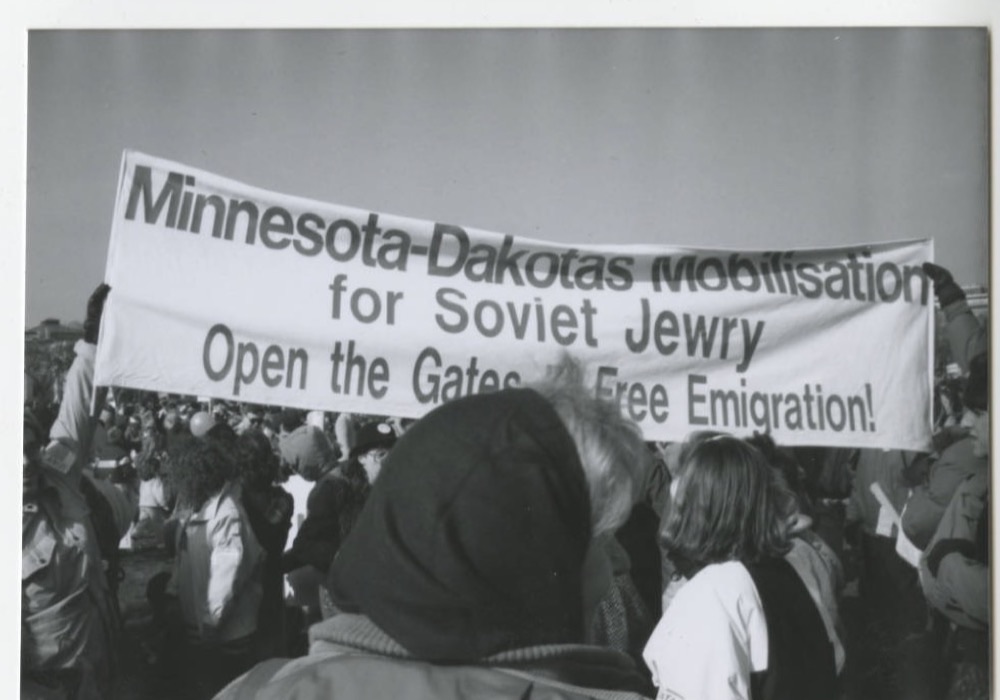
- The network abroad. American Jewish groups — the Student Struggle for Soviet Jewry (founded 1964), the Union of Councils for Soviet Jews, the National Conference on Soviet Jewry — ran a steady campaign from the 1960s through the 1980s. Their rallying cry, "Let My People Go," borrowed from the Passover story, became one of the defining American Jewish causes of the postwar era. Parallel networks worked in Britain, Canada, France, and Australia.
Jackson-Vanik · 1974
America ties trade to the right to leave.
The Jackson-Vanik Amendment to the Trade Act of 1974, written by Senator Henry "Scoop" Jackson of Washington and Representative Charles Vanik of Ohio, made a direct bargain: a communist country could only get normal U.S. trade terms and credit if it let its people emigrate freely. Any country that "denied or seriously restricted" the right to emigrate was locked out of those benefits.
Congress passed it as part of the Trade Act on December 13–20, 1974, and President Gerald Ford signed it into law on January 3, 1975. It landed in the middle of the Nixon administration's push for détente, warmer relations and big economic deals with Moscow, and it deliberately tangled that effort up with how the Soviet Union treated its own Jews, which caused real diplomatic friction.
Moscow's reaction was hostile. Soviet officials called the amendment an intrusion into their internal affairs and used it as a reason to cut Jewish emigration through the late 1970s and early 1980s, the numbers leaving for Israel and the United States fell from about 51,000 in 1979 to about 1,300 by 1986. Historians have argued ever since about whether Jackson-Vanik helped or hurt; the common verdict is that it cut emigration in the short run but increased it over the longer run, helping open the floodgates of the late 1980s and 1990s.
The amendment stayed formally in force against Russia until December 14, 2012, when Congress repealed it as part of granting permanent normal trade relations and replaced it with the Magnitsky Act, a human-rights measure. It still applies to some other former Soviet states. Its core idea, linking American trade policy to specific human-rights conditions, has shaped U.S. trade law ever since.
The first wave out
The door opens a crack: the 1970s.
The first real wave of emigration came in the 1970s: about 250,000 Soviet Jews left between 1968 and 1980. It worked through a narrow, specific channel: the Soviet authorities allowed emigration only to Israel, and only on the grounds of "family reunification." That meant an applicant had to produce a vyzov, an official invitation from a relative in Israel, which the Soviet bureaucracy then used to grant or deny an exit visa.
The wave peaked in 1979 at about 51,000 people. Early on, roughly 80 percent went to Israel. But a growing number, especially in the later 1970s, "dropped out" at the transit point in Vienna (the term was noshrim) and headed instead for the United States, Canada, or Australia. That sparked a heated debate inside the Jewish world: should Soviet Jews be helped to settle wherever they chose, or steered toward Israel? It was a live argument all through the period.
On the American side, two laws shaped how Soviet Jews were received: the Refugee Act of 1980, which set up the modern U.S. refugee system, and the Lautenberg Amendment of 1989 (named for Senator Frank Lautenberg of New Jersey), which made it far easier for Soviet Jews and certain other Soviet religious minorities to enter as refugees. The Lautenberg framework ran for the main Soviet Jewish population through about 2011 and continues for some groups today.
The great exodus
The dam breaks: 1989–1995.
Under Mikhail Gorbachev, the emigration walls came down. As part of the wider late-1980s liberalization, the restrictions collapsed across 1988–89, and the largest part of the whole century-long exodus followed: about 1.2 million people from 1989 through the mid-1990s.
How the great wave broke down:
- 1989–91. About 370,000 Soviet Jews left. Most, roughly 200,000, went to Israel, with large numbers also reaching the United States (about 90,000) and Germany (about 50,000).
- 1992–95, after the collapse. About 565,000 more. When the Soviet Union dissolved on December 26, 1991, the economic and political chaos across the new states pushed even more people out. Israel took in about 350,000; the United States about 130,000; Germany a large share of the rest, with smaller numbers to Canada and Australia.
- After 1995. Emigration kept on through about 2000 and then slowed. All told, the post-1989 outflow through 2000 came to roughly 1.6 million people.
The effect on the Jewish map was enormous. Israel's population grew by about 900,000 over the period, the biggest single addition since the founding years of 1948–51. The American Jewish community gained between 325,000 and 400,000 Russian-speaking Jews, reshaping major centers like Brooklyn's Brighton Beach and the wider New York area, and parts of Boston, Philadelphia, Chicago, and Los Angeles. And in Germany, where the Holocaust had all but ended Jewish life, the community was rebuilt almost from scratch by these arrivals: about 90 percent of Jews in Germany today are post-Soviet immigrants or their children. Smaller but real communities took root in Toronto, Montreal, Sydney, and Melbourne.
The world they built
The Russian-speaking Jewish world today.
The Russian-speaking Jewish diaspora, mostly the product of that post-1968 exodus, now numbers around 1.5 million people: roughly 900,000 in Israel, about 600,000 in the United States counting their children, about 200,000 in Germany, around 50,000 in Canada, about 25,000 in Australia, and smaller communities elsewhere.
These are living, growing communities, not a postscript:
- In Israel. About 1.3 million Israelis trace their roots to the Soviet Union and its successors, counting the children of immigrants, roughly 15 percent of the country's Jews. They have shaped Israeli politics (the Yisrael Beiteinu party under Avigdor Lieberman; many figures across the political spectrum), built a Russian-language press and broadcasting scene, and become woven into the country's economy and culture.
- In America. Brighton Beach in Brooklyn, "Little Odessa", is the heart of it, with large communities also in Manhattan (Washington Heights, the Upper West Side) and Queens (Forest Hills, Rego Park). The community runs its own institutions: the Council of Jewish Émigré Community Organizations (COJECO), a Russian-language Jewish press, and a network of schools, synagogues, and cultural groups.
- In Germany. With about 90 percent of German Jews now of post-Soviet background, these immigrants effectively rebuilt Jewish life in the country, reopening synagogues and reviving communities in Berlin, Munich, Frankfurt, and beyond. German Jewish life today is, in its everyday texture, heavily Russian-speaking, with the second generation switching to German.
- Still in the former USSR. Real communities remain: in Russia (around 150,000), in Ukraine (about 50,000 before the 2022 war drove further emigration), and in Belarus, Moldova, the Baltic states, Central Asia, and the Caucasus. Their life today includes a religious revival led by the Federation of Jewish Communities and the Chabad-Lubavitch network, local synagogues, schools, and steady ties to Israel and the wider Jewish world.
Contested elements
The honest accounting.
Serious scholars still argue over several questions here, and the platform lays them out plainly rather than pretending they are settled:
- Jews and the early Bolsheviks. Several prominent early Soviet leaders (Trotsky, Zinoviev, Kamenev, Sverdlov, Litvinov) were of Jewish origin, and historians have studied that fact from many angles. The broad consensus is that the Jews who joined the Bolsheviks did so as individuals breaking away from a community that the empire's restrictions had pushed toward radical and assimilationist alternatives, not as agents of Jewish interests. The Jewish community as a whole opposed Bolshevism, through its religious, Zionist, and Bundist movements. The antisemitic conspiracy theory of "Jewish Bolshevism" (fed by forgeries like the Protocols of the Elders of Zion, covered in the Protocols Topic) runs straight into the documentary record, in which the Bolshevik state set about dismantling Jewish life, as this Topic describes.
- Who did the killing on Soviet soil. The official Soviet line after the war was that only the German occupiers had murdered Soviet Jews. The scholarship that became possible after the 1991 archive opening documents the part played by local auxiliaries (Ukrainian, Latvian, Lithuanian, and Belarusian) in those killings. How to weigh that record against the enormous Soviet sacrifice in the war (about 27 million Soviet citizens died, including roughly 2.5 million Jews) is still argued over in each successor state.
- Would Stalin have deported the Jews? Historians debate whether Stalin truly intended to deport the whole Soviet Jewish population in 1953. The evidence pointing that way, the barracks reportedly under construction in Birobidzhan and Kazakhstan, the anti-Jewish press drive of early 1953, the precedent of his earlier deportations of whole nationalities, leads most scholars, including Joshua Rubenstein, to conclude the deportation was planned and stopped only by Stalin's death. Some argue for more limited intentions.
- The "dropout" controversy. When growing numbers of emigrants in the late 1970s chose destinations other than Israel, it set off a sharp argument in the Jewish world about whether to support that choice or discourage it. The view that won out in the 1980s was that emigrants should be helped to settle where they wished, but the debate ran hot for years.
Object Spotlight
The bridge that the Soviet Union used as a door.
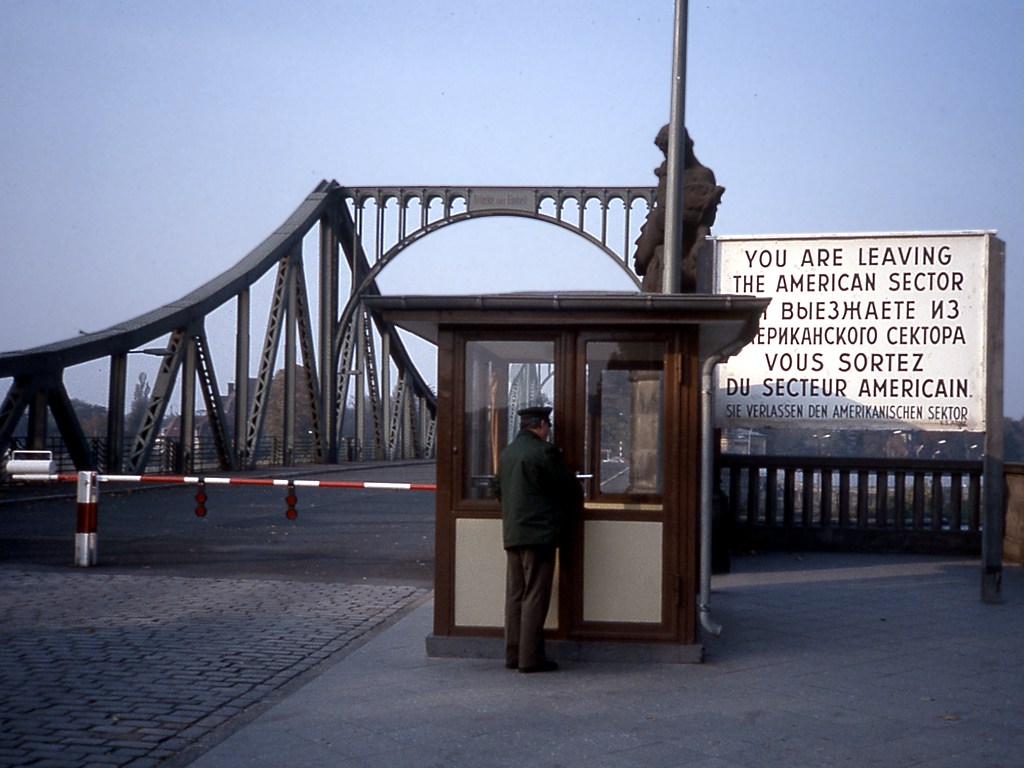
Look at the picture first. A small guard booth, a red-and-white striped barrier across an empty road, and a tall sign in four languages (English, Russian, French, German), all with the same message: you are leaving the American sector. Behind it, a graceful steel arch carries a road over gray water. Nothing is happening in the photo. A single guard stands at the booth. And that quiet is exactly what makes the place worth studying.
What it is: the western checkpoint of the Glienicke Bridge, a road bridge built in 1907 across the Havel river. After Germany was split at the end of the Second World War, the border between West Berlin’s American sector and Communist East Germany ran straight down the middle of this bridge, marked by a painted white line. From 1952 on, ordinary people could not cross. Only Allied soldiers and diplomats could use it at all, which is precisely why it became useful for something else.
Where and when: on the southwestern edge of West Berlin, Germany, at the height of the Cold War. Because the bridge was remote, sealed at both ends, and closed to the public, the two sides could meet here with no crowds and no cameras. Over the years they used it to trade captured agents, so often that Western journalists nicknamed it the “Bridge of Spies.” The bridge was, in effect, a door between two worlds that were otherwise locked shut.
Why it matters to this Topic: on February 11, 1986, the most famous refusenik in the world walked across this bridge to freedom. Anatoly Shcharansky had asked, in 1973, for permission to leave the Soviet Union for Israel. For that he spent nine years in Soviet prisons and labor camps, convicted of espionage on evidence no one outside the Soviet court believed. His release came as part of an East-West exchange, and the Soviet state, by trading a human-rights prisoner across a spies’ bridge, showed exactly how it had chosen to classify a man whose only crime was wanting to leave. Reaching the western end, he became Natan Sharansky.
One detail worth knowing: his KGB escorts ordered him to walk straight across. He zigzagged. It was a small, deliberate act of defiance from a man who had refused for nine years to be told where to step. Because his was a famous case rather than an anonymous swap, photographers were allowed near the bridge for the first time, and the images fixed this quiet checkpoint in the world’s memory.
The afterlife: the bridge that had stood sealed for decades reopened to ordinary traffic on November 10, 1989, the day after the Berlin Wall fell, when people from Potsdam streamed across on foot into West Berlin. Today it is an ordinary road bridge again, with a small museum at the Potsdam end; a metal strip in the roadway marks where the border once ran. Sharansky flew to Israel the day he crossed and went on to serve in the Knesset, as a government minister several times over, as deputy prime minister, and as chairman of the Jewish Agency for Israel from 2009 to 2018. The state that jailed him is gone; the bridge it used as a door still stands. He told his own story in Fear No Evil (1988), one of the primary sources this Topic rests on. The 1962 exchange on this same bridge is the subject of the Steven Spielberg film Bridge of Spies (2015).
Holding: the photograph is hosted on Wikimedia Commons (photographer David Stanley); materials on Sharansky and the refusenik movement are held by the Central Zionist Archives in Jerusalem and the National Library of Israel.
More of the photographic and documentary record of the refusenik movement and the Soviet Jewish exodus is gathered in the Museum, under Photographs.
For the classroom
Where this Topic supports instruction.
- World History: World War II and the Holocaust (NY: Global History 10.5) The Soviet Jewish side of the Holocaust, the mass shootings on Soviet soil (told in full in the Einsatzgruppen Topic), the Jewish Anti-Fascist Committee, the half-million Soviet Jews who served in the Red Army, belongs in the standard Holocaust unit.
- World History: the Cold War (NY: Global History 10.6) The Black Years, the Doctors' Plot, the 1967 turning point, the refusenik movement, and the Jackson-Vanik Amendment fit the standard Cold War unit, and offer a case study of how the Soviet state treated its national and religious minorities.
- US History: postwar immigration and civic life (NY: US History 11.10) The arrival of 325,000 to 400,000 Soviet Jews across the 1970s through the 1990s belongs in the standard postwar immigration story, alongside the movements covered in the American Jewry Topic.
- ELA / Literacy: primary-source analysis (NY: Common Core RH.11-12.6, RH.11-12.9) Sharansky's memoir Fear No Evil (1988), the Jackson-Vanik legislative record, and the post-1991 Soviet archival documents give upper-grade students rich, conflicting material to work with.
- For teachers: The main teaching resources are the Memorial Society (the Soviet-dissident history organization founded in 1988 and forcibly shut by the Russian government in 2021–22, its archives preserved abroad), the YIVO Institute for Jewish Research, and Yad Vashem's online materials. Sharansky's Fear No Evil and Yosef Mendelevich's Unbroken Spirit (Gefen, 2012) both work well as upper-grade primary-source readings.
Sources and citations
Primary sources come straight from the time: documents, letters, speeches, images, and objects created by the people involved. Secondary sources come later: books, articles, and analysis in which scholars study and interpret those primary sources.
Primary sources
- Rubenstein, Joshua, and Vladimir P. Naumov, eds. Stalin's Secret Pogrom: The Postwar Inquisition of the Jewish Anti-Fascist Committee. New Haven: Yale University Press, 2001.
- Grossman, Vasily, and Ilya Ehrenburg, eds. The Complete Black Book of Russian Jewry. Translated by David Patterson. New Brunswick: Transaction, 2002.
- Sharansky, Natan. Fear No Evil. New York: Random House, 1988.
- Mendelevich, Yosef. Unbroken Spirit: A Heroic Story of Faith, Courage, and Survival. Jerusalem: Gefen, 2012.
- Kuznetsov, Eduard. Prison Diaries. Translated by Howard Spier. New York: Stein and Day, 1975.
- The American Jewish Year Book: annual editions document the Soviet Jewish emigration year by year. ajc.org/ajyb →
- The Jackson-Vanik Amendment to the Trade Act of 1974, Public Law 93-618, Section 402, linking U.S. trade status to freedom of emigration.
Secondary sources
- Gitelman, Zvi. A Century of Ambivalence: The Jews of Russia and the Soviet Union, 1881 to the Present. 2nd ed. Bloomington: Indiana University Press, 2001.
- Gitelman, Zvi, ed. The New Jewish Diaspora: Russian-Speaking Immigrants in the United States, Israel, and Germany. New Brunswick: Rutgers University Press, 2016.
- Pinkus, Benjamin. The Jews of the Soviet Union: The History of a National Minority. Cambridge: Cambridge University Press, 1988.
- Ro'i, Yaacov. The Struggle for Soviet Jewish Emigration, 1948–1967. Cambridge: Cambridge University Press, 1991.
- Ro'i, Yaacov, ed. Jews and Jewish Life in Russia and the Soviet Union. London: Frank Cass, 1995.
- Beizer, Mikhail. The Jews of St. Petersburg: Excursions Through a Noble Past. Philadelphia: Jewish Publication Society, 1989.
- Levin, Nora. The Jews in the Soviet Union since 1917: Paradox of Survival. 2 vols. New York: New York University Press, 1988.
- Rubenstein, Joshua. Tangled Loyalties: The Life and Times of Ilya Ehrenburg. Tuscaloosa: University of Alabama Press, 1996.
- Brent, Jonathan, and Vladimir P. Naumov. Stalin's Last Crime: The Plot Against the Jewish Doctors, 1948–1953. New York: HarperCollins, 2003.
- Kostyrchenko, Gennady. Out of the Red Shadows: Anti-Semitism in Stalin's Russia. Amherst, NY: Prometheus Books, 1995.
- Sharansky, Natan. The Case for Democracy. New York: PublicAffairs, 2004.
- Beckerman, Gal. When They Come for Us, We'll Be Gone: The Epic Struggle to Save Soviet Jewry. Boston: Houghton Mifflin Harcourt, 2010.
- Lazin, Frederick A. The Struggle for Soviet Jewry in American Politics: Israel versus the American Jewish Establishment. Lanham: Lexington Books, 2005.
- Stern, Paula. Water's Edge: Domestic Politics and the Making of American Foreign Policy. Westport: Greenwood, 1979. (On the Jackson-Vanik Amendment's legislative history.)
- Friedgut, Theodore H. The Soviet Jewish Cultural Renaissance, 1955–1970. Jerusalem: Hebrew University, 2003.
- Smolar, Boris. Soviet Jewry Today and Tomorrow. New York: Macmillan, 1971.
- The YIVO Encyclopedia of Jews in Eastern Europe (online). yivoencyclopedia.org →
- The National Conference on Soviet Jewry (Advocates for Russian-Speaking Jewry). ncsej.org →
Finding these documents: many primary sources are free online. Good places to start are the Fordham Internet Jewish History Sourcebook, Yale’s Avalon Project (law and diplomacy), German History in Documents, the collections of the US Holocaust Memorial Museum and Yad Vashem, the National Library of Israel, and Sefaria (for Jewish texts). Search the document’s name and date.
Jewish life in America told as immigration history, five waves across nearly four centuries, from the 1654 Sephardic arrival in New Amsterdam to the Soviet Jewry movement, mapped to the U.S.
Comments?
Write to editor@makorproject.org.
Last updated: August 2026.