The Jewish community of Iran is among the oldest in the world, older than the religion of Islam, older than Christianity, more than 2,500 years on the same soil. It runs so deep into Persian history that the two peoples appear in each other's founding stories. And unlike almost every other ancient community in the region, it did not entirely vanish. Tens of thousands of Jews still live in Iran today.
Why this Topic exists
The community that the Bible and the textbook both skip past.
Iran, the country once known to the West as Persia, holds one of the longest continuous Jewish histories anywhere on earth. It begins in the sixth century BCE and runs, unbroken, to the present day. Persian kings appear by name in the Hebrew Bible; a Jewish queen of Persia is the central figure of an entire biblical book. And yet, in most school histories, the Jews of Iran barely register, a footnote between ancient Israel and modern Europe.
This Topic restores the thread. It follows a community that was present at the very beginning of the Jewish diaspora. That community lived through every Persian empire and the arrival of Islam, and developed its own languages and traditions. Then, after more than two and a half thousand years, it went through a wrenching change in the twentieth century. Unlike the Jews of Iraq or the Jews of North Africa, whose communities almost entirely disappeared, Iran's is one of the few ancient communities of the region that still exists, even now.
How to read this Topic
Three points to set straight first.
Common misconceptions this Topic addresses
A few assumptions get in the way of seeing this community clearly.
- "Jews arrived in Persia recently, or as outsiders." See the entry →
- "The Jewish presence in Iran ended with the 1979 revolution." Most Iranian Jews did leave, but a Jewish community of roughly 8,000 to 10,000 people remains, the largest in the Middle East outside Israel.
- "Iranian Jews are the same as Arab Jews." Iran is Persian, not Arab; its Jews spoke Persian and Jewish-Persian languages, not Arabic, and have a distinct history of their own.
A presence at the beginning
The community is as old as the diaspora itself.
The Jewish story in Persia begins with a catastrophe that happened next door. In 586 BCE the Babylonian Empire destroyed Jerusalem and deported much of the Jewish population to Babylonia, the land that is now Iraq. When the Persian Empire conquered Babylon about fifty years later, those exiled communities came under Persian rule. Jewish life then spread across the vast Persian realm, which at its height stretched from Egypt to India.
So the Jewish presence in the Persian world is not a later arrival; it reaches back to the founding moment of the whole diaspora, more than 2,500 years ago. From that point on, Jews lived across the Iranian plateau without a break. They were there through every empire that ruled it: the ancient Persian dynasties, the Greek conquest, the later Persian empires, the arrival of Islam in the seventh century CE, and every regime since.
Cyrus and the return
The Persian king who sent the Jews home.
One figure ties the two histories together more than any other: Cyrus the Great, the founder of the Persian Empire. In 539 BCE, after conquering Babylon, Cyrus issued a decree allowing the exiled Jewish community to return to Jerusalem and rebuild their Temple. For a people who had been forcibly deported, this was an extraordinary reversal: a foreign emperor not only permitting their return but supporting it.
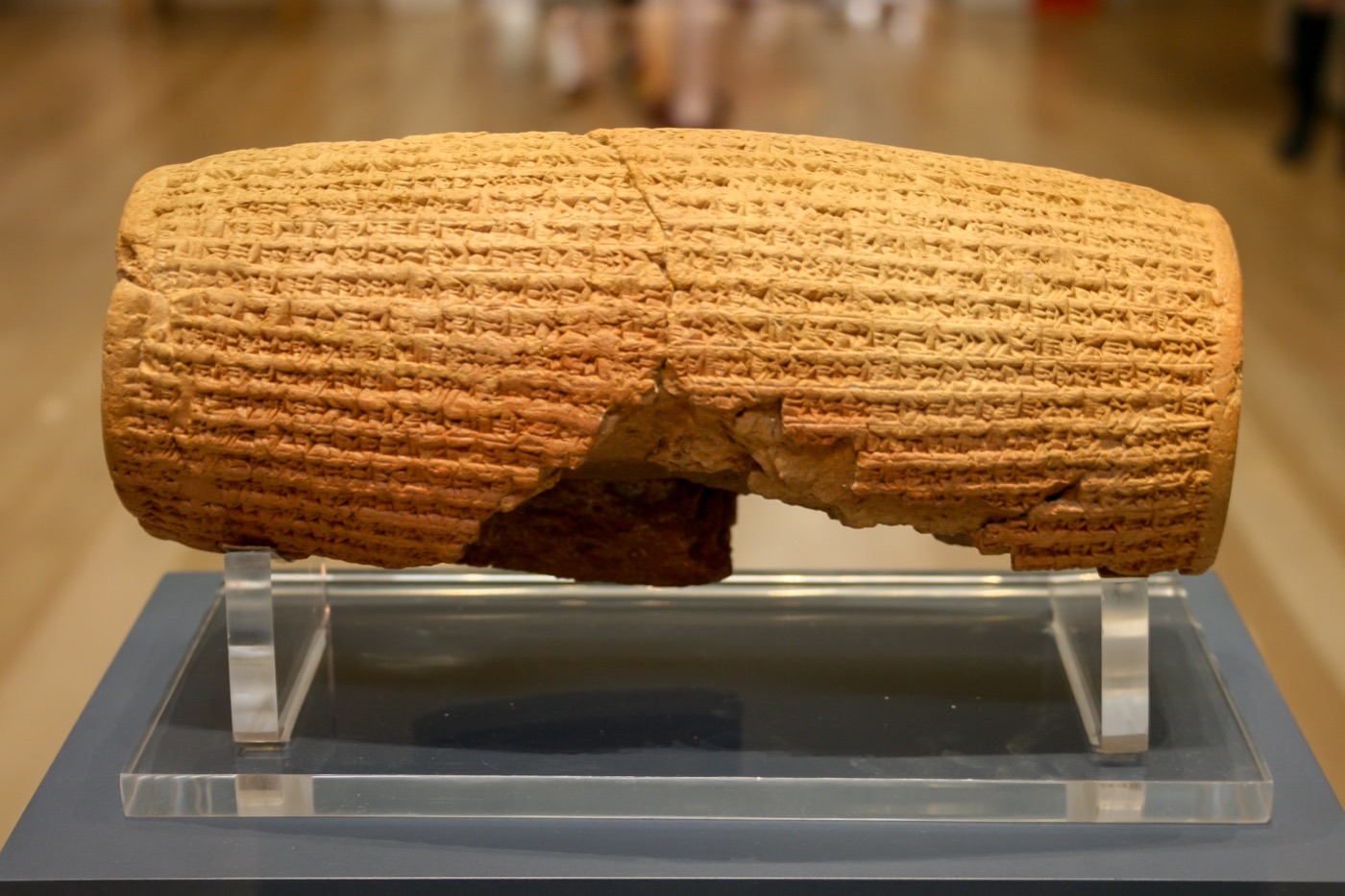
This is why Cyrus holds a place in Jewish memory unlike almost any other non-Jewish ruler. The Hebrew Bible names him directly and casts him in a uniquely favorable light. (As with all such material, this Topic treats the biblical account as a historical document. It records how the community understood its own story; it is not used here as religious proof.) Later Persian kings appear in the Bible too. The Book of Esther is set entirely in the Persian court, and tells of a Jewish queen who saves her people from destruction, the story behind the holiday of Purim, still celebrated everywhere today. Whatever the precise history behind these texts, they show how deeply the Jewish and Persian stories were intertwined from the very start.
A community across the centuries
Through every empire, the community held.
For more than two thousand years, Jewish communities lived in cities across the Iranian plateau: in Isfahan, Shiraz, Hamadan, Tehran, Yazd, Kerman, and many smaller towns. Hamadan was traditionally held to be the burial place of Esther and Mordechai, the heroes of the Purim story, and a shrine there remained a site of Jewish pilgrimage for centuries.
Life was not uniformly easy. Under the various Islamic dynasties that ruled Iran, Jews lived as a religious minority with the second-class status common across the region (described in the Diaspora Topic). There were periods of real hardship: forced conversions, restrictions, and at times persecution, particularly under some of the more rigid dynasties. The community at Mashhad, in northeastern Iran, was forced to convert outwardly to Islam in 1839 while secretly keeping Jewish practice for generations, one of the most striking cases of hidden Jewish life anywhere. Yet through all of it, the community endured, kept its traditions, and remained unmistakably itself.
The Jewish languages of Iran
A family of languages all their own.
Like every old diaspora community, the Jews of Iran developed their own ways of speaking: Jewish forms of Persian, written in Hebrew letters, that scholars group together as Judeo-Persian. These were not a single language but a family of related dialects, varying from city to city, each blending the local Persian with Hebrew and Aramaic.
Judeo-Persian has one of the oldest written records of any Jewish diaspora language: documents survive from more than a thousand years ago, making it a precious source for historians of both Jewish and Persian culture. Alongside everyday speech, Iranian Jews produced religious poetry, translations of the Bible, and literature in these languages, a written tradition that tied them to the wider Jewish world while keeping them rooted in Persian soil.
Object Spotlight
A class of schoolgirls, Iran, the 1970s.
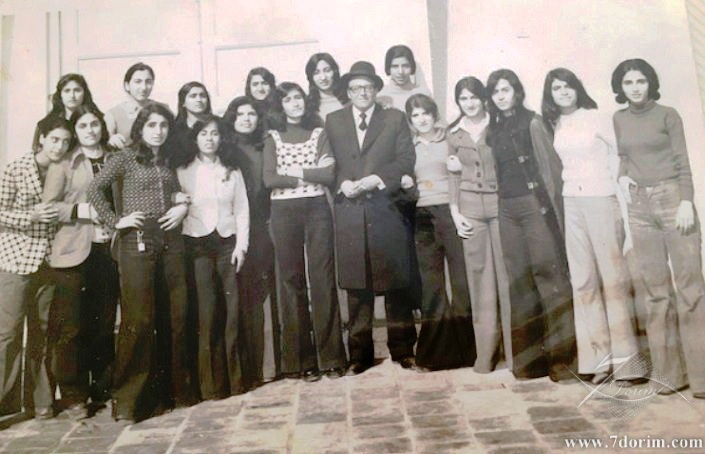
About fifteen teenage girls stand crowded together for a class photo, an older man in a dark suit and hat at the center, their teacher, or the school's principal. The girls are dressed in the fashion of the 1970s: flared trousers, patterned blouses, long straight hair. They could be a graduating class almost anywhere in the world that decade.
What it is. It's a school photograph, a twelfth-grade class at a Jewish school in Iran, taken in the 1970s. The students are young women on the edge of adulthood, posed with the man who taught them. An ordinary record of an ordinary school year.
When and where. The 1970s placed this class at a very particular hinge of history. These girls were growing up in the final years of the Iran most of their families had always known, a community more than 2,500 years old, by then mostly urban, modern, and integrated into Iranian life. Within a few years of this photo, the 1979 revolution would transform their country, and most of the Jewish community would leave.
Why it matters. Look at how modern and unremarkable the scene is: the clothes, the easy poses, the ordinary classroom moment. This is the community at the height of its modern life, in the years just before the great change. The photograph captures something a date in a textbook cannot. The people who lived through these turning points were not figures in a history lesson. They were teenagers in school photos, with futures they assumed would unfold in the only country their families had ever known. Most of these girls would build their adult lives somewhere else entirely.
Look closer. Notice that this is a class of girls, educated through the twelfth grade, a sign of a community that valued schooling for its daughters and had moved firmly into the modern world. The man at the center, formal in his suit and hat, belongs to an older generation; the students around him to a new one that would scatter across the globe.
Afterlife. This photograph, like many images of Iranian Jewish life, survived because families carried it with them when they left, and because community members later gathered and shared such pictures to preserve a record of a world that was changing. The school these girls attended, the city they lived in, the community that built it; much of that dispersed after 1979, to Israel, to the United States (especially Los Angeles and New York), and to Europe. The photograph is a small piece of a community keeping its own memory.
The modern community
A confident community, by the mid-twentieth century.
By the middle of the twentieth century, the Jews of Iran numbered roughly 100,000 to 150,000 people. Under the rule of the Pahlavi shahs (1925–1979), the community's position improved markedly: legal restrictions eased, and Jews moved into the professions, business, medicine, and the arts. A large, prosperous, modern community grew, centered increasingly on the capital, Tehran, with its schools, synagogues, hospitals, and newspapers.
The two photographs in this Topic capture the span of that modern life: a grand school gathering in the early twentieth century, and a class of schoolgirls in the 1970s. Between them lies the story of a community that had moved fully into the modern world while keeping a Jewish life that reached back more than two thousand years.
1979 and the departure
A revolution, and a community scattered.
The turning point came in 1979, when the Iranian Revolution overthrew the shah and established the Islamic Republic. The new order brought deep uncertainty for religious minorities. The Jewish community was officially recognized and permitted to continue practicing. But several pressures pushed most of Iran's Jews to leave: the new political climate, the execution of a prominent Jewish community leader early in the revolution, the war that soon followed with Iraq, and a general atmosphere of insecurity.
Over the following years, the great majority of the community, well over 100,000 people across the broader period, emigrated, primarily to the United States, Israel, and Europe. Los Angeles became home to one of the largest Iranian-Jewish communities in the world; significant communities also formed in New York and in Israel. Unlike the airlifts that emptied Iraq within a few years, Iran's departure was more gradual, stretched across the decades after 1979.
The community today
Still there, after 2,500 years.
Here is what sets Iran apart from nearly every other ancient Jewish community of the Middle East: it did not entirely end. A community of roughly 8,000 to 10,000 Jews remains in Iran today, far smaller than before 1979, but real and continuous, with functioning synagogues, schools, and kosher shops in Tehran and a handful of other cities. It is the largest Jewish community in the Middle East outside Israel.
It is a community living in a complicated position. Its country's government is openly hostile to the State of Israel, yet it formally recognizes its Jewish citizens and reserves them a seat in its parliament. However one reads that situation, the simple fact is remarkable. After more than 2,500 years, through empires, conquests, conversions, and a revolution that scattered most of its members across the globe, a Jewish community still lives on the Iranian plateau. It is an unbroken thread reaching back to the very beginning of the diaspora.
Key takeaways
- The Jewish community of Iran is among the oldest on earth: more than 2,500 years, reaching back to the founding moment of the diaspora in the sixth century BCE.
- Persian history and Jewish history are deeply intertwined: the Persian king Cyrus the Great allowed the exiled Jews to return to Jerusalem in 539 BCE, and the Book of Esther is set in the Persian court.
- Iranian Jews are Persian, not Arab; they spoke Persian and Judeo-Persian languages, which have one of the oldest written records of any Jewish diaspora language.
- By the mid-twentieth century the community numbered well over 100,000, modern and prosperous, centered on Tehran. After the 1979 revolution, most emigrated to Los Angeles, New York, Israel, and Europe.
- Unlike almost every other ancient community of the region, Iran's did not end: roughly 8,000–10,000 Jews remain, the largest Jewish community in the Middle East outside Israel.
Discussion questions
Working from the evidence.
Each question is anchored in something this Topic documents. Students should answer from the evidence on the page.
- The Persian king Cyrus allowed the exiled Jews to return to Jerusalem, and is remembered in Jewish tradition unlike almost any other foreign ruler. Why might a community remember a specific outside leader so powerfully, thousands of years later?
- The Object Spotlight shows a class of schoolgirls in the 1970s, just before the 1979 revolution. Why might an ordinary class photo tell you something about a turning point in history that a list of events cannot?
- Most of Iran's Jews left after 1979, but a community of roughly 8,000 to 10,000 people remains, the largest in the Middle East outside Israel. Why do you think some stayed, and what might it mean to keep a 2,500-year-old community going under difficult conditions?
- Iranian Jews are Persian, not Arab, with their own languages and history. Why does it matter to keep these distinctions clear rather than grouping all Middle Eastern Jews together?
- Compare Iran's gradual departure after 1979 with Iraq's near-total airlift in 1951–1952. What might explain why two ancient communities in the same region ended so differently?
Classroom Connections
Where this Topic fits.
Teaching Connections
The disciplines and courses this Topic naturally supports, for any educator, anywhere.
- World History: the Classical World: the Persian Empire and the Jewish community: Cyrus and the return from exile, and how ancient empires governed diverse peoples.
- World History, Human Rights: the 1979 revolution and its effect on religious minorities; the departure as a documented case of population displacement.
- Historical Thinking & Continuity: a 2,500-year continuous community and the survival of a remnant after 1979: a study in endurance.
- Source Analysis & Archives Education: photographs, memoirs, and community records.
- Geography & Comparative History: Iran’s gradual departure set beside Iraq’s near-total airlift; the distinctness of Persian (not Arab) Jewry.
Standards Alignment
- NYS Global History & Geography: 9.3 (the classical world, the Persian Empire and Cyrus) and 10.10 (human rights, the post-1979 departure).
- Common Core ELA-Literacy: RH.11–12.7 (integrating multiple sources): photographs, memoirs, and community records.
- C3 Framework: Dimension 2 (continuity and change; comparing communities, Iran’s gradual departure versus Iraq’s airlift).
Further Teaching Resources
- Farideh Goldin, Leaving Iran: Between Migration and Exile (Athabasca University Press): an open-access memoir of the Iranian-Jewish departure.
- Encyclopaedia Iranica, the scholarly reference on Iranian history and culture, extensive entries on the Jews of Iran across the centuries.
Sources
Primary sources come straight from the time: documents, letters, speeches, images, and objects created by the people involved. Secondary sources come later: books, articles, and analysis in which scholars study and interpret those primary sources.
Primary sources
- Goldin, Farideh. Leaving Iran: Between Migration and Exile. Athabasca University Press, 2015.
- The Cyrus Cylinder, 539 BCE. The contemporary record of Cyrus of Persia's policy of restoring exiled peoples; the decree permitting the Jewish return is recorded in Ezra 1. The British Museum.
- The Dandan-Uiliq letter, 8th century CE. The earliest known Judeo-Persian document, a trader's letter written in Persian in Hebrew script, found in western China. The British Library.
- The Book of Esther (Megillat Esther), set in the Achaemenid royal court at Susa. The community's founding narrative, read each Purim; free at Sefaria.
- Babai ben Lotf. Kitab-i Anusi (The Book of a Forced Convert), 17th century. The Judeo-Persian chronicle of the forced conversions of Iranian Jews under Safavid rule.
Secondary sources
- Sarshar, Houman, ed. Esther's Children: A Portrait of Iranian Jews. The Center for Iranian Jewish Oral History / Jewish Publication Society, 2002.
- Levy, Habib. Comprehensive History of the Jews of Iran. Mazda Publishers, 1999.
- Soomekh, Saba. From the Shahs to Los Angeles: Three Generations of Iranian Jewish Women. SUNY Press, 2012.
- Stillman, Norman A. The Jews of Arab Lands in Modern Times. Jewish Publication Society, 1991. (includes the wider regional context)
- Encyclopaedia Iranica. iranicaonline.org →
- ANU, Museum of the Jewish People, Tel Aviv. anumuseum.org.il →
Finding these documents: many primary sources are free online. Good places to start are the Fordham Internet Jewish History Sourcebook, Yale’s Avalon Project (law and diplomacy), German History in Documents, the collections of the US Holocaust Memorial Museum and Yad Vashem, the National Library of Israel, and Sefaria (for Jewish texts). Search the document’s name and date.
Between 1945 and 1972, Jewish communities present across the Middle East and North Africa for more than two thousand years were almost entirely gone within a single generation.
Comments?
Write to editor@makorproject.org.
Last updated: August 2026.