Ethiopian Jewry, Beta Israel
In thirty-six hours in May 1991, Israel flew 14,325 people out of a country on the edge of collapse. They were Ethiopian Jews. One El Al jumbo jet, stripped of its seats, carried 1,122 people on a single flight, a world record. A baby was born in the air. Every one of them landed safely.
Why this Topic exists
The Jewish story has an African chapter.
This Topic is about the community at the center of that airlift: the Beta Israel, the Jews of Ethiopia. Most students who learn Jewish history meet the European and Eastern European experience and never meet the African one. Yet Jewish communities lived across Africa for centuries, the Beta Israel in Ethiopia, and the Jews of Egypt, Libya, Tunisia, Algeria, and Morocco covered in the Departure from MENA Topic. This Unit treats that geography at parity with the European story, and the Israeli rescue operations of 1984–91 are among the great humanitarian evacuations of the twentieth century.
Common misconceptions this Topic addresses
Beta Israel, the Jews of Ethiopia, present for at least 1,500 years, is often dismissed as marginal or as recent converts. The dedicated entry lays out the Halakhic recognition (Rabbi Ovadia Yosef, 1973) and the airlifts.
- “The Jewish communities of India, Ethiopia, and China are recent or marginal.” see the dedicated entry →
What the tradition holds
A community that traces itself to Solomon.
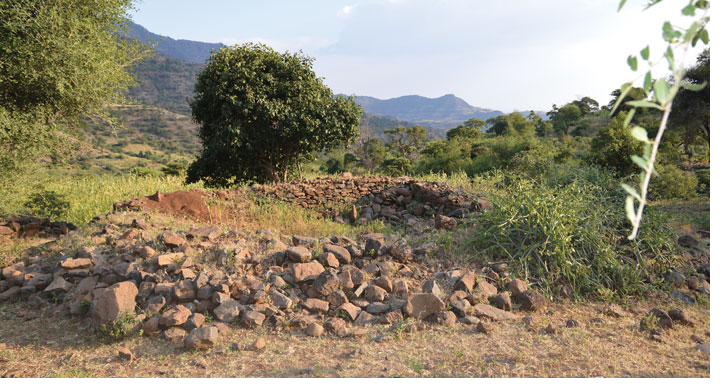
The Beta Israel's own tradition traces the community to the union of King Solomon and the Queen of Sheba, in the Ethiopian Kebra Nagast, the queen Makeda. The tradition holds that their son, Menelik I, returned to Ethiopia from Jerusalem around the tenth century BCE with Israelite priests. They brought the Ark of the Covenant, which Ethiopian Orthodox Christian tradition says remains today at the Church of Our Lady Mary of Zion in Aksum.
Scholars hold several different positions on where the community came from:
- Descent from converts. Set out in Steven Kaplan's The Beta Israel (Falasha) in Ethiopia (1992), this holds that the community descended from Ethiopians who converted to Judaism in the medieval period. The contact may have come through Jewish merchants, or through the Jewish community of southern Arabia (Yemen).
- Christian deviation. An earlier twentieth-century position, holding that the Beta Israel descended from Ethiopian Orthodox Christians who adopted Hebrew Bible–based practices and grew into a distinct community.
- The “lost tribes” framework. Held in the community's own tradition and in several other African Jewish communities, descent from the Israelite tribe of Dan, the basis the 1973 Ovadia Yosef ruling would adopt.
- The dating. The earliest clear evidence of the Beta Israel as a distinct community dates to roughly the fourteenth or fifteenth century CE. The community grew out of older Ethiopian religious traditions, but its distinct Jewish identity was established by the late medieval period.
The term “Falasha”, used in Ethiopia and in older scholarship, comes from a Ge'ez root meaning “exile” or “stranger” and now carries a pejorative sense. The community's own name for itself is “Beta Israel” (House of Israel), and scholarship has shifted to that term.
What the tradition includes
A Judaism shaped by long separation.
Beta Israel religious practice differs in key ways from the Rabbinic Judaism that grew up across the wider Jewish world after the Second Temple was destroyed in 70 CE. Those differences show how long the community was cut off from that world:
- The scriptures. The community preserved the Hebrew Bible in Ge'ez translation, the Orit (“Torah”): but did not preserve the Talmud or the rabbinic literature, which were composed after the community's separation.
- The leadership. The religious leaders are the kessoch (singular kes, roughly “priest”) rather than rabbis, who inherit the role through priestly family lines and lead through ritual rather than the study of the Talmud.
- The practice. It includes the Sabbath (Senbet), the Hebrew Bible festivals (Pesach, Shavuot, Sukkot, Yom Kippur, but not Hanukkah or Purim, which came after the separation), dietary laws, ritual purity, and circumcision on the eighth day.
- Unique observances. The community keeps festivals not found elsewhere in the Jewish world, above all Sigd, observed 50 days after Yom Kippur, marking the giving of the Torah and the community's longing for Jerusalem. Israel recognized Sigd as a national holiday by act of the Knesset in 2008.
- Monasticism. The Beta Israel kept a monastic tradition, celibate religious practitioners in monastic communities, with no parallel elsewhere in the Jewish world. It declined through the twentieth century and has all but disappeared.
The Western encounter
How the wider Jewish world found them.
Western contact began in 1769, when the Scottish traveler James Bruce described the community in his Travels to Discover the Source of the Nile (1790). Nineteenth-century European missionaries and scholars produced accounts of the Beta Israel, along with attempts to convert them to Christianity, and brought the community to wider Western Jewish attention.
The French Alliance Israélite Universelle and the broader European Jewish world engaged with the community from the 1860s on. The question of whether the Beta Israel were recognized as Jews under Jewish law was debated in the rabbinic literature. In 1864, Rabbi David ben Abraham Tzvi Hirsch Lourie, the Chief Rabbi of Aleppo, affirmed the Beta Israel as Jews, a precedent the twentieth-century rulings would build on.
The bridge to world Jewry
One scholar's life work.
The link between the Beta Israel and the modern Jewish world was built by Jacques Faïtlovitch (1881–1955), a Polish-French Jewish scholar. He did fieldwork with the community from 1904 until his death in 1955. He founded the Pro-Falasha Committee in 1907, pressed for recognition of the community as Jews, and set up schools in Ethiopia to support it.
Faïtlovitch's work built the framework that later Israeli engagement would stand on. The community's twentieth-century history ran through the Italian occupation of Ethiopia (1936–41), the restored empire under Haile Selassie (1941–74), and the political upheavals that followed. It was in the 1970s and 1980s that Israeli engagement accelerated.
The Halakhic recognition
A 1973 ruling that opened the door.
On February 9, 1973, Rabbi Ovadia Yosef, the Sephardic Chief Rabbi of Israel, ruled that the Beta Israel were Jews under Jewish law, identifying them as descendants of the Israelite tribe of Dan. The Ashkenazi Chief Rabbi, Shlomo Goren, endorsed the ruling in 1975.
The ruling did not create the community's Jewish identity; it established the halakhic basis on which the wider Jewish world and the Israeli state could formally recognize Beta Israel as Jewish.
The effect was huge. The recognition meant the Beta Israel were entitled to Israeli citizenship under the Law of Return (1950), which grants automatic citizenship to Jews, and that made the rescue operations possible. Prime Minister Menachem Begin's government decided to evacuate the community in 1977. But the Marxist-Leninist Derg regime in Ethiopia, under Mengistu Haile Mariam, refused to allow Jews to emigrate directly to Israel, so getting them out would require other routes.
The road through Sudan
An escape on foot, through famine.
Because the Derg regime banned emigration to Israel, the evacuation had to run through a third country. The route that developed in the early 1980s ran through refugee camps in Sudan.
The wider catastrophe of those years set the stage. The Ethiopian famine of 1983–85, the disaster behind the Live Aid concert of July 1985, drove a mass migration of Ethiopians across the border into refugee camps in eastern Sudan. The Beta Israel, hit by the famine like everyone else, walked from the Gondar region to those camps. The journey was brutal: about 4,000 Beta Israel died along the way or in the camps, from starvation, disease, and banditry on the route.
Sudan made it harder still. The Sudanese government under Jaafar Nimeiry was an Arab League member with hostile relations toward Israel, so there could be no open cooperation. The evacuation depended on covert operations through intermediaries and on payments to Sudanese officials, a quiet, partial cooperation that let the flights happen while letting officials deny them in public.
Operation Moses · 1984–85
The first airlift, and how it ended.
Operation Moses brought about 8,000 Beta Israel from the Sudanese camps to Israel between November 21, 1984 and January 5, 1985. It was run by the Mossad, the Israel Defense Forces, the Jewish Agency, and American Jewish organizations.
The Beta Israel were moved in small groups from the camps to an airstrip near Khartoum, where unmarked Boeing 707s, flying under Belgian Trans European Airways markings, carried them to Israel. About 30 flights ran over six weeks, on the pattern of a covert evacuation through a third country.
The operation was exposed on January 5, 1985, after public comments by Israeli officials. Under Arab League pressure, Sudan halted it, leaving about 1,000 Beta Israel stranded in the camps. The roughly 8,000 brought out became the core of the Ethiopian Israeli community, and the operation proved Israel could mount this kind of covert humanitarian rescue.
Operation Joshua · 1985
The American hand in the rescue.
Operation Joshua, in March 1985, brought out about 800 Beta Israel who had been stranded in the Sudanese camps. This one was run by the U.S. Central Intelligence Agency with Israeli support, the direct American role in the rescue. American C-130 transport planes flew the Beta Israel from the airstrip near Khartoum onward to Israel. Vice President George H. W. Bush, who helped coordinate it, went on to support the broader effort, building the framework that would lead to Operation Solomon in 1991.
Operation Solomon · May 1991
14,325 in 36 hours.
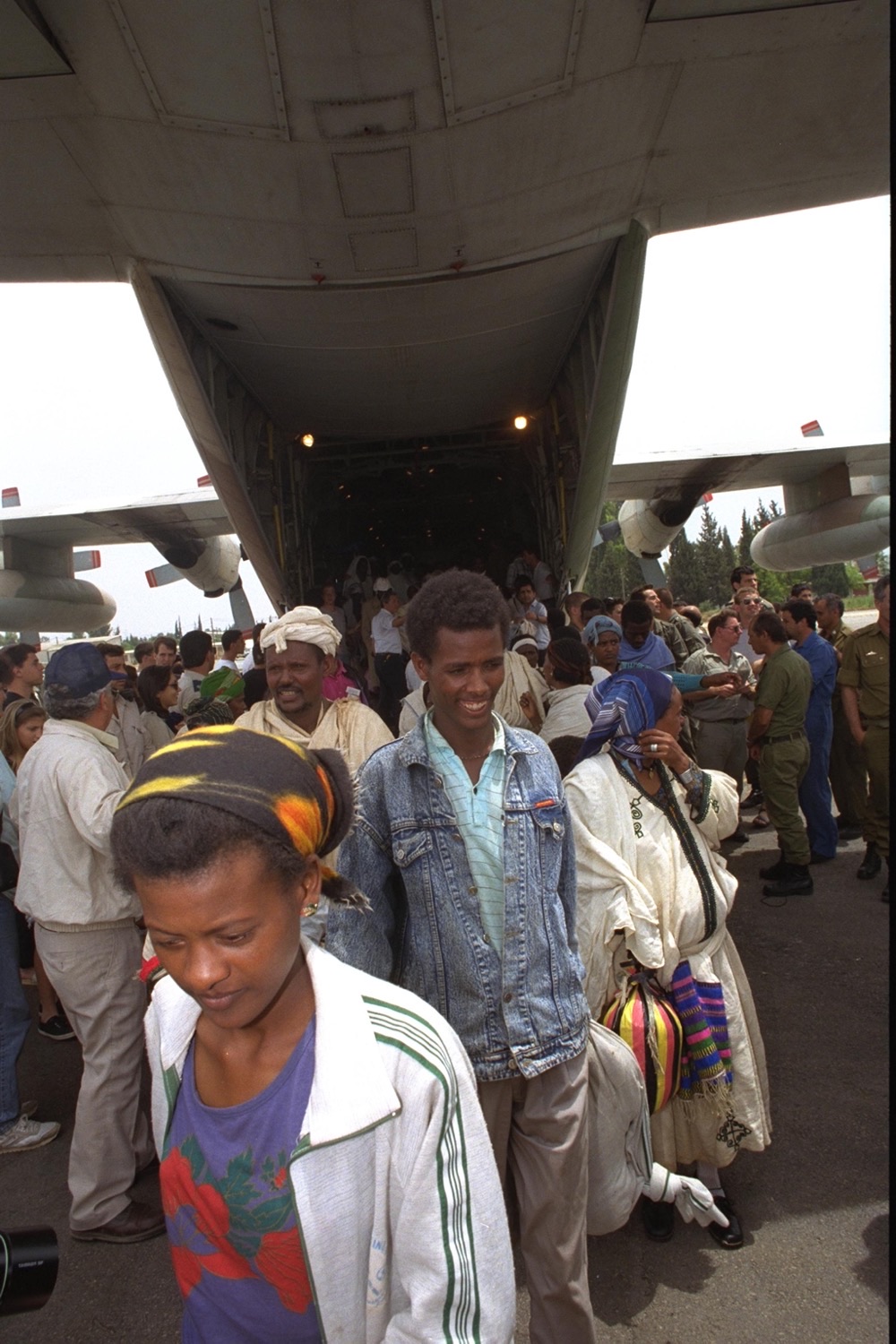
Operation Solomon evacuated 14,325 Beta Israel from Addis Ababa to Israel in about 36 hours on May 24–25, 1991, the largest single airlift in history.
The setting was a country collapsing. The Derg regime was falling to rebel forces under Meles Zenawi. Over the previous two years, with Israeli encouragement, the Beta Israel had moved from the Gondar and Tigray regions to Addis Ababa. They were concentrated in about 100 compounds near the Israeli embassy, waiting for a way out.
A deal made it possible. Mengistu fled to Zimbabwe on May 21, leaving acting president Tesfaye Gebre Kidan in charge. The departing government agreed to let the Beta Israel leave in exchange for about $35 million, paid by the Israeli government and American Jewish organizations. The payment was completed on May 22–24, and the airlift ran in the 36-hour window before rebel forces entered the capital on May 28.
Thirty-five aircraft flew the operation, shuttling between Addis Ababa's Bole airport and Tel Aviv: Israeli Air Force C-130 transports, El Al Boeing 747s with the seats removed, and other civilian planes. One of the 747s carried 1,122 passengers on a single flight, a Guinness World Record. Each round trip took under an hour, and people were loaded as fast as the planes could hold them. A baby was reportedly born aboard one of the El Al flights. All 14,325 arrived without a single casualty. The last plane left Addis Ababa on May 25, hours before the rebels took the city.
What followed the airlifts
Arrival was not the end of the story.
Bringing the Beta Israel into Israeli society, from 1984 on, has been one of the harder social tasks in Israel's history. The framework included absorption centers (such as Mevasseret Zion near Jerusalem), Hebrew instruction, vocational training, and housing programs.
It also raised hard questions. The Israeli Chief Rabbinate questioned whether Beta Israel religious tradition was compatible with its own Rabbinic framework. It required additional ritual steps for those seeking to marry under rabbinical authority, a “symbolic conversion” by immersion and a declaration accepting the Rabbinic framework. The community protested through hunger strikes and demonstrations in the 1980s and 1990s, and the Rabbinate's position has shifted over time.
Wider tensions have included discrimination, economic gaps, and unequal access to education. The work of integration continues, and the Ethiopian Israeli community has produced its own leaders, among them Pnina Tamano-Shata, the first Ethiopian-born Israeli cabinet minister, appointed Minister of Aliyah and Integration in May 2020.
The community today
A living community, still arriving.
The Ethiopian Israeli community numbers about 168,000 as of the 2020s, according to Israel's Central Bureau of Statistics, concentrated in central and southern Israel, in Netanya, Ashdod, Rehovot, Beer Sheva, and Hadera.
The Falash Mura are Ethiopians descended from Beta Israel who converted to Christianity in the nineteenth and twentieth centuries. Most remained in Ethiopia after the main operations and have continued immigrating to Israel since 1991, about 30,000 so far. The status of those still in Ethiopia remains debated.
The Sigd festival, observed 50 days after Yom Kippur, became an Israeli national holiday by act of the Knesset in 2008. It marks the community's religious tradition and its long yearning for Jerusalem, and is now observed with gatherings at the Armon HaNatziv promenade in Jerusalem, overlooking the Old City.
The honest accounting
The honest accounting.
The scholarship on Ethiopian Jewry carries several contested questions, named plainly here:
- Origins. The historical origins remain debated. The community tradition (Solomon and Sheba), the descent-from-converts position, the “lost tribes” framework, and the Christian-deviation position each have adherents. The 1973 ruling adopted the lost-tribes framework for the purposes of Jewish law; the historical question is still open.
- The Falash Mura. The status of the Falash Mura under Jewish law, and Israel's policy toward them, remains contested, involving questions of descent, immigration policy, and politics. The debate continues.
- Absorption. Israel's record on absorption includes failures alongside successes, discrimination in housing, education, and employment, and friction over policing, including the protests of 2015 and 2019 against police violence. Policy reforms have followed, and the work continues.
- The 1996 blood controversy. In January 1996 it was disclosed that Israel's Magen David Adom blood bank had been quietly discarding blood donated by Ethiopian Israelis, over concerns about HIV. The disclosure set off mass protests and reform, a moment that shaped much of the engagement since.
Discussion questions
Working from the evidence.
Each question is anchored in what this Topic documents.
- The Beta Israel kept the Sabbath, the festivals, and the Hebrew Bible, but not the Talmud, which was written after they were separated from the wider Jewish world. What does that tell you about how a tradition survives in isolation?
- A 1973 ruling under Jewish law made the airlifts legally possible by granting citizenship rights. How can a religious or legal decision change the fate of a whole community?
- Operation Solomon moved 14,325 people in 36 hours with no casualties, but it depended on a $35 million payment to a collapsing government. How should we weigh a rescue that also involved a payment like that?
- The Topic gives an “honest accounting” of discrimination and the 1996 blood controversy alongside the rescue. Why does a community's story need both the triumph and the failures?
- Most Jewish-history curricula cover the European experience and not the African one. What is lost when a whole geography of a people's history goes untaught?
Classroom Connections
Where this Topic fits.
Teaching Connections
The disciplines and courses this Topic naturally supports, for any educator, anywhere.
- World History, Decolonization & Modern Africa and the Middle East: the Beta Israel and the Israeli operations of 1984–91, African and Middle Eastern history the standard curriculum rarely covers.
- World History, Human Rights: Operation Solomon, the largest airlift in history.
- World Religions: a community that kept the Sabbath, the festivals, and the Hebrew Bible in isolation, without the Talmud.
- Comparative Migration: read beside Soviet Jewry (the parallel late-twentieth-century migration), the Modern State of Israel (the Law of Return framework), and American Jewry (the American Jewish role in the cause).
- Historical Thinking: recognition, rescue, and the “honest accounting” of discrimination alongside the triumph.
- Source Analysis: the 1973 ruling, the Operation Solomon records, and the Beta Israel oral-history collections.
Standards Alignment
- NYS Global History & Geography: 10.7 (decolonization and the modern Middle East and Africa) and 10.10 (human rights, Operation Solomon).
- Common Core ELA-Literacy: RH.11–12.6 and RH.11–12.9 (source perspective and primary sources): the 1973 ruling, the Operation Solomon records, and the oral-history collections.
Further Teaching Resources
- JDC, Operation Solomon, the American Jewish Joint Distribution Committee, directly involved in the airlift, on how it unfolded.
- USHMM Holocaust Encyclopedia, Ethiopian Jews, background on the community and the airlift era.
- The Jewish Agency, Ethiopian Aliyah, the agency that ran much of the immigration, on the operations and their aftermath.
Sources
Primary sources come straight from the time: documents, letters, speeches, images, and objects created by the people involved. Secondary sources come later: books, articles, and analysis in which scholars study and interpret those primary sources.
Primary sources
- The 1973 Halakhic Responsum of Rabbi Ovadia Yosef on the Status of the Beta Israel. February 9, 1973. Israeli Chief Rabbinate archives.
- The Israeli Government Press Office documentation on Operations Moses, Joshua, and Solomon. gov.il.
- The responsum of Rabbi David ibn Abi Zimra (the Radbaz), Egypt, 16th century, recognizing the Beta Israel as Jews. The halakhic precedent cited in the 1973 ruling.
- Bruce, James. Travels to Discover the Source of the Nile. Edinburgh, 1790. The account that documented the Beta Israel to the Western world.
- Joseph Halévy's mission to the Beta Israel for the Alliance Israélite Universelle, 1867. The first Western Jewish emissary's firsthand report on the community.
Secondary sources
- Kaplan, Steven. The Beta Israel (Falasha) in Ethiopia: From Earliest Times to the Twentieth Century. New York: New York University Press, 1992.
- Salamon, Hagar. The Hyena People: Ethiopian Jews in Christian Ethiopia. Berkeley: University of California Press, 1999.
- Weil, Shalva. Ethiopian Jews in the Limelight. Jerusalem: Hebrew University, 1997.
- Friedmann, Daniel. The Beta Israel Cultural Heritage: New Perspectives. Boston: Brill, 2007.
- Quirin, James. The Evolution of the Ethiopian Jews: A History of the Beta Israel (Falasha) to 1920. Philadelphia: University of Pennsylvania Press, 1992.
- Parfitt, Tudor, and Emanuela Trevisan Semi, eds. The Jews of Ethiopia: The Birth of an Elite. New York: Routledge, 2005.
- Spector, Stephen. Operation Solomon: The Daring Rescue of the Ethiopian Jews. New York: Oxford University Press, 2005.
- Wagaw, Teshome G. For Our Soul: Ethiopian Jews in Israel. Detroit: Wayne State University Press, 1993.
Finding these documents: many primary sources are free online. Good places to start are the Fordham Internet Jewish History Sourcebook, Yale’s Avalon Project (law and diplomacy), German History in Documents, the collections of the US Holocaust Memorial Museum and Yad Vashem, the National Library of Israel, and Sefaria (for Jewish texts). Search the document’s name and date.
The modern State of Israel: the home of about half the world’s Jews, its founding in 1948, its institutions, its people, and its cultural life, told at the same standard as every other community.
Comments?
Write to editor@makorproject.org.
Last updated: August 2026.