For more than two thousand years, there were Jews in North Africa, in the mountain villages of Morocco, the old cities of Tunisia, the coastal towns of Algeria and Libya. They had been there since before the Roman Empire reached the region. In the middle of the twentieth century there were close to half a million of them. Within about twenty years, almost all were gone.
Why this Topic exists
A whole world the textbook skips on its way to Europe.
When school histories follow the Jewish story, they almost always run it through Europe: Spain, Germany, Poland, the Holocaust. North Africa, the broad sweep of land across the top of the African continent, barely appears. And yet for most of recorded history, some of the largest and oldest Jewish communities on earth lived there: across the region the Arabs called the Maghreb, "the west," today's Morocco, Algeria, Tunisia, and Libya.
This was not a faint or fading presence. It was a living civilization with its own languages, music, cooking, dress, and centuries-old traditions, communities that produced great scholars, that traded across the Sahara and the Mediterranean, that wove themselves into the life of every city and many villages. Like the Jews of Iraq, they were at home, and had been for longer than almost anyone. And like the Jews of Iraq, they were almost entirely uprooted in a single generation in the middle of the twentieth century. This Topic tells the life first, and the ending second, because you cannot understand what was lost without seeing what was there.
How to read this Topic
Three points to set straight first.
Common misconceptions this Topic addresses
A few assumptions get in the way of seeing these communities clearly.
- "Jews arrived in North Africa recently, or came with European colonialism." See the entry →
- "North African Jews were a small, uniform group." They were close to a million people across four countries, with sharply different local cultures, languages, and histories.
- "They simply chose to emigrate to Israel or France." The departures followed violence, fear, war, and in some places the stripping of rights, a forced unwinding, not a free choice.
An ancient presence
Older than the Roman ruins around them.
Jewish communities reached North Africa in antiquity. There were Jews in the region in Roman times; the historian and the archaeological record both place them in cities across the coast more than two thousand years ago. When Rome destroyed the Second Temple in Jerusalem in 70 CE, more Jews were dispersed westward along the Mediterranean. By late antiquity, Jewish communities were established across what are now Tunisia, Algeria, Morocco, and Libya.
Two later waves deepened the community. After the Arab conquests of the 600s and 700s CE brought Islam to North Africa, the region became part of a vast Islamic world in which Jewish life, though lived under the second-class dhimmi status described in the Diaspora Topic, could be rich and productive. Then, after Spain expelled its Jews in 1492, many of those Sephardi exiles crossed to North Africa, adding a Spanish-Jewish layer to the older communities already there. The result was a deep, mixed, deeply rooted Jewish world.
A world across the Maghreb
Four countries, four different Jewish worlds.
"North African Jewry" is really a family of distinct communities, each shaped by its own country. A quick map:
- Morocco: by far the largest, with roughly 250,000 to 300,000 Jews in the late 1940s. A community that stretched from the great cities (Fez, Marrakesh, Casablanca, Tetouan) to remote villages high in the Atlas Mountains, some so isolated they had little contact with the outside world. Morocco's Jewish history runs unbroken for more than two thousand years.
- Tunisia: around 100,000 Jews, centered on the capital Tunis and on the island of Djerba, home to one of the oldest continuously inhabited Jewish communities anywhere (its own section below).
- Algeria: roughly 130,000 Jews, with a distinct history: in 1870, French colonial rule granted Algerian Jews French citizenship, tying their fate closely to France and, eventually, to the wrenching end of French Algeria.
- Libya: about 35,000 Jews, mainly in Tripoli and Benghazi, an ancient community that suffered violent attacks in the 1940s.
Across all four, Jews spoke Judeo-Arabic, the local Arabic woven through with Hebrew, alongside, in many places, French (from colonial schools) and, among the Sephardi-descended, traces of Spanish. They were merchants and craftsmen, jewelers and scholars, peddlers and physicians.
A living culture
Traditions that are still alive today.
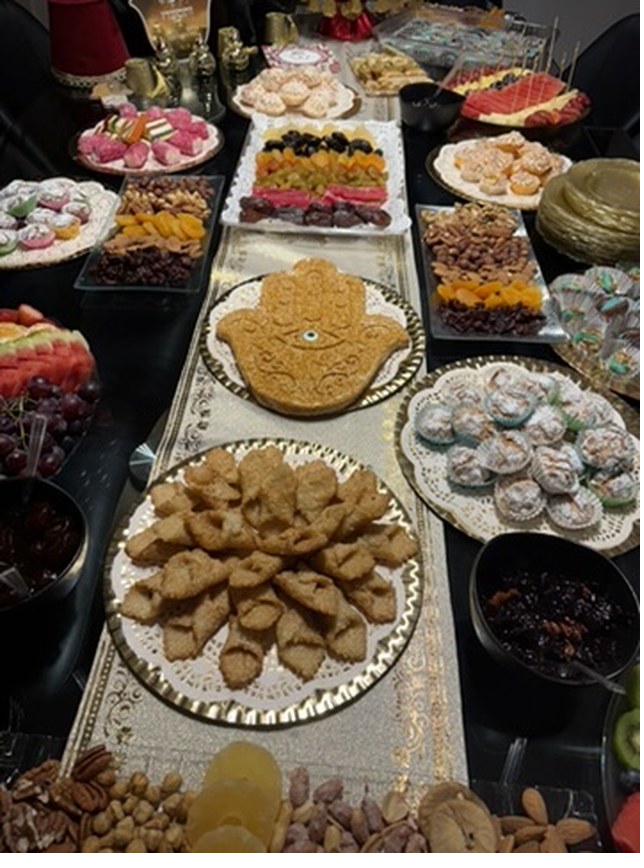
The richness of North African Jewish life is easiest to see in what people still do. Take the Mimouna, a celebration held the night after Passover ends, born among the Jews of Morocco. Families open their homes, set out tables piled with sweets, pastries, dried fruit, and nuts, and welcome neighbors in for a night of hospitality that crosses between communities. When hundreds of thousands of Moroccan Jews later moved to Israel and France, they carried the Mimouna with them; today it is celebrated by huge numbers of people, an entire living tradition carried out of North Africa intact.
The same depth shows up everywhere you look: in the distinctive music of Andalusian-Jewish singers, in elaborate embroidered wedding costumes, in the pilgrimage traditions to the tombs of revered rabbis, in cooking that varied from town to town. North African Jewry was not a community waiting at the edge of history. It was a full world, with its own version of nearly everything.
Object Spotlight
The Mimouna table, a tradition that outlived the place it came from.
Look again at the table in the photograph above. Plates of almond cookies and marzipan, dates and figs and dried apricots, a centerpiece shaped like a hamsa, the open-hand symbol common across North Africa, laid on an embroidered cloth.
What it is. This is a Mimouna spread: the food set out on the night the Jewish holiday of Passover ends, a celebration that began among the Jews of Morocco. Passover is a week of strict dietary rules; the Mimouna is the joyful release on the other side of it, a night of sweetness, open doors, and visiting.
Where it comes from. The Mimouna is North African to its core, Moroccan in origin, then shared across the wider Maghrebi Jewish world. For generations it was a neighborhood event: Jewish families would open their homes, and Muslim neighbors would often take part, bringing the first flour or honey of the post-Passover season. It was a tradition rooted in a specific place, among specific neighbors.
Why it matters. Here is what this table can do that a date or a statistic cannot. When the Jews of Morocco left, and almost all of them did, they did not carry their houses or their cities or their mountain villages. But they carried this. The Mimouna traveled with them to Israel and France, and there it grew, until today it fills public parks and town squares with hundreds of thousands of people. A community can be uprooted from its land and still keep its life alive in its traditions. The table is proof that what was lost in place was not entirely lost.
Look closer. Notice that nearly everything on the table is sweet, and that there is far more than any one family could eat. That is the point: the Mimouna is about abundance and welcome, a table built to be shared with whoever comes through the door. The hamsa at the center is a symbol of protection and blessing, used by Jews and Muslims alike across North Africa, a small reminder of how interwoven these communities once were.
Afterlife. The Mimouna is now one of the most visible living legacies of North African Jewry. In Israel it has become a near-national celebration; in France, Moroccan-Jewish communities keep it as well. The places the tradition came from have almost no Jews left, but the tradition itself is more widely celebrated now than at any point in its history. It is a culture that survived the loss of its homeland by being carried, table by table, in the memory of the people who left.
The island of Djerba
One of the oldest Jewish communities on earth.
Off the coast of Tunisia lies the island of Djerba, home to a Jewish community so old that tradition traces it back more than two and a half thousand years, to refugees who, the stories say, arrived after the destruction of the First Temple in 586 BCE. Whatever its exact beginning, Djerba's Jewish community is genuinely ancient, and unlike almost anywhere else in North Africa, a small community remains there to this day.
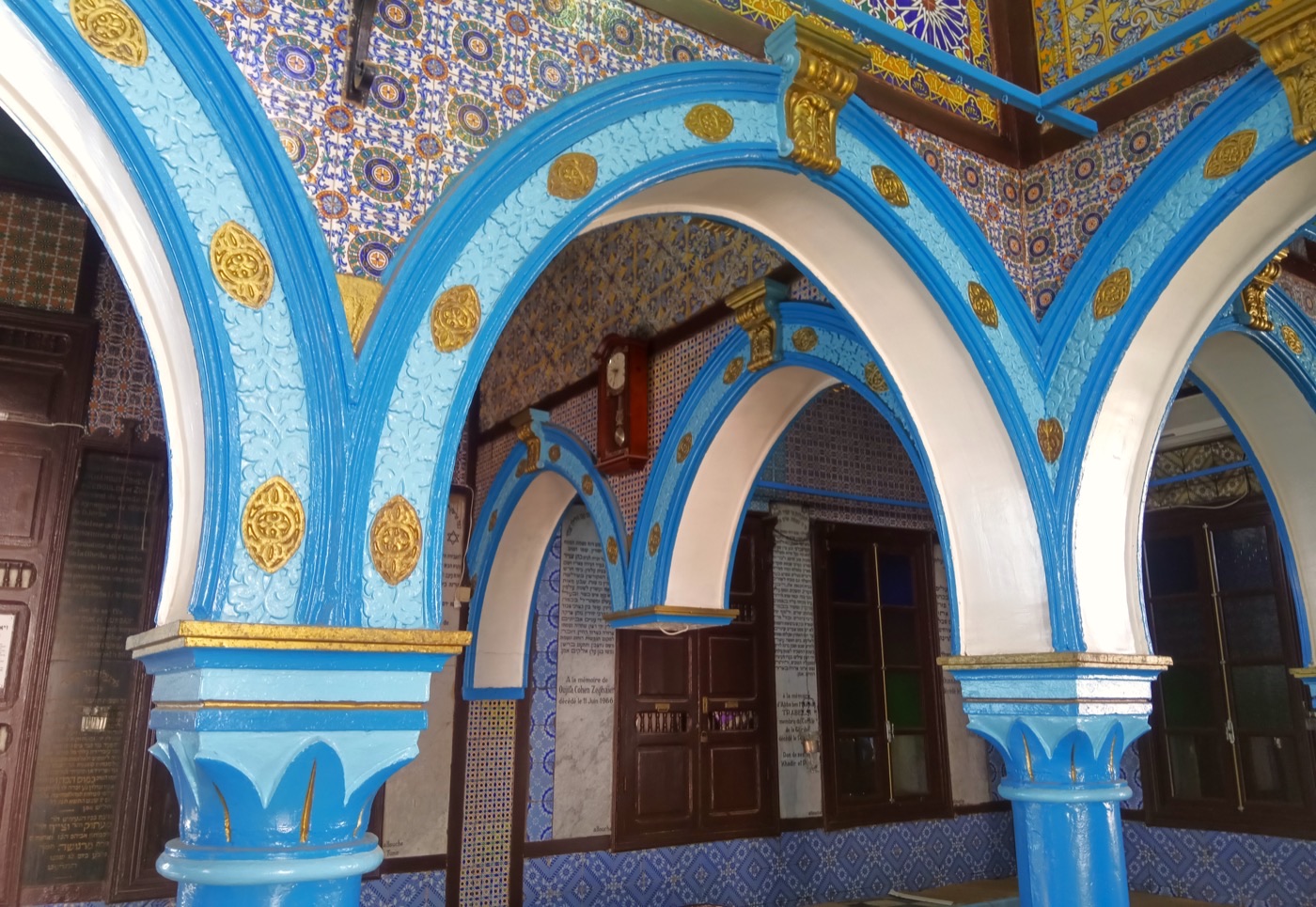
At its heart is the El Ghriba synagogue, one of the oldest synagogues in the world and the site of an annual pilgrimage that still draws Jewish visitors from around the globe. Djerba kept a distinct, deeply traditional Jewish life (its own religious scholars, its own customs) long after many mainland communities had modernized. It stands as a rare living thread of a world that has otherwise almost entirely vanished from the region.
The war years
The Holocaust reached North Africa too.
It is often assumed that the Holocaust was confined to Europe. It was not. During the Second World War, North African Jews came under the reach of Nazi Germany and its allies. In areas controlled by Vichy France (the French government that collaborated with the Nazis) and by Fascist Italy, Jews were stripped of rights, and forced-labor and internment camps were built across the region, in Morocco, Algeria, Tunisia, and Libya. In Tunisia, which came under direct German occupation for six months in 1942–1943, Jews faced deportations, forced labor, and killings.
This chapter, what the Holocaust meant for the Jews of North Africa and the Middle East, is told in full in the Holocaust in North Africa & the Middle East Topic in Unit 4. It is essential background for what came next: a community already shaken by the war years would, within a decade, face the pressures that ended its presence entirely.
The departure
Half a million people, gone in a generation.
After the Second World War, and especially after the founding of Israel in 1948, the position of Jews across North Africa grew steadily harder. Rising national independence movements, the Arab-Israeli conflict, outbreaks of anti-Jewish violence, and growing insecurity all pushed in the same direction. Community by community, the Jews of the Maghreb left.
The patterns differed by country. Most of Morocco's Jews emigrated between the 1950s and 1970s, the majority to Israel, many to France and Canada. Algeria's Jews, who held French citizenship, left almost entirely for France in 1962 when Algeria won independence: about 130,000 people in a single year. Tunisia's community emigrated steadily to Israel and France. Libya's Jews fled after violent riots, and the community was effectively finished by the early 1970s.
A Jewish presence that had lasted more than two thousand years was reduced, across the whole region, to a tiny remnant, with only Djerba keeping a meaningful living community. The broader story of this exodus, and the roughly 850,000 Jews displaced from across the Middle East and North Africa, is told in the Departure from MENA Topic. Here, the point is simpler and more human: an entire world: its cities, its villages, its music and its Mimouna tables, was emptied of the people who had made it, within the span of a single lifetime.
Key takeaways
- Jewish communities lived across North Africa (Morocco, Algeria, Tunisia, and Libya), for more than two thousand years, since before the Roman Empire reached the region.
- It was a family of distinct communities, not one uniform group: close to a million people in the late 1940s, with Morocco by far the largest, and sharply different local cultures, languages, and histories.
- North African Jewish life was a full civilization, with its own Judeo-Arabic language, music, dress, cooking, and traditions like the Mimouna, which is still widely celebrated today.
- The island of Djerba, off Tunisia, holds one of the oldest Jewish communities on earth, with the ancient El Ghriba synagogue, and a small community remains there still.
- The Holocaust reached North Africa through Vichy France and Fascist Italy. After 1948, nearly the entire community left within a generation, to Israel, France, and elsewhere, ending a presence of more than two thousand years.
Discussion questions
Working from the evidence.
Each question is anchored in something this Topic documents. Students should answer from the evidence on the page.
- "North African Jewry" was really four different Jewish worlds across four countries. Why does it matter to see the differences between them, rather than treating them as one group?
- The Mimouna survived the loss of the community's homeland and is now more widely celebrated than ever. What does it mean for a tradition to outlive the place it came from?
- The Holocaust is usually taught as a European event, but it reached North Africa too. Why might that part of the story be so often left out, and what is lost by leaving it out?
- Algeria's Jews held French citizenship and left almost entirely for France in a single year, 1962. How does their story differ from the Jews of Morocco or Libya, and what explains the difference?
- A community of nearly a million people, present for more than two thousand years, was reduced to a tiny remnant within a generation. What questions does the speed of that ending raise about how permanent any long-established community really is?
Classroom Connections
Where this Topic fits.
Teaching Connections
The disciplines and courses this Topic naturally supports, for any educator, anywhere.
- World History & Belief Systems: North African Jewry adapting across many centuries and rulers.
- World History, Human Rights: the end of North African Jewry, tied to decolonization and postwar Middle Eastern and North African politics; the departure as a documented case of population displacement.
- World History, WWII & the Holocaust: the war reached North Africa: Vichy rule in Morocco, Algeria, and Tunisia, and the forced-labor and internment camps across the region.
- Historical Thinking & Cultural Continuity: the survival of the Mimouna after the community’s uprooting: culture outliving displacement.
- Source Analysis & Archives Education: photographs, oral histories, and community records.
- Geography: the four distinct Jewish worlds of Morocco, Algeria, Tunisia, and Libya.
Standards Alignment
- NYS Global History & Geography: 9.2 (Belief Systems), 10.5 (the global conflicts of 1914–1945 (the war in North Africa), and 10.10 (human rights) the departure).
- Common Core ELA-Literacy: RH.11–12.7 (integrating multiple sources): photographs, oral histories, and community records.
- C3 Framework: Dimension 2 (continuity and change; comparing communities and the survival of culture after displacement).
Further Teaching Resources
- The Museum of Moroccan Judaism, Casablanca, one of the few Jewish museums in the Arab world (consult its current visiting and exhibition information).
Sources
Primary sources come straight from the time: documents, letters, speeches, images, and objects created by the people involved. Secondary sources come later: books, articles, and analysis in which scholars study and interpret those primary sources.
Primary sources
- The Crémieux Decree (Décret Crémieux), October 24, 1870, granting French citizenship to the Jews of Algeria; abrogated by Vichy on October 7, 1940.
- Maimonides. Iggeret ha-Shemad (the Epistle on Forced Conversion), c. 1160s. Written for the communities of Morocco under Almohad persecution, while Maimonides himself lived in Fez.
- Maimon ben Joseph (father of Maimonides). Iggeret ha-Nechamah (The Letter of Consolation), written in Fez, c. 1160, to the communities under Almohad persecution.
- The dahir of Sultan Muhammad IV of Morocco, February 1864, issued after Moses Montefiore's mission, ordering the protection of the Sultan's Jewish subjects.
Secondary sources
- Stillman, Norman A. The Jews of Arab Lands: A History and Source Book. Jewish Publication Society, 1979.
- Stillman, Norman A. The Jews of Arab Lands in Modern Times. Jewish Publication Society, 1991.
- Gottreich, Emily Benichou, and Daniel J. Schroeter, eds. Jewish Culture and Society in North Africa. Indiana University Press, 2011.
- Laskier, Michael M. North African Jewry in the Twentieth Century: The Jews of Morocco, Tunisia, and Algeria. New York University Press, 1994.
- Boum, Aomar, and Sarah Abrevaya Stein, eds. The Holocaust and North Africa. Stanford University Press, 2018.
- Simon, Reeva Spector, et al., eds. The Jews of the Middle East and North Africa in Modern Times. Columbia University Press, 2003.
- Diarna Geo-Museum. diarna.org →
- ANU, Museum of the Jewish People, Tel Aviv. anumuseum.org.il →
Finding these documents: many primary sources are free online. Good places to start are the Fordham Internet Jewish History Sourcebook, Yale’s Avalon Project (law and diplomacy), German History in Documents, the collections of the US Holocaust Memorial Museum and Yad Vashem, the National Library of Israel, and Sefaria (for Jewish texts). Search the document’s name and date.
One of the oldest Jewish communities on earth, more than 2,500 years in Persia, woven into the founding stories of both peoples, still present today after a century of change and departure.
Comments?
Write to editor@makorproject.org.
Last updated: August 2026.