The Modern State of Israel
About half of the world's Jews live in one country today: the modern State of Israel. Any honest account of Jewish life across time and place has to include it, its founding, its institutions, its people, and its cultural life.
Why this Topic exists
Half the world’s Jews live here.
This Topic treats the modern State at the same standard applied to every other community and period in these Units. The contemporary Israeli-Palestinian conflict comes up where the historical record requires it, the founding and the early decades cannot be told honestly without it, but the conflict itself is not the subject of this Topic. It has its own large scholarly and political literature, and this Topic points readers to that literature rather than to substitute its own voice for it.
Common misconceptions this Topic addresses
Public debate about Israel includes many claims the historical record speaks to. The dedicated Misconceptions reference treats them at length, citing scholars from across the historiographic spectrum.
- "Jews are foreign colonizers of the Land of Israel." see the dedicated entry →
- "The State of Israel is a colonial enterprise of the European type." see the dedicated entry →
- "The crisis in the Middle East is thousands of years old." see the dedicated entry →
- "The Israeli-Palestinian conflict has no possible answer." see the dedicated entry →
Modern Zionism, 1880s–1940s
Modern Zionism, from the 1880s to the 1940s.
The movement that produced the modern State, modern Zionism, emerged in the late nineteenth century from several sources. The long Jewish relationship to the Land of Israel covered in the Continuous Presence Topic is the deep background; modern Zionism is the specific political movement that turned that relationship into a project for a modern Jewish state. Its founding moments:
- The First Aliyah (1882–1903). About 25,000 Jewish immigrants, mostly from the Russian Empire after the pogroms of 1881–82 (covered in the Evolution of Antisemitism unit), with smaller numbers from Yemen. They founded the first Zionist agricultural settlements, Rishon LeZion, Zikhron Ya'akov, Rosh Pinah.
- Theodor Herzl and political Zionism (1896–1904). The Austro-Hungarian Jewish journalist Theodor Herzl (1860–1904) published Der Judenstaat (The Jewish State) in 1896, making the case for a modern Jewish state as the answer to European antisemitism, which he had seen up close covering the Dreyfus Affair. He organized the First Zionist Congress in Basel, Switzerland, in August 1897, which built the movement's structures: the World Zionist Organization, the Zionist Congress, and the Jewish National Fund (1901). Herzl died in 1904 at 44 and is buried on Mount Herzl in Jerusalem, named for him.
- The Second Aliyah (1904–1914). About 35,000 to 40,000 more immigrants, mostly from the Russian Empire. They built the Zionist labor movement, the first kibbutz, Degania, was founded in 1909, and included the figures who would lead the Yishuv, the Jewish community in the Land, for decades: David Ben-Gurion, Berl Katznelson, Yitzhak Ben-Zvi.
- The Balfour Declaration (November 2, 1917). British Foreign Secretary Arthur Balfour's letter to Lord Walter Rothschild expressing British support for "the establishment in Palestine of a national home for the Jewish people." Issued during the First World War, it became the basis for the terms of the later British Mandate.
- The Third through Fifth Aliyot (1919–1939). Successive waves, the Third (1919–1923, from Russia and Eastern Europe after the Revolution), the Fourth (1924–1929, mostly from Poland), and the Fifth (1929–1939, mostly from Germany after the Nazi takeover of 1933). The Fifth Aliyah brought a wave of physicians, scientists, academics, and cultural figures fleeing Nazi Germany.
The scholarship on modern Zionism is extensive, Walter Laqueur's A History of Zionism (1972), Anita Shapira's Israel: A History (2012), Shlomo Avineri's The Making of Modern Zionism (1981), Derek Penslar's Zionism: An Emotional State (2023). It treats Zionism as the movement it actually was, with real internal diversity, the labor Zionists of Ben-Gurion's tradition, the revisionists of Jabotinsky's, the religious Zionists, the cultural Zionists, and the binationalists of Brit Shalom, rather than as a single monolithic project.
The British Mandate
The British Mandate, 1917–1948.
The British Mandate for Palestine, formally established by the League of Nations in 1922, in effect from the British conquest of 1917, was the framework within which the State eventually emerged. The relevant record here:
- Demographic growth. The Jewish population of the Land grew from about 60,000 at the start of the Mandate to about 650,000 by May 1948, driven by the waves of immigration above, the German refugee Aliyah of the 1930s, and the post-1945 immigration of Holocaust survivors (much of it arriving despite British restrictions).
- Institutions. The Yishuv developed into something like a state-in-waiting: the Jewish Agency (prominent under Chaim Weizmann), the Histadrut trade-union federation (1920), the Haganah self-defense organization (1920, later the basis of the Israel Defense Forces), and the Va'ad Leumi national council.
- Contested questions. The Mandate was contested on several fronts, between the British administration and the Jewish Yishuv (especially over immigration), between the British and the Arab population (most prominently in the 1936–1939 Arab Revolt), and between the Yishuv and the Arab population. This is the immediate background to 1947–1948.
- The 1939 White Paper. The British policy of May 1939 capped Jewish immigration at 75,000 over five years and restricted land purchase, closing off Jewish escape from Nazi-occupied Europe at the very moment escape was most needed.
The 1947 Partition Plan
The 1947 Partition Plan.
On November 29, 1947, the UN General Assembly adopted Resolution 181, the Partition Plan for Palestine. It recommended dividing the Mandate territory into a Jewish state and an Arab state, with Jerusalem under international administration. The vote was 33 in favor, 13 against, 10 abstentions.
The plan provided international legitimation for a Jewish state and a specific territorial framework, and it drew immediate responses. The Jewish Agency accepted it; the Arab Higher Committee and the Arab League states rejected it.
Anti-Jewish violence followed at once in several places. The Aden pogrom of December 2–4, 1947 (covered in the MENA Departure Topic) and the Aleppo pogrom of December 1, 1947, which badly damaged the Aleppo Codex, both came in the days right after the vote. Within the Mandate itself, the months between the Partition vote and the British withdrawal in May 1948 brought escalating intercommunal violence.
May 14, 1948
May 14, 1948, the founding.
The British Mandate expired at midnight on May 14, 1948. That afternoon, at 4:00 p.m. at the Tel Aviv Museum (now Independence Hall), David Ben-Gurion read the Declaration of the Establishment of the State of Israel on behalf of the Jewish People's Council.
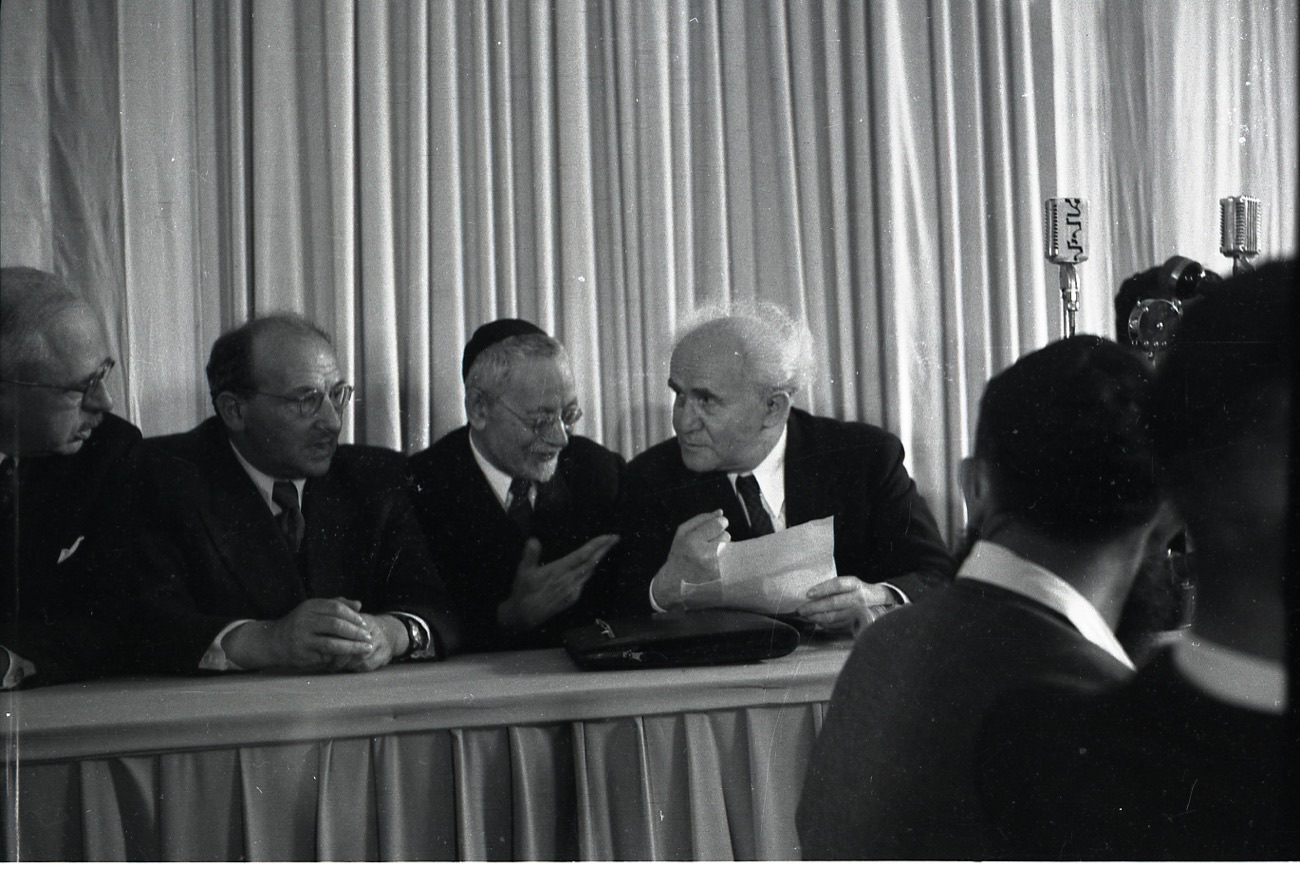
The Declaration is the founding document of the State. Parts of its text are worth preserving in their published English form:
"ERETZ-ISRAEL [the Land of Israel] was the birthplace of the Jewish people. Here their spiritual, religious and political identity was shaped. Here they first attained to statehood, created cultural values of national and universal significance and gave to the world the eternal Book of Books…"
"WE … HEREBY DECLARE THE ESTABLISHMENT OF A JEWISH STATE IN ERETZ-ISRAEL, TO BE KNOWN AS THE STATE OF ISRAEL."
The war and the armistice
The war, the armistice, and the contested record.
The 1948 Arab-Israeli War grew out of the intercommunal violence after the November 1947 vote and continued with the invasion of the new state by the armies of Egypt, Jordan, Syria, Lebanon, and Iraq after the May 14 Declaration. It ended with the 1949 Armistice Agreements between Israel and Egypt (February 24), Lebanon (March 23), Jordan (April 3), and Syria (July 20). The armistice lines, the "Green Line", became Israel's boundaries until the 1967 Six-Day War.
The war was consequential in several ways. Israel emerged from it with territory beyond the Partition Plan's proposed boundaries. About 700,000 Palestinian Arabs left or were displaced from their homes during the war, an event called al-Nakba ("the Catastrophe") in Palestinian historical memory, and the core of the Palestinian refugee question. How to characterize that displacement is the subject of a large and ongoing scholarship, sometimes called the "New Historians" debate among Israeli scholars (Benny Morris, Avi Shlaim, Ilan Pappé, and others from the 1980s on), in dialogue with earlier work and with scholarship by Palestinian and Arab historians. That literature treats the questions, what happened, where, and under what conditions, with care and with real ongoing disagreement.
The existence and substance of this debate are noted here without settling it; the principal works on all sides are listed among the Sources below.
The immediate post-1948 period brought the founding of the State; the creation of the UN Relief and Works Agency for Palestine Refugees (UNRWA) by UN Resolution 302 of December 8, 1949; the major demographic shift from the parallel Jewish departure from MENA countries covered in the MENA Departure Topic; and the reorganization of the new state across the early 1950s.
The achievement and its costs
The achievement and its costs.
The State's first decade (1948–1958) was dominated by the absorption of refugee populations on a scale that more than doubled the country's prewar Jewish population within about five years:
- Holocaust survivors from Europe: about 250,000 reached Israel between 1948 and the early 1950s, reshaping the new society.
- Yemenite Jews (1949–1950): Operation Magic Carpet brought about 49,000, with 14,000 more arriving by other routes (covered in the MENA Departure Topic).
- Iraqi Jews (1950–1951): Operation Ezra and Nehemiah brought about 120,000 (MENA Departure Topic).
- Moroccan, Tunisian, Egyptian, Libyan, and Syrian Jews across the 1950s and 1960s, about 600,000 MENA arrivals in all between 1948 and 1972.
The absorption took place under severe economic strain. With limited resources, the new state struggled to provide housing, jobs, schooling, and health care, and the ma'abarot, transit camps where much of the MENA immigrant population lived, in some cases for years, operated through the 1950s. The record of that period, including the disparities between how Ashkenazi and Mizrahi immigrants were absorbed, has been a major theme of later Israeli scholarship (Tom Segev's 1949: The First Israelis, Yehouda Shenhav, Ella Shohat) and of Israeli political and cultural life since.
By any historical measure the achievement was large: a state of about 650,000 Jewish residents at its founding had grown past 2 million by 1960, through the absorption of refugees at scale, under heavy economic constraint, amid ongoing regional conflict. The difficulties of that absorption belong to the record alongside the achievement.
The structure of the State
The structure of the modern State.
- Parliamentary democracy. Israel is a parliamentary democracy. The Knesset, its single-chamber parliament of 120 members, is elected by proportional representation: voters choose a party list rather than a single local candidate, and the country votes as one nationwide district. A party must clear a 3.25 percent threshold to enter the Knesset at all. The Prime Minister is head of government; the President is head of state with mostly ceremonial duties.
- Government by coalition. No single party has ever won an outright majority of the 120 seats, so every Israeli government has been a coalition of several parties. Those parties span a wide range: secular and religious, left and right, Jewish-majority and Arab-majority. In 2021, for the first time, an Arab party (Ra’am) joined a governing coalition. Because coalitions must be assembled and held together, small parties can carry weight beyond their size, and governments can fall when a coalition breaks apart.
- No single constitution. Israel has no one written constitution. Its constitutional functions are carried by the Basic Laws (foundational statutes enacted from 1950 on), the Declaration of Independence, Supreme Court decisions, and parliamentary tradition.
- The Supreme Court, which sits as both the highest court of appeal and the High Court of Justice. Its role has been the subject of intense domestic political dispute in recent years.
- The Israel Defense Forces, established May 26, 1948, the successor to the Haganah. Most Jewish Israeli citizens are conscripted; specific exemptions apply to ultra-Orthodox citizens and to Arab Israeli citizens, with voluntary service available.
- The religious establishment: the Chief Rabbinate (with separate Ashkenazi and Sephardic Chief Rabbis) and the rabbinic courts for personal-status matters such as marriage and divorce. Religion-state relations are a subject of continuous internal Israeli debate.
- How a person becomes a citizen. There are several paths. The Law of Return (1950) gives any Jew, and their children, grandchildren, and spouses, the right to immigrate and receive citizenship. People who are not eligible under the Law of Return can become citizens by naturalization under the Citizenship Law (1952), which sets requirements such as a period of residence, some knowledge of Hebrew, and renunciation of a previous nationality where required. A third path is historical: when the State was founded, Arab residents who remained within its 1949 borders were made citizens by that same 1952 law. Citizenship also passes from parent to child by birth.
- The citizenry. About 20 percent of Israel’s citizens are Arab (mostly Muslim, with Christian and Druze communities): the country’s largest minority. As citizens they vote and run in national and local elections; Arab-majority parties sit in the Knesset, and Arab citizens have served as government ministers, ambassadors, mayors, and judges, including on the Supreme Court. The record also documents real gaps and disputes: socio-economic inequality, unequal municipal budgets and land-and-permit allocation, and the contested 2018 Nation-State Basic Law, which named Israel the nation-state of the Jewish people and changed Arabic from an official language to one with “special status.” The relationship between the Jewish-state framework and the non-Jewish citizenry is the subject of a large scholarly and political literature.
The population over time
The population across the decades.
- May 1948: about 650,000 Jewish residents at the founding, with a smaller Arab population within the territory that became the State.
- 1960: about 2 million Jewish residents.
- 1980: about 3.3 million.
- 2000: about 4.9 million Jewish residents and about 1.2 million Arab Israeli citizens.
- 2026: about 7.2 million Jewish residents, about 2.1 million Arab Israeli citizens, and a total population of about 9.9 million.
The population is diverse. The Jewish citizenry includes Ashkenazi, Sephardic, Mizrahi, Yemenite, Persian, Ethiopian (the Beta Israel community, brought mainly through Operations Moses in 1984 and Solomon in 1991), and Soviet communities (about 1 million arrivals after 1989 from the former Soviet Union). The Arab Israeli citizenry includes Muslim, Christian, and Druze communities, the Druze distinct in their relationship to the State, with mandatory military service since 1956, along with smaller Circassian, Armenian, and other historical minorities. The reference for current figures is the Israel Central Bureau of Statistics.
Cultural and intellectual life
Cultural and intellectual life.
- Modern Hebrew. The revival of Hebrew as a spoken and literary language across the late nineteenth and twentieth centuries, much of it through Eliezer Ben-Yehuda (1858–1922): is one of the most distinctive achievements of the modern Jewish national project. The Hebrew literary tradition includes S. Y. Agnon (Nobel Prize in Literature, 1966), Amos Oz, A. B. Yehoshua, David Grossman, and Aharon Appelfeld, and a poetry tradition running from Hayim Nahman Bialik and Rachel Bluwstein through Yehuda Amichai and Dahlia Ravikovitch.
- Sciences and medicine. Israeli research centers on the Weizmann Institute (1934), the Hebrew University of Jerusalem (1925), the Technion (1924), and Tel Aviv University. Israeli science Nobel laureates include Ada Yonath (Chemistry, 2009), Aaron Ciechanover and Avram Hershko (Chemistry, 2004), Dan Shechtman (Chemistry, 2011), Daniel Kahneman (Economics, 2002), and Robert Aumann (Economics, 2005).
- Visual arts and music. The arts run through the Israel Museum, the Tel Aviv Museum of Art, and the Bezalel Academy (1906). The Israel Philharmonic was founded in 1936 as the Palestine Orchestra by the violinist Bronisław Huberman, to employ Jewish musicians fleeing Nazi Germany, a notable piece of its history.
- Film and media. Israeli film has won growing international recognition over the past two decades (Joseph Cedar, Ari Folman, Samuel Maoz, Nadav Lapid), and Israeli television formats are distributed internationally.
A note on the conflict
A note on the conflict.
The Israeli-Palestinian conflict is a large and contested subject this Topic does not try to cover in full. The conflict has its own large scholarly and political literature, and the responsibility is to point readers to that literature rather than to stand in for the academic and policy conversation that engages it in depth.
What this Topic provides. The historical record of the founding (1948) and the major events that connect to the conflict, the 1967 Six-Day War, the 1973 Yom Kippur War, the 1978 Camp David Accords, the 1990s Oslo Accords, are part of the record. They are referenced where the record requires; they are not the analytical centerpiece here.
Where to engage the conflict literature. The main scholarly homes include the Institute for Palestine Studies, the Moshe Dayan Center at Tel Aviv University, the Truman Institute at the Hebrew University, the Crown Center at Brandeis, and the Brookings Institution's Center for Middle East Policy. The journals, Israel Studies, the Journal of Palestine Studies, the Middle East Journal, carry the ongoing academic conversation. The Topic's recommendation is to send serious readers to those channels rather than compress the literature into a brief treatment.
Diplomatic relations
Diplomatic relations.
- UN membership. Israel was admitted to the United Nations by General Assembly Resolution 273 on May 11, 1949 (37 to 12, with 9 abstentions).
- The United States–Israel relationship, set out in the scholarship of Steven L. Spiegel, William B. Quandt, and others. It has run across many presidencies and much policy variation, with a broadly continuous underlying structure.
- The peace treaties. Israel and Egypt concluded the Camp David Accords (September 1978) and a formal peace treaty (March 26, 1979): the first between Israel and an Arab state. Israel and Jordan signed a treaty on October 26, 1994. The Abraham Accords of September 15, 2020 normalized relations with the United Arab Emirates and Bahrain, with Morocco and Sudan following in the months after.
- The Vatican–Israel relationship, covered in the Nostra Aetate Topic. The Fundamental Agreement of December 30, 1993 established formal diplomatic relations between the Holy See and Israel.
- Today. As of 2026, Israel maintains formal diplomatic relations with about 165 states.
Classroom Connections
Where this Topic fits.
Teaching Connections
The disciplines and courses this Topic naturally supports, for any educator, anywhere.
- World History, Decolonization & the Modern Middle East: Zionism, the post–World War I mandates, Arab nationalism, and the establishment of the State.
- World History, National-Movement Formation: modern Zionism as a case of late-nineteenth-century nationalism, beside the European nationalisms studied earlier.
- World History, WWII & the Holocaust: the Fifth Aliyah (1929–1939) and the physicians, scientists, and cultural figures fleeing Nazi Germany.
- United States History: postwar foreign relations: the U.S.–Israel relationship.
- Historical Thinking & Source Analysis: the Israeli “New Historians” debate and the parallel Palestinian and Arab scholarship as material for source evaluation.
Standards Alignment
- NYS Global History & Geography: 10.7 (decolonization and the modern Middle East, the creation of the State and modern Zionism) and 10.5 (WWII and the Holocaust, the Fifth Aliyah).
- NYS US History: 11.9 (the United States after 1945, the U.S.–Israel relationship).
- Common Core ELA-Literacy: RH.11–12.6 and RH.11–12.9 (source perspective and conflicting interpretations): the Israeli–Palestinian historiography.
Further Teaching Resources
- Encyclopædia Britannica, Israel, a broad reference overview of the country’s history, government, and society.
- Documents on the conflict, primary texts and agreements, for the conflict’s own large literature.
Sources
Primary sources come straight from the time: documents, letters, speeches, images, and objects created by the people involved. Secondary sources come later: books, articles, and analysis in which scholars study and interpret those primary sources.
Primary sources
- Herzl, Theodor. Der Judenstaat. Vienna: M. Breitenstein's Verlags-Buchhandlung, 1896. English: The Jewish State.
- State of Israel. Declaration of the Establishment of the State of Israel. May 14, 1948. Knesset official English text.
- United Nations General Assembly. Resolution 181 (II), Future government of Palestine, November 29, 1947.
- United Nations General Assembly. Resolution 273 (III), Admission of Israel to the United Nations, May 11, 1949.
- Israel Central Bureau of Statistics · cbs.gov.il →
- The Balfour Declaration, November 2, 1917.
- The Mandate for Palestine, confirmed by the Council of the League of Nations, July 24, 1922.
Secondary sources
- Shapira, Anita. Israel: A History. Waltham: Brandeis University Press, 2012.
- Laqueur, Walter. A History of Zionism. New York: Schocken, 1972.
- Avineri, Shlomo. The Making of Modern Zionism: The Intellectual Origins of the Jewish State. New York: Basic Books, 1981.
- Penslar, Derek. Zionism: An Emotional State. New Brunswick: Rutgers University Press, 2023.
- Penslar, Derek. Theodor Herzl: The Charismatic Leader. New Haven: Yale University Press, 2020.
- Sachar, Howard M. A History of Israel: From the Rise of Zionism to Our Time. New York: Knopf, 3rd ed. 2007.
- Morris, Benny. The Birth of the Palestinian Refugee Problem, 1947–1949. Cambridge: Cambridge University Press, 1987; revised ed. 2004.
- Morris, Benny. 1948: A History of the First Arab-Israeli War. New Haven: Yale University Press, 2008.
- Shlaim, Avi. The Iron Wall: Israel and the Arab World. New York: W. W. Norton, 2000.
- Pappé, Ilan. The Ethnic Cleansing of Palestine. Oxford: Oneworld, 2006.
- Khalidi, Rashid. The Iron Cage: The Story of the Palestinian Struggle for Statehood. Boston: Beacon Press, 2006.
- Khalidi, Rashid. The Hundred Years' War on Palestine: A History of Settler Colonialism and Resistance, 1917–2017. New York: Metropolitan Books, 2020.
- Segev, Tom. 1949: The First Israelis. New York: Free Press, 1986.
- Shenhav, Yehouda. The Arab Jews: A Postcolonial Reading of Nationalism, Religion, and Ethnicity. Stanford: Stanford University Press, 2006.
- Shohat, Ella. On the Arab-Jew, Palestine, and Other Displacements. London: Pluto Press, 2017.
- Spiegel, Steven L. The Other Arab-Israeli Conflict: Making America's Middle East Policy, from Truman to Reagan. Chicago: University of Chicago Press, 1985.
- Quandt, William B. Peace Process: American Diplomacy and the Arab-Israeli Conflict Since 1967. Washington: Brookings Institution Press, 3rd ed. 2005.
- Government of Israel official portal · gov.il/en →
- Institute for Palestine Studies · palestine-studies.org →
- Moshe Dayan Center for Middle Eastern and African Studies, Tel Aviv University · dayan.org →
- Truman Institute for the Advancement of Peace, Hebrew University of Jerusalem · truman.huji.ac.il →
- Crown Center for Middle East Studies, Brandeis University · brandeis.edu/crown →
- Israel Studies. Indiana University Press peer-reviewed journal.
- Journal of Palestine Studies. University of California Press peer-reviewed journal.
Finding these documents: many primary sources are free online. Good places to start are the Fordham Internet Jewish History Sourcebook, Yale’s Avalon Project (law and diplomacy), German History in Documents, the collections of the US Holocaust Memorial Museum and Yad Vashem, the National Library of Israel, and Sefaria (for Jewish texts). Search the document’s name and date.
The next Unit turns to a harder thread, how hostility toward Jews took shape, mutated, and recurred across the centuries.
Comments?
Write to editor@makorproject.org.
Last updated: August 2026.