
In 1948 roughly 850,000 Jews lived across the Middle East and North Africa, in communities that predated Islam, some by a thousand years, one by more than two and a half millennia. Within a single generation almost all of them were gone. This Topic traces how that happened, country by country, and what the record shows about why.
Common misconceptions this Topic addresses
The departure of roughly 850,000 Jews from the Middle East and North Africa is one of the most widely misunderstood population movements of the twentieth century. The dedicated Misconceptions entries document the historical record behind each.
- "The Jews of the Arab world left because the State of Israel was founded in 1948." see the dedicated entry →
- "The campaign against these communities was ancient, local hatred rather than a modern, state-driven one." see the dedicated entry →
- "The ordinary populations of these countries turned on their Jewish neighbors." see the dedicated entry →
A continuous civilization, eliminated in three decades.
The Jewish communities of the Middle East and North Africa were not new arrivals in the twentieth century. They had lived in the lands they left for periods ranging from a few centuries to more than two and a half millennia. The Babylonian Jewish community of Iraq was founded by the exiles deported from the Kingdom of Judah in 597 and 586 BCE, a continuous presence of more than 2,500 years. The Iranian Jewish community was documented from the Achaemenid period of the sixth century BCE. The Yemenite Jewish community claimed pre-Islamic roots and is documented continuously from late antiquity. The Egyptian Jewish community was documented from the late Second Temple period through the Geniza period to the mid-twentieth century. Moroccan, Tunisian, Libyan, Algerian, and Syrian Jewish communities were documented continuously from the Roman period forward, predating the arrival of Islam in those regions by centuries.
Between roughly 1945 and the mid-1970s, this civilizational presence (established institutions, communal records, synagogues, schools, cemeteries, businesses, and the ordinary fabric of communal life across centuries) was mostly eliminated from the region. Approximately 850,000 people were displaced from their countries of birth. The institutional, legal, demographic, and material structures of the communities were dismantled. This Topic documents what happened.
A note on framing
What caused the departure, and what did not.
The driving force was the policy and conduct of the Arab and Muslim-majority states themselves. Legal denationalization, property confiscation and seizure of communal assets, mass arrests, expulsion orders, public hangings of Jewish citizens on fabricated charges, the dissolution of Jewish communal institutions, the closure of Jewish schools and the seizure of Jewish religious property, and recurring violent pogroms (Aden in December 1947, Aleppo in December 1947, Cairo in November 1945 and again in 1948, Tripoli in November 1945 and June 1948) against communities that the regional governments redefined as no longer welcome in their countries of birth. These were the proximate causes of the departure.
The 1948 founding of the State of Israel is a parallel event of the same period, not the cause of the departure. The two events occurred in the same years and are historically connected, Israel became one of the destinations to which displaced communities went, but the departure was driven by the conduct of the home countries against their long-established Jewish populations. The pre-1948 pogroms cited above are part of the documentary record establishing this. The wartime experience documented in The Holocaust in MENA is part of the longer historical root. The timing of the 1948 founding of Israel was coincidental in the sense that the founding did not cause the departures; the departures had their own causes, operating on their own clock, and were already in motion before 1948.
Editorial discipline. The Topic does not impute collective responsibility to the ordinary populations of the regional countries, who in many documented cases sheltered, protected, or otherwise aided their Jewish neighbors. The Topic addresses the policies and conduct of governments and of identifiable actors, not the populations as a whole. This is the standard applied to every regional history in this Unit.
Common misconceptions this Topic addresses
The displacement of approximately 850,000 Jews from MENA countries is mostly mischaracterized in the popular discourse. The dedicated Misconceptions entries document the policy-driven causes, the parallel-not-causal relationship to the 1948 founding of Israel, and the categorical distinction between classical dhimma subordination and the twentieth-century European-import antisemitism that drove the displacement.
- "The 1948 founding of the State of Israel caused the departure of Jews from Arab and Muslim-majority countries." see the dedicated entry →
- "Jewish communities in Arab and Muslim-majority countries were recent arrivals." see the dedicated entry →
- "Iraqi Jews were always a small minority in Iraq." see the dedicated entry →
- "Jewish experience under Islamic rule and Jewish experience under Christian Europe were parallel phenomena, variations on a single anti-Jewish theme." see the dedicated entry →
- "Antisemitism in the modern Islamic world is a recent phenomenon unrelated to European antisemitic traditions." see the dedicated entry →
Browse the full Misconceptions reference →
Distinguishing the framework
The twentieth-century antisemitism that drove the departure was mostly a European import.
The conduct of the Arab and Muslim-majority states against their Jewish populations in the 1945–1972 period was historically novel in scale and ideological intensity. It was not the classical Islamic dhimma framework reasserting itself, it was a mostly different twentieth-century phenomenon. The scholarly literature (Bernard Lewis, Mark Cohen, Norman Stillman, Gilbert Achcar, Jeffrey Herf, Esther Webman) documents this distinction.
The classical dhimma framework: articulated in the Pact of Umar tradition (eighth–ninth century) and elaborated across the Umayyad, Abbasid, Fatimid, Ottoman, and other periods, was a hierarchical legal status applied to "People of the Book," Jews and Christians together as a religious-legal category. Discriminatory, sometimes enforced with violence (the 1066 Granada massacre, the Almohad persecutions of twelfth-century Iberia and the Maghreb, the periodic Yemeni and Moroccan episodes documented in the literature), but it was not the documented targeting of Jews as Jews with a theological theory of their unique malignancy. It subordinated a defined religious category that could in principle be left through conversion, alongside other subordinate categories within the Islamic legal order. The MENA Jewish communities had lived within this framework for, in most cases, more than a thousand years before the events this Topic documents.
The twentieth-century antisemitism that produced the 1945–1972 departure was a substantively different phenomenon. The 1925 Arabic translation of The Protocols of the Elders of Zion and its subsequent regional circulation; the Mufti of Jerusalem's wartime collaboration with the Nazi regime documented in the Holocaust in MENA Topic; the Radio Zeesen Arabic-language Nazi propaganda broadcasts of 1939–1945; the Vichy antisemitic legislation extended across French North Africa; the mid-twentieth-century pan-Arab and Islamist ideologies that incorporated European antisemitic material; the postwar elaboration of these frameworks across the regional press and political infrastructure, these were the documented twentieth-century European-derived frameworks that, grafted onto the older dhimma context, produced the post-1948 conduct of the regional governments.
The Farhud is the canonical case of the distinction. The June 1–2, 1941 Baghdad pogrom is classified here as a "Nazi-influenced pogrom carried out by Iraqi actors", precisely because the documentary record establishes the Nazi influence (the 1941 pro-Axis Rashid Ali coup, the Mufti's role in Baghdad, the German radio propaganda, the disbanded Iraqi army units and the pro-Nazi Futuwwa youth movement that constituted the violent actors). No German military or SS unit was present in Baghdad during the violence. The Farhud sits within the broader "Holocaust in North Africa" scholarly category as Nazi-influenced rather than Nazi-executed. It is not the classical dhimma framework expressing itself, it is the documented twentieth-century European antisemitic framework operating through regional actors.
This reading, which departs from both the "Islam was always antisemitic" framing on one side and the "Islam was always tolerant" framing on the other, is the recognition that the post-1948 regional governments' conduct against their Jewish populations was driven by twentieth-century policies and twentieth-century frameworks, not by the classical Islamic legal tradition reasserting itself. The dedicated misconception on this distinction is at the Misconceptions reference.
The scale of the departure
The numbers, by community.
The approximate prewar and postwar Jewish populations of the major MENA communities, drawn from the standard demographic literature (Stillman, Cohen, the Joint Distribution Committee records, the documentation of JIMENA and the Israeli state demographic services). All figures are approximate; documentation gaps in several communities make precise totals impossible.
- Iraq. Approximately 135,000 in 1948. Fewer than 100 by the late 1990s. The Iraqi Jewish community of 2026 is effectively extinct.
- Iran. Approximately 100,000–120,000 in 1948. Approximately 8,000–10,000 in 2026. (The Iranian community is the largest remaining in MENA outside Israel, and is unusual in that the major departure took place after the 1979 Islamic Revolution rather than in the 1948–1972 period that frames most of the other communities.)
- Yemen and Aden. Approximately 63,000 in 1948. Fewer than 100 in 2026.
- Egypt. Approximately 75,000–80,000 in 1948. Fewer than 20 by the 2020s. The community is effectively extinct.
- Libya. Approximately 38,000 in 1948. Effectively zero by 1970. The community is extinct.
- Syria. Approximately 30,000 in 1948. Effectively zero in Syria itself by the 2020s, with the community having departed for Israel and the United States principally between 1992 and 1994 under the terms of an emigration arrangement negotiated by the United States.
- Lebanon. Approximately 24,000 at the peak of the late 1940s and early 1950s, a number that briefly grew as Syrian refugees arrived, declining to effectively zero by the early 1990s through the Lebanese Civil War period.
- Morocco. Approximately 250,000–270,000 in 1948 (the largest single MENA Jewish community at the moment of Israeli independence). Approximately 2,000 in 2026. The Moroccan community is unusual in the regional record because the Moroccan monarchy maintained a mostly protective posture toward the Jewish community throughout the postwar period; the departure was driven by other factors including economic dynamics, family chain migration, and the broader regional pressures, rather than by the violent state-driven dismantlement that characterized other regional cases.
- Tunisia. Approximately 105,000 in 1948. Approximately 1,000–1,500 in 2026.
- Algeria. Approximately 140,000 in 1948 (most of them French citizens under the Crémieux Decree restoration). Effectively zero in Algeria itself by the time of Algerian independence in 1962, having departed almost entirely for France during the independence transition.
The aggregate figure of approximately 850,000 displaced across the 1945–1972 period is the figure widely used in the literature, including the documentation of the State of Israel's demographic services and the materials of JIMENA, the World Jewish Congress, and the United Nations records of the period.
The pre-1948 record
The pattern was in motion before 1948.
The documentary record of the pre-1948 period, the period before the founding of the State of Israel, establishes that the political pressure on the MENA Jewish communities was significant and increasing in the years leading up to the founding. The 1941 Farhud in Baghdad documented in The Holocaust in MENA is the most-cited single case, but the pattern is broader.
- The 1945 Tripoli pogrom. November 4–7, 1945. Approximately 140 Libyan Jews killed, hundreds injured, thousands of Jewish-owned homes and businesses destroyed across Tripoli and the surrounding region. The 1945 pogrom is the largest single anti-Jewish event in Libyan history before the postwar departure.
- The 1945 Cairo events. November 2–3, 1945. Anti-Jewish riots in Cairo following coordinated protests on the second anniversary of the Balfour Declaration. Several deaths, significant property damage, the burning of the Ashkenazi Synagogue and damage to other Jewish institutions.
- The 1947 Aden pogrom. December 2–4, 1947. In Aden (then a British Crown Colony), in the days immediately following the November 29, 1947 United Nations Partition Plan vote, anti-Jewish rioting killed at least 82 Jews and an unknown but significant number of Muslims. More than 100 Jewish homes were destroyed, four synagogues burned, the Jewish quarter mostly destroyed. The Aden pogrom occurred more than five months before the founding of the State of Israel; the proximate cause was the UN Partition vote, not Israeli independence.
- The 1947 Aleppo pogrom. December 1, 1947. Two days after the UN Partition vote, anti-Jewish rioting in Aleppo, Syria, destroyed approximately 50 percent of the city's Jewish-owned homes and shops, ten synagogues, five Jewish schools, and the principal Jewish library. The Aleppo Codex itself (at that point housed in the Central Synagogue of Aleppo, where it had been preserved for nearly a thousand years) was mostly damaged in the violence; what remains is now in Jerusalem.
- The 1948 Tripoli pogrom. June 12–14, 1948. A second major anti-Jewish pogrom in Tripoli, this one in the immediate weeks following Israeli independence, killing at least 13 Jews and producing further destruction.
- The 1948 Cairo events. July through November 1948. Following Israeli independence and Egypt's entry into the Arab-Israeli War, the Egyptian government carried out the arrest and internment of hundreds of Egyptian Jews; bombings of Jewish neighborhoods in Cairo in July, August, and November 1948 killed approximately 70 Egyptian Jews and injured hundreds.
The 1945 Tripoli, 1945 Cairo, 1947 Aden, and 1947 Aleppo pogroms all occurred before May 14, 1948, when the State of Israel was founded. The pattern of violence and dismantlement was already in motion. The founding of Israel changed the regional political context (adding a state actor, providing a destination, and accelerating certain dynamics) but the pattern itself predates the founding.
Iraq
From the Farhud to Operation Ezra and Nehemiah.
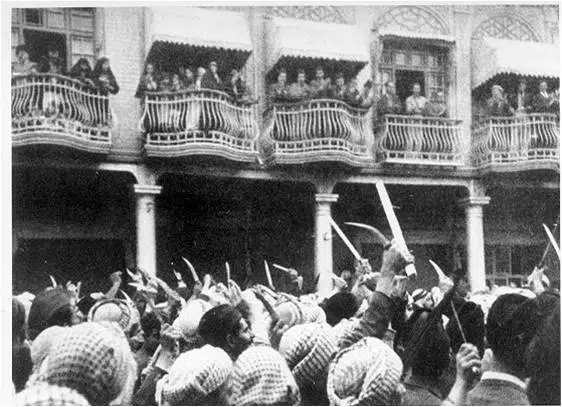
The Iraqi Jewish community of approximately 135,000 in 1948 had lived continuously in Mesopotamia for more than 2,500 years, and Baghdad's Jewish population had at moments in the early twentieth century been close to one-third of the city's total. The community's life (the Great Synagogue of Baghdad, the Frank Eini and Shamash schools, the Hakham Bashi's office, the commercial networks across the Tigris cities) was significant.
The Farhud of June 1–2, 1941 had already shifted the political ground for the community. In the postwar period, successive Iraqi governments, under the Hashemite monarchy and after, instituted increasingly restrictive policies. In 1948, following Iraq's entry into the Arab-Israeli War, the Iraqi government:
- Declared Zionism a criminal offense punishable by imprisonment.
- Arrested hundreds of Iraqi Jews on charges of Zionist sympathy.
- Conducted the public hanging on September 23, 1948 of Shafiq Ades, one of the wealthiest Jewish citizens of Basra, on fabricated charges of arms-trafficking. The Ades hanging, broadcast and publicized, was widely understood within the community as the signal that Iraqi Jews could no longer rely on their citizenship for protection.
- Imposed sweeping economic restrictions on Jewish businesses, including the dismissal of Jewish employees from government positions and the freezing of Jewish bank accounts.
In March 1950, the Iraqi parliament passed Law No. 1 of 1950, the Denaturalization Law, which permitted Iraqi Jews to renounce their citizenship and emigrate within a one-year window. The law was widely understood as the invitation for the community to leave; approximately 110,000 Iraqi Jews registered for departure during the one-year window. Operation Ezra and Nehemiah, the Israeli-organized airlift conducted between 1950 and 1951, transported approximately 110,000 to 130,000 Iraqi Jews to Israel.
In March 1951, immediately after the formal closure of the departure window, the Iraqi parliament passed Law No. 5 of 1951, freezing the assets of all Iraqi Jews who had renounced citizenship under the 1950 law. The cumulative effect was the legal seizure of Iraqi Jewish property at scale, with the dispossessed population permitted to leave only with the equivalent of approximately 50 US dollars in cash per family. The economic dispossession is documented in the records of the Joint Distribution Committee and in the subsequent claims literature; the World Organization of Jews from Arab Countries (WOJAC) has compiled significant documentation of the asset losses.
The Iraqi Jewish community that did not leave in 1950–1951 (approximately 5,000 to 10,000 people, primarily those who had not registered for the departure) was subjected to escalating restrictions across the 1950s and 1960s. In January 1969, the Iraqi Ba'athist government conducted public hangings of nine Iraqi Jews in Liberation Square in Baghdad on fabricated espionage charges. The 1969 hangings, broadcast and celebrated by the Iraqi government, accelerated the departure of the remainder of the community. By the late 1970s, the Iraqi Jewish community of 2,500 years had been reduced to a few dozen.
Yemen and Aden
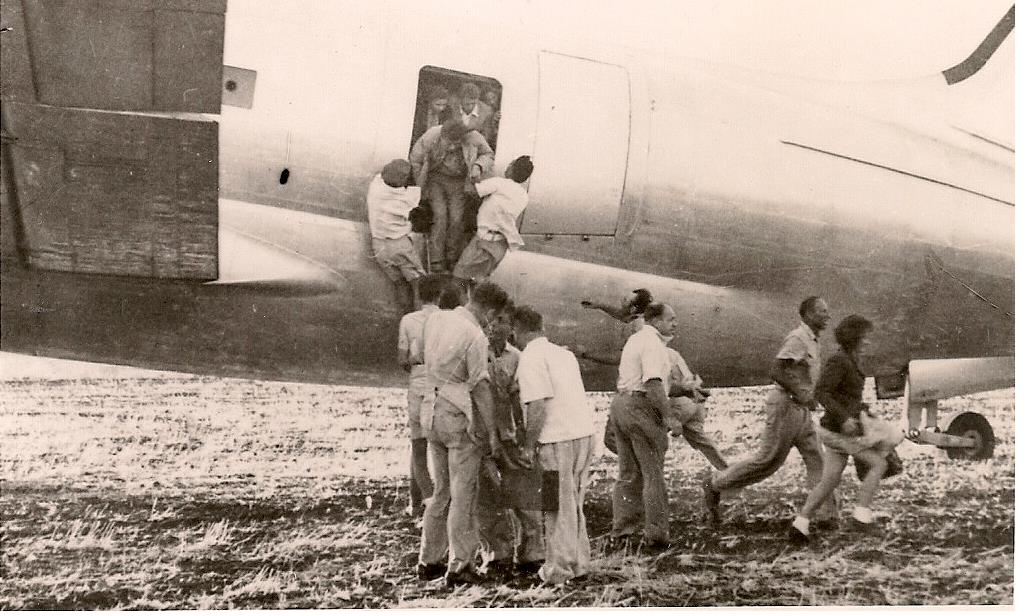
Operation Magic Carpet, 1949–1950.
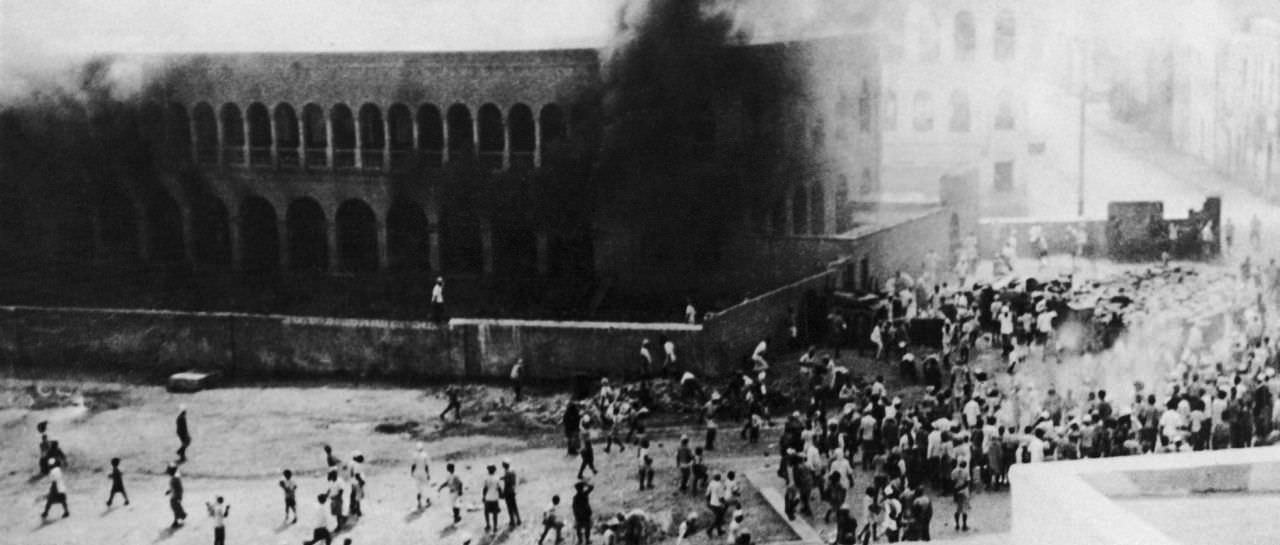
The Yemenite Jewish community traced its presence in Yemen to pre-Islamic antiquity, with significant communities at Sana'a, Aden, and dozens of smaller towns and villages across the country. The community was small in absolute numbers (approximately 63,000 at the start of the postwar period) but distinctive in its religious tradition, its Hebrew calligraphic and manuscript traditions, and its significant cultural separation from the broader Ashkenazi and Sephardic worlds.
The departure of the Yemenite community was driven by a combination of factors that crystallized in the immediate postwar period. The December 1947 Aden pogrom, documented above, produced the immediate displacement of the Aden Jewish community to refugee camps under British administration. The political climate in Yemen itself, under the Imam Yahya and after his 1948 assassination under the successor Imam Ahmad, included formal restrictions on Jewish life that had operated for centuries (under classical Yemenite religious law, Jewish residents were under restrictions including the so-called Orphan's Decree, which assigned guardianship of Jewish orphans under bar mitzvah age to Muslim authorities for forced conversion).
Operation Magic Carpet (Hebrew: Al Kanfei Nesharim, "On Eagles' Wings"), conducted between June 1949 and September 1950, transported approximately 49,000 Yemenite Jews from Aden, where the community had been gathered in a refugee camp known as Hashed, to Israel via American and British charter aircraft. An additional 14,000 had reached Israel by other routes before or after the operation. The Yemenite community departure was mostly complete by the mid-1950s, with the small residual community further reduced across the following decades. Fewer than a hundred Yemenite Jews remained in Yemen as of 2026.
Egypt
1948 internment, 1956 expulsion, and the 1967 final dismantling.
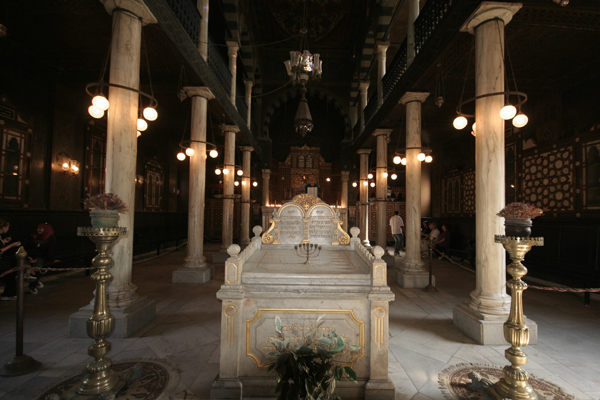
The Egyptian Jewish community of approximately 75,000–80,000 in 1948 was concentrated principally in Cairo and Alexandria, with smaller communities in the Delta cities. It was an exceptionally diverse community (Sephardic, Mizrahi, Karaite, Ashkenazi from late-nineteenth-century European migrations, and Levantine) with multiple foreign-citizenship statuses inherited from the Ottoman and British periods. Significant elements of the community held French, Italian, Greek, Spanish, or British citizenship rather than Egyptian.
The systematic dismantling of the Egyptian Jewish community took place in three identifiable phases.
The 1948 phase. Following Egypt's entry into the Arab-Israeli War in May 1948, the Egyptian government instituted internment of hundreds of Egyptian Jews under emergency-law provisions, conducted the bombings of Jewish neighborhoods in Cairo noted above, and froze the bank accounts of approximately one-third of the community. Approximately 20,000 Egyptian Jews departed in the immediate aftermath of these events, primarily to France, Italy, Brazil, and the United States, with smaller numbers going to Israel.
The 1956 phase. Following the Suez Crisis of October–November 1956, the Egyptian government under Gamal Abdel Nasser declared all "Zionist" residents enemies of the state, instituted a formal expulsion order for British and French nationals (which affected a significant portion of the community holding those citizenships), and conducted mass arrests and internments. The 1956 expulsions and forced departures eliminated approximately 25,000 to 30,000 additional Egyptian Jews from the country. Property was confiscated through emergency legislation; departees were permitted to leave with approximately 20 Egyptian pounds in personal goods.
The 1967 phase. Following the Six-Day War of June 1967, the Egyptian government arrested approximately 425 of the remaining Egyptian Jewish men and interned them, in some cases for extended periods extending into 1970. The 1967 internments and the broader pressure produced the departure of essentially all of the remaining community. By the late 1970s, the Egyptian Jewish community of 2,000 years had been reduced to fewer than a hundred elderly residents.
The principal scholarly references on the Egyptian case are Joel Beinin's The Dispersion of Egyptian Jewry (University of California Press, 1998) and Gudrun Krämer's The Jews in Modern Egypt, 1914–1952 (University of Washington Press, 1989).
Libya
The 1945 pogrom, the 1948 pogrom, and the 1967 finale.
The Libyan Jewish community of approximately 38,000 in the immediate postwar period had been documented continuously in Libya from the late Roman period. The 1945 Tripoli pogrom documented above marked the beginning of a sustained period of violence and pressure. The 1948 Tripoli pogrom that followed Israeli independence further accelerated the departure trajectory.
Between 1948 and 1951, approximately 30,000 Libyan Jews, the great majority of the community, departed for Israel under the Israeli-organized emigration program. The remaining community of approximately 6,000 lived under increasingly restrictive conditions through the 1950s and 1960s under the United Kingdom of Libya (1951–1969). Following the outbreak of the Six-Day War in June 1967, riots in Tripoli killed at least 18 Libyan Jews and produced the displacement of essentially the entire remaining community within weeks. The Italian government conducted an organized evacuation of remaining Libyan Jews to Italy, where most of the displaced community ultimately settled.
The 1969 Libyan revolution under Muammar Gaddafi formally completed the dismantling. The new regime issued decrees in 1970 confiscating all remaining Jewish-owned property in Libya, including the synagogues, schools, communal buildings, and the cemeteries. By the early 1970s, the Libyan Jewish community of 1,900 years was effectively extinct. The principal scholarly reference is Maurice Roumani's The Jews of Libya: Coexistence, Persecution, Resettlement (Sussex Academic Press, 2008).
Syria and Lebanon
The Aleppo Codex
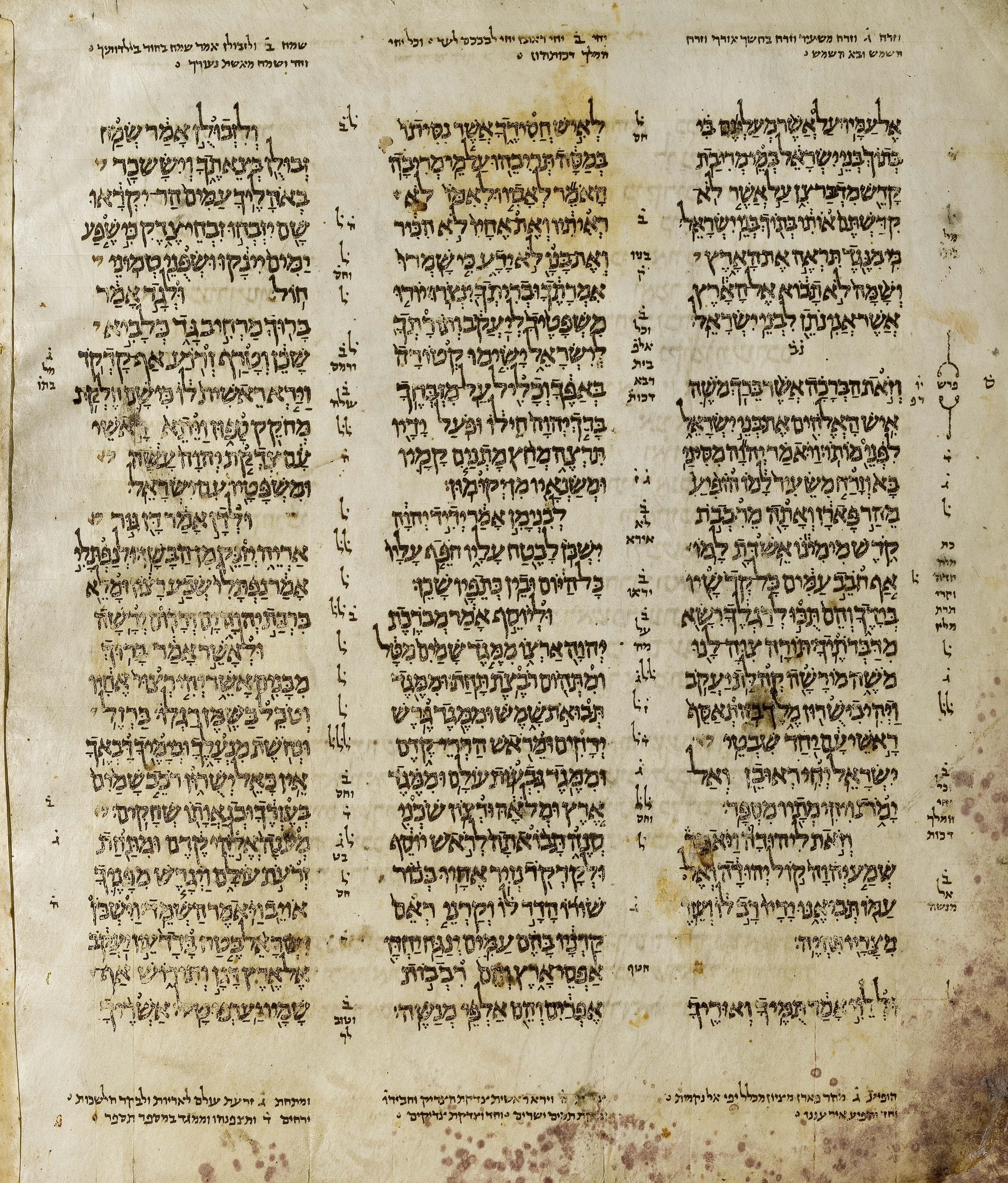
First look. Three columns of small, careful Hebrew writing fill a sheet of worn parchment, with even smaller notes around the edges. The large letters are the text of the Hebrew Bible; the tiny marginal notes are instructions, how each word is spelled, how it is pronounced, where the reader pauses. Together they make one of the most exact copies of the Hebrew Bible ever produced.
What it is. A page from the Aleppo Codex, a complete Hebrew Bible written by hand around 930 CE in Tiberias, in the Land of Israel, by scribes of the Ben-Asher family, the masters of the vowel and accent system that fixed how the biblical text is read. A codex is a bound book, the form that replaced the scroll for study.
When and where. Within a century the book reached Egypt, where the philosopher and legal authority Maimonides studied it and called it the most accurate text in existence. By the late fourteenth century it had come to the Jewish community of Aleppo, in northern Syria, where it was kept in the Great Synagogue for some six hundred years. The community guarded it so closely that it became known as the Crown of Aleppo.
Why it matters. On the night of 1 December 1947, days after the United Nations voted to partition British Mandatory Palestine, mobs attacked the Jewish quarter of Aleppo and set the Great Synagogue on fire. The codex was thought destroyed. It had in fact survived, hidden by members of the community, but pages were lost in the violence and its aftermath. The book kept whole for a thousand years was damaged in the same wave of attacks that ended Jewish life in the city.
Look closer. Of the roughly 487 original leaves, about 295 survive. Most of the Torah, the first five books, is gone; the manuscript now begins partway through Deuteronomy. Scholars still debate exactly how and when the missing leaves disappeared, during or after the 1947 fire. The gaps are not wear; they are the marks of a community's destruction left on its most precious book.
What came after. In the early 1950s the surviving portion was smuggled out of Syria and brought to Jerusalem, where it was given to the Ben-Zvi Institute. It became the base text for modern scholarly editions of the Hebrew Bible. A book made in the Land of Israel, carried to Egypt, treasured in Syria for six centuries, and damaged in the violence that emptied Aleppo of its Jews, returned at last to the place it was written.
The Aleppo Codex, the December 1947 pogrom, the long restriction, the 1992–1994 exit.
The Syrian Jewish community of approximately 30,000 in the late 1940s was concentrated in Aleppo, Damascus, and the smaller community of Qamishli in northeastern Syria. Aleppo's Jewish community had been documented continuously since the Roman period; the Central Synagogue of Aleppo had housed the Aleppo Codex, the earliest known complete Hebrew Bible codex, written in Tiberias c. 930 CE, for nearly a thousand years.
The December 1947 Aleppo pogrom destroyed significant portions of the community's infrastructure and mostly damaged the Aleppo Codex itself. The community's departure began in the immediate aftermath. From 1948 onward, however, the Syrian government instituted formal legal restrictions that made departure progressively more difficult. Syrian Jews were required to obtain government permission to travel, were prohibited from selling property without state approval, were required to maintain identity documents marking them as Jews, and were subjected to surveillance and periodic arrest under emergency-law provisions. Approximately 10,000 Syrian Jews succeeded in departing in the 1948–1951 period; the remainder lived under the restrictive regime through the 1950s, 1960s, 1970s, and 1980s.
The dismantling of the Syrian Jewish community was effectively completed in two phases. Between 1989 and 1992, sustained American diplomatic pressure on the Syrian government under Hafez al-Assad produced a relaxation of the departure restrictions; approximately 3,500 Syrian Jews departed under arrangements coordinated by US Senator Daniel Patrick Moynihan, the Conference of Presidents of Major American Jewish Organizations, and other diplomatic channels, primarily to the United States and to Israel via third countries. The 1992–1994 departure mostly completed the community's exit. Syria's Jewish community as of 2026 numbers a handful of elderly individuals.
The Lebanese Jewish community, approximately 5,000 at the moment of Lebanese independence and briefly larger in the early 1950s as Syrian refugees arrived, declined progressively across the Lebanese Civil War (1975–1990) period. The community is effectively zero in 2026.
Morocco
The protective monarchy and the large slow departure.

The Moroccan Jewish community of approximately 250,000–270,000 in 1948 was the largest single MENA Jewish community at the moment of Israeli independence. Moroccan Jews had been documented in Morocco continuously since the Roman period; the community had been mostly augmented after 1492 by Sephardic refugees from the Iberian expulsions and again after 1830 by smaller migrations.
The Moroccan case is the regional exception to the violent state-driven pattern documented in the other countries. The Moroccan monarchy, under Mohammed V during the wartime period and after independence in 1956 under Mohammed V and Hassan II, maintained a mostly protective posture toward the Jewish community. Mohammed V's wartime stance is documented in The Holocaust in MENA; the postwar monarchy continued the posture of protection.
The departure of the Moroccan community was nonetheless significant. It was driven by a combination of factors: the broader regional pressures and the example of other MENA communities, the dynamics of decolonization (Morocco gained independence from France in 1956), the economic dynamics that affected significant segments of the community, the Zionist organizational efforts that operated within Morocco across the late 1940s and 1950s, and a series of specific events including the late-1950s prohibition on emigration (which produced clandestine departure operations) and the 1961 lifting of those restrictions. Operation Yachin, conducted between 1961 and 1964 under arrangements negotiated between Israel and the Moroccan monarchy with significant American Jewish support, transported approximately 97,000 Moroccan Jews to Israel.
The Moroccan community departure took place across a longer time frame than the other regional cases, most of it between 1948 and 1972, and produced a less complete result. Approximately 2,000 Jews remained in Morocco as of 2026, primarily in Casablanca and Rabat, with active synagogues and a functioning communal infrastructure. The Moroccan case is in the regional record because it documents that the dismantling pattern, while regionally pervasive, was not uniformly enforced by every regional government, and that the postures of specific governments and rulers shaped the outcomes mostly.
Tunisia
The community that survived the Holocaust era only to be displaced after.
The Tunisian Jewish community of approximately 105,000 in 1948 had survived the German occupation of November 1942 – May 1943 documented in The Holocaust in MENA mostly intact in terms of population, though with significant property losses and trauma. The postwar departure proceeded in two principal waves.
The first wave, between 1948 and 1956, was driven by the broader regional pressures and by the unsettled politics of the late French colonial period in Tunisia. Approximately 50,000 Tunisian Jews departed during this period, primarily to Israel and to France.
The second wave followed Tunisian independence in 1956 and the subsequent dismantling of the structures that had supported Jewish communal life in Tunisia under the French protectorate. The Bourguiba government's nationalist policies, while not as overtly hostile as the patterns in Iraq, Egypt, or Libya, produced a sustained departure pressure through the late 1950s and 1960s. Anti-Jewish riots in Tunis in 1961 (during the Bizerte crisis) and in 1967 (following the Six-Day War) accelerated specific waves of departure. By the mid-1970s, the community had been reduced to approximately 7,000, principally in Tunis and on the island of Djerba where the historic synagogue at El Ghriba, believed to incorporate elements dating to late antiquity, remains in operation.
Approximately 1,000 to 1,500 Jews remained in Tunisia as of 2026, principally on Djerba. The El Ghriba synagogue continues to operate and remains a pilgrimage site, though it has been the target of antisemitic violence in the contemporary period, most notably the 2002 al-Qaeda bombing that killed 21 people.
Algeria
The community that left with the French.
The Algerian Jewish case is distinct from the other regional cases because of the legal status the community held under the Crémieux Decree of 1870, which had granted French citizenship to Algerian Jews. The Vichy abrogation of the decree in 1940 (documented in The Holocaust in MENA) and its restoration in October 1943 returned the community to French citizenship.
The Algerian Jewish community of approximately 140,000 at the close of the colonial period departed Algeria almost entirely in the months surrounding Algerian independence in July 1962. The community's departure was mostly aligned with the broader exodus of the pieds-noirs European settler population. Approximately 130,000 of the 140,000 Algerian Jews departed in 1962, the great majority going to metropolitan France. Smaller numbers went to Israel. Within months, the Algerian Jewish community of nearly two thousand years was mostly eliminated.
The Algerian case is distinct in that the departure occurred in the context of decolonization rather than as the result of independent post-independence state actions against the Jewish community. The Algerian government did not need to expel the community; the community departed under the broader logic of decolonization. The result, however, was the same regional outcome: the elimination of a centuries-old Jewish community from the country of its long presence.
Iran
The 1979 break.
The Iranian Jewish community is the major regional exception in temporal terms. The community, approximately 100,000–120,000 at the postwar peak, lived through the 1945–1972 period that frames most of the other regional departures with significant continuity. The Pahlavi monarchy maintained a mostly protective posture toward the Jewish community across the 1940s, 1950s, 1960s, and 1970s. Iranian Jews were citizens, participated in public life, operated communal institutions, and lived in conditions mostly different from the patterns documented in the Arab countries.
The major break came with the 1979 Iranian Revolution and the establishment of the Islamic Republic. The new regime executed several prominent Iranian Jewish citizens in the early postrevolutionary period, instituted formal restrictions on the life of the community, and produced sustained departure pressure. Between 1979 and the mid-1980s, approximately 80,000 Iranian Jews departed, primarily to the United States (most prominently the Iranian Jewish community of Los Angeles, the largest single concentration in the diaspora) and to Israel.
An Iranian Jewish community of approximately 8,000 to 10,000 remained in Iran as of 2026, principally in Tehran, Isfahan, and Shiraz. The community continues to operate synagogues, schools, and communal institutions under formal regulation by the Iranian state. The Iranian case is the largest remaining MENA Jewish community outside Israel, and is the only major regional case in which the principal departure occurred in the post-1972 period.
Where they went
The receiving societies.
The destinations of the approximately 850,000 displaced Jews from the MENA region:
- Israel. Approximately 600,000 of the displaced eventually settled in Israel, the largest single destination by a significant margin. The Israeli reception, particularly in the absorption of the Yemenite community in 1949–1950 and the Iraqi community in 1950–1951, took place under conditions of significant economic hardship and produced a long and complex social-historical record that has been the subject of significant subsequent scholarship and political contestation within Israeli society itself.
- France. Approximately 200,000–230,000 of the displaced settled in France, principally from the North African communities. The Algerian, Moroccan, and Tunisian Jewish populations of France mostly reshaped French Jewish demography in the postwar period; by the 1970s, the majority of French Jewry was of North African origin.
- The United States. Approximately 25,000–30,000 of the displaced settled in the United States, with the Syrian Jewish community of Brooklyn and the Iranian Jewish community of Los Angeles being the two largest distinct subcommunities.
- Canada, the United Kingdom, Italy, Brazil, Argentina, Mexico, and elsewhere. Smaller communities received the remainder.
The receiving societies, particularly Israel and France, were themselves mostly transformed by the absorption. The significant Mizrahi and Sephardic dimension of contemporary Israeli society and the significant North African dimension of contemporary French Jewry are both direct consequences of the 1945–1972 regional displacement.
Property and the question of restitution
The record continues.
The departure produced significant property losses. The departing communities, in most regional cases, were permitted to leave with sharply limited personal goods and minimal cash. Real estate, businesses, communal property (synagogues, schools, cemeteries, communal buildings), and financial assets were left behind. The aggregate scale of the dispossession is the subject of ongoing documentation by the World Organization of Jews from Arab Countries (WOJAC), the Jewish Justice for Jews from Arab Countries organization, and parallel bodies. The numerical estimates vary mostly depending on methodology; aggregate figures range from approximately $6 billion (in 2007 dollars, in some estimates) to mostly higher figures in others.
The question of restitution for Jewish property from the MENA region has been an ongoing diplomatic, legal, and political matter for more than seventy years. The 2008 US Congressional Resolution H. Con. Res. 185, passed unanimously, explicitly affirmed that "the United States, in its bilateral discussions with other states and in multilateral fora, should consistently encourage all parties to take measures to ensure that any explicit reference to Palestinian refugees in any official document is matched by a similar reference to Jewish and other refugees, as a matter of law and equity." The resolution is part of the record of the question, not its resolution.
The property question is part of the documentary record. The political and legal mechanisms by which the property losses might ultimately be addressed remain open. The scholarship on the question is significant and is the appropriate reference for students researching the issue in depth.
International recognition
The documentation.
The recognition of the MENA Jewish departure as a significant twentieth-century population displacement has been the work of several bodies.
- The State of Israel formally designated November 30 as the National Day of Commemoration for the Jewish Refugees from Arab Countries and Iran by legislation passed in 2014.
- The United States Congress passed Public Law 110-93, signed in 2008, and the 2008 Congressional Resolution H. Con. Res. 185 noted above.
- JIMENA (Jews Indigenous to the Middle East and North Africa), founded 2002, is the principal American educational nonprofit dedicated to the documentation of the regional Jewish communities and their displacement. JIMENA's materials are among the strongest single resources for classroom use.
- The Babylonian Jewry Heritage Center in Or Yehuda, Israel, is the center for the documentation of Iraqi Jewish history and the 1950–1951 departure.
- The Or Shalom Center for Libyan Jewish Heritage documents the Libyan case.
- The American Sephardi Federation at the Center for Jewish History in New York holds significant archival material on the regional Sephardic and Mizrahi communities.
- ANU · Museum of the Jewish People in Tel Aviv provides full documentation of all the MENA communities within the broader framework of the global Jewish diaspora.
- The Cinema of Jewish Refugees from Arab Countries: the significant body of documentary and oral-history film produced across the past two decades, provides further documentary access for classroom and individual study.
The international recognition of the regional displacement has lagged mostly behind the recognition of other twentieth-century population displacements of comparable scale. This asymmetry is part of the historical record, noted here without making it the centerpiece of the Topic; the documentation is now significant, available, and increasingly integrated into the broader scholarly literature on twentieth-century population displacement.
Key takeaways
- Jewish communities lived across the Middle East and North Africa continuously for centuries (in Iraq, for more than 2,500 years) long before the modern states that displaced them.
- Between roughly 1945 and 1972, about 850,000 of these Jews were displaced. The communities were dismantled: their institutions closed, their property seized, their legal standing revoked.
- The departure was driven by the policies of the home states, and the pattern was already in motion before the State of Israel was founded in 1948.
- The communities did not vanish, they were rebuilt elsewhere, chiefly in Israel, France, and the Americas, where their traditions continue.
Classroom Connections
Where this Topic fits.
Teaching Connections
The disciplines and courses this Topic naturally supports, for any educator, anywhere.
- World History, Decolonization & the Modern Middle East: the 1945–1972 departure as one of the largest single population displacements of the postwar period.
- World History, Human Rights: the displacement of roughly 850,000 Jews from Arab lands and Iran.
- World History, WWII & the Postwar Era: the pre-1948 events: the Farhud, the 1945 Tripoli and Cairo pogroms, and the 1947 Aden and Aleppo pogroms.
- United States History: the American reception and resettlement of MENA Jewish refugees after 1945.
- Historical Thinking: causation and framing: what caused the departure, and what did not.
- Source Analysis & Archives Education: oral histories, archives, and documentary film.
Standards Alignment
- NYS Global History & Geography: 10.10 (human rights, the displacement of roughly 850,000 Jews from Arab lands and Iran).
- Common Core ELA-Literacy: RH.11–12.7 (integrating multiple sources).
- C3 Framework: Dimension 2 (causation and multiple perspectives: what caused the departure, and how the parallel events of the period relate).
Further Teaching Resources
- The departure on film, the Films & Video collection, organized by region (Remember Baghdad, The Last Jews of Baghdad, Forget Baghdad, and more).
- JIMENA, Jews Indigenous to the Middle East and North Africa: educational resources and a recorded oral-history program of community members describing departure and resettlement. JIMENA oral histories →
- University of Washington Sephardic Studies: a digital collection of documents, recordings, and scholarship on Sephardic and Mizrahi life, free for classroom use. UW Sephardic Studies →
- Unpacked, "The Farhud: The Nazi-Fueled Pogrom in Iraq": an educational feature with photographs and video on the 1941 Farhud and its place in the Iraqi-Jewish departure. unpacked.media →
- World Jewish Congress, Legacy of Jews in MENA: country-by-country profiles of the Jewish communities of the Middle East and North Africa, with history, photographs, and the story of each departure. worldjewishcongress.org →
Sources and citations
Primary sources come straight from the time: documents, letters, speeches, images, and objects created by the people involved. Secondary sources come later: books, articles, and analysis in which scholars study and interpret those primary sources.
Primary sources
- U.S. Congress. House Resolution 185, 110th Cong., 2nd sess., April 1, 2008. (On Jewish refugees from Arab and Muslim-majority countries.)
- Babylonian Jewry Heritage Center, Or Yehuda, Israel. collection on Iraqi Jewry and Operation Ezra and Nehemiah.
- Or Shalom Center for Libyan Jewish Heritage. collection on Libyan Jewry.
- Iraq. Law No. 1 of 1950 (the Denaturalization Law, permitting Jews to leave upon renouncing citizenship) and Law No. 5 of 1951 (freezing the property of departing Jews).
- Libya. The law of July 21, 1970, confiscating the property of the Jews who had left Libya.
Secondary sources
- Stillman, Norman A. The Jews of Arab Lands in Modern Times. Philadelphia: Jewish Publication Society, 1991.
- Cohen, Hayyim J. The Jews of the Middle East, 1860–1972. Jerusalem: Israel Universities Press, 1973.
- Lewis, Bernard. The Jews of Islam. Princeton: Princeton University Press, 1984.
- Roumani, Maurice M. The Jews of Libya: Coexistence, Persecution, Resettlement. Brighton: Sussex Academic Press, 2008.
- Beinin, Joel. The Dispersion of Egyptian Jewry: Culture, Politics, and the Formation of a Modern Diaspora. Berkeley: University of California Press, 1998.
- Krämer, Gudrun. The Jews in Modern Egypt, 1914–1952. Seattle: University of Washington Press, 1989.
- Bashkin, Orit. New Babylonians: A History of Jews in Modern Iraq. Stanford: Stanford University Press, 2012.
- Meir-Glitzenstein, Esther. Zionism in an Arab Country: Jews in Iraq in the 1940s. London: Routledge, 2004.
- Shenhav, Yehouda. The Arab Jews: A Postcolonial Reading of Nationalism, Religion, and Ethnicity. Stanford: Stanford University Press, 2006.
- Stein, Sarah Abrevaya. Family Papers: A Sephardic Journey Through the Twentieth Century. New York: Farrar, Straus and Giroux, 2019.
- Laskier, Michael M. North African Jewry in the Twentieth Century: The Jews of Morocco, Tunisia, and Algeria. New York: NYU Press, 1994.
- Boum, Aomar. Memories of Absence: How Muslims Remember Jews in Morocco. Stanford: Stanford University Press, 2013.
- Levy, Lital. Poetic Trespass: Writing Between Hebrew and Arabic in Israel/Palestine. Princeton: Princeton University Press, 2014.
- Behar, Moshe, and Zvi Ben-Dor Benite, eds. Modern Middle Eastern Jewish Thought: Writings on Identity, Politics, and Culture, 1893–1958. Waltham: Brandeis University Press, 2013.
- Schroeter, Daniel J. The Sultan's Jew: Morocco and the Sephardi World. Stanford: Stanford University Press, 2002.
- Tobi, Yosef. The Jews of Yemen: Studies in Their History and Culture. Leiden: Brill, 1999.
- Parfitt, Tudor. The Road to Redemption: The Jews of the Yemen, 1900–1950. Leiden: Brill, 1996.
- Zenner, Walter P. A Global Community: The Jews from Aleppo, Syria. Detroit: Wayne State University Press, 2000.
- Sutton, David E. Aleppo Chronicles: The Story of the Unique Sephardeem of the Ancient Near East. Brooklyn: Magen David Publications, 1988.
- JIMENA · Jews Indigenous to the Middle East and North Africa. jimena.org.
- American Sephardi Federation. Center for Jewish History, New York. americansephardi.org.
- ANU · Museum of the Jewish People, Tel Aviv. anumuseum.org.il.
Finding these documents: many primary sources are free online. Good places to start are the Fordham Internet Jewish History Sourcebook, Yale’s Avalon Project (law and diplomacy), German History in Documents, the collections of the US Holocaust Memorial Museum and Yad Vashem, the National Library of Israel, and Sefaria (for Jewish texts). Search the document’s name and date.
Three million Jews kept from leaving, and the movement that got them out, the dismantling of Jewish life under the Soviet state, the Black Years, the refuseniks, Jackson-Vanik, and the great exodus to Israel, America, and Germany.
Comments?
Write to editor@makorproject.org.
Last updated: August 2026.