For most of two thousand years, the largest and oldest Jewish communities on earth were not in Europe. They were in Baghdad and Cairo, in Persia and Morocco, in the highlands of Ethiopia and a city in central China. Scattered across three continents, they stayed one people, in steady contact for centuries.
Why this Topic exists
The Jewish world was a network, not an outpost.
It is easy to picture Jewish history as a single line from ancient Israel to modern Europe, with everything important happening in one corner of the map and the communities outside Europe treated as minor branches. The record shows the opposite. For long stretches of history the largest and most influential Jewish communities were in the Middle East and North Africa, not in Europe. The legal and intellectual center of gravity sat for centuries in what is now Iraq. The map below is not a list of exotic outliers. It is the ordinary shape of the Jewish world.
The point of this overview is to give you that whole shape before you study any single piece of it. The eight Topics that follow are deep looks at particular communities. Read on their own, eight separate pages can read like a ranking, as if these were the eight that mattered and the rest were footnotes. They are not a ranking. They are worked examples, chosen because each one is well documented and teaches something the others do not.
Common misconceptions this Topic addresses
The diaspora is often pictured as scattered, isolated, and centered mainly in Europe. The historical record shows something else.
- "Jewish history runs from ancient Israel straight to modern Europe." For most of two thousand years the largest, oldest, and most influential Jewish communities were in the Middle East and North Africa, not Europe. see the dedicated entry →
- "The diaspora communities were isolated from one another." They were a network, sharing texts, law, a calendar, trade, and scholars who moved between them. A ruling from the academies of Iraq could shape practice in Spain. see the dedicated entry →
A world built in waves
These communities formed in waves, and the waves overlap.
Jewish communities did not all begin at once, and they did not begin at random. They formed in distinct waves of movement, each set off by a particular event. Knowing the waves is what keeps the map below from looking like scattered dots; it shows which communities are old and which are newer. (For why the diaspora held together as one people across all of them, see the Unit 1 Topic The Diaspora as a Phenomenon; this overview uses the waves only to place the communities in time.)
The first wave began in 586 BCE, when the Babylonian Empire, centered in present-day Iraq, conquered the Kingdom of Judah, destroyed the First Temple, and deported much of the population eastward. When the Persians later permitted a return, many chose to stay. That decision created the Babylonian community, which became the long spine of the diaspora and persisted through every wave that followed.
The second wave spread Jews across the Greek- and Roman-ruled Mediterranean in the centuries on either side of the year zero, reaching Egypt, Asia Minor, Greece, and Rome itself, drawn by trade and the reach of empire. Jewish life in Italy dates to this period and has continued there, without a break, ever since.
The third wave came with the Roman conquest of Judah and the destruction of the Second Temple in 70 CE, the dispersal most people picture when they hear the word "diaspora." It was large, but the communities of the East were already old by the time it happened.
The fourth wave is medieval and modern: the rise of Jewish life in the Rhineland and Eastern Europe (Ashkenaz); the expulsion of Jews from Spain in 1492, which scattered Sephardi Jews across the Ottoman Empire, the Netherlands, North Africa, and the New World; and the great movements of the twentieth century: the mass migration to the United States, the near-total departure of Jews from Arab and Muslim lands after 1948, and the airlifts that brought Ethiopian Jews to Israel. A continuous Jewish presence in the Land of Israel ran through all four waves; this Unit follows the communities that lived outside it.
The spread
Where the communities were.
Eight of these communities have their own Topic in this Unit. Many others do not, not because they matter less, but because a curriculum has to start somewhere. Here are several of them in brief, so the map is whole even where the deep-dive is not yet written.
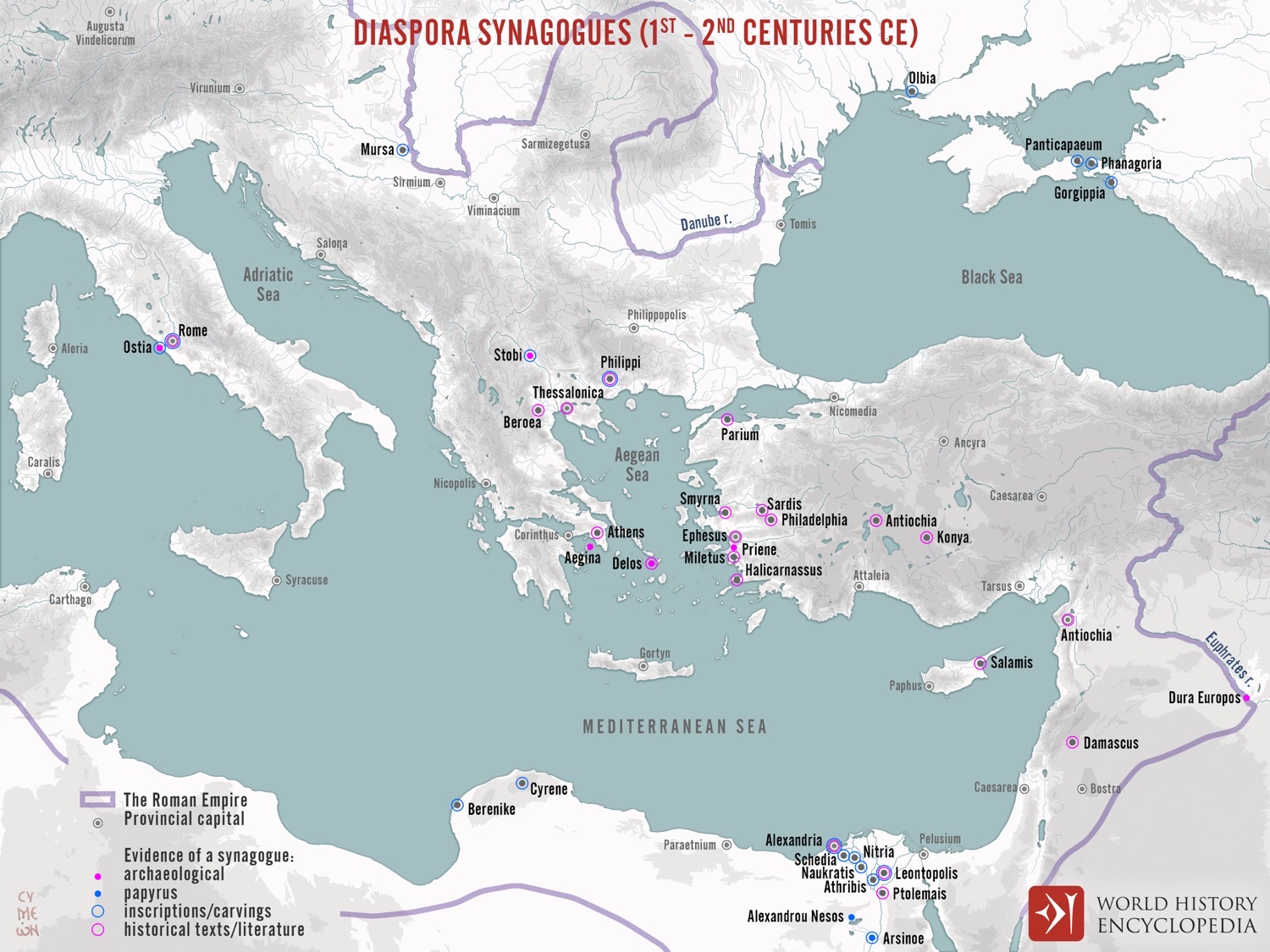
Iraq (Babylonia). The community of Mesopotamia is among the oldest in the entire diaspora, founded with the Babylonian exile of 586 BCE and continuous for some 2,500 years. Its academies compiled the Babylonian Talmud, the central text of rabbinic Judaism, and Baghdad remained a major center of Jewish life into the twentieth century. The community is followed in depth in its own Topic.
Iran (Persia). One of the oldest continuous Jewish communities on earth, present since the sixth century BCE, when Cyrus the Great allowed the exiles to return from Babylon. Persian Jews preserved their own language, Judeo-Persian, and lived across cities from Isfahan to Shiraz. Their long history is followed in its own Topic.
North Africa (the Maghreb). Jewish communities spread across Morocco, Algeria, Tunisia, and Libya, some predating the Arab conquest and some founded by Sephardi exiles after 1492. They produced major centers of learning and, in the modern period, lived under French and Italian colonial rule. Their story is followed in its own Topic.
Egypt. Jewish life along the Nile runs from antiquity through the great medieval community of Fustat (Old Cairo), whose synagogue storeroom, the Cairo Geniza, preserved nearly a thousand years of letters, contracts, and books. Maimonides led this community in the twelfth century. Most Egyptian Jews left in the years after 1948.
Spain and Portugal (Sepharad). The Jews of medieval Iberia built one of the most productive communities in Jewish history before the Spanish crown expelled them in 1492. That expulsion acted as an engine: Sephardi exiles carried their language (Ladino), their legal traditions, and their family names into the Ottoman Empire, the Netherlands, North Africa, and eventually the Americas. The Sephardi diaspora helps trace where the expulsion of 1492 reshaped the Jewish world.
Turkey (the Ottoman heartland). When Spain expelled its Jews in 1492, the Ottoman Empire welcomed them; Sultan Bayezid II is said to have marveled that Spain would impoverish itself to enrich his realm. Istanbul and Izmir became major Sephardi centers, and Ladino-speaking communities flourished across the empire for more than four hundred years.
The Rhineland and Eastern Europe (Ashkenaz). Jewish communities along the Rhine in the Middle Ages developed the traditions, the Yiddish language, and the scholarship that later spread across Poland, Lithuania, and the Russian Empire, becoming the largest Jewish population in the world by the modern period. Their story runs directly into Unit 3 and Unit 4.
Italy (Italkim). Among the oldest communities in the diaspora, Jewish life in Rome dates to the second wave and has continued in Italy without interruption for roughly two thousand years, older than both Ashkenaz and Sepharad. The Jewish catacombs of Rome, with their hundreds of inscriptions and carved menorahs, are the largest body of archaeological evidence for any early Jewish community in Europe.
Greece (Romaniote and Sephardi). Greece held two layers of Jewish life: the ancient Romaniote Jews, present since the Greco-Roman wave, and the Sephardi Jews who arrived after 1492. The port city of Salonika (Thessaloniki) became, for a time, a city with a Jewish majority and a center of Ladino print culture, before its community was almost entirely destroyed in the Holocaust.
Syria. The Jews of Aleppo and Damascus formed one of the Levant's oldest communities. Aleppo guarded the Aleppo Codex, the most authoritative manuscript of the Hebrew Bible, for centuries. The 1840 Damascus Affair, a blood-libel case, drew international attention and is followed in Unit 3.
The Caucasus and Central Asia. Several old communities lived along the Silk Road and in the mountains between the Black and Caspian Seas: the Mountain Jews of the eastern Caucasus, who spoke Judeo-Tat; the Georgian Jews, present for some two thousand years; and the Bukharan Jews of Central Asia, who spoke Bukhori, a Jewish form of Tajik. Most moved to Israel and the United States in the twentieth century.
Yemen. At the southern tip of the Arabian Peninsula, the Jews of Yemen kept distinctive customs, pronunciations, and manuscripts across many centuries of relative isolation. Nearly the entire community was airlifted to Israel around 1949–1950.
India. The Indian subcontinent held three long-separate Jewish communities: the Cochin Jews of the Malabar coast in the southwest, the Bene Israel of the Konkan coast near Bombay (Mumbai), and the Baghdadi Jews who arrived in the port cities under British rule. The Bene Israel lived for centuries in Marathi-speaking villages, so cut off from other Jews that Cochin teachers traveled to them in the 1800s to teach mainstream practice. The Cochin community's Paradesi synagogue, built in 1568 and still standing in the quarter of Kochi still called "Jew Town," is among the oldest in the Commonwealth. Notably, these communities report little history of antisemitism in India. Most of their members moved to Israel in the 1950s; their story is followed by the BBC and My Jewish Learning.
Kaifeng, China. A Jewish community settled in Kaifeng, on the Yellow River in Henan province, by about the tenth century, most likely arriving along the Silk Road from Persia. They built a synagogue in 1163 (in full Chinese architectural style, the building modeled in the banner above) and left a set of carved stone inscriptions recording their own history. The community flourished into the eighteenth century, then declined; by 1850 only about two hundred Jews remained, without a rabbi. One of their Torah scrolls is now in the British Library, and their story is told further by My Jewish Learning.
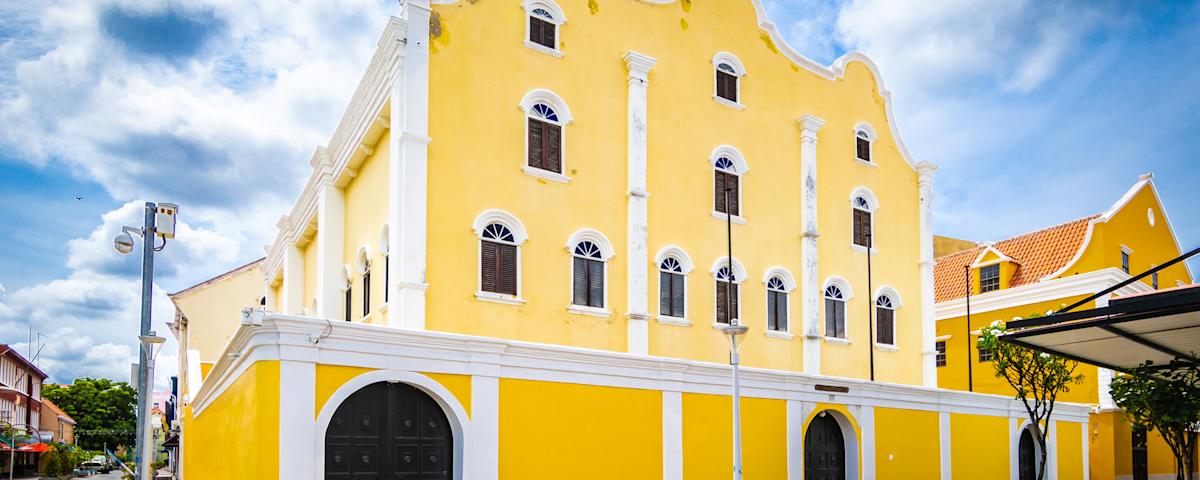
Latin America and the Caribbean. The Sephardi dispersion after 1492 reached the New World early. A Jewish community took root at Recife in Dutch-held Brazil, and when the Portuguese retook the city, refugees from it reached New Amsterdam (today's New York) in 1654, the beginning of organized Jewish life in what became the United States. Other communities settled across the Caribbean. The Mikvé Israel-Emanuel synagogue in Willemstad, Curaçao, consecrated in 1732, is the oldest synagogue in continuous use anywhere in the Americas; its sanctuary keeps a sand floor, a Sephardi custom often said to recall the years when Jews in Iberia had to worship in secret.
One pattern, many tongues
Read in Hebrew letters, spoken in a hundred places.
Nothing shows the balance of difference and connection better than the languages these communities spoke. Hebrew remained the language of prayer, scripture, and scholarship, but for much of Jewish history it was not the everyday language of most Jews. Around the start of the Common Era, Jews in the Land of Israel had already shifted from Hebrew to Aramaic; from then on, wherever a community settled, it tended to take up the local language and make it its own.
The Jews of the Middle East and North Africa spoke Judeo-Arabic. In Iran and Afghanistan, as early as the eighth century, Jews spoke Judeo-Persian. In Italy, Judeo-Italian; in the Caucasus, Judeo-Tat; in Central Asia, Bukhori, a form of Tajik. The two best known are Yiddish, the language of Ashkenaz, medieval German woven through with Hebrew and, later, Slavic, and Ladino (Judeo-Spanish), carried out of Spain in 1492 and kept alive in the Ottoman Empire for four more centuries. In all, Jews have spoken several dozen distinct language varieties, from southern India to Morocco to the Caucasus.
Here is the part that ties the whole Unit together: almost all of these languages, however different they sounded, were written in the same Hebrew alphabet. A Jew in Baghdad writing Judeo-Arabic and a Jew in Salonika writing Ladino used letters the other could read, even when neither could understand the other's speech. The shared script is the connection you can see on the page; the local language underneath it is the difference. Most of these languages are now endangered or gone, thinned by migration, the Holocaust, Soviet suppression, and the pull of new national languages, which is part of why they are worth knowing about at all.
Eight worked examples
The Topics that follow.
Each of the eight Topics in this Unit takes one community and follows it closely, its beginning, its depth, and in many cases its end. Read them as samples of the whole, not as the whole itself.
- The Jews of Iraq, the first-wave community and the long center of Jewish law.
- The Jews of North Africa, Morocco, Algeria, Tunisia, and Libya across centuries.
- The Jews of Iran, one of the oldest continuous communities, on Persian soil.
- The Departure from MENA, how the Middle Eastern and North African communities ended.
- Soviet Jewry, Jewish life and the struggle to leave the Soviet Union.
- American Jewry, from 1654 to the largest diaspora community today.
- Ethiopian Jewry, Beta Israel, the community of the Ethiopian highlands.
- The Modern State of Israel, where many of these communities reconverged.
Key takeaways
- Jewish history did not run through one region. For most of two thousand years its center of gravity was outside Europe: in Iraq, North Africa, Iran, and across the Mediterranean.
- The communities formed in distinct waves of movement, each set off by a particular event, beginning with the Babylonian exile of 586 BCE.
- They were genuinely different worlds: different languages, rulers, food, music, and at the same time a connected network, sharing texts, a calendar, law, and scholars who moved between them.
- The eight community Topics that follow are samples of the whole, not the whole, chosen because a curriculum has to start somewhere, not because the others matter less.
- Many of these communities ended within a single lifetime; the Unit traces both how they were built and, where it applies, how they came apart.
Classroom Connections
Where this Topic fits.
Teaching Connections
The disciplines and courses this Topic naturally supports, for any educator, anywhere.
- World History, the First Civilizations: the diaspora’s origin in 586 BCE Mesopotamia (present-day Iraq), tied to the river-valley civilizations and the Babylonian Empire.
- World History & Belief Systems: how a single belief system held a people together across vast distances, through shared texts, a shared calendar, and a shared script.
- World History, the Classical World: the spread across the Greek- and Roman-ruled Mediterranean and the Roman destruction of the Second Temple in 70 CE.
- Trade Networks & an Interconnected World: the responsa system and the Cairo Geniza document a connected medieval economy stretching from Spain to India.
- Geography: the shape of the whole Jewish world across three continents.
- Languages & Linguistics: the diaspora’s languages (Judeo-Arabic, Ladino, Yiddish, Judeo-Persian) written in the Hebrew alphabet, one pattern repeated across the map.
Standards Alignment
- NYS Global History & Geography: 9.1 (the first civilizations), 9.2 (Belief Systems, incl. 9.2b “belief systems were often used to unify groups of people”), and 9.3 (the classical world).
Sources and citations
Primary sources come straight from the time: documents, letters, speeches, images, and objects created by the people involved. Secondary sources come later: books, articles, and analysis in which scholars study and interpret those primary sources.
Primary sources
- The Cairo Geniza. Hundreds of thousands of manuscript fragments, letters, contracts, and everyday documents from the Ben Ezra Synagogue in Fustat (Old Cairo), spanning roughly the 9th to the 19th centuries. The largest holding is the Taylor-Schechter Genizah Collection at Cambridge University Library, with digitized images free online via the Cambridge Digital Library. Two Geniza manuscripts are in the Makor Museum.
- Benjamin of Tudela. The Itinerary of Benjamin of Tudela, c. 1165–1173. The great medieval travel account of Jewish communities from Spain to Baghdad and beyond, with population counts and named leaders for each. Translated by Marcus Nathan Adler, 1907.
- The Kaifeng synagogue stelae, 1489 and 1512. Stone inscriptions in which the Jews of Kaifeng, China recorded their own history, beliefs, and the rebuilding of their synagogue. Kaifeng Municipal Museum.
- Abraham ibn Daud. Sefer ha-Qabbalah (The Book of Tradition), Toledo, 1161. The medieval chronicle of how learning passed from Babylonia to the communities of Spain and North Africa.
- The Cochin copper plates, c. 1000 CE. The privileges granted by the Chera ruler to Joseph Rabban and the Jews of the Malabar coast, engraved in copper and kept at the Paradesi Synagogue, Kochi, India.
Secondary sources
- Goitein, S. D. A Mediterranean Society: The Jewish Communities of the Arab World as Portrayed in the Documents of the Cairo Geniza. 6 vols. University of California Press, 1967–1993. (The foundational study of the connected medieval diaspora, built from the Cairo Geniza documents.)
- Stillman, Norman A. The Jews of Arab Lands: A History and Source Book. Philadelphia: Jewish Publication Society, 1979.
- Ben-Sasson, H. H., ed. A History of the Jewish People. Cambridge, MA: Harvard University Press, 1976.
- Gerber, Jane S. The Jews of Spain: A History of the Sephardic Experience. New York: Free Press, 1992.
- Rutgers, Leonard V. The Jews in Late Ancient Rome. Leiden: Brill, 1995. (On the Roman Jewish community and the catacomb evidence.)
- Many of the objects and texts referred to here can be explored through the holding institutions: the Metropolitan Museum of Art, the British Museum, and the open-source Jewish library at Sefaria.
Finding these documents: many primary sources are free online. Good places to start are the Fordham Internet Jewish History Sourcebook, Yale’s Avalon Project (law and diplomacy), German History in Documents, the collections of the US Holocaust Memorial Museum and Yad Vashem, the National Library of Israel, and Sefaria (for Jewish texts). Search the document’s name and date.
This Unit opens with the whole diaspora in view. The Topics that follow visit individual communities (in Iraq, North Africa, Iran, and beyond) one at a time.
For more than 2,500 years, Iraq held one of the oldest and most influential Jewish communities on earth, the home of the great academies, a modern urban world, and a presence that ended in a single generation.
Comments?
Write to editor@makorproject.org.
Last updated: August 2026.