For a thousand years the Jewish people had no country, no army, and no capital, scattered across three continents, speaking different languages. By every rule of history they should have dissolved into strangers. Instead, a question could leave a synagogue in Spain, travel by ship and camel to a scholar in Baghdad, and the answer would come back and be followed. They ran a civilization by mail.
Why this Topic exists
The diaspora is a network, not a list of expulsions.
Most of the time, when school history mentions the Jewish diaspora, it shows up as a string of disasters: the Babylonians destroy Jerusalem and march the Jews off to Babylon in 586 BCE; the Romans burn the Second Temple in 70 CE; Spain expels its Jews in 1492; waves of mob violence sweep the Russian Empire in the late 1800s. Each of these happened, and each matters. But a list of times Jews were forced to move tells you almost nothing about what the diaspora actually was for most of its history.
Because for century after century, the diaspora was not a scattering of broken-off pieces. It was a working system: communities spread from Spain to Iraq to Yemen that stayed in touch, answered to the same law, prayed nearly the same prayers, sent letters and scholars and books back and forth, traded along the same routes, and kept a shared sense of pointing back toward one place. This Topic looks at how that system worked. The forced expulsions belong to the Topics that tell each region's story; here, the subject is the machinery that held it all together.
How to read this Topic
Three ideas worth correcting before we start.
Common misconceptions this Topic addresses
Most people carry a few assumptions about the diaspora that the historical record doesn't support. Each links to its dedicated entry in the Misconceptions reference.
- "The diaspora began when the Romans destroyed the Temple in 70 CE." See the entry →
- "The diaspora was just scattered, disconnected communities." See the entry →
- "'Diaspora' means exile, a punishment Jews were simply waiting to end." See the entry →
- "Most Jews historically were Eastern European and Ashkenazi." See the entry →
A note on the word
Where the word "diaspora" comes from.
"Diaspora" comes from a Greek word, diaspora, meaning "a scattering," the way a farmer scatters seed. Greek-speaking Jews used it more than two thousand years ago when they translated the Hebrew Bible into Greek (a translation called the Septuagint, made in Egypt in the 200s BCE). So the word has been attached to the Jewish experience from very early on.
Today scholars use "diaspora" for many scattered peoples: the Armenian, Greek, Irish, Chinese, Indian, and African diasporas, among others. The Jewish case is one of the historical examples scholars most often use for comparison, partly because it lasted so long and partly because of how tightly it remained connected. That comparison is itself a useful classroom tool, and we come back to it at the end.
One more note about words. In Hebrew, two different terms get translated as "diaspora," and they don't mean quite the same. Galut means "exile", being driven out, against your will, after a defeat. Tefutzot means "dispersion", simply the fact of Jews living in many places, with no sense of punishment attached. We use the plain English word "diaspora" so that one era's feelings about the experience aren't stamped onto the whole long story.
It started before the exile
The diaspora was already old when the Temple fell.
Here is the fact that reorders the whole picture. The event everyone treats as the beginning of the scattering, the Romans destroying the Second Temple in Jerusalem in 70 CE, happened when the diaspora was already centuries old and thriving. By the time the Temple fell, the largest Jewish city in the world was not Jerusalem. It was Alexandria, in Egypt.
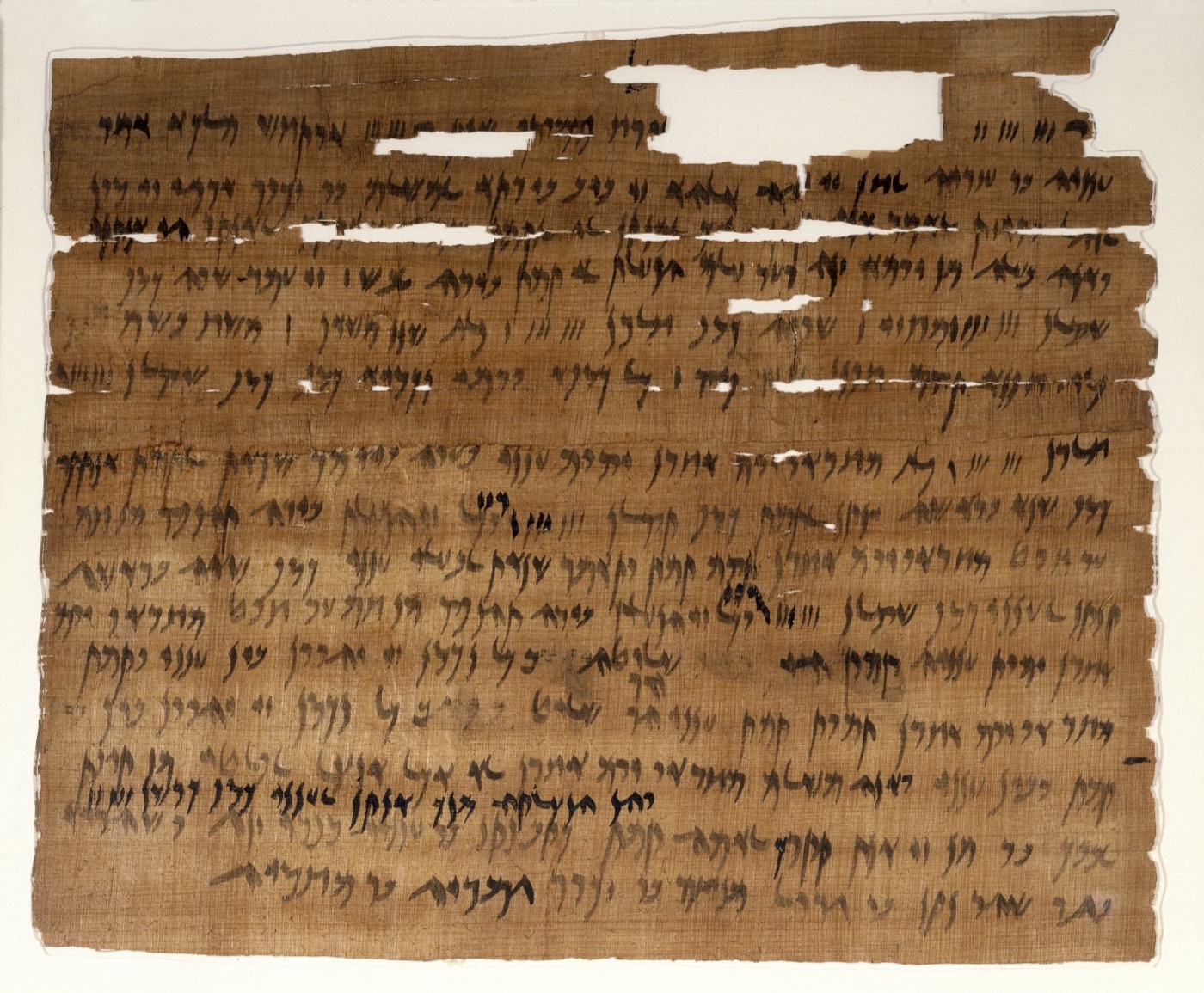
Trace it back. After the Babylonians conquered Jerusalem in 586 BCE, large Jewish communities settled across the Persian Empire, and Babylonia (roughly today's Iraq) stayed a center of Jewish life for more than a thousand years afterward. Then came Alexander the Great's conquests in the 330s and 320s BCE, which spread Greek culture across the eastern Mediterranean and pulled Jewish communities into the Greek-speaking world: Alexandria, Antioch (in today's Turkey), Cyrene (in today's Libya), and far beyond.
Alexandria's Jewish community was big enough, and Greek-speaking enough, that it needed the Bible in Greek, which is why the Septuagint translation was made there. One of its members, the philosopher Philo (born around 20 BCE), wrote a large body of work blending Jewish thought with Greek philosophy. None of this depended on Jerusalem falling. By the first century CE there were documented Jewish communities in Rome, across Asia Minor, in Egypt and Greece, and out past the edge of the Roman world in Babylonia and Persia. The destruction of 70 CE made the dispersion deeper and more permanent. It did not start it.
What held it together
Six threads kept the diaspora one people.
If communities were spread across thousands of miles, under different rulers, speaking different everyday languages, what stopped them from drifting into unrelated groups who forgot one another? Historians point to six connections that did the work. The rest of this Topic walks through each one.
- A network of letters. Communities wrote to each other constantly, sending legal questions, religious rulings, news, money, and scholarly arguments back and forth across the map.
- One shared law. Wherever they lived, communities followed the same body of Jewish law (called halakhah), with local variation but a common core and a built-in way to settle differences.
- Nearly the same prayers. A Jew from Poland could walk into a synagogue in Yemen and recognize the service: the same key prayers, the same weekly Torah reading, in the same order.
- The Jewish languages. Beyond Hebrew, the shared language of prayer and study, each region grew its own everyday Jewish language: Yiddish, Ladino, Judeo-Arabic, and more, tying a community both to its neighbors and to the wider Jewish world.
- Texts and people on the move. Scholars, rabbis, merchants, and refugees traveled the network, carrying books and ideas that kept distant communities in step with each other.
- Trade routes. Jewish merchants ran long-distance trading networks that linked the Mediterranean, the Sahara routes, the Indian Ocean, and later the Atlantic, moving goods and, with them, contact.
The network of letters
A civilization run by mail.
The single most striking feature of the Jewish diaspora is the letter-writing network that connected far-apart communities for roughly fifteen hundred years. The exact channels changed over the centuries, but the basic pattern held the whole time: a community with a question would write to a recognized center of learning, and the answer would come back and be put into practice.
The clearest early example runs from about 600 to 1040 CE. A community anywhere in the Islamic world (Spain, Yemen, Persia, Egypt) could send a legal or religious question to the great Jewish academies in Babylonia, at two towns called Sura and Pumbedita. The scholars there, called the Geonim, would write back a ruling. These letters and answers (known as responsa, Latin for "answers") meant that academies in Iraq served as a kind of supreme court for communities thousands of miles away, with no government enforcing any of it. People simply chose to ask, and to follow.
In the Middle Ages the pattern spread to many centers at once: Spain, southern France and the Rhineland (in today's Germany and France), Italy, and across the Mediterranean. Communities exchanged questions through a web of overlapping correspondence, and the rulings piled up into a vast written record (the responsa literature) that survives today and is now searchable in digital collections like the Bar-Ilan Responsa Project in Israel.
One law across the world
The same legal system, from Baghdad to Kraków.
Across almost the entire diaspora, communities followed one shared legal tradition, halakhah (Jewish law). It held together for a few practical reasons:
- One core text everyone used. From the early Middle Ages on, the Babylonian Talmud, a huge record of legal debate finished around 500 CE, was the foundation almost everywhere. Local customs differed; the bedrock did not.
- Master summaries that traveled. Every so often a scholar would organize the whole sprawling system into a single reference. Maimonides did it in his Mishneh Torah (1180); Jacob ben Asher did it in the 1300s; Joseph Karo's Shulchan Aruch (1565), with notes added by Moses Isserles for Northern European practice, became the standard handbook still used today. Each one spread across the whole network.
- A way to handle new questions. When a situation came up that the old texts didn't cover, it was settled through those letters (the responsa) which kept the system flexible without breaking its unity.
- Local self-government underneath. Each community ran its own affairs through a religious court (a beit din), a council, and the authority of the local rabbi. Bodies like the Polish-Lithuanian "Council of Four Lands" (1580–1764), the Jewish town-councils of Spain, and the organized communities of the Ottoman Empire all governed themselves, while staying inside the same shared legal world.
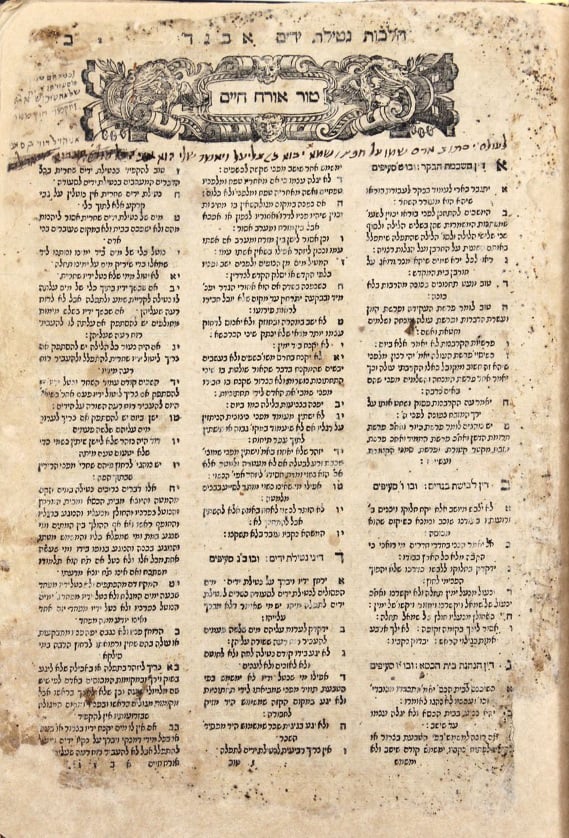
The result was a legal system that worked across enormous distances yet still allowed for local difference. The standard modern study of how this was achieved is Menahem Elon's Jewish Law: History, Sources, Principles.
Living under others' rules
The diaspora also lived under laws made by others.
Everything above describes the laws Jews made for themselves. But every Jewish community also lived under the laws of whoever ruled the place, and those outside rules defined what Jews were allowed to do, own, build, and be. Historians treat these outside systems as genuinely different from one another, not as one long sameness, and we keep the distinctions because they matter for honest history.
Under classical Islamic rule: the dhimma. Starting in the 700s and 800s and running for centuries, Islamic law gave Jews and Christians together a defined second-class status called dhimmi ("protected people"). It meant a special tax (the jizya), limits on building synagogues or churches taller than mosques, special clothing markers in some periods, weaker standing in court, and a bar from certain government jobs. Converting to Islam ended the restrictions. It was discriminatory, and at times it turned violent, the 1066 massacre in Granada, the harsh Almohad persecutions in Spain and North Africa in the 1100s. But it applied to a religious category you could, in principle, leave, alongside other subordinate groups, not a campaign aimed specifically and only at Jews.
Under medieval Christian rule: something different. Christian Europe built its treatment of Jews on a specific religious idea, covered in the Adversus Judaeos Topic, that blamed Jews for the death of Jesus. That idea produced a whole legal architecture: Jews defined as the personal property of the king or emperor; the rules of the Fourth Lateran Council (1215), which required Jews to wear a badge; the walled ghetto, told in its own Topic; the blood libel accusations; and repeated mass expulsions (England 1290, France twice, Spain 1492, Portugal 1497, many German towns). Like the dhimma, conversion offered an exit. Unlike the dhimma, this was a sustained religious project aimed specifically at Jews.
Under the racial idea of the late 1800s: the trap closes. In 1879 a new and far more dangerous idea took shape, covered in The Racial Turn, that redefined Jewishness as a matter of blood rather than belief. That single change removed the exit both older systems had always left open: if being Jewish is inherited and permanent, then conversion can't save you. This is the idea the Nazis would later build on, and it was categorically different from everything before it.
Why include all this in a Topic about the diaspora as a network? Because the achievements described on this page, the law, the libraries, the prayer, the philosophy and science covered in Unit 5, were built inside these outside constraints, often against them. You can't measure what the diaspora accomplished without knowing what it was working against.
The same prayers everywhere
Walk into any synagogue and you'd know the service.
A Jew from Poland, Yemen, Italy, or Iran could enter a synagogue elsewhere in the diaspora and recognize the structure of the service, even though local customs and melodies varied. The backbone of the service was the same across nearly every tradition: the Shema (the central declaration of faith), the Amidah (the standing prayer), the weekly Torah reading, and the shape of the Sabbath and holiday services. What changed from place to place was the trim, not the structure: the exact wording in spots, the melodies, the religious poems each region added, and local customs.
The story of how the prayer book got standardized is itself a snapshot of the network at work. The first complete Jewish prayer book, the Seder Rav Amram (800s CE), was written by the head of the Babylonian academy at Sura, because the community in Spain wrote and asked for one. A request travels from one edge of the Jewish world to its center; the answer comes back and then spreads everywhere. That is the diaspora in miniature.
One more example shows how fast ideas could travel. The Friday-night service that opens the Sabbath in synagogues worldwide today, including the beloved hymn Lekha Dodi, was invented by mystics in the small town of Safed, in the Galilee, in the 1500s. Within about a hundred years it had been adopted across the entire diaspora. A local innovation became a global standard, carried by the network.
The Jewish languages
One sacred language, many everyday ones.
The diaspora developed a distinctive language pattern: Hebrew (with Aramaic alongside it) as the shared language of prayer and study everywhere, plus a homegrown everyday language in each region. These everyday languages usually blended the local tongue with a layer of Hebrew and Aramaic, so a community could belong to its host society and to the wider Jewish world at the same time. The major ones:
- Yiddish: the everyday language of Jews in Central and Eastern Europe (the Ashkenazi communities). Built mostly from medieval German with Hebrew, Aramaic, and Slavic mixed in. By the late 1800s about 11 million people spoke it, the largest Jewish-language community ever. It had a huge newspaper press, a famous theater, school systems, and a rich literature (writers like Sholem Aleichem and, later, Nobel winner Isaac Bashevis Singer).
- Ladino (Judeo-Spanish): the language of the Sephardic Jews descended from those expelled from Spain in 1492. Built from medieval Spanish with Hebrew and, in the Ottoman lands, Turkish and Greek. It flourished in cities like Salonika (in today's Greece) and Istanbul. The Holocaust destroyed most of its Balkan communities, and far fewer speak it today.
- Judeo-Arabic: the language of Jews across the Middle East and North Africa, with many regional dialects (Iraqi, Egyptian, Moroccan, Yemenite). Maimonides wrote some of his greatest works in it.
- Judeo-Persian: spoken by Jewish communities in Iran and Central Asia, with its own literary tradition.
- Judeo-Italian: spoken by the old Jewish communities of central and southern Italy.
- Judeo-Greek (Yevanic): spoken by the Romaniote Jews of Greece, one of Europe's oldest Jewish communities.
- And smaller ones: including Judeo-Tat in the Caucasus mountains and Krymchak and Karaim in Crimea.
The pattern repeats everywhere: each community spoke a language all its own, woven through with Hebrew, that let it live as part of its neighborhood while staying tied to Jews everywhere else.
The Cairo Geniza
A storeroom in Cairo that proved it all.
For a long time, much of this was reconstructed from formal books: law codes, prayer books, the famous responsa. Then one discovery turned the everyday life of the medieval diaspora from guesswork into evidence you can hold.
In an old synagogue in Cairo, the Ben Ezra Synagogue, there was a geniza: a storeroom where worn-out documents were placed instead of thrown away, because Jewish practice forbids destroying any paper that might carry God's name. For roughly a thousand years, the community had been dropping papers into that room and not clearing it out. When scholars finally examined it at the end of the 1800s, they found around 300,000 fragments.
And it was not just sacred books. It was the ordinary paper trail of real lives: business contracts, marriage agreements, shopping lists, schoolchildren's writing practice, letters between merchants whose trade reached India, complaints, debts, gossip. The historian S. D. Goitein spent decades reading it and produced a six-volume work, A Mediterranean Society, that reconstructs the medieval Jewish world of the Mediterranean in extraordinary detail: what people ate, how they married, how they did business across the sea. The Geniza is the closest we have to a window into how the diaspora network actually felt from the inside, day to day. The discovery of the storeroom itself (Solomon Schechter, the Ben Ezra Synagogue, the carrying-off of the fragments) is the Object Spotlight of the Continuous Presence Topic. Here, one specific fragment from it tells the diaspora's story.
Object Spotlight
A prayer book carried across the world, in pieces.
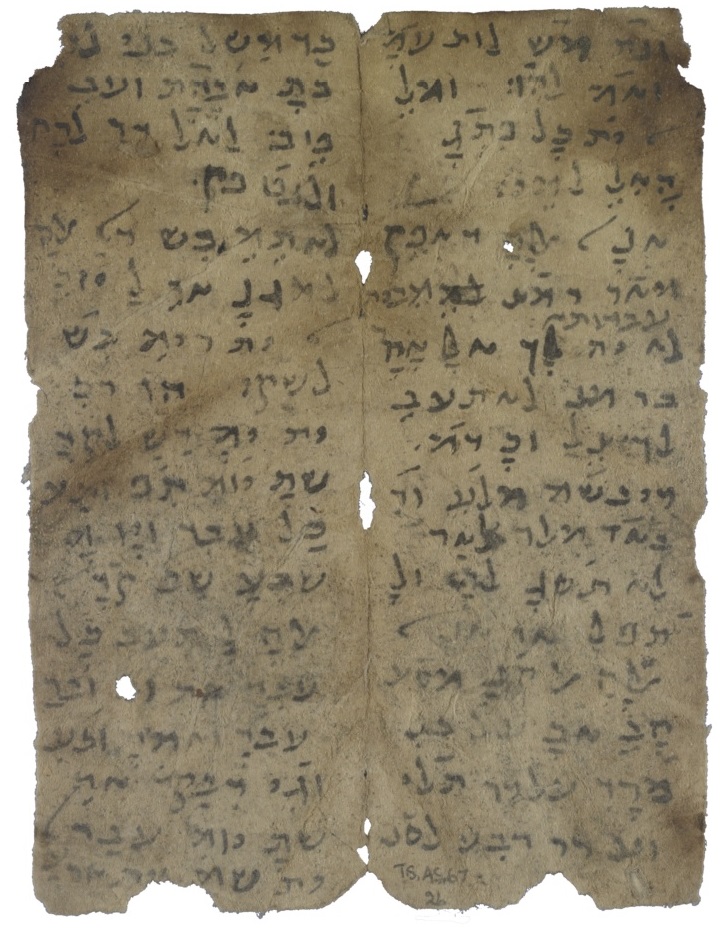
Look at it for a moment. A single leaf, brown with age, torn along every edge, punched through with little holes where the parchment gave way. Two columns of Hebrew, written by hand, by someone who is long gone. It looks like a scrap, the kind you would throw away. And that is almost exactly what happened to it: it was placed in a storeroom for worn-out paper and left for a thousand years.
What it is. This is a page from a siddur (a Jewish prayer book) and not just any one. It is a surviving fragment of the Seder Rav Amram, the first complete Jewish prayer book ever assembled. The word seder means "order"; the book set down, in order, the prayers for the whole year. Before it, the prayers existed but were not gathered into one fixed sequence anyone could follow. This is the book that fixed them.
When and where. The Seder Rav Amram was composed in the 800s CE in Babylonia (today's Iraq) by Amram ben Sheshna, the head of the great Jewish academy at Sura. The original is long lost; what survives are later copies, and this fragment is one of them, recovered from the Cairo Geniza, the storeroom of worn documents in the Ben Ezra Synagogue in Egypt. It now lives in the Taylor-Schechter collection at Cambridge University Library in England, an English library holding an Egyptian copy of an Iraqi book. The object's own journey is the diaspora in miniature.
Why it matters. Here is the part that opens this whole Topic. The Seder Rav Amram was not written for Babylonia. It was written because the Jewish community in Spain wrote a letter asking for it. A community at one far edge of the Jewish world sent a request across the entire map to the recognized center of learning at the other edge ("send us the order of the prayers") and the head of the academy answered by composing a complete prayer book and sending it back. That book then spread outward until versions of it shaped Jewish prayer everywhere. One object holds the entire argument of this page: a people with no shared government, running a working civilization by mail.
Look closer. Notice that this is ordinary, hard-used paper, not a showpiece. The holes, the wear, the cramped practical hand, this was a book somebody actually prayed from until it fell apart, not a treasure locked away. That is what makes the Geniza fragments so valuable to historians: they are the real, used objects of real lives, not the polished versions. At the bottom you can see a small marking, "T-S AS 67", that is not part of the prayer; it is the catalog number Cambridge gave the fragment when it was sorted, the modern world's label on a thousand-year-old page.
Afterlife. The community that prayed from this leaf eventually wore it out and, because Jewish practice forbids throwing away paper that may carry God's name, placed it in the Geniza instead of discarding it. There it sat for centuries, until scholars examined the storeroom at the end of the 1800s and carried its contents to libraries in Cambridge, Oxford, New York, and elsewhere. The prayer book it came from never stopped being used: the basic order Amram set down in the 800s still stands behind the prayer books in synagogues today, more than eleven hundred years later. The fragment is a piece of the network caught in the act, a request answered across the world, a book that outlived every empire it passed through.
The thread back to the Land
However far they scattered, one place stayed at the center.
For all its spread, the diaspora never let go of a single point of reference: the Land of Israel, and Jerusalem in particular. This wasn't only a feeling, it was built into daily life. Jews prayed facing Jerusalem, no matter where they stood on earth. The yearly cycle of holidays followed the seasons and harvests of the Land. Prayers asked, year after year, for return. The Passover meal ended with the line "Next year in Jerusalem." A small Jewish presence remained in the Land continuously, and pilgrims and scholars kept traveling there, the subject of the Land of Israel and Continuous Presence Topics.
That steady orientation is part of what makes the Jewish diaspora unusual among scattered peoples: it kept a fixed center in its imagination and its practice for the entire length of the dispersion, not as a vague memory but as a daily habit.
What changed in the modern age
The last two centuries rebuilt the map.
The diaspora was never frozen, but the 1800s and 1900s reshaped it more sharply than any stretch before. A few changes stand out:
- Mass migration. Between roughly 1880 and 1924, about two and a half million Jews left Eastern Europe, most for the United States. The center of gravity of Jewish life began shifting westward across the Atlantic.
- New institutions. Much of the framework of modern Jewish life took shape in this period, major organizations, charitable federations, newspapers, schools, and the academic study of Jewish history itself.
- The Holocaust. The murder of six million European Jews between 1933 and 1945, told across Unit 4, tore the heart out of the diaspora. The Yiddish-speaking world of Poland and Lithuania, which had been its largest cultural center, was almost entirely destroyed. Afterward, the weight of Jewish life shifted toward the survivors' new homes in America, France, Britain, and Latin America.
- The founding of Israel in 1948. For the whole length of the diaspora, the Land had been one community within the network. The creation of the State of Israel changed that relationship into something new: a Jewish state and a worldwide diaspora, distinct but deeply connected. Scholars are still working out what that shift means.
The diaspora continues right now. About 15.7 million Jews live across roughly 100 countries today, the largest communities in Israel and the United States, followed by France, Canada, Britain, Argentina, and others. The same basic pattern persists: separate communities, spread across the world, tied together by shared institutions, law, language, and memory, exactly as they have been for more than two thousand years.
Explore
The World Jewish Congress maintains an interactive map of Jewish communities around the world today, by country, with the size and history of each. It is a way to see the living diaspora as a present-day fact, not only a historical one. Open the interactive map →
Key takeaways
- The Jewish diaspora was not a scattering of broken-off pieces. For most of its history it was a working network, communities from Spain to Iraq to Yemen linked by law, letters, prayer, language, and trade.
- It began long before the Romans destroyed the Temple in 70 CE. By then, Alexandria already held one of the largest Jewish communities in the ancient world, and Babylonia had been a center of Jewish life for centuries.
- The network ran on letters. A community could send a legal or religious question across thousands of miles to a recognized center of learning, and the answer would come back and be followed, with no government enforcing any of it.
- Wherever they lived, communities shared one body of law, a common core of prayer, and Hebrew as the language of study, while each region developed its own everyday Jewish language, from Yiddish to Ladino to Judeo-Arabic.
- The Cairo Geniza (some 300,000 documents preserved in one Cairo storeroom) turned the everyday life of the medieval diaspora from guesswork into evidence you can hold.
Discussion questions
Working from the evidence.
These questions ask students to work from the evidence on this page and reach their own conclusions. Each is anchored in a specific fact the Topic documents.
- The page argues the diaspora was a network, not just a scattering. What exactly held distant communities together, and which do you think mattered most? Defend your choice using examples from the page.
- By the time the Temple fell in 70 CE, the largest Jewish city in the world was Alexandria, not Jerusalem. Why does it change the story to learn that the "scattering" was already centuries old and thriving before the event usually treated as its beginning?
- The Seder Rav Amram prayer book was written in Babylonia because the community in Spain wrote a letter asking for it. What does that single exchange tell you about how a people with no shared government stayed one people?
- Each region developed its own Jewish language (Yiddish, Ladino, Judeo-Arabic) that blended the local tongue with Hebrew. How can a language tie a community both to its neighbors and to a wider world at the same time?
- The Jewish diaspora is often used as the reference point for studying other scattered peoples (Armenian, Greek, Irish, Chinese, Indian, African). What features of the Jewish case might make it a useful comparison, and where might the comparison break down?
Classroom Connections
Where this Topic fits.
Teaching Connections
The disciplines and courses this Topic naturally supports, for any educator, anywhere.
- World History & Belief Systems: one of the longest-running examples of how a faith community holds together across huge distances.
- Medieval & Early-Modern World History: the medieval Mediterranean diaspora (the Cairo Geniza and the responsa) and the Sephardic world rebuilding after 1492 across the Ottoman, Italian, and Atlantic regions.
- Geography & Migration: the diaspora as a working network across three continents.
- Comparative Diasporas: the Jewish case beside the Armenian, Greek, Irish, Chinese, Indian, and African diasporas.
- Languages & Linguistics: Yiddish, Ladino, and Judeo-Arabic, the diaspora’s regional Jewish languages.
- Historical Thinking & Source Analysis: reading and combining the Geniza documents and the responsa.
Standards Alignment
- NYS Global History & Geography: 9.2 (Belief Systems).
- Common Core ELA-Literacy: RH.6–8.7, RH.9–10.7, and RH.11–12.7 / RH.11–12.9 (integrating and comparing multiple sources): the Geniza documents and the responsa.
Further Teaching Resources
- Bar-Ilan University, the Responsa Project, the searchable archive of the letters-and-answers tradition that connected the diaspora for centuries (an advanced resource for teachers).
Sources
Primary sources come straight from the time: documents, letters, speeches, images, and objects created by the people involved. Secondary sources come later: books, articles, and analysis in which scholars study and interpret those primary sources.
Primary sources
- Cambridge University Library, Taylor-Schechter Genizah Research Unit. cam.ac.uk/genizah →
- The Friedberg Genizah Project. genizah.org → (digitized Geniza fragments)
- Bar-Ilan University Responsa Project. responsa.co.il →
- The Elephantine Papyri, 5th century BCE. Aramaic documents of the Judean garrison community at Elephantine, Egypt; major holdings at the Brooklyn Museum and the Egyptian Museum, Berlin.
Secondary sources
- Goitein, S. D. A Mediterranean Society: The Jewish Communities of the Arab World as Portrayed in the Documents of the Cairo Geniza. 6 vols. University of California Press, 1967–1993.
- Baron, Salo Wittmayer. A Social and Religious History of the Jews. 18 vols. Columbia University Press, 1952–1983.
- Cohen, Mark R. Under Crescent and Cross: The Jews in the Middle Ages. Princeton University Press, 2nd ed., 2008.
- Rustow, Marina. The Lost Archive: Traces of a Caliphate in a Cairo Synagogue. Princeton University Press, 2020.
- Biale, David, ed. Cultures of the Jews: A New History. Schocken, 2002.
- Boyarin, Daniel. A Traveling Homeland: The Babylonian Talmud as Diaspora. University of Pennsylvania Press, 2015.
- Elon, Menahem. Jewish Law: History, Sources, Principles. 4 vols. Jewish Publication Society, 1994.
- Ben-Sasson, Haim Hillel, ed. A History of the Jewish People. Harvard University Press, 1976.
- Stillman, Norman A. The Jews of Arab Lands. Jewish Publication Society, 1979.
- Cohen, Robin. Global Diasporas: An Introduction. Routledge, 2nd ed., 2008. (comparative diaspora studies)
- ANU, Museum of the Jewish People, Tel Aviv. anumuseum.org.il →
Finding these documents: many primary sources are free online. Good places to start are the Fordham Internet Jewish History Sourcebook, Yale’s Avalon Project (law and diplomacy), German History in Documents, the collections of the US Holocaust Memorial Museum and Yad Vashem, the National Library of Israel, and Sefaria (for Jewish texts). Search the document’s name and date.
The next Unit follows the Jewish people outward, to the communities they built across the Middle East, North Africa, and beyond.
Comments?
Write to editor@makorproject.org.
Last updated: August 2026.