The Nazis did not invent the ghetto. They borrowed the word, and part of the form, from an institution that had been operating in European cities for more than four hundred years before they came to power.
The Ghetto System · Unit 3
Why this Topic exists
An institution that named itself.
Most American students meet the word "ghetto" for the first time in a unit on the Holocaust (Warsaw, Łódź, Vilna, Kraków) and many leave that unit believing the Nazis invented it. They did not. They borrowed a word, and part of a form, from an institution that had been operating in European cities for more than four hundred years before they came to power. The borrowing was deliberate, and the confusion it left behind is worth clearing up.
This Topic is about the original: the early-modern European ghetto, born in Venice in 1516 and dismantled three centuries later by the laws of emancipation. It follows the institution from its exact founding date through its daily life, the work that was made inside it, and its slow undoing. And it draws the line the shared word obscures, between an enclosure built for long-term coexistence and the Nazi holding pens built for murder, so that a student can hold both in mind without collapsing one into the other.
Common misconceptions this Topic addresses
The ghetto system produced specific patterns (in moneylending, in medicine, in the trades Jews were permitted and the ones they were barred from) that have since been mythologized into claims about Jewish "nature." The dedicated entries show the legal architecture the popular tropes invert.
- "Jews are culturally or religiously obsessed with money." See the entry →
- "Jews became moneylenders out of some inherent orientation to money." See the entry →
- "Jews are doctors because of natural talent or genetic disposition." See the entry →
- "The ghetto was a Nazi institution." See the entry →
- "'Ghetto' is a vague word whose origin is unknown." See the entry →
Two ghettos, one word
The distinction the term hides.
The early-modern European ghetto (1516 – c. 1870). A legally fixed, walled, gated Jewish quarter in a European city, created by civil or church decree. It lasted, sometimes for three hundred years and more. People inside it lived ordinary lives: they raised families, ran businesses, kept their own schools and religious courts, wrote and printed and prayed, and were free to leave only during set daylight hours. The gates were locked at night by Christian guards whom the Jewish community itself had to pay. The aim was segregation within a lasting coexistence, the community was enclosed, not eliminated.
The Nazi-era ghetto (1939 – 1944). A sealed zone in occupied territory, mainly Poland and the Baltic, into which the Jews of a whole region were packed under deliberate starvation, overcrowding, and forced labor. These were not lasting institutions but transit sites, held for two to four years before their populations were deported to the killing centers. The aim was not coexistence; it was the temporary holding of people already marked for death.
The link. The Nazi planners knew the early-modern institution and took its name on purpose. The surface likeness (an enclosed Jewish zone in a European city) is real. What the word names in each period is not. They are treated here as separate subjects: this Topic is the early-modern institution; the Nazi-era ghettos belong to the Holocaust Era unit and its Topic on the camp and ghetto system.
Venice · March 29, 1516
The first ghetto.
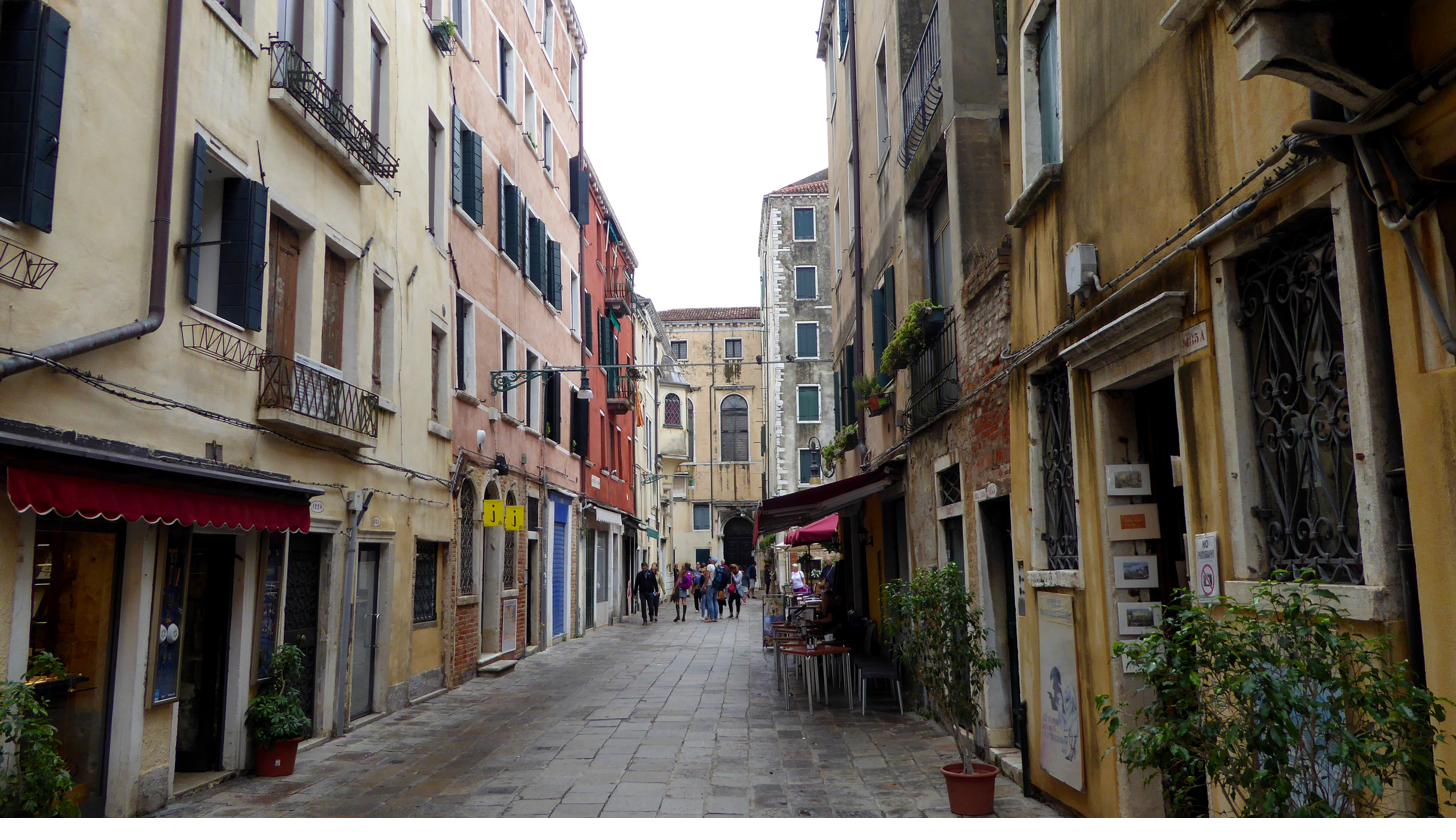
The institution has an exact birthday. On March 29, 1516, the Venetian Senate, arguing over how to handle a Jewish community that had grown in the city during the War of the League of Cambrai, ordered all the city's Jews into a single enclosed area. The site was an old copper foundry on the northwest edge of Venice, in the sestiere of Cannaregio. In the Venetian dialect a foundry was a geto, from gettare, "to cast" metal. The quarter took the foundry's name, and from this one decree the word entered the languages of Europe.
The original quarter, the Geto Nuovo, was a small island ringed by canals on three sides. Gates were built at its two access points and locked at night, with Christian guards, paid by the Jewish community, patrolling the perimeter. Residents could leave during set daylight hours to do business in the city, and were required to wear a yellow hat or badge when they did, a marker carried over from earlier Venetian rules on Jewish dress.
As the community grew across the sixteenth and seventeenth centuries, the quarter grew with it. The Geto Vecchio ("Old Ghetto") was added in 1541 for Levantine merchants from the Ottoman Empire; the Geto Nuovissimo ("Newest Ghetto") in 1633 for Sephardic refugees of the Iberian expulsions. By the 1600s as many as 5,000 people lived on roughly four acres, one of the most crowded districts anywhere in early-modern Europe. Buildings were subdivided again and again and pushed upward; some reached seven and eight stories in a city where most stood at two or three. The Venetian Ghetto ran for 281 years, until Napoleon's army entered Venice on July 11, 1797 and ordered the gates burned.
Rome · July 14, 1555
The papal model.
The second great ghetto was Rome's, created by the bull Cum Nimis Absurdum, issued by Pope Paul IV on July 14, 1555, barely two months into his reign. Its opening words gave it its name and stated the theology behind the law: "Since it is absurd and improper that the Jews, condemned by God to eternal servitude for their guilt…" The bull confined the Jews of Rome (present in the city continuously since the second century BCE, the oldest Jewish community in Europe) to a single enclosed strip along the Tiber, near the Portico of Octavia, in a low-lying district prone to flooding and counted among the least desirable in Rome.
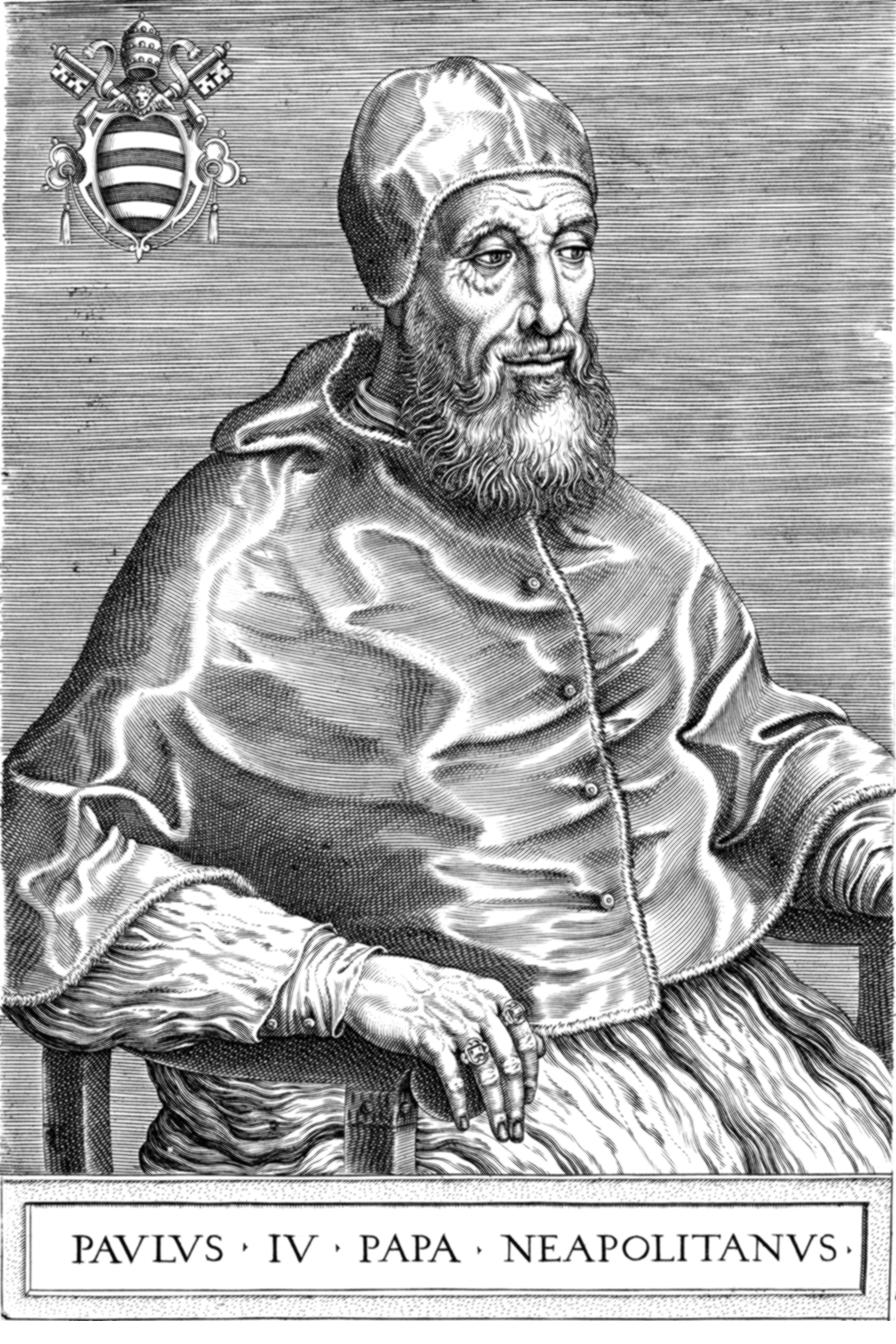
Rome's terms were harsher than Venice's. Beyond the enclosure, Roman Jews had to attend a compulsory Catholic sermon each Saturday, were shut out of most trades, could not own property outside the ghetto, were made to wear distinguishing dress, and lived under a stack of further regulations enforced by the papal authorities. The Roman Ghetto was at times the largest in Europe by population, and it lasted 315 years, until its gates came down on September 20, 1870, when the army of the Italian Risorgimento entered Rome and papal rule over the city ended.
Cum Nimis Absurdum became the template for the papal ghettos that followed across the Papal States, Ancona, Bologna, Ferrara, Avignon, and others. Later popes kept or tightened it: Pius V's 1569 bull Hebraeorum Gens expelled Jews from most of the Papal States outside Rome and Ancona; Sixtus V eased some rules; Clement VIII reimposed them. The rhythm of expansion, restriction, and brief relief ran on through the seventeenth and eighteenth centuries.
The system across Italy
From a model to a standard form.
After Venice and Rome, the ghetto became the default way Italian cities managed their Jewish communities. Among the major foundations:
- Florence and Siena (1571). Both established under Cosimo I de' Medici by the decree of October 2, 1571. The Florentine ghetto ran for 277 years, until 1848.
- Ferrara (1624). Created under direct papal authority after the city passed to the Papal States in 1598.
- Modena (1638). Established by Duke Francesco I d'Este.
- Padua (1601–1603). Two enclosures created under Venetian rule.
- Mantua (1612). Established by Duke Vincenzo I Gonzaga, and notable for the architectural ambition of its synagogue interiors.
- Verona (1599) and Turin (1679). Under Venetian authority and the House of Savoy, respectively.
- Ancona (1555). Founded by the same papal authority as Rome.
By the mid-1600s, nearly every Italian city with a sizable Jewish community had one. The form was settled. The clearest exception, Livorno, where the Medici grand dukes used the 1591 Livornina charter to grant the Jewish community wide freedom of residence and attract Sephardic merchants, came from competing economic interests, not from any principled objection to the institution.
The system beyond Italy
Frankfurt, Prague, and the German lands.
Outside Italy, the enclosure took deepest root in the German lands and the Habsburg territories of central Europe.
- Frankfurt am Main (1462). The Judengasse predated Venice by more than fifty years, though Venice and its name are conventionally treated as the start of the modern institution. It was a single narrow street, gated and locked at night and on Christian holidays, and it ran for nearly 350 years until its removal between 1796 and 1811 under French Revolutionary law. It was the birthplace of the Rothschild banking family.
- Prague (from 1215). The Jewish Quarter, Josefov, developed over many centuries, with its most restrictive enclosure in the seventeenth and eighteenth. It preserved an unusually deep material record of early-modern European Jewish life, including the Old-New Synagogue (built c. 1270, the oldest synagogue in continuous use in Europe) and the Old Jewish Cemetery.
- Trieste, Gorizia, and the smaller Habsburg cities. Restricted quarters existed in most Habsburg cities, and were eased under Joseph II's 1782 Patent of Toleration, which opened the long Habsburg unwinding.
- The Polish-Lithuanian Commonwealth. Jewish life here, by the eighteenth century the demographic center of world Jewry, ran through a very different architecture: the kahal of communal self-rule and the shtetl, the small Jewish-majority market town. These were not ghettos in the sense this Topic uses, and the Commonwealth is treated separately in the Unit on communities across the world.
Life inside the gates
The reality.
The ghetto was a closed world that ran, internally, as a working community. The law set its outer edges; the Jewish community organized the life within them. The shared features, across the Italian and German cases:
- Self-government. Each ghetto was run by a council of Jewish leaders, the Università degli Ebrei in Italy, the Judengemeinde in the German lands. It collected taxes, ran the rabbinic court (beit din), kept the synagogue and cemetery, ran the schools, and spoke for the community to the civic authority.
- Many synagogues. The Venetian Ghetto held five, the Scuola Grande Tedesca (German rite, 1528), the Scuola Canton (Ashkenazi, 1532), the Scuola Italiana (Italian rite, 1575), the Scuola Levantina (Sephardic), and the Scuola Spagnola (Spanish, c. 1580): each for a distinct liturgical tradition living inside the same walls. All five survive.
- Work. Residents did business in the city by day. Italian ghettos carried real trade, moneylending (the inherited medieval Jewish occupation), textiles, secondhand goods, jewelry, and a growing engagement with the commercial economy from the 1600s on. Cities developed specialties: Rome in textiles, Venice in moneylending and Levantine trade, Mantua in luxury goods.
- Schools and learning. Each major ghetto ran its own schooling, from children's religious instruction to advanced study and, in a few cases, formal rabbinical academies. Venice, Mantua, and Rome were each serious centers of Jewish learning in the period.
- Overcrowding. A fixed perimeter and a growing population produced severe crowding. Apartments were subdivided; upper floors were stacked until the buildings could bear no more. Historians rank the seventeenth-century Venetian Ghetto among the densest pre-industrial districts in Europe.
- Health. Crowding, poor drainage in low-lying sites (the Roman Ghetto by the Tiber especially), and thin sanitation drove disease rates above those of the surrounding cities. The plague years of 1630 and 1656 struck ghetto populations disproportionately.
What was made there
The cultural record of the ghetto period.
Confinement did not extinguish Jewish intellectual and cultural work, and in some periods it concentrated it. The Topic covers this because it belongs to the record of the institution, and because treating three centuries only as a span of suffering writes out the people who actually lived through them.
- The Venetian Hebrew press. From the late 1500s, the Venetian Ghetto was one of the great centers of Hebrew printing in the world. The Bomberg press (Daniel Bomberg, a Christian printer working with Jewish editors from 1516) produced the first complete printed Talmud and the first Rabbinic Bible. The page layout it set, with Rashi's commentary on the inner margin and the Tosafists on the outer, is still the form of the printed Talmud today.
- Sara Copia Sullam (Venice, c. 1592–1641). A Jewish woman of the ghetto who kept a literary and philosophical salon, corresponded with Christian intellectuals, and published a 1621 defense of her convictions against a Christian polemicist. Her surviving letters and writings are a rare record of the intellectual life of an early-modern Jewish woman.
- Leon of Modena (Venice, 1571–1648). Rabbi, scholar, translator. His autobiography, The Life of Judah, is among the great early-modern Hebrew prose works and one of the most-cited windows onto daily life in the Venetian Ghetto.
- Mantuan Hebrew theater. From the late sixteenth century the Jewish community of Mantua built a Hebrew and Italian theatrical tradition, above all in Leone de' Sommi (1525–1590), sometimes called the first Jewish playwright of the European tradition.
- Synagogue art and silver. The interiors of the Italian ghetto synagogues (Venice's Scuola Spagnola, Padua's Scuola di Conegliano, the Asti synagogue in Piedmont, the Mantua synagogues) are among the finest in early-modern Europe. The period's decorative silver (Torah crowns and finials, Hanukkah lamps) survives in collections including the Israel Museum and the Jewish Museum, New York.
- The Rothschilds at Frankfurt. The Frankfurt Judengasse was where Mayer Amschel Rothschild (1744–1812) and his sons built one of the foundational banking houses of modern European finance, from a small house on the street known as the House at the Green Shield, now a museum.
The long dismantling
The end of the institution.
The ghetto came apart not in a single moment but across a long process running from the 1780s into the 1870s, pushed by three forces in succession.
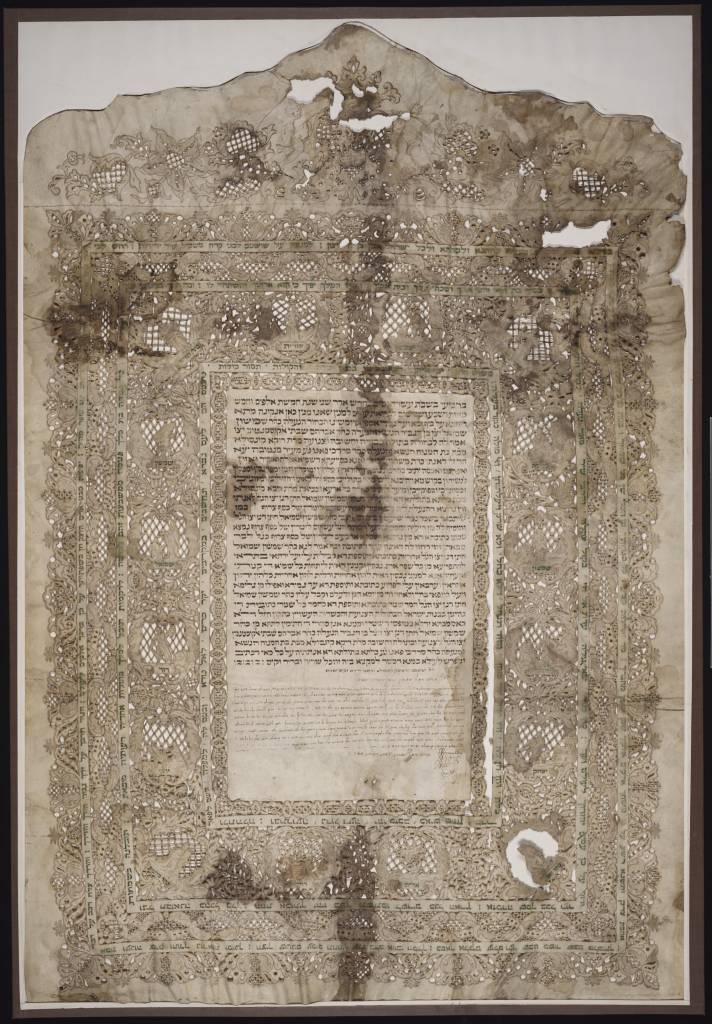
The Habsburg Patent of Toleration (1782). Joseph II's edict of October 13, 1781 and the Patent of January 2, 1782 began the formal unwinding of Habsburg ghetto restrictions, granting Jews incremental rights, to attend public schools and universities, to enter trades long closed to them. It did not abolish the institution outright, but it set the legal machinery by which it would be wound down.
The French Revolution and Napoleon (1789–1815). The Revolutionary settlement of 1791 made French Jews full citizens, the first European state to do so, and the Napoleonic conquests carried the model across Western Europe. French troops burned the gates of the Venetian Ghetto on July 11, 1797. The Roman gates came down during the short-lived Roman Republic of 1798–99, only to be restored when the papacy returned. The Frankfurt Judengasse was taken apart between 1796 and 1811. Much of this was reversed after 1815, but the legal template for emancipation had been set.
Emancipation across the nineteenth century. Full legal emancipation took most of the century. The Habsburg lands emancipated Jews in 1867; the North German Confederation in 1869, then the unified German Empire in 1871. The Italian states moved across the 1848 revolutions and the unification that followed, Piedmont and Florence in 1848, the rest as it joined the Kingdom of Italy. The last ghetto dismantled in the formal sense was Rome's, whose gates were pulled down by order of the Italian government on September 20, 1870, after the army entered the city. The end of the ghetto in Europe is conventionally dated to that day.
Removing the gates did not remove what the gates had made. Many Jewish communities went on living in the old ghetto districts for generations, out of economic necessity, communal closeness, or choice. The neighborhoods stayed. What ended was the ghetto as an institution the law enforced.
Sites that survive
Where the record stands.
Much of the early-modern ghetto system survives in stone and is open to scholars, teachers, and students. The major sites:
- Venice, the Venetian Ghetto. The Campo del Ghetto Nuovo in Cannaregio. All five synagogue interiors are preserved and shown by guided tour through the Jewish Museum of Venice (Museo Ebraico di Venezia).
- Rome, the Roman Ghetto. The historic district along the Tiber near the Portico of Octavia. The Great Synagogue of Rome (Tempio Maggiore), built 1901–1904 just outside the old boundary, houses the Jewish Museum of Rome.
- Prague, Josefov. The most extensive surviving early-modern Jewish quarter in Europe: the Old-New Synagogue (c. 1270), the Old Jewish Cemetery (begun 1439), the Pinkas Synagogue (now a Holocaust memorial), and the Klausen, Spanish, and Maisel synagogues, all administered by the Jewish Museum in Prague.
- Frankfurt, the Judengasse. Most of the street was lost to nineteenth-century redevelopment and the Second World War. The Museum Judengasse, opened in 1992 over preserved foundation ruins, presents the record.
- Padua and Mantua. Padua preserves the Scuola Italiana and the Scuola Ashkenazita, shown through the Padua Jewish Museum; Mantua preserves the Norsa Torrazzo Synagogue (1751), kept by the Jewish Museum of Mantua.
Object Spotlight
The Bomberg Talmud, Venice, 1520–1523.
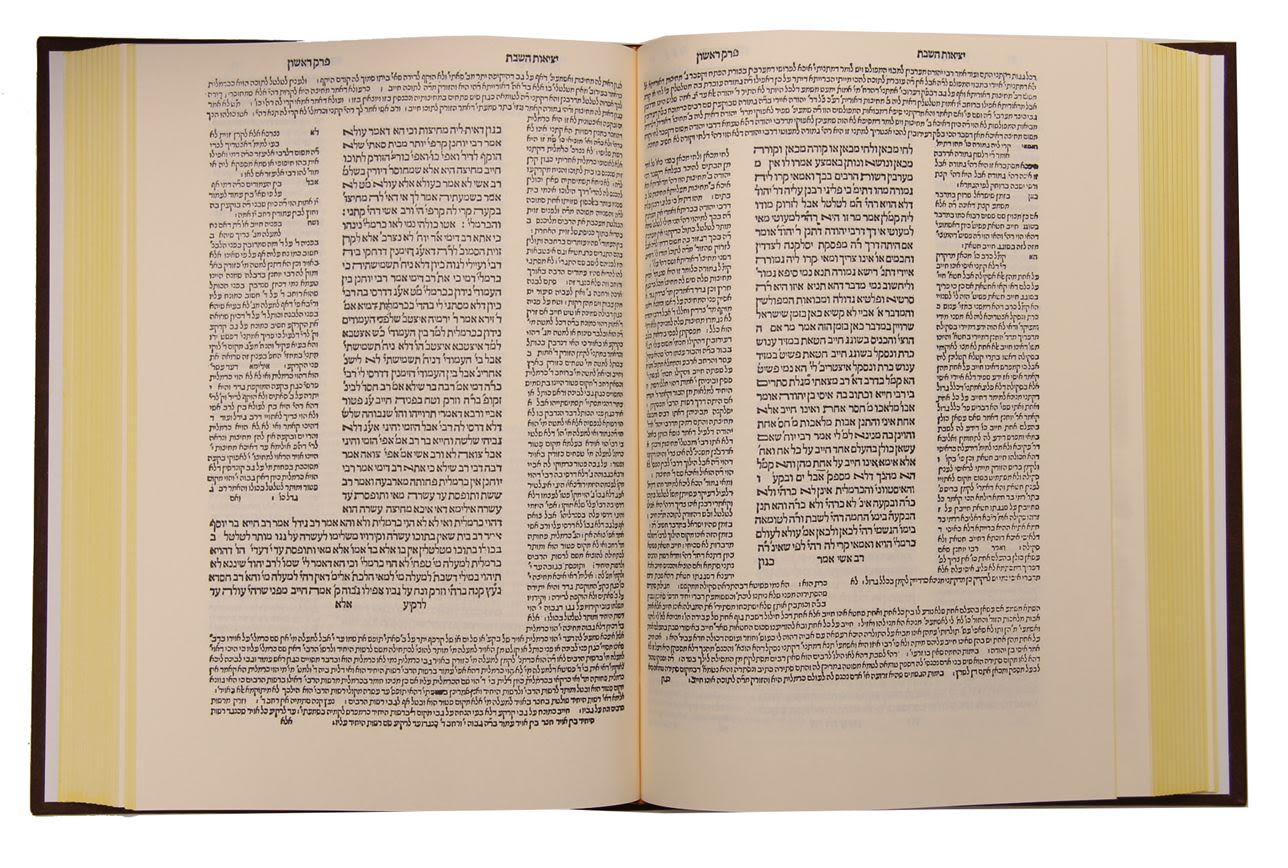
Look at the open book before worrying about the words. The page is not one column of text but three layers at once: a dense block in the middle, and two narrower columns of smaller type wrapped around it on the left and right edges, with a few more lines tucked along the bottom. It looks less like a page to read straight through than like a conversation crowded onto paper, a main voice in the center, others talking back in the margins.
That is exactly what it is. The book is the Talmud, the vast record of centuries of rabbinic discussion and law, the central text of Jewish study. The big central block is the ancient core text. The columns around it are commentaries written centuries later: closest to the spine, the explanations of Rashi, the eleventh-century French scholar; on the outer edge, the arguments of his successors. This particular arrangement was set by a printer named Daniel Bomberg, a Christian working in Venice with Jewish editors, who produced the first complete printed edition of the Talmud between 1520 and 1523.
Here is why this page opens the whole Topic. Bomberg printed it in Venice in the 1520s, the same city, the same decade, as the world's first ghetto, the locked and gated quarter the Jews of Venice were confined to in 1516. So the object holds two facts together that are hard to hold at once: Jews were being walled into a corner of the city at night, and out of that same place and time came one of the most important books in the history of printing. The ghetto was confinement. It did not wipe out a culture, and this page is the proof in your hand.
Look closer at what the layout did. By fixing the text and its commentaries into one stable, repeatable page, Bomberg gave every later student the same map, a teacher in Vilna and a teacher in Baghdad could say "look at the top of the page" and mean the identical spot. Before print, every handwritten copy was a little different; after Bomberg, the page itself became shared ground. A design decision made in a print shop became, quietly, part of how a whole civilization studies.
And it held. Nearly every printed Talmud since 1523 (for five hundred years, in every country Jews have lived) has followed the Bomberg layout, down to where each commentary sits and which word starts each page. Surviving copies of the original edition are now among the treasures of the great libraries; complete sets are held at the Library of Congress, the British Library, the Library of the Jewish Theological Seminary in New York, the National Library of Israel, and the Bibliothèque nationale de France, several with digital facsimiles online. The format a Venetian shop fixed beside the ghetto gates outlived the gates by centuries.
Key takeaways
- The ghetto is an early-modern European institution with an exact birthday (Venice, March 29, 1516) not a Nazi invention. The word comes from the Venetian geto, a copper foundry on the site.
- It spread from Venice and Rome (Cum Nimis Absurdum, 1555) across Italy and into the German and Habsburg lands, becoming the standard way European cities enclosed their Jewish communities for three centuries.
- It was built for segregation within a lasting coexistence, the Nazi-era ghettos that borrowed its name were short-lived holding sites for populations marked for murder. Same word, different histories.
- Inside the gates, communities governed themselves and produced lasting work: the Bomberg Talmud, the writings of Sara Copia Sullam and Leon of Modena, the synagogue art of Venice and Mantua.
- The institution was dismantled across a long process from the 1780s to 1870, the Habsburg toleration patent, the French Revolution and Napoleon, and the emancipation laws of the nineteenth century. The last gates to fall were Rome's, on September 20, 1870.
Classroom integration
Where this Topic supports instruction.
- World History, the medieval world (NY: Global History 9.7) The Lateran councils and the canonical regulation of Jewish life set the legal ground the ghetto would later grow from.
- World History, revolution and nationalism (NY: Global History 10.2) The ghetto is a standard feature of early-modern European urban life, and its inclusion balances the usual treatment of the era as one of widening freedoms.
- World History, early-modern Europe (NY: Global History 9.9) The dismantling of the ghetto is part of the standard story of European emancipation.
- Common Core ELA-Literacy.RH.9-10.7 and RH.11-12.7: Integrating text and visual sources. The institution is attested through papal bulls, Senate decrees, surviving buildings, Hebrew literary sources, contemporary Christian polemics, and printed objects like the Bomberg Talmud, an unusually rich set for source-integration work.
- C3 Framework D2.His.2 and D2.His.5: Continuity, change, and causation. The 354-year span from Venice 1516 to Rome 1870 is among the strongest case studies available for these questions.
Learn more · take this further
Verified resources from outside organizations for teachers and students. Where a dedicated classroom resource does not yet exist, The Makor Project is developing one.
Three single books carry the subject especially well: Stow's Theater of Acculturation on the Roman ghetto, Calabi's edited Venice, the Jews, and Europe on the first ghetto, and Bonfil's Jewish Life in Renaissance Italy for the wider frame. The resources below are free to read online.
Questions for discussion
These questions ask students to work from the evidence on this page and reach their own conclusions. Each is anchored in a specific fact the Topic documents.
- The page argues the Nazis borrowed the word and part of the form of the ghetto, but not its purpose. Using the Venice 1516 decree and what you read about the Nazi camps, what was the early-modern ghetto for, and how did the Nazi use of the word differ? Why does the distinction matter?
- The word "ghetto" comes from the Venetian geto, a copper foundry, from gettare, to cast metal. What does it tell you that the institution took its name from an industrial site rather than from anything about the people confined there?
- Inside the gates, the community governed itself, its own council, court, schools, and one of the great Hebrew printing centers in the world. How does the record of what was made in the ghetto change the way you read three centuries usually summarized as confinement?
- The ghetto came apart gradually, from the 1782 Patent of Toleration into the 1870s, not in a single act. What does a long, staged dismantling suggest about how deeply the institution was built into European cities?
- The same evidence on this page (a dated decree, a named site, a documented daily life) is how historians study any institution. Test the equal-treatment standard: is this the same depth the curriculum gives other major institutions it teaches? Why or why not?
Sources and citations
Primary sources come straight from the time: documents, letters, speeches, images, and objects created by the people involved. Secondary sources come later: books, articles, and analysis in which scholars study and interpret those primary sources.
Primary sources
- Modena, Leone (Judah Aryeh of Modena). The Autobiography of a Seventeenth-Century Venetian Rabbi: Leon Modena's Life of Judah. Translated and edited by Mark R. Cohen. Princeton: Princeton University Press, 1988.
- Pope Paul IV. Cum Nimis Absurdum. Papal bull, Rome, July 14, 1555. Latin text in the standard Vatican bullaria. (Primary source.)
- Venetian Senate. Decree of March 29, 1516, establishing the Geto Nuovo. Archivio di Stato di Venezia. (Primary source.)
- Sullam, Sara Copia. Manifesto. Venice, 1621. The Venetian ghetto poet's published defense of herself, a voice from inside the ghetto.
- Pope Pius VI. Editto sopra gli ebrei (Edict Concerning the Jews). Rome, 1775. The late reassertion of the ghetto restrictions on the Jews of Rome.
- Decree of the Provisional Municipality of Venice, July 1797, abolishing the ghetto; the gates were torn down on July 11, 1797.
Secondary sources
- Stow, Kenneth R. Theater of Acculturation: The Roman Ghetto in the Sixteenth Century. Seattle: University of Washington Press, 2001.
- Stow, Kenneth R. Catholic Thought and Papal Jewry Policy, 1555–1593. New York: Jewish Theological Seminary of America, 1977.
- Calabi, Donatella, ed. Venice, the Jews, and Europe: 1516–2016. Venice: Marsilio, 2016. (Catalogue of the Doge's Palace 500th-anniversary exhibition.)
- Calabi, Donatella. The Jews of Venice: An Urban Phenomenon. Cambridge: Cambridge University Press, 2017.
- Bonfil, Robert. Jewish Life in Renaissance Italy. Berkeley: University of California Press, 1994.
- Ravid, Benjamin. Studies on the Jews of Venice, 1382–1797. Aldershot: Ashgate Variorum, 2003.
- Ruderman, David B. Early Modern Jewry: A New Cultural History. Princeton: Princeton University Press, 2010.
- Toaff, Ariel. Love, Work, and Death: Jewish Life in Medieval Umbria. London: Littman Library, 1996.
- Cooperman, Bernard Dov, and Barbara Garvin, eds. The Jews of Italy: Memory and Identity. Bethesda: University Press of Maryland, 2000.
- Adelman, Howard. Women and Jewish Marriage Negotiations in Early Modern Italy: For Money and Honor. London: Routledge, 2018.
- Westreich, Elimelech. "Sara Copia Sullam: A Jewish Woman in Early-Modern Venice." Jewish Quarterly Review 99, no. 2 (Spring 2009): 178–207.
- Heller, Marvin J. Printing the Talmud: A History of the Earliest Printed Editions of the Talmud. Brooklyn: Im Hasefer, 1992.
- Bregoli, Francesca. Mediterranean Enlightenment: Livornese Jews, Tuscan Culture, and Eighteenth-Century Reform. Stanford: Stanford University Press, 2014.
- Karp, Jonathan, and Adam Sutcliffe, eds. The Cambridge History of Judaism, Volume 7: The Early Modern World, 1500–1815. Cambridge: Cambridge University Press, 2018.
- Davis, Robert C., and Benjamin Ravid, eds. The Jews of Early Modern Venice. Baltimore: Johns Hopkins University Press, 2001.
- Roth, Cecil. The History of the Jews of Italy. Philadelphia: Jewish Publication Society, 1946.
- Jewish Museum of Venice, Jewish Museum of Rome, Jewish Museum in Prague, Museum Judengasse Frankfurt, the surviving-site museums.
Finding these documents: many primary sources are free online. Good places to start are the Fordham Internet Jewish History Sourcebook, Yale’s Avalon Project (law and diplomacy), German History in Documents, the collections of the US Holocaust Memorial Museum and Yad Vashem, the National Library of Israel, and Sefaria (for Jewish texts). Search the document’s name and date.
The Expulsions, how medieval and early-modern rulers repeatedly invited, taxed, restricted, exploited, and then expelled Jewish communities, and how those expulsions reshaped the Jewish diaspora.
Comments?
Write to editor@makorproject.org.
Last updated: August 2026.