The Nazi Ghettos, 1939–1944
When Germany occupied Poland, it did not at first build the killing centers. It built walls. In more than a thousand cities and towns, Jewish families were ordered from their homes with only what they could carry and sealed into a few guarded streets, the largest such ghetto in Warsaw, with some four hundred thousand people. The Germans packed them in, confiscated what they left behind, subjected them to starvation and forced labor, and held them there until deportation. The ghettos were never meant to last. They were holding pens, and the trains that emptied them ran to the killing centers.
Why this Topic exists
The stage between the rise and the killing.
Other Topics in this Unit cover the years before the war, the murder of the disabled, and the mobile killing units. This one covers what happened to most of the Jews of occupied Europe in between: confinement. Before the deportation trains, there were the ghettos, sealed quarters where people were held, sometimes for years, under starvation and forced labor. The ghettos are where the largest Jewish communities in Europe spent their last years, and where some of them rose up. They belong in any account of how the Holocaust unfolded.
A necessary distinction
Not the same word twice.
These Units carry a separate Topic on the early-modern ghetto, the walled Jewish quarter that began in Venice in 1516. The two share a name and almost nothing else, and it matters not to confuse them.
The early-modern ghetto was a lasting institution. It could stand for three hundred years. People inside it raised families, ran businesses, kept their own courts and schools, and were locked in only at night. Its aim was separation within a society that meant for the community to continue.
The Nazi ghetto was the opposite. It lasted two to four years, not three centuries. Its aim was not separation but holding, a temporary place to keep people who had already been marked for death, until the means to kill them was ready. The same word covers a quarter built to endure and a trap built to empty. This Topic is about the second.
The scale and the order
What the ghettos were.
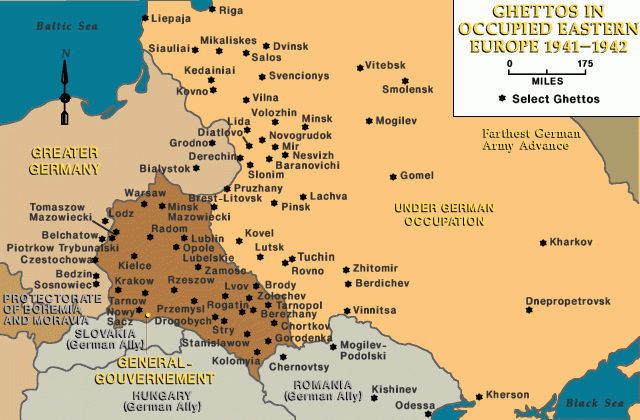
It is easy to picture the ghetto as one place, Warsaw, behind its wall. It was not one place. After Germany invaded Poland in September 1939, and then the Soviet Union in 1941, it built more than a thousand ghettos. They stretched across occupied Poland, the Baltic states, and the western Soviet Union, in great cities and in small towns most people have never heard of: Kraków, Białystok, Lvov, Lublin, Vilna, Częstochowa, Minsk, and a thousand others. Whole regions of Jewish life, communities that had stood for centuries, were swept into them.
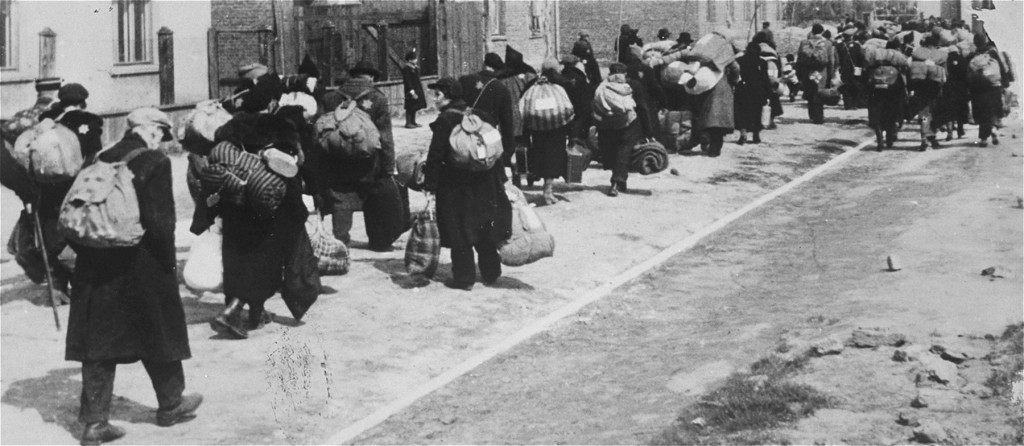
For a family, it began with an order. A notice would go up, or soldiers would come to the door: you have until a stated hour to leave your home and report to the ghetto. You could take only what you could carry. Everything else (the house, the furniture, the shop, the savings, the photographs on the wall, everything a family gathers over generations) stayed behind, and was taken. People left their front doors for the last time carrying a suitcase or a bundle, a child by the hand, not knowing they would never come back.
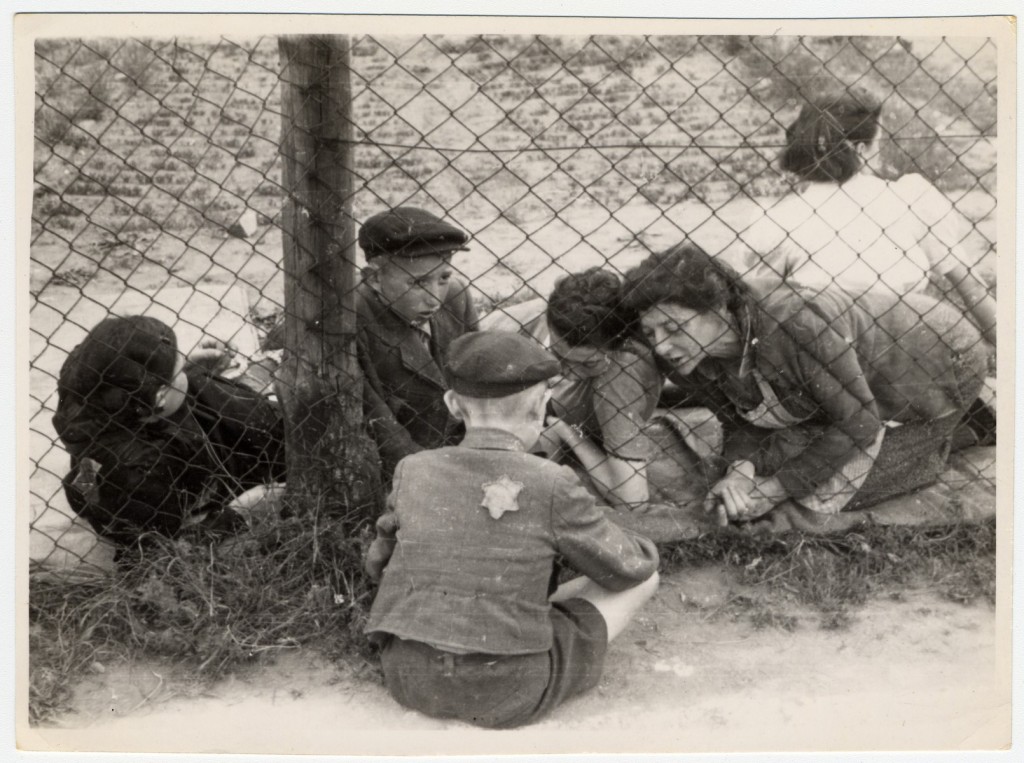
Where they were sent was a few streets of a poor district, walled off with brick or fenced with barbed wire, the gates guarded so no one could leave. Into it the Jews of a whole region were packed, far more people than the space could hold, families crowded six and seven to a single room, strangers sharing the floor. The door of a home you had lived in your whole life closed behind you, and ahead was a single room, a wall, and a guard. That was the beginning. What came after was hunger.
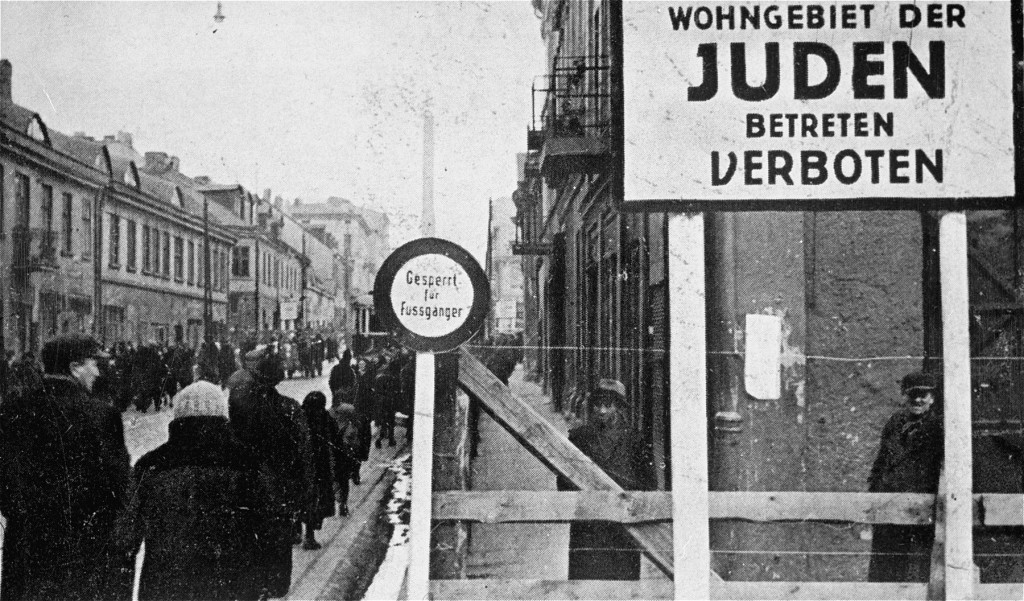
The ghettos varied: some sealed completely, some more open; some lasting weeks, some years. But two were far larger than all the rest, and most of what survives of ghetto life comes from them.
The largest
Warsaw.
Warsaw held the largest Jewish community in Europe and the second largest in the world, after New York. In October 1940 the Germans ordered a ghetto there; in November they sealed it. Around four hundred thousand people were confined behind walls enclosing roughly two percent of the city’s area.
The crowding and hunger were lethal on their own. Tens of thousands died inside the ghetto of starvation and disease before any deportation began. Then, from July to September 1942, the Germans deported about two hundred and sixty thousand people from Warsaw to the Treblinka killing center, where they were murdered.
The last to fall
Łódź.
Łódź, in western Poland, held the second-largest ghetto. The Germans renamed the city Litzmannstadt, sealed the ghetto in the spring of 1940, and turned it into a vast workshop, its residents, including children, making uniforms and goods for the German war effort. More than two hundred thousand people passed through it.
The head of its Jewish council, Mordechai Chaim Rumkowski, gambled that if the ghetto made itself useful enough to the German war machine, its people might be spared. He was wrong, but the gamble kept Łódź alive longer than any other ghetto in Poland. Deportations to the Chelmno killing center began in 1942; in the summer of 1944 the Germans liquidated what remained, sending the last residents, Rumkowski among them, to Auschwitz. Of more than two hundred thousand, fewer than a thousand were found alive in Łódź when Soviet forces arrived in January 1945.
Object Spotlight
The boxes that came out of the ground.
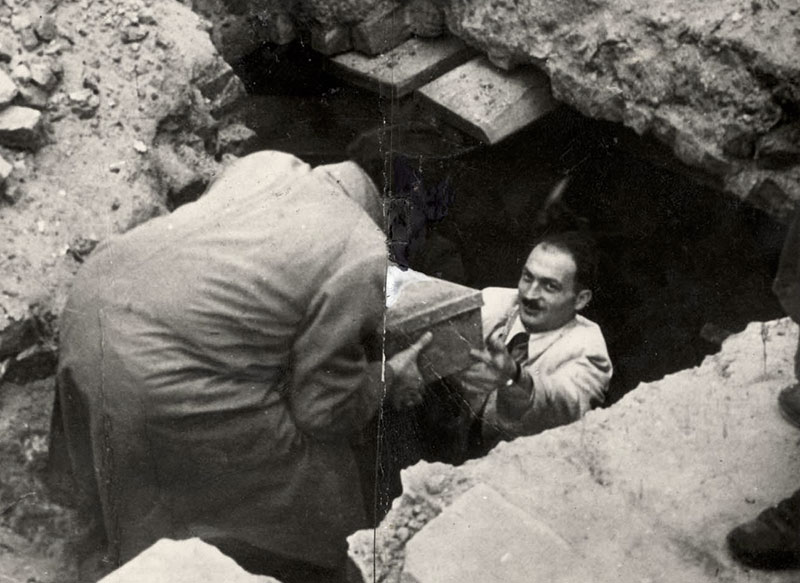
What you see. Two men in a pit dug into broken brick and rubble. One stands down in the hole; the other reaches in. Between their hands is a dented metal box, lifted up out of the ground. It is an ordinary container, the kind that might hold tools or food. What it held was a record of an entire world.
What it is. This is one of the metal boxes of the Oneg Shabbat archive, the secret record of the Warsaw ghetto, buried beneath its streets and dug out after the war. The man who started it was Emanuel Ringelblum, a historian. He gathered a hidden group of perhaps sixty people who set out to document everything around them: the hunger and the smuggling, the schools and the deportations, the jokes, the rumors, the deaths. They met on Saturdays and took the cover name “the joy of the Sabbath.”
When and where. The Warsaw ghetto, in German-occupied Poland, 1940–1943. As the deportations emptied the ghetto, the group sealed its papers into metal boxes and milk cans and buried them in three caches under the streets. Parts were recovered in 1946 and 1950; one milk can came out of the ground at 68 Nowolipki Street. This container is held today by the Jewish Historical Institute in Warsaw, on loan to Yad Vashem.
Why it matters. Almost everything the world knows about how people died in the Holocaust comes from the records of the people who killed them, German orders, lists, photographs. The Oneg Shabbat archive is the great exception: a record of the ghetto written by the people inside it, while it was happening, in their own words. Yad Vashem calls it the most important collection of its kind in the world. It exists because a group of people decided that being remembered was worth dying for.
What else. Of the roughly sixty members of the group, only three lived to see the end of the war. Ringelblum himself was found hiding in Warsaw and murdered in 1944, with his wife and his twelve-year-old son. The instruction he gave a colleague was simple, and it tells you everything about why the boxes exist: collect as much as possible; they can sort it out after the war.
Afterlife. The people who buried the archive were nearly all killed. The archive survived them. What they collected (the diaries, the drawings, the underground newspapers, the last letters) is now one of the only accounts of the Holocaust written by its victims as it happened. It is the reason much of what this Topic tells can be told at all. The Germans set out to end a people and bury the proof with them; the boxes in this photograph are that proof, lifted back out of the ground.
Daily life
Life inside.
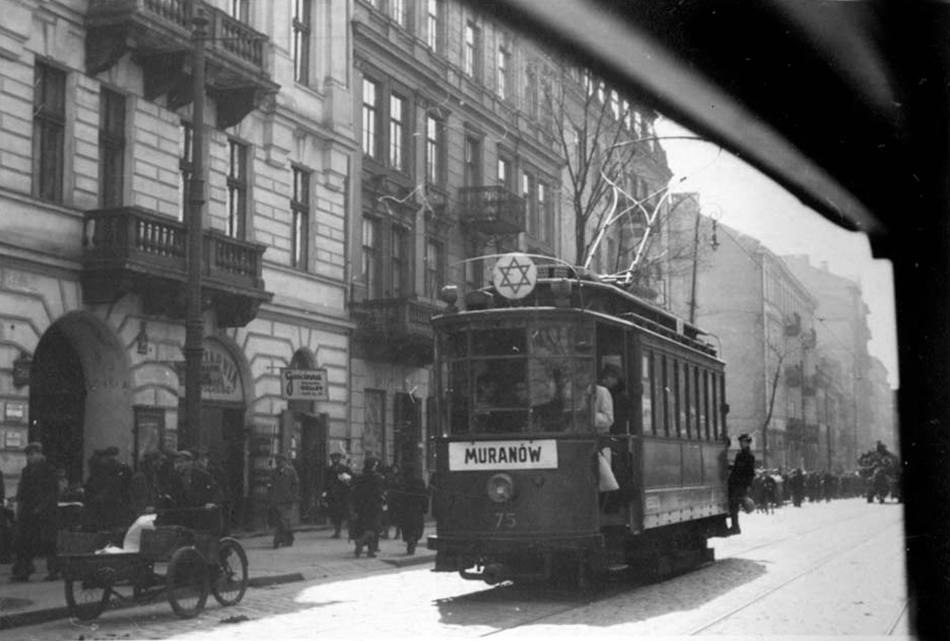
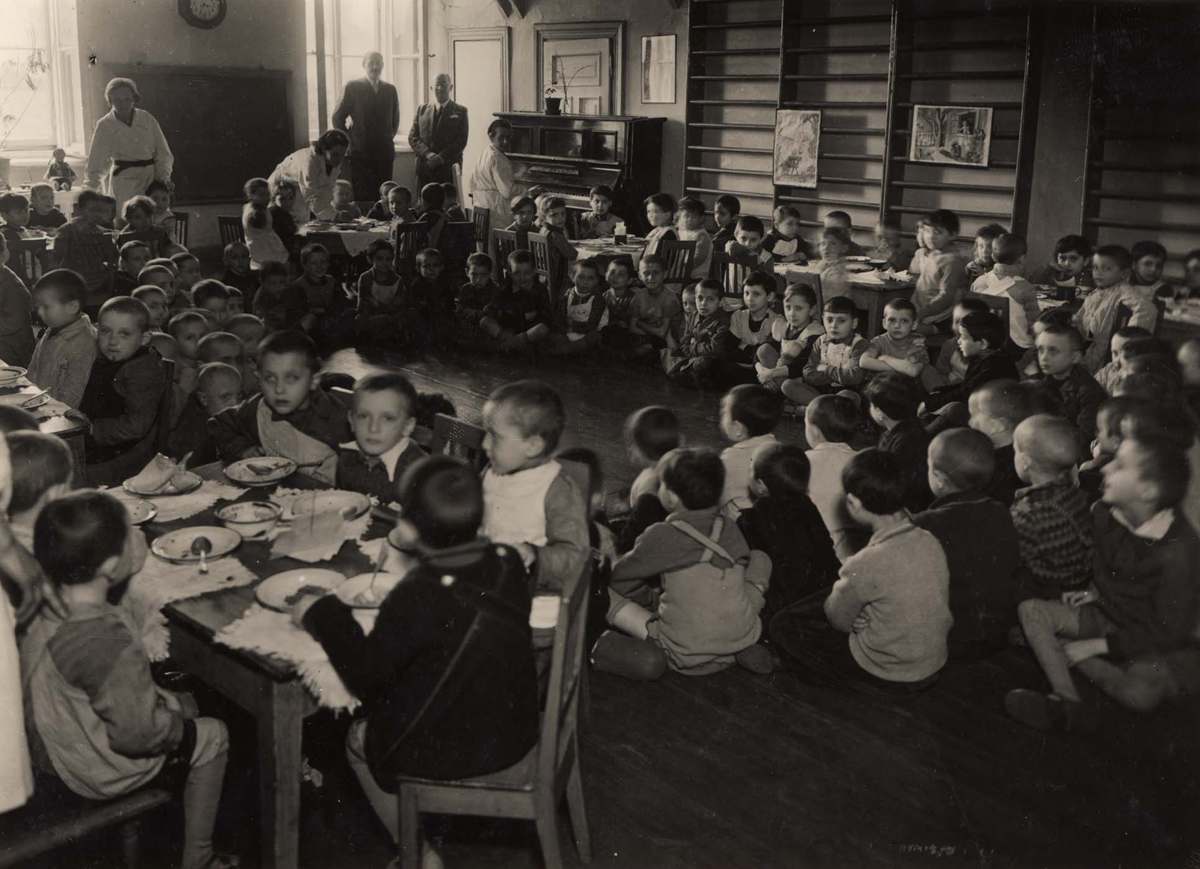
Hunger governed everything. In Warsaw the Germans set the official food ration for a Jew at about 181 calories a day, roughly a tenth of what a person needs to live. People made up the difference however they could, almost all of it illegal. Much of the smuggling was done by children, small enough to slip through gaps in the wall or the sewers, who brought back food on their bodies and were shot if caught. By the summer of 1941, more than five thousand people a month were dying in the Warsaw ghetto of starvation and the diseases that follow it. Six or seven people shared a single room.
“When it’s so cold, even my heart is heavy. There is nothing to cook today; we should be receiving three loaves of bread but we will be getting only one bread today… Does this deserve to be called life?”An anonymous girl, diary kept in the Łódź ghetto, March 7, 1942. A partial diary found in the ghetto in 1945; its author was never identified. Via the United States Holocaust Memorial Museum.
And inside that, life did not stop. People ran secret schools for children who were forbidden to be taught. They held prayer services, lectures, and concerts. Doctors, themselves starving, ran a clinical study of the effects of hunger on the human body, so that something might be learned from what was being done to them. Even under starvation, people struggled to preserve education, religious life, cultural life, and the historical record.
The fullest expression of that will was an archive. In the Warsaw ghetto, a historian named Emanuel Ringelblum gathered a secret group of perhaps sixty people who set out to document everything around them (the hunger, the smuggling, the schools, the deportations) and then buried their papers in metal boxes beneath the streets, so the record would outlive them. Most of the group did not survive; the buried archive did. The Object Spotlight below tells its story.
The impossible position
The choice with no good answer.
Inside each ghetto the Germans appointed a Jewish council, the Judenrat, and made it carry out their orders. At first that meant distributing food and organizing labor. Later it meant something unbearable: drawing up the lists of who would be put on the deportation trains.
No one forced into that position had a good option, and two men who held it answered the demand in opposite ways.
In Warsaw, the council was led by an engineer named Adam Czerniaków. For three years he tried to keep the ghetto alive. When the Germans ordered him, in July 1942, to begin handing over thousands of people a day for “resettlement”, and refused his plea to spare the orphans, he understood what resettlement meant. On July 23, 1942, the day after the deportations to Treblinka began, he swallowed a cyanide pill at his desk. In a note to his wife he wrote that they were demanding he kill the children of his people with his own hands, and that he could not.
In Łódź, Mordechai Chaim Rumkowski chose the opposite path. He believed that if he made the ghetto too useful to the German war effort to destroy, “rescue through labor”, he could save at least some of his people. So he complied. In September 1942, ordered to hand over twenty thousand of the ghetto’s children and elderly, he stood before the community and begged the parents to give up their children so that the rest might live. The deportations he organized sent tens of thousands to the killing centers. He was deported himself, on the last transport, in 1944.
History has judged these two men very differently, and it still argues about them. The point of setting them side by side is not to award praise or blame. It is to see the position the Germans engineered, one in which every available choice led to death, and the only question left was whose, and by whose hand. That position, and not only the killing itself, is part of what the ghettos were.
Resistance
The Warsaw Ghetto Uprising.
By early 1943, the people left in Warsaw understood what the deportations meant. When the Germans came in April 1943 to empty the ghetto for good, a few hundred young fighters with smuggled and homemade weapons fought back.
They could not win, and they knew it. They held out for nearly a month against a far larger, better-armed force, longer than some national armies had lasted against Germany. The Germans crushed the uprising block by block and destroyed the ghetto. Most of the fighters were killed. The Warsaw Ghetto Uprising was the largest armed Jewish revolt of the Holocaust, and it was meant, in part, as a message to the world that the Jews of Warsaw had not gone quietly.
Where it led
Where the ghettos led.
The ghettos were a stage in the Holocaust, not its final destination. They were where the killing was organized and the victims were held, and they emptied into the killing centers, Treblinka, Chelmno, Auschwitz, and the rest. To follow that next step, see the Topic on the mobile killing units and, when it is published, the Topic on the camp system.
By the end of the war the great ghettos were gone, and with them most of the communities that had filled them, centuries of Jewish life in Poland, ended in a few years. What survives is the record: the buried archives, the testimonies, the few who lived. That record is why the ghettos can still be studied, and why they must be.
Key takeaways
- The Nazi ghettos (1939–1944) were sealed holding zones in occupied Poland and the East, not the lasting early-modern ghetto, which is a separate Topic.
- There were more than a thousand of them, in cities and small towns alike. Families were ordered from their homes with only what they could carry; everything they left behind (homes, businesses, possessions) was taken.
- Their principal purpose was the concentration, exploitation, and eventual deportation of Jewish communities to killing centers.
- Warsaw was the largest, about 400,000 people; some 260,000 were deported to Treblinka in the summer of 1942 alone.
- Łódź lasted longest, run as a forced-labor workshop under Rumkowski, and was the last ghetto in Poland to be liquidated, in 1944.
- The official food ration in the Warsaw ghetto was about 181 calories a day; over 80,000 people died there of starvation and disease, much of the smuggling that kept others alive done by children.
- Inside the walls people ran secret schools, worship, and concerts, and the Oneg Shabbat group secretly archived ghetto life in buried milk cans, one of the only records of the Holocaust written by its victims as it happened.
- The Germans forced Jewish councils (the Judenrat) to draw up deportation lists: in Warsaw Adam Czerniaków took his own life rather than hand over the children; in Łódź Rumkowski complied, betting on “rescue through labor.” Neither choice could save them.
- The Warsaw Ghetto Uprising of 1943 was the largest armed Jewish revolt of the Holocaust.
Questions for the classroom
For discussion.
None of these has a single expected answer. Each asks students to weigh what is on this page and reach their own judgment.
- The Germans ordered families to leave their homes with only what they could carry, and took everything left behind. Why might controlling people’s property and movement come before the violence that followed, rather than after? C3 D2.His.14.9-12 (causation).
- Adam Czerniaków took his own life rather than sign the deportation lists; Mordechai Rumkowski chose cooperation, believing labor might save some. The page asks you not to award praise or blame, but to see the position the Germans built. Why is that a hard discipline to hold, and why does the history demand it? C3 D2.His.16.9-12 (interpretation).
- Emanuel Ringelblum’s circle buried their archive in milk cans; Mendel Grossman photographed the deportations in secret; an unnamed girl kept a diary. All risked their lives to make a record. What does it mean to decide that being remembered is worth dying for? C3 D2.His.10.9-12 (sources).
- One photograph on this page was taken by a German soldier treating the ghetto as a spectacle; another was taken by a Jewish prisoner documenting his own people’s deportation. How should a historian weigh an image differently depending on who held the camera, and why? Common Core RH.11-12.6 (point of view).
- There were more than a thousand ghettos, but most of what survives comes from Warsaw and Łódź. How should we think about the communities that left few or no records, and what does the unevenness of evidence do to the story we can tell? C3 D2.His.10.9-12 (limits of evidence).
For the classroom
Where this Topic fits the standards.
- World History, NY Grade 8 (United States History) 8.5 and NY Global History 10.5 (World War II and the Holocaust). Examines Nazi occupation policy, forced segregation, deportation, and the role of the ghettos within the Holocaust.
- NYS Holocaust Education Mandate, Education Law §801. Supports Holocaust instruction through the study of ghettoization, daily life, documentation, and deportation.
- Common Core, Reading in History/Social Studies (grades 6–12). Students assess an author’s purpose and point of view (RH.6–8.6, RH.9–10.6, RH.11–12.6) and compare and corroborate multiple sources (RH.6–8.9, RH.9–10.9, RH.11–12.9), working from maps, diaries, photographs, demographic records, and survivor testimony.
- C3 Framework, D2.His.1 and D2.His.14 (grades 6–8 and 9–12). Students investigate historical context, continuity and change, and evidence-based interpretation.
- Classroom Applications. Students can:
- interpret diaries, maps, and photographs as primary sources;
- compare daily life across different ghettos;
- analyze the geography of forced segregation;
- trace the path from ghettoization to deportation;
- construct evidence-based historical arguments.
- International Classroom Relevance. Supports Holocaust education, urban history, human-rights education, and museum-based learning.
Learn more
For students and teachers.
Sources and citations
Primary sources come straight from the time: documents, letters, speeches, images, and objects created by the people involved. Secondary sources come later: books, articles, and analysis in which scholars study and interpret those primary sources.
Primary sources
- “Anonymous Girl Diarist from the Lodz Ghetto” and “Young Diarists from the Lodz Ghetto.” Holocaust Encyclopedia, United States Holocaust Memorial Museum.
- “Deportation to Chelmno” (photograph by Mendel Grossman) and “Give Me Your Children: Voices from the Lodz Ghetto.” Holocaust Encyclopedia, United States Holocaust Memorial Museum.
- “Chaim Rumkowski and the Deportation of Children from the Lodz Ghetto (1942).” German History in Documents and Images, German Historical Institute.
- Czerniaków, Adam. The Warsaw Diary of Adam Czerniaków. Edited by Raul Hilberg, Stanislaw Staron, and Josef Kermisz. New York: Stein and Day, 1979.
- Ringelblum, Emanuel, and the Oyneg Shabes group. The underground archive of the Warsaw Ghetto (the Ringelblum Archive), 1940–1943. Jewish Historical Institute, Warsaw.
Secondary sources
- Gutman, Israel. The Jews of Warsaw, 1939–1943: Ghetto, Underground, Revolt. Bloomington: Indiana University Press, 1982.
- Trunk, Isaiah. Łódź Ghetto: A History. Edited and translated by Robert Moses Shapiro. Bloomington: Indiana University Press, 2006.
- Kassow, Samuel D. Who Will Write Our History? Emanuel Ringelblum, the Warsaw Ghetto, and the Oyneg Shabes Archive. Bloomington: Indiana University Press, 2007.
- United States Holocaust Memorial Museum. “Ghettos,” “Warsaw,” “The Lodz Ghetto,” and “The Oneg Shabbat Archive.” Holocaust Encyclopedia. encyclopedia.ushmm.org.
- Yad Vashem. “The Ghettos” and the ghetto pages on Warsaw and Łódź. yadvashem.org.
Finding these documents: many primary sources are free online. Good places to start are the Fordham Internet Jewish History Sourcebook, Yale’s Avalon Project (law and diplomacy), German History in Documents, the collections of the US Holocaust Memorial Museum and Yad Vashem, the National Library of Israel, and Sefaria (for Jewish texts). Search the document’s name and date.
The Nazi camp system was not a single kind of place: concentration camps, transit camps, forced-labor camps, and the six killing centers each had a different purpose.
Comments?
Write to editor@makorproject.org.
Last updated: August 2026.