The Years Before the Killing, 1933–1939
None of it was hidden. Between 1933 and 1939, Nazi Germany stripped Jewish citizens of work, rights, citizenship, property, movement, and safety through hundreds of laws and decrees. The process unfolded in public, through ministries, courts, police offices, universities, schools, professional associations, and local administrations. Before mass murder came a documented legal process of exclusion.
Common misconceptions this Topic addresses
This Topic separates the beginning of Nazi rule from the beginning of the Holocaust. The dedicated Misconceptions entries explain why the distinction matters.
- "The Holocaust began in 1933 with the Nazi seizure of power." see the dedicated entry →
- "'Antisemitism' is a general term for any hostility toward Jews going back to antiquity." see the dedicated entry →
- "Nazi racial ideology was Hitler's invention." see the dedicated entry →
January 30, 1933
January 30, 1933.
On January 30, 1933, Germany's elderly president, Paul von Hindenburg, named Adolf Hitler Chancellor, the head of the government. It was done by the rules of the Weimar Republic, Germany's democratic government of the 1920s, on the advice of a former chancellor, Franz von Papen. Papen had arranged a deal: Hitler's party, the Nazis (in German, the NSDAP), would hold the chancellorship, but conservative non-Nazis would hold most of the cabinet seats. The conservatives who set this up thought they could control him. Papen's own line, often quoted since, was "we have hired him." They were wrong within weeks.
Germany in early 1933 was a country under heavy strain. The Great Depression, which began with the American stock-market crash of October 1929, hit Germany harder than most of Western Europe, because German banks had leaned on short-term American loans that suddenly vanished. By early 1932 roughly 6 million Germans were out of work, about 30 percent of the workforce, and the political system was breaking down with the economy. The Nazi Party rode that collapse upward: from 12 seats in 1928, to 107 in September 1930 (the second-largest party), to 230 in July 1932 (the largest). Their support dipped to 196 seats in November 1932, but the older mainstream parties had fallen apart so badly that the Nazis remained the biggest party even as they slipped.
Germany's Jewish community at that moment numbered about 525,000 people, roughly three-quarters of one percent of a national population of about 65 million. It was a mostly city-dwelling community; about a third lived in Berlin. Jews were well represented in the professions: about 16 percent of Germany's lawyers and about 11 percent of its doctors were Jewish, along with many figures in the universities, the press, and business. They were woven into German civic life. About 100,000 German Jews had served in the Imperial German Army in the First World War, and about 12,000 had been killed fighting for Germany. Most assumed, as later memoirs by Victor Klemperer, Leo Baeck, and others record, that the Nazi government, real threat though it was, would either be held in check by Germany's laws and constitution or would calm down once it had to actually govern. Both assumptions were wrong.
The first year
The legal machinery, built in eleven months.
The major steps of the first year of Nazi rule came fast, one after another:
- February 27, 1933, The Reichstag Fire. The German parliament building burned. A young Dutch Communist, Marinus van der Lubbe, was arrested at the scene and later executed. Historians still debate whether he acted alone or whether the Nazi regime had a hand in it. What is certain is what the regime did with it: used the fire as an excuse to suspend Germany's civil liberties overnight.
- February 28, 1933, The Reichstag Fire Decree. Signed by Hindenburg under the emergency powers of Article 48 of the constitution. It suspended the basic protections Germans had counted on, personal freedom, free speech, the right to assemble and organize, privacy of mail and telephone, protection from arbitrary search, and let the regime take "all necessary measures" against anyone it called an enemy. This decree stayed in force the entire twelve years of Nazi rule. It was the legal ground on which the Gestapo, the secret police, could arrest and jail people without a trial.
- March 5, 1933, Reichstag elections. Held under heavy Nazi intimidation, with the Communist Party's campaigning shut down (using the Fire Decree) and the SA, the Nazi paramilitary, the brownshirts, attacking opposition candidates in the streets. The Nazis won about 43.9 percent of the vote: a large share, but not the majority they had wanted. A coalition with the conservative DNVP gave them a narrow parliamentary majority.
- March 22, 1933, The first concentration camp opens at Dachau. Set up by Heinrich Himmler, then the police chief of Munich. Its first prisoners were mostly Communists, Social Democrats, and trade unionists, political opponents, not yet the Jewish, Roma, gay, and other prisoners who would fill the camps later. Dachau ran until April 1945, twelve years, and became the model for the whole camp system that followed.
- March 23, 1933, The Enabling Act. Its formal name translates as the "Law for the Removal of the Distress of the People and the Reich." Parliament passed it with the two-thirds majority needed to change the constitution, after Nazi intimidation of the deputies in the room and the removal of the Communist deputies. The act let Hitler's cabinet make laws on its own, without parliament, including laws that broke the constitution. This was the legal foundation everything else rested on. Only the 94 Social Democrats present voted no; the Catholic Center Party's decision to vote yes has been argued over by historians ever since.
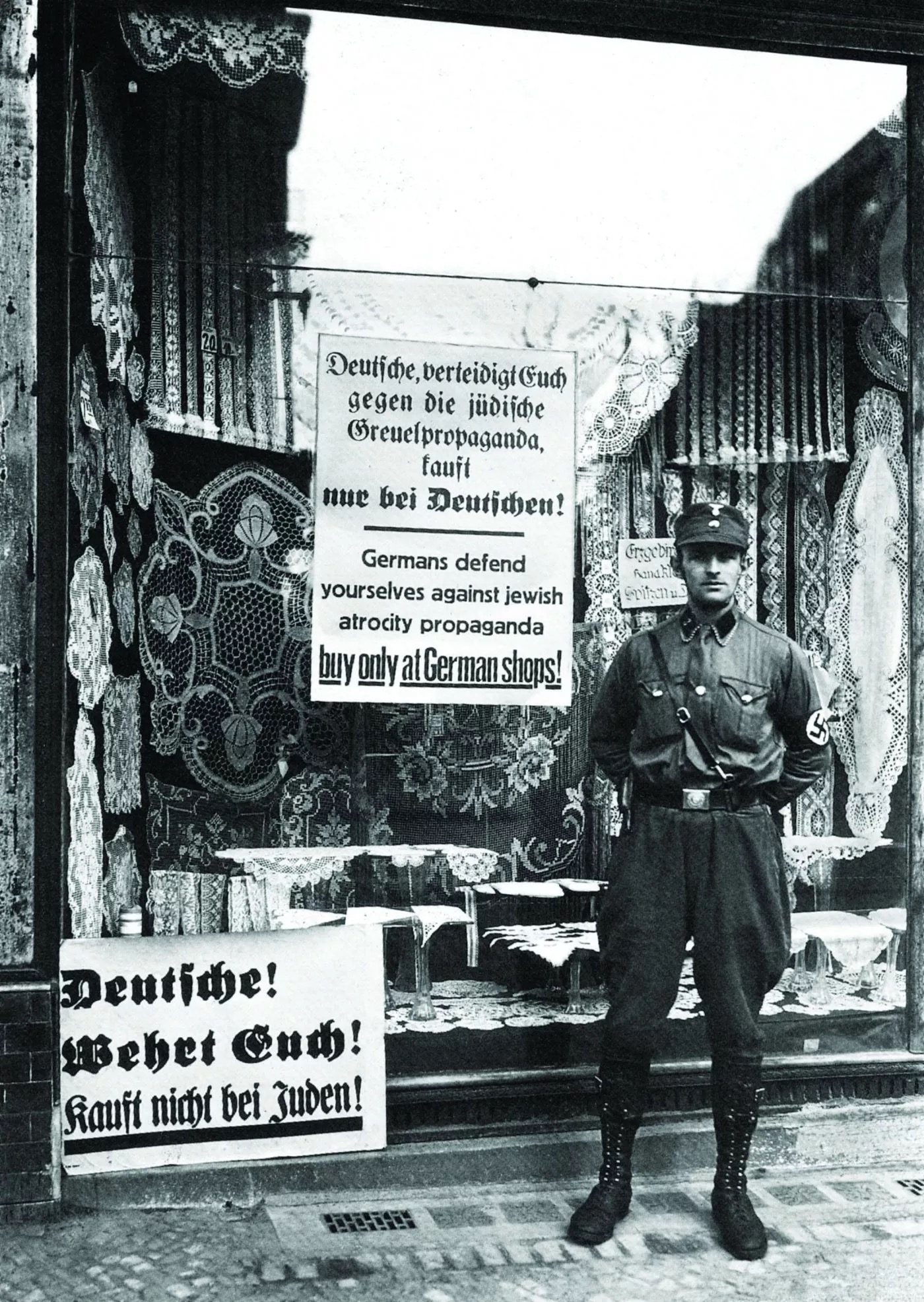
- April 1, 1933, The boycott of Jewish businesses. Organized by the SA under Julius Streicher. For one day across Germany, brownshirts stood at the doors of Jewish-owned shops, offices, and medical practices, with slogans painted on the windows. It mattered as the regime's first nationwide action against Jews, and because ordinary Germans' reactions were mixed: some joined in, some quietly ignored it, and some deliberately shopped at the targeted stores. It did not produce the wave of public agreement the regime had hoped for, and it was called off after a single day. But the message had landed: Jews could no longer count on the ordinary protections of German life.
- April 7, 1933, The Law for the Restoration of the Professional Civil Service. The regime's first major anti-Jewish law. Its "Aryan paragraph" pushed "non-Aryans" out of government jobs. The definition it used, people with at least one Jewish grandparent, set an early legal pattern that the later Nuremberg Laws would refine and expand. At first there were exceptions for First World War veterans and for those whose fathers or sons had died in the war, pushed by President Hindenburg, who personally objected to firing Jewish veterans. Those exceptions were chipped away over 1934–35 and removed by the Nuremberg Laws.
- April 25, 1933, The Law against the Overcrowding of German Schools and Universities. Capped the number of Jewish students allowed in German schools and universities at about 1.5 percent, with further limits on Jews in higher education.
- May 10, 1933, The book burnings. Coordinated across about 34 German university towns by the Nazi Student Union, working with the Propaganda Ministry. About 25,000 books were burned in Berlin's Bebelplatz square alone, with similar scenes across the country. The targets included Jewish authors (Freud, Einstein, Heine, Schnitzler, Werfel, Zweig, Toller, Tucholsky), Marxist and socialist writers, the pacifist Erich Maria Remarque, and anything the regime branded "un-German." Today the Bebelplatz holds a memorial by the Israeli sculptor Micha Ullman, dedicated in 1995: a glass plate set into the ground, looking down into an empty white library with room for all the burned books.
- July 14, 1933, The Law for the Prevention of Hereditarily Diseased Offspring. Authorized the forced sterilization of people the state labeled as carrying "hereditary" diseases. About 400,000 Germans were sterilized under it between 1934 and 1945. It was the opening move toward the later T-4 program, which murdered roughly 70,000 to 80,000 disabled Germans in 1939–41, and toward the wider Nazi medical machinery.
- October 4, 1933, The Editor's Law. Barred Jews, and people married to Jews, from German journalism, ending within the first year a long-standing and prominent Jewish presence in the German press.
Behind these laws and the first camps stood a new kind of organization. The SS: the Schutzstaffel, or “protection squad”, had begun in 1925 as a small bodyguard unit for Hitler. In 1929 Heinrich Himmler took it over, fewer than 300 men at the time, and began turning it into the core of the Nazi machinery of control: selected by race and loyalty, ranked, uniformed in black, and sworn by a personal oath to Hitler rather than to the German constitution. Its members wore the swastika of the wider Nazi movement and, on the collar, the SS’s own emblem: the doubled Sig rune, the twin angular lightning bolts that formed the “SS” itself. The Totenkopf, or death’s-head, marked the units that guarded the camps.
Over the next few years the SS absorbed the powers of the state itself. Hermann Göring created the Gestapo, the secret state police, in Prussia in 1933; by 1934 Himmler controlled it, and in June 1936 he was named Chief of German Police, placing the Gestapo, the criminal police, and the ordinary uniformed police all under his command alongside the SS. Party organization and state authority had fused into a single apparatus. A separate SS branch, the Death’s-Head units (SS-Totenkopfverbände), ran the concentration camps; from 1941 the SS would also carry out the mass shootings and operate the killing centers. By the late 1930s it was no longer an outlaw party militia but a salaried, uniformed, openly recognized branch of the German state, terror built into the ordinary machinery of government.
The pattern of that first year was the building of a legal machine of persecution through ordinary law-making. The Nazis did not need a secret parallel system; they worked through Germany's existing offices, with the cooperation of the civil service, the courts, the police, the universities, and the medical and legal professions. The machine would grow over the next six years, but its foundations, named enemies, suspended liberties, exclusion from jobs and schools, a controlled press, and the power to jail without trial: all were already in place by the end of 1933.
The Nuremberg Laws · 1935
The Nuremberg Laws, defining "Jew" in law.
On September 15, 1935, at the Nazi Party's yearly rally in the city of Nuremberg, Hitler announced two laws that turned the persecution into a fixed legal system. They had been building toward this for two and a half years; now it was written into the code:
- The Reich Citizenship Law. It split German residents into two classes: "Reich citizens," who held full rights, and "state subjects," who did not. Only "persons of German or related blood" could be Reich citizens. The effect was to strip German Jews of their citizenship. Later decrees spelled it out, Jews were state subjects but not citizens, which meant they lost the protections that citizenship had given them.
- The Law for the Protection of German Blood and German Honor. It banned marriage and sexual relations between Jews and "citizens of German or related blood." It barred Jews from employing German women under 45 as household servants. It forbade Jews to fly the German flag. Breaking these rules carried prison terms of up to 15 years.
The laws raised an obvious question: who counted, legally, as a Jew? A follow-up decree on November 14, 1935 answered it by counting grandparents:
- A person with three or four Jewish grandparents was a "full Jew."
- A person with two Jewish grandparents who practiced Judaism, was married to a Jew, or was born of a marriage to a Jew also counted as a Jew.
- A person with two Jewish grandparents and none of those ties was a "first-degree mixed-race" (in German, Mischling).
- A person with one Jewish grandparent was a "second-degree mixed-race."
With this, the regime had finished defining Jewishness as something inherited by blood, regardless of whether a person or their family practiced the religion at all. Through ordinary German law-making, with no real pushback from abroad, a whole category of Germans identified by ancestry had been placed outside the protections of citizenship. The world noticed, Western newspapers covered the laws, but no government took action. The same racial rules were soon extended to Roma and to Black Germans. By the end of 1935, the legal framework of Nazi racism, traced in detail by historians like Saul Friedländer and Peter Longerich, was essentially complete.
1936
1936, The Olympic pause.
When Berlin hosted the Summer Olympics from August 1 to 16, 1936, the visible persecution went quiet. The regime knew the world's press would be watching and that the Games would shape how other countries saw it, so it temporarily took down the anti-Jewish signs around Berlin, reined in much of the SA's street violence, and softened the public face of the persecution in the months before and during the Games.
The substance never paused. The Nuremberg Laws stayed in force, Jewish civil servants and professionals kept losing their jobs, and the Gestapo kept operating under the Reichstag Fire Decree. What paused was only what visitors could see. Historians point to this as telling: the regime could turn the visibility of its persecution up or down depending on who was watching, which suggests it understood, and feared, what sustained international pressure might do. That pressure never came.
The Berlin Games are best remembered for the four gold medals won by the African-American athlete Jesse Owens, a public answer to Nazi racial theory delivered on the regime's own stage. But the Olympics also handed the regime a stamp of legitimacy in front of the many visitors and readers who took in the coverage. International business and diplomacy with Nazi Germany rolled on through 1936 and 1937, in full view of the persecution.
1937–1938
1937–1938, The pressure increases.
After the Olympics, the persecution sped up again:
- Buchenwald concentration camp opens (July 1937), the second major camp after Dachau, built on a hill outside the city of Weimar. It ran until April 1945.
- "Aryanization" of Jewish businesses accelerates. This was the process of forcing Jewish-owned businesses either to sell to "Aryan" buyers at far below their real value or to shut down. By the end of 1938, much of the Jewish economic presence in Germany had been wiped out this way.
- The Decree on the Registration of Jewish Property (April 26, 1938) ordered German Jews to register all property worth more than 5,000 Reichsmarks. The point was to make a list of Jewish wealth for the regime to seize later, and it became the basis for the mass confiscations that followed Kristallnacht.
- The "Names Decree" (August 17, 1938) forced German Jews to add a middle name to their papers, "Israel" for men, "Sara" for women, so that any official document would mark them as Jewish.
- The "J" stamp on Jewish passports (October 5, 1938), added at the request of the Swiss government, which wanted to spot Jewish refugees at its border. The red "J" flagged German Jews to foreign immigration officers and made escape harder.
- The destruction of Munich's main synagogue (June 9, 1938), on Hitler's direct order, the first major synagogue the regime destroyed before the war, five months before Kristallnacht.
Austria · March 1938
The persecution reaches Austria.
On March 12, 1938, the German army marched into Austria, and the next day Hitler declared the Anschluss, the union of Germany and Austria. About 192,000 Jews lived in Austria, most of them in Vienna (around 170,000), with smaller communities in Graz, Linz, and the provinces. Overnight, the German persecution applied to them too.
What happened in Austria was even more violent than the German pattern had been, with more open public participation. Within days, Austrian SA and SS men forced Vienna's Jews into public humiliation, the well-documented scenes of elderly Jews made to scrub the city's streets on their knees while crowds watched, looted Jewish businesses, and drew wide popular participation in the violence. The five and a half years it had taken to build the machine in Germany was matched in Austria in a matter of months.
It was in Vienna, in those months, that Adolf Eichmann, who would later organize much of the Nazi deportation system, set up the new Central Office for Jewish Emigration. His system funneled Austrian Jews through a single bureaucratic channel that forced them to emigrate while stripping away their property as they left. It worked faster than the German process, precisely because it was built on confiscation, and it became the model for the wider emigration and, later, deportation apparatus. About 130,000 Austrian Jews emigrated through Eichmann's office between March 1938 and the outbreak of war in September 1939.
Évian · July 1938
Évian, the world declines to help.
In July 1938, prompted by U.S. President Franklin Roosevelt and by the refugee crisis the Anschluss had set off, representatives of 32 countries met at the resort town of Évian-les-Bains, on the French shore of Lake Geneva, to discuss what to do about Jewish refugees. They talked for nine days, from July 6 to 15. What the conference is remembered for is its failure.
Of the 32 countries, 31 declined to take in more Jewish refugees. The reasons differed but the result was the same. Australia's representative said his country had "no real racial problem" and did not wish "to import one." Britain refused to discuss immigration to Palestine, which it controlled. The United States would not raise its existing immigration quotas, quotas so tight under the 1924 Johnson-Reed Act that they weren't even being filled, because officials were slow to grant visas to Jewish applicants. France said it had already taken in many refugees and could not manage more. Country after country said no.
The one real exception was the Dominican Republic, which offered to admit up to 100,000 Jewish refugees as farm settlers. The dictator Rafael Trujillo had his own tangled motives, but the offer was real. In the end about 645 refugees reached the Dominican Republic through a settlement at Sosúa; the rest of the capacity went unused, blocked by visa restrictions, the difficulty of moving refugees across oceans, and the sheer scale of the crisis.
For the Nazi regime, Évian confirmed something useful: the world was not going to take Germany's Jews off its hands. The Nazi press celebrated the failure and read it as a green light. Historians, beginning with David Wyman's Paper Walls (1968), have treated Évian as one of the turning points of these years.
The Polenaktion · October 1938
The expulsion of Polish-born Jews.
On the night of October 28–29, 1938, the Gestapo arrested about 17,000 Polish-born Jews living in Germany, many of whom had been in Germany for decades and had German-born children, and pushed them across the Polish border at the town of Zbąszyń and other crossings. The trigger was a Polish decree of March 1938 that stripped citizenship from Poles who had been out of the country for more than five years, which described exactly these long-settled Polish Jews. Poland wanted to keep them from returning; Germany expelled them before the citizenship change took effect on October 31.
The expulsion was brutal. People were given about an hour to grab what they could carry; the rest was left behind. Polish border guards at first refused to let them in, and thousands were stranded at the frontier for weeks in miserable conditions. Zbąszyń, on the Polish side, took in about 8,000 of them and became a symbol of the whole episode.
Among those expelled were the parents and sisters of Herschel Grynszpan, a seventeen-year-old Polish Jew living in Paris. On November 7, 1938, after a postcard from his sister describing the family's expulsion, Grynszpan walked into the German Embassy in Paris and shot a diplomat, Ernst vom Rath, who died of his wounds on November 9. The Nazi regime seized on the killing as its excuse for Kristallnacht.
November 9–10, 1938
Kristallnacht, the Night of Broken Glass.
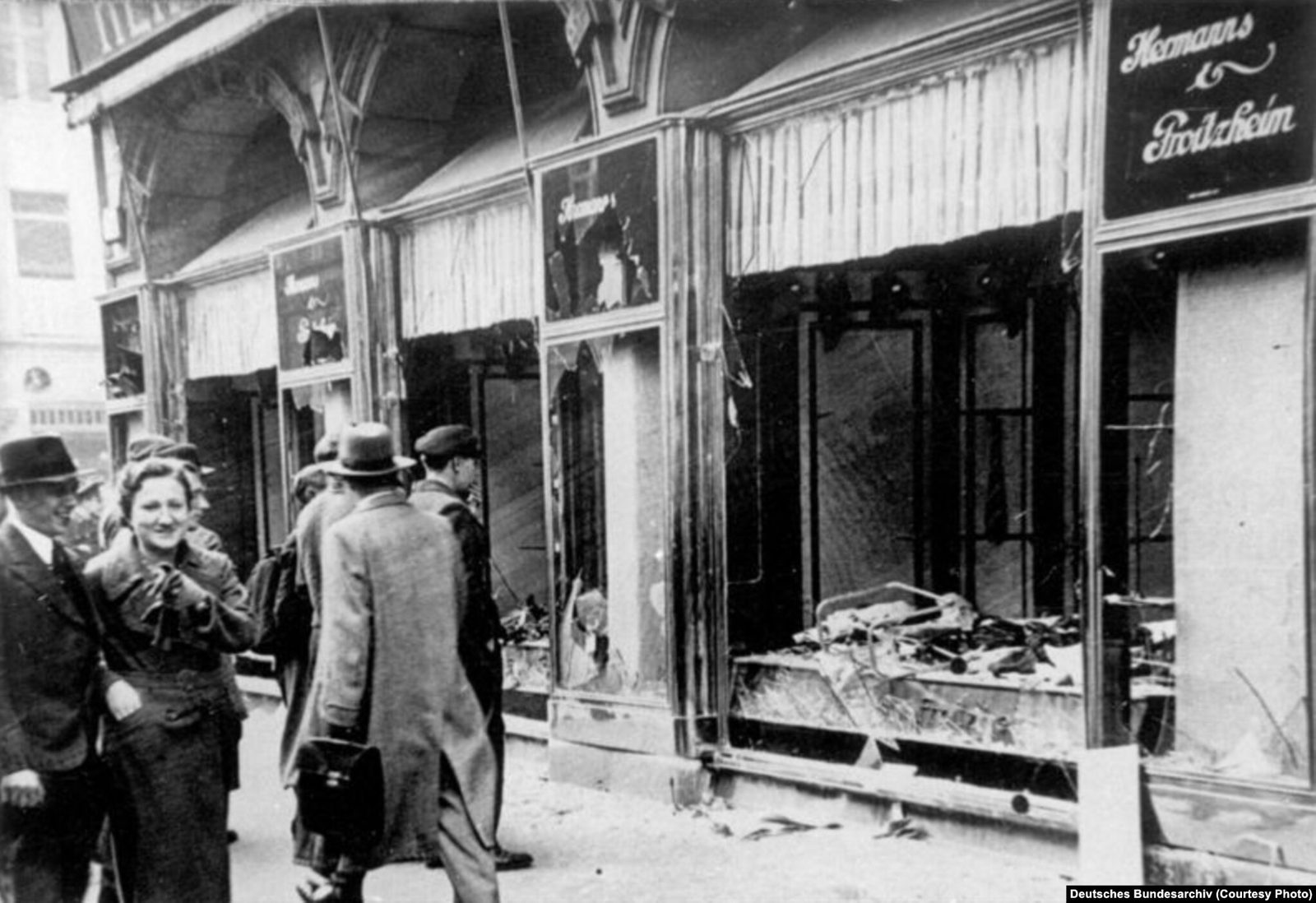
On the night of November 9–10, 1938, organized anti-Jewish violence swept across Germany, annexed Austria, and the recently annexed Sudetenland (the Czech border region Germany had taken under the Munich Agreement of September 1938). Joseph Goebbels, the Propaganda Minister, organized it; the SA, the SS, the Hitler Youth, and parts of the Nazi apparatus carried it out, with documented participation by ordinary civilians. The name, Kristallnacht, "Crystal Night," or the Night of Broken Glass, comes from the shattered glass that covered the streets after Jewish shops, synagogues, and homes were destroyed.
What the night did:
- Killed. About 91 Jews were killed in the immediate violence. Counting deaths in the camp imprisonments that followed and suicides in the days after, the documented toll reaches several hundred; estimates vary among historians.
- Arrested. About 30,000 Jewish men were arrested and sent to Dachau, Buchenwald, and Sachsenhausen. Most were released over the following weeks, often only after proving they had a plan to emigrate, the point being to drive Jewish emigration faster.
- Synagogues destroyed. About 267 synagogues across Germany, Austria, and the Sudetenland were burned or wrecked, with many more damaged. Much of the German Jewish community's religious life, built over centuries, was destroyed in a single night.
- Businesses destroyed or looted. About 7,500 Jewish-owned businesses were smashed or robbed. The forced-sale process of Aryanization sped up sharply afterward.
- Homes ransacked. Much of the urban Jewish community, especially in Berlin and Vienna, was hit by home invasions, looting, and assaults.
The aftermath turned the violence into outright robbery of the community. On November 12, 1938, the regime ordered German Jews to pay a collective fine of one billion Reichsmarks, an "atonement payment" for the damage the regime itself had organized. A decree of December 3, 1938 completed the legal machinery for seizing Jewish businesses, and parallel rules on housing, work, and access to public spaces followed in the months after.
The world reacted more strongly than it had to the Nuremberg Laws, but still not enough. The U.S. ambassador to Germany, Hugh Wilson, was recalled to Washington on November 14, 1938. American and Western European newspapers covered the pogrom, and there was public condemnation in democratic countries. Yet immigration policy barely moved. The United States did not raise its quotas; Britain did not widen Palestine immigration (it would restrict it further in the May 1939 White Paper). The Wagner-Rogers Bill, which would have let 20,000 German Jewish refugee children into the U.S. outside the quota, died in a Senate committee in 1939, blocked by anti-immigrant and antisemitic opposition.
1939
1939, The doors close.
In the first eight months of 1939, the ways out of Germany shut one by one:
- The January 30, 1939 Reichstag speech. On the sixth anniversary of becoming Chancellor, Hitler made a speech containing what he later called his "prophecy": that if "international Jewish financiers" plunged the world into another war, the result would be "the annihilation of the Jewish race in Europe." It was the regime's anti-Jewish aim stated openly as national policy, and Hitler pointed back to this speech again and again during the war to justify the killings.
- The annexation of the rest of Czechoslovakia (March 15, 1939). After the Munich Agreement broke Czechoslovakia apart, the German army occupied the remaining Czech lands, creating the Protectorate of Bohemia and Moravia and bringing about 118,000 more Jews under Nazi rule.
- The May 1939 White Paper. Britain capped Jewish immigration to Palestine at about 75,000 over the next five years, closing off that escape route at the very moment German Jews most needed it. Historians still debate how much British policy was driven by Arab political concerns, imperial calculation, or antisemitism within parts of the establishment.
- The Reich Association of Jews in Germany (July 4, 1939). A compulsory organization every German Jew had to join, replacing the community's own voluntary institutions. The regime used it as the administrative channel for managing emigration, welfare, and the ongoing dispossession.
- The Hitler-Stalin Pact (August 23, 1939). The non-aggression treaty between Nazi Germany and the Soviet Union, with secret clauses dividing Poland and Eastern Europe between them, leaving Poland diplomatically isolated as the German invasion loomed.
- September 1, 1939, Germany invades Poland. The start of the Second World War. German forces crossed the border around 4:45 a.m. Poland's roughly 3.3 million Jews came under Nazi control over the following weeks. The killing operations covered in the Einsatzgruppen Topic began here, with mobile killing units following the army into Poland, about 65,000 Jews and Polish gentiles killed in the autumn of 1939, before the far larger killings that began with the invasion of the Soviet Union in June 1941.
May 1939
The voyage of the St. Louis.
On May 13, 1939, the German ocean liner St. Louis left Hamburg carrying 937 passengers, most of them Jewish refugees fleeing Germany after Kristallnacht. Most held Cuban landing papers they believed would let them off the ship in Havana, with the hope of eventually entering the United States. When the ship reached Havana on May 27, the Cuban government, citing landing certificates it had cancelled the week before, let only 28 passengers ashore.
The ship then sailed north along the Florida coast in early June, close enough to see the U.S. shore, while the captain and Jewish refugee organizations pleaded with Washington to admit the passengers outside the quota. The U.S. government refused. The ship turned back for Europe on June 6 and reached Antwerp on June 17.
Four European countries took the passengers in: the United Kingdom (288), France (224), the Netherlands (181), and Belgium (214). Of the 619 who returned to the European continent, about 254 were later killed in the Holocaust, mostly those admitted to the Netherlands, France, and Belgium, all of which Germany would soon occupy. The 288 who reached Britain survived.
The St. Louis is remembered as it is because it played out in full view of the American press, because the U.S. refusal happened in the open, and because the passengers' later fates could be traced. It became the emblem of a wider refusal, the failure of the United States and other countries to open their doors in 1938 and 1939, the window when doing so would have changed how many of Europe's Jews survived.
Who got out
Who got out, and who could not.
The record of German Jewish emigration, year by year:
- 1933 (the first year of Nazi rule): about 37,000, driven by the shock of the regime taking power.
- 1934–1935: about 25,000, lower, as the first shock faded and many held onto the hope that the regime would soften.
- 1936: about 25,000, during the Olympic-pause year.
- 1937: about 23,000.
- 1938: about 40,000, pushed up by the Anschluss, the speed-up of Aryanization, and Kristallnacht.
- 1939 (through September): about 78,000, the rush to leave after Kristallnacht, before the war closed the routes.
That comes to roughly 270,000 people who emigrated from Germany between 1933 and September 1939, about 60 percent of Germany's 1933 Jewish population. Around 190,000 Jews were still in Germany when the war broke out; most were later deported and killed between 1941 and 1944. Historians have argued at length over whether a wider opening of refugee doors in 1938–39 would have lowered the death toll. The consensus is that it would have; the debate is over how much, not whether.
Where the emigrants went:
- The United States: about 100,000, within the existing quotas, and often only after long waits and heavy paperwork.
- Palestine (then under British control): about 60,000, under the Mandate's restricted certificate system, and including those who left through the Ha'avara Agreement, a contested 1933 arrangement that let German Jewish emigrants move part of their assets to Palestine through German export goods.
- The United Kingdom: about 40,000, including the roughly 10,000 children of the Kindertransport, brought over between December 1938 and September 1939.
- South America: about 50,000, mostly to Argentina, Brazil, Chile, and Uruguay, with smaller numbers elsewhere.
- Western Europe: about 30,000 to France, the Netherlands, Belgium, and Switzerland, often only a temporary refuge, since German occupation would soon follow.
- Asia: about 18,000 to Shanghai, which uniquely required no visa to enter between 1938 and 1941, plus smaller numbers elsewhere.
The honest accounting
The honest accounting.
Several questions about these years are still debated by historians, and it is worth naming them honestly:
- Did Hitler plan the killing from the start? Scholars divide between "intentionalists," who see the murder of Europe's Jews as Hitler's aim from early on, and "functionalists," who see the killing project emerging through escalation between 1933 and 1941. Most historians now land between the two: Hitler's hatred was fixed from the 1920s, but the specific decision that produced the killing of 1941 took shape through the radicalization of these years.
- How much did ordinary Germans take part? The record shows active participation by much of the civil service, the courts, the doctors, the universities, and the police, alongside passive acceptance by much of the wider public. It also shows the smaller number who resisted, who hid Jews or defied the regime, honored today through Yad Vashem's Righteous Among the Nations program.
- How badly did the world fail? The failure of other countries to take in Jewish refugees is clear. What is debated is which alternative policies were actually possible at the time, and exactly how many more lives a wider opening would have saved. The consensus is that the failure was real and costly; the argument is over the size of it.
- The Ha'avara Agreement. The 1933 deal between the German government and the Zionist Federation of Germany let emigrants to Palestine move some of their wealth out through German export goods. Jewish opinion at the time was split, some saw it as a rescue line for German Jews, others as collaboration with the Nazi regime. Historians generally view it as a hard response to a desperate crisis, with real costs and real benefits.
- Why did the rush to leave come so late? Emigration spiked only after the Anschluss (March 1938) and Kristallnacht (November 1938), rather than in 1933–37 when escape was easier. The explanations include the widespread hope that the regime would moderate, the heavy financial cost of leaving (the Reich Flight Tax and other barriers), the bureaucratic tangle of getting out, and the tightening limits of the countries that might have received them.
For the classroom
Where this Topic fits the standards.
- World History, NY Grade 8 (United States History) 8.5 and NY Global History 10.5 (World War II and the Holocaust). This Topic examines the rise of Nazi Germany, the legal dismantling of civil rights, antisemitic legislation, refugee policy, and the progression from discrimination to systematic persecution before mass murder.
- NYS Holocaust Education Mandate, Education Law §801. Supports Holocaust instruction by documenting how propaganda, law, bureaucracy, and state institutions gradually isolated and persecuted Jewish citizens before genocide began.
- Common Core, Reading in History/Social Studies (grades 6–12). Students assess an author’s purpose and point of view (RH.6–8.6, RH.9–10.6, RH.11–12.6) and compare and corroborate multiple sources (RH.6–8.9, RH.9–10.9, RH.11–12.9), working from laws, speeches, photographs, memoirs, newspapers, and refugee records.
- C3 Framework, D2.His.1 and D2.His.14 (grades 6–8 and 9–12). Students investigate chronology, historical causation, continuity and change, and evidence-based historical interpretation.
- Classroom Applications. Students can:
- trace the escalation from discrimination to persecution over time;
- distinguish persecution from genocide;
- analyze laws, speeches, and photographs as primary sources;
- evaluate refugee policy and the international response (the Évian Conference);
- construct evidence-based historical arguments from primary and secondary sources.
- International Classroom Relevance. Supports Holocaust education, genocide studies, human-rights education, and source-based history instruction internationally.
Learn more · take this further
Verified resources from outside organizations for students and teachers. Where a dedicated classroom resource does not yet exist, The Makor Project is developing one.
Sources and citations.
Primary sources come straight from the time: documents, letters, speeches, images, and objects created by the people involved. Secondary sources come later: books, articles, and analysis in which scholars study and interpret those primary sources.
Primary sources
- Law for the Restoration of the Professional Civil Service. April 7, 1933. The first major anti-Jewish law of the regime. English translation at USHMM.
- The Nuremberg Laws: the Reich Citizenship Law and the Law for the Protection of German Blood and German Honor. September 15, 1935. English translation at USHMM.
- Decree on the Exclusion of Jews from German Economic Life. November 12, 1938 (issued days after Kristallnacht).
- Klemperer, Victor. I Will Bear Witness: A Diary of the Nazi Years, 1933–1941. New York: Random House, 1998.
- The Reichsgesetzblatt, the German legal gazette where every Nazi law was published, is preserved in the German Federal Archives (Bundesarchiv). bundesarchiv.de →
- Proceedings of the Évian Conference on the refugee crisis, Évian-les-Bains, July 6–15, 1938.
Secondary sources
- Friedländer, Saul. Nazi Germany and the Jews, Volume I: The Years of Persecution, 1933–1939. New York: HarperCollins, 1997.
- Friedländer, Saul. Nazi Germany and the Jews, Volume II: The Years of Extermination, 1939–1945. New York: HarperCollins, 2007.
- Hilberg, Raul. The Destruction of the European Jews. 3 vols. New Haven: Yale University Press, 3rd ed. 2003.
- Longerich, Peter. Holocaust: The Nazi Persecution and Murder of the Jews. Oxford: Oxford University Press, 2010.
- Browning, Christopher R. The Origins of the Final Solution: The Evolution of Nazi Jewish Policy, September 1939 – March 1942. Lincoln: University of Nebraska Press, 2004.
- Evans, Richard J. The Third Reich Trilogy: The Coming of the Third Reich (2003), The Third Reich in Power (2005), and The Third Reich at War (2008). New York: Penguin Press.
- Burleigh, Michael. The Third Reich: A New History. New York: Hill and Wang, 2000.
- Kershaw, Ian. Hitler 1889–1936: Hubris. New York: W.W. Norton, 1998.
- Kershaw, Ian. Hitler 1936–1945: Nemesis. New York: W.W. Norton, 2000.
- Barkai, Avraham. From Boycott to Annihilation: The Economic Struggle of German Jews, 1933–1943. Hanover: University Press of New England, 1989.
- Kaplan, Marion A. Between Dignity and Despair: Jewish Life in Nazi Germany. New York: Oxford University Press, 1998.
- Wyman, David S. Paper Walls: America and the Refugee Crisis, 1938–1941. New York: Pantheon Books, 1968.
- Wyman, David S. The Abandonment of the Jews: America and the Holocaust, 1941–1945. New York: Pantheon Books, 1984.
- Breitman, Richard, and Alan M. Kraut. American Refugee Policy and European Jewry, 1933–1945. Bloomington: Indiana University Press, 1987.
- Ogilvie, Sarah A., and Scott Miller. Refuge Denied: The St. Louis Passengers and the Holocaust. Madison: University of Wisconsin Press, 2006.
- Bajohr, Frank. "Aryanisation" in Hamburg: The Economic Exclusion of Jews and the Confiscation of Their Property in Nazi Germany. New York: Berghahn Books, 2002.
- Steinweis, Alan E. Kristallnacht 1938. Cambridge, MA: Belknap Press of Harvard University Press, 2009.
- Gilbert, Martin. Kristallnacht: Prelude to Destruction. New York: HarperCollins, 2006.
- Schleunes, Karl A. The Twisted Road to Auschwitz: Nazi Policy toward German Jews, 1933–1939. Urbana: University of Illinois Press, 1970.
- Stoltzfus, Nathan. Resistance of the Heart: Intermarriage and the Rosenstrasse Protest in Nazi Germany. New York: W.W. Norton, 1996.
- USHMM Holocaust Encyclopedia · encyclopedia.ushmm.org →
- Yad Vashem · yadvashem.org →
Finding these documents: many primary sources are free online. Good places to start are the Fordham Internet Jewish History Sourcebook, Yale’s Avalon Project (law and diplomacy), German History in Documents, the collections of the US Holocaust Memorial Museum and Yad Vashem, the National Library of Israel, and Sefaria (for Jewish texts). Search the document’s name and date.
Aktion T-4: the Nazi program that murdered disabled Germans between 1939 and 1941, and built the gas chambers and trained the killers later used in the death camps.
Comments?
Write to editor@makorproject.org.
Last updated: August 2026.