
The Einsatzgruppen, the Holocaust by Bullets
About one in three Jews murdered during the Holocaust was killed not in a camp, but at the edge of a ravine, a forest, or a field, often within sight of the communities where they had lived.
Why this Topic exists
The Holocaust by Bullets.
The standard school treatment of the Holocaust focuses on the killing centers: Auschwitz-Birkenau, Treblinka, Belzec, Sobibór, Majdanek, Chełmno. The killings that happened in the open across the occupied Soviet lands, from June 1941 onward, get far less attention in most classrooms. But the scale was enormous: somewhere between 1.5 and 2 million Jews were murdered in shooting operations before any of the killing centers reached full operation.
This Topic covers what the historian and priest Patrick Desbois named the "Holocaust by Bullets", the killings carried out by the Einsatzgruppen and the wider network around them across the occupied Soviet territories. It happened at thousands of sites, most of them small, most of them seen by local people, and most of them documented only later, piece by piece. This Topic lays out how the killing worked, the major sites, and the long effort since to document it.
Common misconceptions this Topic addresses
Many students picture the Holocaust as taking place entirely inside the camps. A third of the victims died before the camps were running at scale.
- "The Holocaust happened only in the death camps." see the dedicated entry →
- "The killing was hidden from ordinary people." see the dedicated entry →
- "The German army was separate from the Holocaust." see the dedicated entry →
What the Einsatzgruppen were
What the Einsatzgruppen were.
The Einsatzgruppen (German for "task forces" or "deployment groups") were mobile units of the SS Reich Security Main Office, the Nazi regime's central security apparatus under Reinhard Heydrich. Smaller, less lethal versions had operated during the German takeovers of Austria (1938), the Sudetenland (1938), and Poland (1939), carrying out arrests, executions, and violence against the people the regime called political enemies, including much of Poland's leadership and educated class.
The Einsatzgruppen sent in for Operation Barbarossa, the invasion of the Soviet Union that began June 22, 1941, were different in scale and purpose. The four groups (A, B, C, and D) together numbered about 3,000 men. Their mission was set out in Heydrich's instructions of late June and early July 1941: the systematic killing of the Jewish populations of the occupied Soviet lands. The targets also included Soviet political officers, Roma, the educated class, and others the regime branded enemies. The killing of Jewish men of military age began within days of the invasion; the killing of women and children was systematic by August 1941; and by the autumn of 1941, killing entire Jewish communities had become the norm.
The men of the Einsatzgruppen came from the SS, the SD (the SS intelligence service), the Gestapo, the Criminal Police, and the Order Police. Many of the senior officers held doctorates and advanced degrees. This was not the uneducated thuggery some early postwar accounts imagined; it was a body of credentialed professionals who had tied themselves to the Nazi project.
The four groups
The four groups and their commanders.
Each of the four Einsatzgruppen moved alongside one of the four German army groups, and each was split into smaller sub-units (Einsatzkommandos and Sonderkommandos). The commanders:
- Einsatzgruppe A: northern sector, into Lithuania, Latvia, Estonia, and toward Leningrad. Commander: Dr. Walter Stahlecker (killed fighting Soviet partisans on March 23, 1942), then Heinz Jost and others. Group A produced the longest single report, the Stahlecker Report of October 15, 1941. It recorded about 137,346 killings in the first three and a half months, described with the language of "cleansing." It is one of the central documents of the killing process.
- Einsatzgruppe B: central sector, into Belarus and toward Smolensk and Moscow. Commander: Arthur Nebe (formerly head of the Reich Criminal Police), then Erich Naumann and others. Its record covers the major killings in Belarus, including at Minsk and Mogilev.
- Einsatzgruppe C: southern sector, into Ukraine. Commander: Dr. Otto Rasch, then Max Thomas and others. Group C carried out the killings at Babyn Yar in Kyiv and at many other Ukrainian sites.
- Einsatzgruppe D: far southern sector, into Bessarabia, southern Ukraine, and Crimea. Commander: Otto Ohlendorf, then Walther Bierkamp and others. Ohlendorf is the best-documented of the commanders because he testified at length at the postwar trials about how the killing was organized. His testimony at Nuremberg and at the later Einsatzgruppen Trial remains one of the fullest sources on how the operations were run. He was executed at Landsberg Prison on June 7, 1951.
The invasion
The invasion that changed everything.
Operation Barbarossa, the German invasion of the Soviet Union, began around 3:15 a.m. on Sunday, June 22, 1941, along a front of roughly 2,900 kilometers from the Baltic to the Black Sea. About 3.5 million German troops and around 600,000 Axis allies (Romanian, Finnish, Italian, Hungarian, and Slovak) took part. The Soviet lands the Germans would occupy held about 5 million Jews, most of the European Jewish population that had not already fallen under Nazi control in 1939–1940.
The invasion pushed the Nazi anti-Jewish project from its earlier pattern, forced emigration, ghettos, slave labor, worsening conditions, into direct mass killing. The consensus among historians (Christopher Browning's The Origins of the Final Solution, 2004; Saul Friedländer's The Years of Extermination, 2007) is that the move toward genocide across mid-1941 was a radicalization in stages rather than one single decision. The Einsatzgruppen began killing as soon as they entered Soviet territory; the scale grew through July and August; the killing of women and children was systematic by August; and killing whole communities was the norm by autumn.
The decision to pursue full, systematic genocide, the "Final Solution", came together in the late summer and autumn of 1941, well before the Wannsee Conference of January 20, 1942. Wannsee coordinated the killing program across the German bureaucracy; it did not start the killing. The Einsatzgruppen operations of summer and autumn 1941 were the beginning of the systematic genocide.
Thousands of sites
Thousands of sites, a few at terrible scale.
The killing happened at thousands of places across the occupied Soviet lands. Most were small: a ravine outside a village, a forest clearing, an abandoned anti-tank trench, or another isolated place chosen for mass shooting. The total number of sites is huge: the research group Yahad-In Unum has located about 2,700 of them since 2004 (more on that below), and the real total is higher still. A handful of sites, where the largest single operations took place, are documented and widely commemorated:
- Babyn Yar (Kyiv, Ukraine, September 29–30, 1941). 33,771 Jews killed in two days. Covered in its own section below.
- Ponary / Paneriai (near Vilnius, Lithuania, 1941–1944). About 70,000–75,000 Jews killed over the period, along with smaller numbers of Polish and Soviet civilians.
- Rumbula (near Riga, Latvia, November 30 and December 8, 1941). About 25,000 Latvian Jews and about 1,000 German Jews (deported from Germany to Riga) killed in two operations run by Einsatzgruppe A under Friedrich Jeckeln.
- Kamianets-Podilskyi (Ukraine, August 27–28, 1941). About 23,600 Jews killed in two days, including 14,000–16,000 Hungarian Jews who had been expelled into German-occupied Ukraine that July. Historians, including Christopher Browning, mark this as a turning point in the expansion of the killing to whole communities, women and children included.
- Iași (Romania, June 28–30, 1941). The Iași pogrom, carried out by Romanian forces with German participation, killed about 13,266 Jews (the official Romanian postwar figure; some estimates run higher), many of them in sealed "death trains" where people died of heat and thirst.
- Odessa (Romanian-occupied Ukraine, October 22–24, 1941). About 25,000–34,000 Jews killed by Romanian forces under Marshal Ion Antonescu after a bombing of the Romanian military headquarters.
- Bogdanovka (Romanian-occupied Transnistria, December 1941). About 48,000 Romanian and Ukrainian Jews killed by Romanian gendarmes and Ukrainian auxiliaries, the largest single operation carried out by Romanian forces, and far less remembered than the German sites.
- Maly Trostenets (Belarus, 1942–1944). A killing site near Minsk where about 60,000 Jews from Belarus, Germany, Austria, Czechoslovakia, and elsewhere were killed, by shooting and by gas vans.
- Drobytsky Yar (Kharkiv, Ukraine, December 1941). About 15,000 Kharkiv Jews killed by Einsatzkommando units.
Babyn Yar
Babyn Yar.
Babyn Yar (Ukrainian for "Grandmother's Ravine") is a large ravine in the northwest of Kyiv. German forces entered the city on September 19, 1941, after the Soviet defeat at the Battle of Kiev. On September 24–28, explosions in central Kyiv, set by Soviet demolition charges before the retreat, wrecked much of the city center, including the German military headquarters.
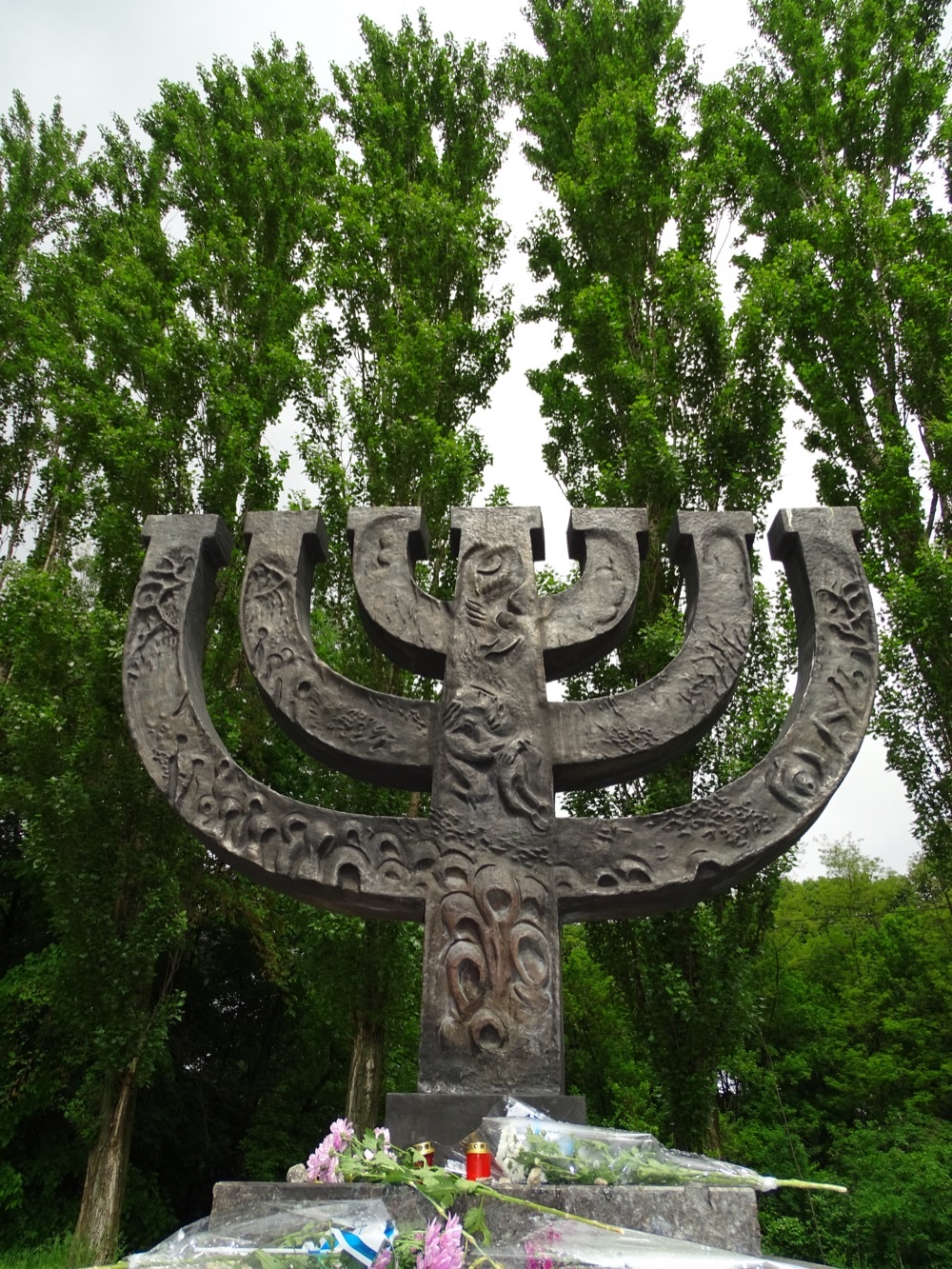
The German occupation authorities, Military Governor Friedrich Eberhardt, SS and Police Leader Friedrich Jeckeln, and the commanders of Einsatzgruppe C under Otto Rasch, including Paul Blobel's Sonderkommando 4a, used the explosions as a pretext to kill the city's Jews. The decisions are recorded in the postwar trial records and in Blobel's own later testimony.
On September 28, 1941, posters went up across Kyiv ordering the Jewish population to assemble the next morning, bringing documents, money, valuables, and warm clothing. The posters spoke of "resettlement", the cover story for what came next.
On September 29 and 30, 1941, about 33,771 Jews, the exact figure reported in the Einsatzgruppe C operational report of October 2, 1941, were killed at the ravine. The victims were led in groups down a path, ordered to undress and hand over their belongings, and shot at the ravine's edge by SS men and German Order Police. The operation ran for roughly thirty-six hours across the two days.
The killing at Babyn Yar continued over the next two years. In all, between about 70,000 and 100,000 people, most but not all of them Jewish, were killed there between September 1941 and the German withdrawal from Kyiv in November 1943. In the final months, the regime ordered the killings covered up: a forced-labor unit of about 300 prisoners was made to dig up and burn the bodies. A few prisoners escaped during an uprising in September 1943 and survived to testify; the chief escapee, Ziama Trubakov, gave detailed postwar accounts.
For decades, Soviet policy avoided naming the Jewish victims of Babyn Yar. The first memorial, put up in 1976, made no specific reference to them. It was Yevgeny Yevtushenko's 1961 poem "Babyn Yar," which opens "No monument stands over Babyn Yar," that pushed the site into Soviet and international awareness. Ukraine's 1991 memorial, after independence, restored the explicit acknowledgment of the Jewish victims, and the Babyn Yar Holocaust Memorial Center, founded in 2016, now carries out commemoration and research there.
Ponary and Rumbula
Ponary and Rumbula.
Ponary (Paneriai in Lithuanian, about 10 kilometers from Vilnius) had been a Soviet construction site: large pits, dug and lined with concrete for fuel tanks, sat ready when the invasion interrupted the work. The Germans turned them into a killing site. From July 1941 to July 1944, about 70,000–75,000 Jews from Vilna and the surrounding region were killed there, along with about 20,000 non-Jewish Poles, about 8,000 Soviet prisoners of war, and others. The killings were carried out by Einsatzkommando 9 at first, then by the Vilna SD and a Lithuanian auxiliary unit. The record at Ponary rests heavily on survivor testimony, some witnesses escaped from the site itself, gathered in the immediate postwar period by Avraham Sutzkever and Shmerke Kaczerginski.
Rumbula (a forest about 12 kilometers from Riga) was the scene of two operations, on November 30 and December 8, 1941, run by about 1,700 men under Friedrich Jeckeln. The purpose was to kill nearly the entire Riga Ghetto, about 25,000 Latvian Jews, plus about 1,000 German Jews deported to Riga days earlier. Rumbula mattered because it included the killing of German Jews, extending the program beyond Soviet and Eastern European Jews. Jeckeln used a method he had developed at earlier operations, forcing victims to lie face-down in layers in the pits, each layer shot before the next, a technique recorded in SS communications and at the postwar trials.
Across the occupied Soviet lands, this pattern of killing produced roughly 1.5 to 2 million Jewish deaths between June 1941 and the end of the German occupation. Most of those deaths happened not at the famous sites but at thousands of smaller ones, about 2,700 of which Yahad-In Unum has located, with the true total higher still.
The wider machinery
The Einsatzgruppen were the core, not the whole.
The Einsatzgruppen numbered only about 3,000 men, far too few, on their own, to kill 1.5 to 2 million people. The killing required a much larger network, which historians have documented in detail:
- The Order Police. German uniformed police battalions sent east for "security" work carried out killings of Jewish civilians. Christopher Browning's Ordinary Men: Reserve Police Battalion 101 and the Final Solution in Poland (1992) traced how one such unit, about 500 middle-aged Hamburg police reservists with no prior Nazi commitment, became a killing unit that murdered about 38,000 Jews in Poland in 1942–43. The study became foundational for understanding how ordinary men became killers. Daniel Goldhagen's Hitler's Willing Executioners (1996) examined the same unit from a different angle, and the Browning–Goldhagen debate has shaped the field since.
- The Waffen-SS. SS combat formations took part in killings across the occupied territories, including at major sites.
- The Wehrmacht. The German Army's role has its own section below.
- Local auxiliary units. The occupation recruited large numbers of local personnel, Ukrainian, Latvian, Lithuanian, Estonian, Belarusian, and others, into police and auxiliary units. They included formal police (the Schutzmannschaften), volunteer groups often drawn from anti-Soviet networks, and Soviet prisoners of war recruited under heavy coercion (the Trawniki training camp, covered in the Camp System Topic, trained many of them).
- Romanian, Hungarian, and other Axis forces. The Axis allies, Romania under Antonescu above all, and Hungary in the 1944 deportations, carried out large-scale killings of their own, often alongside German forces. The Romanian killings (Iași, Odessa, Bogdanovka, the Transnistria operations) account for roughly 280,000 to 380,000 Jewish deaths, making Romania the second-largest perpetrator nation after Germany.
The German Army’s role
The German Army's role, finally faced.
For decades after the war, the standard story, built in the 1950s through the memoirs of senior German officers and the self-presentation of West Germany, held that the Wehrmacht, the regular German armed forces, had been separate from the SS and the killings. That story was overturned in the 1980s and 1990s, partly through scholarship and partly through two large public exhibitions on the Wehrmacht's crimes, organized by the Hamburg Institute for Social Research, which displayed soldiers' own photographs, orders, and unit records.
The consensus that has held since the 1990s, laid out in Omer Bartov's work, in Hannes Heer and Klaus Naumann's War of Extermination (2000), in Wolfram Wette's The Wehrmacht (2006), and in much else, is that the army cooperated with the killing apparatus on a large scale. That cooperation included logistical support for the killings (transport, fuel, food, ammunition); the military operations that trapped the Jewish populations later killed; shootings carried out by army units themselves under "anti-partisan" and "security" labels; and the army's permission for Einsatzgruppen operations in territory it controlled.
Specific orders show the policy in writing. The Reichenau Order of October 10, 1941, issued by Field Marshal Walter von Reichenau, told German soldiers to show "full understanding for the necessity of harsh but just revenge against Jewish subhumanity," and was circulated across the army as a model. Field Marshal Erich von Manstein issued a similar order on November 20, 1941. The Commissar Order of June 6, 1941, ordering the killing of captured Soviet political officers, set the precedent for killing whole categories of people on capture.
Today's German position, stated by the modern German military and the broader German memory framework, acknowledges the Wehrmacht's role in the killings as part of the Nazi war of extermination in the East. The old story of an army untouched by the Holocaust has been rejected.
Local participation
The question of local participation.
The killings were often carried out with the help of local auxiliaries and, in some cases, local civilians. How wide that participation was, and what drove it, has been studied hard and remains sensitive:
- Auxiliary forces. The occupation recruited large numbers of locals into auxiliary police and other units, roughly 300,000 across the Baltic states, Belarus, Ukraine, and the occupied territories. The motives were mixed: anti-Soviet politics, antisemitism, opportunism, and coercion (especially for Soviet prisoners of war, who otherwise faced near-certain death under Nazi policy).
- Civilian participation. The record shows local civilian involvement in some killings, especially the pogroms of the first weeks after occupation, the Lviv pogroms of June–July 1941, the Jedwabne massacre of July 10, 1941 in eastern Poland, and smaller events. Jan Tomasz Gross's Neighbors (2001), on Jedwabne, set off a wide reckoning in Poland over local participation. The question remains contested in Polish, Lithuanian, and Ukrainian historical debate.
- The national cases. Lithuania, Latvia, and Ukraine have each produced their own reckoning with the question. The positions have shifted since the 1990s, as records became accessible and postwar political pressures eased.
Why the camps followed
Why the mobile killing was supplemented by the camps.
The Einsatzgruppen method, face-to-face shooting at improvised pits, created problems for the regime that the Wannsee Conference of January 1942 and the decisions around it addressed:
- Speed. Killing 1.5 to 2 million people by shooting, site by site, took enormous manpower and time. The dedicated killing centers, Chełmno (from December 1941, using gas vans), then Belzec, Sobibór, and Treblinka, and the gas chambers at Auschwitz-Birkenau, let the regime kill far more people, faster, with fewer staff.
- The effect on the killers. The Nazi leadership, including Heinrich Himmler himself, after watching a killing operation in Minsk on August 15, 1941, worried about the psychological toll on the SS men doing the shooting. The camps removed most individual SS men from the moment of killing.
- Concealment. The shootings were visible to many local people and left a documentary trail. The camps, hidden behind fences and run by smaller crews, left far less.
The mobile killing did not stop when the camps opened. It continued across the occupied Soviet lands throughout the war, especially where Jewish communities had survived the first wave and where transport to the camps was difficult. Einsatzgruppen-style killings went on into 1944 in parts of Ukraine, Belarus, and the Baltic states.
The documentary record
The documentary record.
The Einsatzgruppen left one of the most extensive perpetrator records of any phase of the Holocaust, much of the evidence base for postwar Holocaust scholarship. The main sources:
- The Operational Situation Reports USSR. The units sent regular reports to Berlin with killing figures by location and date. There are 195 in all, covering July 1941 through May 1942. Captured by Allied forces at the end of the war, they have been published in scholarly editions (Yitzhak Arad, Shmuel Krakowski, and Shmuel Spector, eds., The Einsatzgruppen Reports, 1989). They record about 1 million killings across the period they cover.
- The Stahlecker Report (October 15, 1941). Einsatzgruppe A's report on its first three and a half months, describing the killings as "cleansing," documenting cooperation with the army and local auxiliaries, and giving figures for the Baltic states. It is one of the central documents of the Holocaust and is held in the captured German records at the U.S. National Archives.
- The Jäger Report (December 1, 1941). The report of Karl Jäger, commander of Einsatzkommando 3, listing his unit's killings in Lithuania from July 2 to December 1, 1941, with location, date, and count for each operation, about 137,000 killings over roughly five months. It is one of the most detailed single perpetrator records that survives.
- The captured photographs. Many killings were photographed by army and SS men, sometimes officially, sometimes as personal souvenirs. These are held at the U.S. National Archives, USHMM, Yad Vashem, and other archives. The images that show the killings directly are not reproduced here; the archives preserve them for researchers and curated programs.
- The postwar trials. The Nuremberg Einsatzgruppen Trial (1947–48), the Ulm trial of 1958 (which launched Germany's own prosecutorial reckoning and led to the investigative center at Ludwigsburg), and later trials. Covered in the Postwar Trials Topic.
- Survivor and eyewitness testimony. Accounts from the few survivors of the killing operations, and from non-Jewish local eyewitnesses, the large body of testimony Yahad-In Unum has gathered since 2004.
Locating the sites
Locating the sites, since 2004.
The most important recent effort to document the Holocaust by Bullets is the work of Yahad-In Unum (a Hebrew-Latin phrase meaning "together in unity"), a research organization founded in 2004 by Father Patrick Desbois, a French Catholic priest. Based in Paris, it conducts fieldwork across the former Soviet lands where the killings took place.
Its method is unlike earlier Holocaust research. Teams go village by village across Ukraine, Belarus, Lithuania, Moldova, Russia, and elsewhere, finding elderly local residents, most of them children at the time, who saw the killings as bystanders. They interview each witness on video, locate the killing sites with their help, and then document the sites through archaeological work. The project has located about 2,700 mass killing sites since 2004, far expanding the earlier record.
The archive, roughly 8,000 video interviews as of 2026, is held at the organization's Paris headquarters and is open to researchers and educators. The research produced Desbois's book The Holocaust by Bullets (2008), which gave the phenomenon its name and reshaped how scholars and the public understand the killings in the former Soviet territories. The work goes on, both to document the sites and to engage the communities that live among them today.
The honest accounting
The honest accounting.
The scholarship on the Einsatzgruppen and the Holocaust by Bullets carries several open questions, named plainly here:
- When the decision came. When exactly the systematic killing of 1941 was decided has been argued for decades. Earlier scholars (Lucy Dawidowicz, Karl Schleunes) placed the decision earlier in the regime's history; more recent scholars (Christopher Browning, Saul Friedländer, Peter Longerich) place its consolidation in the summer and autumn of 1941. The question is still live.
- What drove the killers. Whether the perpetrators were moved mainly by ideology, by situation and peer pressure, by careerism, or by antisemitic conviction has been debated across many positions. Browning's Ordinary Men stressed situation and group dynamics; Goldhagen's Hitler's Willing Executioners stressed antisemitic belief. The consensus is that the motives were mixed and that no single explanation covers the whole perpetrator population.
- Local participation. The role of local people, especially in Lithuania, Ukraine, and Poland, has been contested both in the postwar decades and today. How to weigh local participation alongside German command of the killings, and alongside the many locals who did not take part or who helped Jews, remains debated in each national case.
- The Wehrmacht. The 1990s consensus of large-scale army cooperation with the killings is dominant in the scholarship today, though still resisted in some quarters.
- The scale. The figure of 1.5 to 2 million is an estimate. The records, trials, testimony, and field research support the range but do not yield a single exact number, and the estimates have been refined over the decades.
For the classroom
Where this Topic fits the standards.
- World History, NY Global History 10.5 (World War II and the Holocaust). Examines the Holocaust by mass shooting during Operation Barbarossa and the evolution of Nazi genocide.
- NYS Holocaust Education Mandate, Education Law §801. Supports Holocaust instruction through the study of mobile killing units, perpetrator documents, eyewitness testimony, and forensic evidence.
- Common Core RH.11–12.6 & RH.11–12.9. Students analyze operational reports, maps, photographs, testimony, and trial records.
- C3 Framework, D2.His.1, D2.His.14. Students investigate historical causation, geographic evidence, and interpretation of multiple historical sources.
- Classroom Applications. Compare killing methods, evaluate documentary evidence, analyze perpetrator records, and map historical events.
- International Classroom Relevance. Supports Holocaust education, genocide studies, forensic history, and source-based historical inquiry.
Makor Classroom Companion
Grades 7–8, Coming Soon
A printable classroom chapter designed specifically for middle school learners, including:
- teacher guide
- vocabulary support
- primary source activities
- discussion questions
- classroom worksheets
- standards-aligned instructional materials
- assessment suggestions
The Companion supplements this Topic with developmentally appropriate classroom materials while preserving the full historical content of the primary page.
Learn more · take this further
Verified resources from outside organizations for teachers and students. Where a dedicated classroom resource does not yet exist, The Makor Project is developing one.
Sources
Primary sources come straight from the time: documents, letters, speeches, images, and objects created by the people involved. Secondary sources come later: books, articles, and analysis in which scholars study and interpret those primary sources.
Primary sources
- Arad, Yitzhak, Shmuel Krakowski, and Shmuel Spector, eds. The Einsatzgruppen Reports: Selections from the Dispatches of the Nazi Death Squads' Campaign Against the Jews, July 1941–January 1943. New York: Holocaust Library, 1989.
- Klee, Ernst, Willi Dressen, and Volker Riess, eds. "The Good Old Days": The Holocaust as Seen by Its Perpetrators and Bystanders. New York: Free Press, 1991.
- Yahad-In Unum · yiu.ngo →
- The Jäger Report, December 1, 1941. Einsatzkommando 3 commander Karl Jäger's tally of the killings in Lithuania.
Secondary sources
- Browning, Christopher R. Ordinary Men: Reserve Police Battalion 101 and the Final Solution in Poland. New York: HarperCollins, 1992.
- Browning, Christopher R. The Origins of the Final Solution: The Evolution of Nazi Jewish Policy, September 1939 – March 1942. Lincoln: University of Nebraska Press, 2004.
- Hilberg, Raul. The Destruction of the European Jews. 3 vols. New Haven: Yale University Press, 3rd ed. 2003.
- Friedländer, Saul. The Years of Extermination: Nazi Germany and the Jews, 1939–1945. New York: HarperCollins, 2007.
- Longerich, Peter. Holocaust: The Nazi Persecution and Murder of the Jews. Oxford: Oxford University Press, 2010.
- Snyder, Timothy. Bloodlands: Europe Between Hitler and Stalin. New York: Basic Books, 2010.
- Snyder, Timothy. Black Earth: The Holocaust as History and Warning. New York: Tim Duggan Books, 2015.
- Desbois, Patrick. The Holocaust by Bullets: A Priest's Journey to Uncover the Truth Behind the Murder of 1.5 Million Jews. New York: Palgrave Macmillan, 2008.
- Desbois, Patrick. In Broad Daylight: The Secret Procedures behind the Holocaust by Bullets. New York: Arcade Publishing, 2018.
- Lower, Wendy. Nazi Empire-Building and the Holocaust in Ukraine. Chapel Hill: University of North Carolina Press, 2005.
- Lower, Wendy. The Ravine: A Family, a Photograph, a Holocaust Massacre Revealed. Boston: Houghton Mifflin Harcourt, 2021.
- Westermann, Edward B. Hitler's Police Battalions: Enforcing Racial War in the East. Lawrence: University Press of Kansas, 2005.
- Goldhagen, Daniel Jonah. Hitler's Willing Executioners: Ordinary Germans and the Holocaust. New York: Knopf, 1996.
- Bartov, Omer. The Eastern Front, 1941–45: German Troops and the Barbarisation of Warfare. New York: St. Martin's Press, 1985.
- Bartov, Omer. Hitler's Army: Soldiers, Nazis, and War in the Third Reich. New York: Oxford University Press, 1991.
- Heer, Hannes, and Klaus Naumann, eds. War of Extermination: The German Military in World War II, 1941–1944. New York: Berghahn Books, 2000.
- Wette, Wolfram. The Wehrmacht: History, Myth, Reality. Cambridge, MA: Harvard University Press, 2006.
- Gross, Jan Tomasz. Neighbors: The Destruction of the Jewish Community in Jedwabne, Poland. Princeton: Princeton University Press, 2001.
- Earl, Hilary. The Nuremberg SS-Einsatzgruppen Trial, 1945–1958: Atrocity, Law, and History. Cambridge: Cambridge University Press, 2009.
- Berkhoff, Karel C. Harvest of Despair: Life and Death in Ukraine under Nazi Rule. Cambridge, MA: Harvard University Press, 2004.
- Pohl, Dieter. The Murder of the European Jews During the Second World War: Foreign Policy, Politics, and the Holocaust. (Multiple editions.)
- The Babyn Yar Holocaust Memorial Center, Kyiv · babynyar.org →
- USHMM Holocaust Encyclopedia · Einsatzgruppen · encyclopedia.ushmm.org →
- Yad Vashem · The Untold Stories: Murder Sites of the Jews in the Occupied Territories of the Former USSR · yadvashem.org →
Finding these documents: many primary sources are free online. Good places to start are the Fordham Internet Jewish History Sourcebook, Yale’s Avalon Project (law and diplomacy), German History in Documents, the collections of the US Holocaust Memorial Museum and Yad Vashem, the National Library of Israel, and Sefaria (for Jewish texts). Search the document’s name and date.
The Holocaust era in the Middle East and North Africa, Nazi-executed, Axis-allied, and Nazi-influenced events, treated at the scholarly standard used by USHMM and Yad Vashem.
Comments?
Write to editor@makorproject.org.
Last updated: August 2026.