In 1942 the SS prepared plans for the murder of the approximately 550,000 Jews of Mandatory Palestine. An SS unit was designated for the operation, but the Allied victory at El Alamein prevented those plans from being carried out.
German Federal Archives; Klaus-Michael Mallmann & Martin Cüppers, Nazi Palestine: The Plans for the Extermination of the Jews in Palestine (Enigma Books, 2010)
Why this Topic exists
An established scholarly category that the curriculum rarely teaches.
The standard American secondary-school treatment of the Holocaust is structured around the European theater, Germany, occupied Poland, the killing centers of Auschwitz and Treblinka, the deportations from Western and Central Europe, the camps liberated by Allied forces in 1945. This is appropriate; the European core is where the great majority of the victims were murdered and where the architecture of the Final Solution operated. What the standard treatment omits is the parallel set of events that took place across the Middle East and North Africa, where Jewish communities living under various Axis-aligned, Axis-occupied, and Axis-influenced regimes were subjected to legal persecution, forced labor, deportation, and in several documented cases mass murder.
The United States Holocaust Memorial Museum, Yad Vashem, and the established scholarly literature treat these events as part of the Holocaust era. The United States Holocaust Memorial Museum, Yad Vashem, and the scholarly literature recognize the Holocaust in North Africa as part of the broader Holocaust era. This Topic follows that established framework while distinguishing carefully among Nazi-executed, Axis-allied, and Nazi-influenced events. This Topic documents the historical record at the same scholarly standard applied elsewhere, with the recognition preserved.
Common misconceptions this Topic addresses
- “The Holocaust happened only in Europe.” Its center was in Europe, but its policies, allies, and reach extended into North Africa and the Middle East: Vichy law across the Maghreb, the German occupation of Tunisia, the camps in Libya, and Nazi-influenced violence as far as Baghdad. See the entry →
- “Hostility toward Jews in the Middle East began with the establishment of Israel in 1948.” See the entry →
- “The conflict in the Middle East has been raging for thousands of years.” See the entry →
- “The 1941 Farhud in Baghdad was a Nazi-executed event.” See the entry →
- “Antisemitism in the modern Islamic world is a recent phenomenon unrelated to European antisemitic traditions.” See the entry →
- “Jewish experience under Islamic rule and under Christian Europe were parallel phenomena, variations on a single anti-Jewish theme.” See the entry →
A note on classification
The scholarly categories the Topic uses.
The events documented in this Topic fall into three analytically distinct categories, and keeping them apart is what makes the history legible:
- Nazi-executed. Events in which the German state and the SS apparatus directly carried out the persecution. The German occupation of Tunisia (November 1942 – May 1943) is the clearest case. The operational planning for an extermination operation in Mandatory Palestine is a Nazi-executed plan that did not reach implementation.
- Axis-allied. Events carried out by Axis-allied regimes against the Jewish communities of their territories. Vichy France's antisemitic legislation in Algeria, Morocco, and Tunisia (1940–1943) is the largest case. Fascist Italy's labor-camp system in Libya, most prominently Giado, is the other major case.
- Nazi-influenced. Events in which local actors carried out anti-Jewish violence in a context shaped by Axis-aligned propaganda, Axis-supported political movements, or temporary Axis ascendancy in the region, without direct Nazi execution. The Farhud (the pogrom in Baghdad on June 1–2, 1941) is the central case. The classification matters because it locates responsibility precisely: the Farhud was carried out by Iraqi actors in a context shaped by the Rashid Ali coup and by Axis propaganda, but it was not directly carried out by German forces.
These classifications are used throughout the Topic to distinguish responsibility, agency, and historical context. Where a specific event combines elements of more than one category, the Topic notes the combination explicitly.
Map · the reach of the Holocaust
One region, three kinds of event.
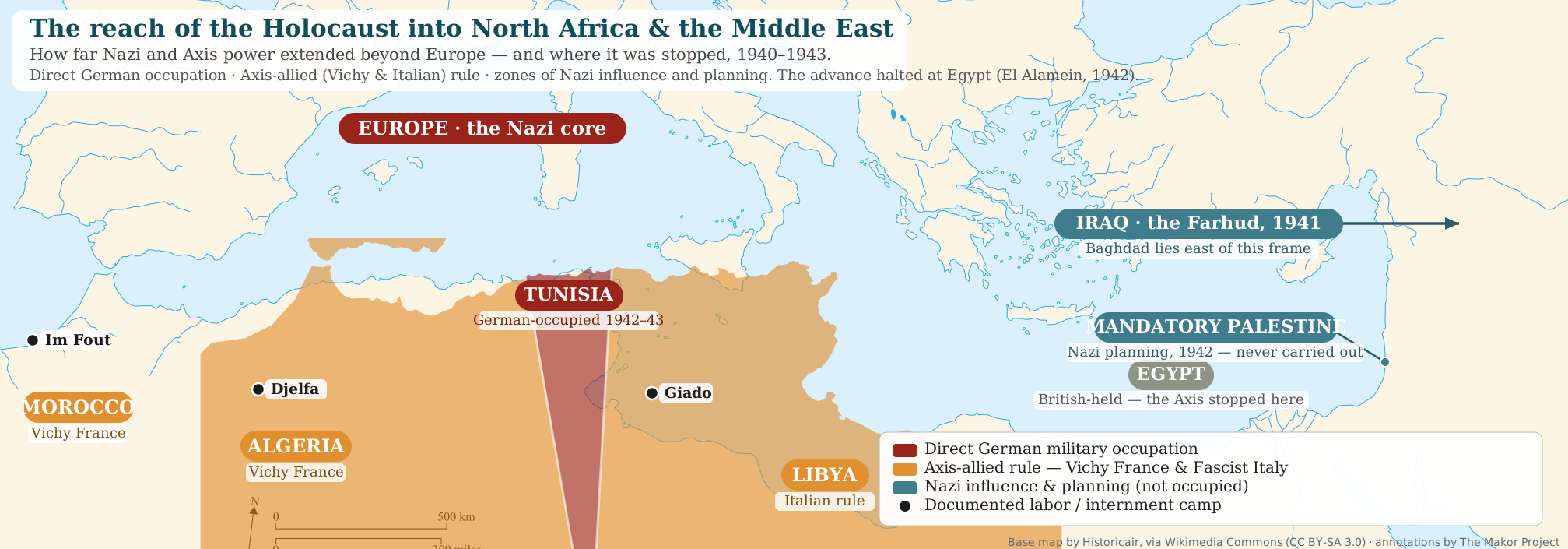
Base map by Historicair, via Wikimedia Commons (CC BY-SA 3.0); annotations by The Makor Project.
Distinguishing the framework
European antisemitism meets the older dhimma context.
The events this Topic documents are the moment in the historical record when twentieth-century European antisemitism (Nazi, Vichy, and Italian Fascist) entered the regional MENA context in which Jewish communities had lived under the classical Islamic dhimma framework for more than a thousand years. The scholarly literature (Bernard Lewis, Mark Cohen, Norman Stillman, Gilbert Achcar, Jeffrey Herf, Esther Webman) treats these as substantively distinct phenomena. The distinction is kept throughout.
The classical dhimma framework was not the same in kind as the Nazi project. The dhimma, articulated in the Pact of Umar tradition (eighth–ninth century) and elaborated across the Umayyad, Abbasid, Fatimid, Ottoman, and other periods, was a hierarchical legal status applied to "People of the Book", Jews and Christians together as a religious-legal category. Discriminatory, sometimes enforced with violence (the 1066 Granada massacre, the Almohad persecutions of twelfth-century Iberia and the Maghreb), but not a theological project specifically about Jews and not eliminationist. The MENA Jewish communities had lived within this framework for many centuries, discriminated against as dhimmis, but not subject to the targeted ideology that would emerge from Christian Europe and reach its endpoint in Nazi Germany.
The events this Topic documents are the import of that European ideology into the regional context. Radio Zeesen's Arabic-language Nazi propaganda broadcasts (1939–1945), the Mufti of Jerusalem's Berlin collaboration (1941–1945), the Vichy antisemitic legislation extended across French North Africa (1940–1943), the Italian Fascist labor-camp system at Giado in Libya, the German occupation of Tunisia (November 1942 – May 1943), the documented Nazi operational planning for an extermination operation in Mandatory Palestine, and the Farhud as "Nazi-influenced pogrom carried out by Iraqi actors", these are twentieth-century European antisemitic frameworks entering the MENA context, not the classical Islamic dhimma framework expressing itself.
The distinction matters because it locates responsibility precisely. The MENA Jewish communities had endured the dhimma framework for centuries; what eliminated them as continuous communities was not the dhimma but the twentieth-century European-derived antisemitism that this Topic documents, grafted onto the older context and elaborated by regional actors. The full categorical distinction between subordination of dhimmi populations and targeted anti-Jewish ideology is documented at the Misconceptions reference. The 1945–1972 displacement that followed is documented in the MENA Departure Topic.
Radio Zeesen · 1939–1945
The Nazi state's Arabic-language broadcast operation.
Nazi Germany operated an Arabic-language radio service from a transmitter at Zeesen, south of Berlin, from 1939 through the end of the war in May 1945. The service broadcast antisemitic and anti-British propaganda across the Middle East and North Africa, including programming directed at Iraq, Egypt, Saudi Arabia, Iran, the French Levant, and French North Africa. Daily broadcasting included political commentary, news manipulation, religious programming designed to align Islamic theological themes with Nazi political objectives, and recurring antisemitic content. The broadcasts were one of the most extensive Nazi propaganda operations targeted at non-German-speaking populations during the war.
The principal scholarly study of the operation is Jeffrey Herf's Nazi Propaganda for the Arab World (Yale University Press, 2009), based on archival research in the German Federal Archives and the records of the Office of Strategic Services. Herf documents the content of the broadcasts in detail, including the specific antisemitic themes, the conspiratorial framing of Jewish presence in Palestine, the appropriation of Quranic anti-Jewish verses, and the call for action against Jewish communities. The Topic treats the Zeesen operation as the context within which several of the events documented below took place.
Programming details. The Arabic service operated multiple daily transmissions in standard Arabic. The principal Arab-language voice of the broadcasts was Yunis Bahri, an Iraqi journalist who had emigrated to Berlin. Programming included religious content delivered by religious figures who had aligned themselves with the Nazi regime, including elements developed in coordination with the Mufti of Jerusalem after his arrival in Berlin in 1941.

The Mufti of Jerusalem in Berlin · 1941–1945
Documented collaboration.
Hajj Amin al-Husseini, the Grand Mufti of Jerusalem, fled British-administered Palestine in 1937 after the suppression of the Arab Revolt and spent the early war years in Iraq and Italy before arriving in Berlin in November 1941. He remained in Germany for the duration of the war, in formal collaboration with the Nazi regime. The collaboration is documented in the German archival record and in the scholarly literature.
The Mufti's wartime activities included:
- A meeting with Adolf Hitler on November 28, 1941. The minutes of the meeting, drafted by Paul Otto Schmidt of the German Foreign Office, survive in the archival record and have been widely reproduced in the scholarly literature. The meeting addressed Husseini's request for a German declaration supporting Arab national aspirations and Hitler's response, which postponed any such declaration but affirmed the alignment of German and Husseini's objectives against Jewish populations.
- Arabic-language propaganda broadcasting. Husseini delivered numerous Arabic-language radio addresses over Radio Zeesen and other Nazi-controlled broadcast services. The texts of several major addresses are preserved in the archival record.
- Recruitment for the Waffen-SS. Husseini participated in the recruitment of Bosnian Muslim units for the Waffen-SS, most prominently the 13th Waffen-SS Mountain Division Handschar, formed in 1943.
- Correspondence opposing the rescue of Jewish refugees. The archival record includes Husseini's correspondence with Heinrich Himmler and others, in which Husseini intervened against negotiated arrangements that would have allowed Jewish refugees, including children, to leave Axis-occupied territory for Mandatory Palestine.
The historiographical question of the Mufti's relative weight in Nazi decision-making is the subject of an extensive scholarly literature. Scholars differ over the extent of the Mufti's influence on Nazi decision-making, but they agree that his collaboration with the Nazi regime is extensively documented. The principal scholarly references are Klaus-Michael Mallmann and Martin Cüppers, Nazi Palestine (Enigma, 2010), and Jeffrey Herf's documentation in Nazi Propaganda for the Arab World.
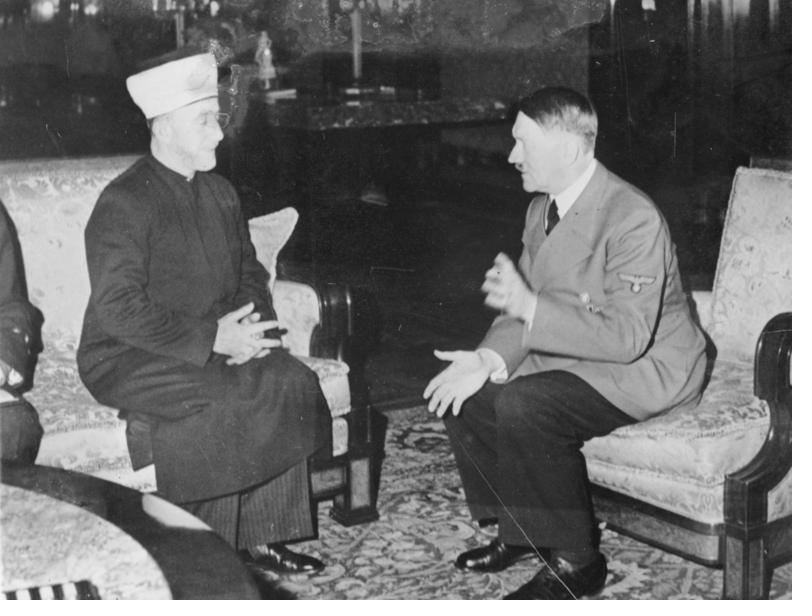
Two truths have to be held together here. The Mufti’s collaboration was real, documented, and historically significant. But it was the choice of one political figure and his circle, and it should not be taken as representative of Arab or Muslim populations generally, whose wartime conduct ranged from collaboration to indifference to the rescue documented below.
The Farhud · June 1–2, 1941
A Nazi-influenced pogrom in Baghdad.
On the festival of Shavuot, June 1–2, 1941, a pogrom against the Jewish community of Baghdad, known by the Iraqi-Arabic word Farhud ("violent dispossession"): killed an estimated 180 Jews, injured between 600 and 2,000 more, and destroyed an estimated 900 Jewish homes and businesses. It was the deadliest single anti-Jewish event in the history of the Iraqi Jewish community, which at that point had lived in Baghdad continuously for more than 2,500 years. The precise casualty figures are still debated by historians: British, Iraqi, and Jewish sources recorded the two days differently, and the ranges above reflect that uncertainty in the contemporary record rather than any doubt about the event itself.
The historical context is precisely documentable and is essential to the classification of the event. In April 1941, the pro-Axis politician Rashid Ali al-Gaylani led a coup against the British-aligned Iraqi government. The coup regime sought German military support. Britain intervened militarily in May 1941; the Rashid Ali regime collapsed; Rashid Ali and his collaborators fled to Iran and ultimately to Berlin (where Rashid Ali joined the Mufti's circle in collaboration with the Nazi regime). The Farhud took place in the brief interregnum between the collapse of the Rashid Ali regime and the full restoration of British and pro-British Iraqi authority. The British military forces in the area were positioned outside the city center and did not intervene during the two days of violence.
The proximate violence was carried out by Iraqi actors, soldiers from disbanded units of the Rashid Ali army, members of the pro-Nazi Futuwwa youth movement, and segments of the urban population that joined the violence as it unfolded. The contextual influence of Axis-aligned propaganda, Radio Zeesen broadcasts had been received in Iraq since 1939, the Rashid Ali coup had taken place in explicit alignment with Axis interests, and the political atmosphere in Baghdad in May 1941 was shaped by Axis-influenced anti-Jewish rhetoric, is the substance of the Nazi-influenced classification. The Farhud was not directly carried out by German forces. No German military or SS unit was present in Baghdad during the violence. That distinction is kept here too.
The Farhud is recognized by Yad Vashem and by the United States Holocaust Memorial Museum as part of the broader Holocaust era. The Babylonian Jewry Heritage Center in Israel maintains an extensive memorial and documentation program. The event ended the traditional security of the Iraqi Jewish community; the demographic decline of Iraqi Jewry that culminated in the near-complete departure of the community in 1950–1951 (Operation Ezra and Nehemiah) had its political starting point in the Farhud.
The principal scholarly references are Edwin Black's The Farhud (Dialog Press, 2010), Hayyim Cohen's The Anti-Jewish Farhud in Baghdad (Middle Eastern Studies, 1966), Orit Bashkin's New Babylonians (Stanford University Press, 2012), and the Yad Vashem and Babylonian Jewry Heritage Center collections.
Why the classification matters. The Farhud is the page's clearest example of a Nazi-influenced event, as distinct from a Nazi-executed one. No German military or SS unit was present in Baghdad during the violence; it was carried out by Iraqi actors in a context shaped by the Rashid Ali coup and by years of Axis propaganda. Naming that distinction precisely (who acted, and in what context) is how the page locates responsibility honestly, without either downplaying the Axis influence or imputing the violence to a whole population.
Vichy France's antisemitic legislation in North Africa · 1940–1943
An Axis-allied policy regime over more than 400,000 Jews.
The Vichy regime, the French government that collaborated with Nazi Germany after the June 1940 armistice, extended its antisemitic legislation to the three French North African territories: Algeria (then administratively part of metropolitan France), Morocco (a French protectorate), and Tunisia (a French protectorate). Approximately 400,000 Jews lived in these territories at the start of the war. The Vichy legislation subjected them to legal persecution comparable in legal architecture to the persecution of Jews in metropolitan France, with regional variations.
The major legislative instruments:
- The Statut des Juifs of October 3, 1940. The Vichy government's first sweeping antisemitic law, defining who was "Jewish" by descent and excluding Jews from public service, teaching, the military officer corps, journalism, theater and film direction, and other listed professions. Extended to Algeria, Morocco, and Tunisia in October 1940.
- The abrogation of the Crémieux Decree (October 7, 1940). The Crémieux Decree of 1870 had granted full French citizenship to approximately 35,000 Algerian Jews. Vichy abrogated the decree, stripping Algerian Jews of French citizenship and reducing them to the legal status of native indigenous subjects (indigènes). The decree was restored by the Free French in October 1943, after the Allied liberation of North Africa.
- The Statut des Juifs of June 2, 1941. A broader antisemitic law extending the legal definitions, expanding the occupational exclusions, requiring registration of Jewish persons and Jewish property, and authorizing administrative internment.
- The Aryanization measures (July 22, 1941). The legal architecture for the confiscation of Jewish-owned property and businesses across French territories, including the colonies.
- Quotas on Jewish education. Limits on the percentage of Jewish students at French schools in the territories.
- Forced-labor camps. Vichy maintained a network of forced-labor camps across Algeria, Morocco, and southern Tunisia, holding Jewish men (and a smaller number of women): many of them refugees from Spain, Central Europe, or the metropolitan French zone. The Bedeau camp in Algeria, the Hadjerat M'Guil camp in Morocco, and the trans-Saharan railway labor camps held thousands.
The Vichy regime in North Africa fell with the Allied invasion of November 8, 1942 (Operation Torch). The restoration of Jewish civil status was uneven and contested, the Crémieux Decree restoration in Algeria did not come until October 1943, more than ten months after the Allied liberation, after a protracted political battle within the post-Vichy French administration of the territory. The political resistance to the immediate restoration of Algerian Jewish citizenship is part of the documented record.
The principal scholarly reference is Michel Abitbol's The Jews of North Africa During the Second World War (Wayne State University Press, 1989). Daniel J. Schroeter's work on Moroccan Jewry, Daniel Lee's Petain's Jewish Children (Oxford University Press, 2014), and the records of the United States Holocaust Memorial Museum's Encyclopedia of Camps and Ghettos extend the scholarly treatment.
The German occupation of Tunisia · November 1942 – May 1943
Six months of direct Nazi rule over a North African Jewish community.
The German occupation of Tunisia is the clearest single case of a Nazi-executed event in North Africa. Tunisia was the only Arab country to fall under direct German military occupation during the war, and so the one place in the region where the machinery of the Holocaust was run on the ground by Germans themselves, rather than through Vichy proxies or local allies. Following the Allied invasion of Morocco and Algeria on November 8, 1942 (Operation Torch), the German army moved into Tunisia from the east to prevent the further Allied advance. The German occupation lasted from November 9, 1942, until the surrender of Axis forces in North Africa on May 13, 1943, approximately six months.
During the occupation, the German command, with SS-Obersturmbannführer Walther Rauff present as the senior SS officer in the region, established a forced-labor regime over the Tunisian Jewish community of approximately 89,000 people. The measures included:
- Mass requisitions of Jewish-owned property and businesses under the formal authority of the German military administration.
- A forced-labor program targeting Jewish men aged 18 to 50, with approximately 5,000 men sent to labor camps across Tunisia. The camps included Bizerte, Mateur, the camps along the Mediterranean coast, and inland sites in the south of the country. Conditions in the camps were severe; an estimated 1,000 to 2,500 men died of disease, malnutrition, or violence over the six-month occupation period.
- Collective fines imposed on the Jewish communities of Tunis, Sfax, and other cities.
- The hostage system by which a designated Jewish communal leadership was required to deliver labor quotas and financial contributions to the German administration on threat of escalation.
- Documented deportation planning. The SS apparatus in Tunisia developed deportation plans that would have transported the Jewish population to the European killing centers had the German occupation lasted longer. The May 1943 Axis collapse in North Africa ended this trajectory.
The Tunisian Jewish community's experience of the German occupation is among the best-documented single cases of the Holocaust era outside the European core, with extensive surviving testimony, postwar trial documentation, and contemporary administrative records. The principal scholarly references are Robert Satloff's Among the Righteous (PublicAffairs, 2006), Daniel Schroeter's various articles on North African Jewish history, and the Yad Vashem and USHMM collections.
The Giado camp · Libya · 1942–1943
An Axis-allied forced-labor and concentration site.
Italy held Libya as a colony from 1911. The Italian Fascist regime, under pressure from Nazi Germany and aligned with Vichy policy by the early 1940s, established a series of labor and concentration camps for the deportation of Libyan Jews from coastal cities to inland sites. The largest of these was the camp at Giado (also spelled Jadu or Gharyan/Jadu region), in the Tripolitanian interior approximately 235 kilometers south of Tripoli.
The Giado camp held approximately 2,600 Libyan Jews who had been deported from Cyrenaica, the eastern Libyan coastal region, after the British military advance and Italian-German counter-advance reshaped the region in 1941–1942. The deportees were primarily from Benghazi and the smaller Cyrenaican Jewish communities. Conditions at Giado included severe overcrowding, inadequate food and water, exposure to extreme desert conditions, and a typhus epidemic that swept the camp in early 1943.
Approximately 562 inmates died at Giado from typhus, starvation, and exposure between mid-1942 and the liberation of the camp by British forces in early 1943. The Giado death toll, while small in comparison to the European killing-center figures, represented approximately one-fifth of the camp's population in less than a year.
Smaller camps and detention sites operated in Libya and in the broader Italian-controlled territories during the same period. The Sidi Azaz site held additional Libyan Jewish deportees. Italian Jews holding Italian citizenship were also subjected to deportation from Libya to Italian internment sites and, in some cases, to the European killing centers.
The principal scholarly references are Maurice Roumani's The Jews of Libya: Coexistence, Persecution, Resettlement (Sussex Academic Press, 2008), Renzo De Felice's Jews in an Arab Land: Libya, 1835–1970 (University of Texas Press, 1985), and the documentation of the Or Shalom Center for Libyan Jewish Heritage.
Nazi operational planning for Mandatory Palestine · 1942
The plan that did not reach execution.
In the summer and autumn of 1942, the German military advance through North Africa under Erwin Rommel raised the possibility, from the Axis side, of a German entry into Mandatory Palestine via Egypt. Anticipating this contingency, the SS apparatus prepared an operational plan for an extermination operation to be conducted against the Jewish community of Mandatory Palestine, approximately 550,000 people as of 1942.
The principal documentation of this operational planning is preserved in the German Federal Archives and is the subject of Klaus-Michael Mallmann and Martin Cüppers's monograph Nazi Palestine: The Plans for the Extermination of the Jews in Palestine (Enigma Books, 2010). The Mallmann and Cüppers study reconstructs the planned deployment of an Einsatzkommando Egypt unit under SS-Obersturmbannführer Walther Rauff. Rauff and an advance team were deployed to Tobruk in mid-1942 with the operational mandate to follow Rommel's army into Egypt and onward into Palestine, and to carry out the killing operations on arrival.
The plan did not reach implementation. The Second Battle of El Alamein (October 23 – November 11, 1942) halted Rommel's eastward advance. The Allied invasion of North Africa on November 8, 1942 (Operation Torch) created a two-front Axis collapse in North Africa that ended with the surrender of Axis forces at Tunis in May 1943. The German advance into Egypt and Palestine did not occur. Rauff was withdrawn to Tunisia, where he became the senior SS officer of the German occupation of Tunis documented above.
The historical significance of the Mallmann and Cüppers documentation is the establishment of the documentary record. The Nazi extermination operation in Mandatory Palestine was planned, the unit was deployed, the operational mandate was issued. Only the military defeat of the Axis advance prevented its implementation. The plan does not appear in standard American secondary-school treatments of the Holocaust because it remained in the operational-planning stage; it belongs here because it is part of the established historical record and because it is essential context for understanding the wartime situation of the Jewish community in Mandatory Palestine.
The Righteous in MENA
The documented record of rescue and resistance.
The wartime record in the Middle East and North Africa includes documented cases of Arab Muslim, Arab Christian, and Berber rescuers who hid, protected, and aided Jewish neighbors at personal risk. These cases matter for a reason beyond the lives they saved. In the same towns, under the same occupation, some people collaborated, most looked away, and a few chose to shelter the hunted at real risk to themselves. That range is the point: behavior in this period was a matter of individual moral choice, not something settled in advance by a person’s religion or region. The rescuers are the proof that a choice always existed, which is among the strongest lessons the historical record offers.
The documented cases include:
- Si Ali Sakkat (Tunisia): Recognized by Yad Vashem as Righteous Among the Nations in 2008. A Tunisian Muslim who sheltered approximately sixty Tunisian Jewish workers who had escaped from a German labor camp during the occupation, hiding them on his estate near Zaghouan until the German withdrawal.
- Khaled Abdul-Wahab (Tunisia): Nominated to Yad Vashem; the case is documented in Robert Satloff's Among the Righteous. A Tunisian businessman who hid Jewish families on his farm at Mahdia during the German occupation.
- Mohammed Helmy (Egypt / Berlin): Recognized by Yad Vashem as Righteous Among the Nations in 2013, the first Arab to receive the recognition. An Egyptian physician working in Berlin throughout the war, who hid the Jewish teenager Anna Boros from 1942 until the end of the war and aided additional Jewish individuals.
- The Sultan of Morocco, Mohammed V. The protective role of Mohammed V over the Moroccan Jewish community during the Vichy period, documented through his recorded resistance to the application of certain Vichy regulations in the Moroccan protectorate, his recorded statement that "there are no Jews in Morocco, only Moroccan subjects," and his maintenance of court and ceremonial inclusion of Moroccan Jewish leaders, is part of the regional record. The historical significance has been the subject of ongoing scholarly attention. Morocco's wartime Jewish community survived the war essentially intact.
- The Mosque of Paris, under Si Kaddour Benghabrit. The role of the rector of the Great Mosque of Paris in providing false documentation for North African Jews and (in some accounts) for Eastern European Jewish refugees during the German occupation of France is documented in scholarly and journalistic accounts, with the precise scope of the operation remaining a subject of ongoing research.
The principal scholarly reference for this material is Robert Satloff's Among the Righteous: Lost Stories from the Holocaust's Long Reach into Arab Lands (PublicAffairs, 2006), which combines original archival and interview research with the documentation maintained by Yad Vashem.
Object Spotlight
A hooded figure, reading, in a city built afterward.
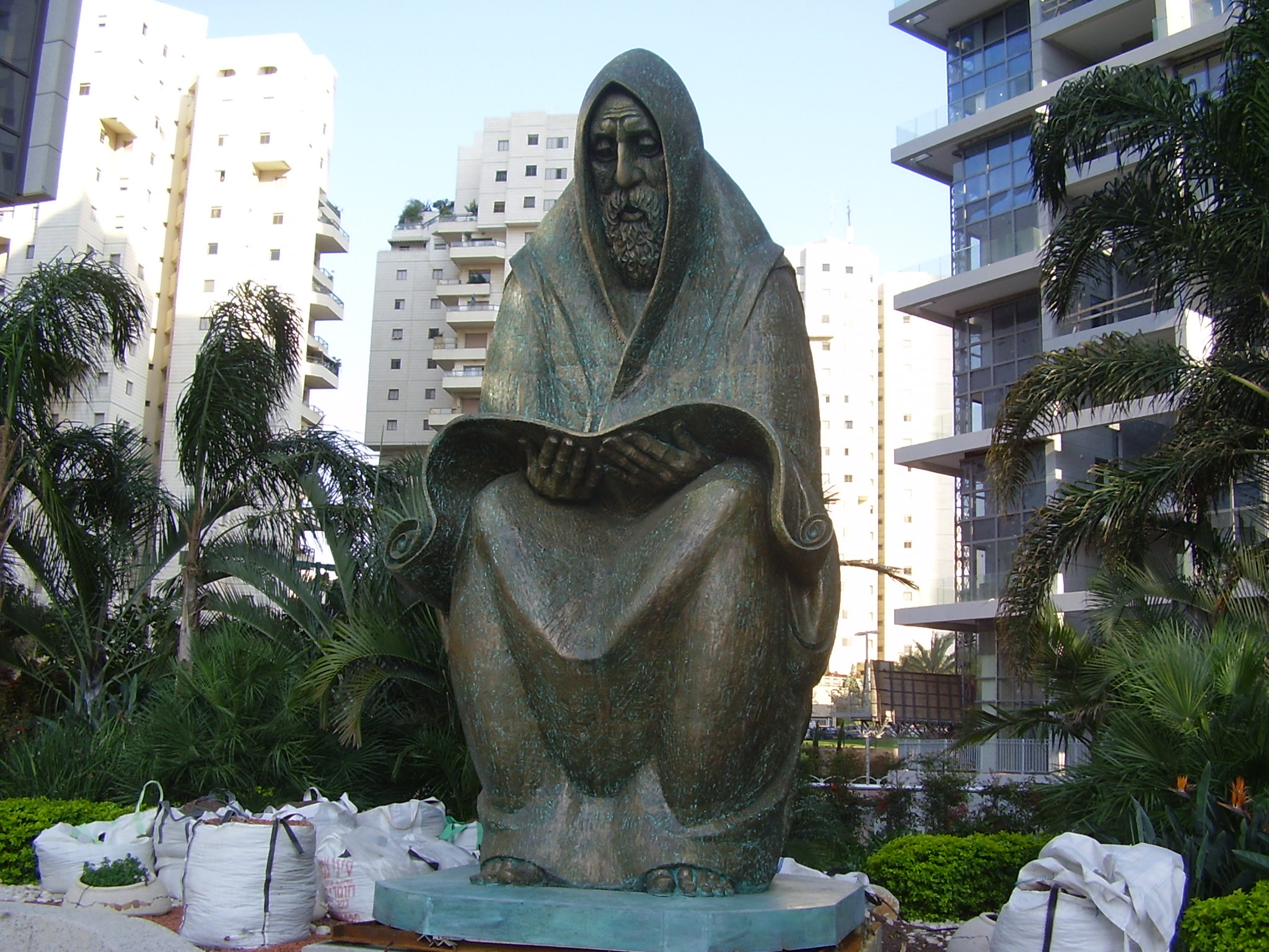
Look at the figure before you know what it marks. A man cast in bronze sits low to the ground, wrapped head to foot in a hooded cloak, bent forward over an open scroll in his lap. The metal has weathered to a soft green. Around him is an ordinary modern square, paving, a few plants, apartment towers rising behind. He is not standing, not pointing, not fighting. He is reading, alone, in the middle of a city going about its day.
This is a memorial, a public sculpture made to mark something and hold it in a shared place. The sculptor titled it Prayer. It stands in Ramat Gan, a city next to Tel Aviv in Israel, and it was put up by Jews who had come from Iraq, specifically from Baghdad, where, on the first two days of June 1941, mobs attacked the Jewish quarter in a wave of killing called the Farhud. The people who raised this memorial, or their parents, had lived through that, then left Iraq and built new lives here. The statue is their marker for the dead they carried with them.
Here is why one quiet sculpture opens this entire Topic. It holds, in a single object, the fact the standard story of the Holocaust leaves out. A student who pictures those years as something that happened only in Europe has nowhere to file a bronze memorial, in a suburb of Tel Aviv, to Jews killed in Iraq. The memorial exists because the history is wider than the map most textbooks draw, and that gap is the whole reason this Topic is taught.
Look closely at the choice the artist made, because it is doing real work. He could have shown the violence, a victim, a weapon, a moment of terror. He chose none of that. He showed a man reading. A community that had every reason to memorialize its loss through horror chose instead to remember through study, the act at the center of its life. That decision, grief carried as continuity rather than as the replayed wound, is itself a statement about how this history is meant to be held.
And the memorial is not a closed chapter; it is a working part of a living community. Iraqi Jews and their descendants are now among the larger Jewish communities in Israel, and the Farhud is marked each year on its anniversary, with this kind of memorial as its anchor, a place to gather, name the dead, and teach the young who ask what the seated figure is reading. The community that the Farhud tried to break did not vanish; it moved, rebuilt, and put up a statue that remembers by doing exactly what it was attacked for. That continuity, against the odds, is the note this Topic ends on.
The aftermath
What the wartime experience produced.
The wartime experience of the Jewish communities of the Middle East and North Africa reshaped the political and demographic landscape of the region. The Farhud is widely treated as the beginning of the political process that ended with the near-complete departure of the Iraqi Jewish community in Operation Ezra and Nehemiah (1950–1951). The wartime experience under Vichy in Algeria reshaped the political consciousness of Algerian Jewry through and beyond the colonial period. The Tunisian and Libyan communities, though smaller in scale than the Iraqi or Egyptian, experienced the wartime period in ways that contributed to the postwar departure of those communities for Israel, France, and elsewhere.
The 1948–1970s departure of approximately 850,000 Jews from Arab and Muslim-majority countries is the subject of separate Topic treatment in the MENA Departure Topic. The departure had multiple political and historical causes, the 1948 founding of the State of Israel and its immediate war, the rise of Arab nationalism and its consequences, the breakdown of the colonial-era state structures within which these communities had lived, and many others. The wartime experience documented in this Topic should be understood as one important part of the history that preceded the later departures, one of their longer historical roots, not a complete explanation for them.
Expanding the geographic history of the Holocaust does not change its center. It makes its historical reach more accurate.
recognition
Where this material lives in the major Holocaust institutions.
- United States Holocaust Memorial Museum. The USHMM's Holocaust Encyclopedia includes entries for the Farhud, North Africa during the Holocaust, the Tunisian camp system, and related material. The Encyclopedia of Camps and Ghettos (vol. 3) treats the labor camps of Vichy North Africa systematically.
- Yad Vashem. Yad Vashem maintains educational materials on "The Holocaust in North Africa" and has recognized Arab Muslim individuals among the Righteous Among the Nations. The documentation includes the Farhud as part of the broader Holocaust-era record.
- Babylonian Jewry Heritage Center, Or Yehuda, Israel. The center for the documentation of Iraqi Jewish history, including extensive Farhud documentation.
- Or Shalom Center for Libyan Jewish Heritage. The center for the documentation of Libyan Jewish history, including extensive Giado-camp documentation.
- The Aladdin Project (Paris). A French educational nonprofit founded under the patronage of UNESCO and the Council of Europe, dedicated to Holocaust education in the Arab and Muslim world. Maintains extensive Arabic-language educational material on the Holocaust era.
- JIMENA · Jews Indigenous to the Middle East and North Africa. American educational nonprofit documenting the long pre-departure history of the Jewish communities of the region, including the wartime experience.
- Sephardi Voices. A digital archive of filmed oral testimony from Jews of the Middle East, North Africa, and Iran, preserving firsthand accounts of community life and of the wartime and postwar years that ended it. Organized by country, with materials for teachers.
Key takeaways
- The Holocaust era reached the Middle East and North Africa. Historians group the regional events into Nazi-executed, Axis-allied, and Nazi-influenced categories, distinctions that matter for understanding what happened where.
- The Farhud of June 1–2, 1941 was a Nazi-influenced pogrom carried out by Iraqi actors in Baghdad; no German unit was present during the violence. It is widely treated as the opening of the long process that ended with the departure of Iraq’s Jewish community a decade later.
- Axis-allied persecution is on the record: Vichy antisemitic law across French North Africa, the German occupation of Tunisia in 1942–1943, and the forced-labor and concentration camps in Libya, where roughly 562 of some 2,600 deportees died at Giado.
- A Nazi extermination operation for Mandatory Palestine was planned and a unit deployed in 1942; only the Axis defeat at El Alamein and Operation Torch prevented its implementation.
- The record also includes Arab Muslim, Arab Christian, and Berber rescuers, a reminder that the regional history was not uniform.
- This Topic stays inside the Holocaust era. The fuller 1948–1970s departure of roughly 850,000 Jews from Arab and Muslim-majority countries is treated separately; the wartime experience is one of its longer roots, not its single cause.
For the classroom
Where this Topic fits the standards.
- World History, NY Global History 10.5 (World War II and the Holocaust). Examines the expansion of Nazi and Axis persecution beyond Europe into North Africa and the Middle East.
- NYS Holocaust Education Mandate, Education Law §801. Broadens Holocaust instruction through documented study of Vichy rule, Libya, Tunisia, Iraq, wartime propaganda, and regional Jewish communities.
- Common Core RH.11–12.6 & RH.11–12.9. Students compare sources from multiple countries, governments, and historical perspectives.
- C3 Framework, D2.His.1, D2.His.14. Students investigate regional comparison, causation, historical perspective, and interpretation.
- Classroom Applications. Compare regional experiences, analyze propaganda, evaluate maps and planning documents, and distinguish different forms of persecution.
- International Classroom Relevance. Supports Holocaust education, Middle East studies, global history, and comparative history.
Teaching resources. For ready-to-use materials and educator training, see Yad Vashem's Education & E-Learning portal, including its databases on Nazi ideology and the Jews of Germany and on the Holocaust in the arts, and the institutions listed above, several of which (USHMM, the Babylonian Jewry Heritage Center, JIMENA) maintain their own classroom materials on the regional record.
Makor Classroom Companion
Grades 7–8, Coming Soon
A printable classroom chapter designed specifically for middle school learners, including:
- teacher guide
- vocabulary support
- primary source activities
- discussion questions
- classroom worksheets
- standards-aligned instructional materials
- assessment suggestions
The Companion supplements this Topic with developmentally appropriate classroom materials while preserving the full historical content of the primary page.
Questions for the classroom
Open questions for discussion and writing.
Each question is tied to a C3 Framework historical-thinking indicator. None has a single expected answer; each asks students to weigh evidence and reach their own judgment.
- Categories. Historians distinguish Nazi-executed, Axis-allied, and Nazi-influenced events in the region. Using the Farhud, the Tunisian occupation, and the Giado camp as your examples, what does each category capture that the others do not, and what is gained or lost by grouping all three under "the Holocaust in North Africa"? (C3 D2.His.1, periodization and the organization of historical events.)
- Causation. The Farhud had several contributing causes operating at once: a pro-Axis coup, years of Nazi radio propaganda in Arabic, local political tension, and the absence of protective authority during the violence. How would you weigh these against one another, and can a single cause be called decisive? (C3 D2.His.14, analyzing multiple and complex causes and effects.)
- Perspective. Compare how this history might be told from the perspective of an Iraqi Jewish survivor, a Tunisian Muslim rescuer, and a wartime Allied official. How does each vantage point shape what counts as the central event? (C3 D2.His.4, explaining how perspectives shaped historical sources and accounts.)
- Evidence. The plan for an extermination operation in Mandatory Palestine is documented but was never carried out. How should historians treat a planned-but-unrealized event, and what kinds of sources would you want before stating what "would have" happened? (C3 D2.His.10, detecting the limitations of historical sources and evidence.)
- The afterward. The Ramat Gan memorial in Israel remembers the Farhud through a reading figure rather than a depiction of the attack. What does a community communicate by how it chooses to memorialize loss, and how does that choice affect how later generations learn the history? (C3 D2.His.3, the historical context behind people's perspectives and actions.)
Sources and citations
Primary sources come straight from the time: documents, letters, speeches, images, and objects created by the people involved. Secondary sources come later: books, articles, and analysis in which scholars study and interpret those primary sources.
Primary sources
- Memorandum of the meeting between Adolf Hitler and Hajj Amin al-Husseini, November 28, 1941. Drafted by Paul Otto Schmidt, German Foreign Office. Reproduced in Documents on German Foreign Policy 1918–1945, Series D, Vol. 13 (Washington: U.S. Government Printing Office, 1954), pp. 881–885.
- Babylonian Jewry Heritage Center, Or Yehuda, Israel. collection on the Farhud.
- Or Shalom Center for Libyan Jewish Heritage. collection on the Giado camp.
- Vichy France. The Statut des Juifs of October 3, 1940, and the law of October 7, 1940 abrogating the Crémieux Decree and stripping Algerian Jews of French citizenship.
Secondary sources
- Satloff, Robert. Among the Righteous: Lost Stories from the Holocaust's Long Reach into Arab Lands. New York: PublicAffairs, 2006.
- Herf, Jeffrey. Nazi Propaganda for the Arab World. New Haven: Yale University Press, 2009.
- Mallmann, Klaus-Michael, and Martin Cüppers. Nazi Palestine: The Plans for the Extermination of the Jews in Palestine. New York: Enigma Books, 2010.
- Abitbol, Michel. The Jews of North Africa During the Second World War. Detroit: Wayne State University Press, 1989.
- Roumani, Maurice M. The Jews of Libya: Coexistence, Persecution, Resettlement. Brighton: Sussex Academic Press, 2008.
- De Felice, Renzo. Jews in an Arab Land: Libya, 1835–1970. Austin: University of Texas Press, 1985.
- Black, Edwin. The Farhud: Roots of the Arab-Nazi Alliance in the Holocaust. Washington: Dialog Press, 2010.
- Bashkin, Orit. New Babylonians: A History of Jews in Modern Iraq. Stanford: Stanford University Press, 2012.
- Cohen, Hayyim J. "The Anti-Jewish Farhud in Baghdad, 1941." Middle Eastern Studies 3, no. 1 (October 1966): 2–17.
- Achcar, Gilbert. The Arabs and the Holocaust: The Arab-Israeli War of Narratives. New York: Metropolitan Books, 2010.
- Lee, Daniel. Petain's Jewish Children: French Jewish Youth and the Vichy Regime. Oxford: Oxford University Press, 2014.
- Schroeter, Daniel J. "Vichy in Morocco: The Residency, Mohammed V, and His Indigenous Jewish Subjects." In Colonialism and the Jews, edited by Ethan Katz et al., 215–250. Bloomington: Indiana University Press, 2017.
- Boum, Aomar, and Sarah Abrevaya Stein, eds. The Holocaust and North Africa. Stanford: Stanford University Press, 2018. (The major recent scholarly synthesis.)
- Sebag, Paul. Histoire des Juifs de Tunisie: Des origines à nos jours. Paris: L'Harmattan, 1991.
- United States Holocaust Memorial Museum. Encyclopedia of Camps and Ghettos, 1933–1945. Vol. III. Bloomington: Indiana University Press, 2018.
- Yad Vashem. Educational materials on the Holocaust in North Africa. yadvashem.org.
- JIMENA. Educational resources on the wartime experience of MENA Jewish communities. jimena.org.
Finding these documents: many primary sources are free online. Good places to start are the Fordham Internet Jewish History Sourcebook, Yale’s Avalon Project (law and diplomacy), German History in Documents, the collections of the US Holocaust Memorial Museum and Yad Vashem, the National Library of Israel, and Sefaria (for Jewish texts). Search the document’s name and date.
Jewish resistance and rescue in the Holocaust: the ghetto and killing-center uprisings, the forest partisans, the Oneg Shabbat archive, the Righteous Among the Nations, the diplomats, and the national rescues of Denmark, Bulgaria, and Italy.
Comments?
Write to editor@makorproject.org.
Last updated: August 2026.