About the Name
Why Makor?
History begins with sources. Primary documents, inscriptions, material culture, scholarly editions, the evidence itself, not secondhand summary. Jewish history, carried across millennia and continents, has too often reached classrooms as summary rather than source. The platform takes its name, and its method, from the correction.
Makor (מָקוֹר) is the Hebrew word for source. In modern academic Hebrew, a researcher cites a makor rishon, a primary source. In the Hebrew Bible, the same word carries the older sense of wellspring or fountain, the fountain of living waters, the fountain of life, the teaching of the wise as a fountain of life. The Mishnah and Talmud use the word for a textual source, the verse from which a later ruling derives. The medieval commentators (Rashi, Ibn Ezra, Maimonides, Nachmanides) use it the same way. The root m-q-r (מ־ק־ר) also produces the verb to dig, to excavate, to trace something back to its origin.
The double meaning is the point. Sources are where stories begin, and where students and teachers should begin too.
Mission
The Makor Project addresses a structural gap: Jewish history runs continuously through the eras the curriculum already teaches (medieval Europe, the Spanish and Ottoman empires, the World Wars, the modern Middle East) but reaches most classrooms only in fragments. The project reconnects that history to the surrounding chapters in which it belongs, holding it to the same historical depth and documentary standards expected elsewhere in the curriculum. It is free, openly licensed, and independent. The argument is parity, not preference.
Founder & Director
Orit Yakuel
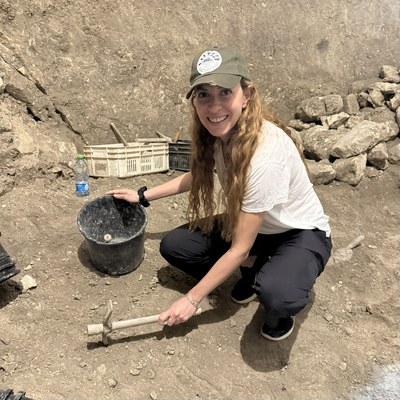
Orit Yakuel is an art historian and educator whose work centers on the material culture of Jewish civilization, the objects, places, and primary sources through which its long continuity can be traced, much of it absent from the standard K–12 curriculum. She founded and directs The Makor Project.
Her training is in art history and archaeology, with fieldwork at Pompeii. She has worked in the Department of Ancient Near Eastern Art at the Metropolitan Museum of Art and at The Jewish Museum in New York (in exhibition research, curatorial support, and collections management) and has run exhibition programs at the University of Pennsylvania's Burrison Gallery and at Columbia University. A U.S. State Department cultural-exchange initiative took her to Egypt to build academic partnerships there.
She has taught art history at Nassau Community College and Hofstra University. The Makor Project emerged from that work, an effort to assemble, from the evidence itself, the connective Jewish history that the standard curriculum leaves fragmented or absent.
Yakuel holds an MA in art history from the University of Pennsylvania and a BA in art history and criticism from Stony Brook University.
About the Logo
The wordmark.
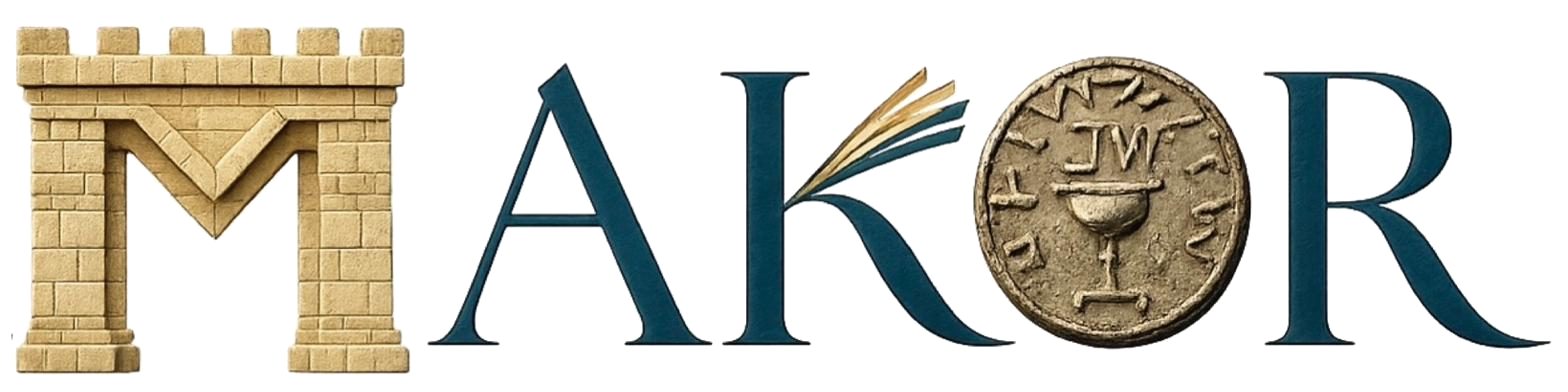

The wordmark spells MAKOR with two letters rebuilt from primary-source material. The M is constructed from Jerusalem limestone blocks, reminiscent of the masonry of the Holy Temple. The O is a silver coin from the First Jewish Revolt against Rome (66–70 CE): its chalice and pomegranate motif and Paleo-Hebrew lettering are visible at this scale. Two objects, two pieces of evidence, set inside the word that means source. (On the coin: a half-shekel discovery ↗, and David Hendin on the shekel's pomegranate motif ↗, American Society of Overseas Research.)
How the platform works
Makor is organized around six Units and a consistent analytical framework: Motive, Mechanism, Evidence. Each topic is built around historical questions, primary sources, and material culture, encouraging readers to move from evidence to interpretation rather than from conclusion to evidence. Topic pages, classroom modules, handouts, and source directories carry that method into the classroom.
Why the platform includes K–5
The two curriculum petitions submitted in spring 2026 target middle- and high-school standards, NYS Global History and Geography and NYS US History. The K–5 portal exists because, by high school, the cognitive frameworks through which students encounter difference are already in place.
Children who first meet Jewish life (synagogues, holidays, neighborhoods, foods, communities) in the early elementary grades develop a different baseline understanding than children who first encounter it abstractly through the Holocaust chapter in middle or high school. The two are not interchangeable. By the upper grades, the question is what the student does with the framework already built. That work begins much earlier.
The petitions argue for what should be taught in middle and high school. The K–5 portal addresses the same need at its earliest natural point of intervention. The two are complementary; the platform serves both.
Good history begins in curiosity, advances through evidence, and follows the record wherever it leads. Everything in Makor is built on that standard.