Adversus Judaeos
“The synagogue is not only a brothel and a theater; it also is a den of robbers and a lodging for wild beasts.”
John Chrysostom, Against the Jews, Homily 1, c. 386 CE, quoted as the charge, never as fact
Why this Topic exists
The teaching that came before the violence.
For roughly a thousand years, Christian Europe taught that the Jewish people bore collective guilt for the death of Jesus, a charge the medieval world called deicide, the killing of God. It was a charge, never a fact, and in 1965 the Catholic Church formally repudiated it. But before the repudiation came the teaching, and before the famous events came the framework that made them thinkable.
School courses usually cover the events (the Crusades, the expulsions, the Reformation) without the literature that supplied their underlying logic. This Topic treats that literature: the body of Christian theological writing known as Adversus Judaeos, "against the Jews."
The posture toward the Christian-Jewish relationship today is the one set out in the Nostra Aetate Topic. Across the postwar decades the Catholic Church and the major Protestant communions repudiated the positions this literature articulated, and those repudiations are themselves part of the record. The Topic is history, not present-day polemic. The Church of 2026 is not the body whose patristic theologians composed this tradition; the reckoning has been real, and the reckoning is part of the story too.
What it is
A definition, before the history.
Adversus Judaeos, Latin for "against the Jews", names a continuous tradition of Christian theological writing that ran from the second century into the early-modern period. The phrase comes from the title of an early work by Tertullian (c. 200 CE) and became the generic label for the whole genre.
The literature argued, in essence, that the Christian Church had replaced the Jewish people in God's plan (the position scholars call supersessionism), that the Jewish people bore collective guilt for the crucifixion (the deicide charge), and that Jewish "blindness" to Christ explained and justified their dispersion and subordination. Those theological claims, repeated and elaborated over centuries, became the framework within which medieval European law, art, and violence toward Jews operated.
What the literature was not is treated below, after the history, because the distinctions only land once the tradition itself is on the table.
Common misconceptions this Topic addresses
Adversus Judaeos is the Christian theological tradition that built the categorical foundation for medieval European antisemitism. The entries below cover both the historical record and the postwar repudiations; each links to its dedicated entry in the Misconceptions reference.
- "The Jews killed Jesus." See the entry →
- "Antisemitism is mainly a Christian-European phenomenon." See the entry →
- "'Antisemitism' is a general term for any hostility toward Jews going back to antiquity." See the entry →
- "The Catholic Church's relationship to the Jewish people hasn't really changed in modern times." See the entry →
The origins · 2nd century
The literature emerges as Christianity separates from Judaism.
The Adversus Judaeos literature emerged in the second century CE, as the Christian movement, which began inside first-century Judaism, separated itself from the wider Jewish world. Historians call that separation the "parting of the ways," and the timing is itself a live scholarly question. The older account placed the split early, in the decades just after 70 CE; more recent work traces a slower process across the second, third, and fourth centuries. The standard reference for the current view is Daniel Boyarin's Border Lines: The Partition of Judaeo-Christianity (University of Pennsylvania Press, 2004).
The earliest surviving texts (works titled "Against the Jews," or polemics addressing Jewish-Christian disagreement) date to the second century:
- The Epistle of Barnabas (c. 130 CE, possibly Alexandria). The earliest surviving anti-Jewish Christian text. It argues that the Church had replaced Israel in God's covenant and that the Jewish people no longer held standing as God's chosen community.
- Justin Martyr, Dialogue with Trypho (c. 155–160 CE, Rome). The main surviving second-century polemic, written as a debate between Justin and Trypho, a Jewish interlocutor possibly modeled on Rabbi Tarfon of the Mishnaic period. It sets out the supersessionist case and the claim that the biblical prophecies point to Jesus rather than to the Jewish reading.
- Melito of Sardis, Peri Pascha ("On the Passover") (c. 160–170 CE, Sardis). A liturgical homily for Christian Easter observance. It carries the earliest surviving explicit deicide charge, the claim that the Jewish people committed deicide in handing Jesus to crucifixion, the accusation that would become central to everything after.
- Tertullian, Adversus Judaeos (c. 200 CE, Carthage). The Latin work whose title gave the whole genre its name. It continues the supersessionist framework laid down by its Greek-language predecessors.
The patristic period · 2nd–5th centuries
The literature develops.
Across the third, fourth, and fifth centuries the literature grew, written by essentially every major Church Father of the period. That centrality matters: the genre sat at the heart of patristic theology rather than off to the side. Major fourth-century contributors:
- Eusebius of Caesarea (c. 263–339), the historian whose Ecclesiastical History framed early Christian self-understanding, also wrote extensive anti-Jewish material in his Demonstratio Evangelica.
- Ephrem the Syrian (c. 306–373), the leading Syriac theologian, composed anti-Jewish hymns and homilies, treated in scholarly work by Christine Shepardson and others.
- Aphrahat the Persian Sage (c. 270–c. 345), whose Demonstrations argue that the Christian community had inherited the standing the Jewish people lost.
- Hilary of Poitiers, Cyril of Jerusalem, and Gregory of Nyssa each added Adversus Judaeos material within their wider theological work.
The fifth century brought more. The single most consequential work, John Chrysostom's Eight Homilies Against the Jews, and Augustine's framework, which would shape the medieval Catholic position for roughly a thousand years, are treated in their own sections below.
The scholarship here is extensive. The principal references include Robert Wilken's John Chrysostom and the Jews (University of California Press, 1983), Marcel Simon's Verus Israel (Oxford, 1986), Miriam Taylor's Anti-Judaism and Early Christian Identity (Brill, 1995), and Jules Isaac's L'enseignement du mépris ("The Teaching of Contempt," 1962), the study that helped drive the Catholic reckoning treated in the Nostra Aetate Topic.
John Chrysostom · the Antioch homilies
The rhetorical apex.
The most consequential single work of the patristic tradition is the Eight Homilies Against the Judaizers by John Chrysostom (c. 349–407), preached at Antioch in 386–387. Chrysostom, then a presbyter at Antioch and later Patriarch of Constantinople, was reacting to Christians in his own congregation who kept up Jewish practices, attending synagogue for the High Holidays, observing Jewish fasts, swearing oaths in synagogues, seeking healing from Jewish religious figures. The homilies were meant to drive that engagement to a stop.
The rhetoric is severe, among the most intense surviving examples of patristic anti-Jewish language. The animal imagery, the comparison of Jewish practice to debauchery and demonic activity, the deicide framing: all of it would shape the Christian rhetorical inheritance that followed.
How to read that rhetoric is a real scholarly debate. Robert Wilken's John Chrysostom and the Jews (University of California Press, 1983) argues it should be read inside the conventions of fourth-century rhetoric, which color how a modern reader should take it; other scholars contest that. What is not in question is the effect: later Christian readers, encountering the homilies outside their original setting, carried Chrysostom's language about the Jewish people into their own. Citations of him run through the medieval and early-modern periods, and the twentieth-century reckoning that produced Nostra Aetate took the Chrysostomic inheritance as one of its central concerns.
Augustine · the witness-people doctrine
The framework that organized the medieval tradition.
The position that organized the medieval Catholic stance toward the Jewish people came chiefly from Augustine of Hippo (354–430), whose work shaped nearly every part of later Western theology. Augustine set out his view across several works, City of God (completed 426), the Tractatus Adversus Judaeos, and others, and what made it distinctive in its period was what it did not argue.
Unlike some of his contemporaries, Augustine did not call for the Jewish people to be eliminated or forced to convert. His position (later known as the "doctrine of Jewish witness") rested on three claims:
- The Jewish people preserved the Hebrew Bible as authentic ancient witness to the prophecies Christian theology read as predictions of Christ. Their preservation of the text was therefore useful to Christian apologetics, the Christian reading could not be dismissed as Christian invention if the Jewish people themselves kept the same scriptures.
- Continuing Jewish existence served as theological evidence. Augustine read the Jewish presence, in what he saw as a state of dispersion and subordination, as witness to the truth of Christian claims about the consequences of rejecting Christ.
- The Jewish people should therefore not be killed or forcibly converted. Drawing on Psalm 59:11 ("Slay them not, lest my people forget"), Augustine held that they should be allowed to continue, though only in the subordinate status his framework prescribed.
The consequence was far-reaching. For roughly the next thousand years the Church's official position operated within Augustine's framework. Medieval Europe's Jewish communities were allowed to continue (under heavy restriction, under the theological hostility of the Adversus Judaeos literature, under legal subordination) but within a framework that was preservative rather than eliminationist.
The reference study is Jeremy Cohen's Living Letters of the Law: Ideas of the Jew in Medieval Christianity (University of California Press, 1999), which traces how Augustine's framework worked across the medieval period and where it broke down. The relationship between that framework and the very real medieval anti-Jewish violence (the First Crusade massacres of 1096, the Rhineland killings of the Black Death years, the expulsions) remains closely studied. The framework set a theological boundary that prevented some violence and failed to prevent the rest.
The themes
What the literature said.
Across its patristic and medieval span, the literature held a fairly consistent set of theological positions:
- Hard supersessionism. The claim that the Church had replaced the Jewish people in God's covenant, which was now superseded or revoked. This is the foundation of nearly the whole tradition. The Catholic Church has since repudiated it, see the Nostra Aetate Topic on "what it ended", and the Vatican's 2015 document The Gifts and the Calling of God Are Irrevocable states the current position that the covenant with the Jewish people has not been revoked.
- The deicide charge. The claim that the Jewish people, across all generations, bore guilt for the crucifixion. It originated with Melito of Sardis in the second century and grew across the patristic and medieval literature. The Catholic Church repudiated it in Nostra Aetate (1965); the exact language is in the Nostra Aetate Topic.
- A theological reading of Jewish dispersion. The claim that the dispersion after 70 CE was divine punishment for rejecting Christ, the frame through which continuing Jewish existence was then read.
- The "fulfillment" reading of the Hebrew Bible. The claim that the Hebrew Bible was really about Christ and the Church, with the Jewish reading treated as a misreading of texts said to belong to the Christian tradition.
- Polemic against rabbinic Judaism. Across the medieval period the literature turned more directly on rabbinic Judaism, which the patristic-era writing had engaged less. The medieval Christian engagement with the Talmud, including the book-burnings and forced disputations below, worked inside this framework.
The medieval disputations
The forced engagement.
Across the medieval period the literature was staged as a series of formal public disputations, debates between Jewish rabbinic figures and Christian representatives, held under conditions that left the Jewish side heavily constrained. The major ones:
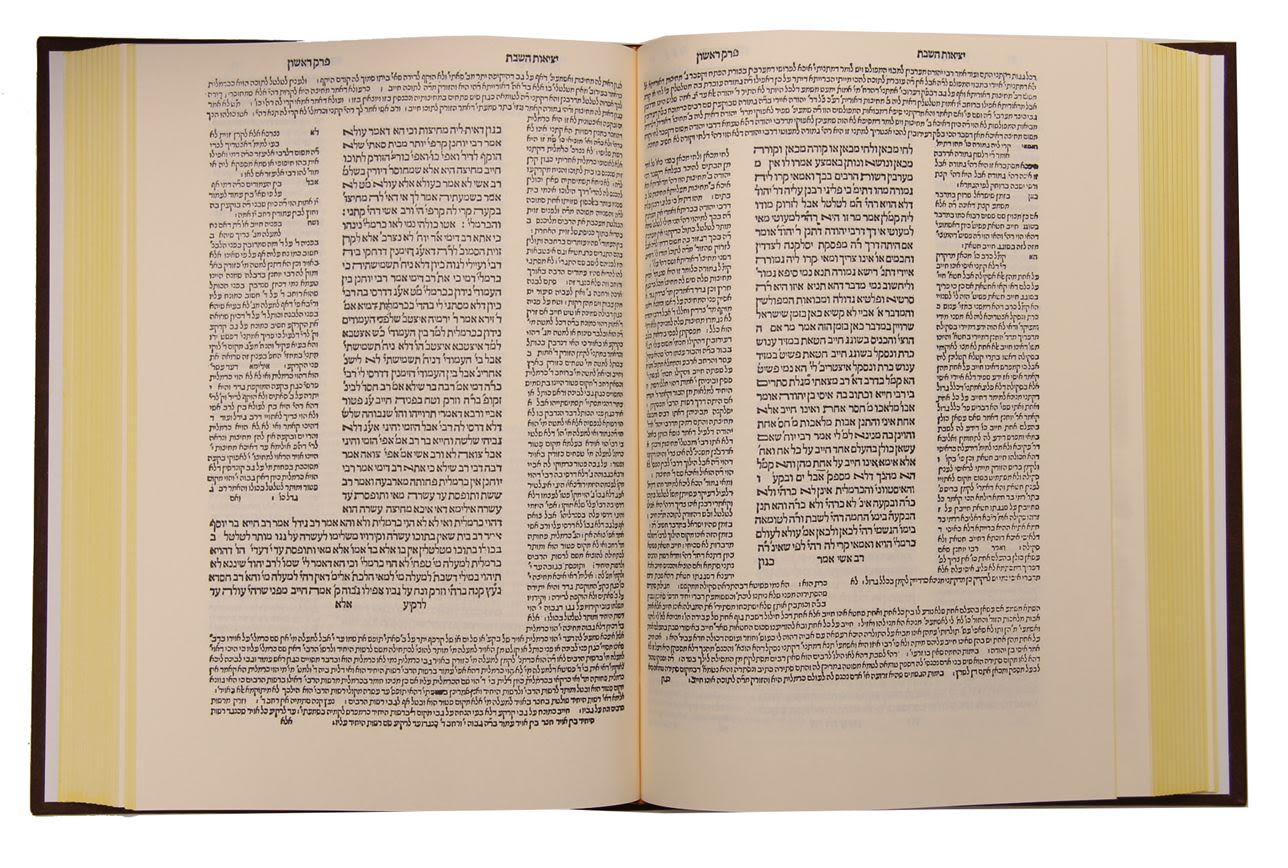
- The Paris Disputation (1240). Convened under King Louis IX of France. The Christian side was argued by Nicholas Donin, a Jewish convert who had accused the Talmud of blasphemy against Christianity; the Jewish defender was Rabbi Yehiel of Paris. The outcome was the formal condemnation of the Talmud and its burning at Paris in June 1242, roughly 12,000 manuscript copies destroyed. It was the first Christian condemnation and burning of the Talmud, and it set the pattern for those that followed.
- The Barcelona Disputation (1263). Convened under King James I of Aragon. The Christian side was argued by Pablo Christiani, a Jewish convert; the defender was Rabbi Moshe ben Nahman (Nahmanides, the Ramban, c. 1194–1270), one of the leading Spanish-Jewish authorities of the age. The result was technically inconclusive, the king himself gave Nahmanides a sizable gift afterward and acknowledged the strength of his defense, but Nahmanides was later expelled from Aragon and settled in the Land of Israel in 1267, treated in the Continuous Presence Topic. His Hebrew account, written soon after, is one of the fullest surviving records of any medieval disputation from the Jewish side.
- The Tortosa Disputation (1413–1414). The longest and most extensive, held at Tortosa, Aragon, under Pope Benedict XIII. The Christian side was argued by Jerónimo de Santa Fe (formerly Joshua Lorki, a Jewish convert); roughly twenty rabbinic figures from across the Aragonese communities were compelled to attend across its 21 months. It produced many conversions among Aragonese Jews, whether through genuine persuasion or under the pressure the proceeding created is debated, and left the Aragonese Jewish community badly weakened in the decades before the 1492 expulsion.
The pattern held across all of them. Christian authorities (royal, papal, or ecclesiastical) convened the debates. The Jewish defenders argued under threat of lost standing, violence, or reprisal against their communities, and the procedure privileged the Christian side at nearly every turn. The scholarship is extensive; see Robert Chazan's Daggers of Faith (University of California Press, 1989) and Hyam Maccoby's Judaism on Trial (Littman Library, 1982).
Ecclesia and Synagoga · visual iconography
The translation into visual culture.
The theological tradition was also translated into a distinctive visual language. The convention, called "Ecclesia and Synagoga," paired two female figures: Ecclesia, the Church personified, and Synagoga, the figure standing for Judaism. It developed from the ninth through twelfth centuries and became standard in medieval European Christian art.
Across the many surviving examples the pairing follows a fixed grammar. Ecclesia appears crowned and regally dressed, holding symbols of authority (a cross, a chalice, sometimes a scepter) upright and triumphant. Synagoga appears blindfolded, her crown falling or fallen, holding a broken staff or a downturned Torah scroll, often turned away from the central Christian scene. The pairing put the supersessionist claim into visible form: Ecclesia the successor, Synagoga the superseded.
Surviving examples include the two figures at Strasbourg Cathedral (c. 1230), among the finest thirteenth-century Gothic sculpture; the Notre-Dame de Paris west facade, whose original figures were damaged in the French Revolution and restored in the nineteenth-century Viollet-le-Duc reconstruction; the Princes' Portal at the Cathedral of Bamberg (c. 1235); and programs at the cathedrals of Reims, Worms, and Bordeaux, among many others.
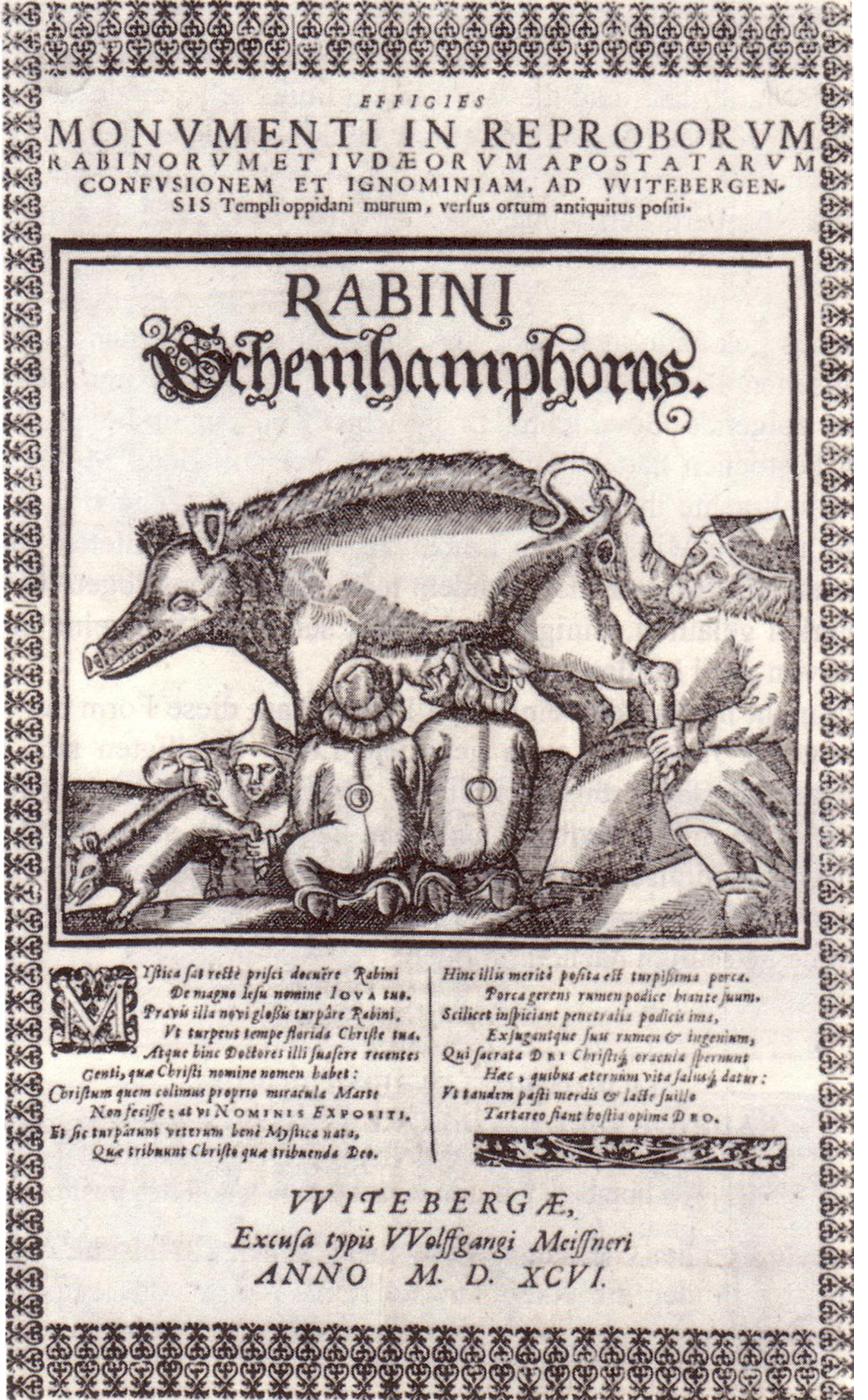
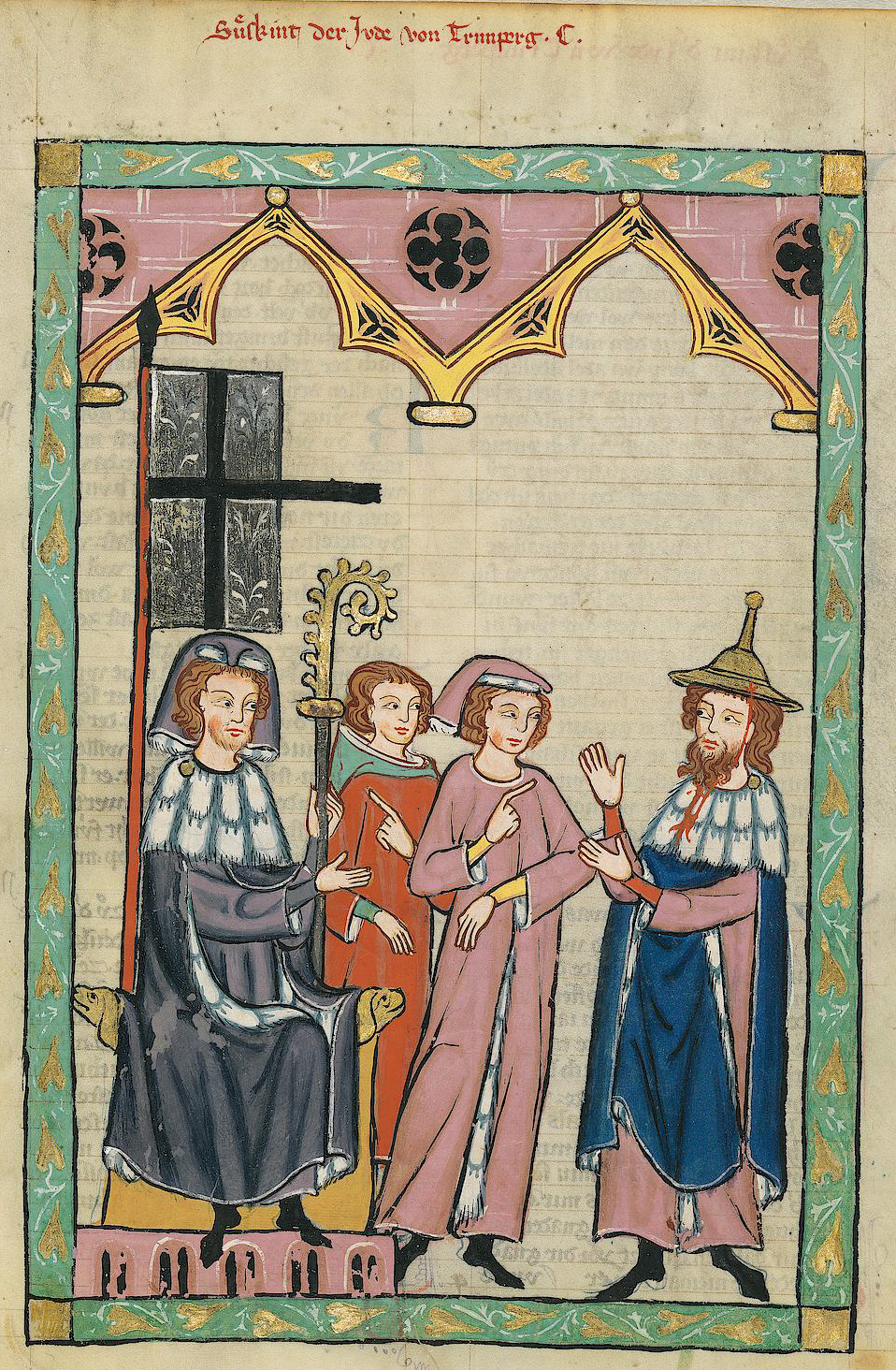
The iconography mattered because it carried the theological tradition to people who could not read it. The supersessionist framework (and, in harsher images, open contempt) was something medieval Europeans met in their ordinary experience of religious space, not only in the scholars' texts.
The contemporary reckoning has taken visual form too. In 2015 Saint Joseph's University in Philadelphia commissioned a new sculptural pairing, "Synagoga and Ecclesia in Our Time" by Joshua Koffman, that shows the two figures side by side, both crowned, both holding their texts, neither above the other. It puts the post-Nostra Aetate position into the same medium the old convention used.
Object Spotlight
Ecclesia and Synagoga, Strasbourg, c. 1230.
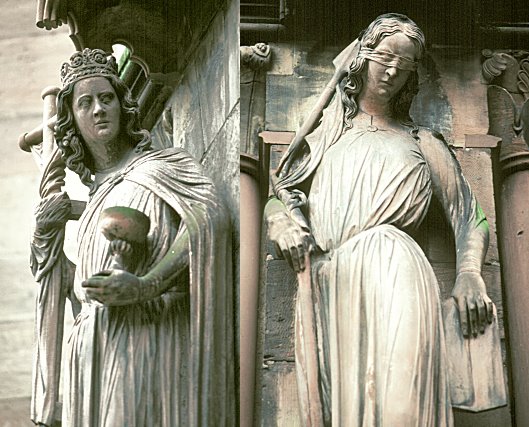
Look first, before you know their names. Two stone women stand side by side, carved more than a foot taller than life. The one on the left is calm and upright, a crown on her head, a cup in her hand. The one on the right has slipped into a long S-curve, her head tipped, a strip of cloth tied across her eyes; the staff in her hand is snapped, and a set of stone tablets is sliding from her grip. One figure has everything together. The other is coming apart, gracefully.
These are sculptures carved around 1230 for the south doorway of Strasbourg Cathedral, in what is now eastern France, but what matters is that they are not a one-off invention. They are an example of a fixed visual type that medieval Christian art repeated for centuries: a matched pair of women with standard names, Ecclesia, Latin for "the Church", and Synagoga, "the Synagogue," meaning Judaism. Once the convention was set, artists across Europe reached for the same pair the way a modern designer reaches for a familiar logo. It was a way of teaching, to a crowd that mostly could not read, a picture-argument about two religions, and because it was a type rather than a single artwork, it could appear almost anywhere.
Here is the argument the carving makes, and why it belongs at the head of this Topic. Everything the Adversus Judaeos writers had claimed in words for a thousand years is set here in a single image you can read figure by figure. The crown against the bare bowed head; the upright cup against the snapped staff; the clear gaze against the bound eyes. One faith is shown risen and whole, the other fallen and fading. The contrast is the claim, that the Church had replaced the Synagogue, and that this was visibly, obviously so.
Look closer at the one detail that does the most work: the blindfold. In the visual shorthand of the period, covered eyes did not mean a person who cannot see. They meant a person who will not, who has the truth right in front of her and refuses to look. That is the old charge of "blindness" and "stubbornness" from the sermons, turned into something a passerby could grasp in a second. And notice what the carver chose not to do: Synagoga is not ugly or monstrous. She is a beautiful young woman, graceful even in defeat. The hostility travels inside beauty, which is exactly what makes it persuasive, and exactly what is worth learning to spot.
And it traveled. From roughly the ninth century to the sixteenth, some seven hundred years, the Ecclesia-and-Synagoga pair turns up on object after object: carved on the great cathedral fronts at Strasbourg, Bamberg, Reims, and Notre-Dame in Paris; glowing in stained-glass windows; painted into illuminated prayer books; struck on seals, ivories, and altarpieces. The same two figures, the same crown-against-blindfold contrast, met worshippers in town after town across most of a millennium, which is exactly what makes it a type and not just a statue. Only in the twentieth century did its meaning come under hard scrutiny, and after the Second Vatican Council's Nostra Aetate (1965) some churches commissioned new versions showing the two as equals, side by side, rather than victor and vanquished. The Strasbourg pair still stands where it was carved, now read not as a truth-claim but as evidence of how an idea was taught to the eye, over and over, for centuries.
Translation into legal architecture
The tradition and medieval European law.
Across the medieval period the theological tradition was translated into the law that governed Jewish life in Christian Europe, through several channels:
- The Church canons. From the Council of Elvira (c. 305–306) through the major medieval councils, canon law set the restrictions on Jewish life. The Third Lateran Council (1179) and Fourth Lateran Council (1215) matter most.
- The Fourth Lateran Council (1215) and the badge. Canons 67–70 set out a series of restrictions: the badge requirement (Jews and Muslims to wear distinctive clothing marking them off from Christians), limits on Jewish public office in Christian states, and limits on Jewish-Christian commercial dealing, the architecture that would shape Jewish life for centuries. The Ghetto System Topic traces the wider consequences. For the badge's full history, from its eighth-century Islamic origins through the medieval variations to the Nazi revival, see the USHMM Holocaust Encyclopedia.
- The papal bulls. A long line of bulls set specific positions on Jewish life. The Sicut Judaeis bull, first issued by Pope Calixtus II around 1120 and reissued by some fifteen later popes, carried Augustine's framework of preservative restriction. The Cum Nimis Absurdum of Pope Paul IV (1555), treated in the Ghetto System Topic, marked the early-modern hardening.
- Secular law. Christian Europe's civil codes absorbed the Church's positions, and the law of Jewish-Christian relations across the medieval West took shape from that merging of theology and civil code.
The result was the medieval legal architecture treated across Section 4, the Ghetto System Topic, and the wider platform. The theology in this Topic supplied the framework that law then operated inside.
The reception into the modern period
The inheritance into the twentieth century.
The tradition ran on through the late-medieval, early-modern, and modern periods. Its passage through the Reformation, the Counter-Reformation, and the rise of modern European Christianity kept much of the patristic and medieval material, sometimes intact, sometimes altered, sometimes carried into forms later theology would sharply contest. Key reception moments:
- Martin Luther's later writings. The Lutheran inheritance, treated in the Nostra Aetate Topic, includes Luther's 1543 treatise On the Jews and Their Lies, an anti-Jewish work that drew on the wider Adversus Judaeos tradition. Twentieth-century German Christian movements aligned with the Nazi regime cited it heavily; the 1984 Lutheran World Federation repudiation addressed that inheritance directly.
- The Counter-Reformation Catholic position. Through the early-modern Counter-Reformation the Church mostly kept the framework, with the hardening under Pope Paul IV's Cum Nimis Absurdum (1555): treated in the Ghetto System Topic, as part of the pattern.
- The Enlightenment and emancipation. The emancipation of European Jews across the late eighteenth and nineteenth centuries (France 1791, the Habsburg lands 1867, the German Empire 1871) proceeded mainly by contesting the framework's legal and political effects. The theology itself, though, lived on in Church settings even as its civil consequences were dismantled.
- The link to modern racial antisemitism. How the patristic-medieval theology connected to the late-nineteenth-century racial antisemitism the Nazi regime later weaponized is much studied. The consensus, set out in Saul Friedländer's Nazi Germany and the Jews (HarperCollins, 1997, 2007), in the Yad Vashem and USHMM materials, and in the wider literature, is that the theological tradition and racial antisemitism are distinct in their foundations but continuous in their operation. The theology supplied the figure of "the Jew as theological enemy"; racial antisemitism then recast it as "the Jew as biological enemy." The two are not the same. They are connected.
Distinguishing the framework
What Adversus Judaeos was, and what it was not.
With the history on the table, the distinctions come into focus. Adversus Judaeos is often conflated with other phenomena it is not the same as. Three frameworks are kept apart here.
1. Adversus Judaeos was a sustained theological project specifically about Jews. The continuous patristic and medieval literature theorized Jewish guilt for the death of Jesus, Jewish "blindness" and "stubbornness," and used those constructions to justify legal disability, periodic massacre, expulsion, and the ghetto. It targeted Jews as Jews, with a worked-out theological theory of their condition. This is the phenomenon this Topic treats.
2. Classical Islamic subordination of dhimmi populations was different in kind. The dhimma framework of the Pact of Umar tradition (eighth–ninth century) was a hierarchical legal status applied to "People of the Book" (Jews and Christians together as one religious-legal category) across the Umayyad, Abbasid, Fatimid, Ottoman, and other periods. It was discriminatory, and at times violent (the 1066 Granada massacre, the Almohad persecutions of twelfth-century Iberia and the Maghreb, periodic Yemeni and Moroccan episodes), but it was not a continuous theological project aimed specifically at Jews. The scholarship (Bernard Lewis, Mark Cohen, Norman Stillman) treats this distinction as foundational. The MENA Departure Topic treats the different, twentieth-century European-import antisemitism that drove the 1948–1972 displacement of roughly 850,000 Jews from Arab and Muslim-majority countries.
3. Nazi racial antisemitism was different again, and it closed the conversion exit. The 1879 racial turn, treated in the Racial Turn Topic, redefined Jewishness as a hereditary biological category with no possible escape. Both classical dhimma and Christian Adversus Judaeos allowed conversion as an exit, however coerced. Nazi racial antisemitism did not. That categorical change is what made the Holocaust ideologically possible.
The point to hold, against both "Christianity caused the Holocaust" on one side and "Christianity had nothing to do with it" on the other, is this: Adversus Judaeos supplied the long-running theological infrastructure within which targeted anti-Jewish persecution became possible in Christian Europe, while remaining a religious framework that conversion could in principle exit. The break to biological-racial categorization was a nineteenth-century development that built on that infrastructure and then transformed it. The further entries are at the Misconceptions reference.
The repudiation
The postwar reckoning.
The postwar response to this inheritance has been far-reaching. The major moments (treated in full in the Nostra Aetate Topic) include:
- Nostra Aetate (1965). The Catholic Church's repudiation of the deicide charge and the supersessionist framework. The 2,221-to-88 vote at the Second Vatican Council set the Catholic position. Later magisterial documents, the 1974 Guidelines, the 1985 Notes, the 1998 We Remember, the 2015 The Gifts and the Calling of God Are Irrevocable, built it out.
- The Protestant repudiations. Treated in the Nostra Aetate Topic's section on the parallel Protestant repudiations: the Lutheran World Federation's 1984 statement, the ELCA's 1994 Declaration to the Jewish Community, the United Methodist Church's 1996 Building New Bridges in Hope, and others.
- The scholarly reckoning. The twentieth-century engagement with the tradition, Jules Isaac's L'enseignement du mépris (1962), which shaped the Nostra Aetate process; the work of Wilken, Simon, Boyarin, Cohen, Chazan, and many others, produced the framework within which this material is now read.
The record is this: the Catholic Church and the major Protestant communions have conducted real postwar repudiations of this tradition, and those repudiations belong to the record alongside the original. The original is set down here because the record requires it, and the repudiations because the record equally requires it. The posture today is partnership, the post-Nostra Aetate dialogue treated in the Nostra Aetate Topic is where the present engagement happens.
Key takeaways
- Adversus Judaeos, "against the Jews", is the Christian theological tradition that ran from the second century into the early-modern period and supplied the framework for medieval European antisemitism.
- Its core claims were supersessionism (the Church had replaced the Jewish people), the deicide charge (collective Jewish guilt for the crucifixion), and a theological reading of Jewish dispersion as punishment.
- It was translated into law (the Fourth Lateran badge, the papal bulls), into forced public disputations, and into the visual culture of Ecclesia and Synagoga, reaching people far beyond the scholars who wrote it.
- It allowed conversion as an exit; Nazi racial antisemitism, defining Jewishness as biology, did not. That distinction is what made the Holocaust ideologically possible.
- In 1965 the Catholic Church repudiated the deicide charge and supersessionism in Nostra Aetate, and the major Protestant communions followed, repudiations that are now part of the record alongside the tradition itself.
Discussion questions
Working from the evidence.
These questions ask students to work from the evidence on this page and reach their own conclusions. There are no single right answers; each is anchored in a specific source or distinction the Topic documents.
- Augustine argued that the Jewish people should be preserved, not eliminated, the "witness-people" doctrine. Using the page's account, how could a doctrine of protection still produce centuries of legal disability? What does that tell you about the difference between a teaching's intent and its effects?
- The Topic keeps three strands apart: the Adversus Judaeos theological tradition, the medieval legal measures it justified, and the later racial antisemitism that replaced it. Why does the distinction matter for understanding cause and effect? What is lost when the three are collapsed into one?
- The Ecclesia-and-Synagoga sculptures render Synagoga as beautiful rather than as a hostile caricature. Why might an idealized figure carry a message as effectively as a crude one? What does that suggest about how ideas travel through images rather than text?
- In 1965, the Second Vatican Council repudiated the deicide charge by a vote of 2,221 to 88. What does it mean that an institution formally reversed a position it had held for centuries? How would you weigh a repudiation against the length of the tradition it addressed?
- The same evidence on this page (a named teaching, its mechanism, its documented effects) is the method historians use to study any tradition. Test the equal-treatment standard: would these questions, asked of how the curriculum already treats another major religious tradition, look out of place? Why or why not?
Classroom Connections
Where this Topic fits.
Teaching Connections
The disciplines and courses this Topic naturally supports, for any educator, anywhere.
- World History & Belief Systems: the Christian theological tradition that developed in late antiquity (the patristic Adversus Judaeos literature).
- Medieval European History: the tradition’s translation into law, the disputations, and the Ecclesia-and-Synagoga iconography.
- Early-Modern History: the inheritance into the Reformation (Luther, 1543) and the Counter-Reformation hardening.
- Comparative Religious Studies: the tradition read beside today’s Jewish-Christian dialogue, as the pre- and post-Nostra Aetate phases of one relationship.
- Historical Thinking & Source Analysis: a named teaching, its mechanism, and its documented effects; and keeping the theological tradition, the legal measures it justified, and later racial antisemitism distinct.
- Pairs with the Nostra Aetate Topic: the record of the phenomenon and the record of the repudiation.
Standards Alignment
- NYS Global History & Geography: 9.6 (the development of Christianity and the world of late antiquity) and 9.7 (the medieval period: the disputations, the iconography, and the translation into law).
- Common Core ELA-Literacy: RH.11–12.6 and RH.11–12.9 (source perspective and the analytical use of sources).
Sources and citations
Primary sources come straight from the time: documents, letters, speeches, images, and objects created by the people involved. Secondary sources come later: books, articles, and analysis in which scholars study and interpret those primary sources.
Primary sources
- Justin Martyr. Dialogue with Trypho. c. 155–160 CE. Standard scholarly edition in the Sources Chrétiennes series.
- Melito of Sardis. Peri Pascha ("On the Passover"). c. 160–170 CE. Critical edition: Stuart George Hall, ed. and trans., Melito of Sardis: On Pascha and Fragments. Oxford: Clarendon, 1979.
- John Chrysostom. Eight Homilies Against the Judaizers. 386–387 CE. Critical edition in Patrologia Graeca 48. English translation (public domain) via tertullian.org.
- Augustine. City of God (De Civitate Dei). Completed 426 CE. Standard scholarly editions.
- Augustine. Tractatus Adversus Judaeos. c. 425 CE. Standard scholarly editions in Patrologia Latina 42.
- Pope Paul VI. Nostra Aetate. October 28, 1965. Latin text in Acta Apostolicae Sedis 58 (1966): 740–744.
- Vatican Commission for Religious Relations with the Jews. The Gifts and the Calling of God Are Irrevocable. December 10, 2015.
- Saint Joseph's University, Philadelphia. "Synagoga and Ecclesia in Our Time" sculpture by Joshua Koffman, 2015. sju.edu/centers/iccji →
- The Theodosian Code, Book 16: imperial Roman laws concerning Jews, 4th–5th centuries CE. English translation: Clyde Pharr, The Theodosian Code (Princeton, 1952).
Secondary sources
- Isaac, Jules. L'enseignement du mépris (The Teaching of Contempt). Paris: Fasquelle, 1962. English translation New York: Holt, Rinehart and Winston, 1964. (The study that shaped the Nostra Aetate process.)
- Wilken, Robert L. John Chrysostom and the Jews: Rhetoric and Reality in the Late Fourth Century. Berkeley: University of California Press, 1983.
- Simon, Marcel. Verus Israel: A Study of the Relations between Christians and Jews in the Roman Empire, AD 135–425. Translated by H. McKeating. Oxford: Oxford University Press, 1986. (Originally published in French, 1948.)
- Taylor, Miriam S. Anti-Judaism and Early Christian Identity: A Critique of the Scholarly Consensus. Leiden: Brill, 1995.
- Cohen, Jeremy. Living Letters of the Law: Ideas of the Jew in Medieval Christianity. Berkeley: University of California Press, 1999.
- Cohen, Jeremy. The Friars and the Jews: The Evolution of Medieval Anti-Judaism. Ithaca: Cornell University Press, 1982.
- Boyarin, Daniel. Border Lines: The Partition of Judaeo-Christianity. Philadelphia: University of Pennsylvania Press, 2004.
- Chazan, Robert. Daggers of Faith: Thirteenth-Century Christian Missionizing and Jewish Response. Berkeley: University of California Press, 1989.
- Chazan, Robert. Medieval Stereotypes and Modern Antisemitism. Berkeley: University of California Press, 1997.
- Maccoby, Hyam. Judaism on Trial: Jewish-Christian Disputations in the Middle Ages. London: Littman Library, 1982.
- Shepardson, Christine. Anti-Judaism and Christian Orthodoxy: Ephrem's Hymns in Fourth-Century Syria. Washington, D.C.: Catholic University of America Press, 2008.
- Fredriksen, Paula. Augustine and the Jews: A Christian Defense of Jews and Judaism. New Haven: Yale University Press, 2008.
- Lipton, Sara. Dark Mirror: The Medieval Origins of Anti-Jewish Iconography. New York: Metropolitan Books, 2014.
- Schreckenberg, Heinz. The Jews in Christian Art: An Illustrated History. New York: Continuum, 1996.
- Friedländer, Saul. Nazi Germany and the Jews. 2 vols. New York: HarperCollins, 1997 and 2007.
- Museum of Jewish Heritage, New York. Recorded panel discussion, “The History of Antisemitism: The Alhambra Decree,” on the 1492 Edict of Expulsion and its aftermath. mjhnyc.org →
- The Council of Centers on Jewish-Christian Relations. ccjr.us → (resources on the post-Nostra Aetate Christian-Jewish dialogue.)
Finding these documents: many primary sources are free online. Good places to start are the Fordham Internet Jewish History Sourcebook, Yale’s Avalon Project (law and diplomacy), German History in Documents, the collections of the US Holocaust Memorial Museum and Yad Vashem, the National Library of Israel, and Sefaria (for Jewish texts). Search the document’s name and date.
A medieval accusation that has outlived its inventor by nearly nine hundred years, its origin, mechanism, and the historical record.
Comments?
Write to editor@makorproject.org.
Last updated: August 2026. Makor is the Hebrew word for source.