Nostra Aetate
In 1965, the Catholic Church set down on paper a reversal of teachings it had carried for most of two thousand years. The document was about 1,600 words long. It changed the relationship between the Church and the Jewish people more than anything in the modern era.
Why this Topic exists
1,600 words that reversed two thousand years.
Nostra Aetate, Latin for "In Our Time," after its opening words, is the Declaration on the Relation of the Church to Non-Christian Religions, issued by the Second Vatican Council on October 28, 1965, under Pope Paul VI. At roughly 1,600 words in the original Latin, it is the shortest of the sixteen major documents Vatican II produced. By wide scholarly agreement, it is also the one with the deepest consequences for how the Catholic Church relates to other religious communities.
The declaration has five parts. The first speaks of the unity of the human family; the second of the world's religions in general, with attention to Hinduism and Buddhism; the third of Islam; the fifth is a closing call against all discrimination. The fourth part (the longest, and the reason the document is remembered) is about the Church's relationship to the Jewish people. This Topic focuses on that fourth part.
Common misconceptions this Topic addresses
The Catholic and Protestant relationships with the Jewish people changed enormously after the war. The dedicated entries lay out both the record of change and the places where work remains.
- "The Jews killed Jesus." see the dedicated entry →
- "The deicide charge is still taught in American Christian religious education today." see the dedicated entry →
- "Replacement theology has been fully removed from Christian teaching." see the dedicated entry →
- "The Catholic Church's relationship to the Jewish people has not really changed in the modern period." see the dedicated entry →
What it ended
What it ended.
To see what Nostra Aetate did, start with what it ended. Part four of the declaration formally rejected three teachings that had been part of Catholic doctrine, in various forms, for many centuries:
- The deicide charge. The teaching that the Jewish people as a whole, across all of history, bore the guilt for the death of Jesus and were therefore under divine punishment. This idea, with roots in the Adversus Judaeos tradition treated in the Evolution of Antisemitism unit, ran through Christian writing, medieval art, and popular religious culture from late antiquity into the twentieth century.
- The "cursed and rejected" teaching. The teaching that the Jewish people, for supposedly rejecting Christ, had been "cursed" or "rejected" by God, and that their continued existence was a standing sign of that rejection. In its various forms, including the late-medieval "wandering Jew" motif, it gave a theological excuse for the legal and social subjugation of Europe's Jews.
- Hard supersessionism. The teaching that the Church had replaced the Jewish people in God's plan, and that God's covenant with the Jews had been revoked. Nostra Aetate did not adopt an explicit "two-covenant" theology in 1965, but it laid the ground that later official documents, the 1985 Vatican Notes on preaching and the 2015 The Gifts and the Calling of God Are Irrevocable, would build on.
These teachings were never the whole of Catholic doctrine on the Jewish people. Alongside them, and in tension with them, the tradition also held that God had a special relationship with the Jewish people, that Israel's election continued, and that forced conversion was forbidden. The 1965 declaration did not invent a Catholic appreciation of Judaism. Rather than creating an entirely new relationship, it drew on older currents within Catholic thought and made them, for the first time, the official teaching of the Church.
The decisive paragraphs
The decisive paragraphs.
The core statements of part four sit in a handful of sentences. The Topic keeps the document's own words at the key points:
- On the Church and the Jewish people: "The Church, therefore, cannot forget that she received the revelation of the Old Testament through the people with whom God in His inexpressible mercy concluded the Ancient Covenant."
- On Israel's continuing election: "The Jews still remain most dear to God because of their fathers, for He does not repent of the gifts He makes nor of the calls He issues." (Citing Romans 11:28–29.) This line is the foundation for the later Church teaching that God's covenant with the Jewish people is "irrevocable."
- On guilt for the death of Jesus: "What happened in His passion cannot be charged against all the Jews, without distinction, then alive, nor against the Jews of today." This sentence is the rejection of the deicide charge.
- On the "rejected" or "cursed" idea: "The Jews should not be presented as rejected or accursed by God, as if this followed from the Holy Scriptures."
- On antisemitism: the Church "decries hatred, persecutions, displays of antisemitism, directed against Jews at any time and from any source."
The document rejects the teachings that had shaped much of Catholic doctrine on the Jewish people for centuries. It affirms the continuing election of Israel. It condemns antisemitism outright, without qualification. In 1965, these were serious theological commitments, with consequences for religious teaching, worship, biblical interpretation, education, and the Church's dealings with the wider world.
John XXIII and Jules Isaac
Pope John XXIII and Jules Isaac.
The document can be traced to a single meeting. On June 13, 1960, the French Jewish historian Jules Isaac (1877–1963) met Pope John XXIII at the Vatican. Isaac was a survivor of the Holocaust; his wife and daughter had been deported and murdered at Auschwitz. He had spent the postwar years working to reform Christian teaching about the Jewish people, and his book The Teaching of Contempt (1962) documented the antisemitic elements that had built up in Christian education and biblical interpretation over the centuries.
At that meeting, Isaac handed the Pope a memorandum summarizing the reforms he urged. John XXIII, who had been the Vatican's representative in Istanbul during the war and had personally helped Jewish refugees then, asked his confidant Cardinal Augustin Bea to draft a statement on the Church's relationship to the Jewish people for the council he was preparing to call.
Bea, a German Jesuit biblical scholar (1881–1968), became the chief architect of Nostra Aetate over the next five years, working through his Secretariat for Christian Unity. John XXIII did not live to see it finished; he died on June 3, 1963, and the work continued under Pope Paul VI.
The personal connection is worth holding onto: a survivor of the Holocaust, who had lost his wife and daughter at Auschwitz, brought to a pope who had personally aided Jewish refugees during the war a memorandum to reform his Church's teaching about Jews. What followed was not abstract. It began as a meeting between two men whose lives had been shaped by the years 1933 to 1945.
The drafting was contested
The drafting was contested.
Part four was written across four sessions of the council between 1962 and 1965. The text went through many revisions and met steady opposition from several directions, documented in detail in John Connelly's From Enemy to Brother (Harvard, 2012), in Mauro Velati's collections of the draft texts, and in the multi-volume History of Vatican II edited by Giuseppe Alberigo. The main sources of opposition:
- Arab Christian and Eastern Catholic bishops worried that any council statement about the Jewish people would be read in the Middle East as a Vatican position on the State of Israel and the Arab-Israeli conflict, with consequences for Arab Christian communities. The Vatican responded by stressing that the document was theological and pastoral, not political, and by widening its scope to include Islam alongside Judaism.
- Traditionalist theologians and bishops objected that the document broke with doctrines they held binding, particularly the language on Israel's continuing election and the explicit rejection of the deicide charge.
- Diplomatic pressure from Arab governments reached the Vatican through diplomatic channels at various points. The Vatican navigated it by keeping the document's focus theological and by the choice to include Islam in the same text.
The drafting produced several successive versions. Some early drafts were stronger than the final text on specific points; others were weaker. The final version is the compromise that could win the supermajority a council requires.
Object Spotlight
Heschel and Cardinal Bea, in conversation.
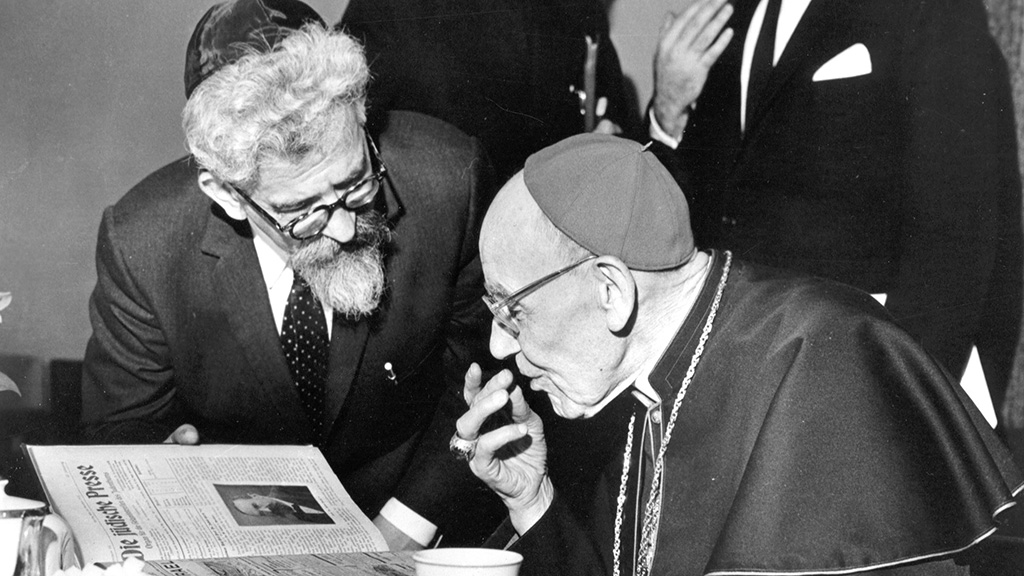
Look first at the two men. They are leaning toward each other across a table, close enough to almost touch foreheads, both bent over an open newspaper between them. The man on the left has a full grey beard, round dark glasses, and a small cap on the back of his head, a yarmulke, the head covering worn by observant Jewish men. The man on the right is older, his face deeply lined, wearing a round skullcap and a heavy robe with a chain and cross on his chest. One of his hands is raised, fingers together, in the middle of making a point. They are working something out.
This is a press photograph, the kind taken by a news agency and printed in newspapers. The two men are Rabbi Abraham Joshua Heschel, one of the most important Jewish thinkers of the twentieth century, and Cardinal Augustin Bea, the German Catholic priest you met a few paragraphs ago, the man Pope John XXIII put in charge of writing the statement that became Nostra Aetate.
The photograph was taken during the years the declaration was being drafted and fought over. Heschel, who taught at the Jewish Theological Seminary in New York, was the main Jewish voice the Vatican consulted while it wrote part four. He met with Bea, sent the Vatican formal memoranda on what the document should and should not say, and pressed hard on one point above all: that the declaration must not call for the conversion of Jews. The newspaper open between them in the picture is Die Jüdische Presse, a Jewish paper, a quiet sign of what the meeting was about.
Here is why this picture matters. Nostra Aetate is usually told as an institutional story: a council, a vote, a pope signing a text. This photograph is the other half of the story. The reversal of a teaching the Church had held for centuries did not happen only in formal sessions. It happened in rooms like this one, in face-to-face conversation between a rabbi and a cardinal who had decided the relationship had to change, not a private friendship, but a negotiation between two communities that had spent most of two thousand years talking past each other. The document was the outcome; the encounter was the work.
The kind of meeting this photograph records, a rabbi and a cardinal sitting down together as equals, became ordinary in the decades that followed, through exactly the dialogue institutions the declaration created. It is one of the few images that shows the human encounter behind the document, and it is reproduced whenever the story of Nostra Aetate is told.
October 28, 1965
October 28, 1965.
The final vote took place on October 28, 1965, in St. Peter's Basilica, during the council's fourth and last session. The declaration passed 2,221 in favor to 88 against, well above the two-thirds needed. Pope Paul VI promulgated it immediately after the vote.
The result carried real weight. The Catholic Church, in formal council with more than 2,300 bishops from around the world, voted by roughly 96 percent to reject the teachings described above and to affirm the continuing election of the Jewish people. A Vatican Council is the highest deliberative body of the Catholic Church, and a document it promulgates carries that authority.
Six decades of partnership
Six decades of partnership.
The sixty years since have produced a steady partnership between the Catholic Church and the major Jewish bodies, built through later official documents, papal acts, and formal dialogue institutions. The major steps:
- The Commission for Religious Relations with the Jews (established 1974), the main Vatican body for the relationship with the Jewish people. It has issued the major follow-up documents: the 1974 Guidelines, the 1985 Notes on preaching and catechesis, the 1998 We Remember: A Reflection on the Shoah, and the 2015 The Gifts and the Calling of God Are Irrevocable.
- The 1985 Notes gave Catholic clergy and teachers practical guidance on how to present Jews and Judaism, the document that turned Nostra Aetate's theology into everyday religious education.
- The 1986 visit of Pope John Paul II to the Great Synagogue of Rome, the first visit of a pope to a Jewish house of worship in modern history. His address used the phrase that has become standard since: "You are our dearly beloved brothers and, in a certain way, it could be said that you are our elder brothers."
- The 1993 Fundamental Agreement between the Holy See and the State of Israel, which established formal diplomatic relations between the Vatican and Israel.
- The 1998 We Remember, the Vatican's reflection on the Holocaust, addressing the relationship between Christian anti-Judaism and Nazi antisemitism and the conduct of the Church during those years. It has drawn ongoing scholarly discussion; note that it is the Vatican's own document and that the conversation about it continues.
- The 2000 visit of Pope John Paul II to Yad Vashem and Jerusalem. His prayer at the Western Wall, asking forgiveness for "the behavior of those who in the course of history have caused these children of yours to suffer," is among the most-cited papal gestures of the postwar era.
- The 2006 visit of Pope Benedict XVI to Auschwitz and the 2014 visit of Pope Francis to Yad Vashem, both continuing the path John Paul II set.
- The 2015 The Gifts and the Calling of God Are Irrevocable, the fiftieth-anniversary document, which states the theology in its fullest official form to date, including that the Church "neither conducts nor supports any specific mission work directed towards Jews", its most explicit rejection of organized efforts to convert Jewish people.
The wider Christian context
The wider Christian context.
The Catholic process was not alone. Major Protestant denominations issued parallel rejections of antisemitic doctrine across the postwar period:
- The Lutheran World Federation (1984) formally rejected the antisemitic elements in Martin Luther's writings, above all his 1543 treatise On the Jews and Their Lies, and committed the Lutheran communion against antisemitism. The 1994 ELCA declaration extended this in the American context.
- The World Council of Churches, in statements from 1948 onward, addressed the theological inheritance of antisemitism; the 1988 Sigtuna Statement is a key reference.
- The United Methodist Church (1996) set out its position in Building New Bridges in Hope, in terms close to the Catholic framework.
- The Presbyterian Church (USA), the Episcopal Church, the United Church of Christ, and other major American mainline bodies adopted parallel statements.
- The Anglican Communion, through the 1988 Lambeth Conference and the 2001 Sharing One Hope statement of the Church of England.
The cumulative effect is that, by the early twenty-first century, every major historic Christian denomination in the Western tradition had formally renounced the antisemitic teachings that had been part of Christian doctrine for centuries.
The Eastern Christian record
The Eastern Christian record.
The Eastern Orthodox churches have not produced a single document like Nostra Aetate. Orthodoxy is structured differently, as a communion of self-governing national churches rather than one body, so its statements on the Jewish people have tended to come as patriarchal statements, conference resolutions, and theological writing rather than council documents.
There has still been real engagement. The Ecumenical Patriarchate of Constantinople has affirmed the rejection of antisemitism, individual Orthodox theologians have contributed to the postwar Christian-Jewish literature, and the 2016 Holy and Great Council of the Orthodox Church in Crete included formulations against antisemitism. The path within Orthodoxy is still developing.
The honest accounting
The honest accounting.
The record above is not the whole story, and saying so plainly is part of the discipline of this Topic. Several questions remain open or contested:
- Implementation varies. The 1985 Notes and the 2015 document have not been put into practice uniformly across every Catholic diocese, education program, or seminary. Some teaching materials still reflect pre-Nostra Aetate framings the official documents have replaced.
- The Holocaust-era conduct of the Church: including Pope Pius XII and the Vatican between 1939 and 1945, remains a subject of active scholarship and debate. The 1998 We Remember made substantive statements; research continues, especially since the Pius XII archives opened in 2020.
- Some traditionalist movements: such as the Society of Saint Pius X, never accepted the council and have kept teaching forms of the older doctrines. They are not in full communion with Rome but remain part of the wider Catholic landscape.
- The wider Christian world includes denominations that have not undertaken comparable reckonings. Evangelical Protestant positions vary widely by group.
- Implementation is ongoing. The 2015 document's statement that the Church does not run organized missionary activity aimed at Jewish people is clear; how individual communities live it out continues to be worked through in the dialogue.
This Topic names these gaps plainly. The reality is a deep postwar rejection of antisemitic doctrine across the major Christian communions, with ongoing implementation, contested historical questions, and continuing dialogue.
What it represents
What Nostra Aetate represents.
Nostra Aetate is, in the historical record, the single most consequential act of theological reversal in modern religious history. The Catholic Church, in formal council with more than 2,300 bishops, voted by roughly 96 percent to reject doctrines that had been part of its teaching for centuries, doctrines that had fed, across the long arc the Evolution of Antisemitism unit traces, the theological and ideological inheritance the Nazi regime turned to its own ends two decades earlier.
This is why the change matters so much. The Catholic Church of 2026 is not the institution of 1933, or of 1555, or of 1215. It is the institution that, in 1965, looked hard at its own long record and changed its course. The partnership built over the six decades since lives in the official documents, the papal acts, and the dialogue institutions the post-Nostra Aetate period created, the record of an old hostility deliberately unlearned.
For the classroom
Where this Topic fits the standards.
- World History, NY Global History 10.10 (Human Rights, Genocide, and the Postwar World). The postwar reshaping of the major Christian bodies (religious freedom, dialogue, and theological reform after the Holocaust) belongs to the postwar global-history unit; Nostra Aetate also anchors a comparative-religion unit (Global History 9.2) on how the Church’s relationship to other faiths developed.
- NYS Holocaust Education Mandate, Education Law §801. The Catholic reckoning with the Holocaust and with the “teaching of contempt”, from Nostra Aetate (1965) through We Remember (1998): is part of the postwar history the mandate supports.
- Common Core RH.11–12.6 & RH.11–12.9. Students analyze the Vatican documents from 1965 to 2015, an unusually rich set for studying how a major institution states and revises its public commitments over time.
- C3 Framework, D2.His.1 & D2.His.14. Students investigate chronology, continuity and change, and evidence-based interpretation while tracing how a religious institution reformed its teaching over decades.
- Classroom Applications. Students can:
- analyze Nostra Aetate as a major primary historical document, in its own words;
- trace institutional change over time, across the 1965–2015 Vatican documents;
- distinguish the declaration’s official statements from their later implementation;
- compare historical continuity with historical change in Church teaching;
- evaluate the declaration’s historical significance through documentary evidence;
- construct evidence-based historical arguments using primary and secondary sources.
- International Classroom Relevance. Because this Topic examines religious change, interfaith dialogue, and institutional reform after the Holocaust, it supports Holocaust education, comparative-religion and world-history courses, civic education, and source-based historical inquiry.
For further classroom use
- Christian-Jewish dialogue curricula. The Topic is built to support the materials of the Council of Centers on Jewish-Christian Relations and the International Council of Christians and Jews.
Learn more · take this further
Verified resources from outside organizations for teachers and students. Where a dedicated classroom resource does not yet exist, The Makor Project is developing one.
Sources
Primary sources come straight from the time: documents, letters, speeches, images, and objects created by the people involved. Secondary sources come later: books, articles, and analysis in which scholars study and interpret those primary sources.
Primary sources
- Pope Paul VI. Nostra Aetate. Declaration on the Relation of the Church to Non-Christian Religions. Second Vatican Council, October 28, 1965. Latin original in Acta Apostolicae Sedis 58 (1966): 740–744.
- Vatican Commission for Religious Relations with the Jews. Guidelines and Suggestions for Implementing the Conciliar Declaration Nostra Aetate. Vatican City, December 1, 1974.
- Vatican Commission for Religious Relations with the Jews. Notes on the Correct Way to Present the Jews and Judaism in Preaching and Catechesis in the Roman Catholic Church. Vatican City, June 24, 1985.
- Vatican Commission for Religious Relations with the Jews. We Remember: A Reflection on the Shoah. Vatican City, March 16, 1998.
- Vatican Commission for Religious Relations with the Jews. "The Gifts and the Calling of God Are Irrevocable" (Rom 11:29). Vatican City, December 10, 2015.
- Lutheran World Federation. Lutheran-Jewish Relations. Geneva: LWF, 1984.
- Evangelical Lutheran Church in America. Declaration of the ELCA to the Jewish Community. April 18, 1994.
- United Methodist Church. Building New Bridges in Hope: A Resolution on Christian-Jewish Relations. General Conference, 1996.
- Pope John Paul II. Address at the Western Wall, Jerusalem, March 26, 2000. Vatican archive of papal addresses.
- Pope Benedict XVI. Address at Auschwitz-Birkenau, May 28, 2006.
- Pope Francis. Address at Yad Vashem, May 26, 2014.
Secondary sources
- Connelly, John. From Enemy to Brother: The Revolution in Catholic Teaching on the Jews, 1933–1965. Cambridge, MA: Harvard University Press, 2012.
- Isaac, Jules. The Teaching of Contempt (L'enseignement du mépris). Paris: Fasquelle, 1962. English translation New York: Holt, Rinehart and Winston, 1964.
- Alberigo, Giuseppe, ed., and Joseph A. Komonchak, English ed. History of Vatican II. 5 vols. Maryknoll, NY: Orbis, 1995–2006.
- Velati, Mauro. Dialogo e rinnovamento: Verbali e testi del segretariato per l'unità dei cristiani nella preparazione del concilio Vaticano II. Bologna: Il Mulino, 2011.
- Phayer, Michael. The Catholic Church and the Holocaust, 1930–1965. Bloomington: Indiana University Press, 2000.
- Kertzer, David I. The Popes Against the Jews: The Vatican's Role in the Rise of Modern Antisemitism. New York: Knopf, 2001.
- Cunningham, Philip A., Norbert J. Hofmann, and Joseph Sievers, eds. The Catholic Church and the Jewish People: Recent Reflections from Rome. New York: Fordham University Press, 2007.
- Boys, Mary C. Has God Only One Blessing? Judaism as a Source of Christian Self-Understanding. New York: Paulist Press, 2000.
- The Council of Centers on Jewish-Christian Relations · ccjr.us →
- International Council of Christians and Jews · iccj.org →
- Center for Christian-Jewish Learning, Boston College · bc.edu/ccjl →
Finding these documents: many primary sources are free online. Good places to start are the Fordham Internet Jewish History Sourcebook, Yale’s Avalon Project (law and diplomacy), German History in Documents, the collections of the US Holocaust Memorial Museum and Yad Vashem, the National Library of Israel, and Sefaria (for Jewish texts). Search the document’s name and date.
Holocaust denial and distortion: what they are, where they came from, how to recognize them, and how the historical record is defended.
Comments?
Write to editor@makorproject.org.
Last updated: August 2026.