Postwar Restitution
"In the name of the German people, unspeakable crimes have been committed which call for moral and material compensation."
, Chancellor Konrad Adenauer, address to the Bundestag, 27 September 1951 · Read the source (German Federal Foreign Office) →
Why this Topic exists
The accountability that came after.
The standard Holocaust unit ends where the killing ends. Makor's second petition, The Holocaust Needs a Continuation, is about what comes next. The previous Topic, Liberation and the Displaced Persons, follows the survivors out of the camps. This one follows the money. But it follows much more than money. It traces the decades-long effort to restore property, businesses, works of art, religious objects, savings, pensions, forced-labor wages, and legal rights after the greatest organized theft in modern history. Together these efforts became known as restitution.
The answer is one of the largest and longest-running restitution efforts in modern history. About ninety billion dollars has been paid, through binding treaties, court judgments, audited settlements, and programs that are still running. The record is uncontested and exact. The payments themselves did not erase the losses. They reveal instead how governments, courts, financial institutions, and museums spent decades attempting to address crimes that could never be fully repaired. And it raises the question Petition 2 puts plainly: if students learn that roughly six million European Jews were murdered, but never learn that West Germany, Austria, Swiss banks, German industry, and much of postwar Europe spent more than seventy years paying for it, and are paying still, they have been taught the crime without the response to it. This Topic supplies the response.
Common misconceptions this Topic addresses
The restitution story (the 1952 Luxembourg Agreement, the Claims Conference, the roughly $90 billion paid across seven decades) is a documented record the standard curriculum treats only in passing. Three points students often get wrong:
- "Holocaust restitution closed the chapter on Nazi-era harms." See the correction →
- "The 1952 Luxembourg Agreement was a quiet diplomatic settlement." See the correction →
- "The Holocaust ended on V-E Day, May 8, 1945." See the correction →
A question with no precedent
What was owed, and to whom?
The problem the postwar settlements had to solve had never been solved before. The Nazi regime had murdered about six million Jews, worked roughly twelve million people as forced and slave laborers across the Reich (Jewish, Roma, Polish, Soviet POW, and others) seized property across occupied Europe, and looted an estimated 600,000 works of art (the figure used by the Claims Conference and the wider scholarship). The destruction ran past anything the existing law of reparations had imagined.
International law at war's end (the Hague Conventions of 1899 and 1907, the treaty framework between sovereign states) covered reparations between warring states for wartime damage. It said nothing about a state compensating a category of its own former citizens (the German-Jewish case), or compensating victims who belonged to no single state at all (the wider European-Jewish case). The innovation was to build a framework that did not yet exist: one recognizing a state's obligation to victims scattered across the countries that took them in, victims who had to be represented by the Jewish people itself.
Three factors made it possible. First, the State of Israel, declared on May 14, 1948, which could negotiate with the new German government on behalf of the survivors who had settled there. Second, the American Jewish community, which supplied the financial and political base for the negotiations. Third, West Germany's own need, sharpened by its Cold War position inside the Western alliance, to show a reckoning with the Nazi past as the price of rejoining the family of nations.
The Claims Conference
A voice for a people scattered across the world.
The Conference on Jewish Material Claims Against Germany, the Claims Conference, was founded in New York City in September 1951 by twenty-three Jewish organizations. Its chairman was Nahum Goldmann (1895–1982), who led both the World Jewish Congress and the World Zionist Organization at once. Its job was to represent the Jewish people Israel could not formally speak for: the global Jewish community outside the new state.
The founding twenty-three spanned the breadth of postwar Jewish life, the American Jewish Committee, the American Jewish Congress, the Joint Distribution Committee, the World Jewish Congress, the Jewish Agency for Israel, the Anti-Defamation League, the Synagogue Council of America, the Council of Jews from Germany, and more. Together they made the Claims Conference the recognized voice of the Jewish people in the negotiations to come.
That work has continued without a break from 1951 to today. The Conference now runs about a dozen separate compensation programs for different categories of survivors, the Article 2 Fund for those who had received nothing from earlier programs, the Hardship Fund for emigrants who left Eastern Europe before 1965, the Special Article 5 Fund, the Child Survivor Fund, and others. Roughly ninety billion dollars has flowed through the Conference and its associated programs since 1952; about three hundred thousand survivors still receive payments in the 2020s. The record is public, in the Conference's annual reports at claimscon.org.
Luxembourg · 1952
The first time a state said: we owe this.
The Luxembourg Agreement (Hebrew Heskem HaShilumim; German Luxemburger Abkommen) was signed in the Luxembourg City Hall on September 10, 1952, quietly, because of the fierce Israeli opposition described below. Three men signed: West German Chancellor Konrad Adenauer, Israeli Foreign Minister Moshe Sharett for the State of Israel, and Nahum Goldmann for the Claims Conference.
What it provided:
To Israel, about 3 billion Deutschmarks (roughly $845 million in 1952, about $9.4 billion in 2025 dollars), to offset the cost of absorbing some 500,000 survivors who had immigrated and of supporting the surviving European Jewish population. It was paid over twelve to fourteen years, mostly in German export goods (machinery, ships, manufactured products) rather than cash.
To the Claims Conference, about 450 million Deutschmarks (roughly $110 million in 1952, about $1.2 billion in 2025 dollars), to compensate Jewish survivors and community organizations outside Israel.
West Germany also committed to pass the Federal Compensation Law for individual survivor claims, covered below.
The agreement mattered far beyond the sums. It was the first time a postwar German government formally acknowledged an obligation to compensate the Jewish victims of the Nazi regime. Adenauer had prepared the ground in his September 27, 1951 address to the Bundestag, accepting that, in the name of the German people, unspeakable crimes had been committed that called for moral and material amends, both for the harm done to individual Jews and for Jewish property left without surviving claimants. The precedent set here, that other European states would, over time, follow Germany in acknowledging their own Nazi-era obligations, runs through every settlement that follows on this page: Austria, Switzerland, France, and the modern architecture all build on Luxembourg.
The Israeli controversy
A nation nearly tore itself apart over whether to take the money.
Inside Israel, the decision to negotiate was bitterly contested. The opposition (led by Menachem Begin's Herut party, heir to Revisionist Zionism and forerunner of today's Likud) argued that taking German money would mean accepting Germany's rehabilitation and putting a price on Jewish lives.
The Knesset debate of January 7–9, 1952, where David Ben-Gurion's government sought authorization to negotiate, became the flashpoint. In his January 7 speech, Begin told the chamber there were fates worse than death, that his people would go with him to die, and that there would be no negotiations with Germany. As he spoke, he urged the crowd outside to march on the Knesset.
The demonstration turned violent. Around 15,000 protesters, organized by Herut and the wider opposition, gathered outside; they threw stones; the building's windows shattered; some 400 demonstrators and police were injured. The Knesset debated under physical siege, the sharpest moment of internal confrontation the young state had faced.
The vote on January 9, 1952 authorized negotiations: 61 in favor, 50 against, 5 abstaining, 4 absent, a close count that measured how deeply the question divided Israeli life. Begin was suspended from the Knesset for fifteen sessions for his part in the riot.
The position shifted with time. The twelve years of German payments became the financial foundation of the early state: Mekorot, the national water company; the Israel Electric Corporation; the Zim shipping line; the railways; much of the country's early infrastructure was built with Luxembourg money. The later scholarship, Tom Segev's The Seventh Million (Hill and Wang, 1993), Ronald Zweig's German Reparations and the Jewish World (Frank Cass, 2001): holds both truths at once: the moral anguish, and the economic lifeline.
The Federal Compensation Law
Reaching the individual survivor · 1953 / 1956 / 1965.
The Luxembourg Agreement paid Israel and the Claims Conference. The German Federal Compensation Law (Bundesentschädigungsgesetz, BEG) reached the individual. First enacted on October 1, 1953, broadened by the supplementary law of June 29, 1956, and completed by the final amendment of September 14, 1965, it remained the main framework for individual claims into the 1990s.
It compensated several kinds of harm: damage to life (payments to the heirs of those killed); damage to health (for survivors with physical or psychological injury from persecution, imprisonment, or forced labor); damage to liberty (for those held in camps, ghettos, or other detention); damage to property (where the property itself could not be returned); and damage to professional and economic advancement (for careers and educations that persecution had cut short).
The scale: about 4.4 million individual claims were processed between 1953 and the 1990s, and roughly 80 billion Deutschmarks (about €40 billion in later currency, about $50 billion in 2025 dollars) was paid out. Most recipients were Jewish survivors; smaller shares went to other victims of the regime: Roma survivors, persecuted members of religious orders, Communists and Social Democrats.
The law's limits are part of the record. Survivors who had emigrated to Soviet-bloc countries were mostly shut out by Cold War politics, and only reached by later programs after 1989. Many with genuine health damage struggled to meet the law's demanding proof requirements. And forced and slave laborers from non-Jewish populations (Soviet POWs, Polish laborers) were mostly excluded, and only compensated decades later through the Foundation treated below.
East Germany · 1990
Forty years of silence, then a settlement.
East Germany (the German Democratic Republic, 1949–1990) stayed out of the restitution system for its entire existence. Its position was that the reparations question had been settled at the 1945 Potsdam Conference (which let the Soviet Union extract reparations from its occupation zone), and that the East German state owed nothing further to Jewish or other victims. The result: across the Cold War, much of the Nazi-era property and harm inside East German territory went uncompensated.
The Treaty on the Final Settlement with Respect to Germany, the "Two Plus Four Treaty," signed in Moscow on September 12, 1990 by the four wartime Allies and the two German states, reunified the country and passed East Germany's obligations to the reunified Federal Republic. That opened the door to the 1990s expansion: compensation for survivors still in Eastern Europe, restitution of Jewish communal property in the former East, and more.
The 1991 Article 2 Agreement between the Claims Conference and Germany put the reunification settlement into practice. The Article 2 Fund pays ongoing monthly pensions to survivors who never received BEG compensation; about 50,000 survivors still draw Article 2 payments in the 2020s.
The Swiss banks · 1998
The dormant accounts, the Nazi gold, the closed border.
The Swiss Banks settlement of August 12, 1998 resolved the wartime conduct of Switzerland's financial institutions. Pressure had been building through the 1990s: the 1995 declassification of U.S. wartime intelligence on Swiss banking, the 1996 firing of Swiss bank security guard Christoph Meili after he exposed a bank destroying Nazi-era account records (a federal crime in Switzerland), and the Volcker Commission investigation begun that year.
Three questions drove it. Dormant accounts: Holocaust victims had deposited assets in Swiss banks before and during the Nazi years, and many of those accounts had been hidden or withheld from heirs; the Volcker Commission's 1999 report found accounts never returned. Nazi gold: the Swiss National Bank's wartime gold trade with the Reich (including gold taken from Jewish victims and from the national banks of Belgium, the Netherlands, and others) was traced by the Bergier Commission (1996–2002). Refugee policy: Switzerland's 1942 closure of its border to Jewish refugees, which sent people back to Nazi capture, was examined in the same Bergier inquiry.
The settlement paid $1.25 billion, from Credit Suisse and the Union Bank of Switzerland (which merged with Swiss Bank Corporation in 1998 to form UBS). It came through class-action litigation in U.S. federal court (the Eastern District of New York, Judge Edward Korman presiding), and was distributed to about 458,000 claimants across five categories between 2001 and 2014. Stuart Eizenstat, the lead U.S. negotiator, told the story in Imperfect Justice (PublicAffairs, 2003).
Washington · 1998
Forty-four nations agree on a rule for looted art.
The Washington Conference on Holocaust-Era Assets, held December 3, 1998 (convening November 30), produced the framework for everything that followed in art restitution. Forty-four nations and thirteen non-governmental organizations took part; the U.S. State Department organized it under Stuart Eizenstat.
Its product was the eleven Washington Principles on Nazi-Confiscated Art, adopted by consensus on December 3, 1998. They call for identifying Nazi-confiscated art that was never returned, opening records and archives, devoting people and resources to finding looted works, tracing prewar owners and their heirs, encouraging those heirs to come forward, publicizing identified works, building a central registry (the seed of the later project at the U.S. National Archives to trace the ERR, the Nazi task force, the Einsatzstab Reichsleiter Rosenberg, that had carried out much of the looting), resolving disputes through alternative means, and setting up commissions to do the work.
The Principles are non-binding (adopted by consensus, not treaty) but they set the standard against which states and museums are now judged. The framework grew with the Vilnius Forum Declaration of October 2000 and the Terezín Declaration of June 2009, signed by 47 nations at the Holocaust Era Assets Conference in Prague and Terezín.
Slave and forced labor · 2000
Compensation for the twelve million.
The German Foundation "Remembrance, Responsibility and Future" (Stiftung "Erinnerung, Verantwortung und Zukunft", EVZ) was created by federal law on August 2, 2000 to compensate survivors of Nazi forced and slave labor, a group the BEG had never adequately reached, especially the non-Jewish laborers from Poland, the Soviet Union, Ukraine, and the rest of Eastern Europe.
It was endowed with €5.2 billion (10 billion Deutschmarks before the 2002 euro switch), split evenly between the German federal government and the German companies that had used forced and slave labor. About 6,500 firms contributed through the German Economic Foundation Initiative. Between August 2001 and the main distribution's close in June 2007, roughly 1.66 million surviving laborers in about 100 countries were paid: slave laborers (survivors of concentration-camp labor) up to €7,669, forced laborers (those deported to labor outside the camp system) up to €2,556, with smaller categories paid proportionally.
Its meaning ran beyond the money. German industry's acknowledgment of its own conduct (IG Farben's use of Auschwitz inmates, the wartime forced labor at Daimler-Benz, Volkswagen, Siemens, BMW, Krupp, and across the industrial base) was the private sector's public reckoning, traced in scholarship such as Peter Hayes's Industry and Ideology: IG Farben in the Nazi Era (Cambridge, 1987).
Austria · 2001
The reckoning that arrived half a century late.
Austria spent decades behind a single idea: that it had been Hitler's "first victim." The phrase came from the Allies' own 1943 Moscow Declaration, which called Austria the first free country to fall to Nazi aggression, and Austria leaned on it through the postwar era to stay out of the restitution system. The scholarship (Robert Knight, Bertrand Perz, and the wider reckoning that gathered pace after the 1986 Waldheim presidential controversy) has dismantled that self-image.
The General Settlement Fund Law (Allgemeines Entschädigungsfondsgesetz) of January 17, 2001 was Austria's answer. It endowed $210 million for property claims, liquidated businesses, real estate taken from Jewish owners and never returned, household property, and the range of Austrian-Jewish losses from 1938–45. About 19,300 claims were filed in 2001–2003, with distribution running 2005–2015.
The Washington Agreement of January 17, 2001 between Austria and the United States framed the settlement. Other Austrian programs followed: the National Fund of the Republic of Austria for Victims of National Socialism (founded 1995, expanded in 2001) and the Austrian Reconciliation Fund, Austria's counterpart to the German EVZ, for forced and slave laborers.
Looted art
The piece of the reckoning that is still unfinished.
Art is the most unresolved part of the whole architecture. The estimate is that about 600,000 works were looted by the Nazi regime (paintings, drawings, sculpture, books, manuscripts, ceremonial objects) and that roughly 100,000 remain unaccounted for, sitting in museum and private collections and public archives. The 1998 Washington Principles set the rule; enforcement has been uneven.
A few cases shaped the field. In Republic of Austria v. Altmann (U.S. Supreme Court, June 7, 2004), the Court let Maria Altmann, heir of Adele and Ferdinand Bloch-Bauer, owners of Gustav Klimt's Portrait of Adele Bloch-Bauer I ("Woman in Gold," 1907) and four other Klimts, pursue her claim against Austria in U.S. court; an Austrian arbitration panel awarded her the five paintings on January 16, 2006. The story reached a wide audience through the 2015 film Woman in Gold. The Gurlitt case (2012–2014): about 1,500 works found in the Munich apartment of Cornelius Gurlitt, son of the Nazi-era dealer Hildebrand Gurlitt, led to a German task force in 2013 and the return of roughly fifteen works to identified heirs. Standing bodies now carry the work: Germany's Limbach Commission (established 2003), the UK's Looted Art Commission (2000), the Dutch Restitutions Committee, and France's CIVS.
Much of it remains undone. The commissions still sit; major museums are still researching the provenance of their holdings, tracing where each work came from and who owned it before the war; the work will run for decades more.
Further reference · Provenance research
The work of identifying looted works and returning them is ongoing, and much of it is public. These projects let students and teachers see the research as it happens.
- The Central Registry of Information on Looted Cultural Property 1933–1945: a searchable database of looted and recovered objects, claims, and the laws and reports that govern restitution. lootedart.com →
- Claims Conference, Provenance Research in U.S. Museums: an overview of how American museums research the wartime histories of works in their collections. art.claimscon.org →
- The Metropolitan Museum of Art, Nazi-Era Provenance Research: one major museum's account of how it investigates and publishes the histories of works that changed hands between 1933 and 1945. metmuseum.org →
- The Museum of Modern Art, Provenance Research Project: MoMA's published findings on works in its collection with gaps in their wartime ownership history. moma.org →
- U.S. National Archives: holds the federal records of looted assets and Nazi-era art. Search the catalog for "Holocaust-era assets" or "Nazi looted art." archives.gov →
Object Spotlight
Adriaen van Ostade, Customers Conversing in a Tavern, 1671.
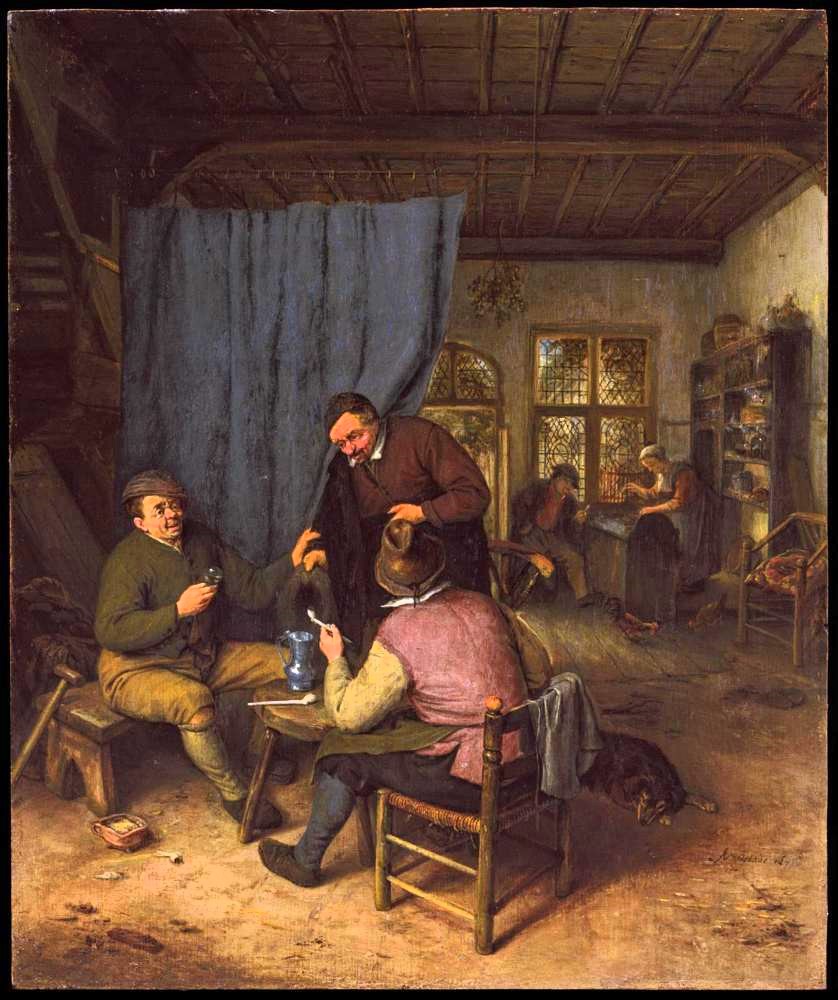
A small tavern scene, less than a foot and a half tall, is one of the clearest examples the looted-art reckoning has to show. By 1937 it belonged to Paul Graupe, a Jewish art dealer in Paris; his partner Arthur Goldschmidt was Jewish too. Both had already been forced out of Nazi Germany. When the Paris gallery closed in 1940, the painting went into storage, and as Graupe fled Europe he asked Goldschmidt to save what he could.
It was not saved. In February 1941 it was sold to Karl Haberstock, an agent buying for Hitler, and in April it entered the Reich Chancellery, picked for the museum Hitler planned to build in Linz. Allied forces recovered it in 1945 and shipped it to France for return. No one claimed it; in 1951 the French state auctioned it off. It changed hands for decades, bought in 1992 by collectors who had no idea what they held, until research traced the gap and, in 2023, the museum and the heirs of Graupe and Goldschmidt reached a settlement.
Read the panel itself: nothing in the picture is about the Holocaust. The whole history lives in its provenance, the record of who owned it, when, and how it changed hands. That is what the 1998 Washington Principles asked museums to make public, and why a seventeenth-century tavern scene became evidence in a twenty-first-century reckoning. About 100,000 looted works are still unaccounted for; most of them have no such record yet.
The work continues
What is still active in the 2020s.
This is not closed history. Survivor compensation: about 300,000 survivors still receive monthly payments through the Claims Conference, the German government, and related programs (chiefly the Article 2, Hardship, and Child Survivor funds) at roughly $400–500 million a year. Property claims: these are still filed across Europe, especially in Poland (where the framework remains contested), the Czech Republic, and Hungary, where postwar Communist governments had nationalized Jewish property. Art: the Washington Principles keep producing returns, and provenance research continues in museums across Europe and North America. Communal property: synagogues, schools, cemeteries, and community buildings across the former Nazi-occupied lands remain mostly unreturned, pursued by the World Jewish Restitution Organization (founded 1992). Documentation: the archives at USHMM, Yad Vashem, and elsewhere, and the scholarship, keep growing.
The totals
What was paid, across seventy-plus years.
No single payment covered everything. The money came instead in separate settlements, each answering a different piece of the crime, one for the survivors who reached Israel, one for individual claims, one for slave labor, one for the Swiss banks, and others. Added together, in 2025 dollars where the figures allow, the record looks like this:
- West Germany, Luxembourg Agreement (1953–1965): about $9.4 billion.
- West Germany, BEG individual compensation (1953–1990s): about $50 billion across roughly 4.4 million claims.
- Germany, Article 2 Fund and post-1990 Claims Conference programs: about $20 billion.
- Foundation "Remembrance, Responsibility and Future" (2000–2007): €5.2 billion (~$7.5 billion) to about 1.66 million laborers.
- Swiss Banks settlement (1998): $1.25 billion to about 458,000 claimants.
- Austrian General Settlement (2001): $210 million, with other Austrian programs totaling about $1 billion.
- French banking settlement (2000): about $480 million.
- Insurance settlements (through ICHEIC, established 1998): about $300 million.
The estimated total: about $90 billion, paid to roughly 2–3 million people (survivors and surviving heirs) across more than seventy years. It is the largest postwar reckoning of its kind in the history of nations. It was never offered as a substitute for the harm; no payment could be. It was a partial, material acknowledgment of losses beyond repair. The record is exact and complete, and the standard curriculum still passes it by.
What remains contested
The honest accounting.
The scholarship treats several questions as open, and so does this Topic.
The 1952 Israeli question. The opposition Begin led has been weighed ever since. The retrospective consensus is that accepting the agreement was decisive for the early state's economy, but the moral question he raised, whether a financial settlement truly serves memory and accountability, has never fully closed.
The Austrian "first victim" question. Austria's long self-presentation as a victim, eroded by the Waldheim controversy of 1986 and the reckoning that followed, is now widely rejected by historians. The 2001 settlement marked the turn away from it.
The adequacy question. Whether the totals matched the harm: the scholarly view is that the sums were large as fact but could never restore what was lost, and were never meant to. How to design such settlements for harms of comparable scale elsewhere remains an open problem.
The "Holocaust industry" charge. Norman Finkelstein's The Holocaust Industry (Verso, 2000) attacked the Claims Conference and the wider system as corrupt. It drew a sharp scholarly response, including from Israel Singer and others, that rejected its central claims while taking seriously the real questions about administrative costs and transparency that every large compensation program faces. The Conference's transparency reforms across the 2010s and 2020s addressed those procedural points; Finkelstein's broader framing has not been adopted in the scholarship.
The communal property question. How to return Jewish communal property (especially in Poland and across Eastern Europe, where Communist governments nationalized it) is still unsettled. Poland's stance has been contested across the post-1989 period, and the work goes on.
Key takeaways
- "Restitution" is the financial and material reckoning for the Holocaust, payments, returned property, and pensions for the murders, the slave and forced labor, the stolen property, and the destroyed culture.
- It is one of the largest and longest-running restitution efforts in modern history: about ninety billion dollars paid across more than seven decades, through binding treaties, court judgments, audited settlements, and programs still running today.
- The problem had no legal precedent. Existing international law covered reparations between warring states, not a state compensating a category of its own former citizens, or victims belonging to no single state at all. The framework had to be invented.
- The milestones run from the 1952 Luxembourg Agreement and the Claims Conference through the Federal Compensation Law, the 1990 reunification settlement, the 1998 Swiss banks settlement and Washington Conference, the 2000 slave-and-forced-labor fund, and the ongoing return of looted art.
- Petition 2, The Holocaust Needs a Continuation, turns on this: to teach that six million were murdered but not that much of postwar Europe spent seventy years paying for it is to teach the crime without the response.
For the classroom
Where this Topic fits the standards.
- World History, NY Global History 10.10 (Human Rights, Genocide, and the Postwar World). The Luxembourg Agreement, the BEG, the 1990 reunification settlement, the Swiss-banks and slave-labor settlements, and the Washington Principles are core postwar history, the largest accountability framework ever built between nations.
- NYS Holocaust Education Mandate, Education Law §801. Postwar restitution is exactly the content the mandate supports, and the gap Petition 2, The Holocaust Needs a Continuation, asks schools to close.
- Common Core RH.11–12.6 & RH.11–12.9. Students analyze the Luxembourg Agreement, the BEG and its amendments, the Washington Principles, the Volcker and Bergier reports, and the Eizenstat memoir while evaluating perspective, purpose, and corroboration across primary sources.
- C3 Framework, D2.His.1 & D2.His.14. Students investigate chronology, causation, continuity and change, and evidence-based interpretation while examining how nations and institutions built accountability over decades.
- Classroom Applications. Students can:
- trace the provenance and ownership of looted property and art;
- weigh the ethics and the limits of financial repair;
- compare national and institutional responses (West Germany, Austria, Swiss banks, German industry, U.S.-brokered settlements);
- analyze treaties, audited settlements, and restitution programs as primary sources;
- evaluate why money alone is an incomplete form of accountability;
- construct evidence-based arguments using primary and secondary sources.
- International Classroom Relevance. Because this Topic examines reparations, transitional justice, looted-art restitution, and cross-border accountability, it supports Holocaust education, human-rights and legal education, museum and provenance studies, and source-based historical inquiry.
For further classroom use
- For teachers.the Claims Conference (claimscon.org) carries extensive documentation; USHMM's online encyclopedia and Yad Vashem's resources both cover postwar restitution; the Claims Conference annual reports are public.
- The petitions. This Topic supports the content of Petition 2: The Holocaust Needs a Continuation.
Questions for discussion
These questions ask students to work from the evidence on this page and reach their own conclusions. Each is anchored in a specific fact the Topic documents.
- The page argues that teaching the six million murders without teaching the seventy-year, ~$90 billion reckoning means students learn "the crime without the response." Do you agree that the response is part of the history that should be taught? What is lost when only the crime is covered?
- International law at the war's end had no framework for a state compensating a category of its own former citizens, or victims who belonged to no single state. How do you build a system of accountability for a harm that existing law never imagined, and who gets to represent victims scattered across many countries?
- The page notes the 1952 Luxembourg Agreement was deeply controversial in Israel, not a quiet diplomatic settlement. Why might accepting payment from the perpetrator state be painful or divisive for survivors and their community, even when the need was real?
- Restitution came in many forms over decades, treaties, court judgments, audited bank settlements, industry funds, the return of looted art. Why might money alone be an incomplete form of accountability, and what can returned property or art do that a payment cannot?
- The page calls this "one of the largest and longest-running restitution efforts in modern history," and says the record is uncontested and exact. Test the equal-treatment standard: is this documented aftermath given the same curricular weight as the events that made it necessary? Why might the response be taught less than the crime?
Makor Classroom Companion
Grades 7–8, Coming Soon
A printable classroom chapter designed specifically for middle school learners, including:
- teacher guide
- vocabulary support
- primary source activities
- discussion questions
- classroom worksheets
- standards-aligned instructional materials
- assessment suggestions
The Companion supplements this Topic with developmentally appropriate classroom materials while preserving the full historical content of the primary page.
Sources and citations
Primary sources come straight from the time: documents, letters, speeches, images, and objects created by the people involved. Secondary sources come later: books, articles, and analysis in which scholars study and interpret those primary sources.
Primary sources
- The Volcker Commission. Report on Dormant Accounts of Victims of Nazi Persecution in Swiss Banks. Bern: Independent Committee of Eminent Persons, 1999.
- The Bergier Commission. Switzerland, National Socialism and the Second World War: Final Report. Zurich: Pendo, 2002.
- The Luxembourg Agreement (September 10, 1952): full text via the Israel Ministry of Foreign Affairs archives and the German Federal Foreign Office.
- Adenauer's Bundestag address, 27 September 1951, German Federal Foreign Office. auswaertiges-amt.de →
- The Washington Principles on Nazi-Confiscated Art (December 3, 1998): U.S. State Department.
- The Terezín Declaration on Holocaust Era Assets and Related Issues (June 30, 2009).
Secondary sources
- Goschler, Constantin. Compensation in Practice: The Foundation 'Remembrance, Responsibility, and Future' and the Legacy of Forced Labour during the Third Reich. New York: Berghahn Books, 2017.
- Marrus, Michael R. Some Measure of Justice: The Holocaust Era Restitution Campaign of the 1990s. Madison: University of Wisconsin Press, 2009.
- Zweig, Ronald W. German Reparations and the Jewish World: A History of the Claims Conference. London: Frank Cass, 2nd ed. 2001.
- Eizenstat, Stuart E. Imperfect Justice: Looted Assets, Slave Labor, and the Unfinished Business of World War II. New York: PublicAffairs, 2003.
- Segev, Tom. The Seventh Million: The Israelis and the Holocaust. New York: Hill and Wang, 1993.
- Authers, John, and Richard Wolffe. The Victim's Fortune: Inside the Epic Battle Over the Debts of the Holocaust. New York: HarperCollins, 2002.
- Bazyler, Michael J. Holocaust Justice: The Battle for Restitution in America's Courts. New York: New York University Press, 2003.
- Bazyler, Michael J., and Roger P. Alford, eds. Holocaust Restitution: Perspectives on the Litigation and Its Legacy. New York: New York University Press, 2006.
- Petropoulos, Jonathan. The Faustian Bargain: The Art World in Nazi Germany. New York: Oxford University Press, 2000.
- Nicholas, Lynn H. The Rape of Europa: The Fate of Europe's Treasures in the Third Reich and the Second World War. New York: Alfred A. Knopf, 1994.
- Edsel, Robert M., with Bret Witter. The Monuments Men: Allied Heroes, Nazi Thieves, and the Greatest Treasure Hunt in History. New York: Center Street, 2009.
- Hayes, Peter. Industry and Ideology: IG Farben in the Nazi Era. Cambridge: Cambridge University Press, 1987.
- Conference on Jewish Material Claims Against Germany. claimscon.org →, annual reports, program documentation, and the broader record.
- The World Jewish Restitution Organization. wjro.org.il →
- USHMM Holocaust Encyclopedia · Postwar Restitution. encyclopedia.ushmm.org →
- Yad Vashem · The Aftermath of the Holocaust. yadvashem.org →
- The German Foundation "Remembrance, Responsibility and Future" (EVZ). stiftung-evz.de →
Finding these documents: many primary sources are free online. Good places to start are the Fordham Internet Jewish History Sourcebook, Yale’s Avalon Project (law and diplomacy), German History in Documents, the collections of the US Holocaust Memorial Museum and Yad Vashem, the National Library of Israel, and Sefaria (for Jewish texts). Search the document’s name and date.
Comments?
Write to editor@makorproject.org. Last updated: August 2026. Makor is the Hebrew word for source.
How the world built its memory of the Holocaust: Yad Vashem, the U.S.
Comments?
Write to editor@makorproject.org.
Last updated: August 2026.