The Afterlife of the Image
On the outside wall of a working church in Germany, figures labeled as Jews are carved nursing from a pig, the animal Judaism holds unclean. It was put there around 1305 to humiliate, on the church where Martin Luther later preached. It has weathered seven hundred years of rain. It is still there.
Why this Topic exists
A hateful object can also be a historical document.
Most of these Units deal with hatred as something that happened, a charge made, a law passed, a community uprooted. This Topic deals with what hatred leaves behind in stone. It turns on a question with no comfortable answer: what should a society do with an object built to degrade a living people, when that same object is also evidence of how the degrading was done?
The question is not abstract. Across Germany, and in a few places beyond it, medieval carvings made to insult Jews are still fixed to the outsides of churches, not in museums, but on buildings people still use. Some have stood for seven hundred years. In the past few decades, communities and courts have had to decide whether they stay, come down, or stay with something added to answer them. Watching how that decision gets made is one of the clearest ways to think about a problem every society eventually faces: what to do with the monuments a later age comes to find shameful.
Two objects, one purpose
Contempt in two registers.
Medieval Christian art found more than one way to put Jews in their place on the walls of churches, where nearly everyone could see them and almost no one could read the theological arguments behind them. Two kinds of image did the work, and both survive.
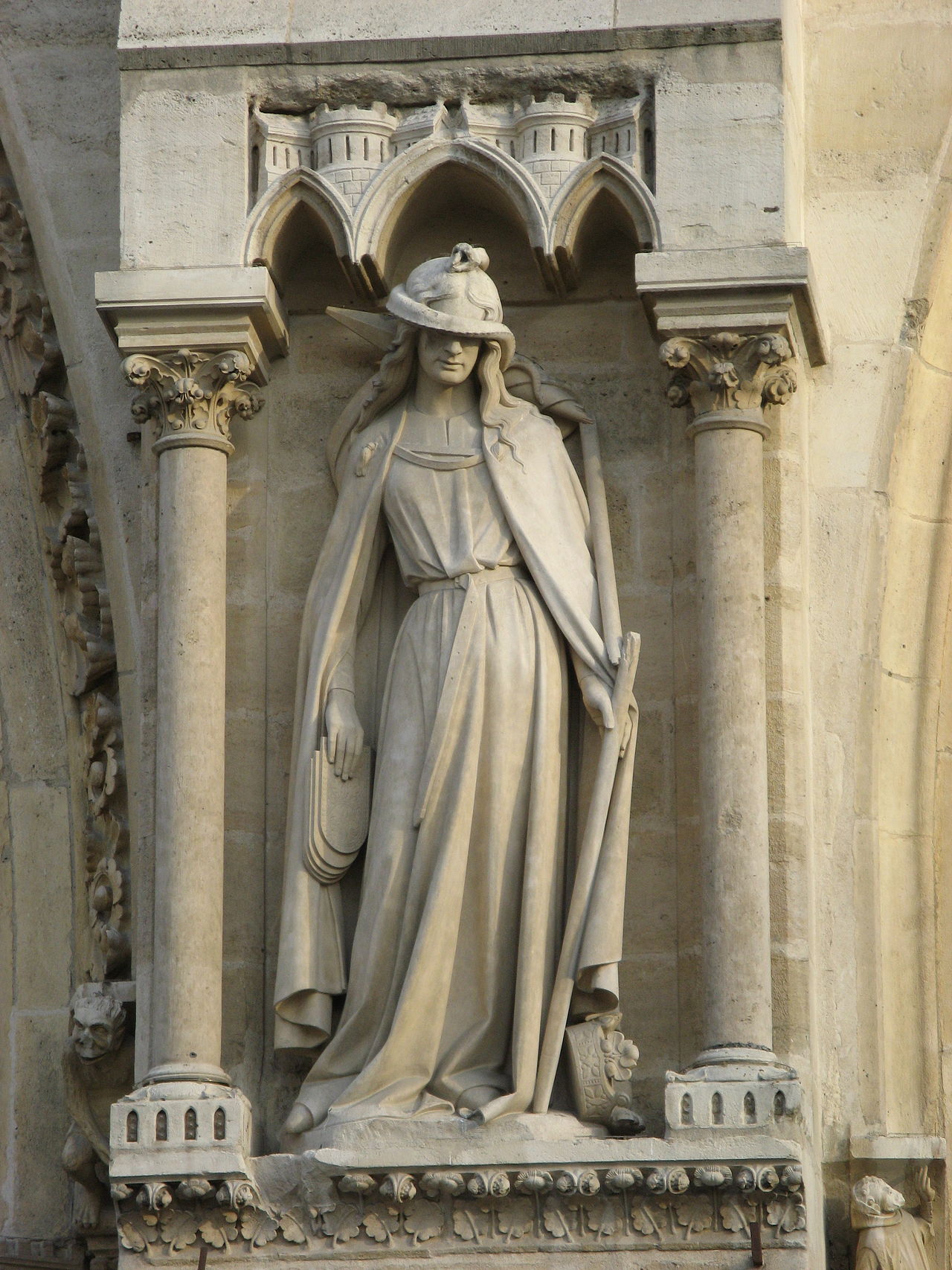
The first register is dignified cruelty. In the Ecclesia and Synagoga pairing, two graceful female figures stand on either side of a church doorway: Ecclesia, the Church, upright and crowned; Synagoga, Judaism, her eyes covered, her staff broken, the tablets of the law slipping from her hand. How that blindness is shown carries its own meaning. At some cathedrals it is a simple cloth blindfold, a passive failure to see. At Notre-Dame de Paris, shown here, it is a serpent coiled across her eyes: a sharper charge, tying her to the serpent of the Garden of Eden and suggesting she was actively led astray rather than merely left in the dark. The message is delivered through beauty, the Jew is not monstrous here, only superseded, too blind to see a truth she is meant to have missed. This is the same supersessionist claim treated in the Unit 3 Topic on Adversus Judaeos: the Church as successor, the synagogue as the superseded predecessor.
These paired figures were carved across medieval Europe, and they survive today in varying conditions. Some still stand where they were placed, on the façades of working cathedrals. Others, fragile after centuries of weather, have been moved indoors into museums or church interiors to protect them, with weather-resistant copies set in their original outdoor places. And some did not survive at all, lost or damaged over the centuries, including during the destruction of the Second World War, and in places replaced by later restorations on the original cathedral fronts.
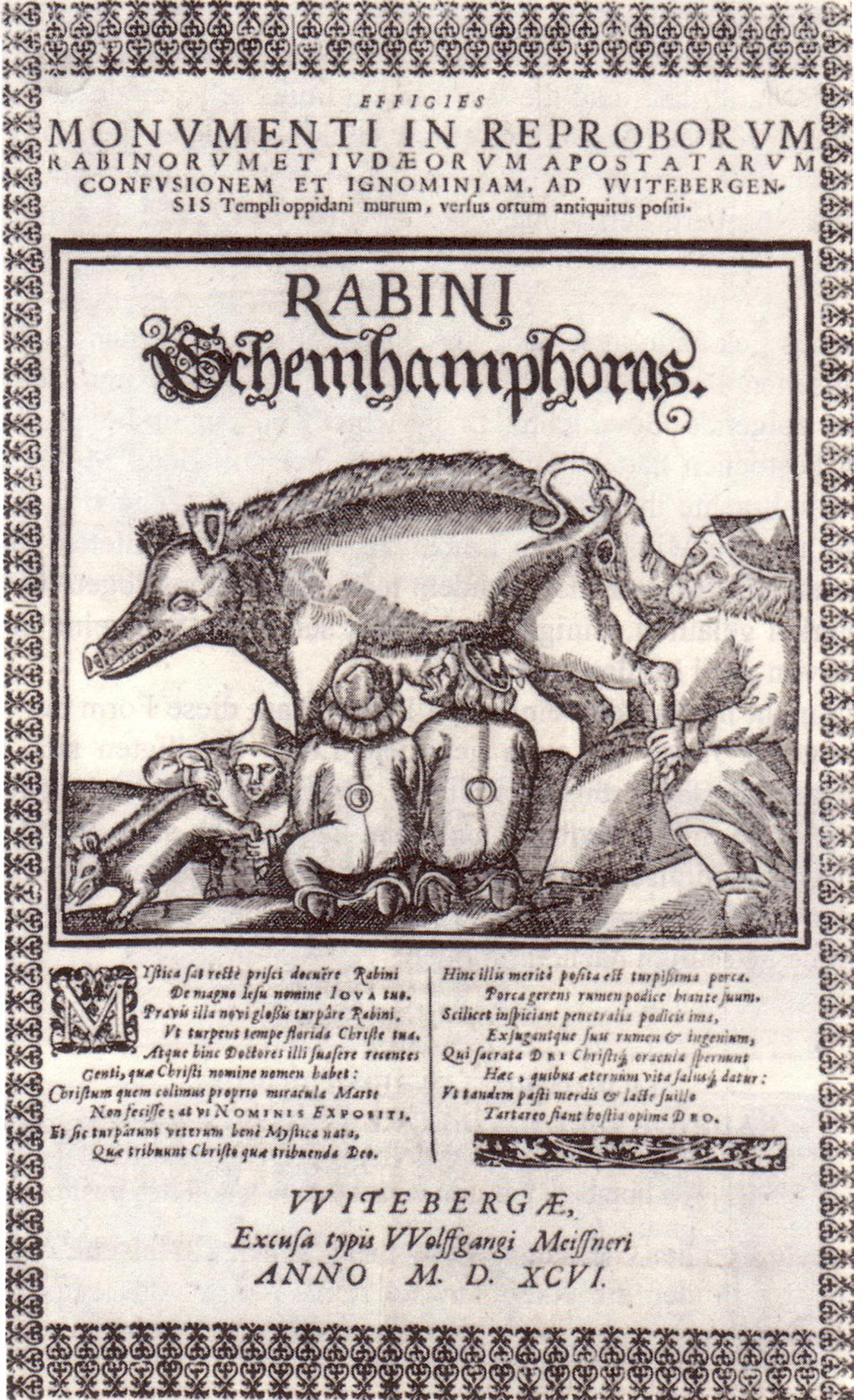
The second register drops the dignity entirely. The Judensau, literally “Jew’s sow”, shows Jews in degrading contact with a pig, the animal their own law forbids. There is no theology to decode; the point is open contempt, aimed at the gut. Where Ecclesia and Synagoga made the argument through idealized subjection, the Judensau made it through disgust. Both reached the people who could not read. Both were teaching tools, repeated until the lesson felt like common sense.
Where they still are
Most of them never came down.
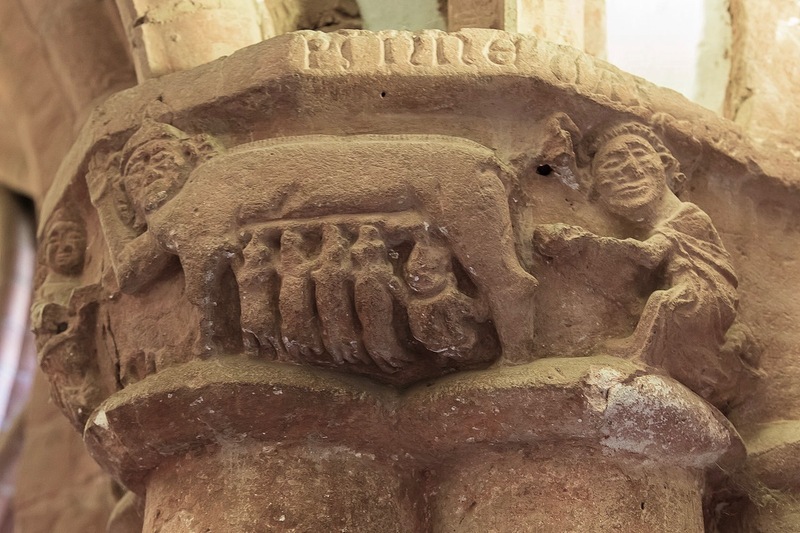
These are not images known only from old books. By most counts, somewhere between thirty and forty Judensau carvings still survive on churches across Germany, with a small number elsewhere in central Europe. Most were carved between the 1200s and the 1500s, and most are still in place, some on exterior walls, like Wittenberg; others inside, carved into columns and cloisters, like the example at Brandenburg Cathedral below.
The Ecclesia-Synagoga figures, too, still stand on cathedral fronts across Europe, the Notre-Dame pair in Paris among the best known. They are read now not as a truth-claim but as evidence of how an idea was taught to the eye, over and over, for centuries. The Wittenberg Judensau is the most argued-over of all of them, partly because of where it is: on the church most closely tied to Martin Luther, whose own later writings against the Jews were drawn on by the Nazis four centuries later.
The knot
Two truths, pulling in opposite directions.
The difficulty is that the carving works two ways at once, and both are real. It is an act of defamation against a living people, the same contempt that, over centuries, helped license real violence. And it is evidence: physical proof, fixed in stone, of how ordinary antisemitism was built and repeated, in a form that reached people who could read nothing.
Remove it, and you take down a standing insult. Remove it, and you also lose the evidence, the proof that this was taught, here, in public, for centuries. Keep it, and the evidence survives. Keep it, and so does the insult. There is no move that does only good. That is what makes it worth bringing into a classroom: it is a problem with no clean answer, only a choice about which loss to accept.
There is one more question the stone cannot settle. These carvings were made to fix the Jews of Europe in contempt forever, to put their inferiority literally in writing, on the most permanent surface a town had. Seven centuries on, the carvings are still on the walls. So are the Jewish people they were meant to wipe out. The stone outlived its makers; the people outlived the stone. Whatever a community decides to do with the object, that is the fact standing underneath the whole debate.
Object Spotlight
The Wittenberg Judensau, on the wall, today.
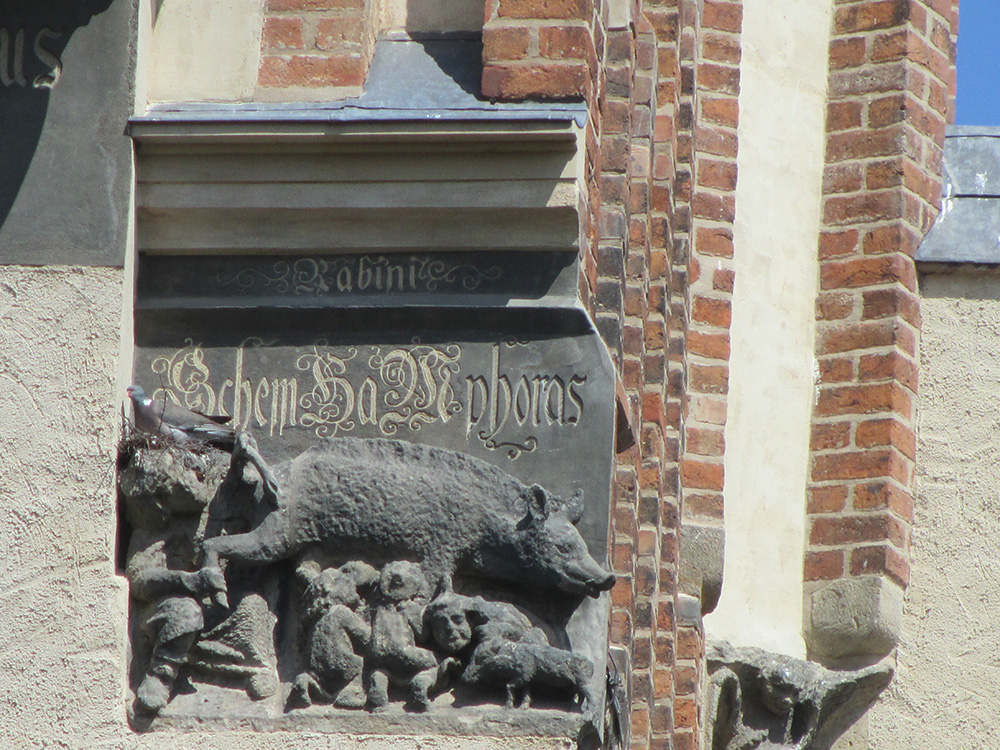
Describe what you see. A blackened sandstone carving juts from a brick church wall. A large sow stands in the center; beneath and around it are several small human figures in contorted poses. Above the carving, set into the stonework, a band of gold Gothic lettering reads “Schem HaMphoras.” A pigeon has made a nest on the carving’s left edge. The whole carving is weathered, streaked, and plainly outdoors, part of the building, not a display.
What it is. It is a Judensau, a medieval relief made to associate Jews with a pig, the animal their law holds unclean. This one dates to about 1305. It was carved into the exterior of the town church of Wittenberg, where it has remained, through every century since, in full public view.
When and where, and who added to it. The carving is medieval; the gold inscription above it is not. “Schem HaMphoras” refers to a 1543 tract by Martin Luther, who preached in this church and whose later writings turned violently against the Jews. The inscription was added to mock a Hebrew term for the name of God. So the object has layers: a 1300s carving, a 1500s inscription tying it to Luther, and, out of frame, a 1988 memorial on the ground below, answering both.
Why it matters. This single wall holds the whole problem of the Topic. The carving is a defamation; it is also the best surviving evidence of how casual, public, and architectural medieval antisemitism could be. Whether it should stay went all the way to Germany’s highest civil court, which let it remain, because of the memorial added beneath it. Standing in front of it, you are looking at the debate itself, frozen on a wall.
Look closer. The pigeon is the accidental detail that says the most. The carving was meant to fix the Jews of Wittenberg in contempt forever. Seven hundred years on, it is weathered nearly smooth, a bird nests on it, and the people it was meant to degrade are not the ones who have to explain it, the church that displays it is. The object outlived its purpose without ever quite losing its sting.
Afterlife. The carving never came down. It was printed and spread as an engraving in 1596, reaching far past the one wall, and centuries later a memorial and an explanation were set into the ground beneath it. Whether that was enough to let it remain, and what a court eventually made of the question, is where this Topic turns next. It remains today what it has been the whole time: an object made to wound, now forced to testify against itself.
The debate
Two cases, each made in good faith.
Both of the arguments below are made by serious people, including within the Jewish community. Read each as the strongest version of itself.
Take it down
A church is not a museum. It is a living place of worship. A carving made to degrade Jews has no business on its walls in the twenty-first century, least of all in Germany, and least of all on a building tied to Luther, whose writings against the Jews the Nazis later used. Leaving it up, even with a sign nearby, still means a defamation of a living people is permanently displayed on a sacred building. A small plaque on the ground does not cancel a carving four meters overhead; most people who pass will see the insult and never read the answer. The honest place for such an object is inside a museum, labeled and behind glass, not weathering on a wall where it was placed to wound. To keep it in place is to decide that heritage matters more than the dignity of the people it targets.
Keep it, and confront it
Tearing the carving off the wall does not undo the history; it hides it. The strongest move a society can make is to leave the evidence in place and force itself to reckon with it, to stand beneath the object, in public, and say: this happened here, and it was wrong. An empty patch of wall teaches nothing and comforts everyone. A carving with a memorial and a plain explanation set beneath it teaches the whole truth: the hatred, and a later generation’s judgment of that hatred. Removal also risks a quiet forgetting, the easy sense that such images are safely behind us. Better to keep the wound visible, name it honestly, and let the object testify against the very idea it was built to spread.
How Wittenberg was decided
Not “take it down,” not “leave it alone”, a third option.
This argument has been to court. A Jewish member of the Wittenberg congregation sued to have the carving removed. German courts, up to the Federal Court of Justice in 2022, declined to order it taken down, but the reasoning is the part that matters. The carving, the court found, was no longer a standalone insult, because of what had been added around it: a memorial and an explanatory text were later set into the ground beneath it. The court treated the object and its added context as a single whole, an indictment of the hatred rather than an endorsement of it.
In other words, the resolution was neither of the two clean options. It was a third: leave it up, but never let it stand unanswered. Whether that is courage or compromise is exactly the question to put to a class.
The same question, elsewhere
Every society eventually faces this.
Wittenberg is one case of a problem that keeps returning: what to do with a public monument that a later generation comes to see as shameful. The specifics differ, but the menu of choices is short and always the same, remove it, relocate it, or keep it and add the truth around it.
- Denazification. After 1945, occupied Germany systematically stripped Nazi symbols, monuments, and street names from public space, a society-wide decision that some objects do not belong on display at all.
- Toppled regimes. After the fall of the Soviet Union and the Eastern Bloc, many countries pulled down statues of Lenin, Stalin, and other figures of the old order. Some were destroyed; others were gathered into open-air parks where the statues are preserved together and presented as history to study rather than to honor.
- Colonial-era statues. In recent years, monuments to figures tied to slavery and empire have been challenged across Britain, South Africa, and elsewhere, public campaigns to remove or relocate them have been widely debated. Outcomes have ranged from removal to relocation to retention with added explanation.
- Confederate monuments in the United States. Many American towns and cities have faced the same decision over Civil War monuments, most of them erected long after the war itself. Communities reached different answers, some removed, some moved to cemeteries or museums, some kept in place with new historical markers added. The disagreement itself is part of the public record students will recognize.
The Wittenberg Judensau is one of the oldest living versions of this same human problem. It is old enough that the verdict on it has had centuries to change, and recent enough that it was still being argued in a courtroom in our own decade.
Three answers a society can give
Recontextualize, repudiate, refute.
Across all of these cases, the responses sort into three kinds, two of which are treated at length elsewhere in these Units.
- Recontextualize the object: leave it in place and build the truth around it, as Wittenberg did with its ground memorial and sign.
- Repudiate the idea behind it: formally reverse the teaching that produced it. The clearest case is the Catholic Church’s 1965 rejection of the charge that the Jewish people were collectively guilty for the death of Jesus, the subject of the Unit 6 Topic on Nostra Aetate.
- Refute the lie when it returns in new form: answer falsehood with documented evidence. That is the work of the planned Topic on Holocaust Denial and the Response.
But there is something more these answers cannot reach, and it is the reason this Unit does not end here. Recontextualizing a carving, repudiating an old charge, refuting a denial, each addresses a hatred that has been named and confronted. None of them touches the version that was never reckoned with at all: the strain of this same hatred that survived the war, moved, and is still being taught. That is the subject of the Topic that follows, It Didn’t End.
Key takeaways
- Medieval churches across Germany, and a few beyond, still carry carvings made to degrade Jews, in two forms: the dignified Ecclesia and Synagoga pairing and the openly contemptuous Judensau.
- The hard question is that such a carving is both a standing insult to a living people and irreplaceable evidence of how antisemitism was taught, removing it ends the first but destroys the second.
- The Wittenberg case went to Germany’s Federal Court of Justice, which in 2022 allowed the carving to remain, but only because a 1988 memorial and explanation had been added beneath it, recontextualizing the object.
- Societies face the same choice with many shameful monuments (denazification, toppled Soviet statues, colonial-era figures, Confederate monuments) and the menu is always the same: remove, relocate, or keep and add the truth.
- Three kinds of answer recur: recontextualize the object, repudiate the idea behind it, and refute the lie when it returns, but none of these reaches a hatred that was never confronted at all, which the next Topic takes up.
For the classroom
Where this Topic fits the standards.
- World History, NY Global History 10.10 (Human Rights, Genocide, and the Postwar World). What later societies do with monuments and images that preserve a record of contempt (whether to remove, contextualize, or keep them) belongs to the contemporary history of public memory and human rights.
- NYS Holocaust Education Mandate, Education Law §801. Supports Holocaust instruction by examining how societies confront the surviving material record of antisemitism and decide what to preserve, contextualize, or remove.
- Common Core RH.11–12.6 & RH.11–12.9. Students analyze the in-situ photograph, the 1596 engraving, the Wittenberg court’s reasoning, and the comparative cases while evaluating perspective, purpose, and evidence across sources.
- C3 Framework, D2.His.1 & D2.His.14. Students investigate context, causation, continuity and change, and evidence-based interpretation while weighing how societies respond to inherited public symbols.
- Classroom Applications. Students can:
- analyze monuments and visual culture as historical evidence;
- evaluate competing approaches to difficult historical objects (recontextualize, repudiate, refute);
- distinguish preservation from endorsement;
- compare public memory across societies (denazification, Soviet monuments, colonial statues, Confederate memorials);
- interpret legal reasoning in historical context (the Wittenberg decision);
- construct evidence-based historical arguments from primary and secondary sources.
- International Classroom Relevance. Because this Topic examines monuments, public memory, and how societies handle inherited symbols of hatred, it supports Holocaust education, art and visual-culture studies, civics, comparative public history, and source-based historical inquiry.
Questions for discussion
Each question is anchored in something this Topic documents. Students should answer from the evidence on the page.
- The carving is both a defamation and a piece of evidence. If you could keep only one (the dignity of removing the insult, or the testimony of keeping the evidence) which would you choose, and what would you lose?
- The Wittenberg court did not order removal, but only because a memorial had been added beneath the carving. Does added context change what an object means, or only what we say about it?
- Compare the Judensau to one modern example on the page, a Soviet statue, a colonial figure, a Confederate monument. What makes the choices feel alike, and what makes them different?
- Who should decide the fate of a public monument, the community that lives with it, the group it targets, historians, or the courts? Make the strongest case for each.
- Is there a difference between a monument built to honor something and one built to degrade someone? Should that difference change what we do with it?
Learn more · take this further
Verified resources from outside organizations for teachers and students. Where a dedicated classroom resource does not yet exist, The Makor Project is developing one.
Sources
Primary sources come straight from the time: documents, letters, speeches, images, and objects created by the people involved. Secondary sources come later: books, articles, and analysis in which scholars study and interpret those primary sources.
Primary sources
- NPR. “A German Jew Vows To Fight On To Remove Anti-Semitic Sculpture After Court Defeat,” February 8, 2020. npr.org →
- German Federal Court of Justice (Bundesgerichtshof), ruling on the Wittenberg relief, 2022. Reported in major German and international press; it is also documented on the Museum page (Stiftung Luthergedenkstätten).
- The Wittenberg Judensau relief, c. 1305, on the Stadtkirche in Wittenberg, the church where Luther preached. The object at the center of the modern litigation.
- Luther, Martin. Vom Schem Hamphoras. 1543. The tract in which Luther invoked the Wittenberg carving, binding the image to the text.
Secondary sources
- Shachar, Isaiah. The Judensau: A Medieval Anti-Jewish Motif and Its History. London: Warburg Institute, 1974.
- Schreckenberg, Heinz. The Jews in Christian Art: An Illustrated History. New York: Continuum, 1996.
- Consider the Source (New York). “Judensau, Wittenberg.” considerthesourceny.org →
- On Ecclesia and Synagoga: see the Unit 3 Topic Adversus Judaeos and its cited scholarship.
Finding these documents: many primary sources are free online. Good places to start are the Fordham Internet Jewish History Sourcebook, Yale’s Avalon Project (law and diplomacy), German History in Documents, the collections of the US Holocaust Memorial Museum and Yad Vashem, the National Library of Israel, and Sefaria (for Jewish texts). Search the document’s name and date.
The Holocaust in Europe ended; the hatred did not.
Comments?
Write to editor@makorproject.org.
Last updated: August 2026.