The Postwar Trials
More than 200,000 people helped carry out the Holocaust. About 6,500 were ever convicted.
Why this Topic exists
Much of what we know about the Holocaust, we know because of these trials.
Here is something most people never stop to think about. We know what happened in the Holocaust (the orders, the numbers, the machinery of it) in enormous detail. How? Because in the years right after the war, the evidence was gathered, placed under oath, and tested in open court. The captured Nazi files, the testimony of survivors and of perpetrators, the findings that judges wrote down: that is the foundation the entire history rests on. A student who learns the events of the Holocaust but never learns where the proof came from is standing on a floor without ever seeing the ground beneath it. The ground is the trial record.
The trials did something else, too, something the world had never had before. They gave these words legal force. "Crimes against humanity." "Genocide." "War crimes against civilians." Before 1945 these were not categories a court could try; the Nuremberg proceedings helped establish them as foundational concepts of modern international criminal law. Every later attempt to put mass murder on trial (Rwanda, the former Yugoslavia, Sierra Leone, Cambodia, the permanent International Criminal Court) traces its language back to that room. This Topic follows the record from the first courtroom in 1945 to the last frail defendants tried in the 2020s.
How we handle it
Telling a long legal story without taking sides in the legal arguments.
What this Topic does. Walk through the major trials, who was tried, where, on what evidence, with what result, and what each one left behind for the record. It leans on the trial transcripts themselves (the Nuremberg transcripts are public U.S. government documents) and on the historians who have studied them, and it points to the archives where the originals are kept.
What it leaves to the scholars. The hard arguments lawyers and philosophers still have about the trials, whether the first tribunal was "victor's justice," whether it punished people under laws written after the fact, whether any courtroom could ever be enough for a crime this size. Those debates are real, and the page names them where they touch the history. It does not pretend to settle them.
Common misconceptions this Topic addresses
The trials are the reason "I was only following orders" is not a defense, and the reason the documentary record exists at all. They sit at the heart of Petition Two's claim, that the story does not end when the killing stops. The full entries are on the Misconceptions page.
The Nuremberg tribunal · 1945–46
The first time a country's leaders were tried for crimes against humanity.
The International Military Tribunal at Nuremberg, usually just called the IMT, was the first major trial of the top leaders of a defeated nation for what its founding document named "crimes against humanity." It ran under the London Charter, signed by the United States, Britain, the Soviet Union, and France on August 8, 1945. The Charter set out the crimes the court would try: crimes against peace (planning and waging a war of aggression), war crimes (breaking the laws of war), and crimes against humanity (the deliberate targeting of civilians, including the persecution and murder of Jews and other groups). A fourth charge, conspiracy to do all three, was added.
The trial opened on November 20, 1945, in the Palace of Justice in Nuremberg, and the choice of city was deliberate. Nuremberg was where the Nazi Party had held its giant rallies, and where the 1935 race laws that stripped Jews of their rights had been announced. Twenty-four men were named in the indictment; twenty-one actually sat in the dock. Martin Bormann was tried in his absence (he had died in Berlin in May 1945, though that was not confirmed until 1972). Robert Ley killed himself before the trial began. Gustav Krupp was ruled too ill. Hermann Göring, the most senior surviving Nazi, was the main defendant.
The American chief prosecutor was Robert H. Jackson, a sitting Justice of the U.S. Supreme Court who stepped away from the bench to lead the case. His opening statement on November 21, 1945 has been quoted in nearly every account of the trial since: "The wrongs which we seek to condemn and punish have been so calculated, so malignant, and so devastating that civilization cannot tolerate their being ignored, because it cannot survive their being repeated." Britain's chief prosecutor was Sir Hartley Shawcross; France's was François de Menthon and later Auguste Champetier de Ribes; the Soviet Union's was Roman Rudenko.
The trial ran 218 days. The prosecution built much of its case on the Nazis' own paperwork, the regime had been an obsessive record-keeper, and a great deal of its archive was captured intact in the last months of the war. On November 29, 1945, the court screened Nazi Concentration Camps, a film the U.S. Army had assembled from footage shot at the liberated camps. Watching the defendants watch it became part of the record itself.
The verdicts. On October 1, 1946, the Tribunal delivered its judgments. Twelve men were sentenced to hang: Göring, Joachim von Ribbentrop, Wilhelm Keitel, Ernst Kaltenbrunner, Alfred Rosenberg, Hans Frank, Wilhelm Frick, Julius Streicher, Fritz Sauckel, Alfred Jodl, Arthur Seyss-Inquart, and Bormann in absentia. Three got life in prison: Rudolf Hess, Walther Funk, and Erich Raeder. Four got fixed terms: Karl Dönitz (10 years), Baldur von Schirach (20), Albert Speer (20), and Konstantin von Neurath (15). And three were acquitted outright: Hjalmar Schacht, Franz von Papen, and Hans Fritzsche. Those acquittals mattered, they were the proof that this was a court reaching verdicts, not a firing squad with paperwork.
The executions were carried out on October 16, 1946, in the gymnasium of Nuremberg Prison. Göring cheated the hangman, swallowing cyanide the night before. The bodies were cremated at Dachau (a bitter irony noted ever since), and the ashes scattered in a river so no grave could ever become a shrine. The full transcript fills 42 volumes, all public documents, readable today through Yale Law School's Avalon Project and the Library of Congress.
The twelve successor trials · 1946–49
Trying the doctors, the judges, the businessmen, the killing units.
The famous tribunal tried the men at the very top. But the genocide had been carried out by tens of thousands of others, and after the IMT closed, the United States held twelve more trials at Nuremberg, the Nuremberg Military Tribunals, run from October 1946 to April 1949 under Telford Taylor, who had been Jackson's deputy. Each one took on a different kind of perpetrator:
- The Doctors' Trial. Twenty-three defendants, mostly physicians, for lethal "experiments" on camp prisoners and for running the T4 "euthanasia" murders of disabled people. Seven were sentenced to death. Out of this trial came the Nuremberg Code, the rule that no one may be experimented on without their informed, voluntary consent. It is the foundation of medical research ethics to this day.
- The Justice Trial. Sixteen judges, prosecutors, and Justice Ministry officials, charged with running the Nazi persecution through the ordinary court system. It documented something chilling: how an entire legal profession became a tool of mass crime while following its own procedures.
- The Pohl Trial. Eighteen men from the SS office that ran the camp system and the slave labor. Oswald Pohl, who led it, was executed in 1951.
- The IG Farben Trial. Executives of the chemical giant that ran a slave-labor plant at Auschwitz and, through a subsidiary, made the Zyklon B gas used in the killing centers. Thirteen were convicted, eleven acquitted, a split that historians have argued over ever since.
- The Einsatzgruppen Trial. The largest murder trial in history. Twenty-four commanders of the mobile killing squads that shot roughly 1.5 to 2 million Jews and others across the occupied Soviet territories, the "Holocaust by bullets." The lead defendant, Otto Ohlendorf, calmly described the shootings he had commanded; his testimony is still one of the most important records we have of how the mass shootings worked. He was executed in 1951.
- And six more: the Milch, Flick, Hostages, RuSHA, Krupp, Ministries, and High Command cases, reaching field marshals, industrialists, race-office bureaucrats who had kidnapped children for "Germanization," and senior army officers.
The transcripts run to fifteen volumes, the "Green Series," also public documents. But the story does not end clean: in 1951, the U.S. High Commissioner for Germany, John J. McCloy, sharply reduced many of these sentences in a clemency program, a move made as the early Cold War pushed America to want West Germany as an ally, and one that historians and Taylor himself criticized hard.
Trials beyond Nuremberg · 1945–49
The thousands of other trials the textbooks skip.
Nuremberg was the most visible reckoning, but far from the only one. Across their occupation zones and the lands the Nazis had occupied, the four Allied powers held thousands more trials. A few that mattered most:
- The Belsen Trial (Lüneburg, 1945). Forty-five SS staff from Bergen-Belsen and Auschwitz, before a British court, the first big trial of camp personnel, including Josef Kramer, "the Beast of Belsen," and Irma Grese. Eleven death sentences.
- The Höss Trial (Warsaw, 1947). Rudolf Höss, the longest-serving commandant of Auschwitz, tried by Poland. While awaiting trial he wrote a detailed memoir that remains a key source on how the camp's killing worked. He was hanged at Auschwitz itself, on a gallows built next to the crematorium of the original camp.
- The Dachau Trials (U.S. Army, 1945–48). The U.S. Army alone held 489 trials at the Dachau site, with about 1,672 defendants, camp staff and others.
- The French trials. France tried thousands of collaborators, including Pierre Laval (executed 1945) and Marshal Pétain (death sentence commuted to life). France's own role in deporting about 76,000 Jews to Auschwitz was not fully faced in court until the 1990s.
- The Soviet trials. The Soviet Union held its own war-crimes trials (at Riga, Minsk, and Kiev in early 1946) for German crimes on Soviet soil.
- The Tokyo tribunal (1946–48). Nuremberg's Pacific counterpart tried twenty-eight Japanese defendants. Not part of the Holocaust record, but part of the same new legal architecture built in 1945–46.
The Eichmann trial · 1961
The man who organized the deportations, in a glass booth in Jerusalem.
Adolf Eichmann was the SS officer who managed the logistics of the deportations, the trains, the schedules, the paperwork that moved Jewish communities to the killing centers. At the end of the war he slipped out of American custody, made his way through Italy under a false name, and by 1950 was living in Argentina as "Ricardo Klement," working at a Mercedes-Benz plant near Buenos Aires.
Israeli intelligence found him in 1957 through an unlikely thread: a German Jewish refugee in Argentina, Lothar Hermann, whose blind daughter was dating one of Eichmann's sons. Prime Minister David Ben-Gurion approved the operation, and in the spring of 1960 Mossad agents seized Eichmann on a Buenos Aires street, held him in a safe house, and flew him to Israel aboard an El Al plane on May 22, 1960. The capture broke Argentina's sovereignty, and the UN Security Council noted the violation, but did not order him returned.
The trial opened on April 11, 1961, in a Jerusalem auditorium, before three judges led by Moshe Landau. The prosecutor was Israel's attorney general, Gideon Hausner. Eichmann sat through it inside a bulletproof glass booth, built so that no one could kill him before the verdict, and the image of the man in the glass box became one of the defining pictures of postwar memory.
What set this trial apart was the witnesses. The prosecution called 112 of them, most of them survivors, telling a courtroom and a listening country what had been done to them and to the people they came from. Their testimony, broadcast on Israeli radio and reported around the world, was for many Israelis the first time they had heard survivors speak at length in public. The trial reshaped how the Holocaust was remembered, in Israel and far beyond it.
Eichmann's defense was that he had only been a functionary following orders, that he had killed no one with his own hands, that he held no personal hatred of Jews. The court rejected it. He was convicted on December 15, 1961, and hanged on May 31, 1962, the only judicial execution in the history of the State of Israel. His ashes were scattered at sea, beyond Israel's waters. The journalist Hannah Arendt covered the trial and drew from it her famous, fiercely argued book about "the banality of evil", the subject of the Hannah Arendt Topic. Later research, using Eichmann's own Argentine-era writings that the trial never saw, showed his hatred ran far deeper than the meek clerk he played in court.
The Frankfurt Auschwitz trial · 1963–65
When Germany finally put Auschwitz on trial itself.
For nearly two decades, the big trials had been run by others, the Allies, the Poles, the Israelis. The Frankfurt Auschwitz Trial, which opened on December 20, 1963 and ran 183 days, was different: it was West Germany prosecuting Auschwitz staff before German judges, with German witnesses. It was driven by one determined man, Fritz Bauer, the attorney general of the state of Hesse, who pushed it through against heavy resistance from a legal and political establishment still full of unrepentant former Nazis.
Bauer was himself a Jewish German who had survived a early concentration camp and fled to Scandinavia during the war. He was also, quietly, the man who had passed Eichmann's location to Israeli intelligence. He died in 1968 in circumstances that are still investigated.
Twenty-two defendants stood trial, from a senior adjutant down to mid-level SS men. The prosecution called 360 witnesses, 211 of them survivors, and built a detailed record of how Auschwitz actually operated, the selections on the arrival ramp, the gas chambers, the experiments, the everyday cruelty. On August 19, 1965, seventeen of the twenty-two were convicted; six got life. The sentences were lighter than the prosecution wanted, because German law mostly convicted these men as accessories to murder rather than as the murderers themselves, the legal theory being that the true principals were the dead leaders at the top.
However the law strained, the trial did something the country needed: for the first time, German society sat through a long, public account of Auschwitz, told in its own courtrooms. The playwright Peter Weiss sat in the gallery and turned the transcript into a documentary drama, The Investigation (1965), performed around the world ever since.
The long German reckoning
Six thousand convictions, out of more than 200,000 perpetrators.
West Germany, and after 1990 unified Germany, kept prosecuting Nazi crimes for the rest of the century. A special federal office set up in Ludwigsburg in 1958 opened roughly 106,000 investigations over the following decades. Out of all of that came about 6,500 convictions. Set that against the scale of the crime: counted broadly (camp staff, the killing units, the deportation and slave-labor administrators, the wide network of people who made the genocide run), the perpetrators numbered well over 200,000. German courts reached something on the order of three percent of them. The overwhelming majority were never tried at all.
A lot of that gap came down to a single legal problem: time limits. Under German law, only murder had no statute of limitations; lesser charges expired after a set number of years. The Bundestag debated this for decades and finally, in 1979, removed the time limit on murder entirely, so that murder charges from the Nazi years could always be brought. The reasons so many escaped (the expired limits, the Cold War pressures, the former Nazis still working inside the postwar German state, the many who had died or fled) are documented at length by historians.
Major later trials included the Düsseldorf Treblinka Trial (1964–65), which reached Kurt Franz, Treblinka's last commandant; the Düsseldorf Majdanek Trial (1975–81), the longest criminal trial in West German history at five and a half years; and the Sobibór and Belzec cases, the Belzec trial nearly impossible to bring, because the Nazis had murdered almost all of that camp's own staff in 1943 to erase the witnesses.
The last Nazis on trial
Trials into the 2020s.
The legal ground shifted in 2011, with the conviction of John Demjanjuk in Munich. Demjanjuk, a Ukrainian-born former Soviet POW who had served as a guard at the Sobibór killing center, had been tried once before, in Israel in the late 1980s, accused of being "Ivan the Terrible" of Treblinka. He was convicted and sentenced to death, but Israel's Supreme Court overturned it in 1993 when new evidence showed the identification was not certain. He was sent back to the United States; later investigation placed him at Sobibór instead.
Germany tried him again, and on May 12, 2011 the Munich court convicted him as an accessory to the murder of 28,060 people at Sobibór, on a new legal theory: that serving at a death camp at all made a person an accessory to the murders committed there, without needing to prove any one specific act. That precedent reopened the door.
A short series of late trials followed, of the last surviving camp staff:
- Oskar Gröning, the "Bookkeeper of Auschwitz", convicted in 2015, at 94, as an accessory to 300,000 murders. He had given interviews about his service; his own words helped convict him.
- Reinhold Hanning, an Auschwitz guard, convicted in 2016 as an accessory to 170,000 murders.
- Bruno Dey, a Stutthof guard, convicted in 2020; because he had been 17 or 18 at the time, he was tried in juvenile court and given a suspended sentence.
- Irmgard Furchner, a Stutthof camp secretary, convicted in 2022 at age 96 as an accessory to 10,505 murders, the first woman convicted in this late wave and one of the last perpetrators alive to be tried.
People argue about what these trials were for. Most defendants were extremely old, and their sentences were often suspended or never served. Some see the cases as the law finally reaching people who had escaped it for seventy years; others see them as mostly symbolic. What few dispute is that they stand as record, proof of how far the law was finally willing to reach, even if it could never make up for the trials that never happened.
The law it left behind
The words and rules that started at Nuremberg.
The trials ended, but the legal framework they created spread across the whole world:
- The Genocide Convention (1948). Written chiefly by Raphael Lemkin, a Polish Jewish lawyer who had coined the word "genocide" in 1944, this treaty made genocide a specific crime in international law. It defines genocide as acts "committed with intent to destroy, in whole or in part, a national, ethnical, racial or religious group." By 2026, 153 countries are parties to it.
- The Universal Declaration of Human Rights (1948). Drafted by a committee chaired by Eleanor Roosevelt, it put into words the principle Nuremberg had established: that a government does not get unlimited power over the people inside its borders, and that some acts are crimes no matter what a country's own laws permit.
- The four Geneva Conventions (1949). Rewritten in light of what the Nazis had done, to protect civilians, prisoners, and people living under occupation.
- The Yugoslavia and Rwanda tribunals (1990s–2010s). Two UN courts set up to try the crimes of the Balkan wars and the Rwandan genocide, direct descendants of Nuremberg, which between them convicted more than 150 people and sharpened the law on command responsibility and on sexual violence as a war crime.
- The International Criminal Court (created 1998, working since 2002). The first permanent world court for genocide, war crimes, and crimes against humanity. By 2026, 124 countries are members, though several major powers, including the United States, Russia, China, India, and Israel, have stayed out. Contested as it is, it stands as Nuremberg's direct heir.
What the trials did not do
The honest accounting.
Serious people still argue over the trials, and the arguments are worth laying out rather than pretending they are settled:
- Victor's justice. The first tribunal was run by the winners against the losers, and the rules it enforced were not applied to the winners' own conduct, the Soviet occupation of Poland and the Baltics, the Allied bombing of German cities, the atomic bombings of Japan. Whether the trials were genuine law or dressed-up revenge has been argued from every side. Most legal scholars hold that the court did operate as a real legal proceeding; the philosophers are more divided.
- Laws written after the fact. "Crimes against humanity" and "crimes against peace" did not exist as written-down crimes before the Charter created them, so the defendants were tried under categories that were not law when they acted. The court's answer was that the underlying acts had always been crimes everywhere, and that it was naming them, not inventing them. The debate continues.
- The scale problem. About 6,500 German convictions, against a perpetrator population of well over 200,000. The law reached a sliver. The reasons (time limits, Cold War politics, former Nazis still in office, perpetrators who died or fled) are well documented, and they are why the gap between crime and punishment remains the central uncomfortable fact of this whole story.
- Whether a courtroom could ever be enough. A trial documents, convicts, and sentences. It does not absolve, heal, or close. The wider work (memory, education, restitution, the religious reckonings that this Unit also follows) runs alongside the legal record, not inside it.
Where the record lives
The archives that hold the trials.
Object Spotlight
Twenty-one men in a wooden dock, November 1945.
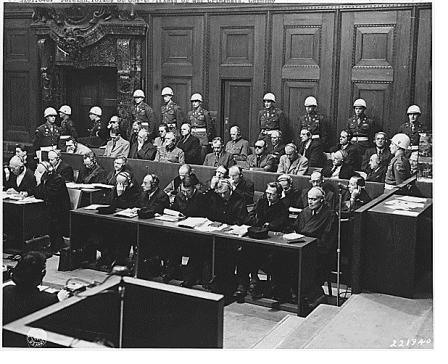
Look at the picture first. Two wooden rows, like church pews or a jury box, and in them sit two rows of men in suits and uniforms, twenty-one defendants in all. Some look bored, some defiant, one or two have their heads in their hands. Standing behind them are white-helmeted American military police. There is nothing dramatic in the frame, no violence, no shouting. It is just men sitting in a room, waiting. And that ordinariness is the whole point.
What it is: a press photograph, taken by the U.S. Army's Signal Corps, of the defendants at the International Military Tribunal in Nuremberg. The Signal Corps photographed the trial so that the world would have a permanent visual record, the same instinct that had sent army cameramen into the liberated camps a few months earlier.
Where and when: Courtroom 600 of the Palace of Justice, Nuremberg, Germany, during the trial that opened in November 1945. The men in the rows are the surviving leadership of a state that had, a year earlier, controlled most of a continent. By the trial’s seating, Hermann Göring sat at the front-row left, Rudolf Hess beside him, then Joachim von Ribbentrop, and on down the rows.
Why it matters: the picture exists because of a choice. When the war ended, the Allies could simply have lined these men against a wall, Winston Churchill, for one, had favored exactly that. Instead they chose a courtroom. Robert Jackson, the American prosecutor, explained why in his opening statement, and the line is the reason the photograph is worth studying: "That four great nations, flushed with victory and stung with injury, stay the hand of vengeance and voluntarily submit their captive enemies to the judgment of the law is one of the most significant tributes that Power has ever paid to Reason." The men in the dock are not being shot. They are being tried. That difference is what the photograph records.
One detail worth noticing: the dock is small, and the men in it are unremarkable to look at, middle-aged, tired, ordinary. That gap, between how ordinary they appear and what they did, is what the trial forced the world to confront. It is also the question Hannah Arendt would chase a generation later, sitting in the gallery of the Eichmann trial.
The afterlife: the photograph became one of the most reproduced images of the twentieth century, printed in textbooks and newspapers around the world. The room itself, Courtroom 600, is now a museum. And the choice the picture captures, law instead of vengeance, became the model for every war-crimes court since. The men in the dock are long dead; the principle they were tried under outlived them, and it is still being used.
Holding: photographs of the Nuremberg tribunal are held by the U.S. National Archives and Records Administration and the U.S. Holocaust Memorial Museum, among others; the trial transcripts are at Yale's Avalon Project and the Library of Congress.
More of the photographic and documentary record of the trials is gathered in the Museum, under Photographs.
For the classroom
Where this Topic fits the standards.
- World History, NY Global History 10.10 (Human Rights, Genocide, and the Postwar World). The Nuremberg trials, the Eichmann trial, and the later prosecutions belong to the postwar legal order, the birth of international criminal law and the human-rights framework built after 1945.
- NYS Holocaust Education Mandate, Education Law §801. Supports Holocaust instruction by examining how the crimes of 1933–1945 were documented, prosecuted, and entered into a permanent public record.
- Common Core RH.11–12.6 & RH.11–12.9. Students analyze indictments, trial transcripts, captured German documents, sworn affidavits, defense arguments, and historical scholarship while evaluating perspective, purpose, and corroboration across sources.
- C3 Framework, D2.His.1 & D2.His.14. Students investigate chronology, causation, and evidence-based interpretation while examining how a court assembles a historical record that historians still use.
- Classroom Applications. Students can:
- evaluate legal evidence and sworn testimony;
- trace the origins of international criminal law (the meaning of “crimes against humanity” and “genocide”);
- weigh individual responsibility against the “following orders” defense;
- analyze how a trial builds a documentary record historians still rely on;
- compare Nuremberg with later tribunals (Eichmann, Rwanda, the former Yugoslavia, the International Criminal Court);
- construct evidence-based arguments using primary and secondary sources.
- International Classroom Relevance. Because this Topic examines international criminal law, transitional justice, and individual accountability, it supports Holocaust education, genocide studies, legal and civic education, human rights education, and source-based historical inquiry.
For further classroom use
- For teachers: The Avalon Project at Yale and the USHMM collections are the main free resources. Robert Jackson's opening statement, read in class against a section of the documentary evidence, works well as an upper-grade primary-source exercise.
- Unit 6 anchor: The Postwar Trials pair with the Hannah Arendt Topic (which covers the Eichmann trial and the argument it set off), the Nostra Aetate Topic (the Catholic reckoning that ran in parallel with the German legal one), and the wider story of memory and responsibility this Unit follows.
Sources and citations
Primary sources come straight from the time: documents, letters, speeches, images, and objects created by the people involved. Secondary sources come later: books, articles, and analysis in which scholars study and interpret those primary sources.
Primary sources
- Trial of the Major War Criminals before the International Military Tribunal, Nuremberg, 14 November 1945 – 1 October 1946. 42 vols. Nuremberg: International Military Tribunal, 1947–49. (The "Blue Series", the official tribunal transcript.)
- Trials of War Criminals Before the Nuernberg Military Tribunals Under Control Council Law No. 10, Nuernberg, October 1946 – April 1949. 15 vols. Washington: U.S. Government Printing Office, 1949–53. (The "Green Series.")
- Taylor, Telford. The Anatomy of the Nuremberg Trials: A Personal Memoir. New York: Knopf, 1992.
- Weiss, Peter. The Investigation. Translated by Alexander Gross. London: Calder & Boyars, 1966.
- The Avalon Project at Yale Law School · tribunal transcripts. avalon.law.yale.edu →
- The USHMM Nuremberg Trial collection. collections.ushmm.org →
- The Trial of Adolf Eichmann, District Court of Jerusalem, Criminal Case 40/61, 1961. Record of proceedings; session transcripts published by the State of Israel.
Secondary sources
- Marrus, Michael R. The Nuremberg War Crimes Trial 1945–46: A Documentary History. Boston: Bedford / St. Martin's, 1997.
- Persico, Joseph E. Nuremberg: Infamy on Trial. New York: Viking, 1994.
- Tusa, Ann, and John Tusa. The Nuremberg Trial. New York: Atheneum, 1984.
- Douglas, Lawrence. The Memory of Judgment: Making Law and History in the Trials of the Holocaust. New Haven: Yale University Press, 2001.
- Bloxham, Donald. Genocide on Trial: War Crimes Trials and the Formation of Holocaust History and Memory. Oxford: Oxford University Press, 2001.
- Earl, Hilary. The Nuremberg SS-Einsatzgruppen Trial, 1945–1958. Cambridge: Cambridge University Press, 2009.
- Wittmann, Rebecca. Beyond Justice: The Auschwitz Trial. Cambridge, MA: Harvard University Press, 2005.
- Pendas, Devin O. The Frankfurt Auschwitz Trial, 1963–1965: Genocide, History, and the Limits of the Law. Cambridge: Cambridge University Press, 2006.
- Lipstadt, Deborah E. The Eichmann Trial. New York: Schocken, 2011.
- Cesarani, David. Becoming Eichmann: Rethinking the Life, Crimes, and Trial of a "Desk Murderer". Cambridge, MA: Da Capo, 2006.
- Stangneth, Bettina. Eichmann Before Jerusalem: The Unexamined Life of a Mass Murderer. New York: Knopf, 2014.
- Mulisch, Harry. Criminal Case 40/61: The Trial of Adolf Eichmann. Philadelphia: University of Pennsylvania Press, 2005.
- Wojak, Irmtrud. Fritz Bauer 1903–1968: Eine Biographie. Munich: C.H. Beck, 2009.
- Steinacher, Gerald. Nazis on the Run: How Hitler's Henchmen Fled Justice. Oxford: Oxford University Press, 2011.
- Douglas, Lawrence. The Right Wrong Man: John Demjanjuk and the Last Great Nazi War Crimes Trial. Princeton: Princeton University Press, 2016.
- Power, Samantha. "A Problem from Hell": America and the Age of Genocide. New York: Basic Books, 2002. (On Lemkin and the Genocide Convention.)
- The Memorium Nuremberg Trials. museums.nuernberg.de/memorium →
- The Fritz Bauer Institute. fritz-bauer-institut.de →
- The Zentralstelle der Landesjustizverwaltungen, Ludwigsburg. zentrale-stelle-ludwigsburg.de →
Finding these documents: many primary sources are free online. Good places to start are the Fordham Internet Jewish History Sourcebook, Yale’s Avalon Project (law and diplomacy), German History in Documents, the collections of the US Holocaust Memorial Museum and Yad Vashem, the National Library of Israel, and Sefaria (for Jewish texts). Search the document’s name and date.
Hannah Arendt (1906–1975): the political thinker who gave us “totalitarianism,” “the banality of evil,” and “the right to have rights”, and the controversy over her Eichmann book that still runs today.
Comments?
Write to editor@makorproject.org.
Last updated: August 2026.