Contemporary Antisemitism
The hatred did not end in 1945. The historical patterns remained, while the language, media, and political settings through which they were expressed continued to change. This Topic hands you the documentary record and lets you judge.
Contemporary antisemitism, treated as analysis, not as commentary on any current headline
Why this Topic exists
The hatred did not end in 1945.
The arc the earlier units trace, the early Christian hostility, the medieval laws, the racial pseudoscience of the nineteenth century, the Protocols and the conspiracy tradition, the Holocaust, did not stop when the war did. It continued, and it continues now. What changed is its language: the people who study it find the old patterns intact beneath a new, contemporary vocabulary. Contemporary antisemitism is best understood not as a completely new phenomenon, but as the latest expression of recurring ideas whose historical development can be traced across two thousand years.
So this Topic asks one question: after studying the historical mechanisms of antisemitism across this Unit, what should a student be able to recognize in the present? Studying contemporary antisemitism is not primarily about predicting future events or taking political positions. It is about recognizing recurring historical patterns, evaluating evidence carefully, and distinguishing documented prejudice from ordinary political disagreement.
A note on how the Topic handles a charged, living subject: it sets out the published frameworks scholars use, in their own words, and the institutions that monitor incidents, but it does not take sides on contested current events, name a current war or election, or label any living person, party, movement, or government as antisemitic. Those judgments are left to the reader, using the frameworks and sources gathered here.
What "contemporary antisemitism" refers to
The descriptive scope.
Scholars use the phrase "contemporary antisemitism" for anti-Jewish discourse, harassment, discrimination, and violence from about 1945 to today. The literature treats these as continuous with, or built on the same patterns as, the history the earlier units cover. The scope is broad and includes:
- Anti-Jewish violence: assaults on Jewish persons, attacks on Jewish institutions, vandalism of Jewish cemeteries and houses of worship, and the documented terrorism targeting Jewish communities across the postwar decades.
- Anti-Jewish discrimination: employment, housing, educational, and institutional discrimination of the kind found in the record of every postwar decade.
- Anti-Jewish harassment: verbal harassment, social-media abuse, and patterns of intimidation directed at Jewish individuals and communities.
- Anti-Jewish discourse: conspiratorial framing of Jewish presence in finance, media, politics, or public institutions; the use of antisemitic tropes inherited from the historical arc the earlier units trace; the continuing circulation of texts including the Protocols of the Elders of Zion documented in that Topic.
- Holocaust denial and Holocaust distortion: the categories developed by the United States Holocaust Memorial Museum and the International Holocaust Remembrance Alliance to describe the falsification, trivialization, or instrumentalization of the historical record of the Holocaust.
The category does not include every criticism of any Jewish person or institution; criticism, including sharp criticism, of identifiable Jewish actors on grounds unrelated to their being Jewish is part of ordinary discourse. The analytical question, what makes specific discourse antisemitic and what does not, is the subject of the analytical frameworks documented below.
A plainer name. The term took hold in 1879 as a scientific-sounding name for an old hatred (see The Racial Turn), and a number of scholars and writers now argue for the plainer one. Deborah Lipstadt writes the word without its hyphen, on the ground that there is no ‘Semitism’ to be against and that the hatred is, simply, Jew-hatred. The novelist Dara Horn has argued that ‘antisemitism’ is too mild a word for what it describes. Naming it plainly, as Jew-hatred, keeps the target of the hatred in view.
Common misconceptions this Topic addresses
- “Antisemitism ended with the Holocaust.” It did not. The monitoring institutions document a continuous, rising record from 1945 to the present. See the entry →
- “Contemporary antisemitism is a completely new phenomenon.” It is the latest expression of recurring tropes (power, disloyalty, greed, blood libel) whose origins this Unit traces across two thousand years. See the entry →
- “Antisemitism comes from only one part of the political spectrum.” The scholarly record finds it across the spectrum; no political tradition is immune. See the entry →
- “Any criticism of Israel is antisemitism.” No. All three analytical frameworks explicitly protect criticism of Israel’s policies, leaders, and laws as ordinary political speech. See the entry →
- “There is no serious way to define antisemitism.” Several respected frameworks exist (IHRA, the Jerusalem Declaration, Nexus); they overlap on the core and differ mainly at the boundary with criticism of Israel. See the entry →
- “If scholars disagree about the definition of antisemitism, the term has no objective meaning.” No. The principal scholarly frameworks agree on the core principle that hostility, discrimination, or violence directed against Jews as Jews is antisemitism. Their disagreements concern a narrower set of questions, particularly how certain forms of discourse about Israel should be evaluated. Scholarly disagreement over difficult boundary cases does not erase the substantial areas of agreement. See the entry →
Continuity with the historical arc
What recurs and what is new.
The scholarly literature on contemporary antisemitism identifies deep continuities with the historical arc, and some features specific to the contemporary period. Several features recur. Jewish life is framed as a conspiracy, an inheritance that runs from the medieval period through the Protocols and into today’s online material. Old caricatures reappear, their visual language traced to medieval and early-modern Europe. Medieval themes resurface in new political vocabularies. And Holocaust-era tropes keep circulating into the present.
The contemporary period also includes features specific to it. The online environment has reshaped the circulation of antisemitic material, providing both faster distribution and a context in which moderation, attribution, and accountability operate differently from the print and broadcast environments of the prior century. The scholarly literature on online antisemitism, including the work of the Network Contagion Research Institute, the Anti-Defamation League's Center for Technology and Society, and the Stephen Roth Institute, treats the online dimension as both continuous with the historical phenomenon and structurally distinct from its earlier forms.
The Topic does not present continuity and novelty as opposed framings. It presents the contemporary moment as one in which long historical patterns operate within a reshaped, technological environment. The frameworks documented below were developed to function within that contemporary reality.
The propaganda continuum
One inheritance, carried forward.
The hatred did not end in 1945. Its instruments, the forged document, the cartoon, the radio broadcast, the slogan, were built once and then handed down, each era adapting the last era's material to its own politics. Historians of antisemitism trace a single line through otherwise unconnected regimes and movements:
- 1879: Wilhelm Marr's racial reframing gives the old religious hostility a pseudo-scientific vocabulary.
- 1903: the Protocols of the Elders of Zion forgery supplies the master template of the secret-Jewish-conspiracy myth.
- 1923–1945: Nazi propaganda, from Der Stürmer to state radio, industrializes the imagery and carries it toward genocide.
- 1953: the Soviet "Doctors' Plot" campaign repurposes the conspiracy frame for a communist state.
- 1975: UN General Assembly Resolution 3379 declares "Zionism is racism" (rescinded in 1991), moving the charge into the language of international diplomacy.
- Post-2000: social media restructures distribution, giving the inherited material faster reach and weaker accountability than print or broadcast ever had.
Two points the scholarship draws from this line. First, the material is portable: the same template serves a Russian secret police, a Nazi ministry, a Soviet politburo, and a present-day online network, with only the target's costume changed. Second, it did not stay in Europe. Nazi-era propaganda was translated and broadcast into the Arabic-speaking world during the Second World War, the record documented in The Holocaust in North Africa, and the Protocols has circulated in Arabic editions since 1925. The conspiratorial framing that began in nineteenth-century Europe took root elsewhere and, through the open distribution of the internet, has returned to Western circulation under contemporary vocabularies. This is the continuity the monitoring institutions and the analytical frameworks below were built to address.
Recognizing the pattern
How the disinformation works, and how to spot it.
The reason a case study in antisemitism is useful well beyond the Jewish community is that the propaganda has a recognizable structure. It is not random prejudice; it is a small set of recurring myths that have been recombined and re-skinned for two thousand years. Once the structure is visible, the individual instance becomes legible, which is the practical aim of studying it before encountering it in the wild.
The Anti-Defamation League's reference guide Antisemitism Uncovered organizes the material around seven enduring tropes, each with an ancient origin and a contemporary mutation. The same seven account for most of what circulates today, which is why naming them is the single most useful recognition tool a student can carry:
- Power: the claim that Jews secretly control governments, banks, or the media. The template is the Protocols forgery; the contemporary form substitutes a named individual or institution for the imagined cabal.
- Disloyalty: the claim that Jews are inherently treacherous or answer to a foreign power rather than their own country. The medieval and early-modern versions reappear whenever Jewish citizens are told their loyalty is conditional.
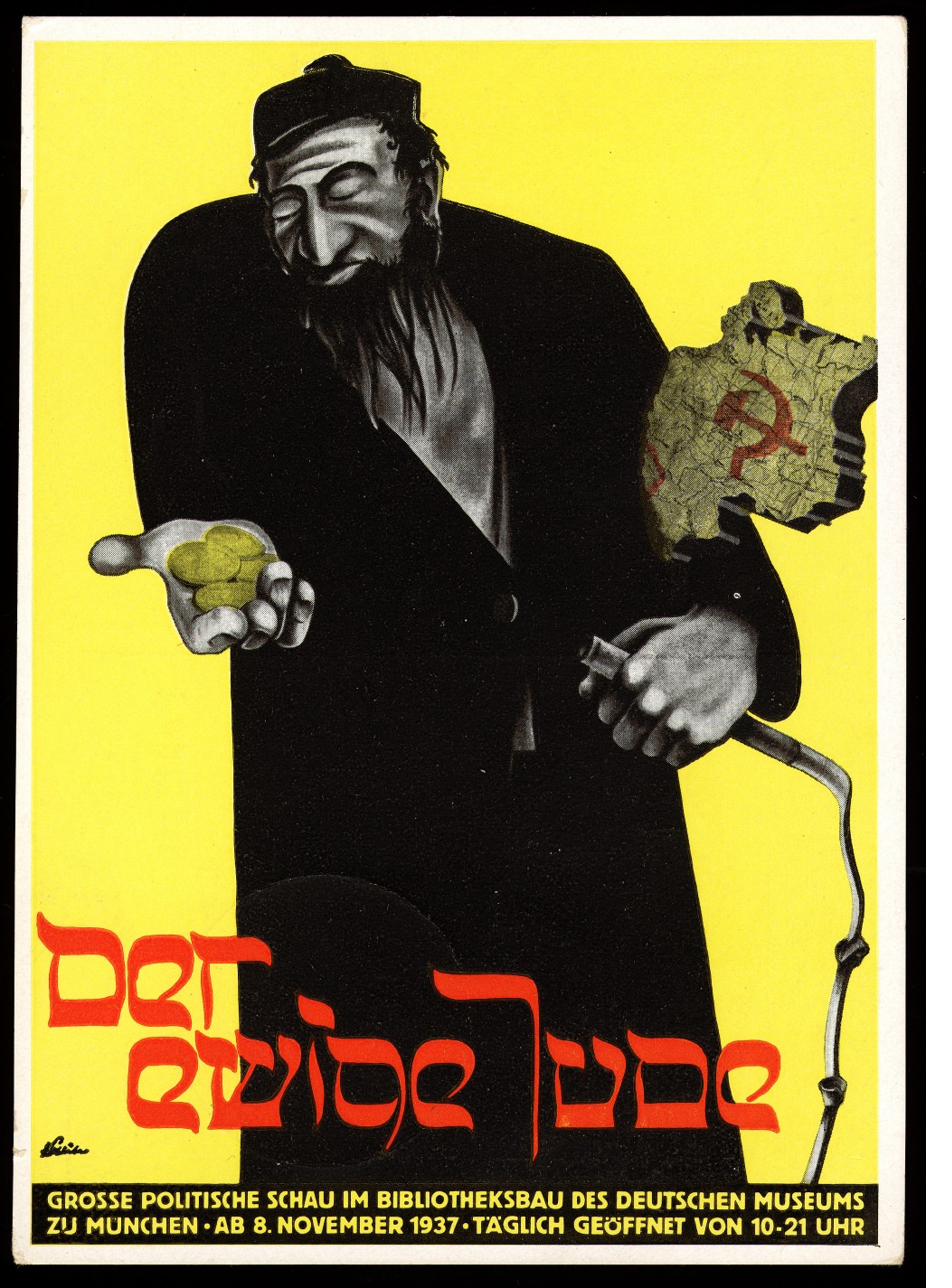
- Greed: the claim that Jews are uniquely avaricious or money-controlling. The coin-clutching caricature of the Der ewige Jude poster above is the same image that recurs in present-day memes.
- Deicide and demonization: the theological charge documented in the Adversus Judaeos tradition, which cast Jews as collectively guilty and less than human, and which supplied the emotional charge later movements drew on.
- Blood libel: the accusation, examined in its own Topic, that Jews ritually murder the innocent. Its modern descendants are the claims that Jews or the Jewish state harvest organs or deliberately target children.
- Holocaust denial and distortion: examined in its own Topic: the claim that the genocide was fabricated, exaggerated, or inverted.
- Delegitimization: the newest mutation, in which the classic tropes are transferred onto the Jewish state as a collective stand-in. This is the contested boundary the analytical frameworks above were written to map, and the page takes no position on where any given critic falls.
Three mechanics make the pattern easier to catch in practice, all of them drawn from the documented record rather than from any single example. First, substitution: the structure stays fixed while the named target changes, a Russian secret police, a Nazi ministry, a Soviet politburo, and a present-day online account can run the identical script. Second, the closed loop: a conspiracy claim is built so that any evidence against it is treated as proof of the conspiracy's reach, which is the signature of disinformation rather than argument. Third, dual coding: the same statement is offered as innocent to outsiders and as a signal to those who recognize the trope, which is why context and history matter for identification. None of these requires a student to adjudicate a political dispute; they are tools for seeing the inherited machinery at work.
This is the page's reason for existing in a curriculum. A student who can name the seven myths and recognize the three mechanics is equipped to identify antisemitic disinformation on sight, and, because the same machinery is turned on other groups, to recognize the broader category of conspiracist propaganda when it appears. The ADL guide is available in full as a classroom reference. (ADL, Antisemitism Uncovered: A Guide to Old Myths in a New Era.)
The same myths travel as symbols, the swastika, coded numbers, online memes, the triple parentheses. Makor’s Hate Symbols recognition guide explains each one: what it is, where it came from, how it is used, and why context decides its meaning.
| The recurring trope | Historical origin | Contemporary form |
|---|---|---|
| Power | The Protocols forgery (1903): a secret Jewish cabal ruling the world. | A named individual or institution standing in for the imagined cabal. |
| Disloyalty | The medieval charge that Jews answer to a foreign power, not their own country. | Questioning Jewish citizens’ loyalty to the nations where they live. |
| Greed | The medieval moneylender stereotype; the coin-clutching caricature. | The same caricature recycled in cartoons and online memes. |
| Blood libel | The medieval accusation that Jews ritually murder the innocent. | Revived ritual-murder claims and their modern inversions. |
Tropes after the Anti-Defamation League, Antisemitism Uncovered.
Object Spotlight
A definition as a historical document.
“Antisemitism is a certain perception of Jews, which may be expressed as hatred toward Jews. Rhetorical and physical manifestations of antisemitism are directed toward Jewish or non-Jewish individuals and/or their property, toward Jewish community institutions and religious facilities.”
, International Holocaust Remembrance Alliance, Working Definition of Antisemitism, adopted in Bucharest, May 26, 2016.
Read it first as an object. These three sentences were adopted by the thirty-one member states of the International Holocaust Remembrance Alliance at a meeting in Bucharest on May 26, 2016. They are not a law and not the last word, but they have become one of the most widely cited, and most widely debated, definitions of antisemitism in the world, referenced by governments, universities, and courts. Two of the three frameworks treated below were written partly in response to this one.
So what can a historian learn from a definition? That definitions are not timeless. They are made (at a particular moment, by particular bodies, for particular reasons) and once made, they acquire histories of their own: adopted here, rejected there, amended, contested. The IHRA text is a primary source twice over. It defines antisemitism, and it documents how one institution, at one point in the early twenty-first century, attempted to. Studying it is practice in reading a definition the way historians read any document: by asking who wrote it, when, why, and what happened next.
Definitions are historical documents. Like constitutions, treaties, or court decisions, they preserve how institutions understood a subject at a particular moment in time. Historians therefore study definitions not only for what they say, but also for when they were written, why they were written, who adopted them, and how later generations interpreted or challenged them.
Following the evidence
Read the documents, not the summaries.
The question. How can different scholars examine the same statement and reach different conclusions?
Read the relevant passages from the three published frameworks (the IHRA Working Definition of Antisemitism, the Jerusalem Declaration on Antisemitism, and the Nexus Document) and then work through the record:
- Where do all three documents agree?
- Where do they differ?
- Which sections define antisemitism itself?
- Which sections discuss speech about Israel?
Finally consider: why is reading the original documents more reliable than relying on someone else’s summary of them?
Historical method. Historians work from original sources whenever possible. Reading the documents themselves allows students to distinguish between what a framework actually says and how it is later described by supporters or critics.
The analytical frameworks
Three published reference instruments.
The scholarly literature on contemporary antisemitism includes several published analytical frameworks. The three most widely referenced in the educational context are set out below. The Topic preserves each framework's own published language at the operative points and notes both their convergences and the points at which they differ.
For students, the goal is not to memorize one framework or choose a preferred definition. It is to understand why several respected frameworks exist, where they agree, where they differ, and how scholars use them when evaluating historical evidence and contemporary claims.
The IHRA Working Definition
2016 · The most widely referenced framework.
The International Holocaust Remembrance Alliance (IHRA) adopted the Working Definition of Antisemitism at its plenary on May 26, 2016, in Bucharest. The Working Definition has subsequently been adopted, endorsed, or referenced by more than forty national governments and by many hundreds of state, municipal, institutional, and educational bodies. It is the most widely referenced contemporary analytical framework for the identification of antisemitism.
The Working Definition consists of a brief core definition followed by a non-exhaustive list of contemporary examples illustrating the kinds of discourse the definition is intended to identify. The full text is published by IHRA and is available in the document of the same name; the operative core sentence reads, in the IHRA's published language:
"Antisemitism is a certain perception of Jews, which may be expressed as hatred toward Jews. Rhetorical and physical manifestations of antisemitism are directed toward Jewish or non-Jewish individuals and/or their property, toward Jewish community institutions and religious facilities."
The Working Definition is, in IHRA's own language, "a non-legally binding working definition." Its function is analytical, providing bodies with a calibrated descriptive framework for evaluating specific discourse, rather than regulatory in itself. The text repeatedly notes that the examples it provides "could, taking into account the overall context," constitute antisemitism, rather than asserting unconditional verdicts.
Two features of the Working Definition are particularly relevant to the question of how it treats discourse touching on Israel:
- The "double standards" principle. The definition's examples include "applying double standards by requiring of [Israel] a behavior not expected or demanded of any other democratic nation" as a possible form of antisemitism, contextually evaluated.
- The explicit preservation of legitimate criticism. The Working Definition states explicitly: "criticism of Israel similar to that leveled against any other country cannot be regarded as antisemitic." This formulation is in IHRA's published text and is part of the framework on equal footing with the example clauses.
The Working Definition is the framework most commonly referenced by major Jewish bodies, including the Conference of Presidents of Major American Jewish Organizations, the World Jewish Congress, and the Anti-Defamation League. It is also the most contested framework in the academic literature. Critics have focused on one question: whether some of its examples concerning Israel could be misused to suppress legitimate criticism. The Jerusalem Declaration documented below was developed in part as a response to that scholarly concern.
Holding: International Holocaust Remembrance Alliance. Working Definition of Antisemitism. Adopted Bucharest, May 26, 2016. The full published text is available at holocaustremembrance.com.
The Jerusalem Declaration
2021 · A scholarly framework with a different calibration.
The Jerusalem Declaration on Antisemitism (JDA), published on March 25, 2021, was developed and signed by approximately 200 scholars of antisemitism, Jewish studies, the Holocaust, and related fields, working under the coordination of the Van Leer Jerusalem Institute. It was issued as a scholarly response to the debate the IHRA Working Definition had set off. Its stated aim was to give clearer guidance, especially at the boundary between criticism of Israeli policy and antisemitism.
The JDA's core definition reads, in its published text:
"Antisemitism is discrimination, prejudice, hostility, or violence against Jews as Jews (or Jewish institutions as Jewish)."
The JDA includes a set of guidelines organized into three categories: examples of antisemitism (regardless of context), examples of speech that are "in principle" not antisemitic, and examples of speech that "could" be antisemitic depending on context. The structural feature distinguishing the JDA from the IHRA Working Definition is the explicit identification of categories of speech concerning Israel that the JDA's signatories consider not in principle antisemitic, including, in the JDA's published guidelines, "evidence-based criticism of Israel as a state. This includes its institutions and founding principles," "boycott, divestment and sanctions are commonplace, non-violent forms of political protest against states… when applied to Israel, they are not, in and of themselves, antisemitic," and several other formulations.
The JDA was developed by scholars who in many cases had been active critics of what they considered limitations or risks of misapplication in the IHRA Working Definition. The JDA's signatories include figures broadly recognized in the academic study of antisemitism and Jewish history, including some who have served on bodies that adopted the IHRA framework. The JDA itself notes that it is "intended as a complement to the IHRA Definition" rather than as a replacement.
The JDA has been the subject of extensive subsequent scholarly conversation. Some bodies have adopted it or referenced it alongside the IHRA framework; others have declined to adopt it on the grounds that they consider its formulations on Israel insufficient. The Topic preserves both frameworks because both are the work of recognized scholarly bodies and both are part of the ongoing analytical conversation.
Holding: Coordinated by the Van Leer Jerusalem Institute. Jerusalem Declaration on Antisemitism. Published March 25, 2021. Full text and signatory list at jerusalemdeclaration.org.
The Nexus Document
2021 · An American-focused framework on the Israel-antisemitism question.
The Nexus Document, published in 2021 by the Nexus Task Force at the University of Southern California's Center for the Study of Hate, addresses specifically the analytical question of how to distinguish antisemitism from legitimate political criticism of Israeli policy, with attention to the American political and educational context. The document was developed under the coordination of Kenneth Stern (a longtime antisemitism researcher who had been the lead drafter of an earlier definition that became a foundation for the IHRA Working Definition) and a working group of American Jewish figures, scholars, and educators.
The Nexus Document's structure is similar to the JDA's in that it identifies categories of speech that are antisemitic, categories that "may" or "could" be antisemitic depending on context, and categories that are not in principle antisemitic. The document is shorter than the JDA and is calibrated specifically for the American environment, including American university campuses, American workplaces, and the American public conversation.
The Nexus Document and the JDA share substantive overlap. Both reflect the scholarly concern that the IHRA Working Definition's examples concerning Israel can in some applications produce overreach. Both seek to preserve a clearer space for what their signatories consider legitimate political criticism. The two documents differ in their specific formulations but converge on the underlying analytical project of distinguishing antisemitism from criticism of state policy on identifiable analytical grounds.
Holding: The Bard Center for the Study of Hate (which administers the Nexus framework in its current form). The Nexus Document. Originally published 2021. nexusproject.us.
Where the frameworks differ
The point of analytical disagreement.
The three frameworks converge on most of what they address. All three identify the core of antisemitism as hostility, discrimination, or violence against Jews as Jews. All three identify the historical inheritance the earlier units trace: the conspiratorial framing, the inherited iconography, the long arc of religious and racial hostility, as core to contemporary antisemitism. All three explicitly preserve the legitimacy of strong criticism of the State of Israel and its policies on grounds parallel to the criticism that any state's policies receive.
The frameworks differ on calibration at the boundary between criticism of Israeli policy and antisemitism. The IHRA Working Definition's examples include discourse about Israel. The signatories of the JDA and Nexus frameworks argued, in their published rationales, that those examples can be stretched too far when applied to specific cases. The JDA and Nexus documents articulate that boundary with somewhat broader explicit preservation of criticism. The disagreement is a real scholarly disagreement, conducted within the academic literature on substantive grounds.
The disagreement is documented here honestly. The frameworks are not interchangeable in every application, and reasonable decision-makers, scholars, and educators have reached different judgments about which framework better serves particular settings. The Topic equips readers to understand the disagreement and to make their own informed judgments.
The short version. All three frameworks agree on the core: hostility, discrimination, or violence against Jews as Jews is antisemitism, and strong criticism of the State of Israel on the same grounds any state receives is not. They differ only on where exactly the line falls between criticism of Israeli policy and antisemitism, a real scholarly disagreement, argued on substantive grounds. The page documents all three and endorses none; the judgment in any specific case is the reader's.
The anti-Zionism question
Where the hardest line is drawn.
Most of the disagreement among the three frameworks comes down to a single word: anti-Zionism. Zionism is the movement for Jewish national self-determination, the idea that the Jewish people, like other peoples, are entitled to a state of their own. Anti-Zionism is opposition to that idea. Because the frameworks were written mainly to answer one question, when does hostility toward Israel become hostility toward Jews?, anti-Zionism is the ground on which they were built, and the ground on which they differ.
The frameworks agree on more than the public argument suggests. All three hold that criticism of the Israeli government, its leaders, its laws, and its policies, including sharp, sustained criticism, is ordinary political speech, no different in kind from criticism leveled at any other state. None of them treats disapproval of a government as antisemitism.
Where serious scholars and institutions disagree is over how to classify some forms of anti-Zionism. What all three frameworks share is a method rather than a verdict: they ask the reader to examine the content of a claim, its context, the standard being applied (is one state held to a test no other faces?), and whether it carries inherited antisemitic patterns. The frameworks supply the questions; they do not settle every case in advance, and this Topic does not settle them for you.
The line they draw, and the line worth understanding clearly, falls between criticism of what a state does and opposition to whether it should exist at all. There are roughly 190 nations in the world. Their governments are criticized constantly; that is the normal business of politics. What has no parallel is a sustained movement calling for the elimination of one specific nation-state, and that one state is the world's only Jewish-majority country, founded in the decade after two-thirds of Europe's Jews were murdered. A number of scholars of antisemitism argue that singling out that one state's existence for opposition, while extending to every other nation the presumption that it may continue to exist, functions differently from political criticism, that it applies to the Jewish state a standard applied to no one else, and so belongs to the long pattern the earlier units trace, in which Jews are denied what others are granted as a matter of course. This is the reasoning behind the IHRA Working Definition's example concerning the denial of "the Jewish people their right to self-determination."
Other scholars, including the authors of the Jerusalem Declaration, reach a different judgment. Their published guidelines hold that opposing Zionism as a form of nationalism, or offering evidence-based criticism of Israel's founding principles, is "on the face of it" not antisemitic, and that whether a particular anti-Zionist statement is antisemitic depends on its content, intent, and context rather than on the position by itself. On this view, a person may oppose the principle of a state defined by national or religious identity (anywhere, including Israel) as a political position, without that opposition being hostility toward Jews.
Both judgments are held by serious scholars of antisemitism, and both have their defenders. What is not in dispute among them is the test that matters most in a classroom: the difference between an argument and an animus. When opposition to Israel reaches for the old machinery: the blood libel, the conspiracy of secret control carried by the Protocols, the dual-loyalty charge, the inherited caricatures the earlier units document, it has crossed from a position about a state into the inheritance the earlier units trace, whatever contemporary vocabulary it borrows. The frameworks were written to help readers tell the difference.
The monitoring institutions
Where the contemporary data come from.
The documentation of contemporary antisemitic incidents: assaults, vandalism, harassment, and the broader documentary record, is the work of a small number of established monitoring institutions, whose own reports are the place to follow the figures in detail.
Anti-Defamation League (ADL)
Founded 1913. The principal American monitor of antisemitic incidents. Publishes the annual Audit of Antisemitic Incidents, a continuous record going back to 1979. Operates the Center on Extremism, which tracks the broader extremist landscape. Publishes the Hate Symbols Database and extensive educational materials.
Community Security Trust (CST)
Founded 1994. The principal British monitor of antisemitic incidents. Publishes annual incidents reports going back to 1984 and operates security services for the British Jewish community.
Service de Protection de la Communauté Juive (SPCJ)
The principal French monitor of antisemitic incidents, working in coordination with the French Ministry of the Interior. Publishes annual reports.
The Stephen Roth Institute for the Study of Contemporary Antisemitism and Racism
Tel Aviv University. The principal academic center for the ongoing scholarly study of contemporary antisemitism. Publishes annual reports and a large research literature.
The Vidal Sassoon International Center for the Study of Antisemitism (SICSA)
Hebrew University of Jerusalem. The center for the scholarly study of antisemitism as a long historical phenomenon, with extensive contemporary research.
FBI Hate Crime Statistics
The Federal Bureau of Investigation's Uniform Crime Reporting Program publishes annual Hate Crime Statistics, including disaggregated data on incidents motivated by religious bias, with Jewish-targeted incidents reported as a specific category.
EU Agency for Fundamental Rights (FRA)
The European Union's body for fundamental-rights data. Publishes Antisemitism: Overview of antisemitic incidents recorded in the European Union on an annual basis, drawing data from member-state monitoring institutions.
United Nations Special Adviser on the Prevention of Genocide
The UN architecture for the monitoring of antisemitic incidents at the international level includes the work of the Special Adviser and the periodic UN reports on contemporary forms of racism and intolerance.
The monitoring institutions use different methodologies, draw on different data sources, and report at different granularities. Direct comparison across institutions is not always meaningful; the relevant comparison is typically within each institution's own continuous time series.
Documented contemporary patterns
What the monitoring institutions have documented.
The continuous monitoring data across the postwar period, and particularly in the past two decades, establish a documented record on which the scholarly literature draws. The broad patterns in that record are these, described without claims about specific actors or events.
- Quantitative trends. The ADL Audit of Antisemitic Incidents, the CST annual reports, the SPCJ reports, and the FRA aggregate reports have recorded sharp increases in incident counts across the past several years compared to the early 2000s. The precise magnitude of the increase varies across reports and across jurisdictions; the broad direction of the trend is consistent.
- Categories of incidents. The monitoring distinguishes between assault, harassment, vandalism, and other categories. Assaults remain a minority of total incidents but constitute the gravest category. Vandalism of Jewish cemeteries, schools, and houses of worship is documented across jurisdictions.
- Geographic patterns. The record documents both broad postwar patterns and specific country and regional patterns. France, the United Kingdom, Germany, the United States, Argentina, and Canada among others have monitoring sufficient to produce continuous time series.
- The online dimension. The post-2000 record increasingly distinguishes online from offline incidents. The Anti-Defamation League's Center for Technology and Society and parallel research institutions document online antisemitism as a distinct and major component of the contemporary phenomenon.
- Holocaust denial and distortion. The IHRA's working definition of Holocaust denial and distortion (developed separately from the antisemitism working definition) provides the analytical framework for this specific category, which the major institutions document as a continuing component of the contemporary record.
The reports themselves are the place to go for the detail; they update annually, and any figure quoted here would date quickly.
A documented pattern
Not a historical record, an ongoing one.
The clearest evidence that this subject is present rather than past is its sheer volume. In the United States alone, the Anti-Defamation League recorded 9,354 antisemitic incidents in 2024, an average of more than twenty-five a day, more than one an hour, and the highest annual total since the ADL began counting in 1979. The figure was up 344 percent over five years and nearly 900 percent over ten. In the United Kingdom, the Community Security Trust recorded its second-highest annual total ever, the first year in which every single month exceeded 200 incidents. These are not the numbers of an occasional problem.
Most of that volume is not the attacks that reach the news. It is the daily texture of harassment, vandalism, and intimidation aimed at ordinary Jewish life: synagogues defaced and threatened (the ADL counted 627 bomb threats against Jewish organizations in 2024, nearly nine in ten of them aimed at synagogues) Jewish schools and community centers vandalized, swastikas and "Heil Hitler" sprayed near houses of worship, and graffiti on the homes, vehicles, and businesses of Jewish families. The Community Security Trust recorded its highest-ever annual total of damage and desecration of Jewish property. To give the categories specific faces, all from a single year of the ADL's documented record: a swastika carved into a tree at a Jewish family's home in Belmont, Massachusetts; the stained-glass Star of David windows of a synagogue in Portsmouth, New Hampshire smashed with a hammer; a community center vandalized with swastika graffiti and the words "Heil Hitler" in St. Johns County, Florida. None of these required interpretation, the act carried its own meaning. This is the broad base of the pattern; the fatal attacks below are its visible peak. (ADL regional audits, 2024.)
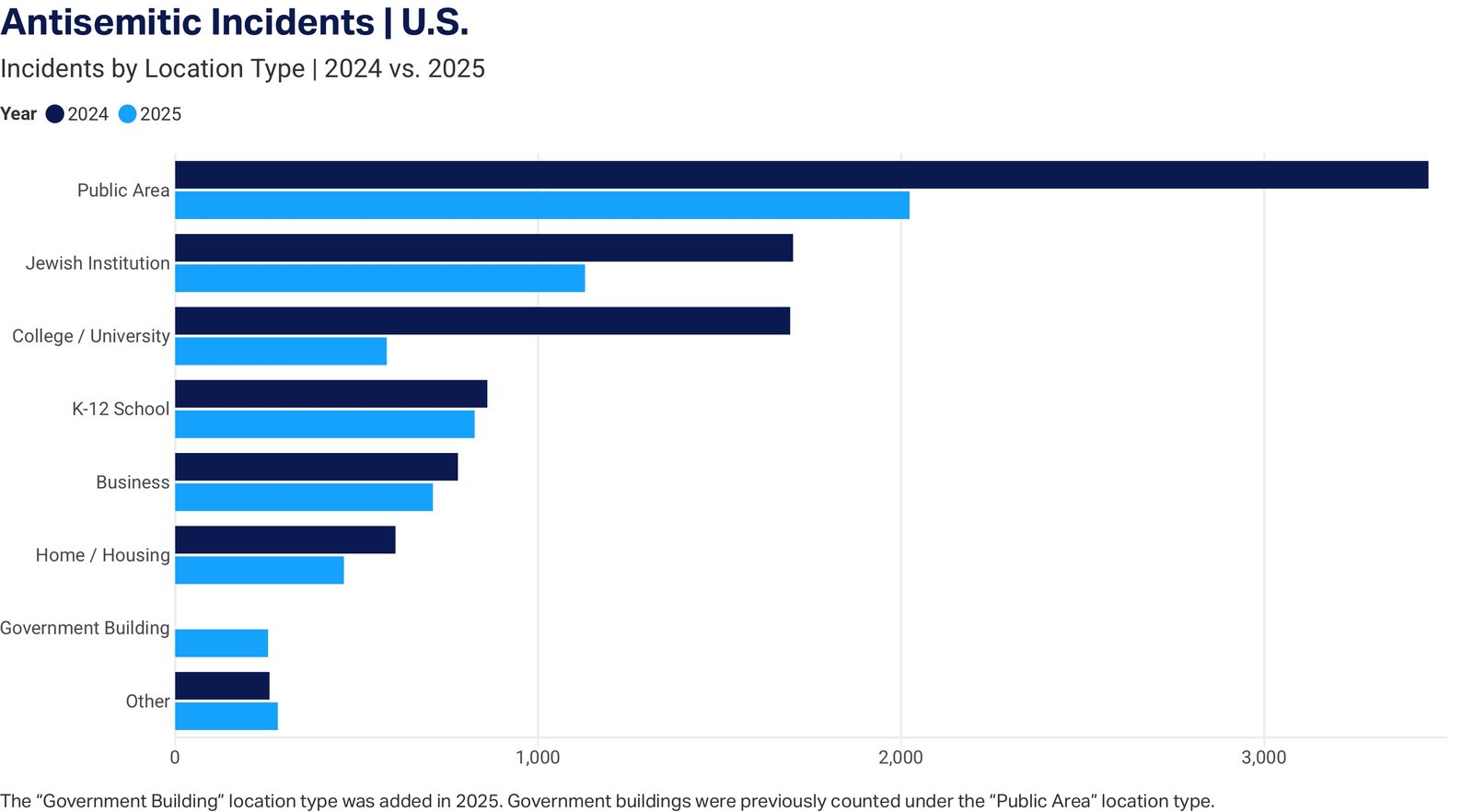
The pattern has reached schools and universities as well, where Jewish students have reported harassment and, in documented cases, being physically blocked from parts of campus. One example reached a federal court: in Frankel v. Regents of the University of California, Jewish students alleged that during a 2024 protest encampment they were excluded from parts of the UCLA campus, including classrooms and the main library. In August 2024 a federal judge issued a preliminary injunction, the first time a U.S. court had ruled against a university over its handling of the demonstrations, ordering that the university could not provide programs or campus areas to other students if Jewish students were being excluded from them. In July 2025 the case settled for $6.13 million, with the injunction made permanent. The case appears here not to single out one institution but as a documented, adjudicated example of how the broader pattern has operated. (NPR; JTA.)
At that lethal edge, a partial record of the gravest attacks of the recent period:
- Israel · October 7, 2023: the antisemitic terrorist attack on Israeli civilians by Hamas: roughly 1,200 people killed and some 250 taken hostage, the deadliest single attack on Jews since the Holocaust. The firsthand record is preserved in the USC Shoah Foundation's October 7 testimony collection.
- Pittsburgh, United States · October 27, 2018: the Tree of Life synagogue shooting: eleven worshippers killed, the deadliest antisemitic attack in United States history. (ADL.)
- Poway, United States · April 27, 2019: a shooting at the Chabad of Poway synagogue. (ADL.)
- Halle, Germany · October 9, 2019: an attempted assault on a synagogue on Yom Kippur that killed two people nearby when the attacker failed to breach the doors. (ADL.)
- Jersey City, United States · December 10, 2019: an attack on a kosher market. (ADL.)
- Monsey, United States · December 28, 2019: a stabbing attack at a Hanukkah celebration. (ADL.)
- Colleyville, United States · January 15, 2022: a hostage-taking at Congregation Beth Israel. (ADL.)
- Manchester, United Kingdom · October 2025: the Heaton Park Synagogue attack on Yom Kippur, which killed two congregants: by the Community Security Trust's record, the first fatal antisemitic terrorist attack on British soil since the Trust began recording in 1984. (CST.)
- Sydney, Australia · December 14, 2025: a shooting at a Hanukkah event at Bondi Beach in which at least fifteen people were killed; Australian authorities classified it as antisemitic terrorism and opened a federal royal commission. (AJC timeline.)
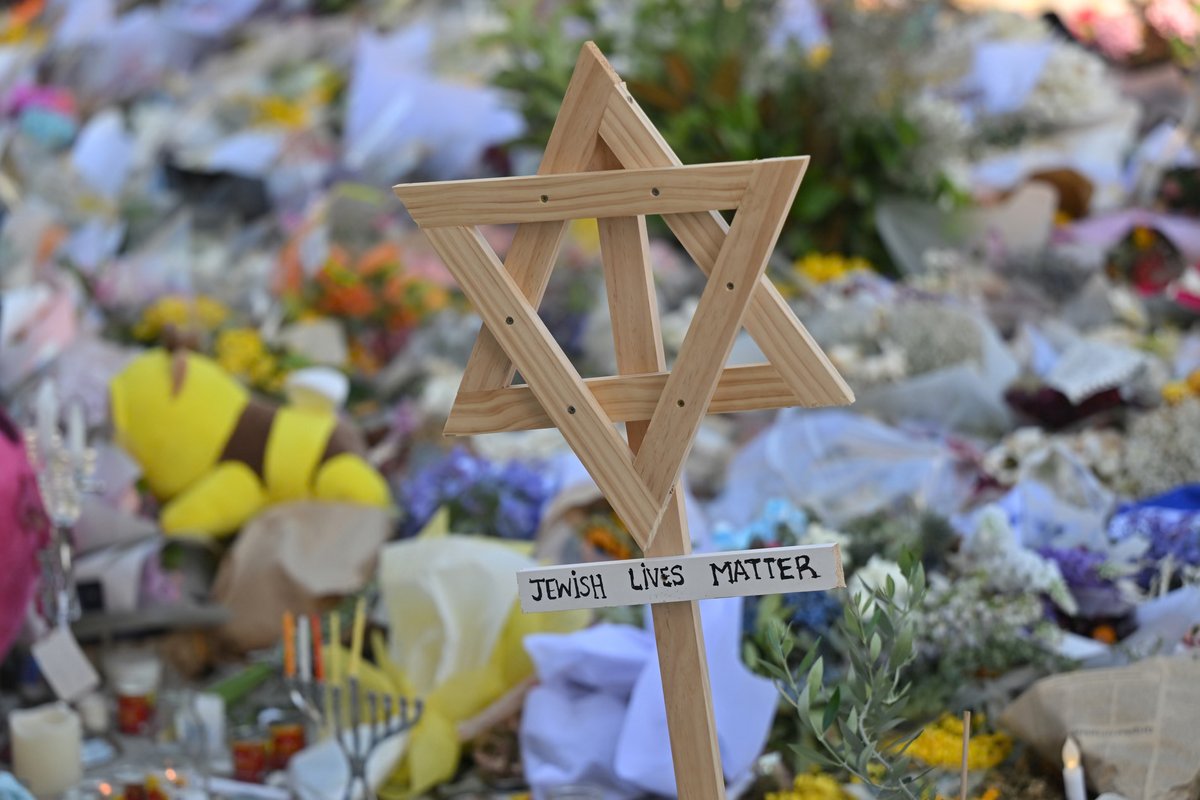
This list is a curated illustration, not a complete record. The monitoring institutions are explicit that their own counts are not an attempt to catalog every act; the fatal attacks above are a fraction of a far larger documented volume. The point is not that any single year is the worst, but that the pattern is unbroken and geographically wide: the same categories of incident appear in the United States, the United Kingdom, France, Germany, Australia, and beyond, year after year. In Germany the figures come from the state itself: the Federal Interior Ministry’s 2025 crime statistics recorded 6,548 antisemitic offenses (an all-time high, and more than four times the 2017 total) with the federal police noting that the offenses spanned right-wing extremism and incidents tied to the Middle East conflict alike. (German Federal Ministry of the Interior, Politically Motivated Crime 2025, reported June 9, 2026.) The European Union Agency for Fundamental Rights, surveying Jews across the EU, found that a large majority reported encountering antisemitism and that most avoid wearing or displaying anything that would identify them publicly as Jewish, a measure of how the climate is experienced by the people living inside it. Reported incidents have run at multiples of the level of a decade ago and have not returned to their pre-2023 baseline.
Antisemitism across the political spectrum
The scholarly literature on political distribution.
The scholarly literature documents that antisemitism in the contemporary period operates across the political spectrum, in distinct ideological forms, and through distinct channels. The literature does not assert that antisemitism is equally distributed across the political spectrum; the empirical question of its distribution across particular periods, countries, and political subcultures is the subject of ongoing research. What the literature does establish is that no political tradition is immune.
A substantial scholarly literature treats this question at the level of analytical taxonomy; the principal works (Lipstadt, Wistrich, Hirsh, Nelson, and others) are listed among the Further Teaching Resources and Sources below, where students can weigh the debate from the originals.
The scholarly literature is the place to follow this debate in full; students working from those sources directly can weigh it for themselves.
The online dimension
The new context.
The online environment has reshaped the dynamics of antisemitic discourse. The scholarly literature on this dimension is a rapidly developing body of work. Key contemporary research centers include:
- The Network Contagion Research Institute: academic research on the spread of extremist content across online networks.
- The Anti-Defamation League's Center for Technology and Society: documentation of online antisemitism and policy work with major technology platforms.
- The Institute for Strategic Dialogue (ISD): UK-based research institution on online extremism and disinformation.
- The Global Network on Extremism and Technology (GNET): the academic research network coordinated by the Global Internet Forum to Counter Terrorism.
The online environment has produced both the rapid resurgence of historical antisemitic materials, including the Protocols of the Elders of Zion, the long iconographic inheritance, the conspiratorial framing, and forms of antisemitic discourse specific to the online environment. The Topic notes the online dimension without attempting to substitute for the large and rapidly evolving research literature that addresses it.
The record, updated
See the scope for yourself.
History pages close; this subject does not. The organizations below maintain the contemporary record in real time. The Makor Project does not reproduce their feeds, it points you to them, because the judgment about what counts, and what has been verified, belongs to the monitors who do that work. Use these the way you would any primary source: read them critically, check the date, and weigh them against the frameworks above.
Live trackers, maintained by outside organizations, updated on their own schedules:
- ADL H.E.A.T. Map (United States): an interactive map of recorded incidents of hate, extremism, antisemitism, and terrorism, updated monthly using ADL's published methodology.
- ADL · Tools to Track Hate, the full set of ADL tracking tools, including the global A.T.L.A.S. trends tool.
- Community Security Trust (United Kingdom): incident reports and current reporting for the British Jewish community.
- EU Agency for Fundamental Rights (European Union): official intergovernmental data on antisemitic incidents across member states.
One caution, stated plainly: ADL's rapid "Tracker" feed notes that some items are not independently verified. The H.E.A.T. Map, which applies ADL's published methodology, is the steadier classroom tool.
In the news, a monthly selection
A small set of documented incidents from around the world, refreshed periodically. Each is reported by a monitoring or news organization. This block is intentionally current, read it as a snapshot of its date, not a permanent record. Updated: August 2026.
- Sydney, Australia · December 2025: at least fifteen people were killed in a shooting at a Hanukkah event at Bondi Beach; Australian authorities classified it as antisemitic terrorism and convened a federal royal commission. (American Jewish Committee timeline of antisemitism in Australia.)
- Lam, Germany · June 2026: a hotel refused an Israeli family's booking with a message stating that Jews were not allowed; after public response, the booking platform removed the property. (Reported by the Combat Antisemitism Movement; the platform's removal of the listing was confirmed in subsequent coverage.)
- Manchester, United Kingdom · October 2025: two congregants were killed in a terrorist attack on Heaton Park Synagogue on Yom Kippur. (Community Security Trust, Antisemitic Incidents Report 2025.)
- European Union · 2024 survey: across thirteen EU countries, a large majority of Jewish respondents reported encountering antisemitism, and most said they avoid displaying items that would identify them publicly as Jewish. (EU Agency for Fundamental Rights survey of Jewish experiences of antisemitism.)
Legitimate criticism is not antisemitism
A position all three frameworks share.
A position shared explicitly by all three of the analytical frameworks documented above:
Criticism is not in itself antisemitism, including sharp criticism of the State of Israel and its policies, of Jewish individuals on grounds unrelated to their being Jewish, of Jewish positions on contested political questions, or of any specific person's conduct. The real question is what separates such criticism from antisemitism, and the three frameworks offer different answers for different settings.
This point is preserved here explicitly. The same long historical record that establishes the reality of contemporary antisemitism also establishes that the suppression of legitimate criticism, including legitimate Jewish self-criticism, has never been the answer to anti-Jewish hostility. The frameworks documented above were developed by bodies whose signatories have, in their published rationales, treated the protection of legitimate criticism as integral to the analytical work of identifying what is and is not antisemitism.
The distinction the frameworks draw, in plain terms:
- Ordinary political criticism: of Israeli policies, of its leaders or governments, of its laws, however sharp: this is normal political speech, no different from criticism of any other state.
- Where antisemitism enters: hostility to Jews as Jews; the denial that the Jewish people, alone among peoples, are entitled to self-determination; or the use of inherited antisemitic tropes or double standards: a test applied to one state and to no other.
responses
The architecture of contemporary response.
The response to contemporary antisemitism operates at several levels and through several channels.
- Government and legal institutions. The architecture of hate-crime law in the United States and parallel statutes in other countries provides the legal framework for the prosecution of violent antisemitic incidents. The position of the Special Envoy to Monitor and Combat Antisemitism at the U.S. Department of State (created by the Global Anti-Semitism Review Act of 2004), the corresponding positions in the U.S. Department of Education and the U.S. Department of Justice, and parallel positions in other governments provide the architecture of governmental response.
- The major Jewish bodies. The Conference of Presidents of Major American Jewish Organizations, the World Jewish Congress, the European Jewish Congress, the Board of Deputies of British Jews, the Conseil Représentatif des Institutions juives de France (CRIF), and parallel national bodies coordinate the response of the organized Jewish community.
- Civil-society organizations. The Anti-Defamation League, the Simon Wiesenthal Center, the American Jewish Committee, and parallel organizations across countries operate responses including education, monitoring, legal advocacy, and partnerships with broader civil-society institutions.
- Educational institutions. The response of universities, K–12 schools, and the broader educational system to contemporary antisemitism is the subject of ongoing development. The Department of Education's Office for Civil Rights has responsibility for the enforcement of Title VI of the Civil Rights Act in educational contexts.
- Inter-faith and inter-community partnerships. The post-Nostra Aetate partnership documented in that Topic, the broader Christian-Jewish dialogue infrastructure, and the parallel Muslim-Jewish and inter-faith partnerships across countries constitute a response that operates outside the directly governmental and Jewish channels.
The purpose of this Topic is not to settle every contemporary debate. It is to provide the historical knowledge, documentary evidence, and analytical tools needed to evaluate those debates thoughtfully and independently. Understanding the history of antisemitism allows students to recognize recurring patterns while remaining attentive to historical context, evidence, and legitimate scholarly disagreement.
Key takeaways
- Contemporary antisemitism is best understood not as a new phenomenon but as the latest expression of recurring ideas, the same conspiratorial, racial, and religious tropes traced across this Unit, in new vocabulary and new media.
- The most useful recognition tool is the small set of enduring tropes (power, disloyalty, greed, deicide, blood libel, Holocaust denial, delegitimization), each with an ancient origin and a contemporary form.
- Several serious analytical frameworks exist, the IHRA Working Definition, the Jerusalem Declaration, and the Nexus Document. They overlap on the core and differ mainly at the boundary between criticism of Israel and antisemitism; readers should consult the documents directly.
- All three frameworks protect legitimate criticism of Israel, of its policies, leaders, and laws. Antisemitism enters with hostility to Jews as Jews, denial of Jewish self-determination alone among peoples, or inherited tropes and double standards.
- The contemporary record is documented by established monitoring institutions (ADL, CST, FRA, the Kantor Center, and others); their dated reports are where the figures should be followed.
- Studying this is not about predicting events or taking political positions, it is about recognizing recurring patterns, evaluating evidence carefully, and distinguishing documented prejudice from ordinary political disagreement.
Discussion questions
Working from the evidence.
Grounded in the sourced record above. Each asks students to work with the frameworks and the data rather than restate a conclusion.
- The IHRA, Jerusalem Declaration, and Nexus frameworks all begin from the same core, hostility toward Jews as Jews, yet they differ at the boundary between criticism of a state's policy and antisemitism. Why might careful people who agree on the core still disagree on where that boundary falls?
- All three frameworks state explicitly that criticism of Israel "similar to that leveled against any other country" is not antisemitic. Why would a definition of antisemitism take the trouble to say what it does not cover?
- The monitoring institutions use different methods and report at different granularities, so their numbers often can't be compared directly. What does that tell you about how to read a single year's incident figure quoted out of context?
- The scholarly literature finds that antisemitism appears across the political spectrum but does not claim it is evenly distributed. Why is the distinction between "present across" and "evenly distributed" important to keep straight?
- This Topic deliberately names no current event, party, or person. What is gained, and what is lost, by analyzing a live subject only through frameworks and data rather than cases?
Classroom Connections
Where this Topic fits.
Teaching Connections
The disciplines and courses this capstone Topic naturally supports, for any educator, anywhere.
- Historical Thinking & Source Analysis: recognizing recurring tropes, evaluating the analytical frameworks and monitoring data, and distinguishing documented antisemitism from ordinary political disagreement.
- Modern & Contemporary History: antisemitism as a continuous phenomenon from 1945 to the present.
- Civics & Government: the architecture of response: special envoys, hate-crime law, and the monitoring institutions.
- Media & Information Literacy: the online circulation of inherited material, and conspiracy literature in new media.
- Capstone of Unit 3: connecting the historical mechanisms studied across the Unit to the forms they take today.
Standards Alignment
- NYS Global History & Geography: 10.10 (human rights: the postwar architecture of monitoring and analytical frameworks) and 10.9 (globalization and the present: the online and global circulation of inherited material).
- NYS US History: 11.10 (domestic issues since 1945: the American response architecture).
- NYS Participation in Government (grade 12): the civic response to antisemitism.
- Common Core ELA-Literacy: RH.11–12.8 (evaluating an author’s claims and the documentary basis of a source).
Further Teaching Resources
Read the frameworks themselves:
- IHRA · Working Definition of Antisemitism, the full text of the most widely referenced framework.
- The Jerusalem Declaration on Antisemitism, full text, guidelines, and signatories.
Teaching resources:
- Recognizing Propaganda: Then and Now: The Makor Project’s printable 9–12 handout on the recurring myths and a recognition routine.
- ADL · Antisemitism Uncovered, the seven recurring myths traced from origin to present, with a video series.
- Facing History · Contemporary Antisemitism and Youth, a free, ready-to-teach lesson.
- ADL · Audit of Antisemitic Incidents, the continuous American monitoring record, with methodology.
Scholarship on the political distribution:
- Deborah Lipstadt, Antisemitism: Here and Now (Schocken, 2019); Robert Wistrich, A Lethal Obsession (Random House, 2010); David Hirsh, Contemporary Left Antisemitism (Routledge, 2017); Cary Nelson, Israel Denial (Indiana University Press, 2019); and the journals Journal of Contemporary Antisemitism and Antisemitism Studies.
Sources and citations
Primary sources come straight from the time: documents, letters, speeches, images, and objects created by the people involved. Secondary sources come later: books, articles, and analysis in which scholars study and interpret those primary sources.
Primary sources
- International Holocaust Remembrance Alliance. Working Definition of Antisemitism. Adopted Bucharest, May 26, 2016. holocaustremembrance.com.
- Jerusalem Declaration on Antisemitism. Published March 25, 2021. jerusalemdeclaration.org.
- Nexus Task Force. The Nexus Document. Originally published 2021; currently administered by the Bard Center for the Study of Hate. nexusproject.us.
- Anti-Defamation League. Audit of Antisemitic Incidents. Annual publication. adl.org.
- Community Security Trust. Antisemitic Incidents Report. Annual publication. cst.org.uk.
- EU Agency for Fundamental Rights. Antisemitism: Overview of antisemitic incidents recorded in the European Union. Annual publication. fra.europa.eu.
- Federal Bureau of Investigation. Hate Crime Statistics. Annual publication. fbi.gov/services/cjis/ucr/hate-crime.
- International Holocaust Remembrance Alliance. Working Definition of Holocaust Denial and Distortion. Adopted 2013.
Secondary sources
- Lipstadt, Deborah E. Antisemitism: Here and Now. New York: Schocken Books, 2019.
- Wistrich, Robert S. A Lethal Obsession: Anti-Semitism from Antiquity to the Global Jihad. New York: Random House, 2010.
- Hirsh, David. Contemporary Left Antisemitism. London: Routledge, 2017.
- Nelson, Cary. Israel Denial: Anti-Zionism, Anti-Semitism, & the Faculty Campaign Against the Jewish State. Bloomington: Indiana University Press, 2019.
- Penslar, Derek J. Zionism: An Emotional State. New Brunswick: Rutgers University Press, 2023.
- Stern, Kenneth S. The Conflict over the Conflict: The Israel/Palestine Campus Debate. Toronto: University of Toronto Press, 2020.
- Engel, David. Historians of the Jews and the Holocaust. Stanford: Stanford University Press, 2010.
- Bauer, Yehuda. The Death of the Shtetl. New Haven: Yale University Press, 2009.
- The Stephen Roth Institute for the Study of Contemporary Antisemitism and Racism, Tel Aviv University. en-humanities.tau.ac.il/roth.
- The Vidal Sassoon International Center for the Study of Antisemitism (SICSA), Hebrew University of Jerusalem. sicsa.huji.ac.il.
- U.S. Department of State, Special Envoy to Monitor and Combat Antisemitism. Office established by the Global Anti-Semitism Review Act of 2004 (Public Law 108-332).
- U.S. Holocaust Memorial Museum. Confronting Holocaust Denial and Distortion. USHMM materials. ushmm.org.
- Journal of Contemporary Antisemitism. Peer-reviewed academic journal.
- Antisemitism Studies. Indiana University Press peer-reviewed academic journal.
- Horn, Dara. People Love Dead Jews: Reports from a Haunted Present. New York: W. W. Norton, 2021.
Finding these documents: many primary sources are free online. Good places to start are the Fordham Internet Jewish History Sourcebook, Yale’s Avalon Project (law and diplomacy), German History in Documents, the collections of the US Holocaust Memorial Museum and Yad Vashem, the National Library of Israel, and Sefaria (for Jewish texts). Search the document’s name and date.
The next Unit follows that history into the twentieth century, the Holocaust, documented stage by stage.
Comments?
Write to editor@makorproject.org.
Last updated: August 2026.