
The Racial Turn of 1879
“You may gnash your teeth about Germanic apathy. I bow down in amazed admiration before this Semitic race that has set its foot upon our necks.”
Wilhelm Marr, Der Sieg des Judenthums über das Germanenthum, 1879 (trans. Richard S. Levy): quoted as the charge, never as fact · German History in Documents →
Why this Topic exists
The year hatred changed its rules.
For nearly two thousand years, the hatred aimed at Jews in Christian Europe had a door in it. The charge was religious: a Jew who accepted baptism could, in principle, walk out of the persecution and into the surrounding society. Cruel and uneven as the centuries were, that exit existed in principle, and many walked through it. Then, in a single decade in the late nineteenth century, a small group of German and French writers built a new version of the hatred, one that defined Jewishness as a hereditary, biological category. Conversion could not touch it. There was no door.
That change is the subject of this Topic. The Holocaust is taught as the Nazi attempt to murder Europe's Jews on the basis of their racial category, but students are rarely taught when that category was invented, or by whom. The four-grandparent definition of "Jew" in the 1935 Nuremberg Laws did not appear from nowhere; it was the end of a six-decade movement that began, in 1879, with a pamphlet, a league, and a word. The Adversus Judaeos Topic covers the religious tradition this racial turn built on and transformed; this one covers how the rules changed.
One point to hold from the start: the racial idea was pseudo-science. Leading scholars of the moment, Theodor Mommsen among them, rejected it as it was being built. It is set down here as a historical force with enormous consequences, never as a position to be entertained.
Common misconceptions this Topic addresses
The idea that 1879 marks a real categorical break (religious anti-Judaism on one side, racial antisemitism on the other) is one of the more pedagogically novel claims the platform makes. The dedicated entries explain why the break is foundational to the Holocaust era and not reducible to what came before or after it.
What came before 1879
The hatred with a door in it.
The anti-Jewish hatred that ran across Europe from late antiquity into the nineteenth century was fundamentally religious. The Adversus Judaeos tradition, the Christian theology that cast Jews as the bearers of religious error and the rejecters of Christ, was its foundation. On top of that theology sat the medieval machinery: the expulsions (England 1290, France 1306 and 1394, Spain 1492, Portugal 1497, Naples 1541), the ghetto system, the blood-libel and host-desecration accusations, the whole legal architecture of Jewish disability. All of it operated inside the religious frame.
Because the frame was religious, it had a structural feature the racial version would later strip out: conversion offered an exit. Jews who became Christian (by choice in tolerant periods, under coercion in others) could in principle enter the surrounding society, and their descendants often did. The Conversos of the Iberian Peninsula, the German-Jewish conversions of the early nineteenth century, the integration of converted families into German, French, and wider European life across the 1820s–1870s: these were patterns the religious framework permitted.
Iberia is the important complication. After the mass conversions that followed the anti-Jewish violence of 1391 and the expulsions of 1492 and 1497, Spanish and Portuguese institutions began barring “New Christians”, the converts and their descendants, from offices, guilds, universities, and military orders, through the estatutos de limpieza de sangre, the “purity of blood” statutes that spread from the mid-fifteenth century. This was a genuine ancestry-based exclusion: it reached people who were, by their own profession and practice, Christians, on the grounds of Jewish or Muslim descent. It is a real precursor, and worth naming plainly. But it was not yet the racial antisemitism of 1879. It was argued in the religious and genealogical language of Christian “purity,” not modern biological race-science; it applied to a converted population rather than to Jews as such; and over generations it admitted a slow dilution the later racial category would deny. What it shows is that ancestry-based exclusion existed in Europe well before the nineteenth century, and that the conversion exit, even where it formally existed, was never as clean as a single rule suggests.
The other great religious-legal system worked the same way. The classical Islamic dhimma, the subordinate but protected status of Jews and Christians as “People of the Book”, was, like the Christian framework, a religious-legal order from which conversion to Islam offered an exit. It was discriminatory, and at times violent, but it remained religious-legal, and conversion remained the way out; the fuller comparison is set out in the Misconceptions reference. The racial turn broke from both frameworks at once: by defining Jewishness as biology, it changed the basis of exclusion from belief, which a person could in principle change, to descent, which no one can. That is the change that made the Holocaust ideologically possible.
The exit also helps explain why the new hatred took the shape it did. By the 1870s, most Jews in Germany, France, Austria, and Central Europe had won legal emancipation (full equal citizenship, the right to live, work, and worship like anyone else): France in 1791, Prussia in 1812, the German states across the 1840s–60s, the Habsburg Empire in 1867, the unified German Reich in 1871. Jews entered the universities, the professions, the press, banking, and cultural life in numbers that were new and visible. The racial turn was, at bottom, a reaction to that visibility: an argument that emancipation had been a mistake, that Jewishness was a fixed hereditary category no integration could dissolve, and that the Jewish presence in national life had to be reversed.
Timeline
From a pamphlet to a law.
Marr and the word that named it
The man who gave it its name.
Wilhelm Marr (1819–1904) was a German journalist and political agitator with an unlikely past. He had taken the radical-democratic side in the 1848 revolutions; he had worked among movements that included Jewish members and backed Jewish emancipation. The arc of his later career was a long turn away from that democratic radicalism and toward the racial doctrine he assembled across the 1860s and 1870s.
His pamphlet was Der Sieg des Judenthums über das Germanenthum: Vom nicht confessionellen Standpunkt aus betrachtet ("The Victory of Judaism over Germandom: Viewed from a Non-Religious Standpoint"), published in Bern in late 1879. The title carried the whole shift in miniature: the conflict was framed not as religion against religion but as one people (Volk) against another. The subtitle made the point explicit: this was a quarrel argued from a "non-religious standpoint," set apart from the old theological tradition on purpose.
The argument inside was that the German nation had been beaten by Jewish economic, cultural, and political ascendancy, that the Jewish presence in German life was the proof of that defeat, and that the racial difference between Jews and Germans made the presence incompatible with the national project. Marr's language did the framing's work: Jewish economic activity became "parasitism," Jewish cultural life became "subversion," and emancipation became the "victory" of his title.
The pamphlet sold. Der Sieg des Judenthums went through twelve editions in 1879 and 1880, a runaway success in the German pamphlet trade, and the public conversation it opened is what the League, the Petition, and the wider movement drew on.
The word Antisemitismus, "antisemitism", is the part most often misremembered. The term was not strictly Marr's invention; forms of it appear in print before he made it famous. What Marr did was give it its political career. Through his 1879–80 pamphlets and the league he founded, the word moved from a philologist's coinage into the name of a movement. The choice of "Semitism" as the racial label borrowed from the nineteenth-century classification of Semitic languages (Hebrew, Aramaic, Arabic) and stretched it across a whole population said to descend from them. It was muddled as science and potent as a slogan, and it stuck. Marr chose the new word over the conventional German one for the same hatred, Judenhass, or Jew-hatred. Judenhass carried the old religious meaning; Antisemitismus sounded racial and scientific, and that was its appeal. The plainer, older word still names the thing itself: the hatred of Jews.
Wilhelm Marr did not invent hostility toward Jews; what he did was redefine it. The older anti-Jewish traditions cast Jews as the adherents of a mistaken religion. Marr argued instead that Jewishness was an inherited racial identity, fixed at birth and therefore beyond the reach of conversion, assimilation, or personal belief. That shift, more than the word he popularized, marks the beginning of a new form of antisemitism, and it is the distinction the rest of this Topic turns on.
The League of Antisemites · 1879
The first group to take the name.
Marr founded the Antisemiten-Liga ("League of Antisemites") in Berlin on September 26, 1879, the first political organization to wear the new label as its name and program. Its membership ran to a few hundred at most; its reach was wider, carried by Marr's publications and by the parties that picked up the name after him.
The League's program was the reversal of Jewish emancipation. Its proposed means: barring Jews from the civil service, the universities, the law, medicine, the press, and banking; restricting Jewish immigration (a response to the Eastern European Jewish arrivals of the 1870s); and enforcing social separation between Germans and Jews. The element that marked it as new was its refusal of the old religious offer: there would be no integration through conversion.
The League itself was short-lived. Marr's limits as an organizer and the politics of the moment dissolved it by 1881. Its legacy outran its lifespan. The parties that followed, Adolf Stoecker's Christian Social movement (treated below), Otto Böckel's German Social Antisemitic Party with its parliamentary seats in the 1890s, the wider völkisch current of the same decade (völkisch meaning the German nationalist movement that defined the nation by blood and race rather than citizenship): all drew on the idea the League had named.
Treitschke and the lecture hall
"The Jews are our misfortune."
If Marr was the agitator, Heinrich von Treitschke (1834–1896) was the establishment. A historian and professor at the University of Berlin, editor of the Preussische Jahrbücher, the leading journal of German national-liberal opinion, he was one of the most respected intellectuals of the unified Reich. When the racial argument appeared under his name, it stopped being marginal.
His intervention was a November 1879 article in the Jahrbücher titled "Unsere Aussichten" ("Our Prospects"). Surveying the state of the new German nation, he turned to what he called the "Jewish question," and produced the line that became the movement's slogan: "Die Juden sind unser Unglück", "The Jews are our misfortune."
The significance was not the phrase but the signature on it. Where Marr was a fringe figure, Treitschke was the German academy. His standing made racial antisemitism a respectable subject for educated discussion, and across the 1880s it spread through the German middle class on the strength of that respectability.
The slogan outlived him. It ran on the masthead of Der Stürmer, the Nazi antisemitic paper Julius Streicher published from 1923 to 1945. The line from a professor's 1879 article to a propaganda sheet's masthead half a century later is one of the clearest threads connecting the racial turn to the Nazi project.
Stoecker, pulpit to parliament
The chaplain who built a party.
Adolf Stoecker (1835–1909) was court chaplain to Kaiser Wilhelm I and founder of the Christian Social Workers' Party (Christlich-soziale Arbeiterpartei), set up in Berlin in January 1878. His role was to fuse the new racial doctrine with Protestant conservative politics, a hybrid the German antisemitic movement of the 1880s and 1890s would adopt.
Stoecker was a study in contradiction: a clergyman carrying forward the old religious anti-Judaism, a politician bolting the racial theory onto it, a courtier whose position lent the whole mixture standing in the conservative establishment. The template he built (religious antisemitism with a racial overlay, mobilized through Protestant networks) was the one the German antisemitic parties of the next decades would copy.
His own party failed at the polls. The Berlin Protestant working class he set out to win did not respond to the antisemitic appeal. What survived was the method: the racial idea as an electoral platform, pushed through established institutions (the church, the conservative press, the trade and farm associations) in search of a mandate for restrictions on Jews.
The Antisemites' Petition · 1880–81
A quarter-million signatures, handed to Bismarck.
The Antisemitenpetition was a signature campaign run across 1880–81 by a coalition of antisemitic organizers, Marr, Stoecker, and the court preacher Bernhard Förster among them. (Förster later married Friedrich Nietzsche's sister Elisabeth and founded the antisemitic Nueva Germania colony in Paraguay.) Its demand was the rollback of Jewish emancipation in Germany.
The petition asked for:
- Restricting Jewish immigration to Germany, aimed at the Eastern European arrivals of the period.
- Excluding Jews from the civil service and from positions of public authority.
- Barring Jews from teaching in elementary and secondary schools.
- Limiting Jewish appointments to the judiciary.
- Reinstating a separate official count of the Jewish population.
Circulated through 1880, it carried roughly 250,000 signatures by the time it was presented to Otto von Bismarck on April 13, 1881. The signers came heavily from the Protestant clergy, the teaching profession, the farm and small-business associations, and the educated middle class, a measure of how far the idea had reached into respectable German society.
Bismarck did not act on it. He let it lie, partly out of broader political calculation: opposition from the National Liberals, concern for the stability of the young Reich, and his own preference for the legal status quo. The emancipation the petition wanted reversed stayed in place for the moment. But the doctrine had been planted, and the political organizing went on.
The petition failed to change German law, but it demonstrated something just as important: racial antisemitism had moved beyond pamphlets and lecture halls into organized political activism. Within two years of Marr's pamphlet, a quarter-million signatures had been gathered in support of restricting Jewish rights. The movement had become public, organized, and national.
The Berlin controversy · 1879–81
The reply from the other side.
Treitschke's article set off a public exchange, the Berliner Antisemitismusstreit, the "Berlin Antisemitism Controversy", that ran across 1879–81 in the press and the journals. Much of it survives in the scholarly record (Walter Boehlich's collected edition, Insel-Verlag, 1965). The replies to the racial theory included some of the era's leading minds:
- Theodor Mommsen (1817–1903), the great classicist and later Nobel laureate, answered with Auch ein Wort über unser Judenthum ("Another Word about Our Judaism," 1880). He rejected it as a "monstrous offspring of national passion" and defended Jewish emancipation as consistent with the German national project. His stature gave the counter-position weight.
- Hermann Cohen (1842–1918), founder of the Marburg School of Neo-Kantian philosophy, replied in Ein Bekenntnis in der Judenfrage ("A Confession on the Jewish Question," 1880), arguing that the Jewish religious tradition sat squarely within the German philosophical one and that Jewish life in Germany was a contribution, not a threat.
- Moritz Lazarus (1824–1903), a founder of the field of Völkerpsychologie, answered in Was heisst national? ("What Does National Mean?," 1880), holding that nationhood was a matter of culture (language, custom, participation) not race, and that German Jews were German by exactly those measures.
Much of the intellectual establishment lined up against the racial theory. That it lost the argument among the learned and still spread is the point worth holding: rejection by the experts did not stop it. Enough of the educated public took it up to carry the political movement forward.
Object Spotlight
Musée des Horreurs, no. 26, 1900.
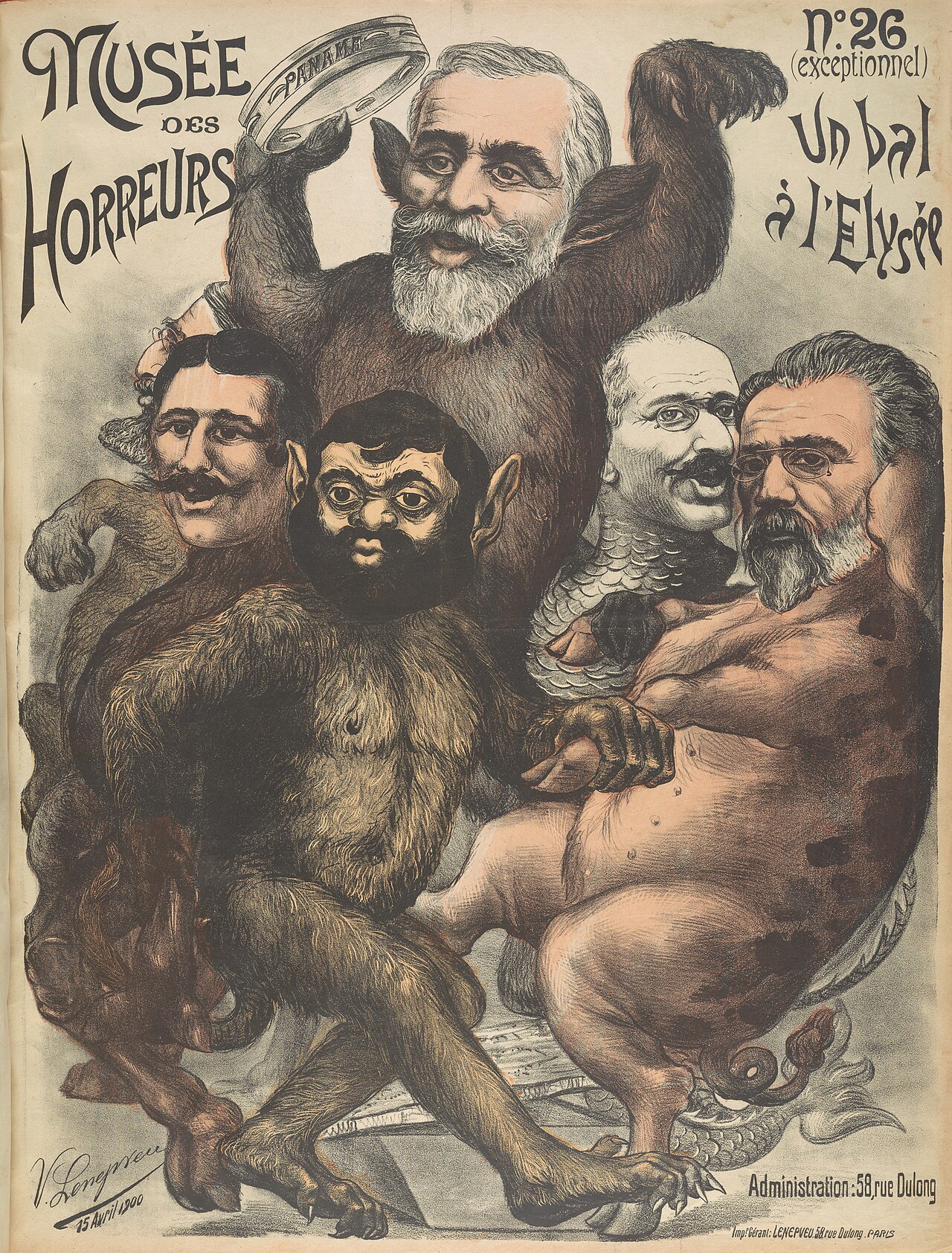
Look at what the picture does. The faces are carefully, recognizably human, real men, drawn so clearly you could pick them out of a crowd. But each head sits on the body of an animal: an ape, a scaled creature, a clawed beast. The faces are accurate on purpose. The whole effect depends on your recognizing the person and then being shown a body that says: this one is not really human.
This is a poster: a large color print, the kind sold cheaply on the street. It comes from a Paris series called the Musée des Horreurs ("Museum of Horrors"), published week by week between 1899 and 1900 by an artist using the name V. Lenepveu. Each plate took a real, named public figure (here, men tied to the Dreyfus Affair, the scandal then tearing France apart over a Jewish army officer falsely convicted of treason) and grafted their face onto a monstrous body. About fifty plates appeared before the government banned the series.
Here is why this poster, and not a page of text, opens the Topic on the "racial turn." Older hatred of Jews accused them of something (a belief, a deed) that a person could in principle answer, renounce, or convert away from. This picture makes no accusation you could argue with. It simply shows the person as not fully human, fixed that way by birth, beyond any defense. That is the whole shift the Topic is about: hatred moving from what a person believes to what a person supposedly is.
Look closer at the single cruelest choice: keeping the faces exact. A cartoonist mocking an idea would distort the face. Lenepveu does the opposite: he keeps the face true and changes the body, so the message is not "this man is foolish" but "this man's kind is a different species." You cannot separate the individual from the body assigned to "their kind." That is racial thinking, drawn.
The series was banned, but the method was not. Cheap color prints carried the racial idea to people who would never read a word of theory, and the technique Lenepveu used, the human face on the subhuman body, became a staple of antisemitic caricature straight through to the Nazi press of the 1930s and the propaganda film Der ewige Jude. Trace it backward and the line is just as clear: from the word "antisemitism" coined twenty years earlier, to the bodies drawn here, to the racial laws of the next century. Once hatred is moved from creed to blood, the next step is to picture the blood, and this is what that picture looked like.
Compare this image with the religious art encountered earlier in the Unit. Medieval anti-Jewish imagery portrayed Jews as spiritually blind, stubborn, or corrupt, wrong in what they believed. This poster does something fundamentally different: it no longer argues that Jews hold the wrong beliefs; it presents them as biologically different beings. That distinction is the central historical shift this Topic traces.
The legal texts that turned prejudice into statute, the Nuremberg Laws and their administrative charts among them, are gathered in the Museum, under Documents and primary papers.
Following the evidence
How do we know the turn was real?
The question: how can a historian tell that the racial turn was a genuine change, and not just another expression of the older anti-Jewish prejudice? Set three pieces of evidence from this Topic side by side:
- Marr’s pamphlet (1879): frames the conflict as one between peoples, argued, in its own words, “from a non-religious standpoint.”
- The Antisemites’ Petition (1880–81): turns that argument into a mass demand to reverse Jewish emancipation, carried by a quarter-million signatures.
- The Nuremberg racial-classification chart (1935): defines “Jew” by the religion of a person’s grandparents: ancestry, not belief.
Read in sequence, the three show the same element shifting, the basis of exclusion moving from religious identity, which a person could in principle change, to hereditary racial identity, which no one can. Naming that transition, and explaining why it mattered, is the reasoning this Topic asks for, not a set of dates to memorize.
Dresden · September 1882
The hatred goes international.
The First International Anti-Jewish Congress met in Dresden on September 11–12, 1882. Organized by the German movement, Stoecker and his coalition foremost, it drew delegates from Germany, Austria-Hungary, and Russia, and its purpose was to spread the doctrine across the European political space.
Its public output was a "Manifesto to the Governments and Peoples of the Christian Nations Threatened by Judaism." The language ran along the now-familiar lines: Jews as an "alien race" inside the Christian nations, a demand to reverse emancipation, proposed restrictions on Jewish presence and immigration, enforced separation.
Dresden marked a pattern that held for decades. Antisemitic movements in France (next section), Austria-Hungary, and Russia, where the 1881–82 pogroms and the May Laws of 1882 were the violent edge, became a connected European network of periodicals, parties, and publishers, operating across borders from the 1880s into the new century.
France: Drumont and the Dreyfus Affair
The French parallel, and its breaking point.
France ran a parallel course through the 1880s and 1890s. Its leading figure was Édouard Drumont (1844–1917), a Catholic journalist who founded the paper La Libre Parole in 1892. His book, La France juive: Essai d'histoire contemporaine ("Jewish France"), appeared in 1886, the French counterpart to Marr's pamphlet. It framed the Jewish presence in French life as a threat to the nation, Jewish economic activity as "exploitation," the racial difference as unbridgeable. It sold roughly 100,000 copies in its first year and built the audience the French antisemitic movement would draw on.
The framework's collision with the French Republic came in the Dreyfus Affair of 1894–1906. Captain Alfred Dreyfus (1859–1935), a French artillery officer from an Alsatian-Jewish family, was convicted of treason on December 22, 1894 on forged evidence: a memorandum, the bordereau, blamed on Dreyfus but in fact the work of another officer, Major Ferdinand Walsin Esterhazy. Dreyfus was sentenced to life on Devil's Island, off French Guiana, and on January 5, 1895 was publicly stripped of his rank in the courtyard of the École Militaire, the scene in this Topic's banner.
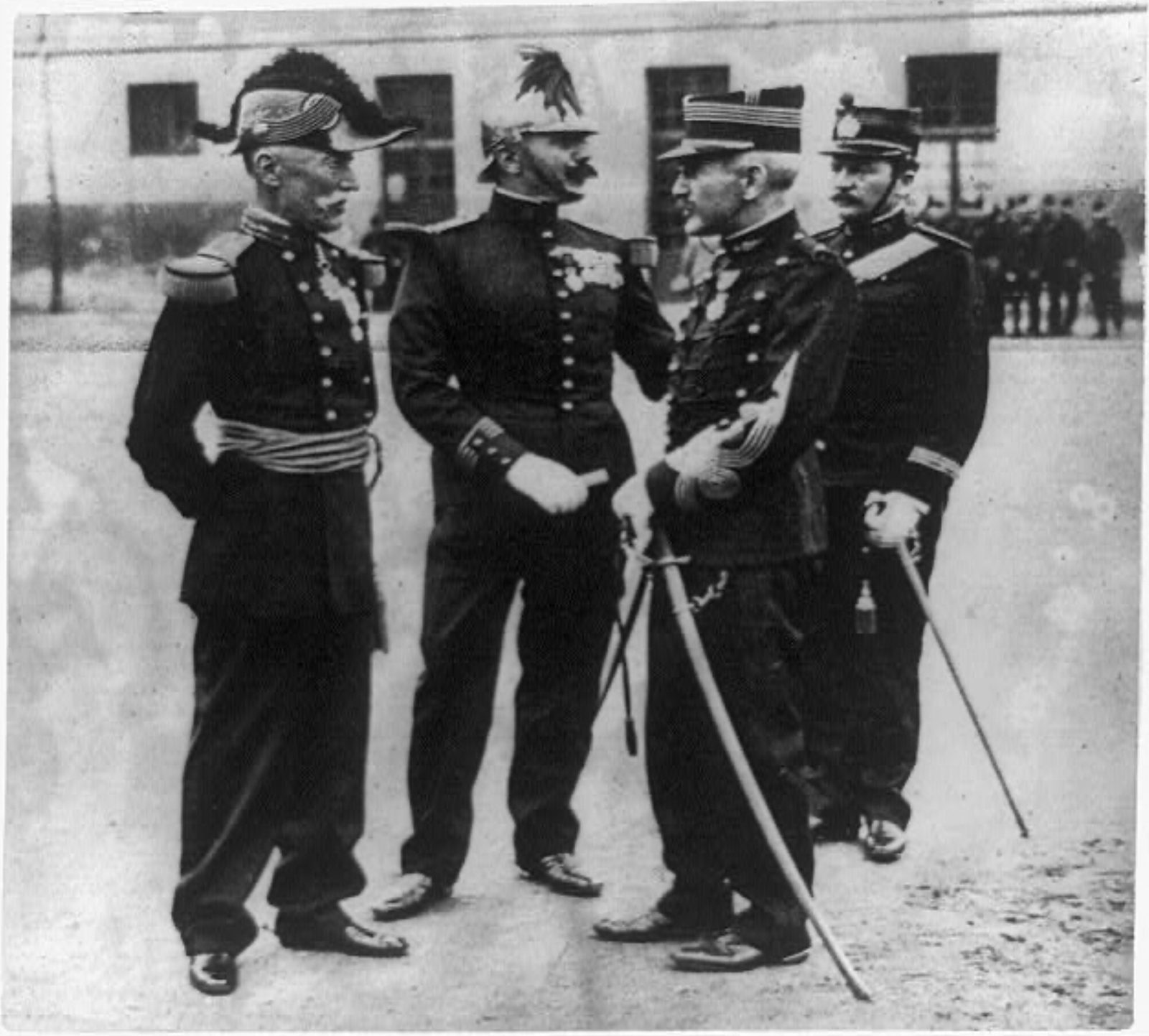
What followed, from 1896 to 1906, was an open national struggle between the antisemitic camp (backed by parts of the Catholic establishment, the army command, and conservative networks) and a Republican coalition of the liberal press, the scientific and intellectual world, and Republican politicians. Its most famous moment was Émile Zola's open letter J'Accuse…!, published in L'Aurore on January 13, 1898, denouncing the conspiracy that had produced the conviction.
The Republic, in the end, held. Dreyfus was brought back from Devil's Island in 1899, retried and convicted again under political pressure (a "guilty with extenuating circumstances" verdict), pardoned by President Émile Loubet on September 19, 1899, and fully exonerated by the Cour de cassation on July 12, 1906. The Affair showed both how far it had reached into French life and that a republic could resist it. It reshaped French politics, the 1905 separation of church and state owed much to it, and it had one further consequence the platform follows elsewhere.
Theodor Herzl (treated in the Herzl Topic) covered the Dreyfus degradation for Vienna's Neue Freie Presse. What he watched in that courtyard, a Jewish officer humiliated before a crowd in the capital of republican Europe, fed directly into his Der Judenstaat (1896) and the movement that followed.
More than a French scandal, the Dreyfus Affair showed that racial antisemitism had become a mass political force beyond Germany, adapting to a new national context while keeping its core assumptions intact. That is why it belongs in this Topic.
Chamberlain and the pseudo-science
The framework, bound between covers.
Houston Stewart Chamberlain (1855–1927) was an English-born writer, later a naturalized German, who married Richard Wagner's daughter Eva in 1908. His major work, Die Grundlagen des neunzehnten Jahrhunderts ("The Foundations of the Nineteenth Century"), appeared in Vienna in 1899, twelve hundred pages attempting to dress the racial theory in the clothes of serious nineteenth-century scholarship.
Its scheme cast European civilization as the achievement of an "Aryan," mainly Germanic-Nordic, race, with Jews set up as the antithetical category. The claims were pseudo-science and were rejected as such by the scientific community. The reach was another matter. The book sold around 100,000 copies up to the First World War and helped shape how a generation of educated Germans understood race and history.
Its readers included Kaiser Wilhelm II, who corresponded with Chamberlain and kept the work in the imperial library, and the German conservative and völkisch literary world. Its most consequential reader was Adolf Hitler, who read Chamberlain over the years and visited him in Bayreuth in September 1923, four months before the Beer Hall Putsch. A letter Chamberlain wrote Hitler that October endorsed him as the man who would carry the racial project forward.
Fritsch's handbook
The Handbuch der Judenfrage.
Theodor Fritsch (1852–1933) was a German antisemitic publisher and the author of the Handbuch der Judenfrage ("Handbook on the Jewish Question"), first issued in 1888 and expanded across forty-nine editions into the 1930s. It was the movement's manual, a compendium of the racial theory, the stock arguments, and quotations drawn from the wider anti-Jewish literature, including Luther's anti-Jewish writings and the Christian theological tradition.
What the Handbuch did was consolidate. It put the whole doctrine into one widely circulated reference, the book German antisemitic activists, publishers, and organizers reached for between 1888 and 1933. Its line to the Nazi movement was direct: Hitler engaged with it, the Nazi era reprinted it, and Fritsch's publishing house (Hammer-Verlag, founded in 1902) was one of the bridges from the late-nineteenth-century theory to the regime that followed.
The bridge to 1935
From the racial turn to the Nuremberg Laws.
The framework built in 1879 reached the Nazi racial categorization of the 1930s through several channels:
- Eugenics. The late-nineteenth and early-twentieth-century eugenics movement, Francis Galton's work in Britain, the American movement under Charles Davenport (with its forced-sterilization laws in many states), and the German Rassenhygiene ("racial hygiene") school under Alfred Ploetz, Wilhelm Schallmayer, and Eugen Fischer, supplied the pseudo-scientific apparatus the Nazi racial project inherited.
- The völkisch movement. The German völkisch current, traced in George Mosse's The Crisis of German Ideology (Schocken, 1964): combined the racial idea with a mystical-national mythology, producing the cultural matrix the Nazi project drew on.
- The pre-1914 antisemitic parties. The German Social Antisemitic Party, the Austrian Christian Social Party under Karl Lueger (Vienna's mayor 1897–1910, whose antisemitic program shaped the city of Hitler's youth), and the wider antisemitic politics of pre-war Central Europe were the political precursors of the Nazi movement.
- The Nuremberg Laws. The four-grandparent definition of "Jew" set in the First Supplementary Decree to the Reich Citizenship Law, November 14, 1935, treated in the 1933–1939 Topic, was the racial doctrine of 1879 turned into statute. The fifty-six years from Marr's pamphlet to that decree are the spine of this Topic.
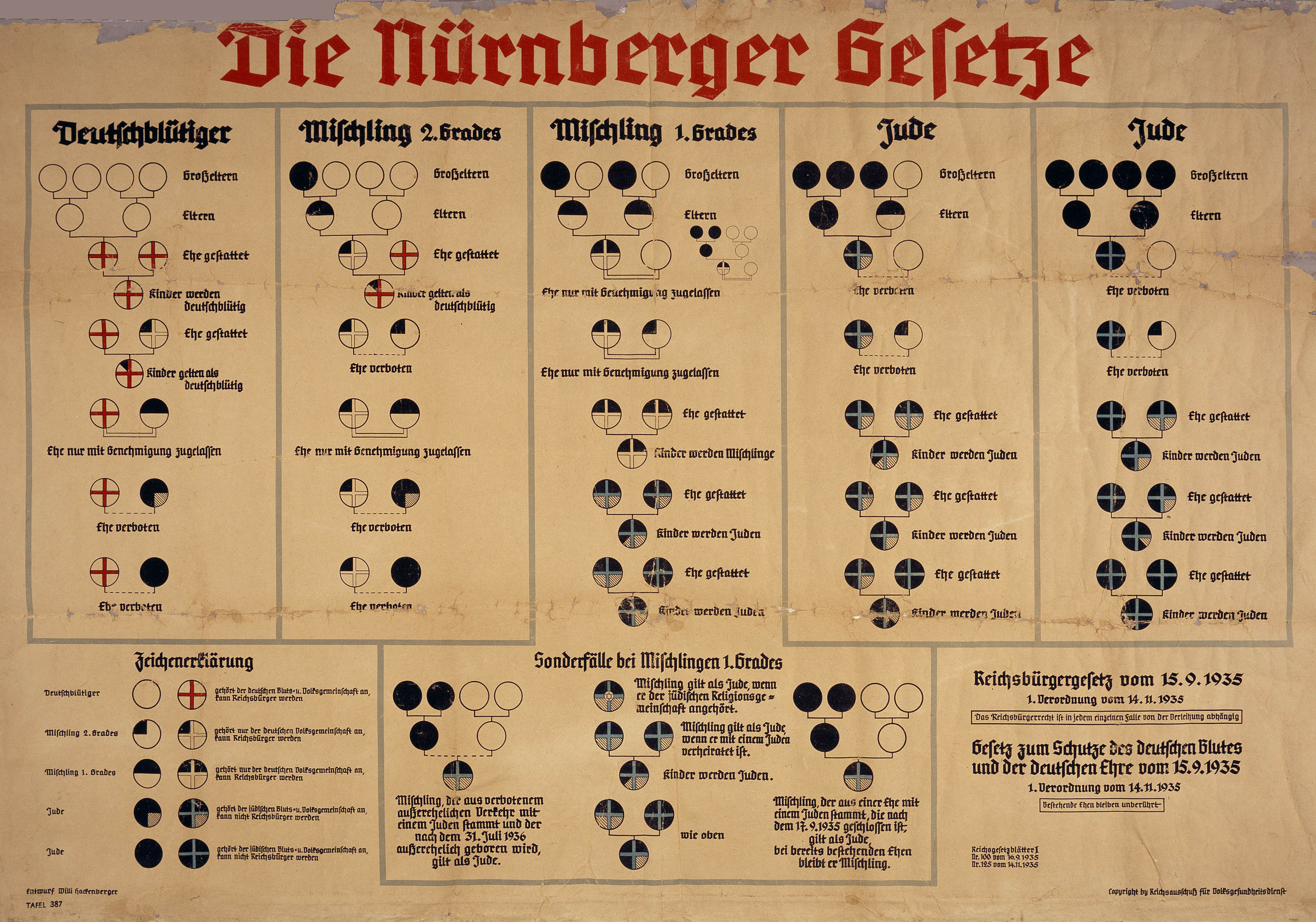
This Topic ends where the Holocaust Unit begins. The racial theories built between 1879 and the early twentieth century became the legal categories that Nazi Germany, after 1933, turned into state policy.
What scholars debate
The honest accounting.
The history of the racial turn carries several open questions. Naming them is part of the method.
- Continuity or break? Whether the racial turn was continuous with the older religious anti-Judaism (broadly Jacob Katz's position in From Prejudice to Destruction: Anti-Semitism, 1700–1933, Harvard, 1980) or a genuine break (broadly Shulamit Volkov's in Germans, Jews, and Antisemites, Cambridge, 2006) is long debated. The middle view holds that the racial turn was a new system that grew out of and extended the religious tradition while adding the one element it had lacked, biological categorization.
- The Sonderweg question. Whether Germany's path from 1879 to the Nazi project was a unique "special path" (Sonderweg) or a variation on a broader European pattern is contested. The view set out in David Blackbourn and Geoff Eley's The Peculiarities of German History (Oxford, 1984) is that Germany's path was distinctive in important ways yet part of a wider European pattern that also produced the Dreyfus Affair, the Russian pogroms, and antisemitic movements across the continent.
- Necessary, or sufficient? Whether the framework Marr and his contemporaries built already contained the Nazi killing project, or was radicalized into it by later events, is debated along intentionalist and functionalist lines. The common judgment is that the framework was a necessary but not a sufficient condition, it set the categorical architecture, while later circumstances (followed in the 1933–1939 Topic) produced the murder.
- The Jewish response. Whether the Jewish responses to the racial turn (integrationist, religious-traditional, Zionist, socialist) were adequate to the danger is a question asked mostly in hindsight. The responses were varied and shaped by what the moment seemed to allow; judging them by what came later is its own kind of distortion.
Key takeaways
- In 1879 a small group of German and French writers recast anti-Jewish hatred from a religious charge into a hereditary, biological one, a category that conversion could no longer escape.
- Wilhelm Marr gave the new framework its name and its first organization; Heinrich von Treitschke gave it academic respectability with the line "The Jews are our misfortune."
- The movement organized fast: the League of Antisemites (1879), the Antisemites' Petition to Bismarck (250,000 signatures, 1881), the Dresden congress (1882), and the French parallel that broke open in the Dreyfus Affair.
- Leading historians, scientists, philosophers, and public intellectuals rejected racial antisemitism as it emerged, yet it continued to gain political influence across Europe.
- The four-grandparent definition of "Jew" in the 1935 Nuremberg Laws was this framework turned into law. The distance from a pamphlet to a statute was fifty-six years.
Discussion questions
Working from the evidence.
These questions ask students to work from the evidence on this page and reach their own conclusions. Each is anchored in a specific fact the Topic documents.
- The page dates the "racial turn" to 1879, the moment anti-Jewish hatred was recast from a religious charge into a hereditary, biological one. Why does it matter that the new version defined Jewishness as something conversion could no longer escape? What does that change about who is targeted, and how?
- Wilhelm Marr coined the term and founded the first organization; Heinrich von Treitschke, a respected historian, gave the idea academic standing with "The Jews are our misfortune." What does it tell you that the movement needed both a popularizer and a respectable scholar to spread?
- The page documents how fast the movement organized, the League of Antisemites in 1879, a 250,000-signature petition by 1881, a congress by 1882. What allows an idea to move from a pamphlet to a mass political movement in just a few years?
- Leading scientists and scholars of the day rejected the racial framework as it was being built, and it spread anyway. The page calls that "the lesson worth holding." Why might expert rejection fail to stop a false idea, and what does that imply about how such ideas are actually countered?
- The four-grandparent definition of "Jew" in the 1935 Nuremberg Laws was this 1879 framework turned into law, fifty-six years from pamphlet to statute. Tracing that line is the same kind of cause-and-effect analysis historians apply to any ideology that becomes policy. Is this intellectual prehistory given the same weight in the curriculum as other roads to state violence? Why or why not?
Classroom Connections
Where this Topic fits.
Teaching Connections
The disciplines and courses this Topic naturally supports, for any educator, anywhere.
- World History, Nationalism & the Modern State: the racial turn as a late-nineteenth-century nationalist movement, and a case study in how an intellectual movement becomes a political one.
- Holocaust & Genocide Studies: the intellectual and legal prehistory of the Nazi racial categorization: the bridge from 1879 to the 1935 Nuremberg Laws.
- Historical Thinking & Source Analysis: Marr’s pamphlet, Treitschke’s article, the Antisemites’ Petition, the Berlin-controversy replies, Drumont’s La France juive, and Zola’s J’Accuse…! as a primary-source set, and distinguishing a pseudo-science recorded as a historical force from one entertained as valid.
Standards Alignment
- NYS Global History & Geography: 10.2 (the rise of nationalism, 1750–1914: the racial turn as a nationalist movement) and 10.5 (the roots of the global conflicts of 1914–1945: the intellectual prehistory of Nazi racial doctrine).
- NYS Holocaust Education Mandate: Education Law §801.
- Common Core ELA-Literacy: RH.11–12.6 and RH.11–12.9 (source perspective and the use of complex primary sources).
Further Teaching Resources
- USHMM Holocaust Encyclopedia, “Antisemitism in History: Racial Antisemitism, 1875–1945”, covers this exact period and includes discussion questions.
- Facing History & Ourselves, “The Roots and Impact of Antisemitism”, a classroom-ready mini-lesson (grades 7–12).
- Echoes & Reflections (USC Shoah Foundation and Yad Vashem): a secondary curriculum (grades 6–12) with a unit on antisemitism.
Sources and citations
Primary sources come straight from the time: documents, letters, speeches, images, and objects created by the people involved. Secondary sources come later: books, articles, and analysis in which scholars study and interpret those primary sources.
Primary sources
- Marr, Wilhelm. Der Sieg des Judenthums über das Germanenthum, vom nicht confessionellen Standpunkt aus betrachtet. Bern: Rudolph Costenoble, 1879. English translation in Richard S. Levy, Antisemitism in the Modern World: An Anthology of Texts (1991); excerpt via German History in Documents.
- Treitschke, Heinrich von. "Unsere Aussichten." Preussische Jahrbücher, vol. 44 (November 1879): 559–576.
- Drumont, Édouard. La France juive: Essai d'histoire contemporaine. 2 vols. Paris: C. Marpon & E. Flammarion, 1886.
- Chamberlain, Houston Stewart. Die Grundlagen des neunzehnten Jahrhunderts. Munich: F. Bruckmann, 1899.
- The Antisemites' Petition (Antisemiten-Petition), submitted to Chancellor Bismarck, April 1881, with some 265,000 signatures. Text in Richard S. Levy, ed., Antisemitism in the Modern World (1991).
- Zola, Émile. “J'Accuse…!” Open letter to the President of the Republic. L'Aurore (Paris), January 13, 1898.
Secondary sources
- Katz, Jacob. From Prejudice to Destruction: Anti-Semitism, 1700–1933. Cambridge, MA: Harvard University Press, 1980.
- Volkov, Shulamit. Germans, Jews, and Antisemites: Trials in Emancipation. Cambridge: Cambridge University Press, 2006.
- Volkov, Shulamit. "Antisemitism as a Cultural Code." Leo Baeck Institute Year Book 23 (1978): 25–46.
- Pulzer, Peter G. J. The Rise of Political Anti-Semitism in Germany and Austria. Cambridge, MA: Harvard University Press, rev. ed. 1988.
- Massing, Paul W. Rehearsal for Destruction: A Study of Political Anti-Semitism in Imperial Germany. New York: Harper, 1949.
- Mosse, George L. The Crisis of German Ideology: Intellectual Origins of the Third Reich. New York: Schocken, 1964.
- Mosse, George L. Toward the Final Solution: A History of European Racism. New York: Howard Fertig, 1978.
- Lindemann, Albert S. Esau's Tears: Modern Anti-Semitism and the Rise of the Jews. Cambridge: Cambridge University Press, 1997.
- Wistrich, Robert S. Antisemitism: The Longest Hatred. New York: Pantheon, 1991.
- Bergmann, Werner. Geschichte des Antisemitismus. Munich: Beck, 2002.
- Zimmermann, Moshe. Wilhelm Marr: The Patriarch of Anti-Semitism. New York: Oxford University Press, 1986.
- Levy, Richard S., ed. Antisemitism in the Modern World: An Anthology of Texts. Lexington: D.C. Heath, 1991.
- Levy, Richard S., ed. Antisemitism: A Historical Encyclopedia of Prejudice and Persecution. 2 vols. Santa Barbara: ABC-CLIO, 2005.
- Boehlich, Walter, ed. Der Berliner Antisemitismusstreit. Frankfurt: Insel-Verlag, 1965.
- Niewyk, Donald L. The Jews in Weimar Germany. Baton Rouge: Louisiana State University Press, 1980.
- Blackbourn, David, and Geoff Eley. The Peculiarities of German History: Bourgeois Society and Politics in Nineteenth-Century Germany. Oxford: Oxford University Press, 1984.
- Bredin, Jean-Denis. The Affair: The Case of Alfred Dreyfus. New York: George Braziller, 1986.
- Birnbaum, Pierre. The Anti-Semitic Moment: A Tour of France in 1898. New York: Hill and Wang, 2003.
- USHMM Holocaust Encyclopedia · Antisemitism. encyclopedia.ushmm.org →
- Yad Vashem · The Roots of Modern Antisemitism. yadvashem.org →
Finding these documents: many primary sources are free online. Good places to start are the Fordham Internet Jewish History Sourcebook, Yale’s Avalon Project (law and diplomacy), German History in Documents, the collections of the US Holocaust Memorial Museum and Yad Vashem, the National Library of Israel, and Sefaria (for Jewish texts). Search the document’s name and date.
The pogrom era of the Russian Empire, confinement in the Pale of Settlement, the waves of 1881, Kishinev in 1903, the violence of 1905, and the world that survived it.
Comments?
Write to editor@makorproject.org.
Last updated: August 2026.