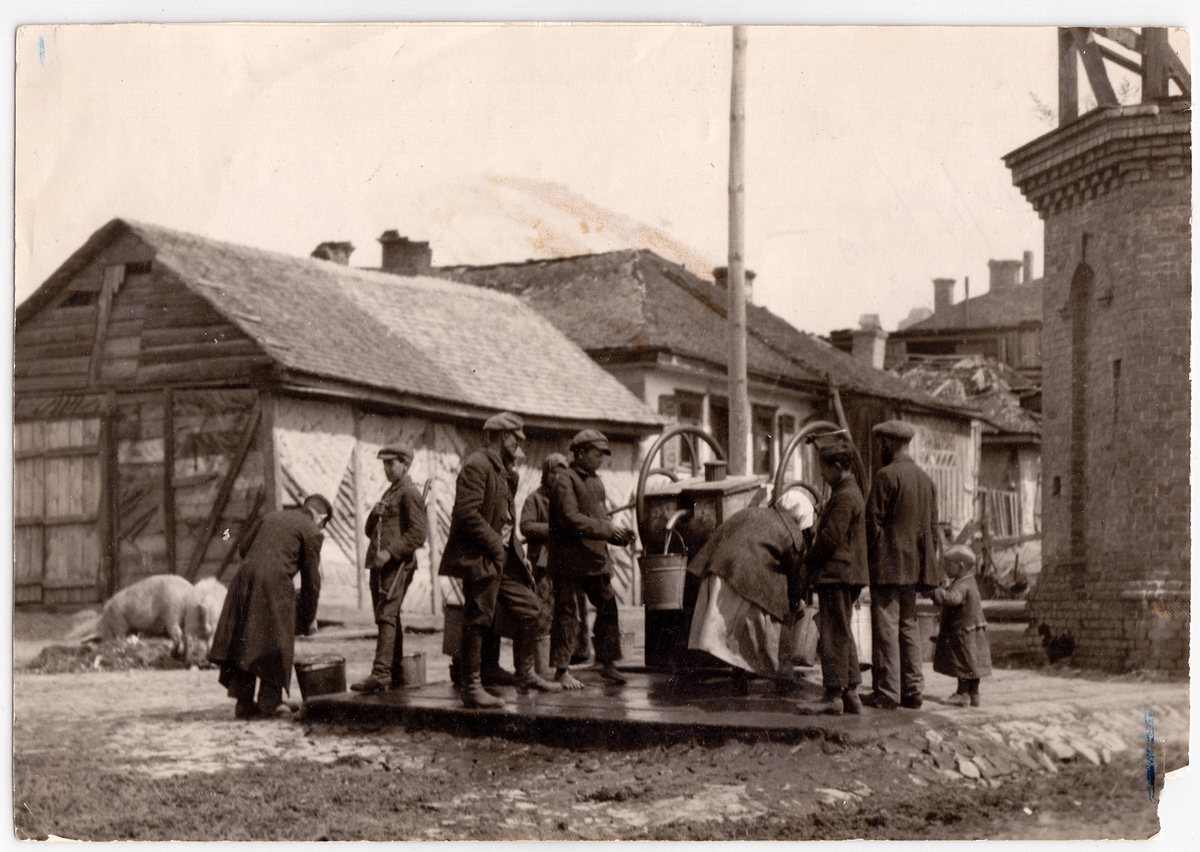
By 1900 roughly five million Jews lived in the Russian Empire, the largest Jewish population on earth, nearly all of them confined by law to a single western zone, and increasingly under attack inside it.
Population figure from the 1897 Imperial Russian census, the first empire-wide count; see John D. Klier, Russians, Jews, and the Pogroms of 1881–1882 (Cambridge University Press, 2011)
Why this Topic exists
The word the world borrowed from this story.
At the dawn of the twentieth century, the largest Jewish community in the world did not live in Berlin, Paris, London, or New York. It lived inside the Russian Empire. Nearly five million Jews lived across thousands of cities, market towns, and villages within the Pale of Settlement. It was a world of synagogues and schools, merchants and craftsmen, newspapers and literature, family life and religious tradition. Within a generation, repeated waves of anti-Jewish violence would transform that world and redirect the course of modern Jewish history.
The English language did not originally have a word for these organized attacks. It borrowed one from Russian: pogrom, derived from a verb meaning “to wreak havoc” or “to demolish.” The word entered English because the events themselves demanded a name.
This Topic follows the history of those attacks while placing them within the larger system that made them possible. It examines the legal restrictions that confined millions of Jews, the political crises that fueled repeated outbreaks of violence, and the migrations that reshaped Jewish life in America and the Land of Israel.
The world that was attacked
Five million people, a thousand towns.
Before it is a story about violence, this is a story about a place, or rather about thousands of places. The Jews of the Russian Empire lived in cities such as Warsaw, Vilna, Odessa, and Kishinev, and in the small market towns the Yiddish-speaking world called shtetlekh. They worked as artisans, traders, peddlers, tailors, water-carriers, and laborers. They prayed in synagogues and study-houses, argued in the press in three languages, sent their children to traditional schools and, increasingly, to Russian ones. They produced the Yiddish literature of Mendele Mocher Sforim and Sholem Aleichem and the Hebrew poetry of Hayim Nahman Bialik. This was not a marginal community waiting at the edge of history. It was, by 1900, the demographic and cultural heart of the Jewish world.
Understanding this world matters because the story of the pogroms is not only about violence. It is about the destruction, transformation, and migration of one of the largest and liveliest Jewish communities in modern history.
Understanding this world matters because the story of the pogroms is not only about violence. It is about the destruction, transformation, and migration of one of the largest and liveliest Jewish communities in modern history.
A residence fixed by law
The Pale of Settlement.
From 1791 until 1917, Jews in the Russian Empire were permitted to live, with narrow exceptions, only within a designated western zone known as the Pale of Settlement. The Pale was not a ghetto in the medieval European sense, not a walled quarter inside a city, but a territory roughly the size of France, covering what is today Lithuania, Belarus, Moldova, much of Ukraine, and eastern Poland. Within it, Jews were further barred from certain cities and from the countryside in some provinces. Outside it, residence was forbidden to all but a few permitted categories: holders of university degrees, merchants of the wealthiest guild, certain artisans, and military veterans.
Why create such a zone? The Pale took shape from the 1790s, after the partitions of Poland brought the largest Jewish population in the world under Russian rule. The state sought both to control and to contain a community it regarded as culturally and religiously distinct, and to keep it out of the empire’s interior. The result was not simply a geographic boundary but a legal system governing where millions of Jews could live.
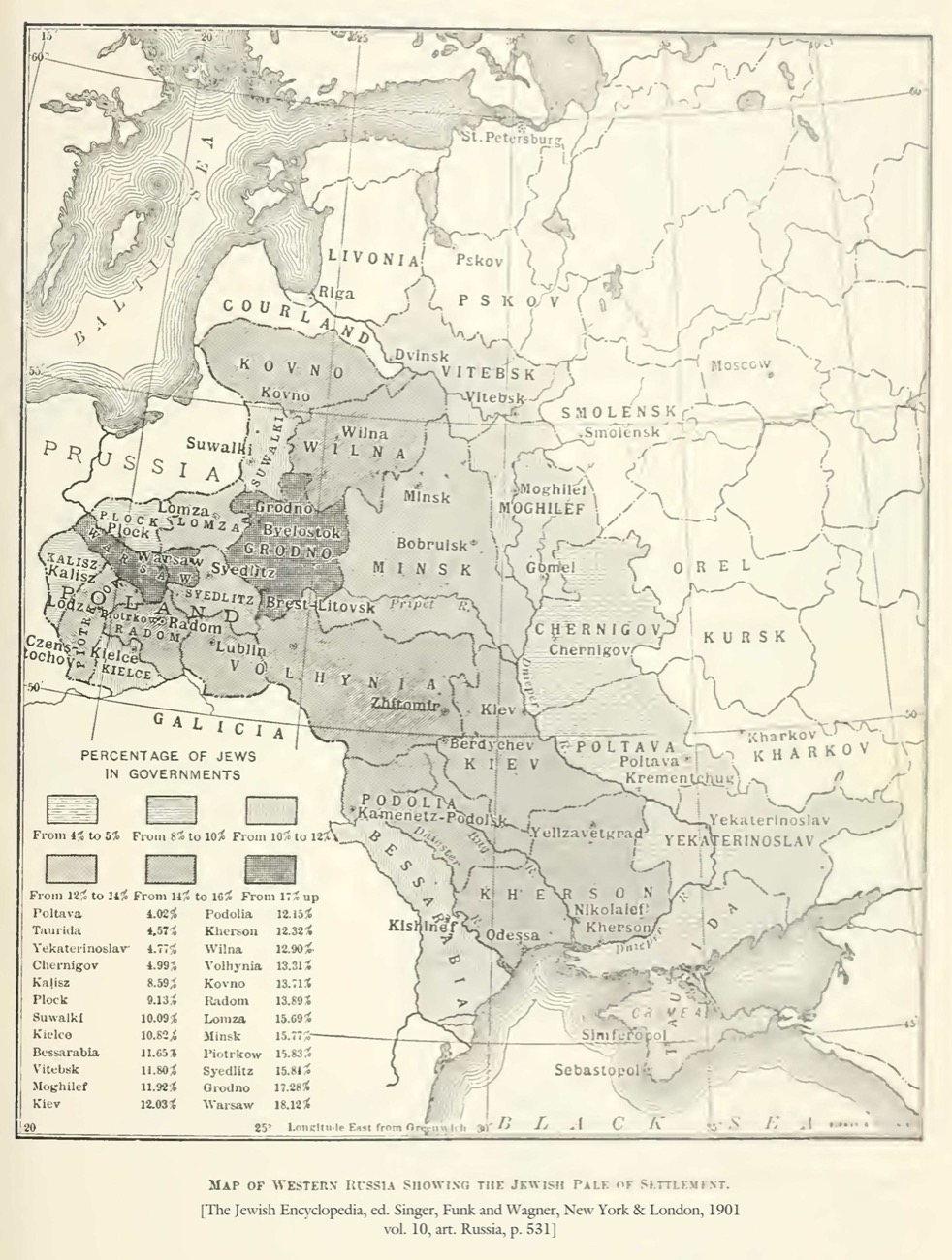
From The Jewish Encyclopedia, vol. 10 (New York: Funk & Wagnalls, 1905). Public domain, via Wikimedia Commons.
The Pale was a tool of confinement, written into law. It packed millions of people into one fixed zone, limited where they could go, capped how many could attend Russian schools, and kept the whole community in plain view of anyone who meant it harm. The violence that came after 1881 happened inside this zone, against a population the law had already gathered up and confined.
Common misconceptions this Topic addresses
The Russian pogroms are often flattened into a single story of top-down state planning, or folded into the later forged conspiracy theories they helped inspire. The dedicated entries separate what the archival record supports from the myths that grew around it.
- "The Tsarist government secretly planned and ordered the pogroms." See the entry →
- "The Protocols of the Elders of Zion exposed a real plot." See the entry →
- "The Russian pogroms were the Holocaust." No. The pogroms and the Holocaust were different historical events separated by decades. The pogroms consisted of repeated episodes of mob violence within the Russian Empire, while the Holocaust was a systematic campaign of genocide carried out by Nazi Germany and its collaborators. Historians study the pogroms because they reveal how legal discrimination, inflammatory propaganda, official indifference, and organized violence can reinforce one another, not because they were identical to the Holocaust. See the entry →
Object Spotlight
A permit to leave, granted one year at a time.
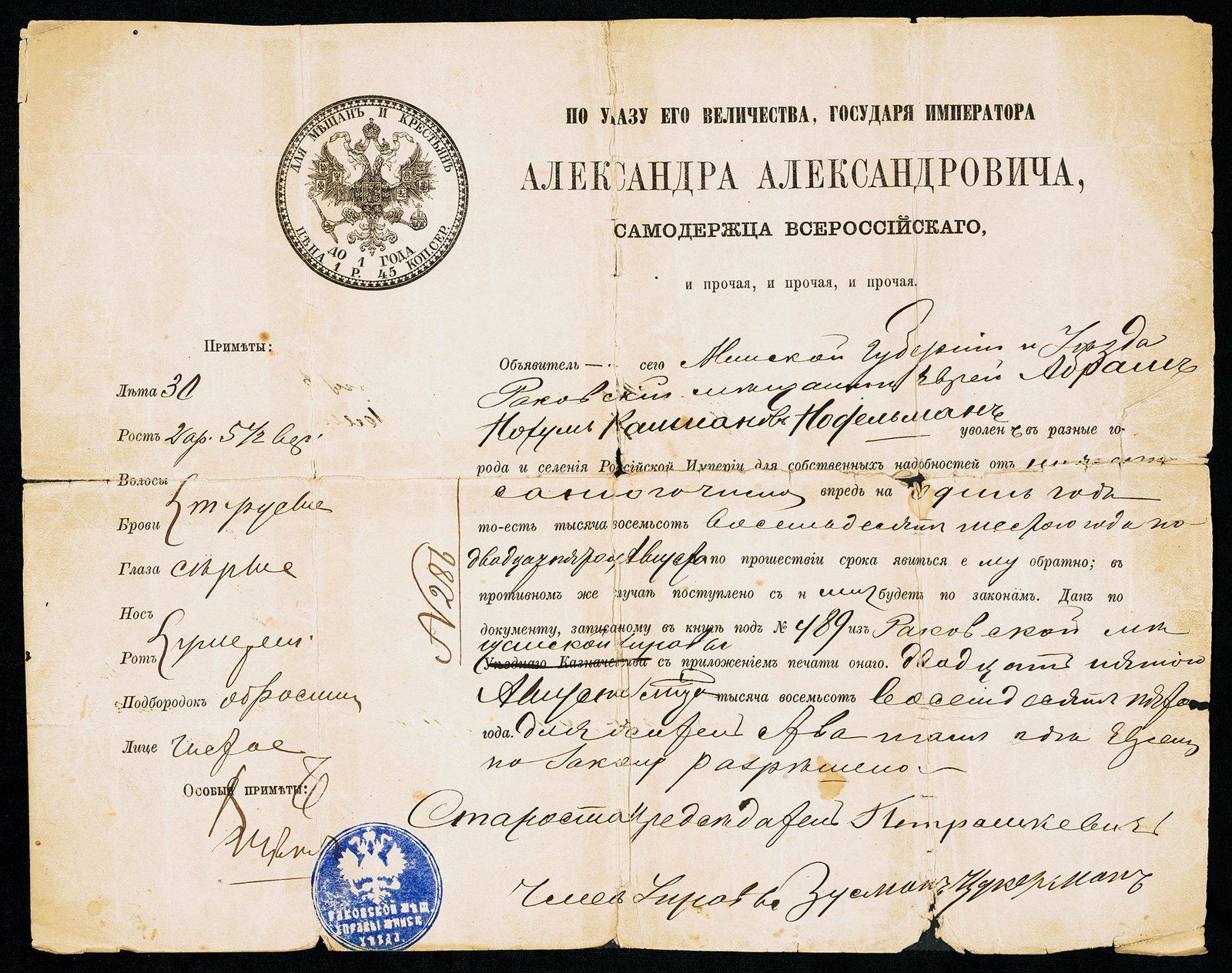
It is a single worn sheet of paper, printed in Russian, soft at the folds from being carried. At the top sits a double-headed eagle, an official stamp. Below the printed lines, someone has filled in blanks by hand: a person's description, a reason, a date. There is an inked stamp down in one corner. It looks like nothing, the kind of form you would throw away. That is the point.
This is a travel permit, issued in 1885 to a Jewish man from the town of Raków. To understand it you need one piece of background: in the Russian Empire, Jews were not allowed to live wherever they wanted. By law they were confined to a region along the empire's western edge called the Pale of Settlement ("pale" being an old word for a fenced-in area). Around five million Jews lived inside it. This sheet of paper gave one of them permission to step outside the Pale, to travel for business, and only for a set length of time.
Here is why a dull little form opens this whole Topic better than any photograph of violence could. The pogroms, the mob attacks, are the loud part of the story. But underneath them ran a quieter, constant pressure: a state that controlled where five million people could stand, sleep, and earn a living, and did it through ordinary paperwork. The permit shows confinement not as a wall but as a routine: stamped, filed, and renewable. For a Jewish subject, leaving the Pale even for a week was not a right. It was a favor the state could grant for a year and refuse the next.
Look closely at the handwritten lines: a physical description of the holder, the single permitted reason, the expiration. The freedom most people never think about, to get on a road and go, was, for this man, spelled out, dated, and stamped by a clerk. Read the document and you can feel the weight of living inside someone else's permission.
And the paperwork had an end point. As the restrictions tightened and the pogroms spread through the 1880s and after, the answer for millions was to leave the empire altogether. Between 1881 and the 1920s, roughly two million Jews emigrated from the Russian Empire (most to the United States, others to Britain, Argentina, Palestine, and beyond) in one of the largest migrations of the era. The little permit, designed to control movement, belongs to the system that finally drove that movement out of the country entirely. The descendants of the people who carried papers like this one now live across the world.
Following the evidence
Were the pogroms spontaneous?
The question: were the pogroms simply spontaneous outbreaks of violence, or did earlier government policies help make them possible? Use four pieces of evidence from this Topic:
- the map of the Pale of Settlement;
- the 1885 travel permit in the Object Spotlight above;
- the May Laws of 1882;
- the description of the Kishinev pogrom.
Trace how legal restriction (the Pale and the permit), inflammatory accusation (the blood libel revived in print in the weeks before Kishinev), and inconsistent government protection (a state that restricted the victims and whose officials stood aside during the violence) combined to create the conditions in which repeated violence could occur.
Rather than looking for a single cause, historians reconstruct how multiple factors reinforced one another over time.
Following the evidence
Were the pogroms spontaneous?
The question: were the pogroms simply spontaneous outbreaks of violence, or did earlier government policies help make them possible? Set four pieces of evidence from this Topic side by side:
- The map of the Pale of Settlement: the population the law had already gathered into one fixed zone.
- The 1885 travel permit in the Object Spotlight above, a single document of how tightly the state controlled where a Jew could go.
- The May Laws of 1882: the state’s answer to violence was further restriction, not protection.
- The account of the Kishinev pogrom: violence prepared by a newspaper’s incitement and let happen by officials who stood aside.
Ask how legal restriction, inflammatory accusations, and inconsistent government protection combined to create conditions in which repeated violence could occur. Rather than looking for a single cause, historians reconstruct how multiple factors reinforced one another over time.
The waves of 1881
The assassination, and the storm that followed.
The assassination of 1881. In March 1881, revolutionaries assassinated Tsar Alexander II. One of the conspirators was a young Jewish woman, and that fact was seized upon. Beginning that spring and continuing into 1882, a wave of anti-Jewish riots swept the southwestern provinces of the Empire, more than two hundred separate outbreaks, concentrated in present-day Ukraine. Mobs looted and destroyed Jewish homes, shops, and synagogues; assaults and rapes occurred; a smaller number of people were killed. The mix differed from town to town, and no two pogroms looked exactly alike, a point worth holding, since the single word can suggest one uniform kind of event.
The historian John Klier, whose research is the standard account, showed that these riots were not ordered from the capital, as later legend claimed. They grew out of local tensions and rumor, in a state that was often slow, careless, or simply unwilling to protect its Jewish subjects. The difference matters. The violence did not need a master plan. It needed only a story that blamed the Jews, a population fixed in place, and officials who looked away. That combination would return again and again.
The state's response
The May Laws of 1882.
The Empire's answer to the violence was not protection. It was more restriction. The "Temporary Regulations" of May 1882, known as the May Laws, banned Jews from settling in the countryside even inside the Pale. They limited Jewish trade on Sundays and Christian holidays. They tightened the quotas that capped how many Jewish students could enter high schools and universities. Rules passed as temporary stayed in force for decades. Crucially, the May Laws did not create the Pale, that zone was already a century old; they made its existing restrictions harsher.
The May Laws made the official logic plain. Confronted with mobs attacking a minority, the government treated the minority as the problem to be managed. Restriction followed violence, and the two reinforced one another: each new legal disability confirmed the message that Jews were a population apart, legitimately subject to special control.
Violence and law reinforced one another. Mobs attacked Jewish communities, while the state responded by imposing even tighter legal restrictions on those same communities. Together they strengthened the idea that Jews were a separate population governed by different rules rather than citizens entitled to equal protection under the law.
Violence and law reinforced one another. Mobs attacked Jewish communities, while the state responded by imposing even tighter legal restrictions on those same communities. Together they strengthened the idea that Jews were a separate population governed by different rules rather than citizens entitled to equal protection under the law.
Kishinev · 1903
The pogrom the whole world read about.
Kishinev, April 1903. At Easter, in the city of Kishinev (today Chișinău, the capital of Moldova), a pogrom broke out that would become the era's defining episode. Forty-nine Jews were killed and hundreds were wounded over two days; homes and shops across the Jewish quarter were destroyed. The ground had been prepared by a local newspaper edited by Pavolachi Krushevan, which had run the old blood-libel accusation, the claim that Jews murdered Christian children for ritual purposes, in the weeks beforehand.
What set Kishinev apart was not its scale, forty-nine dead made it far from the deadliest pogrom of the era, but its reach, and the new ways the world came to know it. Photographs of the aftermath circulated internationally; detailed accounts ran in the world press; protest meetings filled halls across Western Europe and the United States; relief funds were raised across the Atlantic; and the killing drew formal diplomatic protest, including a petition to the Tsar that President Theodore Roosevelt forwarded. The Hebrew poet Hayim Nahman Bialik was sent to interview survivors and produced "In the City of Slaughter," a poem whose fury was directed not only at the killers but at what he saw as Jewish passivity, a work that helped give rise to the Jewish self-defense movement. In its wake, organized self-defense groups began to form across the Pale, a deliberate turn from flight to resistance. Kishinev became a turning point that pushed many toward the conclusion that safety would require either departure or self-protection, and sometimes both.
The violence of 1905
Revolution, and a second, larger wave.
The wave of 1905. In October 1905, defeated in war with Japan and facing revolution, Tsar Nicholas II issued the October Manifesto granting civil liberties and an elected assembly. The concession set off a counter-reaction. Right-wing groups, among them the militias known as the Black Hundreds, blamed Jews for the revolution and for the humiliation of the autocracy, and in the weeks that followed, hundreds of pogroms broke out across the Empire's south and southwest.
The worst fell on Odessa, the great Black Sea port where Jews were about a third of the city. Historians still disagree on how many died there, estimates run from several hundred to more than a thousand, and the true number is contested, but by any count it was, in the words of the historian Robert Weinberg, the most destructive of all the 1905 pogroms. Across the Empire, the autumn of 1905 brought hundreds of separate attacks and thousands of casualties in a matter of weeks. In many places, Jewish self-defense groups, the legacy of Kishinev, fought back.
The civil-war pogroms
The worst was still to come.
The pogroms of the Tsarist period, terrible as they were, were exceeded by the violence that engulfed the former Empire during the Russian Civil War of 1918–1921. As Bolshevik, anti-Bolshevik "White," Ukrainian nationalist, and other forces fought across Ukraine and Belarus, Jewish communities were attacked on a scale without precedent in the region. The forces associated with the Ukrainian leader Symon Petliura were responsible for many of the deadliest episodes, though attacks came from multiple sides.
Historians estimate the dead in these years in the tens of thousands, with some assessments far higher; hundreds of thousands more were left homeless, orphaned, or destitute. This was the largest wave of anti-Jewish violence anywhere between the late-nineteenth-century pogroms and the Holocaust, and a grim demonstration that when central authority collapsed entirely, the restraints that had limited even the Tsarist pogroms fell away.
Writing it down while it happened
The people who documented their own catastrophe.
Something else happened during those years, quieter than the violence but just as remarkable. Even as the pogroms were still going on, a group of Jewish scholars and activists in Kiev, in Ukraine, set out to record them, collecting eyewitness accounts, photographs, lists of the dead, and official papers, town by town. They understood that if no one wrote it down, it could later be denied or simply forgotten. Their collection, the Mizrakh Yidisher Historisher Arkhiv (the Archive for the History of Eastern European Jews), became one of the most complete records of the 1919–1921 pogroms anywhere in the world.
The part of that archive which survived the Holocaust is now held at the YIVO Institute for Jewish Research in New York, within the papers of the historian Elias Tcherikower, and is being cataloged and digitized so that anyone can study it. Among the documents is a building-by-building list of people wounded in a single pogrom in Kiev, the kind of record that turns an unimaginable number back into named individuals on specific streets. It is a primary source in the truest sense: not a later historian's summary, but the evidence gathered by the people who lived through it.
The archive also demonstrates one of the central principles of historical scholarship. Historians do not reconstruct the past from memory alone. They reconstruct it from documents, testimony, photographs, official records, and personal accounts preserved by people who understood, even while events were unfolding, that the evidence itself had to survive. Preserving the record became an act of historical preservation as important as preserving the community’s memory.
The archive also demonstrates one of the central principles of historical scholarship. Historians do not reconstruct the past from memory alone. They reconstruct it from documents, testimony, photographs, official records, and personal accounts preserved by people who understood, even while events were unfolding, that the evidence itself had to survive. Preserving the record became an act of historical preservation as important as preserving the community’s memory.
You can explore some of these materials, and the story of the scholars who saved them, at the YIVO Edward Blank Vilna Online Collections.
What the violence set in motion
Two movements, born from the same pressure.
The pogrom era did not only destroy. It redirected the course of modern Jewish history along two paths that still shape the world.
The first was migration. Between 1881 and 1924, roughly two million Jews left the Russian Empire, the great majority bound for the United States, with others going to Britain, Argentina, South Africa, and beyond. This is the migration that built American Jewry, the story told in the Topic on American Jewry. The second path led to the Land of Israel. The waves of immigration known as the First and Second Aliyah were driven in large part by the Russian pogroms. Kishinev in particular sharpened the urgency felt by Theodor Herzl and the early Zionist movement, a story told in the Topic on Herzl and the Land of Israel.
Neither outcome was what the rioters wanted. The attempt to drive a people out did not make them vanish. It scattered and rebuilt them, in new countries and new languages. The violence redirected modern Jewish history.
One turn of a recurring cycle
The shape of it, seen again.
The Russian pogroms followed a sequence that turns up again and again across this Unit. A community is already set apart by law. A moment of stress arrives, an assassination, a lost war, a revolution. An old accusation is pulled out to explain the crisis. Rumor and incitement spread, often in print. Violence follows. Officials stand aside, or take the mob's side. And afterward come both new restrictions and the slow work of rebuilding. The same steps appear in the medieval blood libel, in the ghetto system, and, at its most extreme, in the Holocaust era.
Recognizing the sequence is the point of studying it. The mechanism is not unique to any one century or country, which is exactly why it can be recognized when it begins to assemble again.
Key takeaways
- By 1900 the Russian Empire held roughly five million Jews, the largest Jewish population on earth, nearly all confined by law to the western zone called the Pale of Settlement.
- The Pale was not a city ghetto but a territory the size of France. It concentrated millions of people in one place, limited their movement and schooling, and kept the community within reach of anyone who meant it harm.
- The English word pogrom was borrowed from Russian in the 1880s, carried on the news of organized mob attacks that came in waves after 1881.
- Kishinev (1903) became the era's defining episode, 49 killed, worldwide press coverage, and a turning point that spurred both Jewish self-defense and the urgency of the early Zionist movement.
- The violence redirected modern Jewish history along two paths: the migration of roughly two million Jews, mostly to America, between 1881 and 1924, and the early waves of settlement in the Land of Israel.
- The major Tsarist pogroms grew from local conditions and official neglect, not from secret orders at the top, which is exactly why the pattern can recur, and be recognized, anywhere.
Discussion questions
Working from the evidence.
These questions ask students to work from the evidence on this page and reach their own conclusions. Each is anchored in a specific fact the Topic documents.
- The Pale of Settlement and the medieval ghetto were different in scale, a quarter of a continent versus a few city streets, but shared a logic. Using what the page says about both, what did confinement by law actually do to the people inside it, and why might a government choose it?
- The travel permit in the Object Spotlight let one man leave the Pale for business, for a limited time. What does it tell you that freedom of movement was granted one document at a time, rather than held as a right?
- Historian John Klier showed the major pogroms were not ordered from the capital. Why does it matter whether catastrophic violence requires a master plan, and how does that change what you watch for?
- Kishinev in 1903 became known worldwide while earlier pogroms did not. What role did the press play, and how does the way an event is reported shape whether the world responds?
- The attempt to drive Jews out of the Empire produced migration to America and settlement in the Land of Israel, not disappearance. What does that outcome suggest about the limits of violence as a tool against a people?
Classroom Connections
Where this Topic fits.
Teaching Connections
The disciplines and courses this Topic naturally supports, for any educator, anywhere.
- World History, Nationalism & the Nation-State: how a modern state controlled a minority through law, and how political crisis turned prejudice into violence.
- Migration & Diaspora: the exodus that built American Jewry and the settlement that reshaped Jewish life in the Land of Israel.
- Historical Thinking & Source Analysis: reading the Pale map, the 1885 travel permit, and the press record of Kishinev as evidence of how violence became possible.
- Civic Education: legal discrimination, official indifference, and the conditions in which mob violence recurs.
- Bridge to Unit 4: the recurring pattern of restriction, propaganda, indifference, and violence, without equating the pogroms with the Holocaust.
Standards Alignment
- NYS Global History & Geography: 10.4 (nationalism and the nation-state) and 10.9 (the causes and effects of mass migration in the nineteenth and early twentieth centuries).
- Common Core ELA-Literacy: RH.11–12.6 and RH.11–12.7 (source perspective; integrating a map, a document, and narrative accounts).
Further Teaching Resources
- Tablet · The Russian Rothschilds (the Gunzburg family), bankers and philanthropists who complicate the stereotype of the Russian Jew.
- YIVO Encyclopedia · The Pale of Settlement, the standard scholarly reference on the legal zone.
- Yad Vashem · Education & E-Learning, classroom materials on Jewish life in Eastern Europe before the Holocaust.
Sources and citations
Primary sources come straight from the time: documents, letters, speeches, images, and objects created by the people involved. Secondary sources come later: books, articles, and analysis in which scholars study and interpret those primary sources.
Primary sources
- Bialik, Hayim Nahman. "In the City of Slaughter" (1904), written after the Kishinev pogrom of 1903. Available in standard English translations.
- First General Census of the Russian Empire, 1897 (population data on the Jewish communities of the Pale).
- The May Laws (Temporary Regulations Concerning the Jews), Imperial Russia, May 15, 1882.
- The decree of Catherine II, 1791, restricting where Jews could live and trade: the legal origin of the Pale of Settlement.
- Davitt, Michael. Within the Pale: The True Story of Anti-Semitic Persecution in Russia. 1903. The journalist's eyewitness investigation of the Kishinev pogrom.
Secondary sources
- Klier, John D. Russians, Jews, and the Pogroms of 1881–1882. Cambridge: Cambridge University Press, 2011.
- Klier, John D., and Shlomo Lambroza, eds. Pogroms: Anti-Jewish Violence in Modern Russian History. Cambridge: Cambridge University Press, 1992. (Includes Robert Weinberg, "The Pogrom of 1905 in Odessa: A Case Study.")
- Klier, John D. Imperial Russia's Jewish Question, 1855–1881. Cambridge: Cambridge University Press, 1995.
- Dekel-Chen, Jonathan, David Gaunt, Natan M. Meir, and Israel Bartal, eds. Anti-Jewish Violence: Rethinking the Pogrom in East European History. Bloomington: Indiana University Press, 2011.
- Pinkus, Benjamin. The Jews of Russia and the Soviet Union: A History of a National Minority. Cambridge: Cambridge University Press, 1988.
- YIVO Institute for Jewish Research. The YIVO Encyclopedia of Jews in Eastern Europe, articles on the Pale of Settlement and on pogroms. encyclopedia.yivo.org.
Finding these documents: many primary sources are free online. Good places to start are the Fordham Internet Jewish History Sourcebook, Yale’s Avalon Project (law and diplomacy), German History in Documents, the collections of the US Holocaust Memorial Museum and Yad Vashem, the National Library of Israel, and Sefaria (for Jewish texts). Search the document’s name and date.
The Protocols of the Elders of Zion, a fabricated text, its Russian origin, the 1864 French satire it plagiarized, its 1921 exposure as a forgery, and how a refuted text kept circulating for a century.
Comments?
Write to editor@makorproject.org.
Last updated: August 2026.