In September 1897, after the First Zionist Congress at Basel, Theodor Herzl wrote in his diary: "At Basel I founded the Jewish State. If I said this aloud today I would be greeted by universal laughter. Perhaps in five years, certainly in fifty, everyone will know it." He died seven years later, at 44, having seen none of it come true. The State of Israel was founded fifty years and nine months after he wrote those words.
Theodor Herzl · Unit 5
Why this Topic exists
One man, eight years, a state.
It is rare for one individual to transform an existing current of thought into an organized international political movement. Herzl did not invent Jewish attachment to the Land of Israel or the earliest Zionist settlements, but he gave modern political Zionism its program, institutions, and international diplomatic strategy. In roughly eight years, from 1896 to his death in 1904, he took an idea that sounded like a fantasy and built the machinery to carry it: a political movement, a yearly congress, a worldwide organization, and a diplomatic campaign that treated a stateless people as if it already had a seat at the table. Fifty years later that machinery produced the State of Israel.
This Topic is the story of how a comfortable, assimilated journalist who had never been especially religious came to spend the last third of his short life on that project, and the honest complications that came with it. It pairs with the Modern State of Israel Topic, which picks up the story Herzl started and follows it to 1948 and beyond. Here we stay with the founder. (Herzl also belongs to Unit 3, on the evolution of antisemitism, because it was antisemitism, more than anything, that made him.)
Object Spotlight
A hundred-page pamphlet.
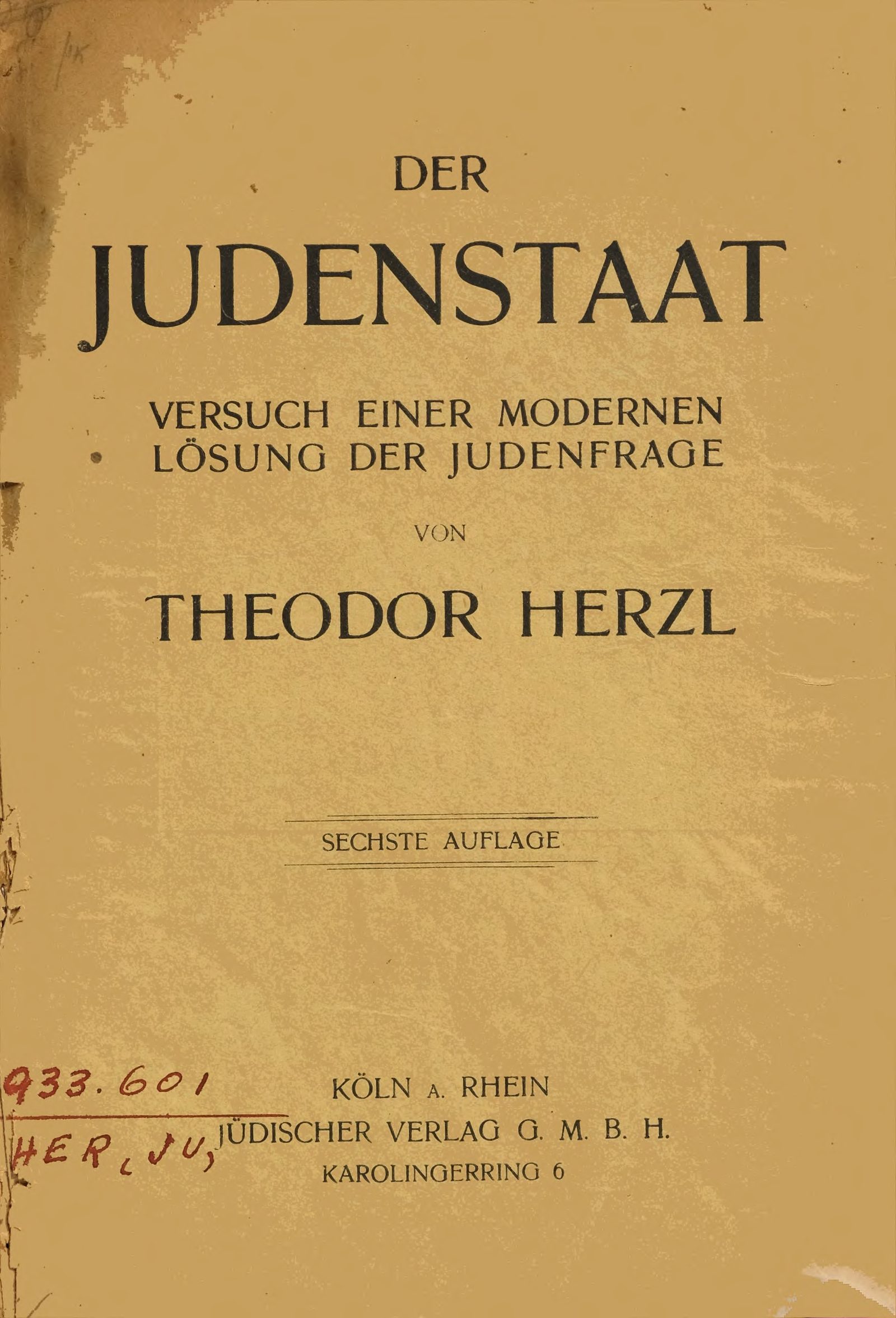
In February 1896 a small book went on sale in Vienna and Leipzig. It was about a hundred pages (a pamphlet, really), and its German title was Der Judenstaat: "The State of the Jews." Its author was a successful newspaper writer with no political following and no money behind him. By any normal measure it should have vanished.
Instead it started a movement. The argument was blunt. For a century, Herzl wrote, European Jews had been told that if they assimilated, dropped their differences, became loyal citizens, blended in, antisemitism would fade. It hadn't. It was getting worse, in the most modern and enlightened cities on the continent. His conclusion followed coldly from that: if Jews could not be safe as a minority inside other nations, they needed a nation of their own, a sovereign state where they were the hosts rather than the guests.
The pamphlet did not just complain; it engineered. Herzl sketched the institutions a future state would need, a body to handle the politics, a body to handle the money, plans for immigration, settlement, and government. He even weighed two possible locations, Argentina and the Land of Israel (Palestine), judging that the historic and emotional pull of the Land of Israel was far stronger. It read less like a dream and more like a business plan for a country that did not yet exist.
The reaction split exactly along the lines you would expect. Comfortable, assimilated Western European Jews, the very people Herzl had been one of, were often embarrassed or hostile; many had staked their lives on the promise that assimilation would work, and here was one of their own declaring it a dead end. The warmest response came from the poorer, more persecuted Jews of Eastern Europe, living under the pogroms and restrictions of the Russian Empire, for whom Herzl's blunt diagnosis simply matched what they already knew.
That is why the little book is the object at the center of this page. It is the document where a private despair became a public plan, and where, for the first time, the idea of a Jewish state stopped being a prayer and became a program with an address, a budget, and a deadline.
Budapest and Vienna · 1860–1894
The assimilated journalist.
Theodor Herzl was born on May 2, 1860, in Pest, the eastern half of what is now Budapest, Hungary, then part of the Austro-Hungarian (Habsburg) Empire. His family were exactly the kind of Jews his later pamphlet would describe: well-off, German-speaking, comfortable in European society, religiously Jewish but not strict about it, and confident that Europe was home. His father was a successful merchant. When Herzl was eighteen the family moved to Vienna, the imperial capital, and he studied law at its university, earning his doctorate in 1884.
He barely practiced. What he wanted was to write, and he was good at it. Through the 1880s and early 1890s he built a real reputation in Vienna's literary world, as a playwright (he wrote around twenty plays, several actually staged) and as an essayist for the Neue Freie Presse, the most important liberal newspaper in the city. In 1891 the paper sent him to Paris as its correspondent. Nothing about this elegant, witty, theater-writing journalist suggested he would become a revolutionary. He was a man of the European establishment, and he liked it there.
He was not blind, though. Political antisemitism was rising across Central Europe (in Vienna, the openly antisemitic politician Karl Lueger was building the following that would make him mayor in 1897), and Herzl had watched it with growing unease for years. The traditional account, drawn from Herzl's own later words, makes one event in Paris the lightning bolt that changed him. Scholars now think it was more like the last straw on a pile that had been building for a while. Either way, what happened in Paris in early 1895 turned unease into a mission.
The Dreyfus Affair · 1894–1895
The mob in Paris.
In 1894, a French army officer named Alfred Dreyfus was convicted of treason and sentenced to a prison island. Dreyfus was a Jew, the evidence against him was forged, and the case would eventually split France in two before he was cleared years later. (The Affair has its own place in the story of modern antisemitism.) Herzl, as the Paris correspondent of his Vienna newspaper, was there to cover it.
On January 5, 1895, he watched the public ceremony in which Dreyfus was stripped of his rank, his sword broken, his insignia torn off, in the courtyard of a Paris military school. And he heard the crowd outside. They were not shouting "Death to the traitor." They were shouting "Mort aux Juifs!", "Death to the Jews!", in Paris, in the country that had been the first in Europe to grant Jews equal citizenship, the home of liberty and the rights of man.
For Herzl that was the proof. If even France, enlightened, republican France, could turn on its Jews this easily, then no amount of assimilation anywhere would ever make Jews safe. The problem was not that Jews had failed to fit in. The problem was that fitting in did not work. Within months he had stopped diagnosing and started building.
Der Judenstaat · 1896
The 100-page pamphlet.
The Object Spotlight above covers the pamphlet itself. What matters for the life is what it did to Herzl: it turned a journalist into a public leader almost overnight. Der Judenstaat, published in early 1896, made him the most talked-about Jew in Europe, admired by some, attacked by many, ignored by none. Letters poured in. Invitations to speak followed. A man who eighteen months earlier had been writing theater reviews now had a cause, a following, and a deadline he had set himself. The next step was to turn readers into a movement.
The First Zionist Congress · August 1897
Basel, 1897.
A pamphlet is an argument. A movement needs a meeting. In August 1897, Herzl convened the First Zionist Congress in Basel, Switzerland, chosen as neutral, reachable ground. About 200 delegates came from 17 countries, in formal dress Herzl insisted on, because he wanted the gathering to look like what he intended it to become: the parliament of a people who did not yet have a state.
Three days produced the framework that would carry the movement for the next half-century:
- A stated goal. The "Basel Program" declared that Zionism sought "a home in Palestine secured by public law" for the Jewish people. (The careful word "home," rather than "state," was a diplomatic choice, Palestine was Ottoman territory, and an open call for a "state" would have provoked the Sultan. Everyone understood what was meant.)
- An organization. The Congress created the World Zionist Organization to run the movement, with the Congress itself meeting regularly as its decision-making body. Herzl was elected president, a post he held until he died.
- The money machinery. Soon after came the financial institutions (a bank and, in 1901, the Jewish National Fund to buy land) that would let the movement act, not just talk.
Four days after the Congress ended, Herzl wrote the diary line that opens this page: "At Basel I founded the Jewish State." He added that anyone hearing it then would laugh, but that in five years, or certainly fifty, it would be obvious. He was off by nine months.
The diplomacy · 1896–1904
Knocking on every door.
For the rest of his life Herzl behaved as if he were the head of state of a country that had not been founded yet. He crossed Europe and the Middle East seeking a single sponsor: a great power, or the Ottoman Sultan who ruled Palestine, willing to authorize a Jewish homeland in writing. He kept meticulous diaries of it all. The doors he knocked on:
- The Ottoman Sultan. This was the big one, Palestine was Ottoman land. Herzl offered Jewish money to help the deeply indebted empire in exchange for a charter permitting Jewish settlement, and even met Sultan Abdul Hamid II in Constantinople (today Istanbul, Turkey) in 1901. The answer was no: small-scale Jewish immigration was tolerable, organized Zionist settlement was not.
- The German Kaiser. Herzl met Kaiser Wilhelm II, including a meeting near Jaffa during the Kaiser's 1898 tour of Palestine, hoping Germany would press his case with the Sultan. Germany stayed politely noncommittal.
- The Pope and others. He met Pope Pius X at the Vatican in 1904 (the Church would not support a Jewish return), and approached British, Italian, French, and Russian leaders in turn. Some of these encounters were uncomfortable, including a 1903 meeting with a Russian minister tied to the very pogroms Jews were fleeing, which Herzl defended on the grounds that escape required dealing with whoever could permit it.
Almost none of it produced a signed agreement. But the knocking itself mattered: it forced the world to treat Zionism as a real political movement with which governments negotiated, and it built the diplomatic habit that his successors would later use to win the breakthroughs Herzl never saw.
The Uganda controversy · 1903
The crisis over Uganda.
One of the hardest moments of Herzl's leadership came in 1903. His years of diplomacy had won no charter for Palestine, and the violence against Jews in the Russian Empire was getting worse, the Kishinev pogrom that April killed dozens and horrified readers around the world. Herzl felt the clock running out for people who needed somewhere to flee now.
So when Britain offered a large territory in British East Africa (discussed as "Uganda," though the land was actually in present-day Kenya) for Jewish settlement, Herzl brought it to that year's Zionist Congress. Not as a replacement for Palestine, he stressed, but as an emergency shelter while the Palestine project continued. The Congress voted only to investigate the offer, and the room nearly came apart. The delegates from the Russian Empire, the very Jews the plan was meant to rescue, walked out in protest. For them the whole point of the movement was the Land of Israel; any substitute, even a temporary one, betrayed it.
Herzl spent his dwindling energy holding the movement together, assuring the Russians that Palestine remained the goal. The crisis passed, and two years later, after his death, the movement formally rejected the Uganda idea for good. But the episode revealed the deep split between Herzl, for whom the urgent need was a refuge somewhere, and those for whom only one place would ever do.
Altneuland · 1902
"If you will it."
In 1902 Herzl tried a different way of making people believe: a novel. Altneuland ("Old New Land") imagines two travelers who drop out of European society and return to Palestine twenty years later to find a thriving, modern Jewish society (cooperative farms, electric power, hospitals, schools, an opera house) living in peace with its Arab neighbors, one of whom is a leading and contented character. It was Herzl showing his readers the future as a place they could walk around in.
Two features of the novel outlived it. Its motto became the unofficial slogan of the whole movement: "Im tirtzu, ein zo agada" in its later Hebrew form, "If you will it, it is no dream." And when the book was translated into Hebrew, the translator titled it Tel Aviv ("Hill of Spring"): a name soon given to the new town founded near Jaffa in 1909, today one of Israel's major cities.
Not everyone was impressed. The leading "cultural Zionist," Ahad Ha'am, attacked the novel for imagining a state that was, to his eye, just a generic European country that happened to have Jews in it, missing the distinctly Jewish cultural soul he thought any Jewish homeland had to have. That argument, between Herzl's practical political Zionism and Ahad Ha'am's cultural Zionism, would run on inside the movement for decades.
Death and what followed
Dead at 44.
The pace destroyed him. Eight years of constant travel, diplomacy, organizing, writing, and the strain of the Uganda crisis wore out a heart that was already failing. Herzl died on July 3, 1904, at a sanatorium outside Vienna, at the age of 44, having seen not one of his diplomatic efforts succeed and not one acre of a Jewish state secured. About 6,000 mourners came to his funeral in Vienna.
He had asked to be buried beside his father, in Vienna, until the day there was a Jewish state to carry him to. That day came. In August 1949, fourteen months after Israel was founded, his remains were brought to Jerusalem and reburied on a hill on the city's western edge, now called Mount Herzl, which became the national cemetery of the State of Israel.
The movement after Herzl · 1904–1948
What came after.
Herzl built the machine; others drove it the rest of the way. In the half-century after his death, the movement he founded kept its shape (the congresses still met, the World Zionist Organization still ran) while growing far beyond his own ideas:
- The diplomacy paid off. Chaim Weizmann, a chemist and Zionist leader, won from Britain the 1917 Balfour Declaration supporting a Jewish national home, the kind of great-power endorsement Herzl had chased in vain. (That thread runs through the Modern State of Israel Topic.)
- The movement split into wings. Labor Zionists (David Ben-Gurion among them), Revisionists (Ze'ev Jabotinsky), Religious Zionists, Cultural Zionists, and binationalists who hoped for a shared Jewish-Arab state all argued fiercely, yet stayed inside the single structure Herzl had built.
- The state arrived. In 1948 the State of Israel was founded, about fifty years after Der Judenstaat, almost exactly the span Herzl had scribbled in his diary in 1897.
The honest accounting
The honest accounting.
A serious page does not hand you a hero without shadows. Several parts of Herzl's record are genuinely complicated, and they belong here:
- The Arabs of Palestine. Herzl's writings gave little serious attention to the large Arab population already living in the land he envisioned. His novel imagines easy goodwill; the reality would prove far harder. Historians debate whether this was naïve optimism, the blind spot of his comfortable European outlook, or both, but most agree his framework did not reckon with what was actually there, and that gap would shape everything that came after.
- A Western man leading Eastern Jews. Herzl was a polished, German-speaking Westerner, while the movement's largest base was the poorer, Yiddish-speaking, traditional Jewish world of Eastern Europe. He understood that world only partly. His genius was organizational and diplomatic, built on a European liberal model; the people he was organizing often lived very different lives.
- A family marked by tragedy. Herzl's marriage was unhappy, and his children's lives ended in sorrow, his daughter Pauline and son Hans both died in 1930, his daughter Trude was murdered in the Theresienstadt camp in 1943, and a grandson died in 1946. The founder of a movement about Jewish survival saw his own line all but extinguished, much of it by the catastrophe the movement existed to prevent. It is part of the record, and a sober one.
Herzl is a major historical figure, and major figures are complicated. The honest move is to keep the whole picture rather than trade it for a simpler one.
Key takeaways
- Theodor Herzl (1860–1904) was an assimilated Viennese journalist who became the founder of modern political Zionism, the movement for a sovereign Jewish state.
- Covering the Dreyfus Affair in Paris, he concluded that assimilation would never protect Jews from antisemitism, and that they needed a state of their own; he laid out the argument in his 1896 pamphlet Der Judenstaat.
- In about eight years he built the movement's machinery (the 1897 Basel Congress, the World Zionist Organization, and a relentless diplomatic campaign) though no government granted him the charter he sought.
- He died at 44 having seen none of it succeed, yet his 1897 prediction that a state would exist within fifty years came true almost to the month, in 1948.
- His record is genuinely complicated, especially his thin engagement with Palestine's Arab population, and an honest account keeps those shadows in view.
Sites that survive
Where the record stands.
- Jerusalem, Mount Herzl (Har Herzl). Herzl's tomb stands at the summit of the hill that became Israel's national cemetery, where the country's memorial-day and independence-day ceremonies are held. herzl.org →
- Jerusalem, the Herzl Museum, at the foot of Mount Herzl, telling his life and the movement's story for school and visitor groups.
- Vienna, Austria, the Döbling cemetery memorial, the site of his original 1904 burial, still marked after his 1949 reinterment in Jerusalem.
- Basel, Switzerland, the Congress sites, including the Stadtcasino Basel, where most of the early Zionist Congresses met under Herzl's leadership.
- Jerusalem, the Central Zionist Archives, the repository of the World Zionist Organization, holding much of Herzl's correspondence and records. zionistarchives.org.il →
For the classroom
Where this Topic fits the standards.
- World History, NY Global History 10.7 and 10.10 (nationalism and modern political movements). Herzl and modern political Zionism belong in the study of nineteenth- and twentieth-century nationalism, self-determination, and the international movements that reshaped the modern world. For grade 8, anchored through Common Core literacy and interdisciplinary humanities.
- Common Core RH.6–8, RH.9–10 & RH.11–12. Students assess an author’s purpose and point of view (RH.6–8.6, RH.9–10.6, RH.11–12.6) and corroborate evidence across sources (RH.6–8.9, RH.9–10.9, RH.11–12.9), working from Herzl’s own writings (Der Judenstaat, his diaries), Zionist Congress records, and modern scholarship.
- C3 Framework, D2.His.1 and D2.His.14 (grades 6–8 and 9–12). Students investigate chronology, historical context, continuity and change, and the evaluation of evidence.
- Classroom Applications. Students can:
- analyze Der Judenstaat and Congress records as primary sources;
- situate Zionism within nineteenth-century nationalism and self-determination;
- distinguish a movement’s founding vision from its later history;
- evaluate how a political idea becomes an organized movement;
- construct evidence-based historical arguments.
- International Classroom Relevance. Because Zionism became a major modern political movement with global consequences, this Topic supports world history, the study of nationalism and self-determination, and modern political history internationally.
Questions for the classroom
Each question is keyed to a standard cited above. They are written as open inquiry, there is no single expected answer.
- Herzl decided that assimilation would never protect Jews only after watching a crowd in Paris, the home of equal citizenship, turn on them. Why might a single scene convince someone of something years of argument had not? (C3 D2.His.5)
- Scholars debate whether the Dreyfus Affair caused Herzl's turn to Zionism or only crystallized thinking already underway. How should a historian weigh a person's own account of why they changed against other evidence? (C3 D2.His.10)
- Herzl died in 1904 having achieved none of his diplomatic goals, yet a state arose in 1948 along the lines he had drawn. How do we measure the influence of someone who set events in motion but did not live to see them? (C3 D2.His.14)
- Herzl's plans gave little attention to the Arabs already living in Palestine. What does it tell you about a historical project when something central to its later consequences was barely addressed at its start? (C3 D2.His.1)
Sources and citations
Primary sources come straight from the time: documents, letters, speeches, images, and objects created by the people involved. Secondary sources come later: books, articles, and analysis in which scholars study and interpret those primary sources.
Primary sources
- Herzl, Theodor. Der Judenstaat. Vienna: M. Breitenstein's Verlags-Buchhandlung, 1896. English: The Jewish State, multiple translations.
- Herzl, Theodor. Altneuland. Leipzig: Hermann Seemann Nachfolger, 1902. English: Old New Land, trans. Lotta Levensohn, New York: M. Wiener, 1941.
- Herzl, Theodor. The Complete Diaries of Theodor Herzl. Edited by Raphael Patai, translated by Harry Zohn. 5 vols. New York: Herzl Press, 1960.
- Herzl, Theodor. Briefe und Tagebücher. Critical German edition. 7 vols. Berlin: Propyläen, 1983–1996.
- The Central Zionist Archives, Jerusalem. zionistarchives.org.il →
- Der Judenstaat (catalog record and digitized editions). The National Library of Israel. nli.org.il →
- The Basel Program, adopted by the First Zionist Congress, Basel, August 1897.
Secondary sources
- Penslar, Derek. Theodor Herzl: The Charismatic Leader. New Haven: Yale University Press, 2020. (The standard contemporary scholarly biography.)
- Avineri, Shlomo. Herzl: Theodor Herzl and the Foundation of the Jewish State. London: Weidenfeld & Nicolson, 2014.
- Avineri, Shlomo. The Making of Modern Zionism. New York: Basic Books, 1981.
- Pawel, Ernst. The Labyrinth of Exile: A Life of Theodor Herzl. New York: Farrar, Straus and Giroux, 1989.
- Laqueur, Walter. A History of Zionism. New York: Schocken, 1972.
- Vital, David. The Origins of Zionism. Oxford: Clarendon Press, 1975.
- Kornberg, Jacques. Theodor Herzl: From Assimilation to Zionism. Bloomington: Indiana University Press, 1993.
- Stanislawski, Michael. Zionism and the Fin de Siècle. Berkeley: University of California Press, 2001.
- "Theodor Herzl." Encyclopædia Britannica. britannica.com →
- Mount Herzl Museum, Jerusalem. herzl.org →
Finding these documents: many primary sources are free online. Good places to start are the Fordham Internet Jewish History Sourcebook, Yale’s Avalon Project (law and diplomacy), German History in Documents, the collections of the US Holocaust Memorial Museum and Yad Vashem, the National Library of Israel, and Sefaria (for Jewish texts). Search the document’s name and date.
Albert Einstein (1879–1955): the most famous scientist of the twentieth century, who became a stateless refugee with a Nazi bounty on his head, and who was once offered the presidency of Israel.
Comments?
Write to editor@makorproject.org.
Last updated: August 2026.