Open a printed Talmud almost anywhere in the world today and the same commentary appears beside the text. Written by a vineyard owner in northern France more than nine hundred years ago, it remains one of the most widely read works in Jewish history and the first guide generations of Jewish students encounter when they begin to study the Bible and the Talmud.
Rashi · Unit 5
Why this Topic exists
The most-read explainer in Jewish history.
For nearly a thousand years, Rashi has been the most-read commentator in Judaism, the explainer Jewish readers reach for first. His explanation of the Five Books of Moses was the first Hebrew book ever printed (in Reggio di Calabria, Italy, in 1475) and has appeared in nearly every Hebrew Bible since. His explanation of the Talmud sits on the inner margin of every standard printed page, in the layout fixed in Venice, Italy, in the 1520s. Jewish children traditionally meet his Bible commentary as their very first text once they can read Hebrew. His reach rivals Maimonides', but along a different line: where Maimonides systematized and codified, Rashi explained and made plain.
This Topic follows him from there: the life, the books, how he worked, the school his grandsons built, the Christian scholars who read him, and why he is still on the page today. It goes with the Maimonides Topic next door. The two men lived a century apart and never met, and they are easiest to understand as opposites. Maimonides, in the Muslim Mediterranean, was a builder of systems, he took a sprawling tradition and organized it into one clean structure. Rashi, in Christian northern France, was the opposite kind of mind: not a builder but an explainer, the person who stands next to a hard text and quietly tells you what it means, word by word, until you can read it yourself.
Object Spotlight
The shape of a Talmud page.
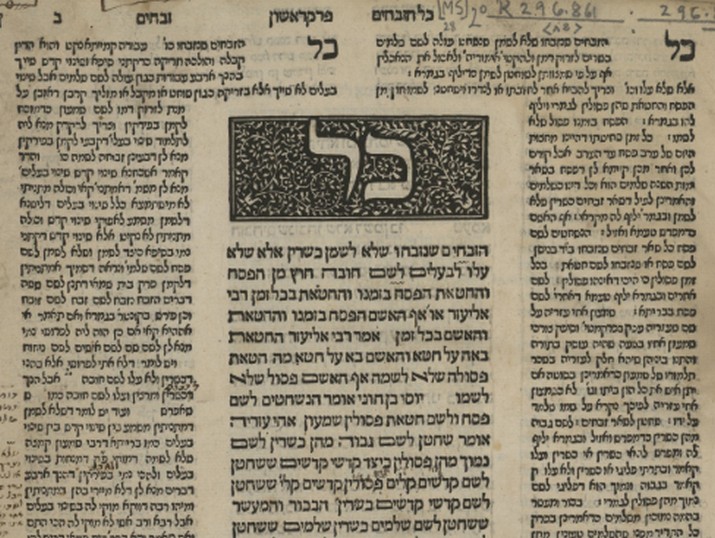
Open any printed volume of the Talmud and the page has a shape you would recognize even if you could not read a word of it. A dense block of text sits in the center. Wrapped around it, in a different and smaller typeface, are two columns of commentary, one tucked along the inner edge by the binding, one along the outer edge. The inner column is Rashi.
That arrangement has a name: the tzurat ha-daf, "the shape of the page." It was fixed in print between 1520 and 1523 by a Christian printer in Venice, Daniel Bomberg, working with Jewish editors, when he produced the first complete printed Talmud. (That press, and the Venetian ghetto it worked in, are the subject of the Ghetto System Topic.) Before printing, every hand-copied Talmud was laid out differently. After Bomberg, the layout froze, and it has barely changed in five centuries. The text in the middle, Rashi on the inside, his students' further commentary on the outside.
Here is why the layout matters as much as the words. The position is not decoration; it is a map of how the text is meant to be read. A student hits a hard phrase in the central Talmud, glances inward to Rashi for the plain meaning, and only then turns outward to the harder questions. The page itself teaches the order of study. A reader encounters the Talmud first, then turns naturally to Rashi for explanation before moving outward to the later discussions of the Tosafists. The layout became a visual guide to learning as much as a format for printing.
And the afterlife is the whole point. Rashi never saw a printed page; he died in 1105, more than four centuries before Bomberg. He wrote to be copied by hand, for the students in front of him. Yet the explanations he wrote became so necessary that when print arrived, the only question was where on the page to put him, never whether. Nine hundred years on, a child in any yeshiva still opens the Talmud and finds him exactly there, on the inside margin, waiting.
Troyes and the eleventh-century Rhineland
The world he worked in.
Rashi worked within the Jewish community of the Rhineland and northern France in the eleventh century, the world the medieval Jewish tradition called Ashkenaz (the Hebrew name for the German-speaking lands and their reach). Its communities included Mainz, Worms, and Speyer (the three "ShUM" cities of the Rhineland, whose Hebrew initials stood for the shared religious-legal tradition that bound them), along with Troyes, Reims, Paris, Rouen, and the wider Champagne and northern French towns.
These communities ran serious Talmudic academies. The Mainz academy under Rabbi Gershom ben Judah (c. 960–1028, remembered as Rabbeinu Gershom Me'or HaGolah, "Our Master Gershom, Light of the Exile") was the forerunner of the schools where Rashi would study. Rabbeinu Gershom's rulings (the ban on polygamy among Ashkenazi Jews, the requirement of mutual consent for divorce, the prohibition on reading others' private mail) shaped the framework of Ashkenazi Jewish life for centuries.
Troyes itself, Rashi's birthplace and the city where he spent most of his life, was an important commercial and political center in eleventh-century Champagne. The Counts of Champagne ran the famous Champagne Fairs, the trade cycle that pulled merchants from across Europe, making Troyes one of the best-connected cities of medieval northern Europe despite its modest size. Its Jewish community, small next to the great Rhineland or Iberian centers, was part of that wider network.
Life and family
The biographical record.
Rashi (the acronym for Rabbi Shlomo Yitzhaki) was born in Troyes in 1040. The record of his life is partial; much of the tradition comes from later medieval sources and from the legal writings of his successors rather than from documents of his own time. What is documented:
- Origin. Born in Troyes, Champagne, into the northern French Jewish community. His father, Rabbi Yitzhak, was a scholar of modest standing whose name turns up in a few of Rashi's citations.
- Study in the Rhineland. As a young man, probably in his late teens and twenties, Rashi went to study at the great Rhineland academies, at Mainz under Rabbi Yaakov ben Yakar, and at Worms under Rabbi Yitzhak ben Yehuda. His writings name these teachers and the specific lessons he took from them.
- Return to Troyes. Rashi was back in Troyes by about 1070 and founded his own academy there. Smaller than the Rhineland centers, it grew over his lifetime into one of the most important seats of Jewish scholarship in northern Europe.
- Family. Rashi had no sons who lived to scholarly adulthood; his line ran through his daughters, who married scholars and whose sons, Rashi's grandsons, founded the Tosafist school described below. The three daughters, Yocheved, Miriam, and Rachel, appear in the tradition, with surviving anecdotes about their own engagement with Jewish learning. The question of women's learning in the Rashi household is taken up in Avraham Grossman's Pious and Rebellious: Jewish Women in Medieval Europe (Brandeis, 2004).
- Livelihood. For most of his life Rashi made his living growing grapes and making wine. The tradition holds that he refused payment for teaching or rabbinic work and supported himself from his vineyards instead, and his own writing bears it out, reaching for vineyard and winemaking terms as analogies in his commentary.
- Death. Rashi died in Troyes on July 13, 1105. The community remembered the area of his burial but never marked the grave, and the exact spot is no longer known.
The Bible commentary
The centerpiece.
Rashi's commentary on the Five Books of Moses is the most-read Jewish commentary in the history of the religion. Its reach shows up in several ways:
- The first printed Hebrew book. The first dated Hebrew book set in movable type was Rashi's commentary on the Five Books, printed at Reggio di Calabria, Italy, by Avraham ben Garton on February 17, 1475. That his work was chosen first, at the very birth of Hebrew printing, says how central it already was.
- First text for children. In traditional Jewish education, across Ashkenazi and Sephardic communities alike and from the Middle Ages to today, children typically meet Rashi's Bible commentary as their first text once they can read Hebrew. Nearly every traditionally educated Jew has spent part of childhood learning to read Rashi.
- The script. The semi-cursive type Rashi's commentary has been printed in since 1475 is called "Rashi script", though Rashi never used it himself; Italian Hebrew printers developed it in the late 1400s. It still sets his commentary, the Talmud commentary, and the medieval commentary tradition apart from the main biblical or Talmudic text on the page.
His method moves verse by verse through the text, blending a few distinct modes:
- Peshat, the plain meaning. Reading the text in its grammatical, word-level, and contextual sense. Rashi's insistence on peshat as the foundation is itself one of his contributions; his line at Genesis 3:8, that his aim is "the plain meaning of the verse" (peshuto shel mikra), became the rallying point of later Jewish biblical interpretation.
- Midrash, the rabbinic storytelling tradition. Where the rabbis' Midrash addresses a verse in a way that genuinely illuminates it, Rashi folds it in, choosing, from a vast body of material, the reading that best opens the text. The choosing is itself the skill: he knew the whole corpus and selected with sharp judgment.
- La'azim, Old French glosses. Where a Hebrew word needed clarifying, Rashi often gave the Old French equivalent (his own everyday language, written in Hebrew letters). These glosses, roughly 1,300 in the Bible commentary and many more in the Talmud commentary, matter twice over: they helped his own neighbors read him, and they are now one of the largest surviving records of eleventh-century spoken French, valuable to scholars of the French language.
The commentary's reception across the later Jewish tradition has been near-total. Nearly every printed Hebrew Bible (Ashkenazi, Sephardic, Mizrahi) runs Rashi alongside the text. Beyond the Five Books, Rashi commented on almost the entire Hebrew Bible, the Prophets and the Writings, in the same plain, accessible way; his reading of the Song of Songs as an allegory of the love between God and Israel became the standard one. The leading modern critical edition is the Mossad ha-Rav Kook edition (Jerusalem, ongoing); the long-standard English is the Silbermann edition (London, 1929–1934), with the Hebrew–English Sapirstein edition (Brooklyn, 1995 on) the main contemporary one.
The Talmud commentary
The companion to the Talmud.
Rashi's commentary on the Babylonian Talmud is, in the later Jewish tradition, inseparable from the Talmud itself.
- Coverage. Rashi wrote on nearly all of the Babylonian Talmud, about 30 of its tractates. The gaps are documented: he died before finishing the commentary on a few (including Bava Batra and Makkot), and the printed editions fill them with later work, most of it by his grandson Rabbi Shmuel ben Meir (the Rashbam).
- Method. The Talmud commentary works word by word through the text, unpacking obscure Aramaic and Hebrew terms, supplying the background of each rabbinic debate, naming the technical vocabulary, and spelling out the unstated logical steps. The aim is to make the Talmud followable for a first-time reader, and a useful reminder for everyone else.
- The page. In the standard printed layout fixed by the Bomberg press in Venice in the 1520s, Rashi's commentary runs along the inner margin of every page, nearest the binding; the work of his successors, the Tosafists, runs along the outer margin. The page is a picture of the conversation: the Talmud in the center, Rashi clarifying just inside, the later development just outside.
- Why it is indispensable. In the traditional world, reading the Talmud without Rashi is hardly imaginable, he is the baseline. The whole culture of Talmud study, from the paired-partner chevruta to the yeshiva curriculum, is built around Rashi as the companion text.
Rashi's method
What made it work.
Scholars have long asked what made Rashi's work the one that stuck. The features that recur:
- Clarity and brevity. Rashi writes short, usually a sentence or two, rarely a paragraph. Because the comment is so brief, it can be read right alongside the text without slowing the reader much. That concision is exactly what lets him serve as a companion, where a longer commentary could not.
- Selective attention. He does not comment on everything. He comments where there is a real difficulty, a hard grammatical form, an unclear word, missing context, a Midrash that changes how a verse reads. So a Rashi comment is itself a signal: this is a spot that needs attention.
- Precision with language. His command of biblical and Mishnaic Hebrew, of Aramaic, and of the wider linguistic world shows throughout, in his grammar notes, his word origins, his exactness.
- Plain meaning and Midrash together. By weaving the plain sense and the rabbinic tradition (now one, now the other, sometimes both) he produced a kind of curated synthesis of the available readings. The achievement is the judgment about what to keep and what to leave out.
- A teacher's voice. The commentary is addressed to a student. It is patient and explanatory, focused on the reader's understanding rather than on showing off the author's learning. Putting the student first is itself part of what made it last.
The Tosafist school
The school he left behind.
Rashi's work passed to his daughters and their descendants, above all to his grandsons and great-grandsons, who founded the school of Talmud commentary known as the Tosafot ("additions"). The major figures:
- Rabbi Shmuel ben Meir (Rashbam, c. 1085–c. 1158). Rashi's grandson. He carried on the work, including completing the Talmud commentary where his grandfather's death left gaps. His own commentary on the Five Books (pushing the plain meaning even harder than Rashi, at the expense of Midrash) stands in the standard editions and matters in its own right.
- Rabbeinu Tam (Yaakov ben Meir, c. 1100–1171). Rashi's grandson and Rashbam's younger brother, the most important of the Tosafists. His Sefer ha-Yashar is the core of the Tosafist tradition; he corresponded with scholars across the medieval Jewish world, including Maimonides, and his rulings on many questions became standard.
- Ri ha-Zaken (Rabbi Yitzhak ben Shmuel, c. 1115–1184). A nephew of Rabbeinu Tam, the figure who organized the Tosafist enterprise into the form preserved in the printed editions.
- The wider school. Many more Tosafists across the twelfth and thirteenth centuries produced the body of work that fills the outer margin of the Talmud page, one of the great collaborative scholarly achievements of the Middle Ages.
The Tosafists built on Rashi in a particular way. Where he clears up the immediate difficulty, they ask the next question: they compare passages across the Talmud, point out apparent contradictions, resolve them, and draw out the underlying principles. The page mirrors the division of labor, Rashi clarifying on the inside, the Tosafists developing on the outside.
The First Crusade and Rashi's response
A witness.
The First Crusade, called by Pope Urban II at the Council of Clermont on November 27, 1095, produced one of the most consequential events in the history of medieval European Jewry: the massacres of the Rhineland Jewish communities in May and June 1096. The Jewish communities of Worms (May 18), Mainz (May 27), and Cologne (late June): the ShUM cities that had been the academic heart of Ashkenazi life, were all but destroyed by Crusader-allied mobs (distinct from the official Crusade army, though overlapping with it). Scholars estimate the Jewish dead across the Rhineland that spring at roughly 4,000 to 5,000, a large share of the affected region's Jewish population.
Rashi was about 55 at the time, living in Troyes, which the Rhineland violence did not reach. His response is documented in several forms:
- Direct correspondence. His surviving letters and legal rulings from the aftermath address the questions facing survivors, the status of those forced to convert to Christianity (a parallel to the question Maimonides would later face under the Almohads), remarriage where a spouse's death was uncertain, and the rebuilding of communities that had been all but wiped out.
- The selichot. Rashi wrote penitential poems (selichot) in response to 1096; the best known is preserved in the Ashkenazi liturgy and recited on set days in the year.
- The rebuilding. His academy at Troyes, spared the Rhineland violence, became a major center for rebuilding Ashkenazi learning in the early twelfth century, the Tosafist work of his grandsons grew in part from the recovery his own response made possible.
The massacres themselves are recorded in three Hebrew chronicles written soon after, the Mainz Anonymous, the Solomon bar Samson, and the Eliezer bar Nathan chronicles. They matter both as documentary record and for shaping the Jewish religious response to massacre, the framework of Kiddush Hashem ("sanctification of the Divine Name") for those who died rather than convert. The standard scholarly reference is Robert Chazan's European Jewry and the First Crusade (University of California Press, 1987).
The Christian reception
Read by Christians too.
Rashi was read by Christian scholars from the twelfth century on, in one of the most notable cross-tradition relationships of the period. The main channels:
- The Victorine school of Paris. The twelfth-century Christian center at the Abbey of Saint-Victor in Paris, especially Andrew of Saint-Victor (c. 1110–1175): drew on Rashi's biblical commentary, citing him in their Latin commentaries. The draw was his plain-sense, philological reading of the Hebrew, useful to Christian scholars then learning the language.
- Nicholas of Lyra (c. 1270–1349). The Franciscan whose Postilla Litteralis, the standard medieval Latin Bible commentary, leaned heavily on Rashi, so heavily that a medieval saying ran, "Si Lyra non lyrasset, Lutherus non saltasset" ("If Lyra had not played, Luther would not have danced"), tying Nicholas's Hebrew-informed reading to the later Reformation.
- Martin Luther. Luther engaged Rashi in his own biblical work, citing him as "Rabbi Salomon." The relationship is complicated: Luther's later antisemitic writings, addressed, with the Lutheran World Federation's 1984 repudiation, in the Nostra Aetate Topic, do not undo his documented earlier debt to Rashi the commentator.
- The wider reach. Christian Hebraist scholars through the Renaissance and the early-modern period, such as Sebastian Münster, continued to read Rashi.
It is one of the best-documented cross-tradition intellectual relationships of the era. Rashi's reach across Jewish and Christian scholarship (in the same period as Maimonides' reach across Jewish, Christian, and Islamic traditions) places the medieval Jewish intellectual world inside the broader medieval conversation rather than apart from it.
The long legacy
The long reach.
- The education tradition. The practice of beginning Hebrew Bible study with Rashi has held unbroken from the medieval period to today, so the cumulative Jewish engagement with Rashi over roughly 950 years is one of the most sustained reading practices of any text anywhere.
- Commentaries on the commentary. Scholars have written whole commentaries on Rashi himself, Elijah Mizrahi (1455–1525, chief rabbi of Constantinople), Judah Loew ben Bezalel (the Maharal of Prague, c. 1525–1609), and many more.
- The 900th anniversary. The 900th anniversary of Rashi's death (2005) brought wide commemoration in France, Israel, and the Jewish world. Troyes maintains the Rashi European Center for Jewish Studies, and France marks him as a major figure of medieval French intellectual history.
Sites that survive
Where the record stands.
- Troyes, France, the Rashi European Center for Jewish Studies. The center for Rashi studies, established in Troyes in the 1990s; the city also holds a statue of Rashi by Raymond Moretti (1990) at the Place Jules Patenôtre and markers of his presence.
- Worms, Germany, the Rashi Synagogue and Jewish Quarter. The medieval Jewish quarter, including the synagogue tied by tradition to Rashi's study at Worms (the surviving building is later medieval). Destroyed in the November 1938 Kristallnacht pogrom and rebuilt in the 1950s and 1960s.
- Speyer, Worms, and Mainz, the ShUM Sites. The medieval Rhineland Jewish heritage sites of the three ShUM cities, inscribed on the UNESCO World Heritage List in 2021. shumstaedte.de →
- Worldwide, the Sefaria Rashi corpus. Rashi's complete works, Bible and Talmud commentaries, in a free digital edition with parallel Hebrew and English. sefaria.org →
Key takeaways
- Rashi (1040–1105) of Troyes, in northern France, is the most-read Jewish commentator of the last thousand years, read first by Jewish children and present on nearly every printed page of the Bible and the Talmud.
- His commentary on the Five Books was the first dated Hebrew book ever printed (1475); his Talmud commentary has run along the inner margin of every standard printed page since the 1520s.
- His method was brief, selective, precise, and addressed to a student, blending the plain meaning of the text with the rabbinic tradition, and including some 1,300 Old French glosses now prized by scholars of medieval French.
- His grandsons founded the Tosafist school, whose work fills the outer margin of the Talmud page opposite Rashi's inner margin.
- Christian scholars, including the Victorines and Nicholas of Lyra, drew extensively on Rashi's biblical commentary, helping transmit aspects of medieval Jewish interpretation into Christian biblical scholarship.
For the classroom
Where this Topic fits the standards.
- World History, NY Global History 9.7 (the medieval world). Rashi is one of the strongest single biographies for medieval northern European intellectual life, paired with the Mediterranean world that Maimonides represents. For grades 7–8, anchored through Common Core literacy and interdisciplinary humanities, since medieval Jewish scholarship has no dedicated middle-school social-studies standard.
- Common Core RH.6–8, RH.9–10 & RH.11–12. Students assess an author’s purpose and point of view (RH.6–8.6, RH.9–10.6, RH.11–12.6) and corroborate evidence across sources (RH.6–8.9, RH.9–10.9, RH.11–12.9), working from a commentary set beside the text it explains, the Hebrew chronicles of 1096, and modern scholarship.
- C3 Framework, D2.His.1 and D2.His.14 (grades 6–8 and 9–12). Students investigate chronology, historical context, continuity and change, and the evaluation of evidence.
- Classroom Applications. Students can:
- analyze how a commentary shapes the reading of a primary text;
- trace the transmission and Christian reception of Rashi’s work (the Victorines, Nicholas of Lyra);
- compare the “text-explainer” Rashi with the “system-builder” Maimonides;
- use Rashi’s roughly 1,300 Old French glosses as historical-linguistic evidence;
- construct evidence-based historical arguments.
- International Classroom Relevance. Because Rashi shaped both Jewish learning and later Christian biblical scholarship, this Topic supports world history, religious studies, and the history of the book in classrooms internationally.
For further classroom use
- The First Crusade. The 1096 Rhineland massacres are part of the standard treatment of the First Crusade; Rashi’s response and the Hebrew chronicles give strong primary-source material.
- French language and culture. Rashi’s Old French glosses are among the most important surviving sources for eleventh-century spoken French, a fit for an upper-grade French course.
Questions for the classroom
Each question is keyed to a standard cited above. They are written as open inquiry, there is no single expected answer.
- Rashi wrote short, and only where the text was hard. What does it tell you about a reader's needs when an explainer chooses what not to comment on? (C3 D2.His.5)
- The standard Talmud page puts Rashi on the inner margin and his students on the outer one. What can the physical layout of a page tell a historian about how people were meant to use it? (C3 D2.His.10)
- Christian scholars studied a Jewish commentator's reading of the Hebrew Bible for centuries. What does that exchange suggest about the lines between religious communities in medieval Europe? (C3 D2.His.1)
- Rashi's Old French glosses, written to help his neighbors, are now a major source for the history of the French language. How does a source come to matter for something its author never intended? (C3 D2.His.11)
Sources and citations
Primary sources come straight from the time: documents, letters, speeches, images, and objects created by the people involved. Secondary sources come later: books, articles, and analysis in which scholars study and interpret those primary sources.
Primary sources
- Rashi. Commentary on the Pentateuch. Mossad ha-Rav Kook critical edition (Jerusalem, ongoing); Silbermann English edition (London, 1929–1934).
- Rashi. Commentary on the Babylonian Talmud. Printed on the inner margin of every Talmud page since the 1520–1523 Bomberg edition.
- Rashi. Sapirstein Edition Pentateuch with Rashi. Brooklyn: Mesorah Publications, 1995–1998.
- Eidelberg, Shlomo, ed. and trans. The Jews and the Crusaders: The Hebrew Chronicles of the First and Second Crusades. Madison: University of Wisconsin Press, 1977.
- Nicholas of Lyra. Postilla Litteralis super Totam Bibliam. 14th century.
- The ShUM Sites of Speyer, Worms, and Mainz. UNESCO World Heritage List, 2021. shumstaedte.de →
- Sefaria. sefaria.org → (digital edition of Rashi's complete works.)
Secondary sources
- Grossman, Avraham. Rashi. Translated by Joel Linsider. Oxford: The Littman Library of Jewish Civilization, 2012. (The standard contemporary scholarly biography.)
- Grossman, Avraham. Pious and Rebellious: Jewish Women in Medieval Europe. Waltham: Brandeis University Press, 2004.
- Shereshevsky, Esra. Rashi: The Man and His World. New York: Sepher-Hermon Press, 1982.
- Pearl, Chaim. Rashi. London: Peter Halban, 1988.
- Banitt, Menahem. Rashi: Interpreter of the Biblical Letter. Tel Aviv: Tel Aviv University Press, 1985.
- Chazan, Robert. European Jewry and the First Crusade. Berkeley: University of California Press, 1987.
- Smalley, Beryl. The Study of the Bible in the Middle Ages. 3rd ed. Oxford: Oxford University Press, 1983.
- Hailperin, Herman. Rashi and the Christian Scholars. Pittsburgh: University of Pittsburgh Press, 1963.
- National Library of Israel, "The Christian Who Set the Talmud's Layout." blog.nli.org.il/en/daf_gemara →
- Unpacked (OpenDor Media). "How Rashi Decoded Ancient Jewish Texts." unpacked.media → (Story-style introduction for general readers.)
Finding these documents: many primary sources are free online. Good places to start are the Fordham Internet Jewish History Sourcebook, Yale’s Avalon Project (law and diplomacy), German History in Documents, the collections of the US Holocaust Memorial Museum and Yad Vashem, the National Library of Israel, and Sefaria (for Jewish texts). Search the document’s name and date.
Moses Maimonides (1138–1204): philosopher, codifier of Jewish law, and physician to Saladin's court, the medieval Jewish thinker read seriously by the Islamic, Christian, and Jewish traditions alike.
Comments?
Write to editor@makorproject.org.
Last updated: August 2026.