
When Jews today want to know how Jewish law applies to daily life, from keeping the Sabbath to the laws of marriage, prayer, or kashrut, they often begin with a single book written more than four and a half centuries ago by a refugee expelled from Spain as a small child.
Joseph Karo · Unit 5
Why this Topic exists
The man who put Jewish law on one page.
If you wanted to follow Jewish religious law in the year 1500, you had a problem: the rules were real, but they were scattered across a thousand years of debate, in dozens of books, often disagreeing with each other. To answer a simple question you had to be a scholar with a wall of volumes. Joseph Karo fixed that. He gathered more than a thousand years of legal discussion into a single practical code that ordinary scholars, rabbis, and communities could consult without tracing every ruling back through the entire legal tradition, the Shulchan Aruch. It is still, today, the standard reference for traditional Jewish practice, the book against which nearly every religious question is checked.
This Topic is the story of how that happened, and it is a stranger story than the result suggests. Karo belongs with Rashi and Maimonides as one of the three figures whose work shaped daily Jewish life most, but where they were medieval, Karo stands at the hinge into the modern world, and his life ran straight through one of the great catastrophes of Jewish history before it produced one of its most lasting books.
Object Spotlight
A set table and a tablecloth.
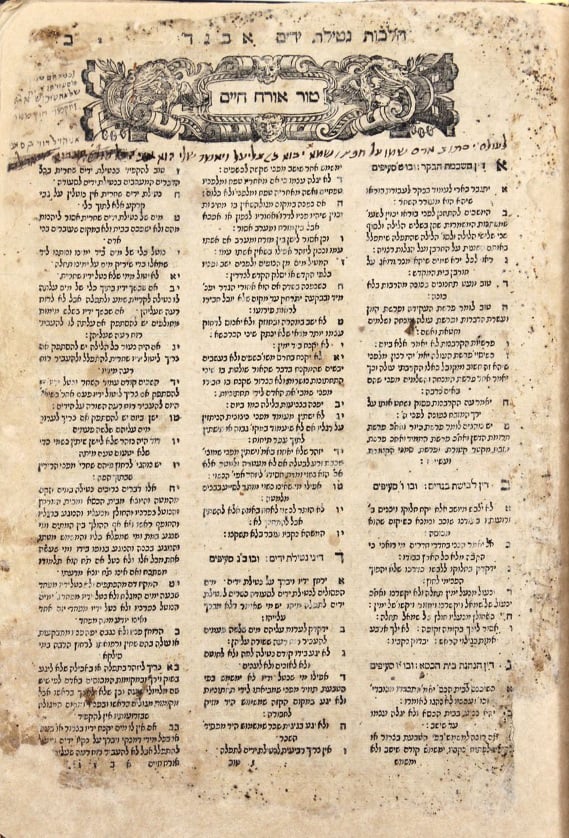
Look at the page. Under the decorated header, the text comes in short, numbered rulings, one after another: do this, not that, on these days, in this order. No long arguments, no back-and-forth, just the bottom line. That accessibility is the innovation. Karo did not simplify Jewish law by reducing it; he organized centuries of legal discussion into a practical code that could serve as a common point of reference for Jewish communities across the diaspora. After a thousand years of scholars debating Jewish law across giant volumes, here it was, served ready to use, in sentences a student could memorize.
The book is the Shulchan Aruch, Hebrew for "the Set Table." Karo finished it in 1563 and it was first printed in Venice, Italy, in 1565. The name is the key to the whole idea. Karo meant it as a meal laid out and ready: you do not have to cook, or even know the recipe, the food is on the table, just take what you need.
But there was a catch. Karo was Sephardic, from the Jewish world of Spain and the Mediterranean, and he had built his rulings mostly on Sephardic authorities. So his "set table" quietly served Sephardic food. Jews in central and eastern Europe, the Ashkenazi world, followed some customs differently, and Karo's text left their customs out.
Here is the move that made the book universal. A Polish rabbi named Moses Isserles, instead of writing a rival book, wrote notes that added the Ashkenazi practice wherever it differed, and folded them into Karo's text. He named his additions the Mappah, "the Tablecloth." Karo had set the table; Isserles spread the cloth over it. From the Kraków edition of 1578 on, the two were printed together, one page a Sephardic reader and an Ashkenazi reader could both follow, each finding their own practice on it. The metaphor was a peace treaty in book form.
And that is why the object still matters. Almost five hundred years later, the combined book, Karo's table plus Isserles's cloth, is open in front of rabbis, students, and ordinary observant Jews every day, the first place anyone looks to settle a question of practice. Two refugees from opposite ends of the Jewish world, who never met, still share a page that runs the room.
Iberia and the 1492 expulsion
Expelled at four.
Joseph ben Ephraim Karo was born in 1488, into the Jewish community of Spain. (The exact city is uncertain, tradition says Toledo, in Castile, central Spain; some scholars argue for Portugal or elsewhere on the Iberian Peninsula, the landmass that is today Spain and Portugal.) His family belonged to the Sephardic world: the long-established, deeply rooted Jewish society of medieval Spain.
When Karo was about four years old, that world ended. On March 31, 1492, King Ferdinand and Queen Isabella, the same monarchs who that year sent Columbus across the Atlantic, signed the Alhambra Decree, ordering every Jew out of their kingdoms. Convert to Christianity or leave, within about four months. Somewhere between 150,000 and 200,000 Jews left Spain that summer, ending more than a thousand years of Jewish life there. (Those who converted but kept practicing Judaism in secret, the Conversos, were then hunted by the Spanish Inquisition.)
Karo's family was among those who left. They went first to Portugal, until Portugal forced its own Jews to convert in 1497, and then kept moving east, toward the one large power actively welcoming the refugees: the Ottoman Empire, the Muslim empire then centered in what is now Turkey. Its sultan, Bayezid II, reportedly marveled that Spain would impoverish itself by throwing out its skilled and educated subjects, whom he would happily take in. Karo grew up a refugee, carried across a continent before he was old enough to choose anything.
The Ottoman wanderings · 1492–1536
Forty years of wandering.
For about the next four decades, Karo lived the life of the Ottoman Sephardic diaspora, moving from city to city across the empire's lands, studying and teaching in one refugee community after another. The stops the record names:
- Nikopol, in what is now Bulgaria, where the young Karo got his first rabbinic schooling from his father and the local Sephardic community.
- Adrianople and Constantinople (today Edirne and Istanbul, in Turkey), the great centers of Ottoman Sephardic life. At Adrianople, Karo fell under the spell of Solomon Molcho (c. 1500–1532): a man born a secret Jew in Portugal who returned openly to Judaism and chased a dangerous, mystical, would-be-messianic path until the Inquisition burned him at the stake in Italy in 1532. Molcho's death marked Karo deeply; in his private writings Karo confessed he longed to die a martyr "as Molcho did." (His own life would go very differently.)
- Salonika (today Thessaloniki, in Greece), the largest Jewish city in the whole Ottoman world, so Sephardic that it ran on a Jewish rhythm. Here Karo went deeper into both law and Kabbalah, the Jewish mystical tradition.
And through all of it, the moving and teaching and the passing decades, he was writing one enormous book. By his own account he began it in 1522, at about thirty-four, and worked at it for twenty years, city after city, before it was done. We will come to that book; first, where the wandering finally stopped.
Safed · 1536–1575
The hilltop town.
Around 1536, Karo went to Safed (in Hebrew, Tzfat): a town high in the hills of the Galilee, in the north of the Land of Israel. In the sixteenth century Safed became something remarkable: a small mountain town that turned, for a few generations, into the spiritual capital of the Jewish world, drawing the era's greatest scholars and mystics. Karo spent the last thirty-nine years of his life there, and it is where he became not just a scholar but a leader.
In Safed he ran a major academy, trained students who became leading rabbis in their own right, and served as head of the town's religious court. He also took part in a bold, controversial experiment in 1538: an attempt to revive semikhah, the original chain of rabbinic ordination that traced back to the ancient Sanhedrin (the supreme Jewish court of antiquity) and had been broken for over a thousand years. The effort drew sharp opposition and ultimately failed, but Karo was among the first ordained under it, a sign of how central he had become.
Karo died in Safed on March 24, 1575, at the age of eighty-seven, and was buried in the town's old cemetery, alongside many of the great figures of Safed's golden age. His grave is still visited today.
The Beit Yosef · 1522–1542
The twenty-year book.
Before the famous short rulebook came the giant one behind it. For twenty years, the whole span of his wandering, from 1522 to 1542, Karo wrote the Beit Yosef, "the House of Joseph." It is not light reading: it is a vast work that takes an earlier medieval law code and, for every single ruling, traces the answer all the way back through the centuries of debate to its root in the Talmud, showing the full chain of reasoning. In effect, Karo built an encyclopedia of the entire Jewish legal tradition up to his own day.
Writing it forced him to solve a problem: when the great medieval authorities disagreed, as they constantly did, whose answer wins? Karo set a rule. He picked three towering medieval judges, and where two of the three agreed, that was the law. It was a clean, defensible system. But it had a quiet bias built in: all three of his chosen authorities came from the Sephardic, Mediterranean world. So when Karo later distilled this giant work into his short rulebook, the rulebook leaned Sephardic, which is exactly what would soon provoke the response from northern Europe.
The Shulchan Aruch · 1565
The Set Table.
The Beit Yosef was the scholar's version, too big for daily use. So Karo took its practical conclusions and stripped them down to the essentials: short, flat statements of what to do, with all the argument removed. He finished this around 1563, and it was printed in Venice in 1565 as the Shulchan Aruch, "the Set Table." It is organized into four parts covering the whole of Jewish practice:
- Orach Chayim ("Way of Life"): daily life, prayer, the Sabbath, and the festivals.
- Yoreh De'ah ("Teaching Knowledge"): what is permitted and forbidden, including the dietary laws (kashrut), mourning, and conversion.
- Even ha-Ezer ("Stone of Help"): marriage, divorce, and family law.
- Choshen Mishpat ("Breastplate of Judgment"): civil and business law: property, contracts, courts.
Karo's own goal was modest. He wrote in the introduction that the book was a study aid, short enough for young students to review daily and commit to memory, so the shape of Jewish law would live in their heads without a library at their elbow. He aimed at students. What he got was something far bigger: within a single generation, the Shulchan Aruch had become the reference for Jewish practice across the world. How a modest study guide became the law of an entire people is a real historical puzzle, earlier, grander attempts had failed to do it. The answer turned out to depend on a rabbi in Poland.
Moses Isserles and the Mappah
The Tablecloth.
The problem surfaced the moment the book appeared. Jews in Ashkenaz (central and eastern Europe) differed in a great many practices from the Sephardic world, and Karo's Sephardic-leaning rulings simply left their customs out. To an Ashkenazi reader, the "set table" was serving the wrong meal.
The answer came from Rabbi Moses Isserles (known as the Rema, c. 1530–1572) of Kraków, in Poland, the leading Ashkenazi legal mind of the day. Isserles had been writing his own law code when Karo's appeared. He made a generous choice: rather than publish a rival, he wrote a set of notes to Karo's book, adding the Ashkenazi practice wherever it differed. He called his additions the Mappah ("the Tablecloth"), playing directly on Karo's "Set Table." Karo had set the table; Isserles laid the cloth on top.
From 1578 on, the two were printed as one. A Sephardic reader follows Karo's main text; an Ashkenazi reader follows Isserles's notes where they differ. With that, a single book worked for the whole Jewish world at once: Sephardic and Ashkenazi reading the same page and each finding their own practice on it. Maimonides had tried for that kind of universal code three centuries earlier and not managed it. Karo and Isserles, together, did.
The Maggid Mesharim
The secret diary.
There is a second Karo, hidden behind the lawgiver. For about fifty years he kept a private diary, published only after his death, called the Maggid Mesharim. In it he records something startling: a voice that came to him in moments of deep concentration, what he understood as a heavenly mentor (the living spirit of the Mishnah, the early core of the Talmud) speaking to him directly. The voice praised his legal work, scolded his failings, and pressed him on how he lived.
It is one of the fullest first-person accounts of mystical experience to survive from the period, and it complicates the easy picture of Karo as a dry compiler of rules. The standard study, R. J. Zwi Werblowsky's Joseph Karo: Lawyer and Mystic (Oxford, 1962), argues that the two sides were not separate, that the same man who organized the law also lived an intense inner mystical life, and that in sixteenth-century Safed this combination was the norm, not the exception. The town's circle of scholars wove law and mysticism together, and Karo was one of its clearest examples.
Reception across communities
Who follows it.
- Sephardic and Mizrahi Jews: across the Ottoman world, North Africa, and the wider Sephardic diaspora, took Karo's main text as their standard, and the great later Sephardic authorities worked within his framework.
- Ashkenazi Jews: across central and eastern Europe, followed Isserles's notes, and the later Ashkenazi tradition built on his additions.
- Yemenite Jews are the notable exception: many held to the older tradition of Maimonides rather than adopting the Shulchan Aruch, a reminder that "universal" was nearly, but not quite, complete.
- Today, the Shulchan Aruch remains the working reference for traditional Jewish practice, central in Orthodox life and engaged seriously across the other movements.
Sites that survive
Where the record stands.
- Safed (Tzfat), Israel, the tomb of Joseph Karo, in the old cemetery of the Galilee hill town, near the graves of the other great figures of Safed's sixteenth-century golden age, and still visited today.
- Safed, the Karo Synagogue. A synagogue in the old city named for Karo, tied by tradition to his presence there, rebuilt over the centuries and active in Safed's historic Jewish quarter.
- Worldwide, the printed Shulchan Aruch. Karo's text with Isserles's notes, still printed and studied, available in many editions and in free digital form through Sefaria →.
Key takeaways
- Joseph Karo (1488–1575) was driven out of Spain as a small child in the 1492 expulsion and spent about forty years moving across the Ottoman world before settling in the Galilee hill town of Safed.
- His Shulchan Aruch ("Set Table," 1565) boiled a thousand years of scattered Jewish law into one short, usable rulebook, still the standard reference for traditional Jewish practice today.
- Because Karo's rulings leaned Sephardic, the Polish rabbi Moses Isserles added notes (the Mappah, "Tablecloth") with Ashkenazi practice, making one book that served the whole Jewish world.
- Behind the lawgiver was a mystic: his secret diary, the Maggid Mesharim, records a heavenly voice he believed spoke to him, part of Safed's blend of law and Kabbalah.
- The book succeeded where grander codes had failed because it worked for both traditions at once, arrived with the printing press, and met a world rebuilding after the expulsions.
For the classroom
Where this Topic fits the standards.
- World History, NY Global History 9.7 (the early modern world). Karo’s life and work sit within the early modern Mediterranean, the 1492 Spanish expulsion, the Ottoman Empire as a refuge, the community of Safed, and the printing revolution that carried his code across the diaspora. For grades 7–8, anchored through Common Core literacy and interdisciplinary humanities.
- Common Core RH.6–8, RH.9–10 & RH.11–12. Students assess an author’s purpose and point of view (RH.6–8.6, RH.9–10.6, RH.11–12.6) and corroborate evidence across sources (RH.6–8.9, RH.9–10.9, RH.11–12.9), working from the Shulchan Aruch itself, its commentaries (notably Moses Isserles’s Mappah), and modern scholarship.
- C3 Framework, D2.His.1 and D2.His.14 (grades 6–8 and 9–12). Students investigate chronology, historical context, continuity and change, and the evaluation of evidence.
- Classroom Applications. Students can:
- analyze a legal code and its commentary as primary sources;
- trace how the printing revolution carried one code across the Sephardi and Ashkenazi worlds;
- connect Karo’s Safed to the post-1492 Sephardic dispersion;
- examine how a shared text can unify a dispersed community;
- construct evidence-based historical arguments.
- International Classroom Relevance. Because the Shulchan Aruch shaped Jewish practice across the Sephardi and Ashkenazi worlds, this Topic supports world history, religious studies, and the history of law and print culture internationally.
Questions for the classroom
Each question is keyed to a standard cited above. They are written as open inquiry, there is no single expected answer.
- Karo's "Set Table" and Isserles's "Tablecloth" let two different traditions share one book instead of splitting into two. Why might a shared reference matter more to a scattered people than a perfect one? (C3 D2.His.1)
- Karo built his rulings on three authorities who all came from one part of the Jewish world, and the result leaned that way. How do a writer's choices about sources shape what looks like a neutral answer? (C3 D2.His.11)
- Karo meant the Shulchan Aruch as a simple study aid, but it became the law of a whole people. What does it tell you that a work's importance can outrun what its author intended? (C3 D2.His.2)
- The same century gave Karo's law code and Safed's burst of mysticism, often in the same people. What might a time of upheaval, like the years after the expulsions, have to do with both? (C3 D2.His.5)
Sources and citations
Primary sources come straight from the time: documents, letters, speeches, images, and objects created by the people involved. Secondary sources come later: books, articles, and analysis in which scholars study and interpret those primary sources.
Primary sources
- Karo, Joseph. Shulchan Aruch. With the Mappah of Moses Isserles. First integrated edition, Kraków, 1578; standard printed editions with the classic commentaries.
- Karo, Joseph. Beit Yosef. Commentary on the Arba'ah Turim of Jacob ben Asher. First published in four volumes, 1550–1559.
- Karo, Joseph. Maggid Mesharim. Published posthumously.
- Sefaria. sefaria.org → (digital edition of the Shulchan Aruch and the broader Jewish library.)
Secondary sources
- Werblowsky, R. J. Zwi. Joseph Karo: Lawyer and Mystic. Oxford: Oxford University Press, 1962. (The standard scholarly study.)
- Twersky, Isadore. "The Shulhan 'Aruk: Enduring Code of Jewish Law." Judaism 16 (1967).
- Zimmer, Eric, and the broader scholarship on the sixteenth-century rabbinate and the Safed circle.
- Fine, Lawrence. Safed Spirituality and Physician of the Soul, Healer of the Cosmos: Isaac Luria and His Kabbalistic Fellowship. Stanford: Stanford University Press, 2003.
- Wecker, Menachem. "Hard-pressed to imagine world without Shulchan Aruch, 450 years after Joseph Caro's death, experts say." JNS, 2024. jns.org → (General-reader feature.)
- Posner, Menachem. "14 Facts About the Code of Jewish Law (Shulchan Aruch)." Chabad.org. chabad.org → (Introductory explainer, written from within the tradition.)
Finding these documents: many primary sources are free online. Good places to start are the Fordham Internet Jewish History Sourcebook, Yale’s Avalon Project (law and diplomacy), German History in Documents, the collections of the US Holocaust Memorial Museum and Yad Vashem, the National Library of Israel, and Sefaria (for Jewish texts). Search the document’s name and date.
Theodor Herzl (1860–1904): an assimilated Viennese journalist who watched a Paris mob scream 'Death to the Jews,' concluded Jews would never be safe as a minority, and in eight years built the movement that led to the State of Israel.
Comments?
Write to editor@makorproject.org.
Last updated: August 2026.