The Nazi Synthesis
“… the personification of the devil as the symbol of all evil assumes the living shape of the Jew.”
Adolf Hitler, Mein Kampf, 1925, the medieval image of the demonic Jew, restated as racial doctrine. Quoted as the ideology, never as truth.
Why this Topic exists
Nazism invented almost nothing.
This Topic answers one question: what was new about Nazi antisemitism, and what was inherited? It is also the hinge of this entire curriculum, the point where the long history traced across Unit 3 turns into the Holocaust Era of Unit 4.
The uncomfortable answer is that almost every element of Nazi antisemitism already existed. The image of the Jew as Christ-killer and demon came from medieval Christianity (Adversus Judaeos). The fantasy of secret Jewish murder and poisoning came from the blood libel and the well-poisoning charge. The marked, segregated Jew came from the ghetto and the badge. The idea that a government could simply remove its Jews came from the expulsions. The claim that Jewishness was blood rather than belief came from the racial turn of the 1870s and 1880s. Mass killing of Jews as public spectacle had been rehearsed in the Russian pogroms. And the master narrative, a hidden Jewish conspiracy seeking to control the world, had already been forged and was in global circulation as the Protocols of the Elders of Zion.
Nazism did not discover these ideas. It collected them. What it added was a synthesis, and a state. This Topic is about both: how scattered and often contradictory hatreds were fused into one total worldview, and how that worldview, for the first time in the modern era, captured the full machinery of a government and was written into law.
The hatreds it inherited
Seven inheritances.
Read the rest of this Unit and the Nazi worldview stops looking original. Each of its central claims has an address earlier in this history. Set side by side, the inheritance is almost complete:
- Religious contempt. The charge of deicide and the image of the Jew as the devil’s agent came from medieval Christianity (Adversus Judaeos). Nazi propaganda kept that image; Mein Kampf reaches for it almost word for word.
- The murder fantasy. The accusation that Jews secretly kill children and poison wells (the Blood Libel) supplied the emotional template later restated as the Jew the racial “parasite” and “bacillus.”
- Segregation and the mark. The walled quarter and the compulsory badge (the Ghetto System) were medieval inventions the Nazi state revived directly, the yellow star, and the sealed ghettos of occupied Poland.
- Removal by decree. The conviction that a state could order an entire Jewish population out (the Expulsions) was centuries old; the regime began with forced emigration and expulsion before it turned to murder.
- Blood over belief. The decisive modern shift, redefining the Jew as a race rather than a religion (the Racial Turn): closed the exit of conversion that every earlier persecution had left open.
- Killing as spectacle. State-tolerated mob violence against Jewish communities (the Russian Pogroms) was the recognizable model behind the organized “spontaneous” violence of Kristallnacht.
- The world conspiracy. The forged proof of a Jewish plan for global domination (the Protocols) gave the movement its single explanation for everything, and Hitler cited it as authentic.
Not one of these was a Nazi invention. The novelty lay entirely in what was done with them.
What was actually new
The synthesis, and the state.
Two developments were genuinely new, and together they made the difference between hatred and catastrophe.
The first was the synthesis itself. Earlier antisemitism had been plural and often contradictory, the Church’s theological grievance, the resentment of the moneylender, the nationalist’s suspicion of the outsider, the racial theorist’s pseudoscience. These were separate traditions, and they did not always agree. Nazism fused them into a single, total, internally consistent worldview. The Jew became at once a race, the enemy of Christianity, an economic parasite, a Communist agitator, and the hidden hand behind a global conspiracy, every fear in modern European life pointed at one target. A worldview that explains everything by one cause is not an argument to be debated; it is a closed system, and a closed system cannot be reasoned out of.
The second was the state. Every earlier persecution this Unit traces had needed something outside itself to act, a king to sign a decree, a council to pass a statute, a Church to preach, or a mob to gather. Nazism captured the full apparatus of a modern industrial state: its bureaucracy, its courts and laws, its police, its schools, its railways, and its new instruments of mass communication. For the first time, antisemitism was not the policy of a single ruler or the fury of a single crowd. It was the organizing principle of a government, written into legislation, taught in classrooms, broadcast into homes, and administered as ordinary routine.
Hold those two together (a worldview that claimed to explain everything, and a modern state that could act on it without limit) and the distance between medieval hatred and industrial murder begins to close.
Why Germany, why then
The ground it grew in.
A synthesis needs a soil. The ideas were available across Europe; that they became state power in Germany after 1930, rather than somewhere else or not at all, owed to a particular crisis.
Germany’s defeat in the First World War, the punishing terms of the 1919 Treaty of Versailles, and the collapse of the monarchy left a young and contested democracy, the Weimar Republic, carrying the blame for both. Into that wound the radical right poured the “stab-in-the-back” myth (the Dolchstoßlegende): the lie that Germany had not been beaten in the field but betrayed at home, by socialists, democrats, and, above all, Jews. The myth did precisely what the Protocols did. It explained a national catastrophe by pointing to a hidden Jewish hand.
Two economic shocks deepened the ground. The hyperinflation of 1923 destroyed savings and trust; the Great Depression after 1929 threw millions out of work and discredited the moderate parties governing through it. Mass unemployment, humiliation, and fear created a wide audience for a movement that offered a single enemy and a total explanation at once.
None of this made Nazism inevitable. Most Germans never voted for it, and even at its electoral peak the party fell short of a majority. But crisis made the synthesis usable, and a circle of conservative politicians, certain they could harness Hitler and discard him, handed him the levers of the state instead.
From the fringe to the state
From the beer hall to the chancellery.
The movement that would capture Germany began as one of dozens of tiny nationalist groups in postwar Munich. Adolf Hitler joined the German Workers’ Party in 1919; in 1920 it was renamed the National Socialist German Workers’ Party (the NSDAP, or Nazi Party) and issued a twenty-five-point program that already demanded Jews be stripped of citizenship and treated as foreigners.
In November 1923 the party tried to seize power by force in the Munich Beer Hall Putsch, and failed. Hitler was tried and imprisoned, and in prison he wrote Mein Kampf (1925), which set out the synthesis in full, race, living space, and the Jew as the enemy of humanity itself. The book sold modestly at first.
Through the 1920s the NSDAP stayed marginal, winning under three percent of the national vote in 1928. The Depression changed everything. In September 1930 the Nazis became the second-largest party in the Reichstag; in July 1932, the largest, with thirty-seven percent. They never won a governing majority in a free election. But on January 30, 1933, President Paul von Hindenburg, pressed by conservatives who believed they could control him, appointed Hitler Chancellor. Within months the parliamentary democracy that had produced that appointment no longer existed.
Common misconceptions this Topic addresses
Nazism is often treated as a German aberration that appeared from nowhere and was the work of one man. The history is the reverse: old materials, a wide audience, and a worldview many hands helped assemble.
- “Hitler invented Nazi antisemitism.” He synthesized it. Every major element (the religious image, the conspiracy myth, the racial theory) predated him by decades or by centuries. See the entry →
- “Nazism came out of nowhere.” It grew from a long European tradition and a specific postwar crisis; the ideas were mainstream enough to be electorally useful. See the entry →
- “Nazi antisemitism was purely racial.” It was racial and religious and economic and conspiratorial at once. The fusion of all of them into one worldview was the point. See the entry →
- “The Holocaust began in 1941.” Its machinery did. But its logic was set out in 1925 and its law was written in 1935; the killing was the end of a road, not its beginning. See the entry →
- “Germans were uniquely antisemitic.” Antisemitism was Europe-wide. What was unique was not the prejudice but the capture of a modern state willing to act on it without limit. See the entry →
When a worldview became law
The day ideology became government.
Hitler was appointed Chancellor on January 30, 1933. Within weeks the regime began turning the synthesis into the ordinary business of a state, not through riots, but through ministries, statutes, and signatures.
On April 1, 1933, the regime organized a nationwide boycott of Jewish businesses, with SA stormtroopers posted at shop doors to turn customers away, the moment captured in this page’s banner. Six days later, on April 7, 1933, the Law for the Restoration of the Professional Civil Service introduced the “Aryan paragraph,” expelling Jews from government employment: the first national law to define and exclude people by descent. In May 1933 came the public book burnings, and across that year the single-party state, the secret police (the Gestapo), and Joseph Goebbels’s Ministry of Public Enlightenment and Propaganda took shape.
The trajectory reached its clearest expression in September 1935, with the Nuremberg Laws, the Reich Citizenship Law and the Law for the Protection of German Blood and German Honor. They stripped Jews of citizenship and criminalized marriage and relations between Jews and other Germans. For the first time in the modern era, a state defined in law who counted as a Jew, and did so by reaching back to the religion of a person’s grandparents.
This is the hinge. Everything Unit 3 traced (the contempt, the conspiracy theory, the segregation, the expulsions, the racial idea) had become the routine work of a government, enforced by clerks and courts. What that government did next is the subject of Unit 4, the Holocaust Era.
Object Spotlight
1935: race made into a diagram of law.
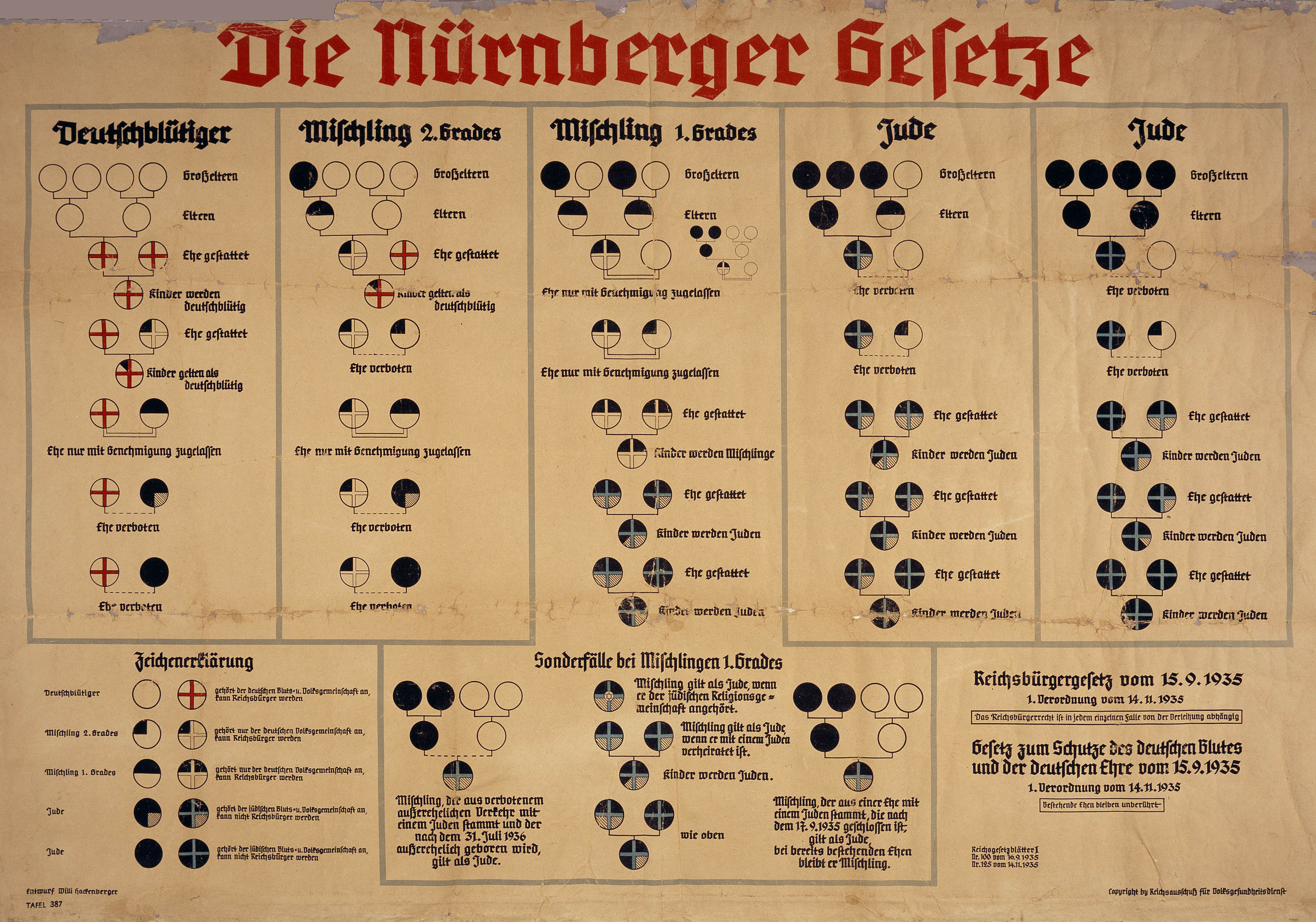
Image courtesy of the United States Holocaust Memorial Museum.
Look first. Rows of circles (white, half-shaded, black) sort human beings into “German-blooded,” into two degrees of Mischling, and into “Jew.” Then read the rule the chart encodes: a person’s “race” is determined by how many of their grandparents belonged to the Jewish religious community. The document built to prove that Jewishness is a matter of blood can establish it only by asking who once went to synagogue.
That contradiction is the whole Topic on a single sheet. The medieval question, what does this person believe?, and the modern racial question, what is this person’s blood?, are fused on one page: religion used to assign race, and race used to assign rights. And it is law. Not a sermon, not a rumor, not a riot, but a diagram a clerk in an office could pick up and apply.
That is the distance this Unit measures. The hatred was old. The diagram was new.
Following the evidence
Reading the threads together.
This page argues that Nazism was a synthesis, an assembly of older parts. The argument is testable, because each thread can be set beside an object that carried it. Read together, the artifacts show what was borrowed and what was genuinely new.
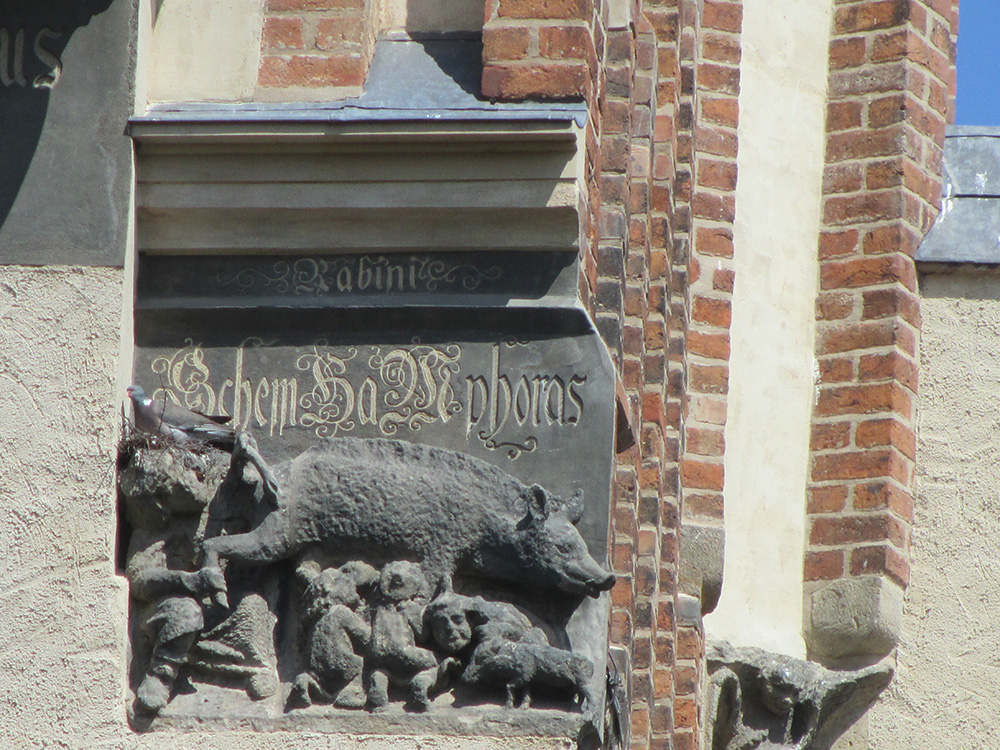
Sculpture public domain by age; photograph by Posi66, via Wikimedia Commons.
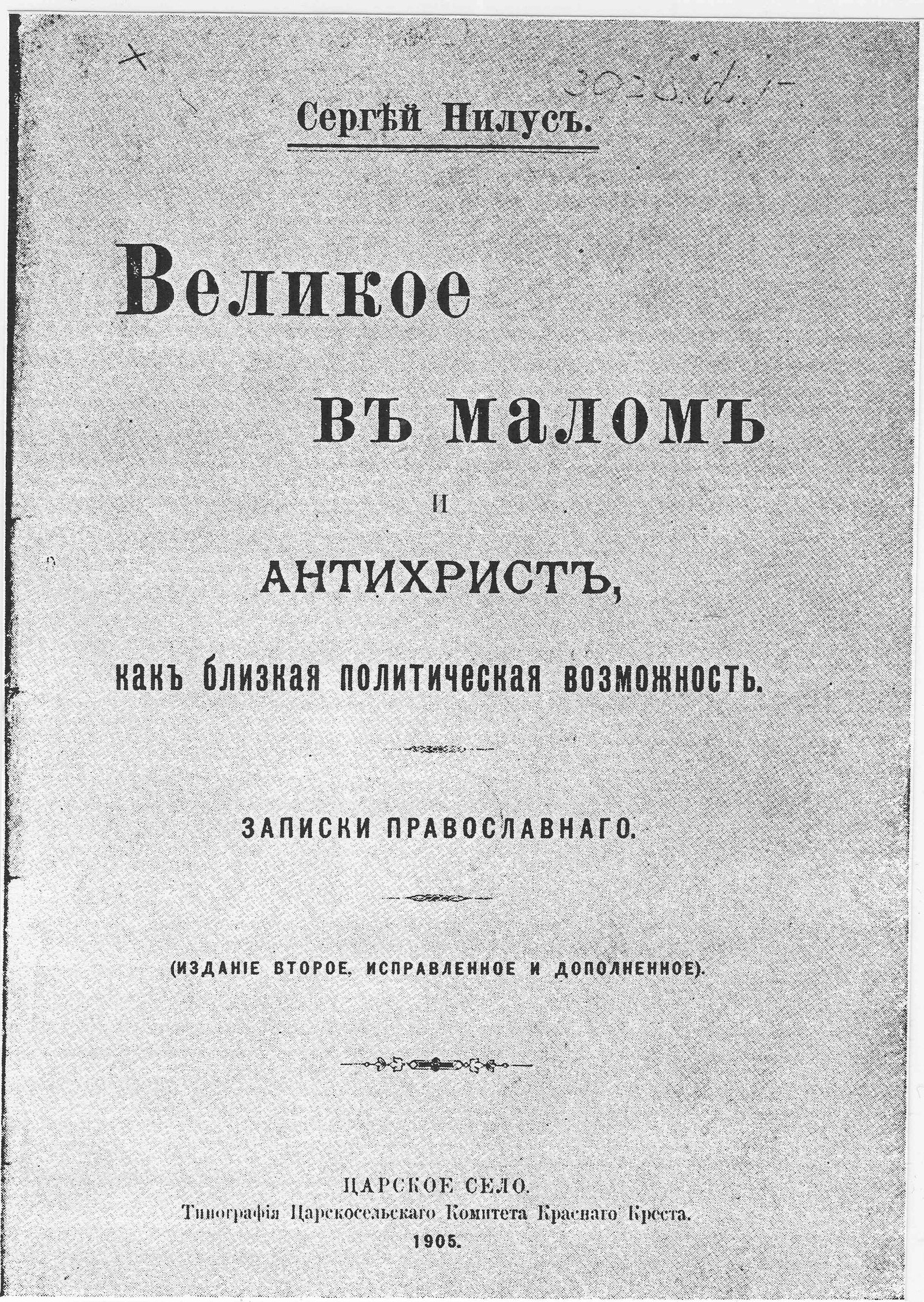
Sergei Nilus, The Great in the Small, 1905. Public domain by age.

Volksempfänger receiver, Smithsonian Institution collection.
Set side by side, the objects make the case the page argues. The contempt is medieval; the conspiracy is a turn-of-the-century forgery; the racial chart in the spotlight above is a bureaucratic form. Only the last of these, the reach of the modern state into every home and office, was new. History did not repeat itself in 1933. It was assembled.
Key takeaways
- Nazi antisemitism was a synthesis, not an invention: its religious, economic, racial, and conspiratorial elements were all inherited from the history traced across this Unit.
- Two developments were genuinely new, the fusion of every antisemitic tradition into one total, closed worldview, and the capture of a modern state willing to act on it without limit.
- The Weimar crisis (defeat in 1918, the “stab-in-the-back” myth, the 1923 hyperinflation, and the post-1929 Depression) made the synthesis politically usable, but a majority of Germans never voted for it.
- The Nazi Party moved from under three percent of the vote in 1928 to government in January 1933, when conservatives handed Hitler the chancellorship expecting to control him.
- Within months the synthesis became law: the April 1933 boycott and civil-service “Aryan paragraph,” and, in 1935, the Nuremberg Laws, which defined “Jew” by the religion of one’s grandparents, fusing the medieval and the racial on a single page.
- This Topic is the hinge between Unit 3 and Unit 4: the moment a long history of ideas became the official policy of a state, and the threshold of the Holocaust.
Discussion questions
Working from the evidence.
These questions ask students to work from the evidence on this page and reach their own conclusions. There are no single right answers; each is anchored in a specific source or distinction the Topic documents.
- The Topic argues that Nazism “invented almost nothing.” Choose two of the seven inheritances and trace each back to an earlier Topic in this Unit. What, then, is left that was actually new?
- The page calls a worldview that explains everything by one cause “a closed system” that cannot be reasoned out of. Using the synthesis described here, why might that kind of explanation be more dangerous than an ordinary prejudice?
- The Nuremberg Laws chart tried to define race but could do so only by counting religious grandparents. What does that contradiction reveal about the racial idea the Nazis claimed was science?
- Most Germans never voted for the Nazi Party, yet it came to power legally in January 1933. What does that combination suggest about how the synthesis reached the state, and about who else had to act for it to do so?
- The page insists this Topic is a “hinge” rather than a beginning. Why does it matter, for understanding the Holocaust, to see 1933–1935 as the end of a long history rather than the start of a new one?
Classroom Connections
Where this Topic fits.
Teaching Connections
The disciplines and courses this Topic naturally supports, for any educator, anywhere.
- Modern European History: the Weimar Republic, the postwar crisis, and the rise of Nazism from fringe movement to government.
- The History of Antisemitism: how older religious, economic, racial, and conspiratorial traditions were fused into a single worldview.
- Government & Civics: how a parliamentary democracy was dismantled, and how law itself can be turned into an instrument of persecution.
- Media & Propaganda: the use of radio, film, press, and schooling to make a worldview ambient and total.
- Historical Thinking & Source Analysis: distinguishing what a movement inherited from what it invented, and recognizing the danger of single-cause explanations.
- Connects to The Racial Turn and The Protocols: the two threads most directly synthesized here, and forward to Unit 4, the Holocaust Era.
Standards Alignment
- NYS Global History & Geography: 10.5 (the interwar rise of totalitarian regimes and the ideological origins of the Second World War and the Holocaust).
- NYS Holocaust Education Mandate: Education Law §801. This Topic establishes the ideological and legal origins of the Holocaust the mandate requires.
- Common Core ELA-Literacy: RH.11–12.2, RH.11–12.6, and RH.11–12.9 (central ideas, author’s point of view, and integrating evidence from several sources to distinguish inherited ideas from new ones).
Further Teaching Resources
- USHMM Holocaust Encyclopedia · Antisemitism, situates Nazi antisemitism within the longer history.
- USHMM Holocaust Encyclopedia · The Nazi Rise to Power, the path from fringe party to government, 1919–1933.
- USHMM Holocaust Encyclopedia · The Nuremberg Race Laws, the 1935 legislation and how it defined “Jew.”
Sources and citations
Primary sources come straight from the time: documents, letters, speeches, images, and objects created by the people involved. Secondary sources come later: books, articles, and analysis in which scholars study and interpret those primary sources.
Primary sources
- Hitler, Adolf. Mein Kampf. Munich, 1925–1926. Cited as a primary source, the program, never as truth.
- The Nuremberg Laws: the Reich Citizenship Law and the Law for the Protection of German Blood and German Honor. Nuremberg, September 15, 1935.
- The 25-Point Program of the NSDAP, proclaimed in Munich, February 24, 1920.
- Hitler's Reichstag speech of January 30, 1939, the “prophecy” of the annihilation of the Jews of Europe.
- Der Stürmer, Julius Streicher's antisemitic weekly, 1923–1945. The mass-propaganda artifact of the synthesis; Streicher was tried and convicted at Nuremberg.
Secondary sources
- Kershaw, Ian. Hitler, 1889–1936: Hubris. New York: W. W. Norton, 1998.
- Evans, Richard J. The Coming of the Third Reich. New York: Penguin Press, 2004.
- Friedländer, Saul. Nazi Germany and the Jews, Volume I: The Years of Persecution, 1933–1939. New York: HarperCollins, 1997.
- Burleigh, Michael. The Third Reich: A New History. New York: Hill and Wang, 2000.
- Confino, Alon. A World Without Jews: The Nazi Imagination from Persecution to Genocide. New Haven: Yale University Press, 2014.
- Herf, Jeffrey. The Jewish Enemy: Nazi Propaganda During World War II and the Holocaust. Cambridge, MA: Belknap Press of Harvard University Press, 2006.
- Wistrich, Robert S. Hitler and the Holocaust. New York: Modern Library, 2001.
- Bergen, Doris L. War and Genocide: A Concise History of the Holocaust. 3rd ed. Lanham: Rowman & Littlefield, 2016.
- Cohn, Norman. Warrant for Genocide: The Myth of the Jewish World-Conspiracy and the Protocols of the Elders of Zion. London: Eyre & Spottiswoode, 1967.
- United States Holocaust Memorial Museum, Holocaust Encyclopedia: “Antisemitism,” “The Nazi Rise to Power,” and “The Nuremberg Race Laws.” encyclopedia.ushmm.org →
Finding these documents: many primary sources are free online. Good places to start are the Fordham Internet Jewish History Sourcebook, Yale’s Avalon Project (law and diplomacy), German History in Documents, the collections of the US Holocaust Memorial Museum and Yad Vashem, the National Library of Israel, and Sefaria (for Jewish texts). Search the document’s name and date.
Contemporary antisemitism, the analytical frameworks (IHRA, Jerusalem Declaration, Nexus), the monitoring institutions, and the documented record, treated as established analysis rather than commentary on current events.
Comments?
Write to editor@makorproject.org.
Last updated: August 2026. Makor is the Hebrew word for source.