This Saturday, a Jew in Yemen, a Jew in Poland, and a Jew in Argentina will open the same book to the same page and read the same words, in the same ancient language. They have never met. They may share no country, no spoken language, and no belief about God. And they are still, unmistakably, one people.
How? That is the question this page answers, and the question the whole platform rests on. Before the land, before the long history of being hated, before anything else, there is a plainer question to answer: what do Jews actually have in common that has held them together across all that distance and all that time?
Why this Topic exists
The first question, usually answered too fast.
Most textbooks open the Jewish story with one sentence, "Judaism is one of the world's oldest religions," and move on. That sentence is true, but it quietly sets up the reader to misunderstand everything that follows. If Jews are only a religion, then the hatred of Jews looks like a quarrel about beliefs, and the existence of a Jewish country looks out of place. Neither survives contact with the actual history.
So this page answers a simpler, harder question: what do Jews actually have in common? What makes a teenager in Morocco, a grandmother in Brooklyn, and a soldier in Tel Aviv one people, when they may share no language, no country, and not even a belief in God? The answer is a set of bonds held for more than three thousand years, across every continent and through repeated attempts to destroy them. Name them first, and the rest of the platform (the land, the texts, the contributions, the long history of persecution) finally reads correctly.
What follows is not a list of rules anyone is asked to accept. It is a description of what has actually bound this people together, told from the outside, the way you would explain any people to someone who had never met one.
What Jews have in common · 1
One God, and an agreement.
At the center is an idea that was radical when it appeared and is now so common it is easy to miss: that there is one God, not many. For most of the ancient world, every city and nation had its own gods. The Israelites held, instead, to a single, invisible God, and understood themselves as bound to that God by a covenant, a two-sided agreement: a people would live a certain way and, in return, understand itself as chosen for a particular responsibility. You do not have to share the belief to see its importance. This is widely regarded as the root from which both Christianity and Islam later grew, which means roughly half the people alive today inherit a religious idea that began with this one small people.
A Jew today may believe every word of this or none of it. That is the strange part, and the next sections explain why it does not break the bond. But the covenant is where the shared story starts, and even secular Jews carry its vocabulary, its calendar, and its consequences.
What Jews have in common · 2
One book, read on the same schedule everywhere.
That shared Saturday reading, the one this page opened with, is no accident. Every Jewish community on earth carries the same core text: the Torah, the first five books of the Hebrew Bible, written by hand on a scroll exactly as it was two thousand years ago. They read it on a shared schedule, divided into weekly portions, moving through the whole scroll across a year and starting again the moment they finish. A single people, scattered across the planet and speaking dozens of languages, turns the same page on the same day. Little else on earth binds a group together so tightly across so much distance.
Around that core sits a vast shared library: the Talmud and centuries of commentary and law, explored in the Sacred Texts Topic. But the Torah is the spine every Jewish community holds in common.
What Jews have in common · 3
A language that refused to die.
That shared reading is possible because of a shared language. Hebrew is the language of the Torah and of Jewish prayer, and for many centuries it was kept alive mainly in study and worship while Jews spoke the local languages of wherever they lived. A Jewish trader in medieval Cairo and a Jewish scholar in medieval Germany could not have chatted easily, but they could both read the same sacred Hebrew. Then something almost unheard-of happened: in the nineteenth and twentieth centuries Hebrew was revived as an everyday spoken language, and it is now the daily speech of millions in Israel. A language that survived as the thread connecting a scattered people became, again, a living tongue.
What Jews have in common · 4
A shared way of life: the commandments.
Judaism is at least as much about what you do as what you believe. The tradition centers on the mitzvot, the commandments, understood as the practical terms of that ancient covenant: a way of ordering daily life. They include resting on the Sabbath from Friday evening to Saturday night, rules about which foods may be eaten (kashrut, the source of the word "kosher"), and the marking of every major holiday and life passage (birth, coming of age, marriage, death) with specific acts and blessings.
Not every Jew keeps all of them, and many keep few or none. But the commandments are the shared script even for those who depart from it, what a secular Jew is being secular about. When a mostly non-observant family still gathers for a Passover meal, or lights candles on Friday night, they are speaking, in shorthand, a language of practice that every Jewish community would recognize.
What Jews have in common · 5
A shared calendar and a shared memory.
Jews keep their own calendar, counting years from a traditional date of creation, so that the Jewish year is in the mid-5780s while the common year is in the 2020s. On that calendar fall the same festivals, kept by the whole people: Passover each spring, retelling the escape from slavery in Egypt; the High Holy Days of repentance in the autumn; the joy of Simchat Torah when the yearly Torah reading begins again. These are not only religious observances. They are a shared memory: the same handful of stories, retold on the same days, in every Jewish home for thousands of years. A people is, in part, those who remember the same stories together, and the Jewish calendar keeps that memory alive, the same days coming around year after year.
What Jews have in common · 6
Responsibility for one another, and for the world.
Underneath all of it is a sense of being one extended family. An old phrase in the tradition holds that all of Israel is responsible for one another, and in practice Jewish communities have long cared for their own, ransoming captives, funding schools and the poor, taking in refugees, as a basic duty rather than charity. To be Jewish has meant being answerable to a worldwide family you mostly never meet.
That responsibility points outward too. A much-cited modern idea, tikkun olam, "repairing the world," frames part of the Jewish purpose as leaving the world better than you found it, working for justice and the relief of suffering beyond one's own community. Many secular Jews who keep none of the ritual commandments still name tikkun olam as the core of their Jewish identity, which is itself a clue to what kind of group this is: one where a value can carry the whole weight of belonging.
Explore
The World Jewish Congress maintains an interactive map of Jewish communities around the world today, by country, with the size and history of each. It is one way to see that the Jewish people are spread across the globe and present right now, not only in the past. Open the interactive map →
What Jews have in common · 7
One place they all point to.
Finally, the shared orientation toward a single place: the Land of Israel. Wherever Jews have lived, their prayers, texts, and festivals have faced it: a Jew in medieval Spain prayed toward Jerusalem and marked harvest festivals tied to the seasons of a country thousands of miles away. The next Topic takes up that land and its long history in full. Here it is enough to note that it is one more bond every Jewish community has shared, and one far older than the modern State of Israel.
Object Spotlight
A synagogue, painted by a living hand.
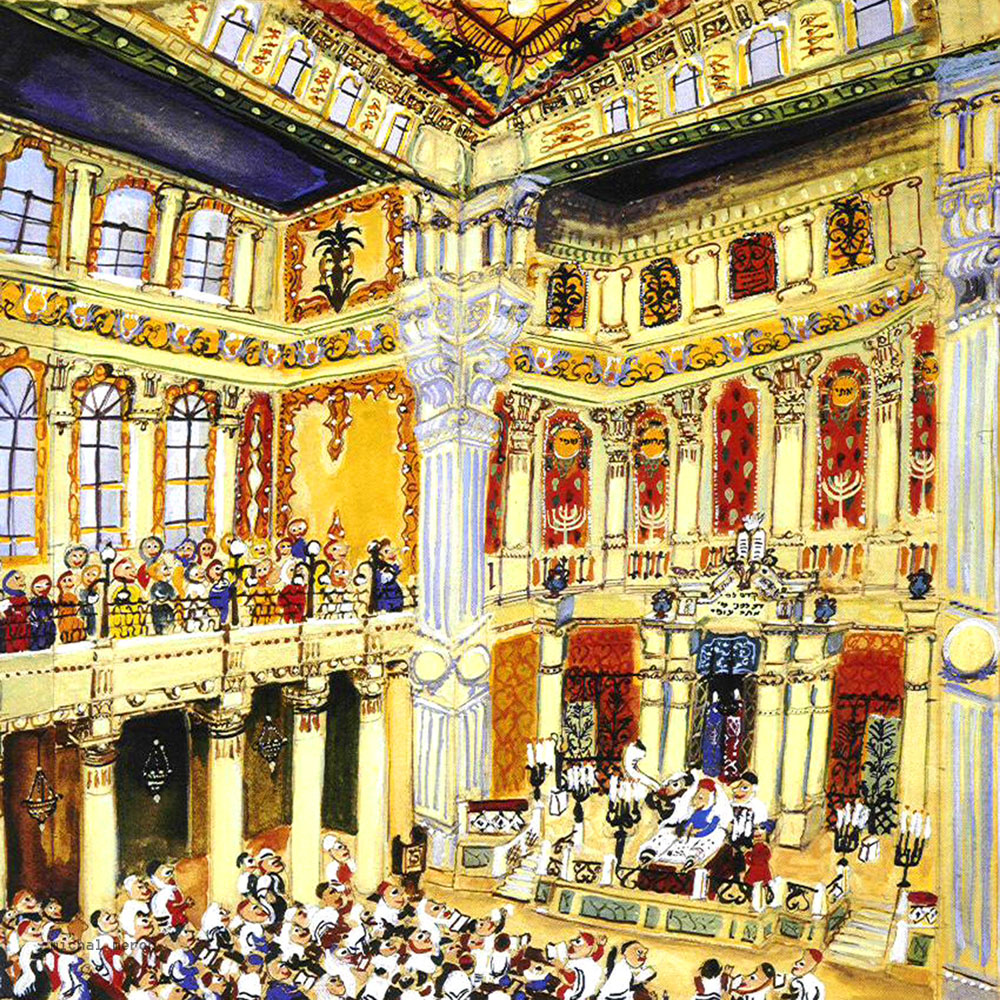
Look at the picture. A synagogue in Rome is packed for Rosh Hashana, the Jewish New Year: worshippers crowd the floor in white and red, more lean over a balcony above, and the whole space glows in gold and warm light. Tall draped curtains mark the holiest spot, the ark where the Torah scrolls are kept. Hanging lamps and a coffered ceiling rise overhead. It is loud, full, and joyful, the opposite of a museum piece behind glass.
This is not a centuries-old painting. It was made recently by Michal Meron, an Israeli artist born in Haifa in 1947 to parents who survived the Holocaust. Her mother had fled Vienna as the Nazis rose. Meron studied art in Vienna, the city her mother escaped, and today runs The Studio in Venice inside the historic Venice Ghetto, the walled quarter where the city forced its Jews to live beginning in 1516, the place that gave the word "ghetto" to the world. There is something pointed in working there. The Ghetto was built to confine and separate a people; five centuries later, a Jewish artist sits inside its walls and fills them with color. From that studio she paints Jewish life across Europe, here a synagogue in Rome on the New Year, in bright, deliberately childlike color, a style she says lets her reach "the child that resides within the adult."
Here is why a living artist belongs on the page that asks who the Jews are. Meron's signature work is an illustrated Torah: full-color paintings of all fifty-four weekly portions, and hand-illustrated Torah scrolls. The Torah scroll is the oldest object in Jewish life, copied by hand the same way for more than two thousand years. Meron takes that ancient form and keeps it going with a new pair of hands, in a new century, in one of the oldest Jewish neighborhoods on earth. The painting is not a record of something finished. It is proof of something still being made. A people is not a relic. It is alive, still painting its own synagogues, still writing its own scrolls, now.
The payoff
So what kind of group is this?
Now the famous puzzle answers itself. Look back at the list: a covenant, a book, a language, a way of life, a calendar, a mutual responsibility, a homeland. Some of those sound like a religion. Some sound like an ethnicity. Some sound like a nation. They are all true at once, and no single English word ("religion," "race," "nationality") holds all of them. The word that does is the oldest one: a people. A people is large enough to contain a faith and an ancestry and a homeland together, and to keep a member who has only one of the three.
That is why the two facts that break every simple definition are not contradictions at all. A person born to a Jewish parent is Jewish without believing anything or doing anything, the way anyone is born into a family: that is the ancestry. And a person with no Jewish ancestors can become fully Jewish through conversion, which by long tradition is understood not as signing up to a set of beliefs but as joining the people, becoming a member of the family, after which their children are Jewish by birth. You can be born into the Jewish people or welcomed into it. Either way, you belong completely. That is exactly what a people is, and exactly what a mere religion or a mere ethnicity is not.
How many, and how few
How many Jews are there?
So the Jews are a people. They are also remarkably few. Roughly 15 to 16 million Jews live in the world today, about 0.2 percent of humanity. It is a small number, and a diminished one. In 1939 there were about 16.5 million Jews. The Holocaust murdered six million, and by 1945 the population had fallen to roughly 11 million. Demographers estimate that without those losses, and had the community kept growing as it had before, world Jewry today would number between 26 and 32 million, roughly 0.3 to 0.4 percent of humanity. More than eighty years later, the population has still not returned to its 1939 size.
Where the confusion comes from
Why the question keeps getting answered wrong.
The trouble is mostly language. English sorts groups into tidy boxes ("religion," "race," "ethnicity," "nationality") that were shaped mostly by Christian and modern European experience, where those categories often are separate. A Christian can be of any nationality; an American can be of any faith. Applied to Jews, who never split those categories apart, the boxes simply do not fit, and people grab whichever one they know best, usually "religion," because that is the part most visible from outside.
That mistake is not harmless. A student taught that Jews are "a religion" will later struggle to understand why Jews were hunted by ancestry, no matter what they believed, or why there is a Jewish state. Into that confusion, propaganda flows easily. Getting the category right at the start is not a technicality. It is the foundation that lets the rest of the history make sense, which is why this is the first Topic and not a footnote.
The point worth holding
One people, many doors in.
So when the question comes (is it a religion, a race, a nationality?), the honest answer is that it is a people, held together by the bonds named on this page and reducible to none of them alone. The atheist in Tel Aviv who keeps no commandment, the rabbi in Brooklyn, the convert in São Paulo, the family in Morocco who kept Sabbath quietly for centuries: all fully Jewish, by different doors into the same house.
Everything else on the platform rests on this. The land, the texts, the long record of contribution, and the dark thread of antisemitism running through the centuries: none of it reads correctly if you start by mistaking a people for one of its parts. Start here, and the rest follows.
Key takeaways
- What Jews hold in common across the world includes a belief in one God and a covenant, a shared book (the Torah, read on the same schedule everywhere), the Hebrew language, a shared way of life (the commandments), a shared calendar and memory, mutual responsibility and the idea of tikkun olam (repairing the world), and a common orientation toward the Land of Israel.
- Not every Jew keeps the commandments or believes in God. They remain the shared inheritance even for those who depart from parts of them.
- Together these add up to a people, a category large enough to hold a faith, an ancestry, and a homeland at once, and to keep a member who has only one of the three.
- That is why a secular atheist can be fully Jewish (by ancestry) and a person with no Jewish ancestors can become fully Jewish (by conversion, understood as joining the people).
- English categories (religion, race, nationality) fit poorly because they were shaped by experiences where those distinctions hold, and for Jews they never did, which is why mistaking the category makes the later history hard to understand.
Classroom Connections
Where this Topic fits.
Teaching Connections
The disciplines and courses this Topic naturally supports, for any educator, anywhere.
- World Religions & Belief Systems. Judaism as one of the world’s belief systems, and what kind of group the Jews are: a people, a faith, and a nation at once.
- World History. Peoplehood and group identity sustained across time and place.
- Civic Education. Identity, peoplehood, and belonging.
- Historical Thinking. How to define a group that does not fit a single familiar category.
Standards Alignment
- NYS Global History & Geography: 9.2 (Belief Systems).
Further Teaching Resources
- Weitzman National Museum of American Jewish History, “Who Are Your People?: Defining Jewish Peoplehood”. Grades 6–12, with handouts and slides, directly on the peoplehood idea at the center of this Topic.
- American Jewish Committee, Translate Hate glossary. A careful reference for the terms and misconceptions that surround Jewish identity.
Questions for the classroom
Use these to turn the page into discussion or a short writing assignment. Each maps to a C3 Framework inquiry standard.
- The page says a person can be a Jewish atheist and a person can convert into Judaism with no Jewish ancestors. In your own words, why do those two facts together show that "religion" alone is not a complete definition? (C3 D2.His.1)
- English sorts groups into "religion," "race," and "nationality." Where do those categories come from, and why might they fit some groups better than others? (C3 D2.His.5)
- The page argues that mistaking the category at the start makes later history harder to understand. Choose one later event (persecution by ancestry, or the founding of a Jewish state) and explain how the "people" framing helps explain it. (C3 D2.His.1)
- Look again at Michal Meron’s Rosh Hashana in Rome. How does a crowded, joyful, present-day scene picture the Jewish people differently than a quiet historical portrait would? What is the artist saying by painting it in bright, almost childlike color? (C3 D2.His.11)
Sources
Primary sources come straight from the time: documents, letters, speeches, images, and objects created by the people involved. Secondary sources come later: books, articles, and analysis in which scholars study and interpret those primary sources.
Primary sources
- Paintings by Michal Meron (b. Haifa, 1947), The Studio in Venice: The Campo Ghetto Nuovo (banner) and Rosh Hashana in Rome (Object Spotlight). Images © Michal Meron, used with the artist's permission; thestudioinvenice.com.
- The Merneptah Stele, c. 1208 BCE. The earliest known reference to “Israel” outside the Bible, in an Egyptian victory inscription. Egyptian Museum, Cairo.
- The Book of Ruth. The biblical narrative of joining the Jewish people: “your people shall be my people.” Free at Sefaria.
Secondary sources
- Biographical detail on Michal Meron from her studio profile and published interviews; her parents were Holocaust survivors and she trained in Vienna and at Tel-Hai College, Israel.
- Framing of Jewish identity as peoplehood drawn from standard reference and scholarly works cited across the platform's Sources page; the platform takes no position on present-day political disputes.
- World Jewish population figures from Sergio DellaPergola, World Jewish Population (American Jewish Year Book; Berman Jewish DataBank). The estimate that world Jewry would today number roughly 26–32 million but for the Holocaust is DellaPergola’s demographic modeling, against a 1939 population of about 16.5 million and roughly 11 million in 1945.
Finding these documents: many primary sources are free online. Good places to start are the Fordham Internet Jewish History Sourcebook, Yale’s Avalon Project (law and diplomacy), German History in Documents, the collections of the US Holocaust Memorial Museum and Yad Vashem, the National Library of Israel, and Sefaria (for Jewish texts). Search the document’s name and date.
The Land of Israel across three thousand years: its geography, its changing names and rulers, and the enduring relationship between the Jewish people and the Land, from the Israelite kingdoms to 1948.
Comments?
Write to editor@makorproject.org.
Last updated: August 2026.