The Jewish Life Cycle
At the happiest moment of a Jewish wedding, someone smashes a glass underfoot, on purpose. Even in the middle of the joy, the ceremony pauses to remember an ancient loss: the destruction of the Temple in Jerusalem, nearly two thousand years ago.
Why this Topic exists
A life has its turning points, too.
Two other Topics in this Unit track Jewish time. The calendar marks the year; the ritual objects mark the week and the festivals. This one marks a single human life. Every culture notices the same handful of moments (a birth, the passage into adulthood, a marriage, a death) and every culture marks them somehow. What this Topic shows is how Judaism marks them: with old and specific rituals, carried across the whole map, and colored each time by wherever Jews happened to be living. The milestones are universal. The way they are kept is a fingerprint.
It is also where a great deal of ordinary Jewish life actually happens. A student who learns the festivals but never meets a bar mitzvah, a wedding under a canopy, or the seven days of mourning has learned the holidays of Judaism without the life of it. This Topic fills that in.
The shape of a life
Four turning points.
A traditional Jewish life is walked through four main gates. At the start, a newborn is brought into the covenant and given a name. Around the age of twelve or thirteen, a child becomes responsible for the commandments, a bar or bat mitzvah. In adulthood, two people marry under a canopy and sign a contract whose form is centuries old. And at the end, the community buries its dead simply, then walks the mourners, step by step, back into life.
These are not customs added onto Judaism. Together they form much of the shared structure through which Jewish life has traditionally been lived. And like the objects in the Topic next door, each takes a different shape in Rome, in Baghdad, in Kraków, in New York, the same rite, in a thousand local accents.
It is worth saying plainly at the start: not every Jew keeps all of this, or holds the same beliefs. Jewish life today runs from the strictly observant to the secular, and how much of this shape a person follows (and what they take it to mean) differs from one Jew, and one community, to the next. What this Topic describes is the shared traditional pattern; how fully it is kept, and what it is believed to mean, is a personal and communal choice.
The first gate
Birth and a name.
The covenant. Eight days after a boy is born, in a ceremony the Torah traces back to Abraham, he is circumcised, the brit milah (in Yiddish, the bris), the “covenant of circumcision.” The book of Genesis describes it as the sign of the agreement between God and Abraham's descendants; a trained specialist called a mohel performs it, usually at home or in the synagogue, with family and friends gathered. Before it is anything else, it is a moment of belonging: the newest member of the family is folded into a very old promise.
A name. The child receives a Hebrew name at the same time, and the name itself often carries memory. In many communities a child is named for a beloved relative who has died, so that the dead are quietly kept present among the living, a small thread running from the end of one life to the beginning of another. Daughters are named too: traditionally with a blessing in the synagogue when the father is called to the Torah, and, in recent decades, with a fuller home ceremony of its own that many families have built for the purpose (a simchat bat, “the joy of a daughter”). The custom for girls is newer; the instinct (to welcome a child by name into the community) is the same.
The second gate
Coming of age: bar and bat mitzvah.
Becoming responsible. At thirteen, a Jewish boy becomes a bar mitzvah: literally “son of the commandment.” That phrase is the key to what the day actually means. It is not a graduation, and it is not the party (though there is usually a party). It marks the moment a child becomes an adult in the eyes of Jewish law, newly responsible for keeping the commandments himself rather than through his parents. The change is automatic: it happens with the birthday whether or not anything is celebrated. But communities mark it by calling the young person up to the Torah for the first time, often to chant a passage aloud before the congregation, the first public act of a Jewish adult. A girl reaches the same status, the bat mitzvah (“daughter of the commandment”), traditionally at twelve. In many synagogues the congregation then showers the new bar or bat mitzvah with soft candy, a sweet, slightly chaotic blessing for the life of learning just begun.
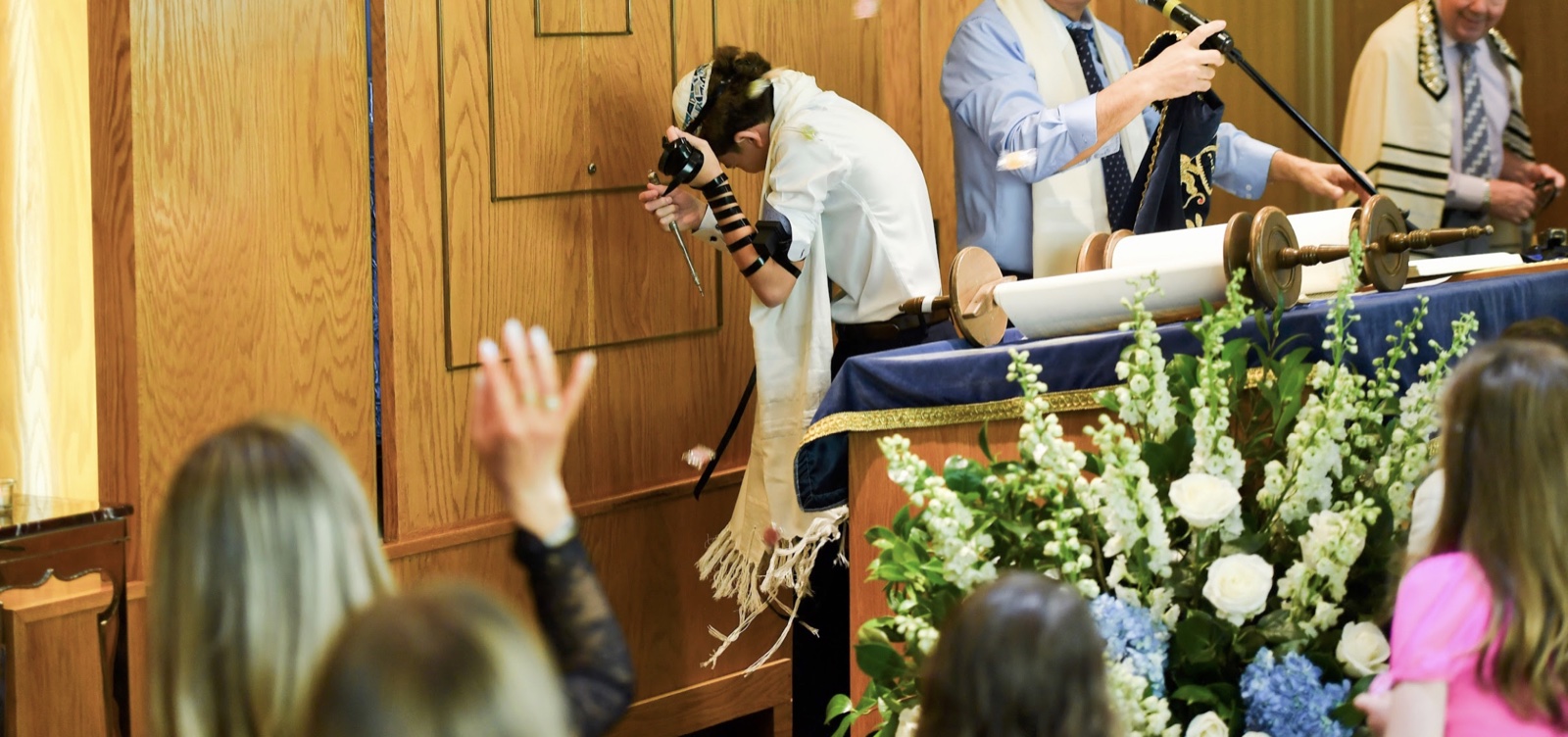
A modern story inside an old one. The public bat mitzvah ceremony is young. The first in America was held in 1922, when Judith Kaplan, the twelve-year-old daughter of the rabbi Mordecai Kaplan, read from the Torah before her congregation in New York, something girls had not done. Within a few generations the bat mitzvah had spread across much of the Jewish world. It is a useful reminder that a “tradition” is not frozen: a very old idea (that reaching adulthood means taking on its obligations) found a new and wider form within living memory.
The third gate
Marriage: under the canopy.
The canopy. A Jewish wedding takes place under a chuppah: a cloth canopy on four poles, open on every side. It is usually read as the new home the couple will build, open to guests the way a home should be.
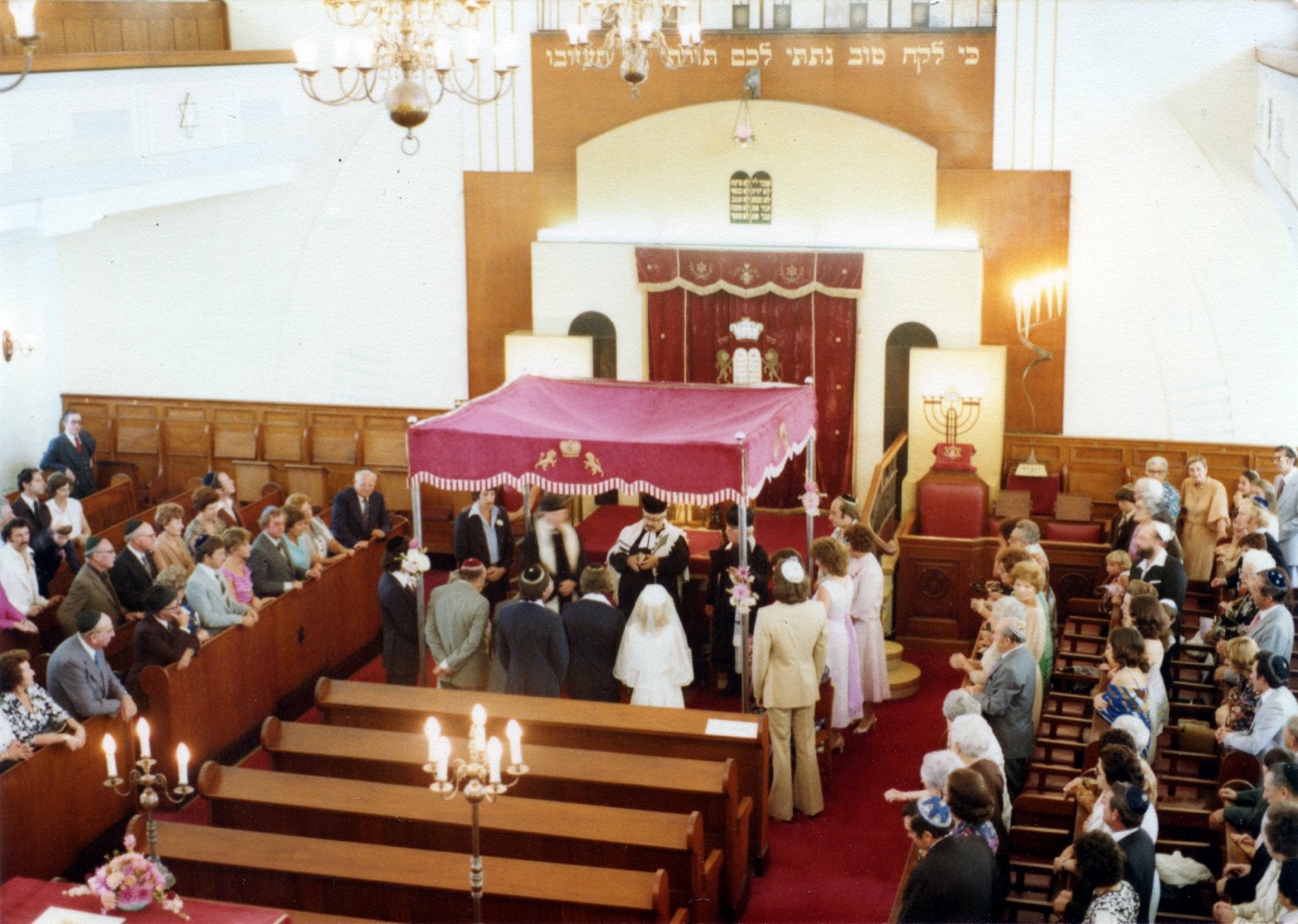
The contract. The marriage is accompanied by the ketubah, the marriage contract that Ritual Objects & Material Culture treats as both a legal document and a work of art.
Ring, blessings, glass. The groom places a ring on the bride's finger and speaks the words that consecrate the marriage, in Jewish law the union is sealed the moment he gives her an object of value and she accepts it, and a plain ring became the customary object. Seven blessings (the sheva brachot) are then recited over a cup of wine, blessing the couple and setting their joy inside the larger story of creation. Then, in one of the most recognizable moments in any Jewish wedding, a glass is wrapped in cloth and crushed underfoot. Tradition reads the broken glass as a deliberate note of sorrow inside the happiest of days, a memory of the Temple destroyed in Jerusalem, kept alive even here, so that no Jewish joy is ever quite complete while that loss is unhealed.
Across the map. The bones of the rite (canopy, contract, ring, blessings, glass) are the same wherever Jews marry. The music, the food, the dress, the look of the chuppah and the ketubah are local every time. The wedding in Delacroix's Morocco at the top of this page and a wedding in old Kraków would share a skeleton and almost nothing else.
The last gate
Death and mourning.
Equal, and quickly. Jewish practice around death is striking for its plainness and its speed. Burial comes fast, ideally within a day, and traditionally before another nightfall passes. The reason is respect for the dead: the Torah instructs that a body not be left out overnight, so to bury without delay is treated as an act of honor, and to leave the dead unburied a disgrace. The body is washed with care and wrapped in a simple white shroud and, by long custom, laid in a plain wooden coffin, the wealthy and the poor buried the same way, because death is the one place where status is meant to fall away.
Filling the grave by hand. At the graveside, once the coffin has been lowered, those who came do not leave the rest to cemetery workers. Family, friends, and the mourners themselves take turns with the shovel and cover the coffin with earth, often staying until the grave is full. It is counted as one of the purest kindnesses a person can do, a last act of care for someone who can never repay it. Many push in the first earth with the back of the shovel, a quiet sign that this is the hardest task, and not an ordinary one.
The work of grief, in stages. What follows is one of the most humane-looking structures in the tradition: mourning is not left formless but walked in steps. For the first seven days the closest mourners “sit shiva”, they stay home, on low seats, while the community comes to them, bringing food and simply being present, so that the bereaved never has to be alone or to play host. A lighter month follows (shloshim, “thirty”), and for a parent, a full year. At the center of it is the Kaddish, the mourner's prayer, which, remarkably, says nothing about death at all. It praises God and asks for peace, recited by the mourner and answered aloud by the congregation, so that grief is always carried in company.
A stone, and a name. Within the first year, a lasting headstone is set over the grave (often unveiled in a short graveside gathering near the first anniversary) so the permanent marker comes only after the rawest grief has passed. Each year after, on the anniversary of a death (the yahrzeit), a candle is lit at home to burn for a full day, and the Kaddish is said again. It closes the circle the brit opened: the name given at the beginning is the name remembered at the end.
When mourning ends. And here is the part that is easy to miss: by design, it ends. Judaism bounds its grief on purpose, the seven days, the thirty, and the year are built to carry the bereaved through sorrow and then hand them back to ordinary life, not to leave them mourning forever. What lasts afterward is remembrance, not mourning. The dead return each year on their yahrzeit, and four times a year the community gathers for Yizkor, the memorial prayer recited in the synagogue at Yom Kippur and at the close of the great festivals, when those who have lost parents and loved ones stand to remember them, so that being remembered, unlike being mourned, never stops.
Beyond the last gate
What Jews believe comes after.
One question the rituals of death raise, they do not loudly answer: what happens next? Here Judaism is famously restrained. It says less about the afterlife than many traditions do, and what it does say has never been narrowed to a single required belief. The reason is partly a matter of emphasis, Judaism has always trained most of its attention on how a person lives this life, on conduct and justice and community, rather than on mapping the next one.
Belief in something beyond death is still old and deep. The Hebrew Bible speaks briefly of Sheol, a shadowy resting place of the dead. The later rabbis taught the immortality of the soul and olam ha-ba, “the world to come,” and, in classical Jewish thought, the resurrection of the dead at the end of days. Some texts picture a Gan Eden, a paradise, and a Gehinnom, a temporary place of cleansing rather than an eternal hell. But the striking part is the range: across the centuries, and across today's Jewish movements, beliefs run from the literal to the symbolic to the frankly uncertain, and that breadth is itself part of the tradition.
The mourning practices in this Topic carry a quieter version of the same conviction: that the dead are not simply gone. The candle lit each year, the name handed to a newborn, the Kaddish said in a roomful of people, each keeps the dead present among the living, whatever a given Jew believes lies beyond.
What the life cycle proves
What stays, and what changes.
Set the four gates side by side and the pattern of this whole Unit appears once more. The structure is fixed and shared: every Jewish community, everywhere, brings a child into the covenant, marks the passage to adult responsibility, marries under a canopy with a contract, and buries its dead simply before walking the mourners home. The texture is local and personal: the melodies, the foods, the language of the blessings, the look of the ketubah, the cut of the clothes all change from Morocco to Poland to America.
A people held together by a shared shape of life, lived out in a thousand particular ways, that is the argument the ritual objects make in silver and parchment, told here in the turning points of a single life.
Common misconceptions this Topic addresses
Three assumptions get in the way of seeing the life cycle for what it is.
- “A bar or bat mitzvah is a graduation.” It is closer to the opposite: not the end of a Jewish education but the start of adult responsibility for the commandments. The learning is supposed to continue, not stop.
- “Breaking the glass at a wedding is just for luck or fun.” It is a deliberate note of mourning (the destroyed Temple) placed inside the happiest moment, on purpose. The joy and the memory are meant to be held together.
- “These customs are basically uniform everywhere.” The structure is remarkably uniform; the form is intensely local. A Moroccan and a Polish version of the same rite can look almost nothing alike.
Discussion questions
Working from the evidence.
Grounded in the rituals above.
- The bar and bat mitzvah marks the start of responsibility, not the end of learning. Why might a tradition choose to mark becoming responsible rather than finishing something? What does that say about how it sees growing up?
- At the most joyful moment of a wedding, a glass is broken to remember an ancient loss. Why might a culture deliberately fold sorrow into its happiest ritual? Can you think of a parallel in another tradition?
- Jewish mourning is walked in fixed stages (seven days, thirty days, a year) rather than left open-ended. What might be the value of giving grief a structure and a timetable?
- The public bat mitzvah is only about a century old, yet it grew out of a very old idea. When is something a “new tradition,” and when is it a new form of an old one?
- Across every community, the structure of these rites stays the same while the style changes completely. Choose one gate (birth, coming of age, marriage, or death) and explain what you think has to stay fixed for it to still be the same ritual.
Classroom Connections
Where this Topic fits.
Teaching Connections
The disciplines and courses this Topic naturally supports, for any educator, anywhere.
- World History & Belief Systems: how a civilization marks birth, adulthood, marriage, and death is primary evidence for how it organizes belief, family, and community.
- World Religions: the life-cycle rituals of naming, coming of age, marriage, and mourning.
- Art History & Museum Education: reading a ceremony, a marriage contract, or a work of art (Delacroix’s Jewish wedding) as historical evidence.
- Geography & Cultural Exchange: a single rite kept in a fixed structure but reshaped by local culture across regions.
- Historical Thinking: continuity and change: what stays the same over time and what varies across place.
Standards Alignment
- NYS Global History & Geography: 9.1 (the development of civilization), 9.2 (Belief Systems), and 9.3 (the classical world).
- Common Core ELA-Literacy: RH.6–8.7 and RH.9–10.7 (integrating visual and material evidence).
- C3 Framework: Dimension 2 (continuity and change; the spread of cultural traits across place).
Sources
Primary sources come straight from the time: documents, letters, speeches, images, and objects created by the people involved. Secondary sources come later: books, articles, and analysis in which scholars study and interpret those primary sources.
Primary sources
- The Hebrew Bible, Genesis 17, on the covenant of circumcision; Leviticus 12 on the eighth day.
- The Mishnah and Talmud, on the law of marriage (tractate Ketubot) and of mourning (tractate Mo’ed Katan).
- Eugène Delacroix, Jewish Wedding in Morocco (1839), Musée du Louvre, Paris.
- Illuminated marriage contracts (ketubot), from communities across the diaspora. Major collections at the Israel Museum, Jerusalem, and the Jewish Museum, New York.
- Wimpels: Torah binders sewn from an infant's swaddling cloth and embroidered with his name and birth date, linking birth to Torah. Examples in the collections of the Jewish Museum, New York.
Secondary sources
- On the first American bat mitzvah: Judith Kaplan Eisenstein and the congregation of Rabbi Mordecai M. Kaplan, New York, 1922.
- Maurice Lamm, The Jewish Way in Death and Mourning, and standard reference works on Jewish lifecycle practice.
Finding these documents: many primary sources are free online. Good places to start are the Fordham Internet Jewish History Sourcebook, Yale’s Avalon Project (law and diplomacy), German History in Documents, the collections of the US Holocaust Memorial Museum and Yad Vashem, the National Library of Israel, and Sefaria (for Jewish texts). Search the document’s name and date.
How a people with no country, no army, and no capital stayed one people across three continents for a thousand years, the diaspora as a working network, not a story of expulsions.
Comments?
Write to editor@makorproject.org.
Last updated: August 2026.