
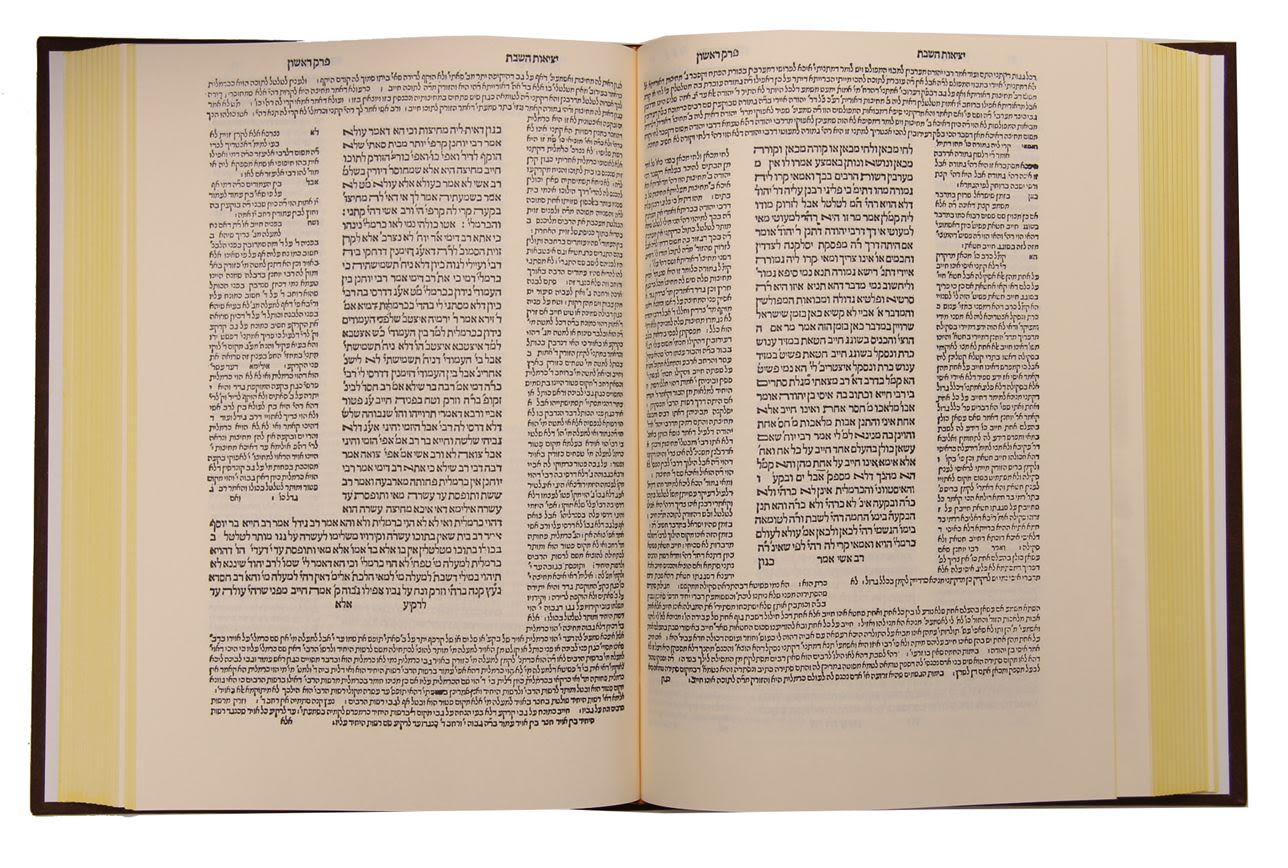
Open a printed page of the Talmud and you are looking at a conversation that spans more than a thousand years on a single sheet of paper. The oldest text sits in the center. Around it, in concentric columns, are the arguments of rabbis from the eleventh century, the twelfth, the sixteenth, each answering the ones before, all printed together so the reader can follow the discussion across the centuries at once.
The Sacred Texts · Unit 1
Why this Topic exists
The textual civilization the curriculum rarely teaches.
The standard secondary-school treatment of Judaism typically mentions the Hebrew Bible and rarely treats anything else. This is inadequate for understanding a civilization in which the textual conversation across centuries is one of the defining features of the tradition. Judaism produced one of the world's great continuous textual civilizations. From the codification of the Mishnah around 200 CE through the modern period, Jewish scholars continued to write, debate, interpret, codify, and preserve earlier traditions.
That literature includes the Mishnah, the two Talmuds, the Midrashic compendia, the Geonic responsa, the medieval commentary tradition, Maimonides' philosophical and legal corpus, the kabbalistic literature, Karo's Shulchan Aruch, the Hasidic and Lithuanian traditions, and the modern scholarly and ethical literature that continues the conversation today.
This Topic introduces the architecture of the Jewish textual tradition so that the people, communities, legal debates, and historical developments encountered throughout the rest of the platform can be understood in their original intellectual context.
Common misconceptions this Topic addresses
The textual tradition of Judaism: the Hebrew Bible, the Mishnah, the two Talmuds, the medieval and modern rabbinic and philosophical literatures, is badly mischaracterized in the dominant secondary-school treatment. The dedicated Misconceptions entries lay out the structure of the textual tradition.
- "The Hebrew Bible and the Christian Old Testament are the same book." see the dedicated entry →
- "The Talmud is a single book." see the dedicated entry →
The textual architecture
How the literatures relate.
Like any great library, this one was built one layer at a time. The Jewish textual tradition has a particular structural feature that distinguishes it from many other religious or philosophical traditions: each subsequent layer reads the earlier ones, responds to them, argues with them, and becomes part of the same continuing conversation. The Mishnah is structured around the Bible; the Talmud is structured around the Mishnah; the medieval commentary tradition is structured around the Talmud; Maimonides's Mishneh Torah codifies the Talmudic legal material; Karo's Shulchan Aruch codifies Maimonides and the subsequent medieval discussion; the Hasidic and Lithuanian literatures operate as further layers of commentary; and the modern literature continues the conversation. The structural pattern means that any single text in the tradition is best understood as a participant in a continuous textual conversation rather than as a standalone work.
The visual representation of this pattern is the layout of the printed Talmud page itself, established by the Bomberg Press of Venice in 1520–1523 and discussed in the Ghetto System Topic. The central Talmudic text occupies the middle of the page; Rashi's eleventh-century commentary occupies the inner margin; the Tosafists' twelfth- and thirteenth-century commentaries occupy the outer margin; subsequent commentaries occupy further surrounding columns. The page is a textual conversation across more than a thousand years, all visible simultaneously to the reader. This is the visual expression of the tradition itself: a civilization that preserves its past by continuing to speak with it.
The Tanakh
The Hebrew Bible.
The Hebrew Bible, known in Jewish tradition as the Tanakh, is the foundation of the Jewish textual tradition. Everything that follows assumes knowledge of it, responds to it, or interprets it. Rather than a single book, the Tanakh is itself a library, bringing together works composed across many centuries. The Tanakh consists of 24 books in the standard Jewish enumeration, organized as follows:
- Torah (the Five Books of Moses, the Pentateuch): Genesis (Bereshit), Exodus (Shemot), Leviticus (Vayikra), Numbers (Bamidbar), and Deuteronomy (Devarim). The core of the Bible, read in synagogue across a weekly cycle (the parashat hashavua) that completes the entire Torah annually. The Torah is the textual reference point for all subsequent rabbinic literature.
- Nevi'im (the Prophets): divided into the Former Prophets (Joshua, Judges, Samuel, Kings, the historical books treating the period from the entry into the Land through the Babylonian exile) and the Latter Prophets (Isaiah, Jeremiah, Ezekiel, and the Twelve Minor Prophets, the prophetic books proper).
- Ketuvim (the Writings): Psalms, Proverbs, Job, the Five Megillot (Song of Songs, Ruth, Lamentations, Ecclesiastes, Esther, read at specific points in the annual liturgical calendar), Daniel, Ezra-Nehemiah, and Chronicles.
The Tanakh is closely related to but not identical to the Christian Old Testament. The two are the same body of literature but are ordered differently, some Christian traditions include additional books (the Catholic and Orthodox Old Testaments include the deuterocanonical books that the Hebrew Bible does not), and the interpretive traditions are different. The platform notes this distinction in the Common Misconceptions page.
The standard text of the Hebrew Bible, the Masoretic Text, was established by the Masoretes of Tiberias across the seventh through tenth centuries, with the major surviving manuscripts being the Aleppo Codex (c. 930 CE, the work of Aaron ben Asher) and the Leningrad Codex (1008 CE, Codex Leningradensis B19A, the oldest complete Masoretic manuscript). The Masoretic text-establishment project documented the consonantal text, added the vocalization system (the nikkud), added cantillation marks (the te'amim for liturgical chanting), and produced the masorah (the marginal notes that ensured the precise preservation of the text across subsequent copying).
The Dead Sea Scrolls, discovered between 1947 and 1956 in the caves at Qumran near the Dead Sea, contain biblical manuscripts dating from approximately the third century BCE through the first century CE, approximately a thousand years older than the Masoretic standard. The Qumran biblical manuscripts allow scholars to compare manuscripts separated by roughly a thousand years, demonstrating how carefully the biblical text was transmitted while also preserving the variants that became part of its scholarly study.
The Mishnah · c. 200 CE
The first major post-biblical text.
The Mishnah marks one of the great turning points in Jewish history. Its compilation responded to a crisis: the Roman destruction of the Second Temple (70 CE) and the defeat of the Bar Kokhba Revolt (135 CE) ended the Temple-centered religious system and made it urgent to preserve the legal and ritual tradition that had until then been transmitted in oral form, through teaching and memory. Around 200 CE, under the editorial leadership of Rabbi Judah the Prince (Yehuda HaNasi, c. 135–c. 220 CE) at his academy at Beit She'arim and Sepphoris in the Lower Galilee, that oral tradition was gathered into the first systematic compilation of post-biblical Jewish religious law.
The Mishnah consists of six "Orders" (Sedarim), each containing multiple tractates (the full Mishnah contains 63 tractates). The six Orders address agricultural law (Zeraim), the liturgical calendar (Mo'ed), family law (Nashim), civil and criminal law (Nezikin), Temple-related ritual (Kodashim), and ritual purity (Toharot). The thoroughness of the work, addressing essentially the entire scope of religious and legal life, established the Mishnah as the foundational document of post-Temple rabbinic Judaism.
The Mishnah's literary form is distinctive: brief, terse statements of law, often presented as the disagreement between named earlier authorities (the tannaim, the rabbinic teachers of the first and second centuries whose opinions the Mishnah records). The text is written in Mishnaic Hebrew (a developed form of Hebrew distinct from biblical Hebrew). The standard scholarly edition is the Hanoch Albeck edition (Jerusalem, 1952–1958); the standard accessible English translation is Jacob Neusner's The Mishnah: A New Translation (Yale University Press, 1988).
The two Talmuds · c. 400 and c. 500 CE
The foundational compendium of post-biblical Judaism.
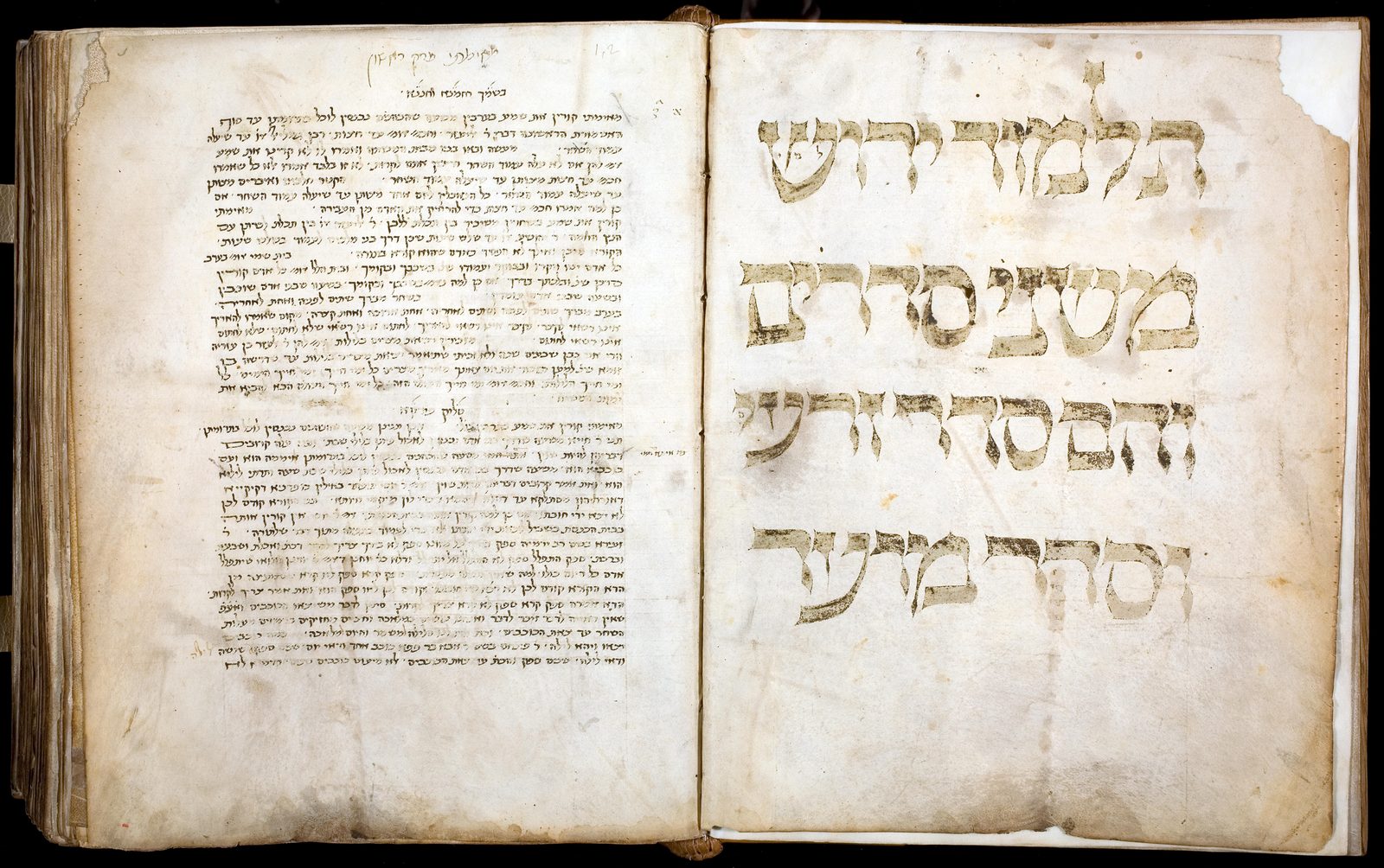
The Talmud became the central work of rabbinic Judaism. Rather than replacing the Hebrew Bible or the Mishnah, it records generations of discussion about how those earlier texts should be understood and applied. Two Talmuds exist, both consisting of the Mishnah together with extensive subsequent rabbinic commentary (the Gemara). The two Talmuds are distinct works:
- The Palestinian Talmud (also called the Jerusalem Talmud; Hebrew: Talmud Yerushalmi): compiled in the Galilean academies of Tiberias, Sepphoris, and Caesarea across the third and fourth centuries CE, with most of it completed around 400 CE. The Palestinian Talmud is shorter than the Babylonian, covers only the first four Orders of the Mishnah (and partially), and uses the Western Aramaic dialect of Palestine. It is less central to subsequent Jewish religious life than the Babylonian Talmud but contains a great deal of unique material and is the subject of a deep scholarly literature.
- The Babylonian Talmud (Hebrew: Talmud Bavli): compiled in the great academies of Babylonia (most prominently Sura, Pumbedita, and Nehardea) across the third through sixth centuries CE, with most of it completed around 500 CE under the editorial leadership of Rav Ashi and Ravina. The Babylonian Talmud is the principal text of post-biblical Judaism. It is approximately 2.5 million words across 37 tractates and uses the Eastern Aramaic dialect of Babylonia. The Babylonian Talmud became the reference point for medieval and modern Jewish religious life across virtually every region of the Jewish diaspora.
The Talmud's literary form is distinctive and worth describing. Each unit of the text begins with a brief statement from the Mishnah and proceeds with extensive rabbinic discussion: disagreement, illustration, anecdote, biblical interpretation, legal reasoning, and the elaboration of underlying principles. The discussion is typically multilayered: the named rabbinic authorities of one generation address each other; subsequent generations comment on the earlier discussion; later anonymous editorial layers (the setam ha-Talmud) shape the whole into the form it ultimately took. The text moves between Hebrew and Aramaic, between law and narrative, between technical legal analysis and ethical and spiritual reflection.
The study of the Talmud, the central activity of Jewish religious learning across the entire post-Talmudic period until the modern era, and continuing as a major commitment of contemporary Jewish religious education, operates through specific scholarly methods. The text is read together (the chevruta method, two students working through the text in dialogue), with reference to the surrounding medieval commentary tradition, and with attention to the textual conversation across centuries.
The Babylonian Talmud was first printed as a complete edition by the Bomberg Press of Venice between 1520 and 1523, within the Venetian Ghetto documented in that Topic. The Bomberg Talmud established the standard page layout (with Rashi on the inner margin and the Tosafists on the outer margin) that has been preserved unchanged across the five hundred years of subsequent Talmudic publishing. The layout itself became so influential that a student opening almost any printed Talmud today still encounters essentially the same page first standardized in sixteenth-century Venice.
The Midrashic literature · c. 200–800 CE
Narrative and homiletical interpretation.
Alongside the Mishnaic-Talmudic legal tradition, the rabbinic period produced a large parallel literature of Midrash, narrative and homiletical interpretations of the Hebrew Bible, organized into compendia across the third through ninth centuries CE. The Midrashic literature is distinct from the Talmud but emerged from the same rabbinic culture and overlapping authorship.
The major Midrashic compendia include:
- Mekhilta de-Rabbi Ishmael (third century CE): Midrash on Exodus.
- Sifra (third century): Midrash on Leviticus.
- Sifre (third century): Midrash on Numbers and Deuteronomy.
- Bereshit Rabbah (Genesis Rabbah, c. fifth century): the most influential Midrashic compendium, on the book of Genesis.
- Vayikra Rabbah, Bamidbar Rabbah, Devarim Rabbah, and the parallel Rabbah-series compendia on the Pentateuchal books.
- Pesikta de-Rav Kahana (c. sixth century) and Pesikta Rabbati: Midrashic compendia organized around the liturgical-festival cycle.
- Midrash Tehillim, Midrash Mishlei, Midrash Tanchuma: additional major Midrashic works.
The Midrashic literature is important because it provides the narrative, ethical, and homiletical tradition that runs parallel to the legal-Talmudic tradition. The interpretations of biblical narratives that became part of standard Jewish religious literacy (Abraham smashing his father's idols, the trial of Akiva by the Roman authorities, the rabbinic stories of the divine response to the destruction of the Temple) typically originate in the Midrashic compendia rather than in the biblical text itself. The standard reference is the H. Freedman and Maurice Simon edited Soncino edition (1939) and the more recent Schocken Library of Jewish Classics translations.
The Geonic period · c. 600–1040 CE
The architecture of the post-Talmudic transition.
The Geonic period, c. 600 to 1040 CE, is the bridge between the rabbinic-Talmudic period and the medieval period proper. The Geonim were the heads of the major Babylonian rabbinic academies (Sura and Pumbedita) and exercised authority across the broad Jewish diaspora of the early Islamic world. The period takes its name from the title Gaon (plural: Geonim, "eminence"), used for the heads of the academies.
The Geonic period produced the architecture of the medieval Jewish responsa literature, the formal written answers of the academy heads to legal and ritual questions submitted from the diaspora communities. The responsa established the pattern of Jewish legal decision-making that would continue across the entire subsequent period. Major Geonim include Yehudai Gaon (eighth century), Amram Gaon (ninth century, whose Seder Rav Amram is the first systematic Jewish prayer book), Saadia Gaon (882–942, the most significant Gaon, philosopher, Bible commentator, and grammarian), Sherira Gaon (tenth century, whose Iggeret Rav Sherira Gaon is the foundational document on the history of the Talmudic tradition), and Hai Gaon (939–1038, the last major Gaon).
Saadia Gaon's contribution is particularly significant. His Emunot ve-Deot (Beliefs and Opinions) is the first systematic Jewish philosophical work, a philosophical theology written in Judeo-Arabic, addressing the relationship between Jewish religious teaching and the rationalist philosophical tradition of the Islamic world. His Arabic translation of the Pentateuch (the Tafsir) was the standard Bible translation for Arabic-speaking Jewish communities for centuries. His Hebrew dictionary and grammatical works founded the systematic linguistic study of Hebrew.
The medieval commentary tradition · 1000–1500
Rashi, the Tosafists, the Spanish commentators.
The medieval period produced the great body of biblical and Talmudic commentary that constitutes the layer between the Talmud itself and the early-modern codification of Jewish law. The major figures and texts:
- Rashi · Rabbi Shlomo Yitzhaki of Troyes (1040–1105). The most influential single commentator in the history of Jewish religious literature. Rashi produced systematic commentaries on essentially the entire Hebrew Bible and on virtually the entire Babylonian Talmud. His commentary is distinguished by its clarity, its philological precision, and its accessibility. Rashi's commentary on the Pentateuch is the most widely studied single Jewish text after the Bible itself. His Talmudic commentary occupies the inner margin of every standard printed Talmud page; reading the Talmud without Rashi is inconceivable in the subsequent tradition.
- The Tosafists · twelfth and thirteenth centuries. Rashi's grandsons, great-grandsons, and their successors (operating in northern France, Germany (the Rhineland), and Provence) produced the school of Talmudic commentary known as Tosafot ("additions"). The Tosafists' work occupies the outer margin of the standard Talmud page. The major Tosafists include Rabbeinu Tam (1100–1171, Rashi's grandson), Ri ha-Zaken (1115–1184), and many subsequent figures whose work is preserved in the printed Tosafot literature.
- Ibn Ezra · Abraham ibn Ezra (1089–1164). Spanish-Jewish biblical commentator, philosopher, grammarian, and astronomer. His Hebrew Bible commentaries are distinguished by their linguistic precision and their willingness to engage critical questions about the biblical text. Ibn Ezra's commentaries are printed alongside Rashi's in the standard Hebrew Bible editions and have been significant across the subsequent tradition.
- Nahmanides · Moses ben Nahman (Ramban, c. 1194–1270). Spanish-Jewish biblical commentator, talmudist, kabbalist, and physician. His commentary on the Pentateuch combines the legal-talmudic, philological, and kabbalistic traditions. His move to the Land of Israel in 1267 (documented in the Continuous Presence Topic) reestablished the Jewish community of Jerusalem.
- Radak · David Kimhi (1160–1235). Provençal biblical commentator and grammarian whose Hebrew Bible commentaries are standard companions to Rashi and Ibn Ezra.
- The Spanish responsa literature. The major Spanish-Jewish authorities of the thirteenth and fourteenth centuries, Rashba (Rabbi Solomon ben Adret, 1235–1310), Ritva (Rabbi Yom Tov ben Asher, 1250–1330), Ran (Rabbi Nissim of Gerona, 1320–1380), and Rabbenu Asher (Rosh, 1250–1327, who emigrated from Germany to Toledo and whose son Jacob produced the Arba'ah Turim, the model for Karo's later Shulchan Aruch): produced the bulk of the medieval responsa and legal literature that subsequently underlay Karo's codification.
Maimonides · 1138–1204
One of the most influential figures in medieval Jewish intellectual history.
Moses ben Maimon, known in the tradition as the Rambam (the Hebrew acronym of Rabbi Moshe ben Maimon) and in the broader Western tradition as Maimonides, is one of the most influential figures in medieval Jewish intellectual history and one of the most consequential figures in the history of the Jewish textual tradition. He was born in Córdoba, Spain in 1138, fled the Almohad persecutions of the 1140s, lived briefly in Morocco and the Land of Israel, and ultimately settled in Fustat (Old Cairo), Egypt, where he served as court physician to the Ayyubid sultan Saladin and his successor and where he produced the bulk of his written work. He died at Fustat in 1204 and was buried at Tiberias.
Maimonides's contribution operates across three principal works, each of which became foundational for the subsequent textual tradition:
- The Commentary on the Mishnah (completed 1168, written in Judeo-Arabic): a systematic Mishnah commentary that organized the legal material and that introduced systematic philosophical introductions to several tractates, most famously the introduction to Pirkei Avot (the "Eight Chapters") and the introduction to Sanhedrin chapter 10 (which articulated the Thirteen Principles of Jewish Faith that subsequently became central to Jewish theology).
- The Mishneh Torah (completed 1180, written in Hebrew): the complete systematic codification of Jewish law across fourteen books. The Mishneh Torah reorganized the entire Talmudic legal material (and the post-Talmudic Geonic and medieval discussion) into a single integrated systematic legal code. The work is, in scope and in systematic ambition, comparable to the most consequential single legal codifications of any tradition. The Mishneh Torah includes Maimonides's commitments on the messianic period (in the closing chapters of Hilkhot Melakhim, the "Laws of Kings") that have been significant in subsequent Jewish thought.
- The Guide of the Perplexed (Moreh Nevuchim, completed c. 1190, written in Judeo-Arabic): the philosophical work in which Maimonides articulates the relationship between Jewish religious teaching and the Aristotelian philosophical tradition. The Guide is one of the most consequential single philosophical works of the medieval period, not only for Jewish thought, but for the broader medieval intellectual conversation that included Islamic and Christian scholastic traditions. Thomas Aquinas read the Guide in Latin translation and cited Maimonides extensively in the Summa Theologica; the connection between Maimonides and the broader Western philosophical tradition is documented in the scholarly literature on medieval philosophy.
Maimonides's medical works (written for the Ayyubid court and for broader physician audiences in the Islamic medical world) are documented in the scholarly literature on medieval medicine and represent a sizable subsidiary corpus alongside the religious-philosophical work. His responsa literature, his correspondence (most famously the Letter to Yemen, addressing the Yemenite Jewish community under the pressure of a messianic movement in the 1170s, and the Letter on Apostasy, addressing the Jewish community under Almohad persecution), and his philosophical commentaries on specific Talmudic and biblical questions extend the corpus further.
The standard contemporary scholarly editions are the Pines translation of the Guide of the Perplexed (University of Chicago Press, 1963), the Moznaim Hebrew-English Mishneh Torah, and the Yale Judaica Series translations of selected works. The principal scholarly studies are Isadore Twersky's Introduction to the Code of Maimonides (Yale, 1980), Herbert Davidson's Moses Maimonides: The Man and His Works (Oxford, 2005), and the extensive subsequent scholarly literature.
The kabbalistic tradition
The Jewish mystical literature.
Alongside the legal-talmudic and philosophical traditions documented above, the medieval period produced the Jewish mystical tradition known as Kabbalah. The kabbalistic literature is distinct from the legal-talmudic literature but emerged from overlapping rabbinic culture and authorship. The major texts and figures:
- The Sefer Yetzirah (Book of Formation): an ancient (c. third to sixth century CE) brief but influential text on cosmogony and language. Its precise dating and authorship are not settled in the scholarly literature; it is treated as the earliest text in the systematic Jewish mystical tradition.
- The Sefer ha-Bahir (Book of Brightness, c. twelfth century, in Provence): the earliest text of the classical kabbalistic tradition proper.
- The Zohar (the Book of Splendor, late thirteenth century, in Spain): the foundational text of classical Kabbalah. The work is presented as the teachings of the second-century rabbi Shimon bar Yochai but is attributed by the scholarly literature to the Spanish kabbalist Moses de León (c. 1240–1305) in late-thirteenth-century Spain. The Zohar is written in a distinctive form of Aramaic and is structured as a mystical commentary on the Pentateuch. It became the reference text of subsequent Jewish mystical thought.
- The Safed circle of the sixteenth century: documented in the Continuous Presence Topic. Moshe Cordovero (1522–1570) systematized the medieval kabbalistic tradition in his Pardes Rimonim (Orchard of Pomegranates). Isaac Luria (the Ari, 1534–1572) produced the developed kabbalistic framework (Lurianic Kabbalah) that became the dominant form of post-medieval Jewish mystical thought. The reference for the Safed-period kabbalistic literature is Hayyim Vital's editorial corpus of Luria's teachings (Luria himself wrote little).
The kabbalistic tradition is significant in the broader textual tradition because it influenced subsequent Jewish religious thought (particularly Hasidism, which developed in the eighteenth century and which drew heavily on Lurianic kabbalistic frameworks), the liturgy (the Friday-evening Sabbath ritual structure developed in Safed is deeply kabbalistic in its theological framework), and the broader culture of post-medieval Judaism. The principal scholarly references are Gershom Scholem's foundational works, Major Trends in Jewish Mysticism (1941), Origins of the Kabbalah (1962, English translation 1987), and the extensive Scholem corpus, together with the subsequent scholarship of Moshe Idel (Kabbalah: New Perspectives, 1988), Yehuda Liebes, and others.
Joseph Karo and the Shulchan Aruch · 1565
The standard code of Jewish law.
Rabbi Joseph Karo (1488–1575): Spanish-born, settled in Safed in 1536 after the family's post-1492 wanderings through Portugal, the Ottoman Balkans, and Egypt, produced the codification of Jewish law that has been the standard reference of subsequent traditional Jewish religious practice. His major works:
- The Beit Yosef (House of Joseph, completed 1542, published 1550–1559): Karo's massive scholarly commentary on the Arba'ah Turim of Jacob ben Asher (the principal fourteenth-century code), tracing each legal ruling back through the Talmudic, Geonic, and medieval sources. The Beit Yosef is the scholarly basis on which the subsequent codification rests.
- The Shulchan Aruch (Set Table, completed 1563, first published 1565): the systematic codification of Jewish law in concise practical form, drawing on the Beit Yosef scholarship. The Shulchan Aruch is organized into four sections: Orach Chayim (the daily and Sabbath ritual), Yoreh De'ah (the laws of permitted and forbidden, including kashrut), Even ha-Ezer (marriage and family law), and Choshen Mishpat (civil and commercial law).
Karo's Shulchan Aruch was supplemented immediately after its publication by the commentary of Rabbi Moses Isserles (the Rema, c. 1530–1572) of Krakow, who added Ashkenazi practices and rulings that complemented Karo's Sephardic framework. The integrated text, Karo's main code with Isserles's Mappah ("Tablecloth") inserted at the relevant points, has been the standard code of Jewish law across both Sephardic and Ashkenazi traditions since the late sixteenth century.
The Shulchan Aruch's significance is comparable in scope to Maimonides's Mishneh Torah. The two codes operate at different levels and with different methodological commitments (Maimonides's work is integrated philosophical-legal exposition; Karo's is practical-codificatory) and the subsequent tradition has read both as foundational. The principal scholarly reference is R. J. Zwi Werblowsky's Joseph Karo: Lawyer and Mystic (Oxford, 1962). The fact that Karo was also a serious mystical-kabbalistic figure (his mystical diary, the Maggid Mesharim, documents an kabbalistic practice alongside his legal work) is part of the record on his work.
Hasidic and Mitnagdic literatures · 1750 onward
The eighteenth-century reorganization.
The founding of the Hasidic movement in mid-eighteenth-century Eastern Europe under Rabbi Israel Baal Shem Tov (the Besht, c. 1700–1760) produced one of the major reorganizations of post-medieval Jewish religious life. The Hasidic movement was distinguished by its emphasis on direct experiential religious devotion, the role of the tzaddik (the rebbe, the leader of each Hasidic community), the development of distinct prayer practices shaped by Lurianic Kabbalah, and the production of a rich religious literature in Hebrew and Yiddish.
The major Hasidic literary works include:
- The Tanya (Rabbi Schneur Zalman of Liadi, 1797): the foundational text of Chabad Hasidism, articulating a distinctive philosophical-mystical theology.
- The Likutei Moharan (Rabbi Nachman of Breslov, 1808): the foundational text of Breslov Hasidism, distinctive in literary form (mostly structured as homiletical teachings).
- Hasidic narrative collections: the Hasidic literature includes a large body of narrative material (the Besht stories, the stories of Rabbi Nachman, the tales of subsequent Hasidic dynasties) that became part of the broader Jewish religious literary tradition.
The opposition to Hasidism, the Mitnagdic tradition, led by Rabbi Elijah of Vilna (the Vilna Gaon, 1720–1797): produced its own rich literary tradition. The Vilna Gaon's textual emendations to the Talmud and his methodological commitments to traditional Talmudic study became the foundation of the Lithuanian Yeshiva tradition that subsequently developed in the nineteenth century under Rabbi Chaim of Volozhin (the Vilna Gaon's principal disciple) and his successors. The Mitnagdic Yeshiva tradition (Volozhin, Mir, Slabodka, Telz, and the major nineteenth-century institutions) produced the architecture of traditional Talmudic study that subsequently transferred to the United States, the Land of Israel, and elsewhere as the foundation of contemporary Orthodox Talmudic education.
The Mussar movement, founded in mid-nineteenth-century Lithuania under Rabbi Israel Salanter (1810–1883), is connected to the Mitnagdic tradition and produced an extensive ethical literature including Rabbi Salanter's writings and the works of his major successors (Rabbi Isaac Blaser, Rabbi Simha Zissel Ziv, Rabbi Nathan Tzvi Finkel of Slabodka). The Mussar literature has been significant across the subsequent traditional Jewish religious tradition and has experienced a strong contemporary revival across multiple Jewish religious movements.
The modern continuation
The textual tradition into the present.
The conversation did not end with the medieval or early modern periods. It continues through universities, rabbinical seminaries, contemporary responsa, philosophy, digital libraries, and new forms of scholarship.
- The Wissenschaft des Judentums (Science of Judaism) movement: founded in early-nineteenth-century Germany under figures including Leopold Zunz, Abraham Geiger, Heinrich Graetz, and others. The founding of the academic study of Judaism as a historical and philological discipline within the broader Western academic tradition. The principal nineteenth- and early-twentieth-century centers were the Hochschule für die Wissenschaft des Judentums (Berlin), the Jewish Theological Seminary of Breslau, and parallel academic centers; the inheritors are the contemporary university programs in Jewish Studies across the world.
- The modern Hebrew Bible scholarship: the historical-critical study of the Hebrew Bible, in which Jewish scholars participated alongside Christian and secular scholars across the modern period. The reference is the scholarly literature documented in the major Jewish Studies academic programs and in the journals of the field.
- The modern philosophical tradition: the deep Jewish philosophical literature of the twentieth and twenty-first centuries, including Hermann Cohen, Franz Rosenzweig, Martin Buber, Emmanuel Levinas, Joseph Soloveitchik (the leader of Modern Orthodox philosophy in the twentieth century), Abraham Joshua Heschel, and many others.
- The contemporary halakhic literature: the continuous responsa and codificatory tradition of the contemporary period, with major output from the leading contemporary halakhic authorities across Orthodox, Conservative, and other Jewish religious movements.
- The contemporary Jewish ethical and political-theological literature: Michael Walzer, Leon Wieseltier, David Hartman, Tamar Ross, and many others writing across the late twentieth century and into the present.
- The Sefaria open-source Jewish library: founded 2011, the contemporary digital repository of Jewish textual literature. sefaria.org → provides open access to the textual tradition in Hebrew and English, with extensive cross-referencing and pedagogical infrastructure. It has made these sources searchable and freely available to anyone with an internet connection.
How the textual page is read
The practice.
The textual tradition traced above is not, in the practice of those who study it, read as a series of discrete works. It is read as a continuous conversation. The standard practice in traditional yeshiva learning, in academic Jewish Studies, and in the broader Jewish educational tradition, involves working through a primary text (typically a Talmudic passage) with reference to the surrounding commentary tradition, the codificatory tradition (Maimonides and Karo), the responsa literature, and the broader scholarly literature, all simultaneously available on the page or in the reading environment.
The chevruta method, two students reading the text together in dialogue, is the practice that the page layout itself supports. The page is structured to make the conversation visible. The pedagogy of Jewish textual study is, in important measure, the pedagogy of a particular form of collaborative reading.
For students and teachers approaching the textual tradition from outside, the platform's recommendation is to begin with one of the entry points: Sefaria.org as the open-source digital library; the Steinsaltz Talmud (Koren edition) or the Schottenstein Edition for the Talmud itself; the Jewish Publication Society's translations for the Hebrew Bible; the courses offered by the major university Jewish Studies programs, the rabbinical seminaries (which offer adult education programs in addition to clergy training), and the bodies of the major Jewish religious movements. The textual tradition is accessible; the entry points are well-established.
Object Spotlight
The Aleppo Codex.
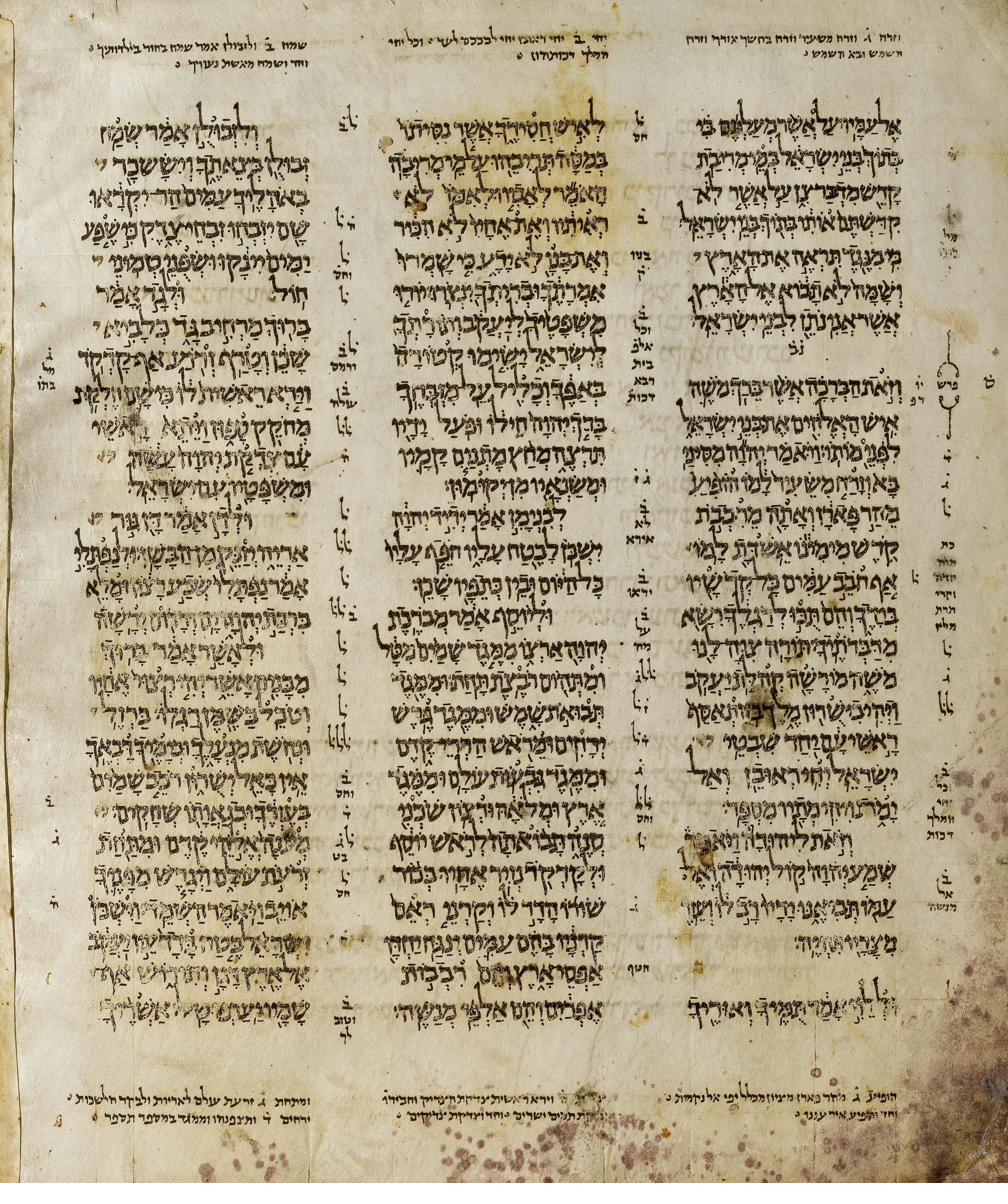
Look at the page first. Columns of Hebrew letters fill the center, neat and even. But crowded into every margin (above, below, between the columns) is a second layer of writing in much tinier script, almost like a frame of fine print around the main text. Those tiny notes are not commentary or decoration. They are instructions for getting the copy exactly right.
This is a page from the Aleppo Codex, made around 930 CE in Tiberias, by the Galilee in the Land of Israel. A codex is a book with pages, the format that replaced the scroll for study. It was written by scholars called the Masoretes, families who spent generations doing one painstaking job: pinning down the precise text of the Hebrew Bible, every letter, plus a system of dots and marks they invented to lock in the vowels and the chanting, none of which the bare consonants show. The tiny marginal notes, the masorah, count letters and flag unusual spellings so a later scribe could check his own copy against them.
Here is why this one book opens the Topic. People often say the Hebrew Bible was copied "the same" for centuries, and it is easy to treat that as a nice claim no one can check. The Aleppo Codex is the claim made physical. It is the single most accurate copy the Masoretes produced, the master against which other copies were corrected, and it shows that the sameness was not luck or assumption but the product of an obsessive, rule-bound craft. The stability has a cause, and the cause is visible in those margins.
Look closer at what those notes mean in practice: a scribe copying a new Bible could check his work letter by letter against a system designed to catch a single mistake. It is, in effect, an error-checking method built into the book, centuries before anyone spoke of "data integrity," the same idea, done by hand.
And the Codex's own survival is a dramatic story. For centuries it was guarded by the Jewish community of Aleppo, in Syria, kept in a synagogue safe and shown to almost no one. In 1947, during anti-Jewish riots in Aleppo, the synagogue was burned and the Codex vanished; it resurfaced years later in Israel, but with pages missing, including most of the Torah, lost or destroyed in the chaos. What remains is held today at the National Library of Israel. The most exact copy of the text ever made nearly didn't survive the twentieth century, and the gaps in it are themselves a record of the violence this platform's later Topics trace.
The codices and manuscripts named here, the Aleppo Codex, the Leningrad Codex, the Cairo Geniza fragments, and more, are catalogued in the Museum, under Manuscripts, with their holding institutions.
Discussion questions
Working from the evidence.
These questions ask students to work from the evidence on this page and reach their own conclusions. Each is anchored in a specific fact the Topic documents.
- The page describes each layer of the tradition as a conversation with the layer before it: the Mishnah built on the Bible, the Talmud on the Mishnah, the medieval commentaries on the Talmud, and so on. How does thinking of a religious tradition as an ongoing argument across centuries differ from thinking of it as a single fixed book?
- Two Talmuds were compiled: the Jerusalem (Palestinian) Talmud around 400 CE and the Babylonian around 500 CE, and the Babylonian became the more central text. Using what the page says about where and how each was produced, what might explain why one became dominant?
- The printed Talmud page places the central text in the middle and surrounds it with commentaries written centuries apart, all readable at once. Why might a tradition design its books so that disagreement and debate are literally printed onto the same page, rather than edited out?
- The Masoretes worked for generations to fix and preserve the exact text of the Hebrew Bible. What does that level of effort tell you about how the tradition understood the relationship between getting the words right and the meaning they carry?
- The same evidence on this page: dated manuscripts, named authors, a traceable chain of transmission, is how scholars study any major textual tradition. Test the equal-treatment standard: is this the same depth the curriculum gives the other foundational textual traditions it teaches? Why or why not?
Classroom Connections
Where this Topic fits.
Teaching Connections
The disciplines and courses this Topic naturally supports, for any educator, anywhere.
- World History & Belief Systems: the textual tradition as a case for the comparative study of belief systems.
- Medieval & Early-Modern World History: Maimonides and the medieval commentary tradition; the printed Talmud, the Safed circle, and Karo’s Shulchan Aruch.
- Literature & Intellectual History: the Hebrew Bible alongside the Homeric epics, the Vedas, and the Chinese classics; the tradition as one continuous conversation.
- Historical Thinking & Historiography: dated manuscripts, named authors, and a traceable chain of transmission.
Standards Alignment
- NYS Global History & Geography: 9.2 (Belief Systems).
- Common Core ELA-Literacy: RH.6–8.4, RH.9–10.4 / RH.11–12.4 (domain-specific vocabulary) and RH.6–8.7, RH.11–12.7 / RH.11–12.9 (integrating multiple sources): the vocabulary of the tradition and the multi-layered Talmud page.
Sources and citations
Primary sources come straight from the time: documents, letters, speeches, images, and objects created by the people involved. Secondary sources come later: books, articles, and analysis in which scholars study and interpret those primary sources.
Primary sources
- Steinsaltz, Adin. The Talmud: The Steinsaltz Edition. Koren Publishers, 1965–2010. (The contemporary Hebrew-English-Aramaic Talmud edition.)
- Schottenstein Edition Talmud. Brooklyn: Mesorah Publications, 1990–2005. (The parallel ArtScroll English-language Talmud edition.)
- Neusner, Jacob. The Mishnah: A New Translation. New Haven: Yale University Press, 1988.
- Albeck, Hanoch, ed. Shisha Sidre Mishnah. 6 vols. Jerusalem: Bialik Institute, 1952–1958. (The standard scholarly Hebrew edition.)
- The Jewish Publication Society. The JPS Hebrew-English Tanakh. Philadelphia: JPS, 2nd ed. 1999.
- Maimonides, Moses. The Guide of the Perplexed. Translated by Shlomo Pines. 2 vols. Chicago: University of Chicago Press, 1963.
- Maimonides, Moses. Mishneh Torah. Hebrew-English edition. New York: Moznaim Publishing.
- Karo, Joseph. Shulchan Aruch. With the commentary of Moses Isserles (Rema). First published Venice, 1565. Standard editions.
- Saadia Gaon. The Book of Beliefs and Opinions (Emunot ve-Deot). Translated by Samuel Rosenblatt. New Haven: Yale University Press, 1948.
- Rashi. Standard editions of his Pentateuch commentary; the Silbermann English edition (London, 1929–1934) is standard.
- Sefaria. sefaria.org → (Open-source library of Jewish textual literature.)
Secondary sources
- Twersky, Isadore. Introduction to the Code of Maimonides (Mishneh Torah). New Haven: Yale University Press, 1980.
- Davidson, Herbert A. Moses Maimonides: The Man and His Works. Oxford: Oxford University Press, 2005.
- Sirat, Colette. A History of Jewish Philosophy in the Middle Ages. Cambridge: Cambridge University Press, 1985.
- Heschel, Abraham Joshua. Heavenly Torah: As Refracted Through the Generations. Translated by Gordon Tucker. New York: Continuum, 2005.
- Stern, David. The Anthology in Jewish Literature. Oxford: Oxford University Press, 2004.
- Werblowsky, R. J. Zwi. Joseph Karo: Lawyer and Mystic. Oxford: Oxford University Press, 1962.
- Scholem, Gershom. Major Trends in Jewish Mysticism. New York: Schocken, 1941.
- Scholem, Gershom. Origins of the Kabbalah. Princeton: Princeton University Press, 1987.
- Idel, Moshe. Kabbalah: New Perspectives. New Haven: Yale University Press, 1988.
- Fine, Lawrence. Physician of the Soul, Healer of the Cosmos: Isaac Luria and his Kabbalistic Fellowship. Stanford: Stanford University Press, 2003.
- Heller, Marvin J. Printing the Talmud: A History of the Earliest Printed Editions of the Talmud. Brooklyn: Im Hasefer, 1992.
- Halbertal, Moshe. People of the Book: Canon, Meaning, and Authority. Cambridge, MA: Harvard University Press, 1997.
- Boyarin, Daniel. Intertextuality and the Reading of Midrash. Bloomington: Indiana University Press, 1990.
- Halivni, David Weiss. The Formation of the Babylonian Talmud. Oxford: Oxford University Press, 2013.
- Association for Jewish Studies. associationforjewishstudies.org → (The principal academic association in the field.)
Finding these documents: many primary sources are free online. Good places to start are the Fordham Internet Jewish History Sourcebook, Yale’s Avalon Project (law and diplomacy), German History in Documents, the collections of the US Holocaust Memorial Museum and Yad Vashem, the National Library of Israel, and Sefaria (for Jewish texts). Search the document’s name and date.
The Jewish calendar as a system for keeping unified time across a dispersed people, lunisolar months, the fixing of the year, and the festival cycle that carried the agricultural seasons of one land across the whole world.
Comments?
Write to editor@makorproject.org.
Last updated: August 2026.