For a century, art historians assumed that observant Jews of the ancient world would never have painted the human figure on the walls of a house of worship. Then, in 1932, the earth was cleared from a synagogue on the Roman frontier at Dura-Europos, and its walls were covered in them.
The Synagogue · Unit 1
Why this Topic exists
The curriculum teaches the cathedral and the mosque. It rarely teaches the synagogue.
The synagogue is the central institution of Jewish communal life. It is not a Jewish church, and not a Jewish version of a mosque. It developed from a specific historical problem: how could Jewish communities pray, study, assemble, and govern communal life when the Temple was no longer accessible, and then no longer standing? To understand Judaism with even rough accuracy, students need to know what a synagogue is, what is inside one, and how it works, just as the curriculum already teaches the cathedral, the mosque, the stupa, and the temple compound.
Common misconceptions this Topic addresses
The synagogue is often slotted into categories borrowed from other religions, or treated as a relic of an extinct ancient world. The evidence on this page corrects both. The dedicated entries carry the fuller treatment.
- "A synagogue is the Jewish equivalent of a church." See the entry →
- "Observant Jews never made figural religious art because the Second Commandment forbade it." See the entry →
- "Jewish communities in the Galilee collapsed once the Roman Empire became Christian." See the entry →
Where the synagogue came from
It was invented because the Temple was destroyed.
The story of the Temple (the First Temple built by Solomon c. 957 BCE and destroyed by Babylon in 586 BCE; the Second Temple built 516 BCE, expanded by Herod the Great, and destroyed by Rome in 70 CE) is treated in its own Topic: The First and Second Temples. That Topic covers what the buildings looked like, where they stood, what survives, and what stands on the Temple Mount today.
What matters here is the consequence. With the Temple gone, Jewish religious life faced a structural problem: the central sacrificial institution that had organized worship for nearly a thousand years no longer existed. The institution developed to meet that problem is the synagogue.
After 586 BCE, the exiles in Babylonia could not access the Temple. After 70 CE, the Temple no longer existed. In both periods, Jewish communities required a way to maintain religious and communal life without the central sacrificial institution that had organized it. The solution was the beit knesset: the "house of assembly," named for the act of gathering rather than for a sacred location. The Greek translation, synagōgē, also meant "assembly." The institution was portable. It could exist anywhere ten Jewish adults could meet.
The synagogue was not designed to replace the Temple. The Temple's central function, sacrificial worship, was suspended, and the rabbis of the post-70 CE generation declared that prayer, study, and acts of loving-kindness would substitute for sacrifice until the Temple was rebuilt. The synagogue became the setting for all three.
The result was one of the earliest portable religious institutions in human history. A synagogue did not require sovereignty, a priesthood, or a single sacred building. It required a community, a Torah, and the act of gathering. That portability helped Jewish civilization remain continuous across Babylonia, Alexandria, Rome, Cordoba, Vilna, Salonika, New York, and every other place the diaspora reached.
Early Jewish art: the visual record
A figural tradition, sustained and influential.
The synagogue is older as an institution than any of its surviving buildings. The earliest synagogues we know of from archaeological evidence date from the late Second Temple period: Gamla in the Golan, Masada, Herodium, and the recently excavated synagogue at Magdala on the Sea of Galilee are first-century BCE to first-century CE examples, but the buildings that preserved enough of their interior decoration to tell us what Jewish religious art looked like in antiquity come from a different group. They survive in three regions: Roman Syria (the painted synagogue at Dura-Europos), Roman and Byzantine Palestine (mosaic floors at Hammath Tiberias, Beth Alpha, Sepphoris/Tzippori, Huqoq, Ein Gedi, Naaran, Susiya, Yafia, Huseifa, Khirbet Wadi Hamam), and the wider Mediterranean (the Jewish catacombs of Rome, synagogues at Sardis in Asia Minor and Stobi in Macedonia, the Naro/Hammam Lif mosaic in Tunisia). Together, they show a Jewish artistic tradition that was figural, narrative, ambitious, and deeply engaged with the visual languages around it.
Dura-Europos · the painted synagogue on the Roman frontier (244 CE)
The find that overturned a long-standing assumption.
In 1932, a French-American archaeological expedition excavating the ruined Roman frontier town of Dura-Europos on the Euphrates River in modern Syria uncovered the walls of a synagogue. The synagogue had been buried in 256 CE, its lower walls filled with earth as part of the Roman defense against a Sasanian siege, and its painted interior had been preserved virtually intact. The wall paintings were dated by an Aramaic inscription on the building's last phase of construction to 244 CE.
The discovery overturned a long-standing scholarly assumption. Many art historians had assumed that observant Jews of late antiquity would never have produced an elaborate figural decorative program for a place of worship, based on a particular interpretation of the second commandment's prohibition on graven images. The walls of the Dura-Europos synagogue showed the opposite. They depict, in sustained figural narrative, scenes from across the Hebrew Bible: the Sacrifice of Isaac, Moses receiving the Tablets, Moses leading the Hebrews out of Egypt, the Crossing of the Red Sea, scenes from the Book of Esther, the resurrection of the dry bones in Ezekiel, the anointing of David by Samuel, the Ark of the Covenant entering the land of the Philistines. The paintings establish that, at least in this third-century Jewish community on the Roman frontier, the second commandment did not preclude figural religious art.
The synagogue's preservation is also a methodological gift. Because the building was sealed shortly after its decoration was completed, and not modified for fourteen centuries, Dura-Europos is the most intact example of late-antique Jewish visual culture that exists. The wall paintings are now divided between Yale University Art Gallery (which holds the bulk of the original excavation finds) and the Damascus National Museum (which holds the in-situ reconstruction of the western wall). The remains of the city itself were destroyed by ISIS between 2011 and 2014. What we know of Dura-Europos is what is preserved in those collections and in the photographic record produced by the excavation between 1932 and 1937.
For deeper study: Carl H. Kraeling, The Excavations at Dura-Europos, Final Report VIII, Part I: The Synagogue (Yale, 1956); Steven Fine, Art and Judaism in the Greco-Roman World (Cambridge, rev. ed. 2010); Annabel Wharton, Refiguring the Post-Classical City: Dura Europos, Jerash, Jerusalem, and Ravenna (Cambridge, 1995).
The Hand of God
The earliest Jewish convention for representing divine presence.
One specific iconographic element of the Dura-Europos murals warrants particular attention, because it is both an early Jewish artistic convention in its own right and one of the visual conventions that subsequent Christian and Islamic religious art absorbed and adapted.
Across multiple panels at Dura-Europos, divine intervention is represented not by a figure but by a single hand emerging from the upper register of the painting. The Hand of God reaches down at the moment of Isaac's near-sacrifice. It points toward the drowning of the Egyptians at the Red Sea. It appears in the Ezekiel resurrection panel. In each case, the visual convention is the same: the God of Israel is not depicted; the action of the God of Israel is depicted by the hand alone. The figural prohibition is preserved by representing the divine agent through the smallest possible part, and through the part that, in human iconography, denotes action, authority, and presence.
The convention appears again, two centuries later, in the floor mosaic of the Beth Alpha synagogue (sixth century CE), where a small hand emerges from a stylized cloud at the Sacrifice of Isaac panel. It appears in the Sepphoris mosaic, in a different formal register. It persisted in Jewish visual tradition into the medieval period: the León Bible of c. 960 CE shows the Hand of God in compositions that have direct iconographic continuity with the Dura paintings, and it became a standard convention in Byzantine and Western medieval Christian art for depicting divine presence in scenes including the baptism of Christ, the giving of the Law, and the martyrdoms. The convention's Jewish origins are documented; the influence on later Christian iconography is real and traceable.
This is one example of a broader pattern. The visual conventions of Jewish religious art in late antiquity (the figural narrative cycle, the hand-as-divinity convention, the iconography of the Torah shrine, the menorah as visual symbol, the seven-branched lampstand flanked by other ritual objects) were developed inside Jewish communities and contributed to the iconographic vocabularies of the religions that emerged from and beside Judaism. Seen in this order, the convention belongs first to the Jewish visual record of late antiquity, and only later to the Christian and Islamic traditions that adapted it.
Hammath Tiberias · the earliest known Jewish zodiac mosaic (4th c. CE)
Sol-Helios in a synagogue floor.
The Hammath Tiberias synagogue, excavated on the shore of the Sea of Galilee and dated to the late third or early fourth century CE, contains the earliest extant version of a composition that would recur in at least seven later synagogues across Roman and Byzantine Palestine. The mosaic floor is organized into three panels: a Torah shrine flanked by menorot and ritual objects at the top, a zodiac wheel surrounding a depiction of Helios driving his sun-chariot in the center, and an inscription panel at the entrance naming the donors in Greek. The figure of Sol-Helios in the central medallion is rendered in full Hellenistic-Roman style: a young god with a radiant crown, his hand raised, holding the orb of the sun. The signs of the zodiac, each labeled in Hebrew, surround him; the four seasons, personified as young women, fill the corners.
Why a sun god in a synagogue. This is a question the curricular literature rarely raises and is worth raising directly. Scholarly opinion proposes several non-exclusive readings: that Sol-Helios functioned as a visual symbol of the orderly rhythms of God's creation, the way the zodiac itself functioned as a cosmological calendar; that the Jewish community of fourth-century Palestine, under increasing Christian imperial pressure after Constantine, used Sol-Helios as a visual claim on the cosmos that distinguished them from the new Christian iconography; that the composition is, in part, a polemic, a visual argument that the Jewish people, not the new Christian majority, remained the heirs of the Hebrew Bible. Whatever the precise interpretation, the recurrence of the composition across nearly two centuries and across multiple synagogues makes it a sustained iconographic choice, not an outlier.
The Hammath Tiberias floor (together with the Beth Alpha, Sepphoris, and Huqoq mosaics discussed below) is catalogued in the Museum, under Mosaics and architectural fragments, with holding locations for each.
Beth Alpha · the most famous Jewish floor mosaic (6th c. CE)
Akedah, zodiac, and Torah shrine on one floor.
The Beth Alpha synagogue was uncovered in 1928 by members of Kibbutz Beit Alfa, who stumbled on the mosaic floor while digging an irrigation channel. Excavation began in 1929 under Eleazar Sukenik of the Hebrew University. The synagogue is small, a 20 × 14 meter basilica building on the northern slopes of Mount Gilboa, in the Beit Shean Valley, but the mosaic floor is one of the most-photographed Jewish artworks of antiquity. A Greek inscription names the artisans: Marianos and his son Hanina, the same father-and-son team whose names appear on the nearby Beth Shean synagogue floor. The Aramaic inscription dates the construction to the reign of Emperor Justinus, probably Justin I (518–527 CE).
The floor is organized in three panels. The northern panel (closest to the entrance) shows the Sacrifice of Isaac in stylized, almost folk-art form: Abraham raises a long knife, Isaac is suspended in mid-air above the altar with his hands bound, a ram is tethered to a tree by a rope, and the Hand of God emerges from a small flame-bordered cloud in the upper center, with the Hebrew inscription "Do not stretch out [your hand]" above. The central panel is the zodiac wheel with Sol-Helios. The southern panel (closest to the apse where the Torah ark stood) shows a stylized representation of the Torah shrine, flanked by two seven-branched menorot, a shofar, a lulav and etrog, and an incense shovel, a visual catalog of the ritual objects that connected the synagogue to the destroyed Temple.
What is happening here. The Sacrifice of Isaac, or Akedah, is among the central scenes in Jewish religious thought. Its appearance on the Beth Alpha floor is not isolated; the same scene appears at Dura-Europos (244 CE) and at Sepphoris (5th c. CE), making Akedah one of the most documented narrative subjects in late-antique synagogue art. The presence of Hebrew script ("Yitzhak," "Avraham," and the quotes from Genesis 22) is itself a distinctive feature: most Jews in the region at the time would have known the narratives through oral tradition rather than reading them, and the script functions both as a label and as a visual marker of the building's Jewish identity in a region where Christianity was rapidly becoming the imperial religion.
Sepphoris/Tzippori · the most elaborate Jewish synagogue mosaic ever found
Genesis through Temple ritual on one floor.
The Sepphoris (Hebrew: Tzippori) synagogue mosaic, discovered by chance in 1993 by a parking-lot construction crew at the edge of the Sepphoris National Park, is the most elaborate and most fully programmatic synagogue floor we have. Dated to the early fifth century CE, the building is unusual in several ways: its bimah was oriented westward, not toward Jerusalem; its narrative program covers Genesis through Temple ritual; and it incorporates Greek, Hebrew, and Aramaic inscriptions across the same floor.
The mosaic is organized in seven panels running the length of the central aisle. Near the entrance: the angels visiting Sarah (Genesis 18), with the three angels rendered as identical winged figures. Behind it: the Sacrifice of Isaac. The central panel: a zodiac wheel with Sol-Helios at center, the four seasons in the corners, and each sign labeled in both Hebrew and Aramaic, the most elaborate version of the composition we have. Beyond it: panels showing the implements and offerings of the Tabernacle and the Jerusalem Temple: Aaron at the altar, the showbread, the menorah, the basin, the incense shovel, and the daily sacrifices. The full program connects the Patriarchs to the cosmos to the Temple, threading them through the lived sacred calendar of the community that walked over the floor.
The Sepphoris floor includes Hebrew inscriptions naming each ritual object, a feature that scholars including Steven Fine and Zeev Weiss read as evidence that the synagogue was understood as a substitute for the destroyed Temple, with the floor functioning as a visual encyclopedia of the Temple service that could no longer be performed.
Huqoq · the recent excavations
The earliest images of biblical women.
The Huqoq synagogue, three miles west of Magdala and Capernaum in the Galilee, was excavated between 2011 and 2023 by Jodi Magness of the University of North Carolina and an international team. What the excavation produced has, in Magness's own words, "revolutionized our understanding of Judaism in this period." The synagogue floor is dated to the fifth century CE, a period during which Jewish settlement in the region was historically thought to have declined under Christian Roman rule, and is the most diverse program of mosaic imagery yet found in any ancient synagogue.
The Huqoq mosaics include, among other subjects: Samson (the earliest securely identified image of Samson in a synagogue, including the scene of Samson tying torches between the tails of foxes); Deborah and Yael from the Book of Judges (the earliest known depictions of these biblical women); Noah's Ark; the Crossing of the Red Sea, with Pharaoh's soldiers drowning and being swallowed by fish; the Tower of Babel; Jonah being swallowed by a series of three increasingly large fish; a zodiac with Sol-Helios; a panel depicting a meeting between a high priest in Jewish vestments and a Greek ruler with war elephants, possibly the legendary meeting between the High Priest and Alexander the Great, the first historical (rather than purely biblical) episode ever found in an ancient synagogue mosaic.
The Huqoq finds matter pedagogically because they document specific facts: that biblical women were depicted; that Jewish communities flourished in the Galilee under Christian rule; that the iconographic repertoire was wider than the previously-known sites suggested; that the workshop tradition was sophisticated and well-organized, and because the excavation is the most thoroughly documented synagogue mosaic find of the modern era.
The mosaics are not in the public domain; images are held by the excavation's photographer and used by permission. To see the finds and read the project's own account of each panel, visit the Huqoq Excavation Project (University of North Carolina at Chapel Hill).
Galilean and Golan synagogue architecture
Capernaum, Bar'am, and the type.
While the mosaic floors document the iconographic record, a parallel record exists in the architecture. The so-called Galilean-type synagogue, best preserved at Capernaum, but documented at Bar'am, Korazin, Meiron, Nabratein, Gush Halav, Arbel, and a dozen other sites, has its own visual identity: monumental three-doored facades facing Jerusalem, large hewn limestone blocks, flagstone floors, stone benches along the side walls, columned interiors, and carved relief decoration on lintels, friezes, capitals, and architraves. The Capernaum synagogue, sometimes called the "White Synagogue" for its limestone construction over a darker basalt earlier phase, stands today as the most impressive surviving synagogue of late-antique Galilee.
The relief carving at Capernaum, Korazin, and Bar'am includes recurring motifs that constitute a Jewish iconographic vocabulary in stone: menorot, the Ark of the Covenant on wheels (a striking image of the portable Tabernacle), shofarot, palm trees and grape clusters, the Star of David as a geometric motif (long before it became the modern national symbol), lions of Judah flanking the Torah ark in formal heraldic pairs, and the amphora as a symbol of the oil pressed for the Temple lamps. These are the same motifs that appear on the floor mosaics. The whole material culture is consistent: a community with a developed iconography of its own, working in stone and tessera and paint across a coherent visual program.
The catacombs of Rome: Jewish symbols outside the homeland. Outside the homeland, the visual record of Jewish life in late antiquity is preserved most extensively in the Jewish catacombs of Rome. Six catacombs are documented: Monteverde, Vigna Randanini, Villa Torlonia, Vigna Cimarra, Via Labicana, and Via Appia Pignatelli. Two are currently accessible. Together they contain roughly 537 inscribed epitaphs (the largest single corpus of Jewish inscriptions from antiquity outside the homeland, in koine Greek, Latin, and bilingually), and dozens of painted chambers decorated with menorot, shofarot, lulavim, etrogim, ritual objects, and the Torah ark. The menorah appears with such consistency in the Roman Jewish catacombs that some archaeologists have argued the menorah's status as the principal symbol of the Jewish people, after the Temple's destruction, was consolidated in the Roman diaspora rather than in the homeland.
The illuminated Hebrew manuscript
A medieval continuation of an ancient visual tradition.
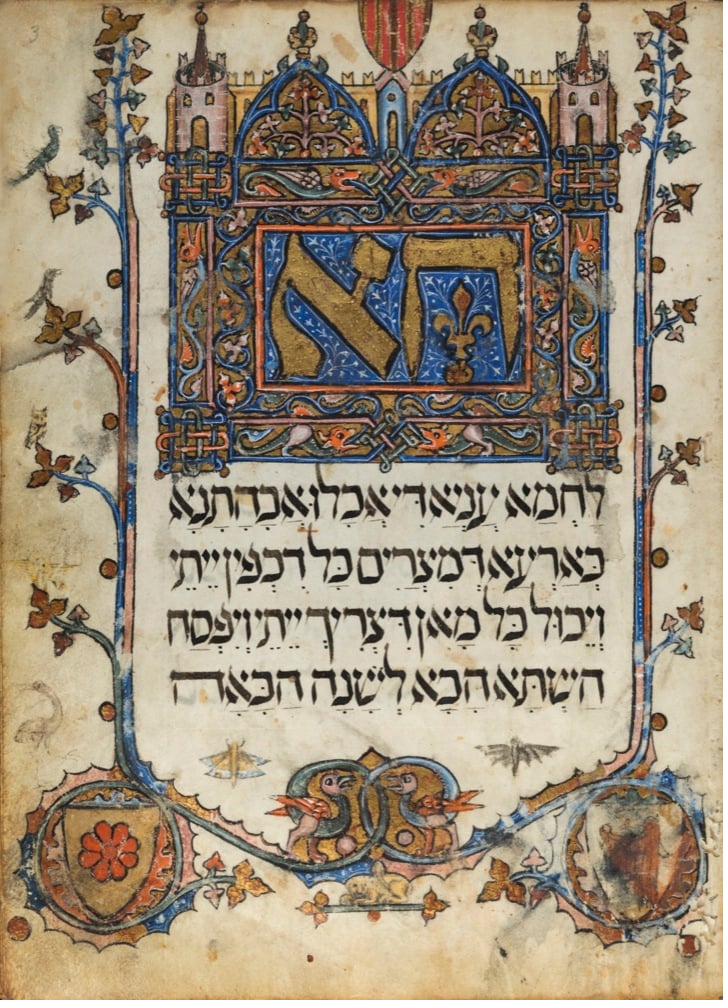
The visual tradition documented at Dura-Europos, Hammath Tiberias, Beth Alpha, Sepphoris, and Huqoq did not stop in late antiquity. It moved into the codex. From at least the tenth century onward, Hebrew manuscripts were produced as illuminated and decorated books across the Jewish world, in the lands of Islam (especially Egypt, the Holy Land, Yemen, and the Maghreb), in Sephardic Spain and Provence, and in Ashkenazic central and northern Europe. The forms varied with the surrounding visual culture, but the project was continuous: the Hebrew word, written and ornamented, as the central object of a visual tradition.
The most famous illuminated Hebrew manuscript in the world is the Sarajevo Haggadah, produced in Barcelona around 1350, probably as a wedding gift for a Jewish family with ties to the rulers of Aragon. It opens with thirty-four pages of full-page illuminations of biblical scenes — the seven days of Creation, Adam and Eve, the Cain and Abel narrative, the Lot story, the Sacrifice of Isaac, the Joseph cycle, the Exodus, the Crossing of the Red Sea, Moses's blessing — followed by the Haggadah text itself, hand-written on bleached calfskin vellum in the square Hebrew script characteristic of medieval Spain. The manuscript was expelled from Iberia with the Jews in 1492; surfaced in Italy in the sixteenth century; was acquired by the National Museum of Bosnia and Herzegovina in Sarajevo in 1894; was hidden by museum staff and by a Muslim cleric, Derviš Korkut, during the Nazi occupation in 1942; and was hidden again during the Bosnian War in the 1990s. It is now displayed in a climate-controlled vault at the museum, and was inscribed in the UNESCO Memory of the World Register in 2017.
The Sarajevo Haggadah is one of a group of approximately ten surviving fourteenth-century Spanish illuminated Haggadot, including the Golden Haggadah (Catalonia, c. 1320, now British Library), the Rylands Haggadah (Catalonia, c. 1330), the Sister Haggadah (Catalonia, mid-14th century, now British Library), and the Kaufmann Haggadah (Catalonia, late 14th century, now Hungarian Academy of Sciences). All share a common structural feature: a full-page biblical picture cycle preceding the Haggadah text proper.
Outside Spain, the most distinctive Ashkenazic illuminated manuscript is the Bird's Head Haggadah, produced in the Upper Rhine region of southern Germany around 1300 (now Israel Museum, Jerusalem). It is one of the oldest surviving Ashkenazic Haggadot. Its human figures are rendered with the heads of birds, a stylization that scholars have read variously as a conservative response to the second commandment's prohibition on representational images, as a marker of Jewish identity in a region where Jews were required by the Fourth Lateran Council (1215) to wear the conical "Jew's Hat" the figures wear on their bird-heads, or as a visual device with multiple parallel meanings.
Other major surviving Hebrew illuminated manuscripts include the Leningrad Codex (Cairo, 1008/1009 CE, the oldest complete Hebrew Bible, with sixteen full carpet pages in micrographic decoration), the Aleppo Codex (Tiberias, c. 930 CE, the most authoritative manuscript of the Masoretic Text), the Damascus Crown (Burgos, c. 1260, illuminated Hebrew Bible now National Library of Israel), the Rothschild Mahzor (Florence, 1492), and the Rothschild Miscellany (Northern Italy, c. 1480, perhaps the most sumptuously illuminated Hebrew manuscript of the Renaissance, with over 800 illuminations).
Micrography
The Hebrew word as visual form.
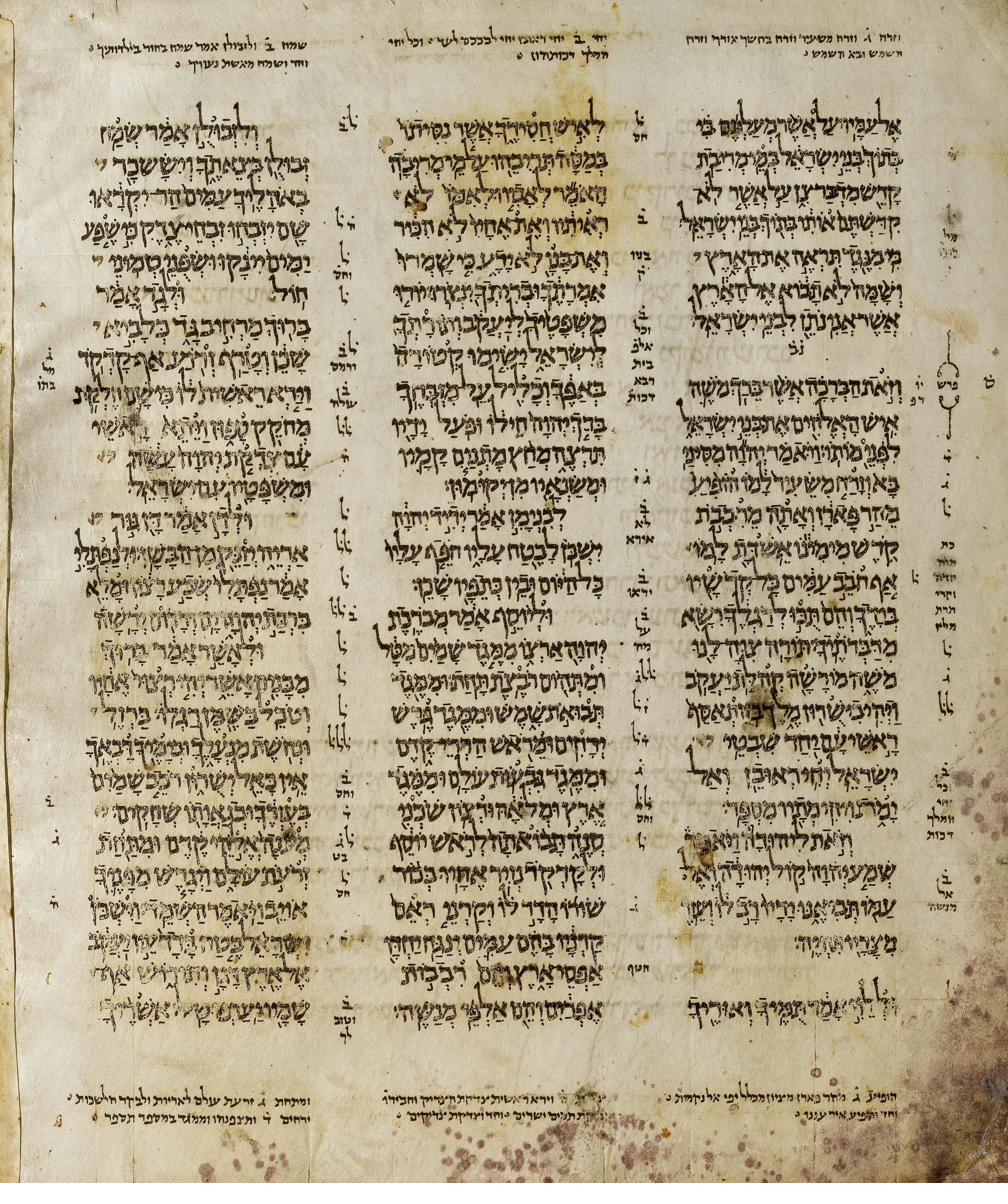
One uniquely Jewish visual tradition, developed inside the Hebrew manuscript culture and without close parallel in Christian or Islamic art-historical categories, is micrography: the use of minute Hebrew script (often the text of the Masorah, the body of traditional notes on the spelling, pronunciation, and accentuation of the Hebrew Bible) to form abstract decorative patterns, geometric carpet pages, architectural designs, animals, plants, and sometimes full figurative scenes. The text is fully legible. The image is built from the words themselves.
The technique is traditionally traced to the Cairo Codex of the Prophets (dated by its own colophon to 895–896 CE, attributed there to Moshe ben Asher in Tiberias, though both the date and the attribution have been questioned by later scholars). Micrography emerged among the Masoretic scribes of Tiberias and Egypt in the late ninth and tenth centuries, who used the technique to record and decorate the masoretic apparatus around the biblical text. From there it spread across the Jewish world: to Yemen (where it became a particularly developed art in the fifteenth and sixteenth centuries; the British Library's MS Or. 2348 of 1469 patterns Psalm 119 into a Mamluk-style design of mountains and fish), to Sephardic Spain (where micrography decorated some of the Catalan Haggadot), and to Ashkenazic Germany and France (where the so-called Masorah figurata tradition produced figurative scenes built from biblical and masoretic text).
Micrography is the answer to a particular question: what does Jewish visual art look like when the word and the image are one and the same, and it is the most direct embodiment of a principle that runs through Jewish visual culture: that the text is itself the central sacred object, and that ornament does not compete with the text but is built from it.
What is inside a synagogue
The same essential elements, in every era.
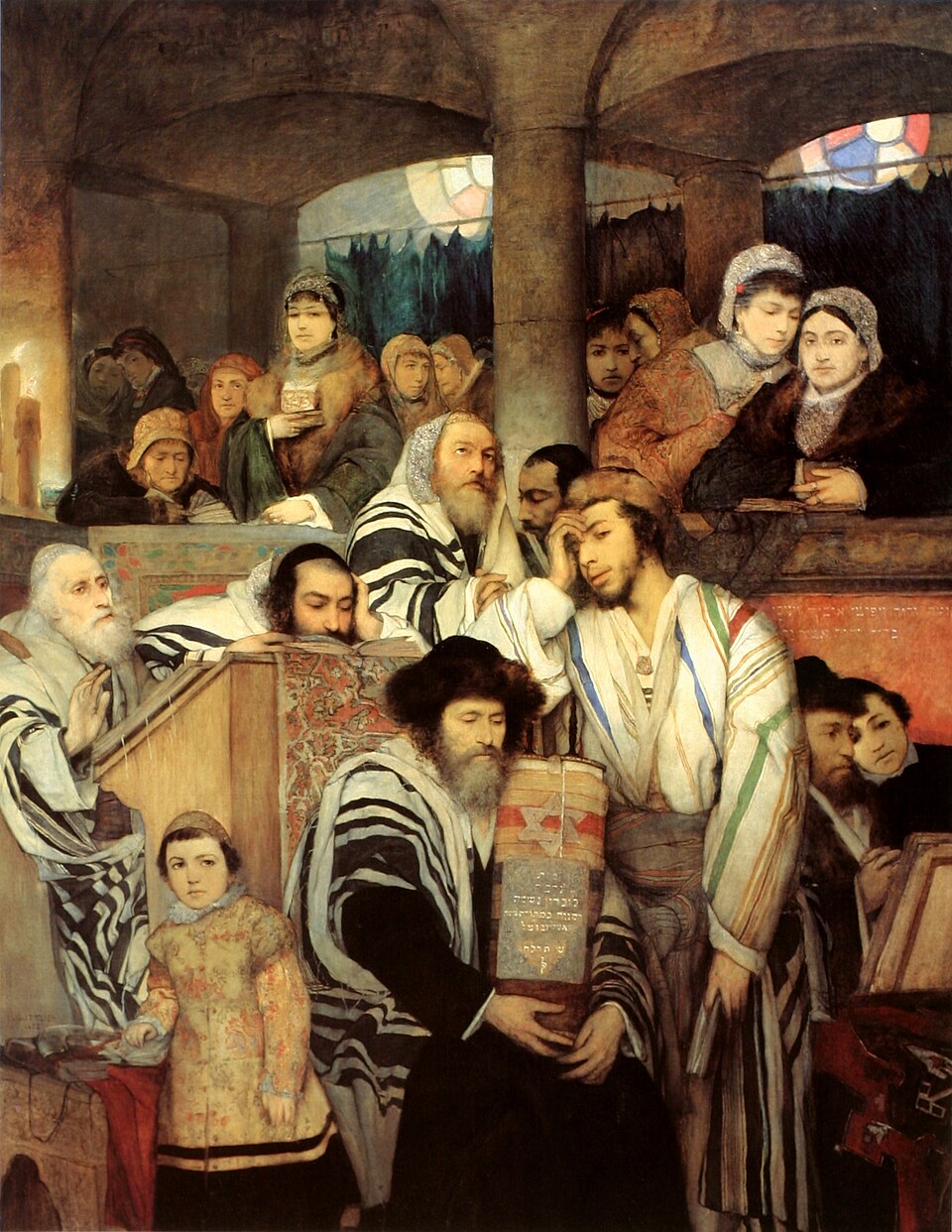
The interior of every traditional synagogue, regardless of era or region, contains the same essential elements. Their arrangement varies; their presence does not.
The Ark (aron kodesh, "holy ark") is the cabinet that holds the Torah scrolls. It is typically built into the wall facing Jerusalem: east in Europe and the Americas, south in Yemen, west in Iran. The orientation is intentional: the congregation faces Jerusalem during the central prayers. The ark is often the most ornate element in the building, with carved wooden doors, an embroidered curtain (parochet) in front, and a crown above. Inside are the Torah scrolls themselves, each handwritten on parchment by a trained scribe over the course of approximately a year.
The Bimah is the raised platform from which the Torah is read aloud. In Sephardi and Mizrahi synagogues, it stands in the center of the room. In most Ashkenazi synagogues, it stands at the front near the ark. The reader places the Torah on the bimah, opens it, and chants from it using a system of musical notation called cantillation, a tradition transmitted orally for two millennia.
The Ner Tamid (eternal lamp) hangs above the ark. It is kept lit continuously, day and night, as a deliberate echo of the perpetual lamp the Torah commanded for the Tabernacle and Temple. In ancient synagogues it was an oil lamp; in modern ones it is usually electric, but the symbolism, and the requirement that it never go out, is the same.
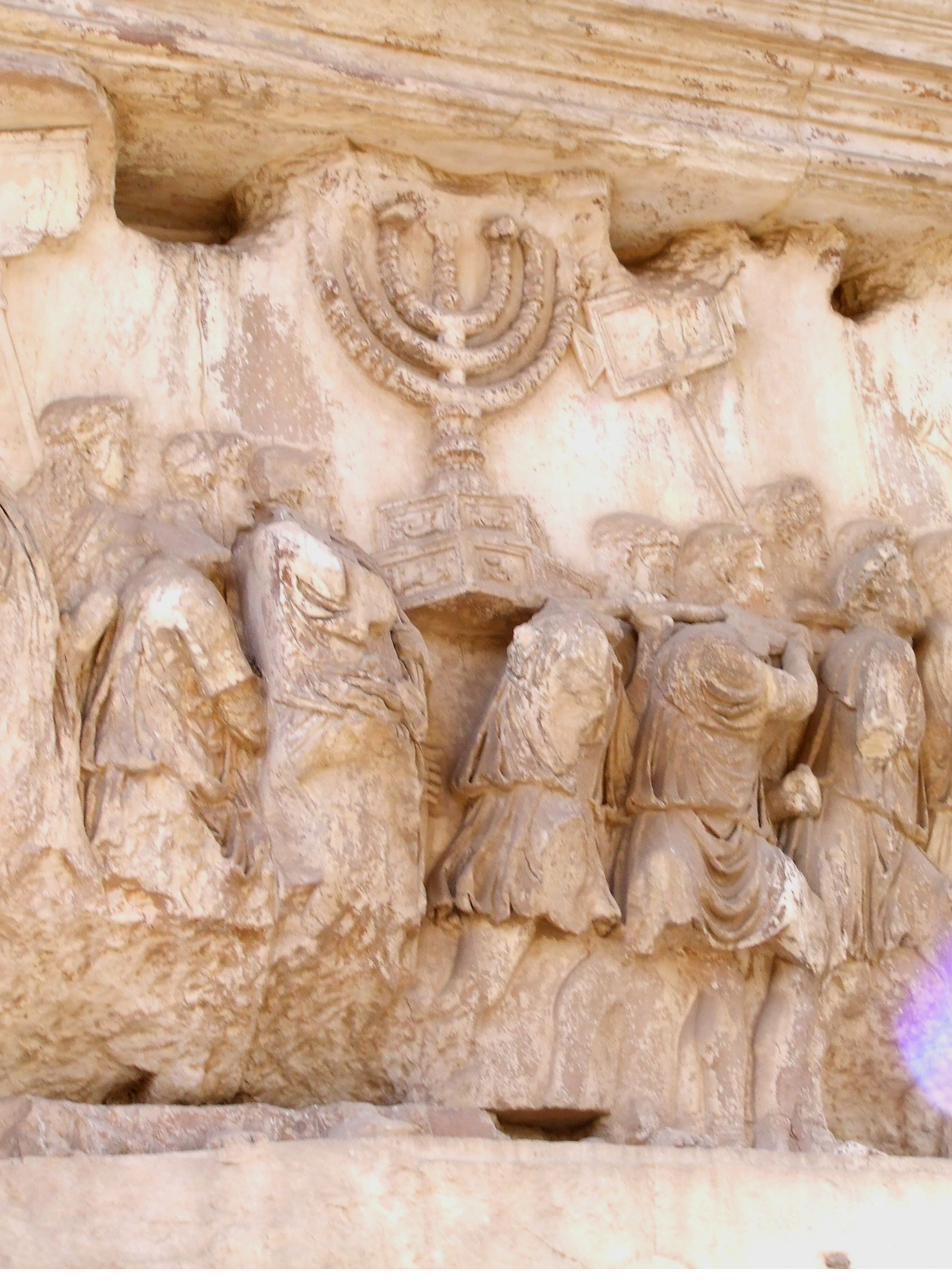
The Menorah. The seven-branched menorah was the central candelabrum of the Jerusalem Temple, carried away by Titus's legions in 70 CE, its image preserved on the Arch of Titus in Rome, where it remains today. After the Temple's destruction, a seven-branched menorah was forbidden for use anywhere else, in mourning. The synagogue menorah, when present, typically has five, six, or eight branches as a deliberate distinction. The nine-branched Hanukkiah, lit during the eight days of Hanukkah, is a separate ritual object.
The Mezuzah is a small case affixed to the doorpost of every Jewish home, and the entrance to every synagogue. Inside it is a small parchment scroll bearing two passages from Deuteronomy, including the Shema, the central declaration of Jewish monotheism. The word mezuzah simply means "doorpost." It is touched in passing, with the fingertips brought to the lips, by many observant Jews.
Seating. In most synagogues, the congregation sits facing the ark, meaning, ultimately, facing Jerusalem. Orthodox synagogues seat men and women separately, divided by a partition called a mechitzah; Conservative, Reform, Reconstructionist, and many modern Sephardi synagogues seat together. In medieval Italian and Ottoman synagogues, women often sat in a separate gallery upstairs.
How a service operates
Ten adults, a Torah, and a weekly cycle.
A traditional Jewish service requires a minyan: a quorum of ten adult Jews. (Orthodox practice counts only men; Conservative and other movements count adults of any gender.) The number ten is derived from a Talmudic interpretation. Without a minyan, certain central prayers cannot be recited, including the Kaddish, the prayer recited by mourners. The minyan requirement is one of the principal reasons Jewish communities have been so densely organized historically: it requires ten Jewish adults to live within walking distance of each other.
The standard weekly cycle of services follows this pattern. Morning service (Shacharit), afternoon service (Mincha), and evening service (Ma'ariv) are recited daily. On the Sabbath, sunset Friday to nightfall Saturday, these are expanded, and the central event of the week, the public reading of the weekly Torah portion (parashah), takes place during Saturday morning. The entire Torah is read in this way, in one-year cycles, every year, in every traditional synagogue in the world. The cycle is synchronized: the same passage is read on the same Sabbath in every traditional synagogue worldwide.
The service is led by a prayer leader (chazan or cantor), traditionally untrained in any formal sense; any knowledgeable congregant can lead. In larger synagogues, a professional cantor is employed for musical leadership, especially of the Sabbath and holiday services. A rabbi may give a sermon (drash), but the rabbi's central traditional role is not as priest but as scholar, teacher, and decisor of Jewish law. The synagogue service does not require a rabbi to be present at all.
Types and traditions
Three regional streams, plus modern movements.
Jewish religious tradition divides historically into three principal regional streams, each with its own liturgical text, melody, ritual variations, and architectural conventions.
Ashkenazi tradition developed among the Jews of the Rhineland, France, Central Europe, and Eastern Europe. The historical vernacular was Yiddish. The liturgical melody and pronunciation, the cycle of religious poetry (piyyutim), and many ritual customs are distinct.
Sephardi tradition developed among the Jews of the Iberian Peninsula. After the 1492 expulsion from Spain, it carried into the Ottoman Empire, North Africa, the Netherlands, and the Americas. The historical vernacular was Ladino (Judeo-Spanish). The liturgical melody, pronunciation of Hebrew, and several ritual practices differ from Ashkenazi tradition.
Mizrahi tradition encompasses the Jewish communities of the Middle East, North Africa, the Caucasus, and Central Asia: Iraqi, Yemenite, Persian, Bukharan, Moroccan, Tunisian, Algerian, Libyan, Syrian, Egyptian. The communities are diverse, and each has its own ritual customs, but they share liturgical features distinct from both Ashkenazi and Sephardi practice.
Within these traditions, modern denominational movements developed in the nineteenth and twentieth centuries, primarily within the Ashkenazi world but increasingly across all traditions. Orthodox Judaism observes traditional Jewish law (halacha) as binding. Reform Judaism, beginning in early-nineteenth-century Germany, treats halacha as historically contingent and emphasizes prophetic ethics. Conservative (in the United States) and Masorti (elsewhere) Judaism, developing in the late nineteenth century, retain halacha but allow for historical evolution and modern adaptation. Reconstructionist Judaism, formalized in twentieth-century America, treats Judaism as an evolving religious civilization. Each movement has its own associated synagogues, prayer books, and ritual conventions, but all recognize each other as Jewish.
Architecture across the diaspora
The institution is constant; the body is local.
One of the most useful exercises for a student is to compare synagogue architecture across regions. The interior elements (ark, bimah, ner tamid, orientation toward Jerusalem) are constant. The exterior frequently mirrors the surrounding civilization's vernacular: Gothic in medieval Prague (the Altneuschul), Mudejar in fourteenth-century Toledo (El Tránsito), classical revival in eighteenth-century Newport (Touro Synagogue), beaux-arts in nineteenth-century New York (Eldridge Street), Bauhaus in 1930s Tel Aviv. The synagogue is the institution; the architectural body is responsive to local time and place.
This means that walking through synagogues across the diaspora is also walking through the architectural history of every region where Jews lived. The Hurva Synagogue in the Jewish Quarter of Jerusalem's Old City (destroyed by the Jordanian Arab Legion in 1948 and reconstructed in 2010) is built in the Ottoman-influenced style of nineteenth-century Jerusalem. The Great Synagogue of Florence (1882) is Moorish revival. The Dohány Street Synagogue in Budapest (1859) is the largest in Europe and combines Romantic and Moorish elements. Each is a synagogue, with the same ark, the same Torah, and the same weekly reading; each is also a building shaped by its city.
Several of the synagogues discussed here are explored in greater depth in the Virtual Field Trips collection, where their architecture, objects, and historical context can be examined in place. →
Key takeaways
- The synagogue was invented out of necessity (after the Babylonian exile of 586 BCE and again after Rome destroyed the Second Temple in 70 CE) to carry religious and communal life without the central sacrificial institution. Its Hebrew name, beit knesset, means "house of assembly": it is named for the act of gathering, not for a sacred place.
- Because it needed no fixed ground, only a quorum of ten adults and a Torah, it is one of the earliest portable religious institutions in human history: the technology that made a continuous Jewish civilization possible across continents for some 2,500 years.
- The painted synagogue at Dura-Europos (244 CE) overturned the long-held assumption that observant Jews made no figural religious art. Its conventions, including the Hand of God for divine presence, were developed inside Jewish communities and later absorbed into Christian and Islamic art.
- A sustained visual tradition runs from the late-antique mosaic floors (Hammath Tiberias, Beth Alpha, Sepphoris, Huqoq) into the medieval illuminated manuscript and the uniquely Jewish art of micrography, where legible Hebrew text is itself the image.
- Every traditional synagogue holds the same essential elements (ark, bimah, ner tamid, mezuzah, orientation toward Jerusalem) while the building's exterior consistently takes on the architectural vernacular of wherever its community lived. The institution is constant; the body is local.
Object Spotlight
The Dura-Europos synagogue, sealed 256 CE.
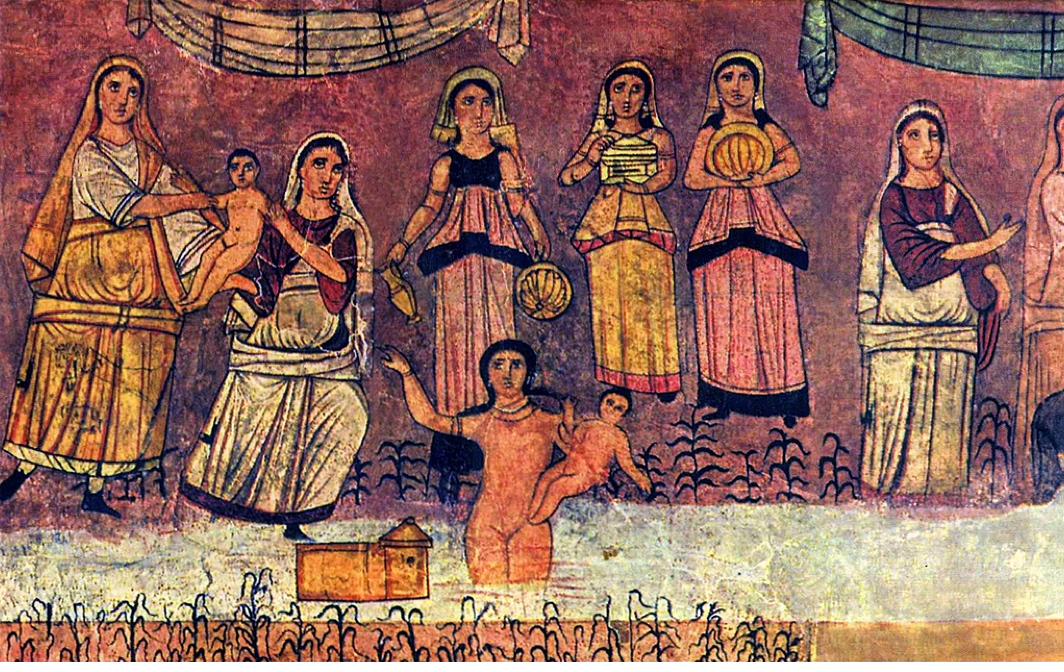
Look at the wall before you label it. A woman stands waist-deep in a river, lifting a tiny baby from the water; other figures wait on the bank. It is painted in flat, bright colors, the figures outlined and frontal, more like a storyboard than a photograph. The scene is the rescue of the infant Moses, and it is painted directly onto the plaster wall of a room, the way you might paint a mural.
That room was a synagogue, a Jewish house of prayer and study, in a frontier town called Dura-Europos, on the edge of the Roman Empire in what is now Syria. The paintings are frescoes, pictures done on a wall while or after the plaster sets. And here is the surprise that makes them famous: the walls are covered, floor to ceiling, with people — Abraham, Moses, Queen Esther, the prophet Ezekiel, King David — dozens of biblical scenes full of human figures, painted around 244 CE.
Here is why this room opens the whole Topic. For a long time people assumed that the Second Commandment, the ban on graven images, had stopped ancient Jews from making religious pictures of people, that Judaism was a religion of words and never of images. Dura-Europos proves that assumption wrong in the most direct way possible: an entire synagogue, painted wall to wall with figures, by a Jewish community that clearly saw no conflict. You cannot argue with a room.
Look closer at one recurring detail: in several scenes a single disembodied hand reaches down from the top edge, the "Hand of God," a way of showing God acting without drawing God's body. It is a solution to a real problem (how do you picture the divine without picturing the divine?), and the same device would later turn up in Christian art that grew up nearby. The conventions worked out on these Jewish walls did not stay on them.
And the way it survived is its own story. Around 256 CE the town was under siege; to brace the city wall, the defenders packed earth against the buildings along it, burying the synagogue and its paintings. The town fell, was abandoned, and the dirt sat undisturbed for nearly fourteen centuries until archaeologists excavated it between 1932 and 1937. The paintings came out astonishingly intact and were moved to safety, many now at the Yale University Art Gallery. The site itself, back in Syria, was destroyed in the fighting between 2011 and 2014. The accident of a siege saved the most complete record of ancient Jewish painting we have; the images outlived the building, the town, and the empire that besieged it.
Discussion questions
Working from the evidence.
These questions ask students to work from the evidence on this page and reach their own conclusions. Each is anchored in a specific fact the Topic documents.
- The page argues the synagogue was "invented because the Temple was destroyed." Using the dates given (586 BCE, 70 CE), explain what problem the destruction created and how the beit knesset solved it. Why does the page call the synagogue "portable," and what did that portability make possible?
- The curriculum teaches the cathedral, the mosque, and the temple, but rarely the synagogue. Based on the four reasons the page gives at the end for why the synagogue is teachable, build the case a curriculum designer would make for including it. Which reason is strongest, and why?
- For a century, scholars assumed observant Jews made no figural religious art. The Dura-Europos walls showed the opposite. What does this reversal teach about how historical assumptions get formed, and about what a single well-preserved find can do to them?
- The "Hand of God" convention appears first in Jewish art at Dura-Europos and later in Christian art. The page argues that teaching it "as a Jewish convention before teaching it as a Christian one restores the chronological and developmental order." Why might the order in which we teach influences and origins matter?
- The page repeats one idea across the mosaics, the manuscripts, and the diaspora architecture: the institution stays constant while its visual body adapts to each time and place. Find three specific examples of this pattern on the page and explain what they have in common.
Classroom Connections
Where this Topic fits.
Teaching Connections
The disciplines and courses this Topic naturally supports, for any educator, anywhere.
- World History & Belief Systems: Judaism beside Christianity and Islam, with the synagogue as the comparative anchor.
- Ancient & Classical History: the synagogue’s emergence after 586 BCE and again after 70 CE.
- United States History: colonial foundations (Shearith Israel, 1654; Touro, 1763; Washington’s 1790 Newport letter) and immigration-era America (Eldridge Street, 1887).
- Art History & Museum Education: Dura-Europos, the Galilean mosaics, micrography, and synagogue architecture across the diaspora.
- Archaeology: the excavated synagogues at Dura-Europos, Sepphoris, and Huqoq.
- Historical Thinking: how one well-preserved find can overturn an assumption, and the continuity of an institutional form across two millennia.
Standards Alignment
- NYS Global History & Geography: 9.2 (Belief Systems) and 9.3 (the classical world).
- NYS United States History: 11.1 (colonial foundations) and 11.5 (immigration and industrial America).
- Common Core ELA-Literacy: RH.9–10.2 (central ideas of primary sources): the Sepphoris floor inscriptions and the Dura-Europos Torah niche.
- C3 Framework: Dimension 2 (D2.His.2 and D2.His.14: continuity and change across the institution’s form).
Further Teaching Resources
Further reading, for students
- Huqoq Excavation Project (UNC-Chapel Hill): the project’s own account of each mosaic panel, with the discovery history. huqoq.web.unc.edu
For teachers: lesson plans, kits, materials
- National Library of Israel · Educator resources: free, English-language teaching materials and high-resolution manuscript images.
- The Weitzman National Museum of American Jewish History (Philadelphia) · Jewish American Heritage Month educator resources: lesson plans filterable by grade band.
- Additional vetted lesson plans and classroom kits are being assembled for this Topic. Using Makor in your classroom? Tell us what you need at hello@makorproject.org.
Sources and citations
Holding institutions and collections referenced on this page:
Primary sources come straight from the time: documents, letters, speeches, images, and objects created by the people involved. Secondary sources come later: books, articles, and analysis in which scholars study and interpret those primary sources.
Primary sources
- Yale University Art Gallery: holds the bulk of the original Dura-Europos synagogue excavation finds (1932–1937), including reconstructed wall paintings.
- The Israel Museum, Jerusalem: the Bird's Head Haggadah, the Hammath Tiberias mosaic floor, the Holyland Model, and major holdings of Judaica from across the diaspora.
- The British Library: the Golden Haggadah, the Sister Haggadah, MS Or. 2348 (Yemenite micrographic manuscript of 1469).
- National Library of Israel: the Damascus Crown (Burgos, c. 1260), an extensive Hebrew manuscript collection, and free English-language educator resources.
- The Jewish Museum, New York: encyclopedic collection of Jewish art and ritual objects spanning four millennia.
- The Metropolitan Museum of Art: Jewish gold-glass medallions from Rome (3rd–4th centuries CE), Hebrew ritual objects, and the Met Open Access collection of public-domain images.
- Center for Jewish Art, Hebrew University of Jerusalem: large image archive of historic synagogue interiors and ritual objects.
- Huqoq Excavation Project, University of North Carolina at Chapel Hill: excavation reports and the project's account of the mosaics (images rights-reserved; used by permission of the project).
Secondary sources
- Levine, Lee I. The Ancient Synagogue: The First Thousand Years. New Haven: Yale University Press, 2nd ed. 2005.
- Krinsky, Carol Herselle. Synagogues of Europe: Architecture, History, Meaning. Cambridge, MA: MIT Press, 1985.
Finding these documents: many primary sources are free online. Good places to start are the Fordham Internet Jewish History Sourcebook, Yale’s Avalon Project (law and diplomacy), German History in Documents, the collections of the US Holocaust Memorial Museum and Yad Vashem, the National Library of Israel, and Sefaria (for Jewish texts). Search the document’s name and date.
Scholarship
- Kraeling, Carl H. The Excavations at Dura-Europos, Final Report VIII, Part I: The Synagogue. New Haven: Yale University Press, 1956.
- Fine, Steven. Art and Judaism in the Greco-Roman World. Cambridge: Cambridge University Press, revised ed. 2010.
- Wharton, Annabel. Refiguring the Post-Classical City: Dura Europos, Jerash, Jerusalem, and Ravenna. Cambridge University Press, 1995.
- Levine, Lee I. Visual Judaism in Late Antiquity: Historical Contexts of Jewish Art. New Haven: Yale University Press, 2012.
- Hachlili, Rachel. Ancient Mosaic Pavements: Themes, Issues, and Trends. Leiden: Brill, 2009.
- Weiss, Zeev. The Sepphoris Synagogue: Deciphering an Ancient Message through Its Archaeological and Socio-Historical Contexts. Jerusalem: Israel Exploration Society, 2005.
- Meyers, Eric M. and Mark A. Chancey. Alexander to Constantine: Archaeology of the Land of the Bible, vol. 3. New Haven: Yale University Press, 2012.
- Magness, Jodi, et al. "Inside the Huqoq Synagogue." Biblical Archaeology Review, May/June 2019.
- Britt, Karen and Ra'anan Boustan. The Elephant Mosaic Panel in the Synagogue at Huqoq. Journal of Roman Archaeology Supplementary Series, 2017.
- UNESCO Memory of the World Register. Sarajevo Haggadah inscription, 2017.
The Jewish textual tradition (Tanakh, Mishnah, the two Talmuds, the commentaries, and the codes) as a continuous library built across more than two thousand years.
Comments?
Write to editor@makorproject.org.
Last updated: August 2026.