On the same night, a Jew in Yemen, a Jew in Poland, and a Jew in Spain would look up at the same thin sliver of new moon and know that a new month had begun, the same month, by the same count, with the same festival coming on the same day. They had never met. They lived under different rulers, spoke different languages, ate different food. But they kept the same time.
The Calendar & the Cycle of the Year · Unit 1
Why this Topic exists
How a scattered people stayed one people in time.
A nation usually shares a calendar because it shares a place. The harvest comes in, the new year is declared, the festivals fall on the days the government prints in red. Take the place away, scatter the people across thousands of miles, under dozens of rulers, for many centuries, and the shared calendar is one of the first systems you would expect to break.
It did not break. For roughly two thousand years, Jews living in lands as far apart as Morocco and Lithuania, Iraq and the Rhineland, kept the same months, the same year-count, and the same festivals falling on the same dates. That shared time is one of the quiet achievements of the civilization, and the curriculum almost never names it. This Topic explains how the calendar works, how it was held together across the distance, and how the year it measures (a year built from the farming seasons of one small land) travelled with the people everywhere they went.
Common misconceptions this Topic addresses
The sections below address three common points of confusion about how the Jewish calendar works.
- "The Jewish calendar is a lunar calendar." It is lunisolar: the months follow the moon, but the year is locked to the sun so the festivals stay in their seasons. see the dedicated entry →
- "Jewish holidays fall on a different date every year." Each holiday falls on the same Hebrew date every year; only the Gregorian date it lands on changes. see the dedicated entry →
- "Hillel II invented the fixed calendar in 359 CE." That is a tradition reported centuries later; the calendar was not fully fixed until around the tenth century. see the dedicated entry →
Moon and sun
Two clocks that do not agree.
Every calendar has to solve the same problem: the two natural clocks in the sky do not divide evenly into each other. The moon gives a clear, visible unit, from one new moon to the next is about 29 and a half days, a month, a word that still carries "moon" inside it. The sun gives the year: about 365 and a quarter days from one spring to the next, the cycle that governs planting and harvest.
Twelve moon-months come to about 354 days. A sun-year is about 365. The gap is roughly eleven days every year. Different civilizations chose different ways to live with that gap. The Islamic calendar follows the moon alone and lets its months drift backward through the seasons, so that Ramadan can fall in summer or winter. The modern Western (Gregorian) calendar follows the sun alone and lets the "months" lose any connection to the actual moon.
The Jewish calendar refused to give up either one. It is lunisolar: the months are true moon-months, beginning at the new moon, but the year is kept locked to the sun so that the festivals never drift out of their seasons. Passover has to stay in spring; the autumn festivals have to stay in autumn. Holding the moon and the sun together, year after year, is the central piece of engineering in the whole system, and the way it was done is a real story, with real people making real decisions.
Why this calendar
Why it had to be this calendar, and no other.
It would have been far easier to keep a simpler calendar. A moon-only calendar, like the Islamic one, needs no leap-month and no astronomy of the sun. A sun-only calendar, like the Gregorian, needs no watching of the moon. The Jewish calendar took on the harder job of tracking both at once, and it did so for a specific reason: its festivals are pinned to two cycles that an easier calendar would force it to choose between.
Each festival is a date and a season at the same time. Passover is the fifteenth of Nisan, a fixed day of a fixed moon-month, and it is also the start of the spring barley harvest. Sukkot is the fifteenth of Tishrei, and it is the autumn ingathering. Drop the moon, and you lose the dated, countable month the festival is named by. Drop the sun, and the festival slides loose from its season until Passover drifts into winter. Only a calendar that holds the moon and the sun together can keep a festival on its day and in its season. That is why the design could not be simplified, and why the festivals could not simply be moved onto whatever calendar a local empire happened to use.
This is also why the calendar travelled instead of being traded. A community in Spain or Iraq lived under rulers who kept their own calendars, whether Roman, Christian, or Muslim. The Jewish year could not be folded into any of them. "The fifteenth of Nisan" cannot be permanently rewritten as a Gregorian date, because Nisan is a moon-month and the Gregorian months are not; the two systems line up differently every year. To keep the festivals at all, a community had to keep the whole machine: the months, the leap-years, the count. The calendar was not a convenience that could be swapped for the local one. It was the carrier of the festivals, and the festivals were the shared life of a people with no shared country.
Fixing the month
Two witnesses and a court.
In the period of the Second Temple and for some centuries after, the calendar was not calculated in advance. It was observed. A new month did not begin until the new moon had actually been seen.
The system worked like this. At the end of a month, people watched the western sky after sunset for the first thin crescent. Those who saw it travelled to Jerusalem and reported to a rabbinic court. The court questioned them (where in the sky, which direction the crescent faced) to be sure the sighting was real. When the testimony of two reliable witnesses held up, the court formally declared the new month begun. The Hebrew term for this declaration, kiddush ha-chodesh, means the "sanctifying of the month."
The same court handled the larger problem of keeping the year aligned to the sun. Because twelve lunar months fall short of the solar year, the seasons would slowly slide, within a few years Passover would arrive before spring. To prevent that, the court added a whole extra month in some years: a second month of Adar, making a leap year of thirteen months. The decision was made by looking at the real world, whether the barley was ripe enough for the spring offering, whether the spring rains were late. If spring was running behind, they added the month and held the festival back to its proper season.
Carrying the date
The problem of distance.
Declaring the month in Jerusalem solved nothing for a community in Babylonia or Egypt unless they could be told, in time, which day had been chosen. The court's solution was direct: messengers. Once a new month, especially the month of a coming festival, was declared, runners and relays of signal-fires carried the news outward across the land and into the diaspora.
But messengers are slow, and distance is long. A community far from Jerusalem might celebrate a festival before word of the official date could possibly reach it. Out of that real, practical uncertainty came a lasting custom: communities outside the Land of Israel kept an extra day for the major festivals (a "second day of the diaspora") so that whichever day Jerusalem had chosen, they would certainly have observed the right one. That extra festival day, born from the speed of a messenger two thousand years ago, is still kept in Jewish communities outside Israel today.
The calculated calendar
From watching the sky to running the numbers.
The observation system depended on a central court with the authority to receive witnesses and declare the month. Under Roman rule that authority came under pressure. As the rabbinic leadership in the Land of Israel weakened and Roman persecution made the gatherings dangerous, relying on witnesses and messengers grew risky: if the center could be silenced, the whole scattered people could lose the ability to agree on what day it was.
The answer was to replace observation with calculation: to fix the calendar by mathematical rule, in advance, so that any community anywhere could work out the date for itself without waiting on Jerusalem. Jewish tradition credits this shift to the patriarch Hillel II around 359 CE. The report comes from a much later source, Hai Gaon around the year 1000, who wrote that Hillel published the once-secret rules of the calendar so dispersed communities could keep time on their own.
Historians treat that neat story with care. The surviving evidence (including a letter found in the Cairo Geniza showing communities still disagreeing over festival dates in the 830s) indicates that the calendar was not fully fixed in one stroke in 359, and did not reach its final modern form until around the tenth century. What is clear is the direction of the change and the reason for it: across these centuries, a people who could no longer count on a single safe center moved to a system that needed no center at all. The rules, once worked out, were the same everywhere, and that is exactly what let a Jew in Yemen and a Jew in Poland keep the same date without ever being in contact.
The calculated calendar runs on a repeating nineteen-year cycle. Because the eleven-day yearly gap between moon and sun adds up to almost exactly seven extra months over nineteen years, the calendar inserts a thirteenth month in seven years out of every nineteen, the 3rd, 6th, 8th, 11th, 14th, 17th, and 19th. After nineteen years the moon and the sun come back into step, and the cycle begins again. (The same nineteen-year pattern was known to ancient Babylonian and Greek astronomers; in Jewish use it became the permanent backbone of the year.) The full set of rules, including the precise length of the lunar month and the day-postponement rules that fine-tune the year, is laid out by the U.S. Naval Observatory.
The cycle of the year
A farming year carried around the world.
The calendar measures a year, and that year has a shape. Its great festivals were, at the start, the markers of the agricultural seasons of the Land of Israel, when to plant, when to harvest barley, when to gather the wheat, when to bring in the last fruit before the rains. What is remarkable is what happened to that farming year after the people no longer farmed that land. Carried into the diaspora, the cycle kept its dates and its seasons even where the seasons no longer matched: Jews in the Southern Hemisphere keep the autumn festivals in their spring, because the festivals belong to the calendar of one particular place, not to the local weather. The year became a portable map of a homeland's seasons.
The months themselves carry a trace of exile in their names. The familiar month-names (Nisan, Iyar, Tammuz, Tishrei, and the rest) are not original Hebrew names. They were adopted from Babylonian month-names during and after the Babylonian exile in the sixth century BCE, and they have stayed in use ever since. The calendar a Jewish child learns today still wears the vocabulary of one of the civilization's oldest displacements. (My Jewish Learning gives a month-by-month walk through the year.)
The three harvest festivals
Passover, Shavuot, Sukkot.
Three festivals anchor the agricultural year. In ancient times they were the Shalosh Regalim, the three "pilgrimage" festivals, when those who could would travel to the Temple in Jerusalem. Each sits at a hinge of the farming calendar, and each was later tied to a moment in the people's history, so that every one carries two meanings at once: a season and a memory.
Passover (Pesach), in early spring. It falls at the start of the barley harvest, the first grain of the year. Its historical meaning is the Exodus, the departure from slavery in Egypt. The requirement that Passover stay in spring is the single hardest constraint on the whole calendar: it is the reason the leap-month exists, the reason the year is tied to the sun at all. Keep Passover in spring, and everything else falls into place.
Shavuot, seven weeks later, in early summer. Its name means "Weeks," because it is counted as seven weeks after Passover. It marks the wheat harvest, the next grain to ripen, and the bringing of the first fruits. In the period after the Temple it took on a second meaning as the festival of the giving of the Torah at Sinai. The seven-week count that links it to Passover, the Omer, is itself a kind of calendar in miniature, a tally of the days from one harvest to the next.
Sukkot, in autumn. Also called the Festival of Ingathering, it comes at the end of the agricultural year, when the last fruit (olives, grapes) is brought in before the winter rains. Its sign is the sukkah, a temporary hut roofed with branches, recalling the shelters of the Israelites wandering in the desert after the Exodus. It is the most fully agricultural of the three, and in ancient Israel it was the largest. The year of festivals begins in spring with going out from Egypt and ends in autumn with the harvest gathered in.
The Days of Awe
The turn of the year.
Set slightly apart from the harvest festivals are the two most solemn days of the calendar, falling in early autumn just before Sukkot. Rosh Hashanah: literally "head of the year", is the Jewish New Year, the day the year-count advances. Yom Kippur, the Day of Atonement, follows ten days later: a day of fasting and reckoning, regarded as the most sacred day of the year. The ten days from one to the other are known as the Days of Awe, a period of self-examination at the year's turn.
It is worth noticing that the year-count begins in autumn, with Rosh Hashanah, while the festival cycle begins in spring, with Passover, the month the Bible calls the first month. The calendar carries two starting points at once, one for counting the years and one for ordering the festivals. That is not a flaw; it is a record of how the system was assembled over a long time, with more than one tradition built into it.
Hanukkah and Purim
Two festivals from later history.
Not every festival comes from the farming year or from the Exodus. Two of the best-known were added later, out of events in the people's own recorded history, and both turn on the survival of the community against a ruler who set out to end it.
Hanukkah, in early winter, marks the rededication of the Temple in Jerusalem in the 160s BCE, after a Jewish revolt against the Seleucid Greek king Antiochus IV, who had outlawed Jewish practice and turned the Temple over to other worship. Purim, in late winter, comes from the Book of Esther and the story of a planned massacre of the Jews of the Persian empire that was averted. The placement of these two festivals fills out the winter half of the calendar, between the autumn harvest and the spring of Passover, so that the cycle has a marker in every season.
When the calendar was forbidden
To attack a people, attack its time.
A calendar looks harmless. But the power to keep your own time, to mark your own days as different from the ordinary working days around you, is a form of independence, and rulers who wanted to break a people understood that. Across the history of antisemitism, the calendar and its festivals were repeatedly targeted, because forbidding them is a way of forbidding the people to be themselves.
The pattern is old. The revolt that Hanukkah remembers began after the Seleucid king Antiochus IV, in the 160s BCE, banned the central practices of Jewish life (among them the Sabbath and the festivals) on pain of death. Centuries later, after the failure of the Bar Kokhba revolt against Rome in the 130s CE, the emperor Hadrian issued decrees against the central practices of Jewish life in the Land of Israel, among them the observance of the Sabbath, the day the calendar set apart from all the others. (Ancient and modern accounts differ on the exact reach of these decrees, but the targeting of the Sabbath is well attested.)
The same logic returned in the modern catastrophe. Under Nazi rule and in the ghettos and camps, keeping the Sabbath or marking a festival became an act carried out at the risk of death, and was carried out anyway, in secret, precisely because holding on to the calendar meant holding on to a self the regime was trying to destroy. The thread runs straight through: when a power sets out to unmake the Jewish people, the ordinary, peaceful business of keeping time becomes something it has to stamp out, and something the people refuse to give up.
Why it is still used
A working calendar, not a museum piece.
None of this is only history. The same calendar, by the same rules worked out in late antiquity, is in daily use right now. It sets the date of every Jewish holiday and of the weekly Sabbath; it fixes the yearly cycle of public Torah reading; it determines the anniversaries on which families mark their dead. A Jew choosing the date of a wedding, or a synagogue scheduling its year, is using the lunisolar system described on this page.
It is also a state calendar. In modern Israel the Hebrew calendar is an official calendar alongside the Gregorian one: national and religious holidays are set by it, and the printed Israeli wall calendar runs from Tishrei to Elul with the Gregorian dates printed beneath. A person there lives in two calendars at once, planning the work-week by the Gregorian date while checking the Hebrew one to see, as the saying goes, "when the holiday falls."
The continuity is the point. The festivals a teenager keeps today fall by the same reckoning a community used in Roman Galilee, carried unbroken through every place the people lived in between. The calendar is one of the longest-running systems of organized time still in everyday use, and it is still doing the exact job it was built for: keeping one scattered people on the same day.
Object Spotlight
The zodiac floor at Hammath Tiberias.
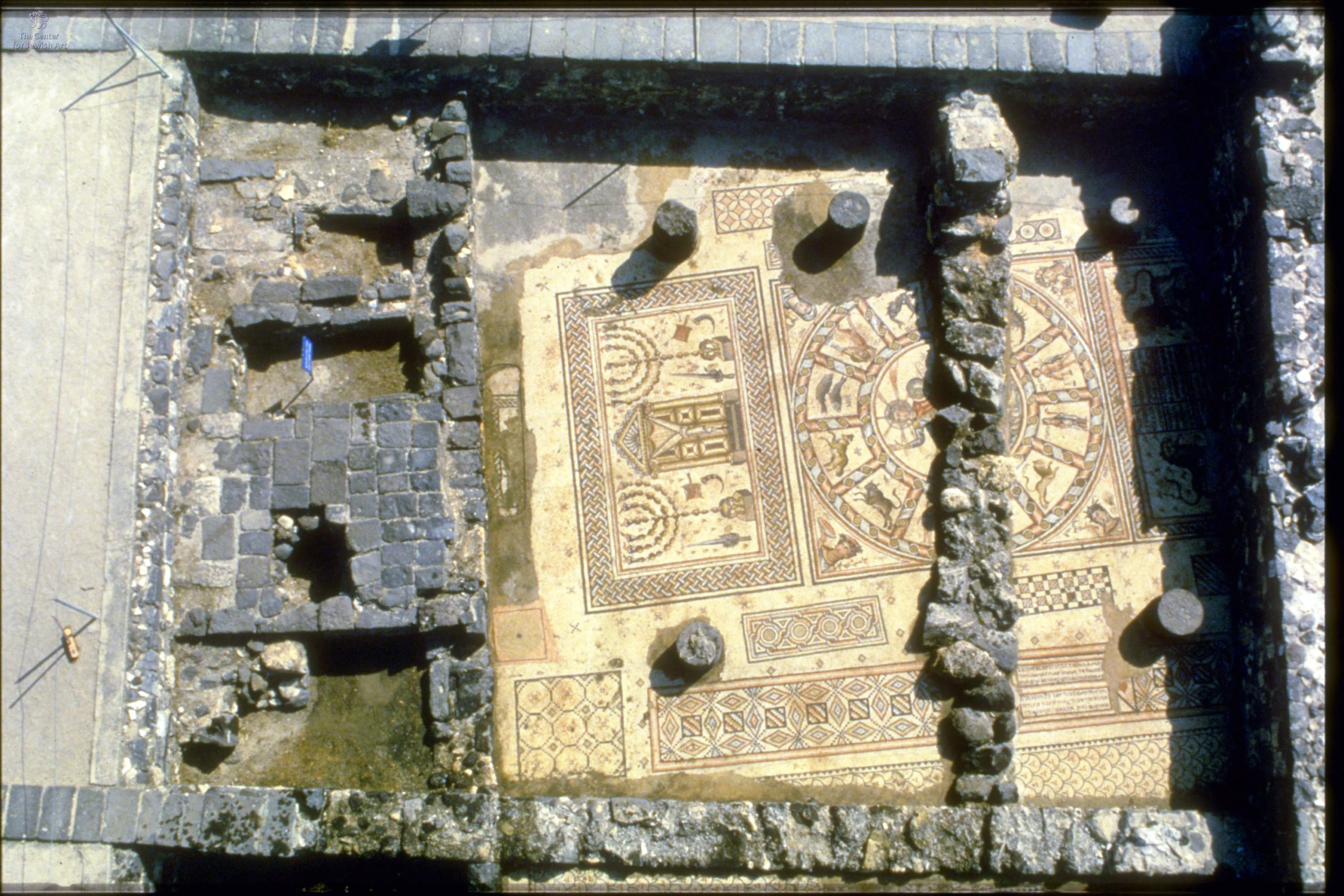
What you are looking at. An excavated synagogue floor, seen from above. Two mosaic panels sit side by side. On the left, a Torah shrine flanked by two menorahs. On the right, a great circle divided into twelve segments, a figure in each, with one figure at the center and four more in the corners.
What it is. The wheel is a zodiac: the twelve constellations that mark the sun’s path across the year, each labeled in Hebrew. At the center rides Helios, the Greco-Roman sun god, in his chariot. The four corners hold figures of the four seasons, with the crops and clothing that belong to each. It is the solar year itself, rendered in stone on the floor of a synagogue.
When and where. Hammath Tiberias lay on the western shore of the Sea of Galilee, in the Land of Israel. The floor dates to the 3rd–4th centuries CE, the same era when, by tradition, the calendar was shifting from sighting the moon to calculating the year. An inscription names a donor, Severus, raised in the household of the Jewish patriarchs; the synagogue is sometimes called after him.
Why it matters here. A synagogue is where the calendar is lived, where festivals are announced and the new month proclaimed. Setting the turning year into the floor makes the abstract system visible: the people who worshipped here crossed a map of the agricultural year every time they entered.
One detail to notice. The sun-figure at the center is borrowed from the surrounding Greco-Roman world; the same image appears in non-Jewish art of the period. Its presence here is a reminder that the communities of late-Roman Galilee lived inside a wider culture and drew on its visual language, while turning it to their own purpose, marking their year, in their synagogue, with the names of the months in Hebrew.
Afterlife. Hammath Tiberias is not alone. Several other ancient synagogues in the Land of Israel, among them Beit Alfa and Sepphoris, have zodiac floors of the same kind, made over several centuries. Together they show that picturing the year as a wheel of seasons was not a one-time experiment but a shared practice across the country in late antiquity, a civilization that thought about time enough to put it under its feet. The archaeology of these synagogues is held and studied by institutions including the Israel Museum, Jerusalem and the Israel Antiquities Authority.
Key takeaways
- The Jewish calendar is lunisolar: its months follow the moon, but the year is held to the sun by adding a thirteenth month seven times in every nineteen years, so the festivals never drift out of their seasons.
- For centuries the month was observed, not calculated: declared by a court in Jerusalem on the testimony of witnesses who had seen the new moon, with the news carried outward by messengers.
- As a single safe center became impossible to rely on under Roman rule, the calendar shifted to a fixed mathematical rule any community could compute for itself, which is what let a scattered people keep the same date with no contact at all.
- The festival year began as the agricultural calendar of one land: Passover at the barley harvest, Shavuot at the wheat, Sukkot at the ingathering of fruit, and was carried, unchanged, across a world where those seasons no longer matched.
- Because keeping your own time is a form of independence, rulers who set out to break the Jewish people, from Antiochus to the modern era, repeatedly targeted the Sabbath and the festivals, and the people repeatedly refused to give them up.
Discussion questions
Working from the evidence.
- Why does keeping a festival "in its season" require tying the calendar to the sun? What would happen, over many years, to a festival fixed only by the moon?
- The shift from watching the moon to calculating the calendar removed the need for a single central authority. Why might that have made the calendar more secure for a scattered people, not less?
- The month-names (Nisan, Tishrei, and the rest) were adopted during the Babylonian exile. What does it mean that a people carried the vocabulary of an exile into its everyday calendar for the next two thousand years?
- Across history, hostile rulers often banned the Sabbath and the festivals first. Why would an attack on a people begin with an attack on its calendar?
Classroom Connections
Where this Topic fits.
Teaching Connections
The disciplines and courses this Topic naturally supports, for any educator, anywhere.
- World History & Belief Systems: a concrete, datable example of how a belief system organizes time, and how that practice persisted across the dispersion of a people.
- Geography · migration & diaspora: the “second day of the diaspora,” the Babylonian month-names, and the survival of one land’s agricultural year across the world.
- Art History & Museum Education: the Hammath Tiberias zodiac floor as a visual primary source.
- Mathematics & Astronomy: the nineteen-year cycle, the eleven-day lunar–solar gap, and the leap-month rule connect to ratio, cycles, and the astronomy of the moon and sun.
- Historical Thinking: how a community keeps a shared identity across distance and time without a central state to enforce it.
Standards Alignment
- NYS Global History & Geography: Key Idea 9.2 (Belief Systems).
- Common Core ELA-Literacy: RH.6–8.7 and RH.9–10.7 (integrating visual and textual information): the zodiac mosaic read alongside the textual account of the calendar.
- C3 Framework: Dimension 2 (applying disciplinary concepts in history and geography): continuity and change over time; the movement of people and ideas.
Sources and citations
Primary sources come straight from the time: documents, letters, speeches, images, and objects created by the people involved. Secondary sources come later: books, articles, and analysis in which scholars study and interpret those primary sources.
Primary sources
- Maimonides, Moses. Mishneh Torah, Sanctification of the New Moon (Hilkhot Kiddush ha-Chodesh). The medieval codification of the rules of the calculated calendar; available in English in the open-source library at Sefaria.org.
- Dothan, Moshe. Hammath Tiberias: Early Synagogues. Jerusalem: Israel Exploration Society. (The excavation and dating of the Hammath Tiberias synagogue and its zodiac mosaic.)
- The Gezer Calendar, 10th century BCE. The ancient Hebrew inscription listing the agricultural seasons of the year, among the oldest known Hebrew texts. Istanbul Archaeology Museums.
- Mishnah Rosh Hashanah, chapters 1–2. The tannaitic record of the witness-and-court procedure for declaring the new moon. Free at Sefaria.
Secondary sources
- Stern, Sacha. Calendar and Community: A History of the Jewish Calendar, 2nd Century BCE – 10th Century CE. Oxford: Oxford University Press, 2001. (The standard scholarly history; basis for the account of the shift from observation to calculation and the caution about dating it.)
- "Jewish religious year." Encyclopædia Britannica. (Structure of the lunisolar calendar; the witness-and-court procedure; the festival cycle and months.)
- "Calendar, History of." The Jewish Encyclopedia. New York: Funk & Wagnalls, 1901–1906. (The Hillel II tradition via Hai Gaon; the role of the Sanhedrin in declaring months and intercalating years.)
- "Three Pilgrimage Festivals" and entries on Passover, Shavuot, and Sukkot. Encyclopædia Britannica. (The agricultural anchoring of the festivals: barley, wheat, and the ingathering of fruit.)
- U.S. Naval Observatory, Astronomical Applications Department. "The Jewish Calendar." (The astronomical mechanics: synodic month, the 19-year cycle, and the postponement rules.)
- On the Hadrianic decrees and their disputed scope: Schäfer, Peter. "Hadrian's Policy in Judaea and the Bar Kokhba Revolt: A Reassessment," in A Tribute to Geza Vermes. (The persecution of Jewish practice after 135 CE and the scholarly debate over its reach.)
Finding these documents: many primary sources are free online. Good places to start are the Fordham Internet Jewish History Sourcebook, Yale’s Avalon Project (law and diplomacy), German History in Documents, the collections of the US Holocaust Memorial Museum and Yad Vashem, the National Library of Israel, and Sefaria (for Jewish texts). Search the document’s name and date.
Ritual Objects and Material Culture: the marriage contract, the Torah finials, the lamp, the ring, what the material record shows about a living, dispersed Jewish civilization.
Comments?
Write to editor@makorproject.org.
Last updated: August 2026.