Jonas Salk
Every summer, American parents kept their children away from pools, movie theaters, and each other, because a virus was paralyzing tens of thousands of them and no one knew how it spread. On April 12, 1955, a son of Russian-Jewish immigrants ended the fear. Asked on national television who owned the patent on his vaccine, he answered: “Well, the people, I would say. There is no patent. Could you patent the sun?”
Jonas Salk, 1914–1995, and the vaccine that ended the polio summers
Why this Chapter exists
The fear that ended on a specific date.
Few contributions in this Unit can be dated to a single announcement. This one can: April 12, 1955, when the verdict on the polio vaccine field trial was read to a packed hall in Ann Arbor, Michigan, and church bells rang across American towns. The man behind it was the eldest son of Russian-Jewish immigrants who never finished high school themselves, the first member of his family to go to college. His story belongs in this Unit both for what he made and for how he carried it: he never patented his vaccine, leaving anyone in the world free to make it (the foundation’s lawyers had doubted a patent was possible at all, a footnote historians add beside the famous answer), and he became, for a generation, the model of what science owed the public.
Before 1955
The polio summers.
Poliomyelitis attacked in warm weather, chose children above all, and struck without pattern: most infections passed unnoticed, but some ended in paralysis or death, and no one could say which child, which town, which summer. The worst recorded American year, 1952, brought nearly 58,000 cases, more than 3,000 deaths, and over 20,000 children left with paralysis; hospital wards filled with iron lungs, the machines that breathed for children whose chest muscles no longer could. Americans of that generation were said to fear polio second only to the atomic bomb. (World Health Organization; the fear comparison is documented in the peer-reviewed literature.)
1947–1955
Pittsburgh, the Pioneers, and the announcement.
Jonas Salk was born in New York City on October 28, 1914, to Daniel and Dora Salk, immigrants from the Russian Empire; he went from City College to medical school and, in 1947, took over a small virus laboratory at the University of Pittsburgh. Against the prevailing scientific fashion, he pursued a killed-virus vaccine: safe by design, because it could not cause the disease it prevented. The March of Dimes, the national polio charity funded by the coins of ordinary families, backed him.
The test of the vaccine was one of the largest field trials in medical history: in 1954, some 1.8 million schoolchildren, remembered as the Polio Pioneers, took part across the country. On April 12, 1955, the trial’s independent evaluator announced the verdict in three words that made front pages worldwide: the vaccine was “safe, effective, and potent.” It was licensed the same day. Vaccination began within weeks. The rollout carried a tragedy that belongs in the record: defective batches from one manufacturer, in what became known as the Cutter incident, caused polio in some vaccinated children and led directly to the modern federal system of vaccine regulation. The campaign continued, and the polio summers began to end; by 1979 the wild virus was gone from the United States entirely. (Salk Institute; CDC.)
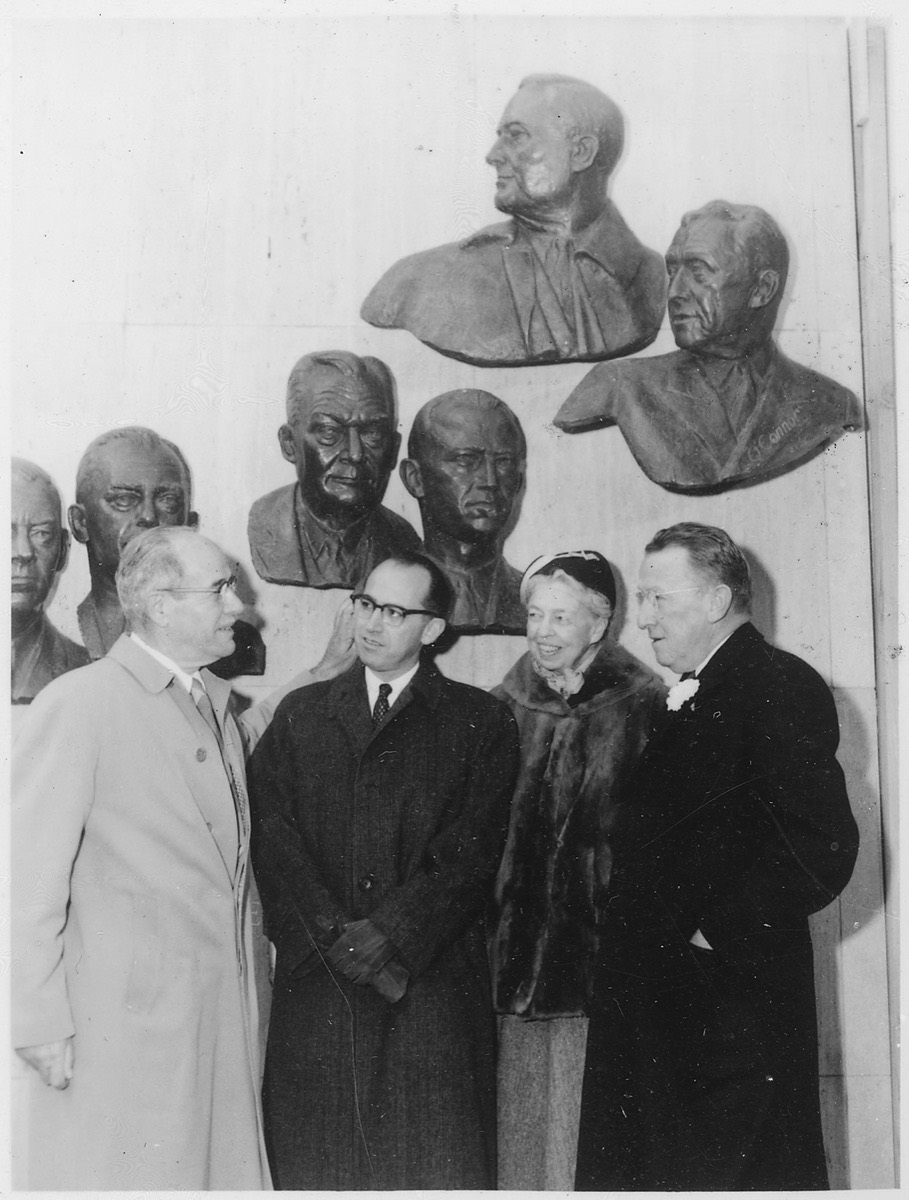
April 12, 1955
“Could you patent the sun?”
On the evening of the announcement, Edward R. Murrow interviewed Salk on CBS television and asked who owned the patent on the vaccine. Salk’s answer, preserved on film: “Well, the people, I would say. There is no patent. Could you patent the sun?” The vaccine stayed unpatented, and Salk spent the rest of his career at the research institute he founded in 1960, which still carries his name and his stated ambition to be, in his phrase, a good ancestor. The finish line belongs to two men, not one. Albert Sabin, also the son of Jewish immigrants, from Białystok, in Poland, then part of the Russian Empire, developed the oral vaccine, licensed in the early 1960s, that carried eradication to much of the world; he and Salk were lifelong rivals, and neither patented his vaccine. Salk died in 1995. Since the global eradication campaign began in 1988, wild polio cases worldwide have fallen by more than 99 percent. (The Murrow exchange, documented in the medical literature; WHO.)
Object Spotlight
An empty iron lung.
The object of this Chapter is one that vanished: the iron lung. Rows of them once filled hospital wards each summer, each cylinder holding a child. Museums, including the Smithsonian, preserve them now as artifacts, machines made obsolete by a syringe.
The analytical question
What the refusal teaches.
A public-school kid, the first in his immigrant family to reach college, did the work, gave the result away, and named the principle when asked. Jewish tradition has a phrase, tikkun olam, the repair of the world; how much any tradition explains any one person is a fair classroom debate. He did the work, and he gave it away.
Key takeaways
- Polio was mid-century America’s most feared disease after the atomic bomb: nearly 58,000 cases in the peak year of 1952, with thousands dead and tens of thousands paralyzed, most of them children.
- Jonas Salk (1914–1995), eldest son of Russian-Jewish immigrants and first in his family to attend college, developed the killed-virus vaccine at the University of Pittsburgh with March of Dimes funding.
- After a field trial of some 1.8 million children, the vaccine was declared “safe, effective, and potent” on April 12, 1955 and licensed the same day; wild polio was gone from the United States by 1979 and is down more than 99 percent worldwide since 1988.
- Salk never patented the vaccine: “There is no patent. Could you patent the sun?” Albert Sabin, whose oral vaccine carried eradication worldwide, was also the son of Jewish immigrants, and also refused to patent.
- He founded the Salk Institute in 1960 and framed his ambition as being “a good ancestor.”
Discussion questions
Working from the evidence.
Grounded in the sourced record above. Each asks students to read the documents rather than restate a conclusion.
- The vaccine was funded by dimes collected from millions of families, and Salk declined to patent the result. What claim does each of those facts make about who medical knowledge belongs to?
- The 1954 trial required 1.8 million families to volunteer their children. What level of public trust does that represent, and what would that trust require today?
- The iron lung became a museum piece within a generation. Why is an obsolete machine a more powerful piece of evidence than a statistic?
- Salk said he wanted to be “a good ancestor.” What would that standard change if it were applied to the figures in the rest of this Unit, or to public decisions today?
- This Unit warns against crediting a group’s “special gift” for its members’ contributions. Using Salk’s biography, make the case for what actually produced this contribution: circumstances, institutions, values, or the man.
Classroom Connections
Where this Chapter fits.
Teaching Connections
The disciplines and courses this Chapter naturally supports, for any educator, anywhere.
- US History: the polio era, the March of Dimes as mass philanthropy, and the 1955 announcement as a national event.
- Biology & Public Health: killed-virus versus live-virus vaccines, field trials, and eradication campaigns from 1955 to the present.
- Ethics: the patent refusal, public funding, and who owns publicly financed discoveries.
- Jewish History: the immigrant arc from the Pale of Settlement to the laboratory, completing the Unit’s pattern.
- Media Literacy: the Murrow interview as a primary source preserved on film.
Standards Alignment
- NYS US History & Government: 11.8–11.9 (postwar America, science, and society).
- Common Core ELA-Literacy: RH.9–10.2 (central ideas from primary and secondary sources) and RST.9–10.9 (comparing scientific accounts).
Further Teaching Resources
- Salk Institute, the founder’s biography, from the institution he built.
- WHO, the history of polio vaccination, the global arc from 1955 to near-eradication.
- Eisenhower Presidential Library, the government’s own 1955 documents.
Sources and citations
Primary sources
A primary source is a record from the time. It was made by people who were there. Examples: letters, diaries, photos, decrees, trial records, and newspapers.
- Murrow, Edward R., and Jonas Salk. See It Now interview, CBS, April 12, 1955. The exchange is preserved on film and documented in the medical literature.
- Francis, Thomas, Jr. Announcement of the field-trial evaluation, Ann Arbor, April 12, 1955.
- Eisenhower Presidential Library. Documents on Salk and the vaccine, 1955. eisenhowerlibrary.gov.
Secondary sources
A secondary source was written later. It is a book or article by a historian who studied those records and explains what they mean.
- Salk Institute for Biological Studies. “Jonas Salk.” salk.edu.
- World Health Organization. “History of Polio Vaccination” and the poliomyelitis fact sheet. who.int.
- Centers for Disease Control and Prevention. Poliomyelitis surveillance chapter. cdc.gov.
- Oshinsky, David M. Polio: An American Story. New York: Oxford University Press, 2005.
The final Unit turns from what Jews built to what the world did with the record: how the Holocaust was remembered, judged, and repaired, and what remains unfinished today.
Comments?
Write to editor@makorproject.org.
Last updated: August 2026.