Emma Lazarus
“Give me your tired, your poor, your huddled masses yearning to breathe free.” Every American knows the words. Far fewer know that a Jewish woman wrote them, or that she wrote them while teaching English to refugees of the Russian pogroms on an island in the East River. The Statue of Liberty says what it says because of what happened to the Jews of Russia in 1881.
Emma Lazarus, 1849–1887, the poet who gave the Statue of Liberty its voice
Why this Chapter exists
The most famous words in American immigration history.
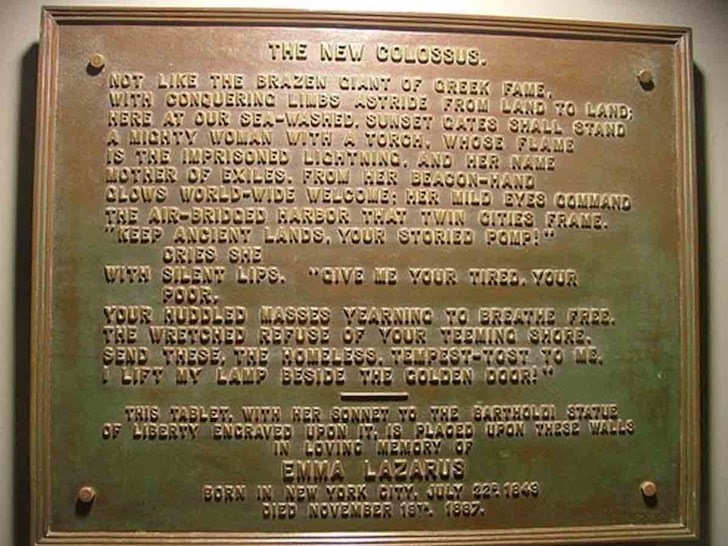
The Statue of Liberty was not built as a monument to immigration. France gave it as a monument to liberty and the American republic. What changed its meaning was a sonnet, auctioned off in 1883 to raise money for the pedestal, forgotten for nearly twenty years, and finally bolted to the inside of that pedestal on a bronze plaque in 1903. The words on the plaque turned a lighthouse of an idea into the Mother of Exiles, her poem’s own name for the statue.
This Chapter tells the story of the woman who wrote them: who she was, why the pogroms of 1881 turned a sheltered American poet into an advocate, and how her words outlived her so completely that the country knows the poem and forgot the poet. It belongs in this Unit because it is a contribution of the clearest kind: language that a nation adopted as a description of itself.
1849–1881
An American poet, rooted before the Revolution.
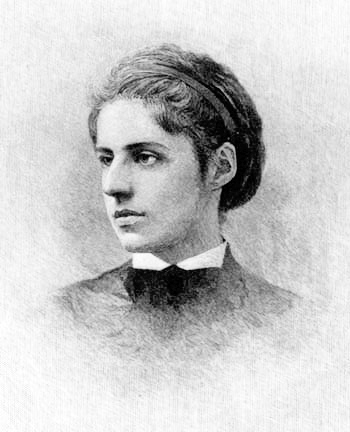
Emma Lazarus was born in New York City on July 22, 1849, into a wealthy Sephardic family, descended from the Jews of Spain and Portugal whose roots in America reached back before the Revolution; her ancestors helped found the country’s oldest congregations. She was about as established as an American could be. She published her first collection of poems at seventeen. Ralph Waldo Emerson, then the most famous writer in America, read it, wrote to her, and mentored her by mail. Through her twenties she was a rising literary figure who wrote little about Jewish subjects and was, by her own account, distant from Jewish religious life.
Nothing in that biography predicts what happened next. What changed her was not something in her life. It was the news.
1881–1883
The pogroms reach New York.
In 1881 and 1882, waves of anti-Jewish violence swept the Russian Empire, the pogroms documented in Unit 3. Refugees began arriving in New York by the thousands. Lazarus went to see them, at the refuge on Ward’s Island in the East River, and what she saw reorganized her life. She taught English classes for the new arrivals. She volunteered with the Hebrew Emigrant Aid Society. She helped found the Hebrew Technical Institute to train refugees for work. And she began to write as a Jew.
The work came fast: Songs of a Semite in 1882, and then fifteen public letters, “An Epistle to the Hebrews,” in the American Hebrew through 1882 and 1883, in which she argued, among other ideas, for a Jewish national home in the land of Israel, more than a decade before Theodor Herzl, whose story follows this one, wrote a word on the subject. An American writer, from a family secure in America for generations, read the news from Russia and concluded that Jewish safety could not depend forever on someone else’s goodwill. (Jewish Women’s Archive; National Park Service.)
November 2, 1883
Fourteen lines for an auction.
That is who she was when the request came in 1883: contribute a manuscript to an art auction raising money for the pedestal of a colossal statue France had given, which New York could not yet afford to stand up. She almost declined; she did not write on commission. Then she thought about what she had seen on Ward’s Island, and on November 2, 1883 she finished a sonnet called “The New Colossus.”
A colossus is a giant statue; the ancient world’s most famous was the bronze warrior at Rhodes. Her poem renames the new one before the country had decided what it was: “not like the brazen giant of Greek fame,” but a “mighty woman with a torch” whose name is Mother of Exiles. And then the lines every American knows, spoken by the statue herself: “Give me your tired, your poor, / Your huddled masses yearning to breathe free.” She wrote them with specific people in mind. She had met them, taught them, and heard the doors of the old world close behind them. The full text is preserved, where it has stood since 1903, by the National Park Service. (NPS, “The New Colossus,” with the full poem.)
1887–1903
The poet forgotten, the poem installed.
Emma Lazarus died on November 19, 1887, at thirty-eight. The poem was not read at the statue’s dedication and, in the National Park Service’s words, slowly faded from public memory. Around 1901 her friend Georgina Schuyler, a great-granddaughter of Alexander Hamilton, came across the sonnet in a bookshop and began a campaign to have it honored. In 1903, a bronze plaque bearing the poem was placed on the inner wall of the pedestal, where it remains.
The rest is the slow work of adoption. Over the twentieth century, as the statue greeted the ships documented in the American Jewry Chapter, her sonnet became the standard account of what the statue means, quoted by presidents of both parties, set to music, carved into the national memory so deeply that most Americans assume the statue was always about immigration. It was not. A Jewish poet, answering the pogroms, made it so.
Object Spotlight
A statue renamed by a sonnet.
The object of this Chapter is the pairing itself: the statue that was, at its unveiling, the tallest in the world, and the fourteen lines that tell it what it is. The chain runs from a pogrom in the Russian Empire, to an island refuge in the East River, to an auction manuscript, to the plaque inside the pedestal.
The analytical question
What one writer changed.
A specific person, responding to a specific documented event, wrote specific words, and the words changed how a nation describes itself. Students can test every link in that chain against the record.
Key takeaways
- Emma Lazarus (1849–1887), an American Sephardic poet mentored by Emerson, wrote “The New Colossus” in 1883 for the auction that funded the Statue of Liberty’s pedestal.
- The poem was her answer to the Russian pogroms of 1881–82: she taught and aided the refugees on Ward’s Island, and wrote the statue’s welcome with them in mind.
- In her “Epistle to the Hebrews” letters (1882–83) she argued for a Jewish national home more than a decade before Herzl.
- She died at 38, largely forgotten as the poem’s author; a friend’s campaign placed the bronze plaque in the pedestal in 1903, and the sonnet became the nation’s account of its own statue.
- The full record, the poem, the plaque, and her story, is kept by the National Park Service at the statue itself.
Discussion questions
Working from the evidence.
Grounded in the sourced record above. Each asks students to read the documents rather than restate a conclusion.
- The Statue of Liberty was given as a monument to liberty, not immigration. What does it tell you about the power of language that fourteen lines, added twenty years later, changed what the monument means?
- Lazarus wrote the poem’s welcome after months of teaching pogrom refugees. Read the sonnet at the NPS link with that fact in mind: which lines change when you know who she was picturing?
- She was wealthy, native-born, and distant from Jewish life until 1881. What does her turn tell you about how events far away can redefine identity at home?
- Her homeland argument came fourteen years before Herzl’s, from an American woman, and is far less remembered. What determines which thinkers history credits?
- The poem was nearly lost; a friend’s campaign saved it. How much of what a culture “remembers” depends on individual acts of preservation, and what does that mean for the records this site keeps?
Classroom Connections
Where this Chapter fits.
Teaching Connections
The disciplines and courses this Chapter naturally supports, for any educator, anywhere.
- US History & Civics: the Statue of Liberty, the immigration era, and how a text became national self-description.
- English & Poetry: “The New Colossus” as a sonnet, the Rhodes allusion, and the first-person voice of a monument.
- Jewish History: the 1881 pogroms’ American echo, and proto-Zionist thought before Herzl.
- Women’s History: a nineteenth-century woman whose words outlived every officeholder of her era.
- Historical Thinking: tracing a cultural artifact’s chain of custody, from event to text to monument to memory.
Standards Alignment
- NYS US History & Government: 11.2 (industrialization and immigration era) and NYS Global History 10.2 (the pogrom context).
- Common Core ELA-Literacy: RH.9–10.9 (comparing a primary text with its historical context) and RL analysis of the sonnet itself.
Further Teaching Resources
- National Park Service, “The New Colossus”, the poem and the plaque at the statue itself.
- NPS, “Emma Lazarus”, the biography as the monument’s keepers tell it.
- Jewish Women’s Archive, the scholarly encyclopedia entry.
Sources and citations
Primary sources
A primary source is a record from the time. It was made by people who were there. Examples: letters, diaries, photos, decrees, trial records, and newspapers.
- Lazarus, Emma. “The New Colossus.” November 2, 1883. Full text at the National Park Service.
- Lazarus, Emma. Songs of a Semite. New York, 1882.
- Lazarus, Emma. “An Epistle to the Hebrews.” Fifteen letters, The American Hebrew, 1882–83.
- The 1903 bronze plaque, pedestal of the Statue of Liberty. National Park Service photograph.
Secondary sources
A secondary source was written later. It is a book or article by a historian who studied those records and explains what they mean.
Fourteen years after Lazarus argued for a Jewish national home, a Viennese journalist covering a mob in Paris arrived at the same conclusion, and built a movement around it.
Comments?
Write to editor@makorproject.org.
Last updated: August 2026.