The Terror Record
Thirty-one years after the Holocaust, gunmen walked through a crowd of hijacked airline passengers and separated the Jews from everyone else. In Rome, a two-year-old boy was killed outside his synagogue. In Buenos Aires, eighty-five people died in a Jewish community center, an ocean away from any battlefield. None of them lived in Israel. What connects them is the subject of this Chapter, and every case in it ends in a court record, an archive, or a memorial with names.
Organized violence against Jewish civilians under a political banner, 1920 to today
Why this Chapter exists
The record, and the rule for reading it.
The Unit to this point has followed antisemitism through its costumes: theology, libel, pseudoscience, state policy. In the twentieth century the violence acquired new banners, a political and national one, and much of it was aimed at the new Jewish state. When is violence in a political conflict war, and when is it antisemitism?
This site does not adjudicate the Arab-Israeli conflict, its wars, or its politics; soldiers killed in battle belong to military history, not to this Unit. What belongs here is the documented record of civilians targeted as Jews: passengers sorted by religion, synagogues bombed on the Sabbath, a community center leveled an ocean away from any front line. Every case below meets that test, and every case ends in a document: a court ruling, a state commemoration, an institutional archive, a memorial with names on it.
Before you read
Eight dates for orientation.
The record below refers to wars and borders that it does not retell. For the reader meeting this history for the first time, eight dates:
- 1948. Israel declares independence; the armies of five Arab states invade the next day; the war ends in the 1949 armistice lines.
- 1956. The Suez war, fought over the canal and the Egyptian border.
- 1967. The Six-Day War; Israel captures the West Bank and Gaza, and the occupation of those territories begins.
- 1973. The Yom Kippur War, launched against Israel on its holiest day.
- 1979. Egypt signs the first peace treaty between Israel and an Arab state; Jordan follows in 1994.
- 1993. The Oslo accords: mutual recognition between Israel and the PLO (the Palestine Liberation Organization), and the creation of the Palestinian Authority.
- 2005. Israel withdraws every soldier and settler from Gaza.
- 2007. Hamas, an Islamist militant movement, seizes Gaza from the Palestinian Authority by force and has governed it since.
The full history, with its sources, is the Modern State of Israel Chapter. This page needs only the dates.
1920–1939
Before the state: the violence was new.
A common claim holds that the crisis in the Middle East is thousands of years old. The record shows the opposite. Jews had lived in Hebron, Safed, Jerusalem, and Jaffa for many centuries among their neighbors; the organized violence against them as Jews began in a specific, modern decade, the same decade the imported conspiracy material began circulating in Arabic. The Misconceptions page addresses the “thousands of years” claim directly; this page holds the evidence.
In April 1920, rioters attacked the Jewish quarter of Jerusalem’s Old City during the Nebi Musa festival, an annual Muslim pilgrimage feast: five Jews killed, some two hundred wounded. The Haganah, the Jewish self-defense organization that later became the basis of Israel’s army, was founded in the weeks that followed; that story is told in the Modern State of Israel Chapter. The land was then called Palestine, governed by Britain under a post-World War I mandate. In May 1921, riots in Jaffa killed 47 Jews, among them the writer Yosef Haim Brenner. Then, in one week of August 1929, riots swept the country: 133 Jews killed and 339 wounded, by the count of the British commission of inquiry. In Hebron, 67 Jews were murdered by their neighbors in a single day, and the survivors were evacuated, ending a Jewish community that had lived in the city for many centuries, nineteen years before the State of Israel existed. Hundreds of Hebron’s Jews survived because Arab families hid them. The hatred was not ancient, and it was not universal. (Figures: the Shaw Commission report, Cmd. 3530, 1930; the memorial record is kept by the Jewish community of Hebron.)
The Arab Revolt of 1936 to 1939, aimed chiefly at British rule, killed some 415 Jews across four years. By the time the state was declared in 1948, a full generation of anti-Jewish violence was already on the record.
1949–1956
The border years.
The violence did not wait for the hijacking era. In the years after the 1948 war, armed infiltrators crossed into Israel from the surrounding territories thousands of times; the raids, called fedayeen raids, killed hundreds of Israelis, roughly 200 to 250 of them civilians by scholarly counts. The Israeli record documents the attacks incident by incident. (Israel Ministry of Foreign Affairs, incident register; the civilian count is the historian Benny Morris’s, in Israel’s Border Wars, 1949–1956.)
These attacks came before the 1967 war, and before the occupation that later accounts point to.
1964–1970
The hijacking era.
The Palestine Liberation Organization was founded in 1964; its amended 1968 charter, preserved by the Avalon Project at Yale Law School, committed the movement to armed struggle. (The Palestinian National Charter, 1968 · Avalon Project.) By the end of the decade, its factions had invented a new form of political violence: the mass hijacking of civilian airliners.
In September 1970, the Popular Front for the Liberation of Palestine (PFLP) seized four airliners in a coordinated operation, landing three of them at a desert airstrip in Jordan called Dawson’s Field and blowing up the emptied planes for the cameras. Most of the roughly 310 hostages were released within days. Fifty-six were kept for weeks longer: the crews, and passengers held with particular attention to who among them was Jewish, a selection recorded in the hostages’ own accounts. (Naval Postgraduate School, Center for Homeland Defense and Security, timeline.)
September 5–6, 1972
Munich.
At the 1972 Olympic Games in Munich, gunmen of Black September, a PLO-linked organization, broke into the Israeli team’s quarters in the Olympic Village. They murdered two team members there and took nine hostage; all nine were killed during a failed rescue at the Fürstenfeldbruck airfield, along with a German policeman. Eleven Israeli Olympic team members died. The Games continued.
Germany maintains an official memorial and documentation site; its record of the attack, hour by hour, is public. (Erinnerungsort Fürstenfeldbruck, the official memorial record.) The banner of this page is the memorial in Munich’s Olympic Park, a granite beam carrying the twelve names.
June 27 – July 4, 1976
Entebbe, and the selection.
On June 27, 1976, hijackers of a PFLP faction, joined by two members of a German revolutionary group, seized an Air France flight from Tel Aviv to Paris and flew it to Entebbe, Uganda. There they did what gives the event its place in this Unit: they separated the Israeli and Jewish passengers from the others and released the rest. The Air France crew refused to leave their passengers and stayed. On July 4, Israeli commandos flew 2,500 miles and rescued 102 of the roughly 106 hostages; three hostages died in the raid, the unit commander Yoni Netanyahu was killed, and an elderly hostage, Dora Bloch, was murdered in Uganda afterward. (IDF, the operation record.)
Thirty-one years after the Holocaust, Jews were once again being separated from non-Jews, this time on an African runway, by people who called their cause anti-Zionist: opposed to the Jewish state. The selection is the single most-cited piece of evidence in the modern debate over where anti-Zionism ends and antisemitism begins.
1970–1978
Inside Israel: the schools and the roads.
In the same years, the attacks inside Israel chose the most defenseless targets available. On May 22, 1970, gunmen ambushed a school bus near Moshav Avivim: 12 killed, 9 of them children. On May 30, 1972, three gunmen of the Japanese Red Army, recruited by the PFLP, opened fire in the arrivals hall of Lod Airport: 26 killed, among them 17 Christian pilgrims from Puerto Rico, which observes a remembrance day for them by law. On May 15, 1974, attackers seized a school in Ma’alot with over a hundred students inside; when the rescue failed, 25 hostages were dead, 22 of them schoolchildren. On March 11, 1978, attackers landing by sea hijacked a bus on the coastal highway: 38 civilians killed, 13 of them children. (Israel MFA, register of major attacks, 1967–1993.)
A school bus, an arrivals hall, a school, a family bus on a highway. None of these was a military target.
1980–1986
The diaspora under attack.
In the 1980s the violence reached the diaspora: Jews living far from Israel, with nothing tying them to it but their Jewishness. On October 3, 1980, a bomb outside the Rue Copernic synagogue in Paris killed four people; in 2023, a French court convicted a suspect in absentia (tried in his absence), a verdict that remains contested, and the case file remains part of the record. On October 9, 1982, gunmen attacked the Great Synagogue of Rome as families left Sabbath services; a two-year-old boy, Stefano Gaj Taché, was killed. The President of Italy has commemorated him by name, at the synagogue, as a son of Italy. (Presidency of the Italian Republic, 40th-anniversary commemoration.) On September 6, 1986, gunmen murdered 22 worshippers during Sabbath services at the Neve Shalom synagogue in Istanbul; the congregation’s own account preserves the record. (Neve Shalom Synagogue, Istanbul.)
On October 8, 1985, aboard the hijacked cruise ship Achille Lauro, gunmen of the Palestine Liberation Front shot Leon Klinghoffer, a 69-year-old retired American in a wheelchair, and threw his body overboard. He was singled out as a Jew. An Italian court at Genoa convicted the operation’s commander in absentia in 1986; his daughters’ memorial foundation at the Anti-Defamation League has documented antisemitic terrorism ever since. (ADL, the Klinghoffer Memorial Foundation.)
A synagogue in Paris, a synagogue in Rome, a synagogue in Istanbul, a cruise ship in the Mediterranean. None of these was a battlefield.
1992 · 1994 · 2024
Buenos Aires, and a thirty-year verdict.
On March 17, 1992, a bomb destroyed the Israeli Embassy in Buenos Aires, killing 29 people. On July 18, 1994, a second bomb leveled the AMIA Jewish community center in the same city, killing 85 people and wounding some 300: until October 7, 2023, the deadliest attack on a diaspora Jewish target since the Second World War. Interpol red notices for six suspects, published in 2007, remain in force. (Interpol.)
The legal record took three decades to conclude. On April 11, 2024, Argentina’s federal criminal appeals court ruled that both attacks were ordered by Iran and carried out by Hezbollah, the Lebanese militia Iran arms and directs, and declared the AMIA bombing a crime against humanity, a category with no statute of limitations. The Argentine public prosecution maintains the full case record. (Ministerio Público Fiscal, AMIA case unit.) The ruling also appears on this site’s Legal Record.
1987–1993 · 2000–2005
The intifadas: what the word refers to.
Students will meet the word intifada, an Arabic word meaning “shaking off,” in chants and slogans today. The word names two distinct periods, and the figures below come from B’Tselem, an Israeli human-rights organization that counts the dead on both sides and is regularly cited against Israeli government positions.
The First Intifada, from December 1987 to September 1993, was largely a campaign of riots, stones, and firebombs. By B’Tselem’s tables, about 180 Israelis were killed through the end of 1993, 100 of them civilians. The same organization documented a second toll inside the word: between roughly 770 and 940 Palestinians were killed in those years by other Palestinians as suspected “collaborators,” and Israeli defense data indicated most had no actual connection to Israel. (B’Tselem, fatality tables; B’Tselem, January 1994 report.)
The Second Intifada, from September 2000 to 2005, was a different event: a campaign of roughly 140 suicide bombings aimed at buses, restaurants, and celebrations. About 1,000 Israelis were killed, the majority of them civilians. Three dates carry the record. June 1, 2001: a suicide bomber outside the Dolphinarium discotheque in Tel Aviv killed 21 people, most of them teenage girls. August 9, 2001: a bomber in the Sbarro pizzeria in central Jerusalem killed 16 people, 7 of them children; the sixteenth victim died in 2023 after twenty-two years in a coma. March 27, 2002: a bomber walked into a Passover seder at the Park Hotel in Netanya and killed 30 people, most of them elderly. (B’Tselem, decade summary; Israel MFA, the named victims.)
2012–2015
The diaspora attacks resume under a new banner.
A generation after Rome and Istanbul, the attacks on Europe’s Jews returned, now under the banners of jihadist (violent Islamist) movements rather than Palestinian national ones. On March 19, 2012, a gunman entered the Ozar Hatorah Jewish school in Toulouse and murdered a rabbi, his two small sons, and a seven-year-old girl; France’s national memorial museum of terrorism keeps their names. (Musée-Mémorial du terrorisme.) On May 24, 2014, a gunman returned from fighting in Syria’s civil war murdered four people at the Jewish Museum of Brussels; a Belgian court sentenced him to life in 2019. On January 9, 2015, a gunman seized the Hypercacher market in Paris, a kosher grocery selling food prepared under Jewish dietary law, and murdered four Jewish men doing their Sabbath shopping; France convicted fourteen accomplices in 2020. A month later, a gunman in Copenhagen killed Dan Uzan, a Jewish volunteer guarding a synagogue during a bat mitzvah celebration (a girl’s coming of age).
A school, a museum, a grocery store, a synagogue door. Different decade, different banner, same selection.
1988 to the present
Hamas: the charter, the attack, and the people it rules.
The founding charter of Hamas, and the propaganda apparatus around it, are documented in the previous Chapter. Its culminating act, the October 7, 2023 attack, is documented in the next section. What the documented sources say about Hamas and the Palestinians it governs is the part of the record that follows.
Human Rights Watch, in a 2018 report, documented systematic arbitrary arrest and torture of Palestinian critics by Hamas in Gaza. (HRW, “Two Authorities, One Way, Zero Dissent,” October 2018.) Amnesty International documented Hamas’s abductions, torture, and summary executions of Palestinians during the 2014 Israel-Hamas war in Gaza. (Amnesty International, May 2015.) In March 2019, when Gazans marched under the slogan “We Want to Live” against the cost of living, Hamas beat and jailed hundreds, including journalists and human-rights workers. (HRW, March 2019.)
Beneath Gaza, Hamas built a vast network of tunnels for its fighters and weapons. Its own leaders have described them. In May 2021, Hamas’s leader in Gaza, Yahya Sinwar, publicly boasted that the tunnels under Gaza exceeded 500 kilometers. In an interview on Russian television on October 27, 2023, the senior Hamas official Mousa Abu Marzouk was asked why civilians could not shelter in them. He answered that the tunnels were built to protect Hamas’s fighters, and that protecting Gaza’s civilians was the responsibility of the United Nations. (Ynet, with the interview record.) In February 2024, UNRWA, the UN relief agency for Palestinian refugees, itself reported the discovery of a tunnel running twenty meters beneath its own Gaza headquarters and called for an independent investigation. (UNRWA, statement of February 13, 2024.) Years earlier, a study in the Journal of Palestine Studies documented the smuggling-tunnel economy, including Hamas’s failure to regulate child labor in tunnels whose collapses had killed at least 160 people by 2012, by the authorities’ own count. (Nicolas Pelham, Journal of Palestine Studies 41:4, 2012.)
2023
October 7, 2023.
On the morning of October 7, 2023, the holiday of Simchat Torah, when the yearly Torah reading begins again, thousands of attackers led by Hamas broke through the Gaza border fence into southern Israel. They attacked more than twenty communities, army posts, and an outdoor music festival.
About 1,200 people were murdered, most of them civilians, and 251 were taken hostage into Gaza. At the Nova music festival near Re’im, 364 people were killed. In Kibbutz Be’eri, a community of about 1,100 people, more than 130 were killed and 32 taken hostage. It was the deadliest single day for Jews since the Holocaust.
The record of that day is preserved in documents and testimony. The USC Shoah Foundation, which has recorded the testimony of Holocaust survivors since 1994, opened an October 7 testimony collection built on the same methodology. Much of the attack was filmed by the attackers themselves; the perpetrators’ own footage became part of the documentary record examined by investigators and journalists worldwide. Two standing acts of witness carry the record to the public: the Nova Music Festival Exhibition, assembled from the festival grounds themselves and shown in cities around the world, and the documentary film We Will Dance Again (2024), built from survivors’ testimony and the day’s footage (see the Films page).
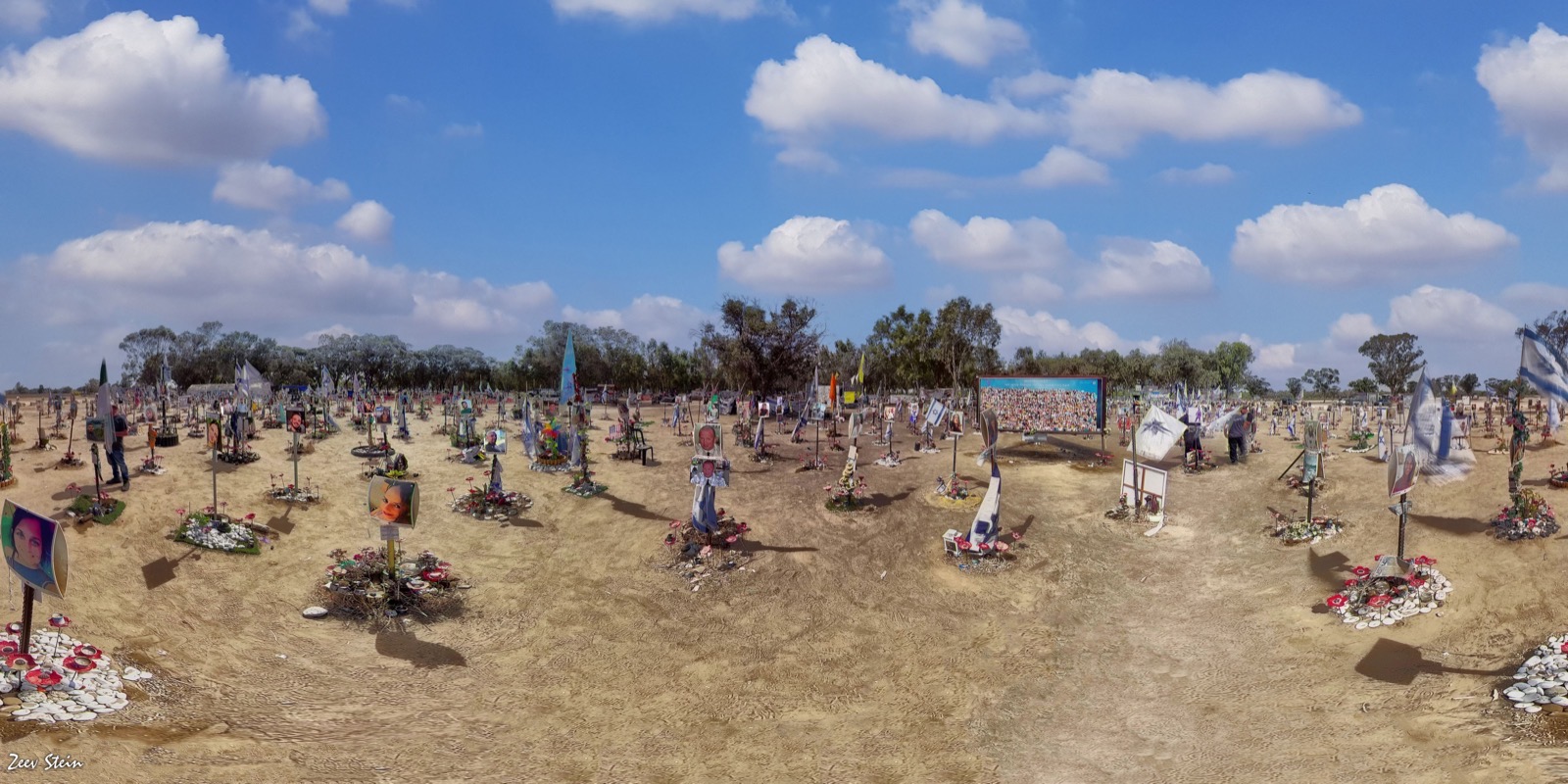
It was the deadliest single day in the record this Chapter keeps, and its aftermath became a record of its own: the worldwide surge, the normalization of the rhetoric, and the institutional reckoning are documented in the Contemporary Antisemitism Chapter, which carries the story from this day forward.
2023 to the present
The record since October 7.
The pattern this Chapter documents, violence reaching Jews far from any war because they are Jews, did not stay in the past. The two years after October 7 added entries on four continents.
Makhachkala, Russia · October 29, 2023. In the capital of Dagestan, a Muslim-majority region in southern Russia, a crowd of about 1,500 stormed the airport when a flight from Tel Aviv landed. Rioters searched the terminal, stopped cars, and checked passports, looking for Jewish passengers. No one was killed. Russian courts later sentenced 135 participants to prison terms of up to fifteen years. (RFE/RL.)
Amsterdam, the Netherlands · November 7, 2024. After a soccer match between Ajax and the Israeli club Maccabi Tel Aviv, visiting fans were assaulted across the city center. Some Maccabi fans had torn Palestinian flags from buildings and chanted anti-Arab slogans the night before, and that is part of the record. What followed was not a street brawl: Dutch courts found that attackers had coordinated in chat groups to hunt the Israelis through the city, and five men were convicted. Five victims went to the hospital. The mayor of Amsterdam, the Dutch prime minister, and the Dutch king condemned the violence as antisemitic. (PBS / Associated Press.)
Melbourne, Australia · December 2024. Before dawn, masked men poured fuel inside the Adass Israel Synagogue, home to a strictly Orthodox (Haredi) congregation, and set it alight; worshippers preparing for morning prayers escaped, and two people were treated for smoke inhalation. Police declared it a terrorist act. Three men have been charged, and the case is before the courts. (Australian Federal Police.)
Washington, D.C. · May 21, 2025. Two young Israeli Embassy staffers, Yaron Lischinsky and Sarah Milgrim, were shot and killed as they left an event at the Capital Jewish Museum. They were a couple; he had bought a ring. The man charged with their murders shouted “Free, free Palestine” as he was led away. Federal prosecutors are seeking the death penalty, and the case is before the courts. (JTA.)
Boulder, Colorado · June 1, 2025. A man threw firebombs into a weekly walk held for the Israeli hostages, called Run for Their Lives, on the town’s pedestrian mall. Twenty-nine people were counted as victims, thirteen of them burned or otherwise injured, and Karen Diamond, 82, died of her injuries weeks later. Investigators found the attacker had searched for “Zionist” groups to target. He pleaded guilty to murder and was sentenced to life in prison. (Colorado Public Radio.)
Sydney, Australia · December 14, 2025. On the first night of Hanukkah, two gunmen opened fire on “Chanukah by the Sea,” a community celebration of about a thousand people at Bondi Beach. Fifteen people were killed, among them a ten-year-old girl, and more than forty were wounded; a bystander wrestled a rifle from one of the gunmen. It was the deadliest terrorist attack in Australia’s history. One gunman was shot dead by police; the other, his son, faces 59 charges, including murder and terrorism, and the case is before the courts. Five days later, thousands stood shoulder to shoulder at sunrise on Bondi Beach in solidarity with the Jewish community, the scene on the banner of the Contemporary Antisemitism Chapter. (NBC News.)
The selection rule of this Chapter holds across all six: an airport crowd checking passports, a synagogue at prayer, a museum event, a walk for hostages, a holiday celebration on a beach. None was a battlefield. The surrounding surge, measured rather than narrated, is documented in Contemporary Antisemitism.
Object Spotlight
Buenos Aires marches with the names.
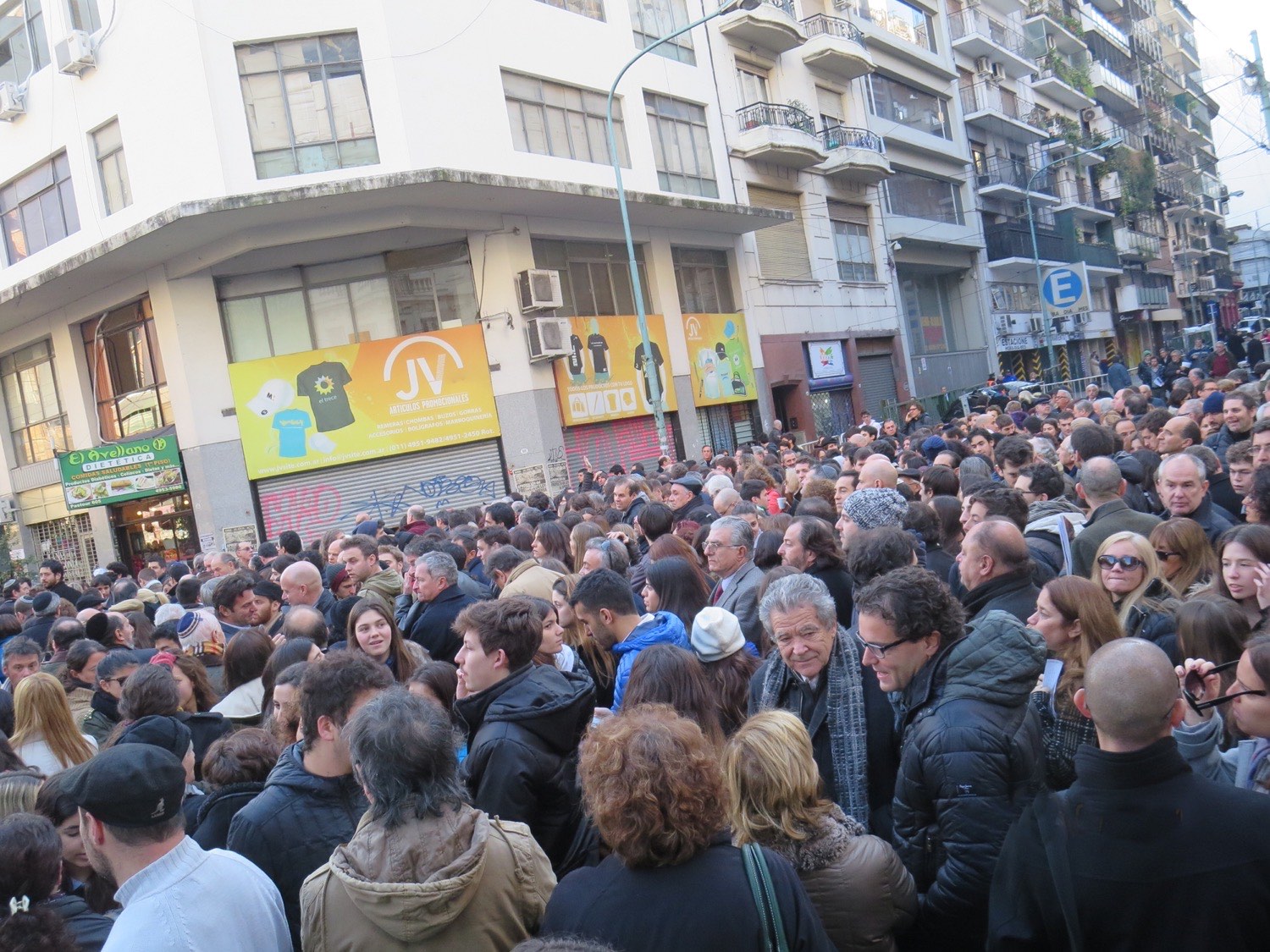
The object this Chapter leaves students with is not a monument but a repeated act: every July 18 since 1994, Buenos Aires gathers at the site of the AMIA bombing with the photographs and names of the 85. The commemoration outlasted the investigations it demanded, and in 2024, thirty years on, it received an answer from Argentina’s courts.
The analytical question
Where war ends and antisemitism begins.
Political violence in a national conflict is a subject with a military history, and this site does not catalog battles. The marker that moves an event into this Unit is selection: the documented moment when the target is chosen for being a Jew.
Not every act of violence in the conflict belongs in this record, and this page does not put it there. But where selection is documented, the event joins a very old pattern this Unit has traced under many banners, and the banner of the moment matters less than the selection itself. The marker to follow is the selection, not the slogan.
A fair question remains: what about Jewish extremists? In 1994, Baruch Goldstein, an Israeli settler, murdered 29 Palestinians at prayer in the Ibrahimi Mosque in Hebron. Israel’s government condemned the attack, outlawed his movement, Kach, as a terrorist organization under Israeli law, and in 1999 the state demolished the shrine that admirers had built at his grave. The next year, 1995, a Jewish extremist assassinated Israel’s own prime minister, Yitzhak Rabin, for signing the Oslo accords; the assassin is serving a life sentence. So the record does not show a people without extremists; no people is. What the record shows, and what a student can check, is what each society’s institutions do next: outlaw the movement, demolish the shrine, imprison the murderer, or name a school for him and pay a stipend to his family, as the Palestinian Authority’s payment program does. The stipend program is itself a matter of law: the United States conditioned aid on ending it in the Taylor Force Act of 2018, named for an American veteran murdered in a 2016 Tel Aviv attack.
Key takeaways
- Since 1920, organized violence against Jewish civilians has run in a documented line: the Hebron massacre of 1929, nineteen years before Israel existed, the border raids of the 1950s, the hijacking era, Munich 1972, Entebbe 1976, the diaspora synagogue attacks of the 1980s, Buenos Aires 1992 and 1994, the suicide-bombing campaign of 2000–2005, and October 7, 2023.
- The defining marker throughout is selection: passengers sorted by religion at Entebbe, worshippers attacked at Sabbath services, victims far from any battlefield, targeted as Jews.
- The record concludes in institutions: an Argentine court ruled in 2024 that the AMIA bombing was a crime against humanity ordered by Iran and executed by Hezbollah; Interpol notices remain in force; national memorials in Germany, Italy, and Israel carry the names.
- The intifadas have a precise record: about 180 Israelis killed in the first, about 1,000, mostly civilians, in the second’s roughly 140 suicide bombings, counted by B’Tselem, an Israeli human-rights organization that documents both sides.
- The documented record on Hamas includes the Palestinians it rules: torture and killing of dissidents recorded by Human Rights Watch and Amnesty International, and tunnels its own leaders say were built for fighters, not civilians.
Discussion questions
Working from the evidence.
Grounded in the sourced record above. Each asks students to read the documents rather than restate a conclusion.
- At Entebbe, the hijackers separated Israeli and Jewish passengers from the rest and released the others. Why does that single documented act carry so much weight in classifying the event? What does selection tell you that a casualty count cannot?
- Leon Klinghoffer was a retired American on a cruise. Stefano Gaj Taché was two years old, outside a synagogue in Rome. Neither had any connection to a battlefield. What do the diaspora attacks establish about who the target of this violence was?
- Argentina’s courts took thirty years to rule on the AMIA bombing. What is gained, and what is lost, when the legal record concludes decades after the event?
- This Chapter takes its casualty figures from B’Tselem, an Israeli organization that counts the dead on both sides and often criticizes Israeli policy. Why would a page like this prefer such a source to a sympathetic one?
- The Chapter’s rule is that selection, being targeted as a Jew, is what moves an event from military history into this Unit. Apply the rule: which events in the news this year would meet it, which would not, and how would you document the difference?
Classroom Connections
Where this Chapter fits.
Teaching Connections
The disciplines and courses this Chapter naturally supports, for any educator, anywhere.
- Modern Middle East: the documented record of political violence against civilians from 1948 to the present, held separate from the military history of the conflict.
- Historical Thinking & Source Analysis: casualty figures read critically, with a human-rights organization’s two-sided count preferred over partisan tallies from either direction.
- Civics & the Rule of Law: how courts, Interpol, and prosecutors turn violence into a legal record, from the Genoa conviction of 1986 to the Argentine ruling of 2024.
- Holocaust & Genocide Studies: the Entebbe selection as the modern echo studied in the scholarship on post-Holocaust antisemitism.
- Media & Information Literacy: the word intifada as a case study in checking a slogan against the record it invokes.
Standards Alignment
- NYS Global History & Geography: 10.7 (the modern Middle East: the conflict-era record) and 10.10 (human rights: civilians targeted as a group, and the international legal response).
- Common Core ELA-Literacy: RH.9–10.2 (central ideas from primary and secondary sources) and RH.11–12.7 (integrating court records, statistics, and institutional accounts).
Further Teaching Resources
- Erinnerungsort Fürstenfeldbruck, Germany’s official Munich 1972 memorial and documentation site.
- Argentina’s AMIA prosecution unit, the full case record of the 1994 bombing.
- B’Tselem statistics, the two-sided casualty record.
- Films & Video: We Will Dance Again and related documentary material in the full Films & Video collection.
Sources and citations
Primary sources
A primary source is a record from the time. It was made by people who were there. Examples: letters, diaries, photos, decrees, trial records, and newspapers.
- Palestine National Council. The Palestinian National Charter. July 1968. English text preserved by the Avalon Project, Yale Law School. avalon.law.yale.edu.
- B’Tselem. First Intifada fatality tables; Collaborators in the Occupied Territories (January 1994); decade summary of the Second Intifada period (September 2010). btselem.org.
- Israel Ministry of Foreign Affairs. Incident and victim registers, 1949 to the present. gov.il.
- Commission on the Palestine Disturbances of August 1929 (the Shaw Commission). Report, Cmd. 3530. London: HMSO, 1930.
- Israel Ministry of Foreign Affairs. Major Terror Attacks, 1967–1993. gov.il.
- Musée-Mémorial du terrorisme (France). The Toulouse and Montauban commemoration record. musee-memorial-terrorisme.fr.
- The Jewish Community of Hebron. The 1929 memorial record. hebron.org.il.
- Ministerio Público Fiscal (Argentina). The AMIA case record, including the ruling of April 11, 2024. fiscales.gob.ar.
- Interpol. Red notices in the AMIA case, 2007, in force. interpol.int.
- Erinnerungsort Fürstenfeldbruck. The official German memorial record of the Munich 1972 attack. erinnerungsort-fuerstenfeldbruck1972.de.
- Presidenza della Repubblica (Italy). Commemoration of Stefano Gaj Taché, October 9, 2022. quirinale.it.
- Neve Shalom Synagogue, Istanbul. The congregation’s account of the September 6, 1986 attack. nevesalom.org.
- Human Rights Watch. Two Authorities, One Way, Zero Dissent (October 2018); crackdown reporting of March and May 2019. hrw.org.
- Amnesty International. “Strangling Necks”: Abductions, Torture and Summary Killings of Palestinians by Hamas Forces. May 2015. amnesty.org.
- UNRWA. Statement of Commissioner-General Philippe Lazzarini on the tunnel beneath UNRWA headquarters, Gaza. February 13, 2024. unrwa.org.
- Ronald Reagan Presidential Library. Statement on the Achille Lauro case, October 1985. reaganlibrary.gov.
Secondary sources
A secondary source was written later. It is a book or article by a historian who studied those records and explains what they mean.
- Morris, Benny. Israel’s Border Wars, 1949–1956. Oxford: Oxford University Press, 1993.
- Naval Postgraduate School, Center for Homeland Defense and Security. Timeline of the Dawson’s Field hijackings. chds.us.
- Pelham, Nicolas. “Gaza’s Tunnel Phenomenon: The Unintended Dynamics of Israel’s Siege.” Journal of Palestine Studies 41, no. 4 (2012): 6–31.
- Wistrich, Robert S. A Lethal Obsession: Anti-Semitism from Antiquity to the Global Jihad. New York: Random House, 2010.
- Ynet. Records of the Sinwar statement of May 2021 and the Abu Marzouk interview of October 27, 2023. ynetnews.com.
A finding note. Casualty figures follow B’Tselem where its tables run, and the named-victim registers of the Israel MFA elsewhere; where scholarly counts differ from institutional ones, the page says so. The Rue Copernic conviction of 2023 was in absentia and remains contested, and this page records it as exactly that. The Pelham tunnel-death figure of 160 is the total recorded by the authorities in Gaza as of 2012, per the journal’s published correction, and is cited here in that corrected form.
The present-day record: the analytical frameworks, the monitoring institutions, the documented patterns, October 7 and what followed, and the discipline of judging a live subject only through official records.
Comments?
Write to editor@makorproject.org.
Last updated: August 2026.