The Eastward Turn
The usual explanation for hatred of Jews in the Middle East is the founding of Israel. But the Protocols of the Elders of Zion was circulating in Arabic by 1925, twenty-three years before Israel existed, and Nazi radio was broadcasting the hatred nightly in Arabic while the Holocaust was still underway in Europe. By the time the state was founded, the material was already there. This Chapter follows how it traveled: a forgery, a radio tower, a charter, a classroom.
The transmission of European antisemitism into the Arabic-speaking world, documented step by step
Why this Chapter exists
A European hatred, documented arriving in a new language.
The Unit to this point has traced the hatred inside Europe: the theology, the libels, the ghettos, the pseudoscience, and finally the Nazi synthesis. The previous Chapter set beside it the different system Jews lived under in the Islamic world, the dhimma, formally ended by Ottoman reform decrees by 1856. This Chapter is where the two stories meet: the European hatred crossing into that world. In the same decades that the hatred reached its European catastrophe, it was being translated, broadcast, and taught in a new region and a new language. Studied only through its European chapters, the story cannot explain where much of today’s antisemitic material comes from, or why it sounds so familiar.
So this Chapter asks one question: how did a hatred built in Europe take root in the Middle East? The answer is a paper trail: dated translations, a wartime radio schedule, a charter you can read online, television broadcasts preserved on film, and school materials reviewed by the very institutions that fund them.
This Chapter documents specific texts, broadcasters, charters, and school materials, each with a date and a document behind it. It makes no claim about a people, a religion, or a region. The Arabic-speaking world is more than four hundred million people; the record below concerns particular institutions that chose to translate, broadcast, and teach a European forgery.
What came before
Centuries of coexistence and subordination, without this text.
Jewish communities lived across the Middle East and North Africa for well over two thousand years, longer than almost anywhere in Europe. Their legal position under Islamic rule was second-class and is documented as such: special taxes, restrictions, and periodic anti-Jewish violence. The massacre of Granada’s Jews, in Muslim Spain, in 1066. The persecutions under the Almohads, a North African dynasty, in the 1100s. The sack of the Jewish quarter of Fez, in Morocco, as late as 1912. That record is the region’s own, and the previous Chapter, The Dhimma, documents it in full. But the specific European tradition this Unit has traced, the secret-conspiracy myth, the blood libel (the invented charge that Jews murder Christian children), the racial pseudoscience, was not native to the region. When the blood libel appeared in Damascus in 1840, the historical record shows European actors introducing it.
What arrived in the twentieth century was layered onto that older record, and it was different in kind. It was an import, and the import has a paper trail. The Departure from MENA Chapter (MENA: the Middle East and North Africa) documents this same import from the other side: what it eventually cost the region’s Jewish communities.
The 1920s
The Protocols changes languages.
The first Arabic translations of the Protocols of the Elders of Zion appeared in the mid-1920s, made by Arab Christians working from French editions: the Protocols Chapter records the first published translation in Cairo in 1925, and the United States Holocaust Memorial Museum records a translation available in Syria by the same year. In January 1926, the Jewish Telegraphic Agency reported that a Catholic periodical in Jerusalem was serializing the text. The first translation by a Muslim scholar followed in Cairo in 1951. (USHMM; JTA archive, January 25, 1926.)
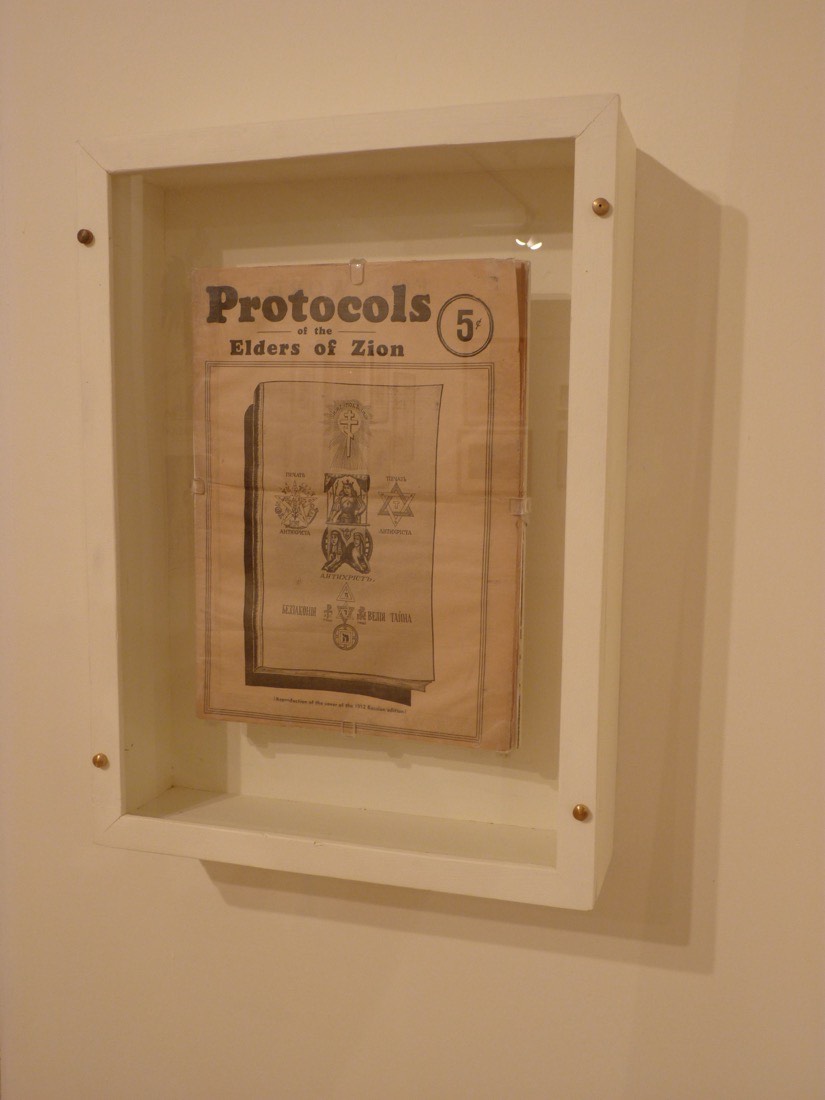
The forgery had been publicly demonstrated in 1921. The translations came anyway, in 1925 and 1926: before the State of Israel existed, before the 1948 war. The text did not follow the conflict into the region. It arrived first.
The story of the forgery itself, its Russian origin, its French source, and its exposure, is told in the Protocols Chapter. This Chapter follows what the region’s new publishers did with it.
1939–1945
The radio years.
From April 1939 until the end of the war in 1945, Nazi Germany broadcast daily Arabic-language radio programming to the Middle East and North Africa from its shortwave station at Zeesen, outside Berlin. The historian Jeffrey Herf, who reconstructed the broadcast record from surviving transcripts, documents programming that fused war news with the full European antisemitic repertoire, night after night, for six years, to a region where radio was the newest and most powerful medium.
The broadcasts had a prominent voice: Haj Amin al-Husseini, the Mufti of Jerusalem (the city’s highest Muslim religious official), who had fled British-ruled Palestine during the crackdown on the Arab Revolt of the late 1930s and made his way to Germany. On November 28, 1941, Hitler received him in Berlin; the German Foreign Ministry’s own record of the meeting survives and is published in the standard documentary series. Al-Husseini spent the rest of the war in Berlin, broadcasting to the Arab world in Arabic. The United States Holocaust Memorial Museum documents his wartime propaganda role in detail. (USHMM, “Hajj Amin al-Husayni: Wartime Propagandist”; the meeting record is Documents on German Foreign Policy 1918–1945, Series D, Volume XIII, Document 515.)
What the war years meant inside the region itself, including for its Jewish communities, is the subject of the Holocaust in North Africa & the Middle East Chapter, where the photograph of the 1941 meeting also appears. For six years, European antisemitism had a daily Arabic-language broadcast schedule.
1988
A forgery becomes a founding document.
The region’s politics were transformed after 1945 by the founding of Israel in 1948 and the wars that followed; the imported material survived every transformation. In August 1988, Hamas, a Palestinian Islamist movement founded the year before in Gaza, published its founding covenant. Article 32 states: “Their plan is embodied in the Protocols of the Elders of Zion, and their present conduct is the best proof of what we are saying.” Article 7 quotes a religious text calling for the killing of Jews as a condition of the end of days. The full document, in English translation, is preserved by the Avalon Project at Yale Law School, and any student can read it. (Hamas Covenant 1988 · Avalon Project, Yale Law School.)
The Protocols was exposed as a forgery in 1921. Sixty-seven years later, a movement that would go on to govern Gaza wrote it into its founding charter as evidence.
In May 2017, Hamas released a new document of general principles at a press conference in Doha. Within days, a senior Hamas official, Mahmoud al-Zahar, told reporters the new document “does not contradict” the founding covenant, and the 1988 charter has never been annulled. Both documents, and both statements, are part of the record. (Reuters, May 10, 2017.)
2007
Broadcast to children.
On April 13, 2007, Al-Aqsa TV, the Hamas-run television station in Gaza, debuted a children’s program called Tomorrow’s Pioneers. Its host was Farfour, a costumed character openly modeled on Mickey Mouse, who taught children about armed struggle between skits and songs. In the final Farfour episode, aired June 29, 2007, the character was beaten to death on screen by an actor playing an Israeli official. The child presenter told viewers Farfour was “martyred while defending his land.” He was replaced by Nahoul the bee, who vowed to continue on Farfour’s path, and later by Assud the rabbit. The program ran until 2009.
The broadcasts were recorded, translated, and reported by international news organizations at the time, and the clips are preserved in the television archive of MEMRI, the Middle East Media Research Institute, which records and translates the region’s broadcasts. (NBC News/AP, 2007; CBS News, 2007; MEMRI TV, clip and transcript.)
The classroom record
What the funders’ own reviews found.
In 2019 the European Union commissioned the Georg Eckert Institute, a German research institute that specializes in textbook analysis, to review the curriculum of the Palestinian Authority, the separate Palestinian government that administers parts of the West Bank (distinct from Hamas in Gaza). The study, published in June 2021, examined 156 textbooks and 16 teachers’ guides. In the institute’s own words, a religious-education textbook “contains cumulative stereotypes and accusations that can clearly be characterised as anti-Semitic,” Jews are “collectively portrayed as adversaries,” and conspiracy framings in the books repeat “classic anti-Semitic ideas.” (Georg Eckert Institute, in its own FAQ.)
On April 29, 2021, the European Parliament, which had condemned hate content in the textbooks in successive annual resolutions, went further and demanded its removal as a condition of European funding. (European Parliament, resolution of April 29, 2021.) IMPACT-se, an independent monitor that reviews the curriculum annually, documents the same pattern year over year, including martyrdom and jihad (holy war) material inserted across subjects as far from politics as mathematics. (IMPACT-se, annual reviews.)
The record extends into the United Nations’ own schools. UNRWA, the UN agency that runs schooling for Palestinian refugees, teaches the host curriculum; reviews in 2022 and 2023 documented UNRWA-branded study materials with the same content, including grammar exercises built on “jihad warriors” and a poem presenting martyrdom as a pastime. A United States government audit found that official reporting to Congress on the textbook problem was incomplete. And on August 5, 2024, the United Nations announced its own conclusion of a different kind: after an internal investigation, it fired nine UNRWA staff members because the evidence indicated they may have been involved in the October 7, 2023 attack on Israel. (IMPACT-se, November 2023; GAO-19-448; UN statement, August 5, 2024.)
Object Spotlight
A document you can read yourself.
The object at the center of this Chapter is not in a museum case. It is a text: the 1988 Hamas covenant, preserved in English translation by the Avalon Project at Yale Law School, the same scholarly archive that holds the Magna Carta and the Treaty of Versailles. Open it and find Article 32. The citation of the Protocols is not a paraphrase or an accusation; it is there, in the document, in one click.
The chain runs: a forgery published in Russia in 1903, exposed in London in 1921, translated in the 1920s, broadcast in the 1940s, and cited as evidence in a founding charter in 1988.
The analytical question
What a translation changes, and what it does not.
Unit 3 has shown the hatred changing costumes: theology in the ancient world, science in the nineteenth century, politics in the twentieth. The translation documented here is the same pattern in a new key. The conspiracy myth arrived in the 1920s; the regional conflict that followed gave it a local vocabulary and a daily subject. The costume changed. The text underneath, sometimes literally the same text, did not.
Political conflict between peoples is not, in itself, antisemitism; two national movements claiming one land is a subject with legitimate arguments on both sides, and this site does not adjudicate it. Writing a proven forgery into a founding charter, broadcasting the murder of a children’s character as martyrdom, and printing conspiracy claims in schoolbooks is a different category, and the difference is checkable: one is a position, the other is a documented technique this Unit has traced for two thousand years.
Key takeaways
- European antisemitism entered the Arabic-speaking world through a documented chain: Arabic translations of the Protocols by the mid-1920s, before the State of Israel existed and before the 1948 war.
- From 1939 to 1945, Nazi Germany broadcast daily Arabic-language antisemitic propaganda to the region, with the exiled Mufti of Jerusalem, Haj Amin al-Husseini, as a wartime voice from Berlin.
- The 1988 Hamas covenant cites the Protocols as fact in Article 32, sixty-seven years after the text was proven a forgery; the charter has never been annulled.
- The transmission reached children through broadcast television in 2007 and reaches classrooms through textbooks whose antisemitic content was confirmed by the European Union’s own commissioned study and condemned by the European Parliament.
- The record in this Chapter is institutional: the EU, the European Parliament, the US Government Accountability Office, the United Nations, and the broadcasters’ own preserved footage. It documents specific institutions and texts, never a people.
Discussion questions
Working from the evidence.
Grounded in the sourced record above. Each asks students to read the documents rather than restate a conclusion.
- The first Arabic translations of the Protocols appeared in the mid-1920s, decades before the State of Israel existed. What does that timing tell you about the claim that this hatred is simply a reaction to the modern conflict?
- Article 32 of the 1988 covenant cites a document that had been publicly proven false in 1921. What does citing a known forgery as evidence tell you about the relationship between a movement’s beliefs and the documentary record?
- Radio in the 1940s, television in 2007, textbooks today: each medium carried the same underlying ideas to a new generation. Comparing the Zeesen broadcasts with Tomorrow’s Pioneers, what changed, and what stayed exactly the same?
- The most damaging findings in this Chapter come from the funders themselves: the EU’s commissioned study, the European Parliament’s resolutions, the UN’s own statements. Why is a funder’s finding harder to dismiss than a critic’s?
- This Chapter opens with a warning: it documents institutions and texts, never a people. Why does that distinction matter, and what would be lost, and what would be wrong, if a reader ignored it?
Classroom Connections
Where this Chapter fits.
Teaching Connections
The disciplines and courses this Chapter naturally supports, for any educator, anywhere.
- Modern Middle East: the documented arrival and institutionalization of European antisemitic material in the region, from the 1920s translations to the present curriculum record.
- Media & Information Literacy: propaganda across four media generations, print, radio, television, and textbooks, with the primary material preserved and checkable in each case.
- Holocaust & Genocide Studies: the Nazi Arabic-language broadcasting effort and the al-Husseini record as documented by the USHMM.
- Civics & International Institutions: how the EU, the European Parliament, the GAO, and the UN generated the oversight record this Chapter is built on.
- Historical Thinking & Source Analysis: a complete chain-of-custody exercise, tracing one text from forgery to charter through dated, checkable documents.
Standards Alignment
- NYS Global History & Geography: 10.5 (the global conflicts of 1914–1945: the wartime propaganda apparatus) and 10.7 (the modern Middle East: the translations and their institutional afterlife).
- Common Core ELA-Literacy: RH.9–10.8 and RH.11–12.8 (evaluating claims against documentary evidence) and RH.11–12.7 (integrating evidence across print, broadcast, and institutional sources).
Further Teaching Resources
- USHMM Holocaust Encyclopedia, “Hajj Amin al-Husayni: Wartime Propagandist”, the wartime broadcasting record.
- Georg Eckert Institute, the EU-commissioned textbook study, with the institute’s own FAQ on its findings.
- IMPACT-se annual curriculum reviews, the ongoing monitoring record.
- Films & Video: documentary material for this period is gathered in the full Films & Video collection.
Sources and citations
Primary sources
A primary source is a record from the time. It was made by people who were there. Examples: letters, diaries, photos, decrees, trial records, and newspapers.
- Hamas. The Covenant of the Islamic Resistance Movement. August 18, 1988. English translation preserved by the Avalon Project, Yale Law School. avalon.law.yale.edu.
- Hamas. A Document of General Principles and Policies. Doha, May 1, 2017. Cited without link; the 1988 covenant was not annulled by it, per Hamas officials’ own statements (Reuters, May 10, 2017).
- German Foreign Ministry. Record of the meeting between Hitler and Haj Amin al-Husseini, November 28, 1941. Documents on German Foreign Policy 1918–1945, Series D, Volume XIII, Document 515.
- Jewish Telegraphic Agency. “Elders of Zion Protocols Translated into Arabic.” January 25, 1926. jta.org.
- European Parliament. Resolution of April 29, 2021 (2019 discharge: hate speech and violence in Palestinian Authority textbooks), P9_TA(2021)0164. europarl.europa.eu.
- United Nations. UNRWA statement on the conclusion of the OIOS investigation. August 5, 2024. un.org.
- IMPACT-se. Review of 2022 UNRWA-Produced Study Materials (2022) and UNRWA Education: Textbooks and Terror (November 2023). impact-se.org.
- U.S. Government Accountability Office. West Bank and Gaza: State Has Taken Actions to Address Potentially Problematic Textbook Content. GAO-19-448, June 2019. gao.gov.
- MEMRI TV. Tomorrow’s Pioneers broadcast recordings and transcripts, Al-Aqsa TV, 2007. memri.org.
- The Protocols of the Elders of Zion. 1903. Citation only; this site does not link to hate texts.
Secondary sources
A secondary source was written later. It is a book or article by a historian who studied those records and explains what they mean.
- Herf, Jeffrey. Nazi Propaganda for the Arab World. New Haven: Yale University Press, 2009.
- Georg Eckert Institute. Report on Palestinian Textbooks (EU-commissioned). Braunschweig, June 2021. gei.de.
- United States Holocaust Memorial Museum, Holocaust Encyclopedia. “Hajj Amin al-Husayni: Wartime Propagandist” and “Protocols of the Elders of Zion.” encyclopedia.ushmm.org.
- Lewis, Bernard. Semites and Anti-Semites: An Inquiry into Conflict and Prejudice. New York: W. W. Norton, 1986.
- Wistrich, Robert S. A Lethal Obsession: Anti-Semitism from Antiquity to the Global Jihad. New York: Random House, 2010.
A finding note. The broadcast record for 1939–1945 rests on the transcript reconstruction in Herf (2009); the wartime meeting record is in the published German diplomatic documents; the 2007 broadcasts survive on film in the MEMRI archive and in contemporary international press coverage; and the textbook record is drawn from the reviewing institutions’ own publications. Where a source is an advocacy organization, this page relies on its preserved primary material, not its characterizations.
The documented record of organized violence against Jews as Jews since 1920: the hijacking era, Munich, Entebbe, the diaspora bombings, the intifadas, and October 7, in courts, archives, and memorials.
Comments?
Write to editor@makorproject.org.
Last updated: August 2026.